


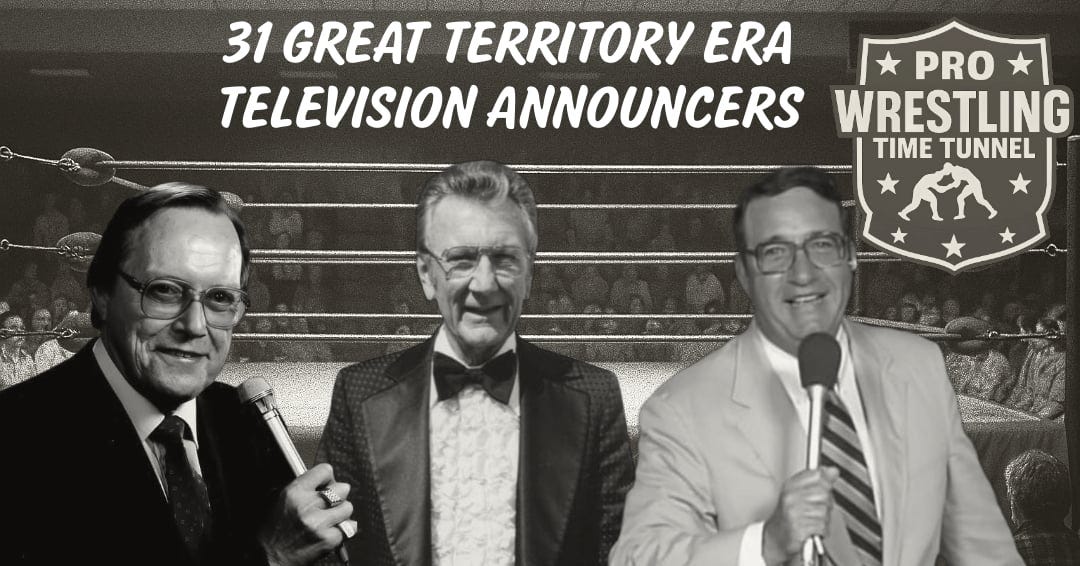
Profile 17: Lance Russell
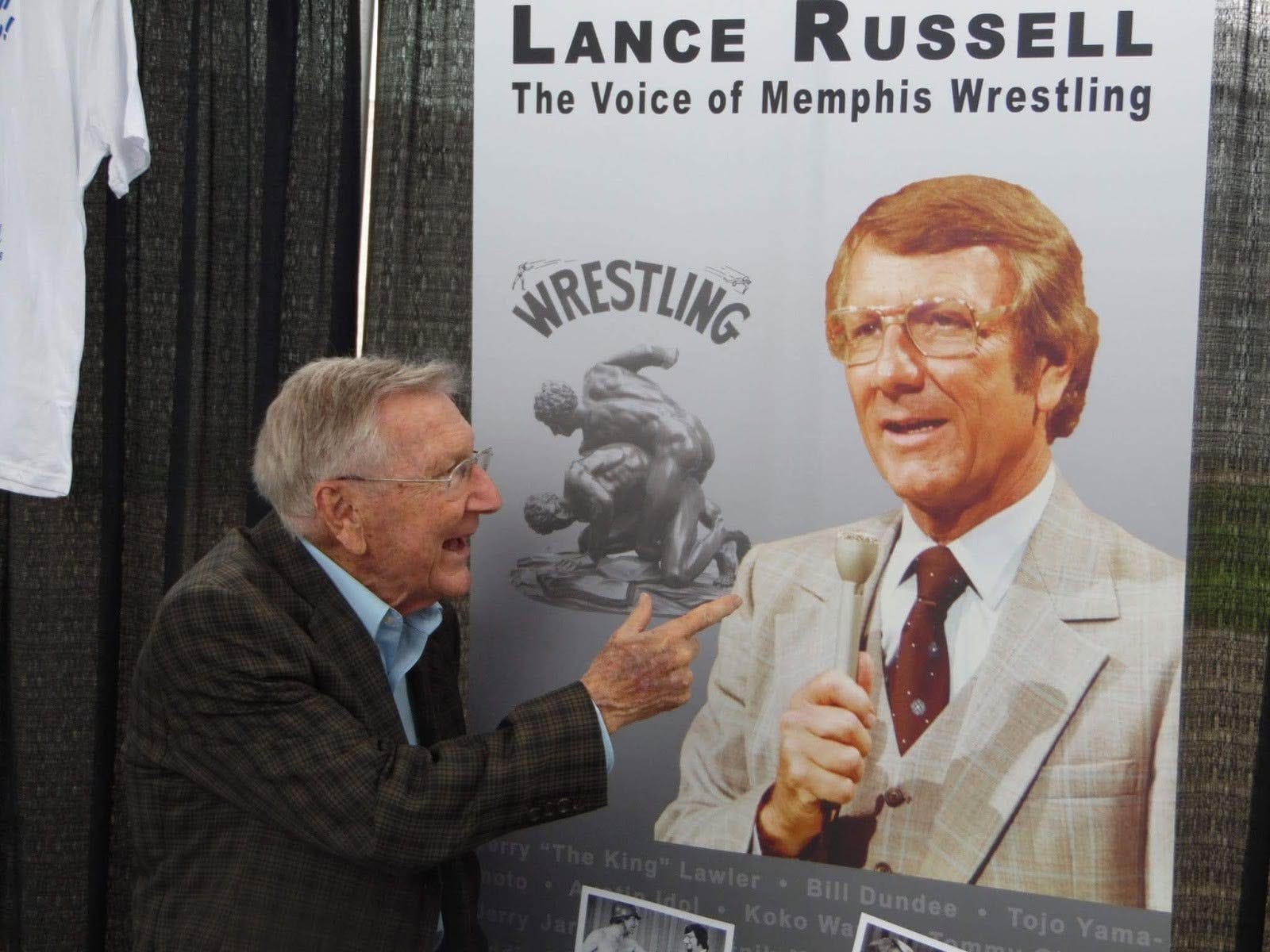
Few television announcers in professional wrestling history became as closely identified with a territory as Lance Russell became with Memphis, Tennessee. For generations of wrestling fans throughout the Mid-South, Russell was more than the man who introduced the wrestlers, called the action, and conducted the interviews. He was the familiar voice who brought the world of professional wrestling into their living rooms every Saturday afternoon.
His importance to Memphis wrestling cannot be measured simply by the number of years he spent behind the microphone. Russell helped establish the personality, credibility, humor, atmosphere, and distinctive presentation that made Memphis wrestling one of the most recognizable television wrestling products in America. He was the straight man to Jerry Lawler’s comedy, the calm presence amid the outrageous antics of heels such as Jimmy Hart, the interviewer who allowed personalities to reveal themselves, and the authoritative voice who could make an ordinary television match feel like an important event.
What made Russell particularly effective was that he never seemed to be trying to become the star of the program. He understood that the wrestlers were the attraction, but he also understood that the announcer was responsible for making the audience care about what they were seeing. His reactions, questions, expressions, and occasional exasperation became part of the entertainment.
To understand the history of Memphis wrestling, one must understand Lance Russell. He was not simply a broadcaster assigned to a wrestling program. He became one of the defining personalities of the entire territory.
The Road to Broadcasting
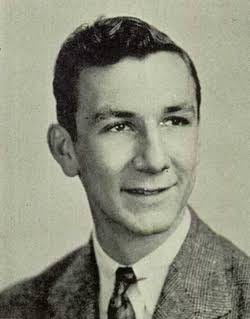
Lanier Lance Russell was born on March 18, 1926. Although professional wrestling would eventually make him a familiar figure across the United States, his career began in broadcasting rather than in the wrestling business. Russell developed the communication skills, timing, and ability to connect with an audience that would become the foundation of his later success.
His professional life encompassed considerably more than wrestling. He worked in radio and television, became a highly rated disc jockey, and eventually held programming and management responsibilities at WHBQ-TV in Memphis. These experiences are important because they explain why Russell approached wrestling differently from many announcers who entered the business without a background in television production.
Russell was a broadcaster who understood that a successful television program required more than an entertaining subject. It needed the right time slot, an understanding of its audience, dependable production, and personalities who could keep viewers watching.
His personal life was equally important to the man he became. Russell married Audrey Lou Renner on June 28, 1947. Their relationship had begun during their high-school years, and they remained married for 67 years, until Audrey’s death in June 2014. They raised three children: William Lance, Valerie, and Shane.
The Russells eventually made Memphis their home, where Lance established himself professionally and the family developed deep roots. Away from television, he enjoyed golf, fishing, and spending time with his family. His obituary also mentioned his faithful dog Buddy and his lifelong enthusiasm for golf, along with his rather less successful attempts at catching fish.
These personal details help explain something that came across so clearly on television:
Russell was comfortable being himself.
He did not cultivate an intimidating broadcasting persona or attempt to make himself larger than life. His familiar Southern manner, conversational delivery, and natural sense of humor were genuine parts of his personality.
The WHBQ Years: Discovering the Potential of Wrestling Television
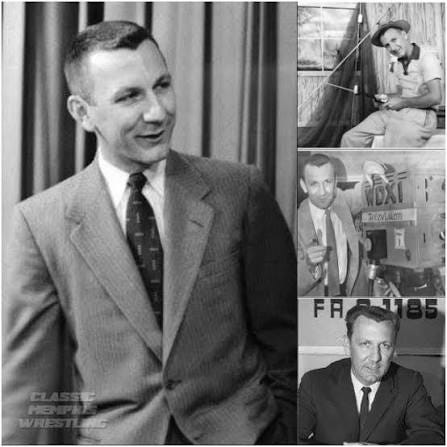
Russell’s association with professional wrestling began in 1959, when he was working in television in Jackson, Tennessee. He was asked to announce a wrestling program associated with the Nick Gulas and Roy Welch pro wrestling organization. His previous experience broadcasting sports, including basketball, boxing, football, and baseball, made him a natural choice. The assignment eventually brought him into the Memphis wrestling picture in late 1961, where he became the principal television voice of the Gulas-Welch organization.
This was an important period in the development of Memphis wrestling. The territory operated within the larger NWA Gulas-Welch promotional structure, and Memphis was one of several important markets in a regional wrestling operation that included Tennessee and surrounding states.
Russell’s contribution went beyond introducing wrestlers and calling matches. He understood television programming and audience behavior, and he was in a position to apply that knowledge to the wrestling product. One of his most consequential decisions involved the Saturday television time slot.
Memphis wrestling had been broadcast on Saturday afternoons, but the program regularly faced interruptions and competition from ABC’s Wide World of Sports and college football. Russell recognized that the wrestling audience was being inconvenienced by the schedule and that the program needed a more dependable position.
He proposed moving wrestling to 11 a.m. on Saturday mornings.
Nick Gulas was reportedly skeptical. The idea of moving a wrestling program to an earlier time seemed counterintuitive, and Gulas questioned whether anybody would be watching. The way the Gulas-Welch management structure worked was that each partner had their own towns and responsibilities.
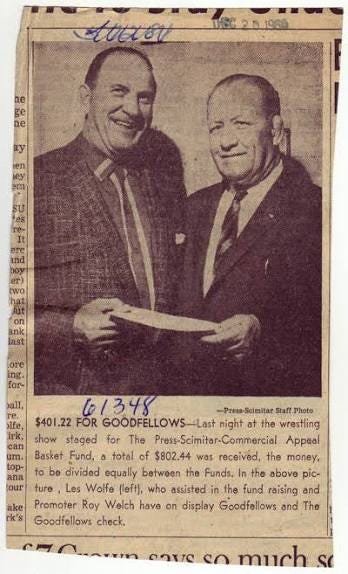
Pictured: Roy Welch and Les Wolfe
Memphis was the apple of Roy Welch’s eye. He had wanted the Memphis market for years. The company already had Nashville and Chattanooga, and they supplied the talent as the booking office for the Cazana Family owned Knoxville. So they owned or had the booking rights to 3 out of the 4 big towns in Tennessee. In July of 1956, Roy Welch and Nick Gulas Wrestling Enterprises bought the rights to book and promote Memphis, Tennessee from Les Wolfe and Charlie Rentrop, the promoter and Sam Muchnick and Sam Avey, the St. Louis and Tulsa offices that were booking Memphis.
Roy had acquired his desired prize. The other Monday night town was Birmingham and it was natural for Gulas to oversee that town because he had been affiliated with it going back to the 1930s when he worked in the booking officeof Chris Jordan. Welch basically was in charge of Memphis and was very assertive at keeping Gulas focused on Birmingham. But, as partner in the company, Gulas was entitled to give his opinion.
There was a very distinct pattern in Gulas’ feedback anytime an aggressive growth move was proposed for Memphis. He was skeptical on the move from Saturday afternoons to Saturday mornings on television. Later, in 1971, Welch and Jerry Jarrett were proposing a move from Ellis Auditorium to the Mid-South Coliseum. Gulas insisted they would never fill it. History shows he was mistaken in his evaluation. Around this same time, Welch, Jarrett and Russell thought the television move would be successful. Russell insisted the audience was there.
Starting in April of 1972, the change proved enormously successful. The Saturday morning program became a weekly institution, and Russell later recalled extraordinary audience penetration figures for the Memphis television market. The format helped establish the familiar Saturday morning wrestling tradition that other territories subsequently adopted or emulated.
It was a decision that demonstrated Russell’s value as a television executive as much as his talent as an announcer. He understood that wrestling was a television attraction, not simply a series of matches being filmed for later consumption. Memphis’ “Championship Wrestling” needed to reach its audience consistently, and Russell helped make that happen.
Creation of the Team
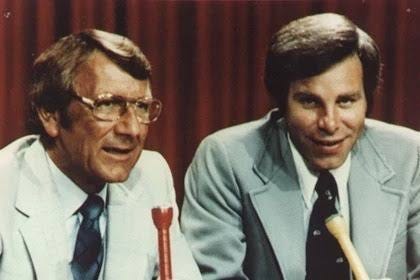
One of the most important developments in the history of Memphis wrestling television was the partnership between Lance Russell and Dave Brown.
Russell recognized that the program could benefit from a second personality at the desk. In 1967, he recruited Brown, then a young University of Memphis student who was also working as a disc jockey at WHBQ radio. Brown initially had been involved in a bingo program, but Russell saw potential in him and brought him into the wrestling broadcasts. It turned out to be an inspired decision.
Russell and Brown developed a chemistry that was difficult to manufacture. Russell was the experienced, conversational lead announcer, while Brown brought a different personality and perspective to the broadcasts. They were comfortable with one another, could joke without making the program feel forced, and knew when to let a wrestler’s interview take center stage.
Their relationship became one of the longest-running partnerships in professional wrestling broadcasting. They worked together for approximately 23 consecutive years, depending on how the various station and promotional transitions are counted.
Brown eventually became one of Memphis television’s most recognizable personalities in another capacity: weather broadcasting. He enjoyed a long career as a television meteorologist, becoming a familiar presence on local news broadcasts. Russell was proud of his contribution to Brown’s development and joked that wrestling had helped establish Brown’s public recognition before his weather career took off.
The partnership also illustrated Russell’s generosity as a broadcaster. He did not need to dominate every segment or turn the program into a showcase for himself. He allowed Brown to develop his own identity and made their differences work to the benefit of the show. Interestingly enough, Brown typically called the play-by-play, move-by-move action in the ring, while Russsell set up the angles, provided the “color comments” on the matches, conducted the interviews and hosted the show. Frankly, both were so talented and smooth, they often moved in and out of each role through the broadcast, that it was not possible to identify who was doing what, but it all clicked marvelously.
For wrestling fans, the combination became inseparable from the Saturday morning experience. The familiar opening, Russell’s greeting, Brown’s presence, and the parade of wrestlers appearing before the camera created a television institution.
There was an additional benefit to the partnership: Brown’s work in weather forecasting gave the wrestling program a connection to the broader television audience. Viewers who knew him from the evening news also knew him from wrestling.
The Art of the Lance Russell Interview
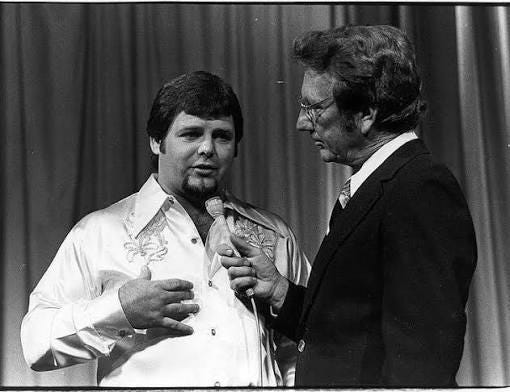
Russell’s interview technique deserves particular attention because it was one of the most important elements of his contribution to Memphis wrestling.
He was not a broadcaster who simply read questions from a prepared sheet. He listened. He reacted. He understood the personalities sitting across from him and knew when to challenge them, when to express disbelief, and when to step aside and let them talk. He understood on an intricate and deep level what Roy Welch as the booker, and his successor, Jerry Jarrett, wanted.
His natural manner was particularly effective with the larger-than-life characters who populated Memphis wrestling.
Consider the difference between Russell and the conventional wrestling announcer. Many announcers relied on volume, exaggerated excitement, and a dramatic delivery. Russell was generally more restrained. He sounded like a regular television personality who happened to be surrounded by some very unusual people. That distinction made the wrestlers seem even more extraordinary.
When Sam Bass and later, Jimmy Hart appeared with one of his latest schemes, Russell could express his frustration in a way that viewers understood. When Jerry Lawler delivered a particularly outrageous insult, Russell’s reactions helped communicate the humor. When a dangerous heel threatened somebody, Russell could become genuinely concerned. He was particularly good at asking questions that allowed a wrestler to explain a situation without making the interview feel overly scripted.
Russell also had a wonderful vocabulary of expressions. Phrases such as “Sam Hill” and “Don’t start with the smart stuff” were not invented as wrestling catchphrases. He explained that many of his expressions came from his family, particularly his older relatives and grandfather. They were simply part of the language he had grown up hearing. That authenticity became a defining characteristic of his broadcasting.
Russell also understood that an announcer should not oversell every match. He explained that he preferred to give viewers a more measured assessment of an upcoming card. If the lineup was ordinary, he would read the matches. If something genuinely exciting was scheduled, he would let the audience know.
It was distinct direction by Jerry Jarrett, who was manipulating the stories and wrestlers, that Lance be the contrast to the approach with promoters who described every card as the greatest event ever presented in a particular city. Jarrett specifically directed Russell that if he was given a show that was not particularly exciting, that he should not hype-up that show as the greatest card ever. This matched Lance Russell’s personal values. Russell believed that credibility mattered. If the audience trusted the announcer, his enthusiasm for a genuinely important match meant something.
That philosophy was especially valuable in Memphis, where the weekly television program was designed to sell tickets for the Monday night matches at the Mid-South Coliseum.
The Memphis Personalities Who Made the Show
Russell had the advantage of working with an extraordinary collection of wrestling personalities. However, he also helped many of them become more effective television performers. There were countless characters that were on the Memphis studio wrestling show starting in 1961, but here are a handful that modern fans would remember or know.
Jerry Lawler
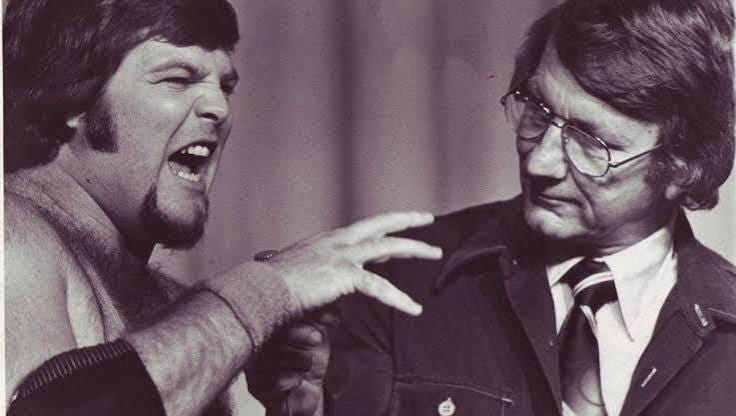
His relationship with Jerry Lawler was especially important.
Russell remembered Lawler as a teenager who was already interested in professional wrestling and drawing pictures of wrestlers. Lawler’s artwork was displayed on the television program, giving him exposure before he became a professional wrestler. Russell knew Lawler from approximately the age of 15 and watched his transformation from a young Memphis fan into one of the most recognizable performers in the business.
He recognized Lawler’s unusual television ability very early. In a 2016 interview, Russell recalled that within a few months of seeing Lawler work, he was already thinking that the young man might eventually take his job because of how naturally talented he was. The relationship between the two men became one of the most entertaining aspects of Memphis television.
Lawler frequently used Russell as the target of his humor. His references to Russell’s nose, including the familiar “banana nose” insult, became part of their television routine. Russell played along, although he was perfectly capable of expressing his irritation when Lawler went too far. Behind the scenes, they were close friends.
Russell understood that Lawler possessed a remarkable ability to develop characters and create situations that would translate into television. He credited Lawler with much of the creativity behind Memphis’s unusual characters, including Kamala and Lord Humongous.
He also recognized Lawler’s talent for working with younger wrestlers and helping them become stars. One of Russell’s most memorable responsibilities was calling the action when Lawler defeated Curt Hennig to win the AWA World Heavyweight Championship in May 1988. It was a major moment for Memphis wrestling, and having Russell at the microphone connected the championship victory to the history of the territory.
Jackie Fargo
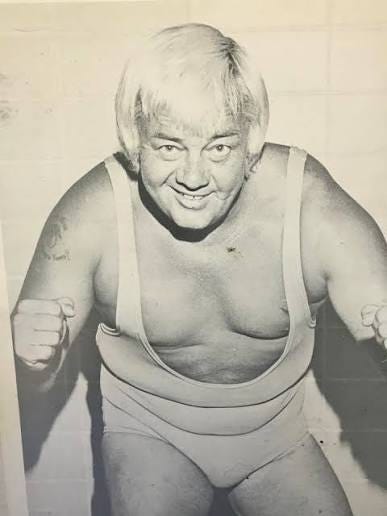
Jackie Fargo was another personality with whom Russell enjoyed working.
Fargo represented the established Memphis wrestling tradition, and his flamboyant personality, distinctive appearance, and ability to entertain made him an ideal television performer. Russell understood that Fargo did not need to be turned into something he wasn’t. The announcer’s job was to give him the opportunity to be Jackie Fargo.
Jimmy Hart
Jimmy Hart provided a different challenge.
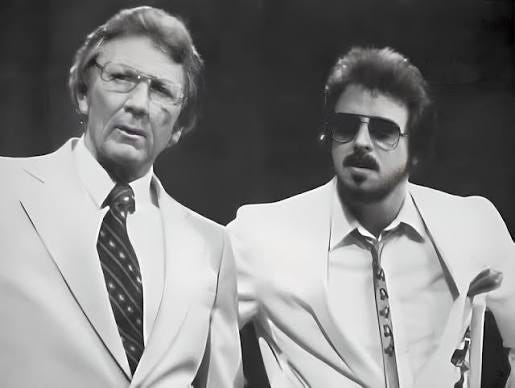
Hart’s extraordinary verbal ability and willingness to create chaos made him a natural antagonist for Russell. Their exchanges were among the most entertaining recurring features of Memphis television. Hart could talk his way into trouble, insult Russell, and then find some new way to disrupt the broadcast.
On more than one occasion, the manager’s antics became physical. One particularly memorable incident involved Hart dumping flour on Russell’s head. Russell’s exasperated reactions were not simply background comedy. They helped establish the idea that the wrestlers and managers were disrupting an otherwise orderly television program.
Bill Dundee
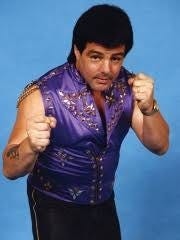
Bill Dundee was another important part of Russell’s Memphis broadcasting history.
Dundee’s personality, sharp tongue, and ability to connect with the audience made him an ideal television attraction. Russell understood the importance of Dundee’s relationship with Lawler and the way their partnership and rivalry could be used to create compelling television. Russell also had enormous respect for Dundee’s willingness to give everything to a performance.
Austin Idol
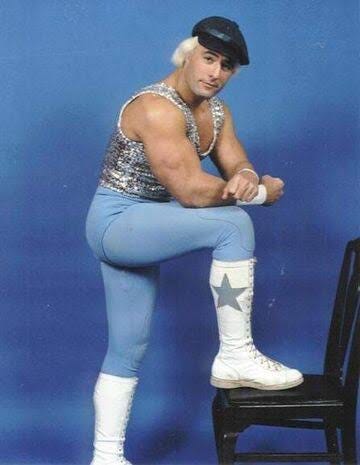
Austin Idol brought a different kind of charisma to the program. His confidence, appearance, and ability to command attention made him one of the territory’s major personalities.
Russell was particularly effective with wrestlers such as Idol because he did not need to compete with them for attention. He could let Idol make his presentation while providing the audience with a familiar voice to guide the segment.
Dutch Mantell
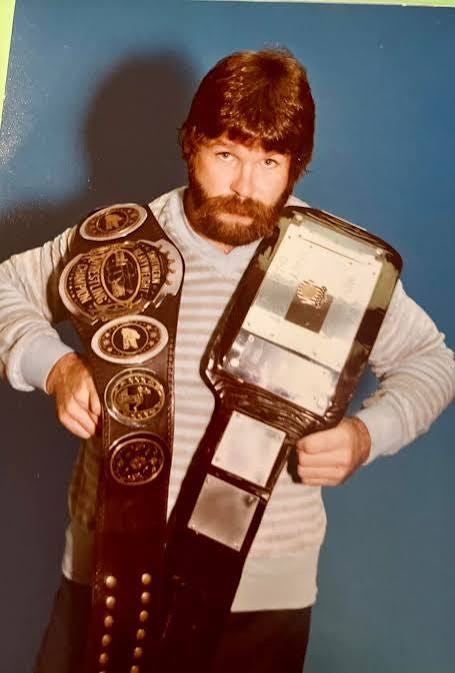
Russell remembered Dutch Mantell as one of the funniest personalities he encountered in the business. Mantell always had a story, a line, or some unexpected observation.
He also recalled Mantell’s use of a whip, joking that it was not always particularly safe to be standing nearby because Mantell could just as easily catch somebody’s ear as his intended target. Russell enjoyed having Mantell around because he was creative, hardworking, and consistently entertaining.
When the Announcer Became Part of the Action
One of the most distinctive features of Memphis wrestling was similar to Championship Wrestling from Florida, that Gordon Solie, the host of that show was “not to ever be touched.” Roy Welch and Jerry Jarrett had laid down a similar edict. Lance Russell had a line that was not to be crossed, but many performers danced right up to that line. Lance was not always protected from the chaos taking place around him. He was frequently drawn into angles, physically threatened, insulted, or placed in situations where the television audience could see his genuine reaction.
This helped make Memphis television different from a conventional sports broadcast.
Russell was not simply an impartial voice sitting safely behind a desk. He was a recognizable part of the program’s world, and his involvement gave the audience another reason to become emotionally invested. There were several particularly memorable examples.
The Jos LeDuc Axe Incident
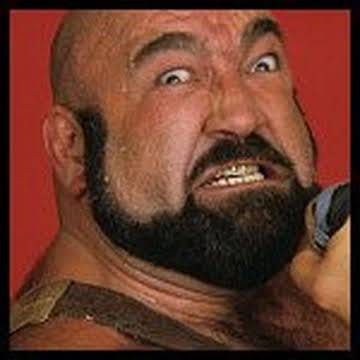
One of the most shocking moments of Russell’s broadcasting career occurred when Jos LeDuc used an axe during a live television interview and cut into his own arm as part of a blood-oath angle.
Russell was stunned.
The incident was particularly unsettling because Russell was not simply a wrestling announcer. He was also an executive with RKO General, the company that owned the television station. He had responsibilities beyond the wrestling program, and suddenly he was watching an extremely graphic incident unfold on the station’s broadcast. He later described how shocked he was to see the axe come down and the injury begin to bleed.
It was a moment that demonstrated how far Memphis wrestling could push the boundaries of television presentation.
The Flour Incident
Jimmy Hart’s flour attack was another example of how the manager’s antics could turn Russell into an unwilling participant in the entertainment.
Russell’s reactions were part of the appeal. He never seemed particularly interested in becoming a wrestling character himself, which made the occasions when he was victimized all the more effective.
The Dream Machine Attack
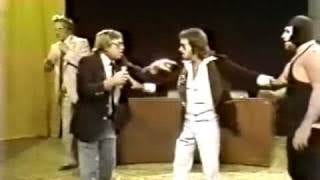
Russell also recalled being physically attacked by The Dream Machine, portrayed by Troy Graham.
The incident became one of the memorable pieces of footage associated with Memphis wrestling. Russell was manhandled, and when he attempted to protest, the situation became even more physical.
He later laughed about the experience, but the attack was effective television because viewers had become accustomed to seeing Russell as the familiar, respectable broadcaster.
The Road Warriors
Even the Road Warriors became involved in incidents in which Russell was physically manhandled during the chaos surrounding a wrestling segment.
These moments helped establish that nobody was necessarily safe when Memphis wrestling’s villains decided to take over the television studio.
Dundee Slaps Lance
On Memphis television in 1986, during the Bill Dundee and Buddy Landel run as The Bill and Buddy Show, Lance Russell made the mistake of saying to the heels what the tape clearly showed. Dundee and Landel had been insisting they had never really lost to Jerry Lawler and Dutch Mantell, blaming referees, Jerry Jarrett, and Eddie Marlin. Russell repeated that Lawler and Mantell had beaten them. Dundee told him not to say that again. Russell said it anyway, and Dundee slapped him across the face on live TV.
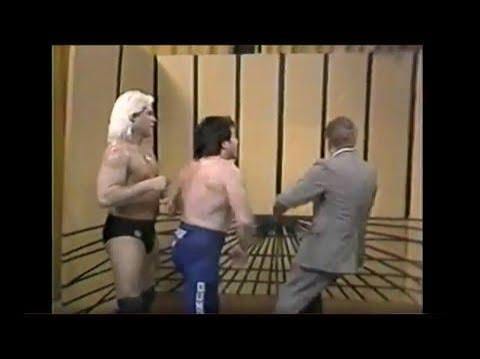
That was the point of the angle. Lance Russell almost never got touched. He was the trusted voice of the program, closer to a neighbor than an announcer, and laying a hand on him was meant to land like slapping someone the audience actually knew. Lawler and Mantell came out of the back to get between Dundee and Russell, which put the territory’s two top babyfaces in the position of defending the announcer. Dutch Mantell later said the spot was a Jerry Jarrett idea, cleared with Russell beforehand, and that Dundee asked Lance if the slap was all right. Russell sold it.
The next week he would not stand in the interview area with them, and Dundee and Landel answered by rolling out their own desk and calling it The Bill and Buddy Show. The slap did the work the matches were supposed to do: it made Dundee look like a man who would hit anybody.
The Empty Arena Match: Lance Russell and One of Wrestling’s Most Unusual Broadcasts
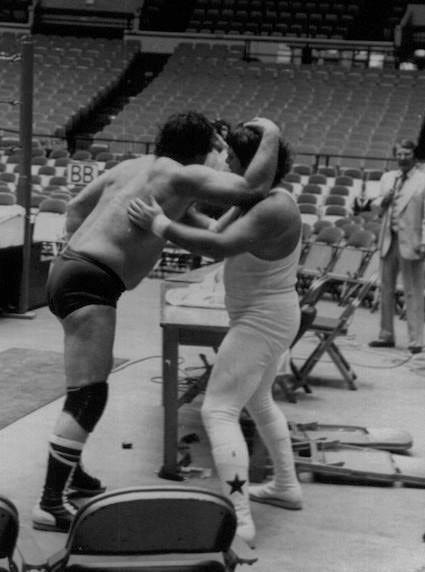
One of the most historically significant broadcasts of Russell’s career was the infamous empty-arena confrontation between Jerry Lawler and Terry Funk in 1981.
The match was an unusual experiment. Rather than relying on the noise and excitement of a packed Mid-South Coliseum, the confrontation took place in an empty building. The production depended almost entirely on the personalities involved, the atmosphere created by the confrontation, and the ability of the announcer to communicate what was happening.
Russell later explained that calling the match was one of the most difficult assignments he had ever undertaken. He had not fully appreciated how much an announcer depended on the audience until the audience was removed. Wrestlers reacted to the crowd, and the announcer reacted to both the wrestlers and the crowd. Without spectators, everybody involved had to create the atmosphere themselves.
It was a remarkable insight into the mechanics of professional wrestling television. Russell was accustomed to having thousands of people react to the action. Now he had to communicate the intensity of a confrontation without those familiar cues. It was also a particular remarkable piece of footage due to the fact they showed what would nirmally be considered “out-takes” such as Russell and the photographer casually talking and Lance smoking a cigarette.
The Lawler-Funk encounter became one of the most remembered examples of Memphis wrestling’s willingness to experiment with presentation. Russell’s participation was essential because his voice provided continuity and helped viewers understand the unusual circumstances.
The Tupelo Concession Stand Brawl
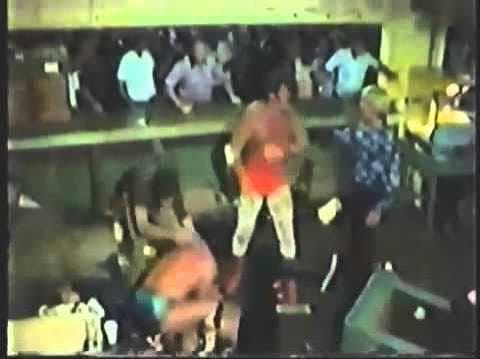
If the empty-arena match demonstrated the creativity of Memphis wrestling, the Tupelo Concession Stand Brawl demonstrated its unpredictability.
The famous confrontation involved Jerry Lawler and Bill Dundee against the Blonde Bombers, Wayne Farris and Larry Latham, at the Tupelo Sports Arena in Mississippi. The match and subsequent confrontation became one of the most famous examples of Memphis wrestling’s ability to turn an ordinary wrestling event into something completely unexpected. Russell’s recollection of the incident is particularly entertaining.
The promotion had converted an old body shop into an arena in Tupelo. Business had not been particularly strong, and the promoters were looking for something that could generate excitement. After the wrestling portion of the evening, Russell and the production crew were preparing to pack up their equipment. Suddenly, he realized that something was happening downstairs. He immediately called to his sound technician and cameraman to get their equipment and follow him.
Russell went down the stairs and positioned himself over the concession stand, trying to get the microphone close enough to capture the action. The resulting footage was extraordinary.
Lawler and Dundee were involved in a wild confrontation with the Blonde Bombers, and the action moved into the concession area. At one point, Lawler threw a gallon container of mustard toward Wayne Farris. The container narrowly missed Farris’s head and exploded against the wooden structure behind him, covering the area with mustard.
Russell was caught up in the excitement and delivered an uncharacteristically colorful exclamation while struggling to position his microphone. Jerry Jarrett later told him that the spontaneous remark helped make the footage believable. Russell considered the incident one of the most exciting experiences of his entire wrestling career.
The story also reveals something important about his instincts as a broadcaster. He was not merely following production instructions. He recognized when something special was happening and immediately understood that the cameras needed to capture it. His decision to follow the action helped preserve one of the most famous pieces of footage in Memphis wrestling history.
Lance Russell and Andy Kaufman: The National Spotlight
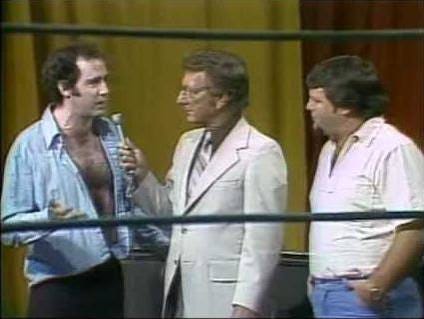
The feud between Jerry Lawler and comedian Andy Kaufman in 1982–1983 brought Memphis wrestling into the national entertainment spotlight.
Although Lawler and Kaufman were the central personalities, Russell played an important role in presenting the story to television audiences. Kaufman was unlike the conventional wrestling personality. He arrived with national name recognition, an unusual sense of humor, and a willingness to blur the distinction between entertainment and reality.
His confrontation with Lawler became one of the most talked-about celebrity wrestling angles of the era. Russell was particularly effective because he treated the situation seriously enough to allow the audience to become invested in it. He did not wink at the camera or constantly remind viewers that they were watching entertainment. Instead, he conducted the interviews, asked the questions, and reacted to the unfolding situation as a broadcaster attempting to make sense of an increasingly bizarre confrontation.
Russell later described the Lawler-Kaufman feud as the biggest thing that had happened to Memphis wrestling. He also shared an interesting observation about Kaufman’s personality. According to Russell, Kaufman would frequently lock himself in a dressing room and meditate for approximately an hour before a performance.
Interestingly, Russell did not claim to have developed a close personal relationship with Kaufman. He explained that Lawler was the member of the Memphis group who became friendly with the comedian. Russell’s contribution was primarily professional: he helped present the story to the television audience and maintain the atmosphere that made the angle successful. The relationship between wrestling and mainstream entertainment was changing, and Russell was right in the middle of it.
The Mid-South Coliseum: The Voice of Monday Night Wrestling
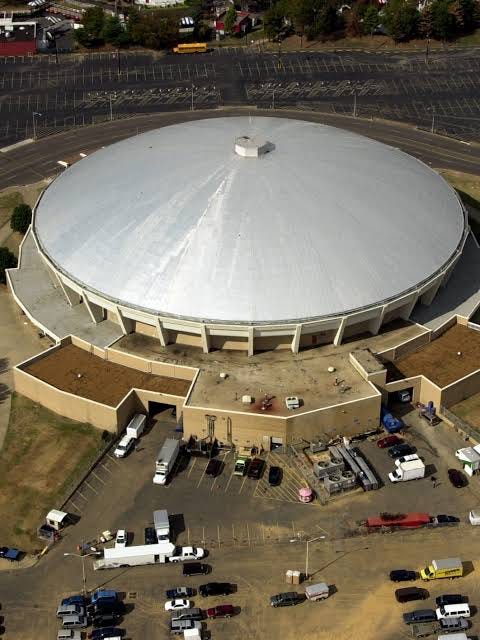
Although the Saturday morning television program established Russell’s identity, his work at the Mid-South Coliseum was equally important.
Monday nights became a Memphis wrestling tradition. The Coliseum was the centerpiece of the territory, and Russell served as the familiar voice introducing the matches and announcing the action.
He understood the relationship between television and live attendance. The Saturday broadcast created anticipation, established rivalries, and gave the wrestlers an opportunity to explain their actions. Monday night provided the payoff.
Russell was proud of the business Memphis generated. In a 2016 interview, he recalled that the Mid-South Coliseum could sell out its approximately 11,000 seats on a weekly basis. He enjoyed comparing Memphis’s attendance figures with those of larger markets. New York might draw 24,000 for a major Madison Square Garden event, but Russell pointed out that Memphis could draw approximately 44,000 across four weekly shows during a single month.
His point was that Memphis was accomplishing something remarkable for a much smaller population. Russell also announced special events outside Memphis, including the live presentation of matches taped in Tupelo. His ability to work in different environments was another indication of his versatility. Whether he was sitting at a television desk, announcing at ringside, or trying to capture an unexpected brawl, he knew how to communicate the action.
The Other Gulas-Welch Television Markets: A Territory of Local Voices
An important part of Lance Russell’s legacy, and something that deserves recognition in understanding the entire Gulas-Welch operation between 1961 and 1977, is that Memphis was only one piece of a much larger television network. Nick Gulas and Roy Welch understood the value of having individual studio wrestling programs in their principal markets rather than relying exclusively on one central Memphis broadcast. Nashville, Huntsville, Chattanooga, and Birmingham each had their own television identities, local announcers, and studio presentations. These programs featured many of the same wrestlers, but they were not simply identical copies of the Memphis broadcast. Each market developed its own personality and relationship with its local audience.
The distinction is particularly important when comparing the announcing arrangements. Lance Russell and Dave Brown developed an unusually consistent partnership in Memphis beginning in 1966. They became the regular television team and remained associated with one another for decades. The other Gulas-Welch markets did not necessarily have that same arrangement. Nashville, in particular, utilized several announcers and different combinations over the years, rather than establishing one permanent weekly announcing partnership comparable to Russell and Brown. This gave the overall Gulas-Welch television operation a collection of different broadcasting personalities, each contributing to the presentation of the territory.
Nashville: The Central Office and a Rotating Announcing Staff
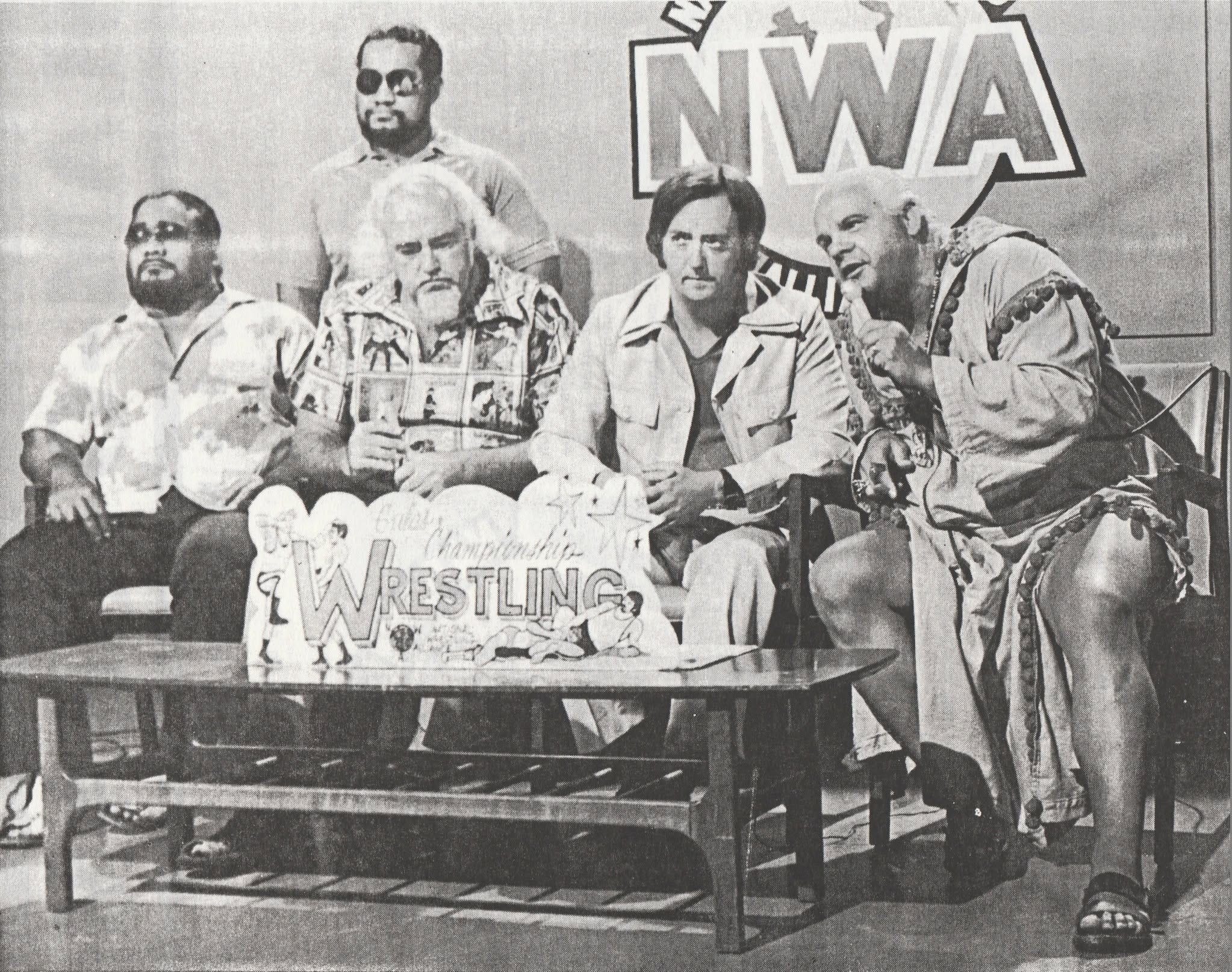
Nashville was the administrative center of the Gulas-Welch operation, and its television program was an important part of the territory’s overall presentation. The Nashville studio broadcast was associated with WNGE-TV, Channel 2, and featured a succession of announcers and combinations rather than a permanent two-man team. Mike Duncan became one of the most recognizable voices associated with Nashville wrestling and deserves particular recognition for his contribution to the program. The Nashville broadcasts also featured visiting announcers from other markets, including Harry Thornton of Chattanooga, who occasionally filled in and conducted interviews.
This gave Nashville viewers exposure to different personalities from throughout the territory. The program also served viewers in surrounding communities, including portions of Kentucky, making it an important outlet for fans who might not regularly receive the Memphis broadcast. Nashville’s television identity was therefore somewhat different from Memphis: rather than building the program around one consistent announcing partnership, Gulas and Welch utilized a rotating group of broadcasters and personalities as well as a “greatest hits-type” of packaging of wrestlers, stories and angles from around the territory, since Nashville house shows typically got the best of everything on Tuesday nights at the Fairgrounds Arena.
Huntsville: Grady Reeves and Channel 19
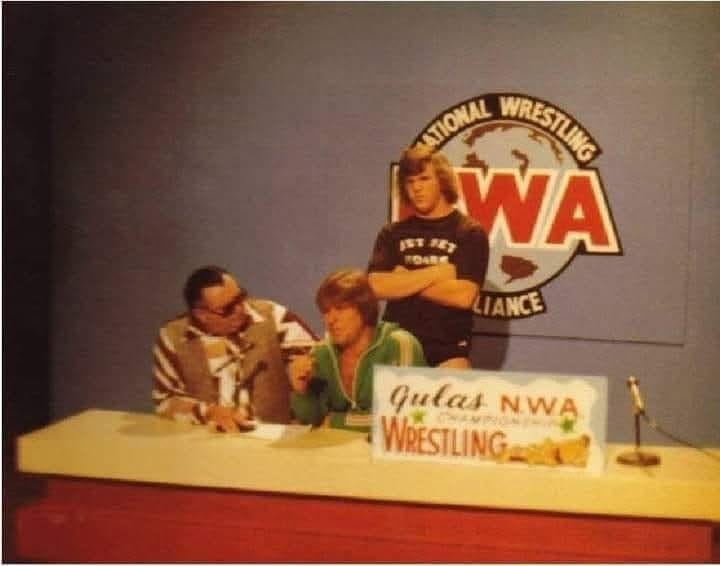
Huntsville had its own distinctive television personality in Grady Reeves, who became the familiar voice of Gulas-Welch wrestling in northern Alabama. His broadcasts were associated with WHNT-TV, Channel 19, and the local studio presentation became an important promotional vehicle for the Huntsville market. Reeves was more than a wrestling announcer. Like several of the other local television personalities in the Gulas-Welch territory, he had an established broadcasting presence outside wrestling and understood how to communicate with a local audience.
His personality was particularly well suited to the studio format, where interviews, wrestler introductions, matches, and promotional announcements all contributed to selling the upcoming live events. Reeves also had a morning television program and was a recognizable local personality. In a 2026 conversation with Michael St. John, the longtime wrestling broadcaster compared Reeves and Chattanooga’s Harry Thornton, observing that they had remarkably similar personalities and both had successful morning television programs. Reeves deserves recognition as one of the important local broadcasting figures in the history of the Tennessee Territory.
Chattanooga: Harry Thornton and Championship Studio Wrestling
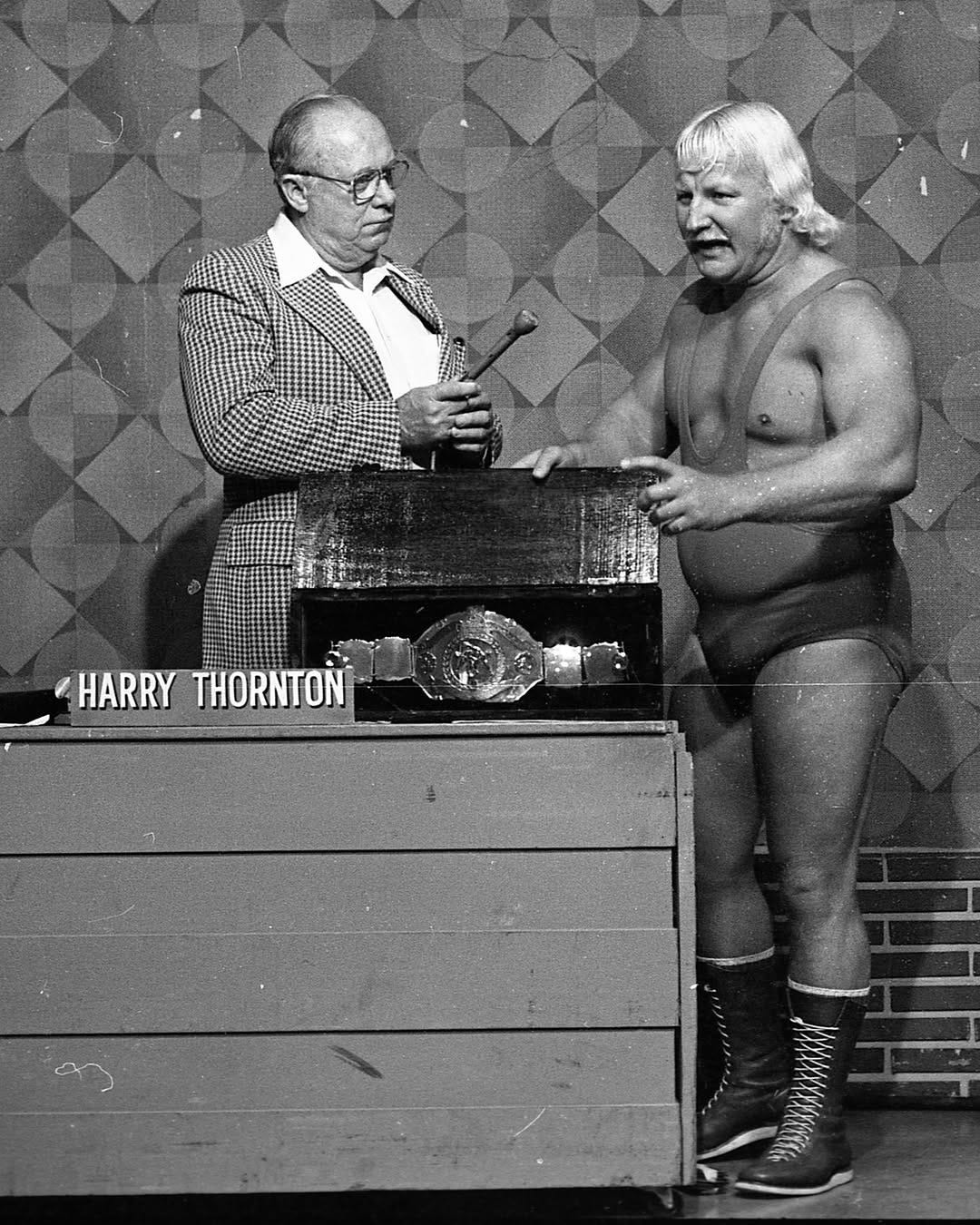
Chattanooga had perhaps the most distinctive local television operation outside Memphis, built around Harry Thornton, a major radio and television personality who became the voice and driving force behind Chattanooga wrestling. Thornton’s program appeared on local television, including WDEF-TV, Channel 12, and was commonly associated with the Championship Studio Wrestling presentation. Unlike a broadcaster who simply arrived to announce the matches, Thornton was deeply involved in the wrestling operation itself. He became a co-promoter with Gulas and Welch, held an ownership interest in the Chattanooga operation, and helped organize the local television and arena presentation.
His Saturday afternoon broadcasts featured interviews, studio matches, and promotional segments designed to sell the cards at Chattanooga’s Memorial Auditorium. Thornton’s personality was quite different from Russell’s. He was more outspoken, opinionated, and willing to become involved in the personalities and conflicts surrounding the program. Norman Veazey served as an important member of the operation, handling ring-announcing and road responsibilities. Thornton’s influence was substantial enough that he occasionally traveled to Nashville to fill in on its television program, demonstrating the cooperation that existed among the different Gulas-Welch markets.
Birmingham: Sterling Brewer and Live Studio Wrestling
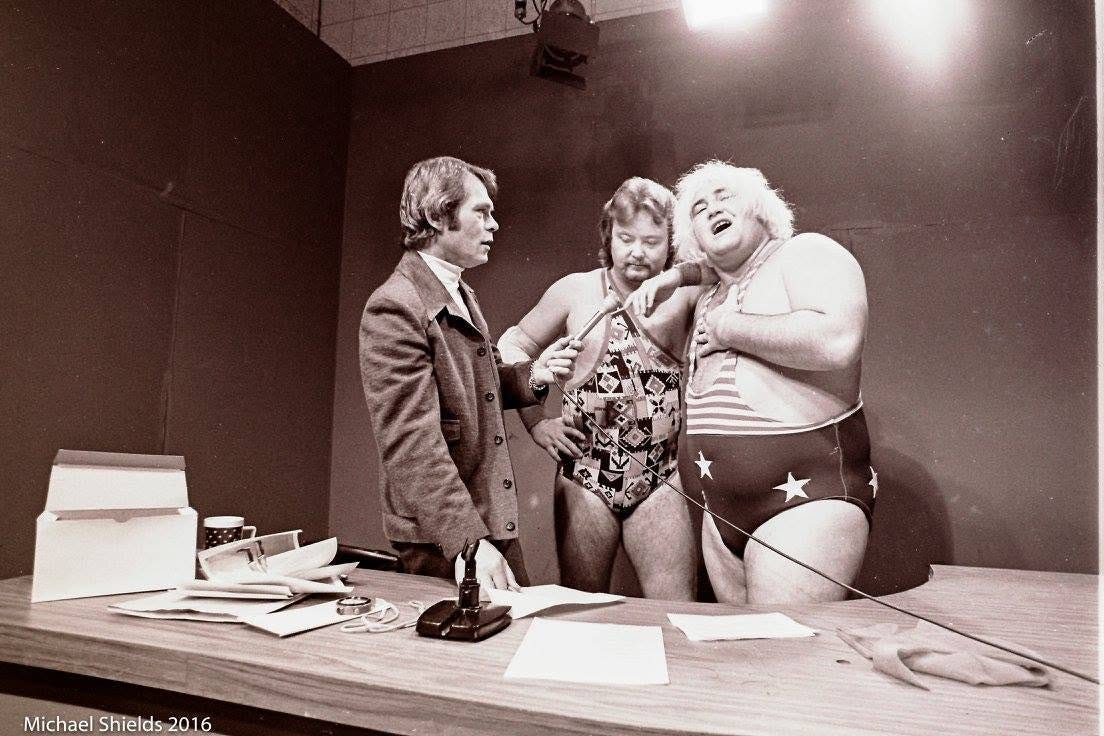
Birmingham had its own recognizable television voice in Sterling Brewer, who announced the Gulas-Welch studio wrestling broadcasts. Birmingham wrestling television had an earlier history on WAPI-TV, Channel 13, before the program disappeared from the schedule around 1962. Wrestling returned to local television in 1965, with WBMG-TV, Channel 42, carrying Live Studio Wrestling on Saturday evenings. Brewer resumed his announcing responsibilities and became closely identified with the Birmingham broadcasts.
The late-night program was particularly memorable for the wrestlers who traveled through the territory because it was frequently the final television stop of a long Saturday. Wrestlers might appear on Memphis television in the morning, travel to Huntsville for an afternoon engagement, work the Chattanooga television program later in the day, and then arrive in Birmingham for the late-night broadcast. In the early days, Lester Welch became a pilot to fly the main event wrestlers around to the television shows and house shows in the huge loop of Saturday towns.
Former wrestlers have recalled making the trip from Chattanooga to Birmingham, sometimes dressing in their automobiles and rushing into the studio just in time for Brewer to introduce their matches. It was a demanding schedule, but it illustrates how the different television markets operated together as part of one regional wrestling organization.
One Territory, Five Different Television Identities
What made the Gulas-Welch television arrangement particularly interesting was that it did not depend on one central program being distributed throughout the entire territory. Memphis, Nashville, Huntsville, Chattanooga, and Birmingham each had their own television personalities and local presentations. There were also additional outlets in smaller markets, and by the mid-1970s versions of the wrestling program were reaching a considerably wider regional audience.
The announcers were not necessarily interchangeable, and each brought something different to the broadcasts. Lance Russell and Dave Brown developed the enduring partnership in Memphis. Harry Thornton combined broadcasting with promotional responsibilities in Chattanooga. Grady Reeves was the familiar Huntsville personality. Sterling Brewer represented Birmingham, while Mike Duncan was one of the principal announcing voices in Nashville.
The distinction is important when evaluating Lance Russell’s place in wrestling broadcasting history. He was not the only talented announcer employed by Gulas and Welch, nor was Memphis the only market with successful studio wrestling. What separated the Memphis presentation was the remarkable consistency of the Russell-Brown partnership. Beginning in 1966, the two developed a recognizable television relationship that became a defining feature of the territory and continued long after the original Gulas-Welch arrangement ended.
Together, these five markets demonstrate that the Tennessee Territory had a much more sophisticated local television network than is sometimes appreciated. Each city had its own voice, its own audience, and its own relationship with the wrestlers. Lance Russell and Dave Brown were the most enduring announcing partnership within that network, but they were part of a much larger broadcasting tradition that helped make Gulas-Welch one of the important regional wrestling operations of the Territory Era.
Russell and Brown were the regular Memphis team, not the announcing team for the entire Gulas-Welch territory. The other markets maintained their own local television identities, with occasional announcer crossover. That makes the Russell-Brown partnership even more significant when examining the history of regional wrestling television.
The Move to WMC-TV in 1977
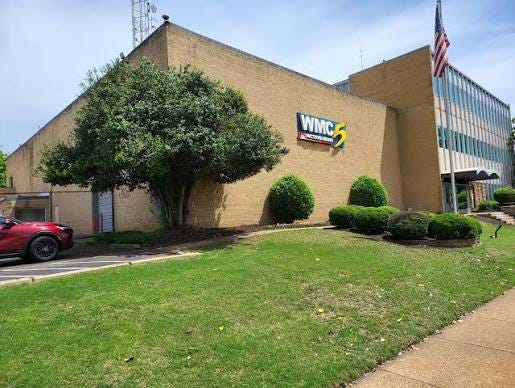
An important chapter in Russell’s career began in 1977, when Jerry Jarrett separated from Nick Gulas and established the Continental Wrestling Association.
The new promotion needed a television home, and the program moved from WHBQ-TV to WMC-TV, Channel 5. Russell and Dave Brown made the transition together.
This was a major development for Memphis wrestling. Jarrett understood the importance of the television program and recognized that Russell and Brown were integral parts of the presentation. The move also represented the beginning of a new promotional era. Working under the direction of Jarrett, Memphis wrestling became increasingly identified with its distinctive characters, highly developed interview segments, and unpredictable television angles. Russell and Brown were at the center of that evolution.
Russell’s relationship with Jarrett was not always smooth. In later interviews, he openly acknowledged that the two men had experienced disagreements and did not particularly like one another personally. Some of this was created when Jerry Lawler and Russell almost executed a coup of the operation by leaving and starting their own promotion, which was abandoned once cooler heads prevailed, Lawler and Jarrett executed a new deal togther and the personal injury inflicted by both men never particularly healed between Russell and Jarrett.
Nevertheless, Lance respected Jarrett’s intelligence as a promoter and recognized what they had accomplished together. Russell also understood that his position gave him considerable influence over the program. He once recalled Jarrett pointing out that Russell received more television exposure than Lawler or virtually anybody else associated with the promotion.
That observation was revealing.
Russell was not necessarily the biggest attraction in terms of wrestling ability or championship accomplishments, but he was a constant presence. The audience saw him week after week, and his personality became inseparable from the promotion.
Beyond Memphis: Lance Russell Joins World Championship Wrestling
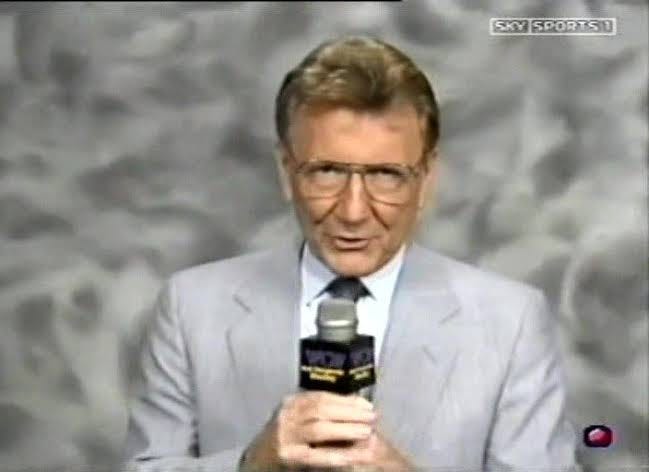
In 1989, Russell entered a new phase of his career when he joined World Championship Wrestling. This was a significant transition. After spending approximately three decades associated with Memphis wrestling, he was now working within a national television operation.
His experience was particularly valuable because WCW was drawing upon talent and broadcasting personalities from several territories, including the iconic Gordon Solie. His relationship with Solie went back many years. The two had developed a friendship through their respective territorial operations. When wrestlers moved between Memphis and Florida, Russell and Solie would sometimes exchange interviews and promotional material to help establish those wrestlers with audiences in the other territory.
It was an early example of cooperation between wrestling television operations. Russell particularly admired Solie’s work, although he recognized that they had different announcing styles. Solie was known for his measured, knowledgeable presentation and extensive wrestling vocabulary. Russell was more conversational, relying on his natural reactions and the personalities of the people around him.
He also enjoyed working with Jim Ross.
Russell described Ross as having a much more explosive announcing style. Ross brought considerable intensity to his commentary, while Russell preferred to allow the excitement to build naturally. He believed that the contrast between their styles was beneficial.
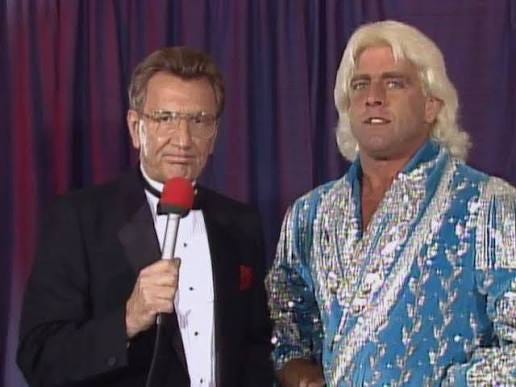
Russell worked for WCW through 1992 and retired from his regular national television duties around 1993. His time with the company gave him exposure to a broader audience and allowed him to work alongside broadcasters and wrestlers from across the country. He later returned for occasional appearances in Memphis wrestling, including work with the USWA and Smoky Mountain Wrestling. He had officially entered semi-retirement by 1997, although he continued making wrestling appearances and participating in special events.
Other Broadcasting Work and Television Responsibilities
It is easy to remember Russell exclusively as a wrestling announcer, but his professional responsibilities extended well beyond the wrestling program.
One of the more interesting aspects of his career was his position as director of programming for RKO General, the company that owned WHBQ-TV. Russell was involved in the programming side of television for years. He understood ratings, scheduling, audience demographics, and the relationship between individual programs and the overall television station.
His decision to move wrestling to Saturday mornings was a direct result of this experience. He also worked in Memphis football broadcasting as a color commentator and handled other sports assignments. His background in football, baseball, basketball, and boxing gave him an extensive foundation in sports broadcasting.
Russell explained that his approach to wrestling commentary was influenced by his boxing experience. Rather than trying to describe every individual punch, he learned to combine the action into a coherent explanation of what was happening.
That approach translated particularly well to professional wrestling. He understood that the announcer needed to communicate the significance of the action rather than simply narrate every movement. His television background also helped him recognize that wrestling was entertainment that depended upon presentation, timing, and personality.
The Personal Side of Lance Russell
There are several personal details about Russell that help round out his story. His early years were in Jackson, Tennessee.Lance often spoke fondly about growing up in Jackson, Tennessee. In a 2016 interview, he recalled his grandfather operating a transfer company that hauled freight from railroad lines and delivered merchandise to local businesses.
Russell remembered going along as a youngster and helping pass heavy bags of flour down a line of workers before they were loaded onto trucks. He also recalled visiting artesian wells along Highway 45 to collect cold water. These memories were important enough to become part of a special Lance Russell celebration in Jackson in 2015. The event was organized around his connection to the community, and Jerry Lawler helped bring the occasion together.
Russell was accompanied by his oldest son, William, who had spent his career in television production.
His marriage to Audrey
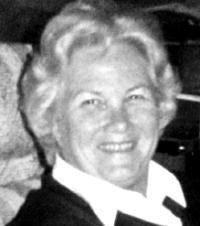
Pictured: Audrey Russell
Russell’s marriage to Audrey Lou Renner was one of the most enduring parts of his personal life. They met as teenagers at Oakwood High School in Ohio. After dating and a separation during World War II, they married on June 28, 1947.
Their marriage lasted 67 years.
Audrey was able to travel with Lance after their children were grown, and the couple enjoyed visiting different cities during his wrestling assignments. One of his favorite stories involved traveling with Gordon Solie and Solie’s wife, Smokey. The two couples would visit different cities, enjoy meals together, and spend time socializing.
Russell joked that people would sometimes recognize his voice while overlooking Solie, which he enjoyed using to tease his friend. Audrey also appreciated the advantages of having a recognizable husband. Russell recalled that when they went to restaurants and faced a long wait, somebody would sometimes recognize him and find them a table. She was less enthusiastic when fans interrupted their meals to request autographs!
His love of golf and fishing
Russell enjoyed golf throughout his life and continued playing after his wrestling career began winding down. Fishing was another interest, although his obituary humorously noted that he possessed an inexplicable ability to frighten fish away. It was an amusing detail that reflected the affection with which his family remembered him.
His children and grandchildren
Lance and Audrey had three children: William Lance Russell, who worked in television production. Valerie Houston. Shane Russell. His family eventually included eight grandchildren and eight great-grandchildren, according to his obituary. After years in Memphis, Lance and Audrey moved to Gulf Breeze, Florida, in 1999, fulfilling a long-held desire to retire along the Emerald Coast. They became involved in their community and attended St. Paul’s Methodist Church.
Recognition and Hall of Fame Honors
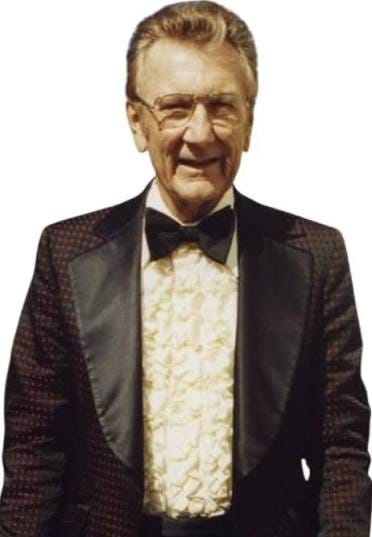
Russell’s accomplishments eventually received recognition throughout the wrestling industry.
His honors included:
Wrestling Observer Newsletter Hall of Fame, 1996.
NWA Hall of Fame, 2006.
NWA Wrestling Legends Hall of Heroes, 2017.
USWA Memphis Wrestling Hall of Fame recognition.
Cauliflower Alley Club Announcer’s Award, 2016.
The Wrestling Observer recognition was particularly significant because it reflected the respect he had earned among wrestling journalists, historians, wrestlers, and fans.
He was also recognized as one of the outstanding television announcers of his generation, receiving the Wrestling Observer Newsletter’s Best Television Announcer award multiple times during the 1980s. The 2016 Cauliflower Alley Club Announcer’s Award was especially meaningful because it came as Russell celebrated his 90th birthday. In an interview that year, he was asked whether he had ever thought of himself as an artist.
His answer was characteristically modest. He said he had never really considered himself an artist and was simply pleased that people enjoyed the broadcasts he and Dave Brown produced. That modesty was part of his personality. He understood that he had been fortunate to work with some extraordinarily talented performers, and he was quick to recognize the contributions of others.
Lance Russell’s Influence on Professional Wrestling Broadcasting
Russell’s influence extended far beyond the Memphis territory. The proliferation of home video recorders and tape trading during the 1980s allowed fans throughout the United States to discover Memphis wrestling. Russell recalled one particularly memorable experience during his WCW years.
He was in Boston preparing for a broadcast when a group of young fans recognized him and began calling his name. He was confused because the Memphis television program was not being broadcast in that market. The fans explained that they were tape traders.They had been exchanging wrestling tapes and had become familiar with Memphis wrestling through recordings circulated among fans. Russell had not fully appreciated how much interest existed outside Tennessee until that experience.
Memphis had become one of the most sought-after territories among tape traders, and Russell’s voice was familiar to people who had never attended a Memphis wrestling event. His influence can be understood through several elements of his broadcasting style.
First, he demonstrated that a wrestling announcer did not need to shout constantly to create excitement. His conversational delivery provided contrast, allowing important moments to stand out.
Second, he showed that interviews were every bit as important as matches. Memphis wrestling often used its television time to develop characters and establish storylines. Russell understood how to facilitate those segments.
Third, he demonstrated the importance of credibility. His reactions helped viewers understand the difference between a routine interview and an extraordinary situation.
Finally, he showed that an announcer could become a beloved personality without taking attention away from the wrestlers.
His influence can be seen in the work of later generations of wrestling broadcasters who recognized the importance of personality, storytelling, and authenticity.
The Final Years and Passing of Lance Russell
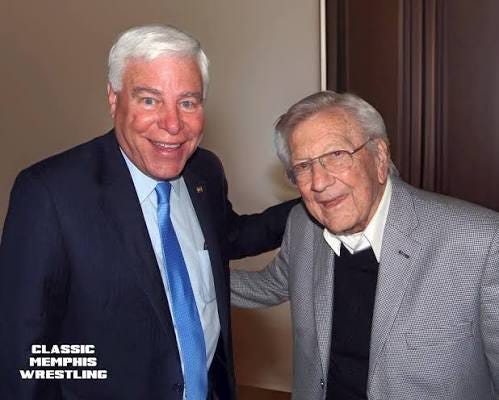
Following his semi-retirement, Russell continued making appearances at wrestling conventions, reunions, and special events. He enjoyed meeting fans and discussing the history of Memphis wrestling. His appreciation for the audience grew as he began to encounter fans from outside Tennessee who had discovered his work through videotapes and later television releases.He was particularly surprised by the number of younger fans who knew his broadcasts.
In 2015, he participated in the special Lance Russell celebration in Jackson, Tennessee, which brought together several important figures from his career. He also continued to maintain friendships with wrestlers and broadcasters from the territorial era.
His wife Audrey died on June 29, 2014, after 67 years of marriage.
Russell eventually returned to Memphis to spend time with his family. His daughter Valerie died on September 29, 2017, after battling cancer. Just four days later, on October 3, 2017, Lance Russell passed away at the age of 91. His death followed complications from a broken hip sustained in a fall.
His passing generated tributes from throughout the wrestling industry.
Dave Brown’s reaction was particularly moving. Brown described Russell as his friend, coworker, and partner for 53 years, saying they had never had a cross word between them. That statement perhaps says as much about Russell’s character as any professional award. He had spent decades working in an environment that could be unpredictable, difficult, and occasionally chaotic, yet maintained relationships that lasted long after the television cameras stopped rolling.
The Legacy of Lance Russell: More Than the Voice of Memphis Wrestling
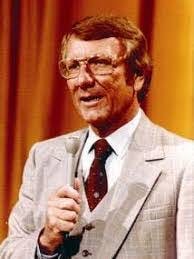
When discussing the great announcers of the Territory Era, several names immediately come to mind.
Gordon Solie represented Florida and Georgia. Bob Caudle became closely associated with the Mid-Atlantic territory. Bill Mercer was an important voice in Texas. Bill Flemming helped define Detroit wrestling. Don Owen’s Pacific Northwest broadcasts had their own distinctive identity.
Lance Russell belongs in that same historical conversation.
However, what made Russell particularly important was the relationship between his broadcasting career and the identity of Memphis wrestling itself. He was there before Jerry Lawler became the King. He was there when Jackie Fargo was The Fabulous One. He was there when Jimmy Hart had so many “greatest days of his life.”. He was there when Bill Dundee, Austin Idol, Dutch Mantell, and countless other personalities helped establish the Memphis style.
He was there for the introduction of the Fabulous Ones, the development of the territory’s increasingly creative television presentation, the Andy Kaufman phenomenon, the empty-arena match, the Tupelo concession stand brawl, and Lawler’s AWA World Championship victory. Through all of it, Russell remained the constant.
His greatest contribution may have been his ability to make the extraordinary seem believable without making the broadcast itself seem artificial.
He could laugh at Lawler, become exasperated with Jimmy Hart, express genuine concern when a situation became dangerous, and maintain the dignity of the program without sacrificing its entertainment value.
He also understood the importance of the audience. Memphis wrestling was built around the relationship between the television program and the live events. Russell helped connect those two worlds. The Saturday morning show made the wrestlers familiar. The interviews created anticipation. The matches provided the payoff. The announcer was the familiar personality who guided the audience through the entire experience.
That was Lance Russell.
There is an interesting comparison between Russell and the great wrestling personalities he introduced. Wrestlers often moved from territory to territory, changed their characters, and reinvented themselves. Russell remained identified with one city and one wrestling tradition for most of his career.
That consistency became his greatest professional asset.
He did not need to be the loudest announcer, the most theatrical, or the most technically elaborate. He simply needed to sound like Lance Russell and for Memphis wrestling fans, hearing that familiar voice say “Yello, everybody!” meant that another Saturday morning of professional wrestling had begun. Over the course of the next nearly four decades, that voice helped make Memphis wrestling a national phenomenon.
Lance Russell was not merely the announcer who called Memphis wrestling. He was one of the people who made Memphis wrestling what it was.
31 Great Territory Era Television Announcers Series
Profile 1: Larry Matysik, Wrestling At The Chase, St. Louis, Missouri
Profile 2: Sam Menacker, World Wrestling Association, Indianapolis, Indiana
Profile 3: Bob Caudle, Mid-Atlantic Championship Wrestling, Raleigh, North Carolina
Profile 5: Ed Whalen, Stampede Wrestling, Calgary, Alberta, Canada
Profile 6: Paul Boesch, Houston Wrestling, Houston, Texas
Profile 7: Ray Morgan, WWWF Washington, D.C.
Profile 8: Bill Mercer, Big Time & World Class Championship Wrestling, Dallas, Texas
Profile 9: Lord Athol Layton, Toronto, Detroit & Australia
Profile 10: Dick Lane, NWA Hollywood, Los Angeles, California
Profile 11: Marty O’Neill AWA Minneapolis, Minnesota
Profile 13: Bill Kersten, All-Star Wrestling, Kansas City, Missouri
Profile 14: Harry Thornton, Gulas-Welch Tennessee Territory, Chattanooga, Tennessee
Profile 15: Dr. Alfonso Morales, Lucha Libre Mexico
Profile 16: Hank Renner, San Francisco and Northern California Territory
Thank You for Watching and Listening
I’m Tony Richards, Pro Wrestling Historian, Author and Storyteller. I share pro wrestling historical items in each issue of the Time Tunnel Pro Wrestling History Newsletter and each episode of our podcast show. Thanks for your support! If you enjoy my information on select events, matches and insights, please share with folks you think might like to be a subscriber!
Remember, Premium subscribers get access to exclusive and special content such as some special issues including a multi-part deep dives on wrestling territories, wrestler bios and championship title histories, special audio and video interviews on territory pro wrestling and more available in the Pro Wrestling Time Tunnel for Premium Subscribers. Being a Premium Subscriber also means you support me in my efforts to document Pro Wrestling History through my research, writing, books, vidoes and podcasts. And…I have something very special planned for our Premium Subscribers on the Podcast side of things in 2027! Details soon here in the Pro Wrestling Time Tunnel.