


Today’s Favorite Quote: The key to everything is patience. You get the chicken by hatching the egg, not by smashing it-Arnold Glasgow
Happy Birthday to those who have passed on and to those great wrestlers still with us:
In Memoriam:
Johnny Weaver 1935
Nightmare Ted Allen 1955
Happy Birthday:
Ed “Moondog” Moretti (69)
David Kempeter\Ramjin Singh (51)
Mitsonobu Kikuzawa\Kikutaro (50)
Jay Bradley (46)
Iazimin Benitez\Mercedes Martinez (46)
RIP Memorial: We stop & remember those who have passed on this day and gave themselves to the business for us, the fans. We salute you and thank you.
Joseph Godfrey\Rufus Jones 11-17-1951 at the age of 38

Cristofo Mirena\Chris Dundee 11-17-1998 at the age of 91

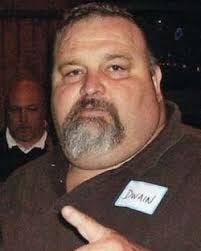
Dwain McCullogh\Awesome Kong 11-17-2012 at the age of 54
7 Stages of the Territory Era
Stage 5: Consolidation
Year Two, Month Eleven
November 1966
Tokyo Pro Wrestling (1966–1967)
Tokyo Pro Wrestling was a short-lived Japanese promotion that operated from mid-1966 into early 1967. It was the first serious competitor to the Japan Pro Wrestling Alliance (JWA) since the early years of puroresu, and it briefly gave Antonio Inoki his first sustained run as a top star in Japan.
The promotion was formed by Michiharu Toyonobori (better known simply as Toyonobori), a former sumo wrestler who had become a professional wrestler and, for a time, president of the JWA. In early 1966 Toyonobori was forced out of the JWA amid allegations of financial misconduct involving company funds and gambling. He took a small group of wrestlers with him, including Katsuhisa Shibata and Masao Kimura (later known as Rusher Kimura). Antonio Inoki, returning from a long American excursion, joined the new venture rather than going back to the JWA. The company was formally announced in April 1966 and held its first card on October 12, 1966, at the Kuramae Kokugikan (Sumo Hall) in Tokyo, drawing roughly 9,000 fans.
Link to my story on Toyonbori’s exit from JWA earlier this year:

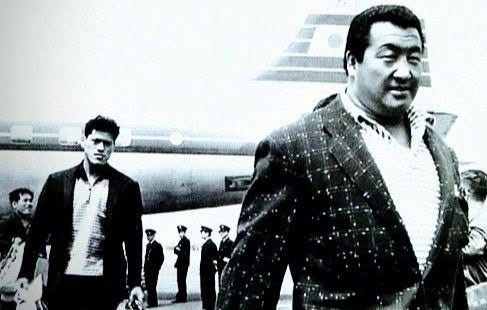
Pictured: The legendary Rikidozan with a trailing young Antonio Inoki behind him
Antonio Inoki was Toyonobori’s top recruiting target.
Young Inoki entered professional wrestling as one of Rikidozan’s hand-picked prospects and spent the first decade of his career moving between the Japan Pro Wrestling Alliance, an American excursion, a short-lived independent promotion, and a return to the JWA as half of its dominant tag team.
Inoki emigrated to Brazil with his family in 1957 at age 14. While living there he competed in track and field and won national titles in the shot put and discus. In 1960 Rikidozan, on a trip to Brazil, recruited the 17-year-old and brought him back to Japan. Inoki trained in the JWA dojo alongside Shohei Baba (later Giant Baba). His teachers included Karl Gotch, amateur wrestler Isao Yoshiwara, and kosen judoka Kiyotaka Otsubo. Both Inoki and Baba made their professional debuts on the same card on September 30, 1960. Inoki lost to Kintaro Oki (Kim Il); Baba defeated Yonetaro Tanaka. Inoki was billed early on under his real name or variations of it. By late 1962 or 1963 he was using the ring name Antonio Inoki, a nod to Antonino Rocca.
After Rikidozan’s death in December 1963, Inoki remained in the JWA but worked largely in Baba’s shadow. In March 1964 he left for a long excursion to the United States. Over the next two years he worked Hawaii, Los Angeles (as Little Tokyo), the Central States (as Tokyo Tom), Oregon (as Mr. Kazimoto), Texas, and Tennessee. He held the NWA Texas Heavyweight Championship in 1965 and, in early 1966, the NWA World Tag Team titles in Mid-America with Hiro Matsuda. The American years hardened his style and gave him experience against a range of regional talent, including Fritz Von Erich and Killer Karl Kox in Texas.
In early 1966 Toyonobori, contacted Inoki in Hawaii and recruited him for a new promotion.
The recruitment was dubbed in puroresu circles “The Plunder of the Pacific” (or similar phrasing). It was treated as a raid: Toyonobori had already been forced out under a cloud, and he was now pulling one of the JWA’s most promising young wrestlers (plus a handful of others) into an independent company rather than allowing Inoki to return to the established office. The JWA viewed the move as disloyal and disruptive. Inoki returned to Japan in April and joined Tokyo Pro Wrestling rather than rejoin the JWA. In short, the departure was controversial on two levels: the initial “poaching” of Inoki by a recently expelled executive, and the subsequent collapse of Tokyo Pro amid fresh accusations of financial misconduct.
As previously mentioned, Tokyo Pro’s first show was held on October 12, 1966, at the Kuramae Kokugikan in Tokyo. The main event of the debut show saw him defeat Johnny Valentine by count-out in just under 32 minutes. Valentine was billed as the United States Heavyweight Champion on the basis of his recognition in Toronto. Tokyo Pro treated that claim as legitimate so Inoki could challenge for and win it. On November 19, 1966, at Osaka Baseball Stadium in front of approximately 14,000 fans, Inoki defeated Valentine in three falls to claim the title. The series of matches with Valentine is widely regarded as the first major step in establishing Inoki as a legitimate main-eventer capable of hanging with top foreign talent.
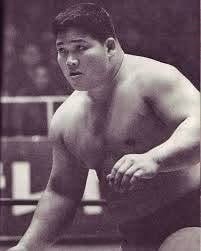
Pictured: Toyonobori
The roster also included Toyonobori himself, Dean Higuchi, Johnny Powers, and several younger Japanese wrestlers. Haruka Eigen, who would later become a longtime presence in All Japan and Pro Wrestling Noah, made his professional debut under the Tokyo Pro banner. Despite the name, the promotion ran shows across Japan rather than staying in Tokyo. Attendance was respectable on the bigger nights, but the company lacked a stable television deal and a deep network of local promoters. Many planned dates, especially in the Tohoku region, were canceled.
Financial and internal problems surfaced quickly. Japanese sources describe opaque bookkeeping, unpaid wrestlers, and allegations that substantial gate money was diverted. By January 1967 the situation had deteriorated to the point that Inoki held a press conference accusing Toyonobori and others of embezzlement. The promotion effectively collapsed that month. Most of the remaining talent, including Toyonobori, moved to the newly formed International Wrestling Enterprise (IWE). Inoki returned to the JWA later in 1967, where he was paired with Giant Baba as the B-I Cannon. The United States title he had won from Valentine was simply abandoned when Tokyo Pro closed; Valentine continued to be recognized as champion in Toronto as if the Japanese matches had not occurred.
Tokyo Pro Wrestling lasted less than a year and never developed the infrastructure to survive as a full-scale promotion. Its primary historical importance is that it gave Inoki his first real platform as a singles star in Japan and served as a brief, early crack in the JWA’s monopoly. The experiment also showed how difficult it was, even with a popular young headliner and imported foreign talent, to challenge an established office that controlled the major venues and television relationships.
Thank You for Watching and Listening
I’m Tony Richards, Pro Wrestling Historian, Author and Storyteller. I share pro wrestling historical items in each issue of the Time Tunnel Pro Wrestling History Newsletter and each episode of our podcast show. Thanks for your support! If you enjoy my information on select events, matches and insights, please share with folks you think might like to be a subscriber!
Remember, Premium subscribers get access to exclusive and special content such as some special issues including a multi-part deep dives on wrestling territories, wrestler bios and championship title histories, special audio and video interviews on territory pro wrestling and more available in the Pro Wrestling Time Tunnel for Premium Subscribers. Being a Premium Subscriber also means you support me in my efforts to document Pro Wrestling History through my research, writing, books, vidoes and podcasts. And…I have something very special planned for our Premium Subscribers on the Podcast side of things in 2026! Details soon here in the Pro Wrestling Time Tunnel.