



Happy Birthday to those who have passed on and to those great wrestlers still with us:
In Memoriam:
Art Michalik 1930
Jorge Gonzalez\El Gigante 1966
Happy Birthday:
Jesus Lopez\Chief Thundercloud (92)
Dave “Fit” Finlay (68)
RIP Memorial: We stop & remember those who have passed on this day and gave themselves to the business for us, the fans. We salute you and thank you.
Dutch Mantell 1-31-1941 at the age of 60

Count John Von Bromberg 1-31-1989 at the age of 78

Joe McHugh 1-31-1993 at the age of 88

Black Jack Heddon 1-31-2010 at the age of 65
(no photo available)
Shohei “Giant” Baba 1-31-1999 at the age of 61

Significant Debuts:
1-31-1947: George Bollas (24) defeated Fred Carone in Columbus, Ohio
The Life and Career of Count John Von Bromberg
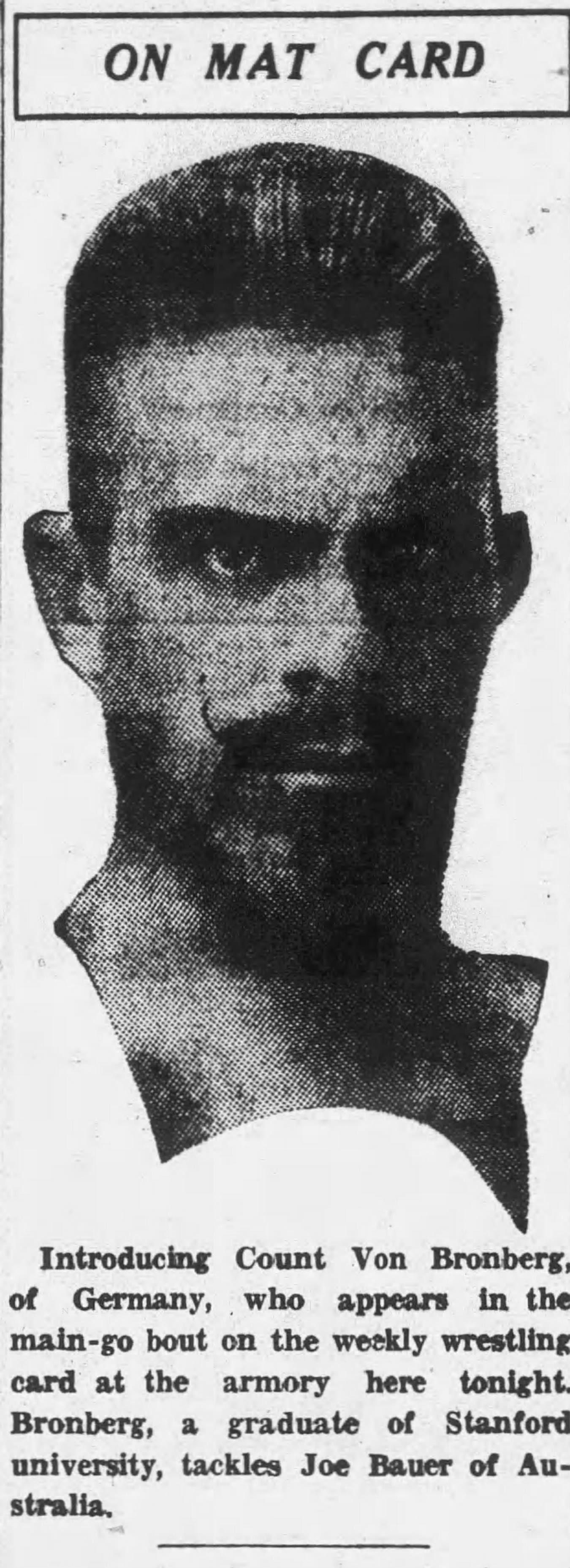
Pictured: June 4th, 1935, Von Bromberg featured in the Hearld Palladium in Benton Harbor, Michigan
Count John von Bromberg, a wrestler whose aristocratic ring name evoked images of European nobility, but whose career was firmly rooted in the American wrestling circuit of the 1930s. Though not as famous as contemporaries like Jim Londos or Lou Thesz, Count von Bromberg left a mark on the sport through his competitive matches and a brief reign as a world champion. His story is one of perseverance in a demanding industry, pieced together from historical records of bouts and titles. Little is known about Count von Bromberg’s early life or real identity, as was common for wrestlers of the era who often adopted elaborate personas to captivate audiences. The name “Count Johan von Bromberg” suggests a gimmick inspired by German or Eastern European aristocracy, possibly to play on the heel (villain) archetype popular at the time. Wrestlers like Baron von Raschke or Killer Karl Krupp would later use similar Teutonic themes, but von Bromberg was an earlier example. He emerged in the professional wrestling scene during the Great Depression, a period when the sport provided affordable entertainment and escapism for struggling Americans. His career appears to have spanned at least the mid-1930s, with documented matches from 1934 to 1939, primarily in the Midwest and South.
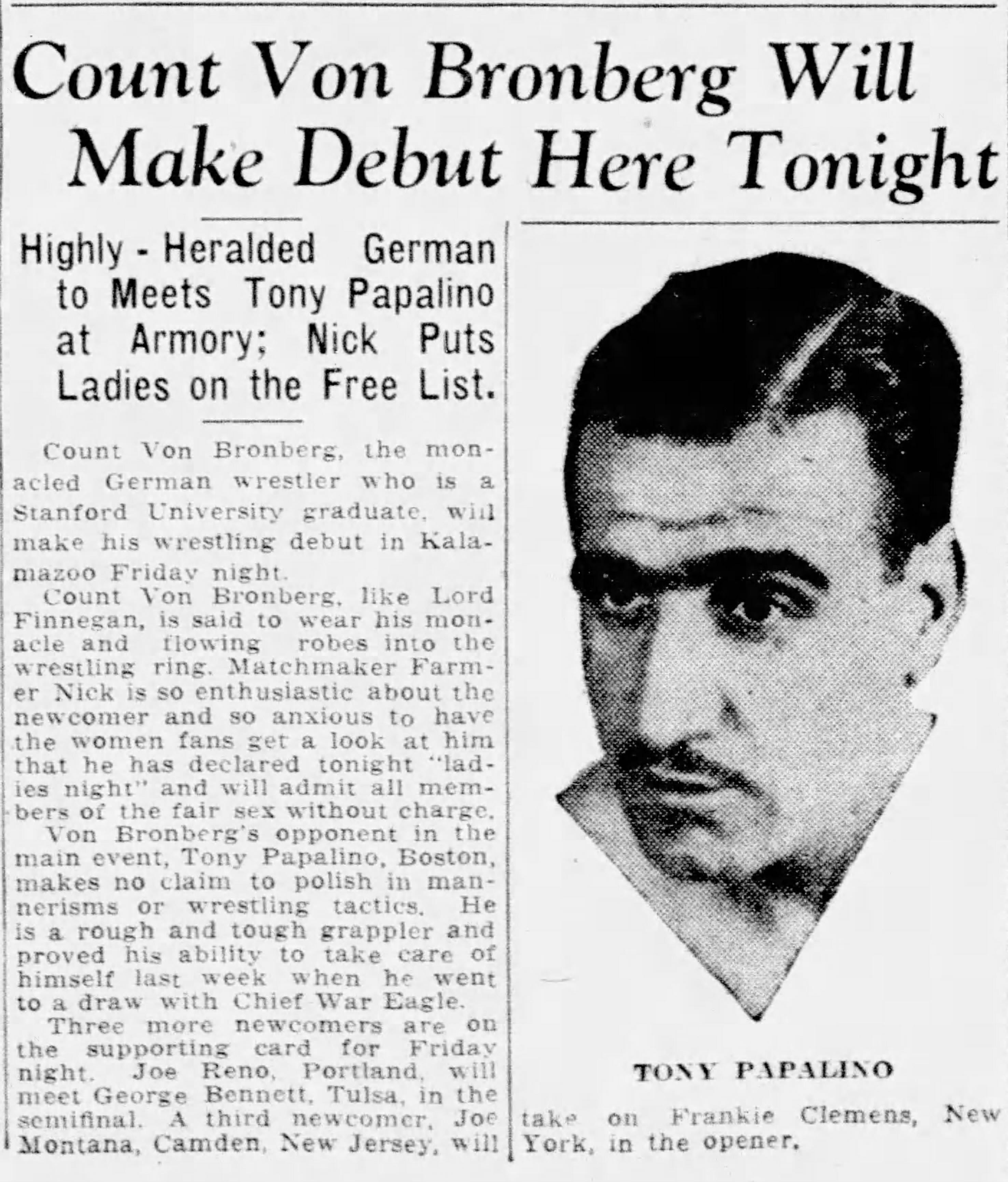
Pictured: May 31st, 1935 Kalamazoo, Michigan Gazette
Von Bromberg’s in-ring style and persona are not extensively detailed in surviving accounts, but his participation in high-profile cards indicates he was a respected mid-card performer. He competed in the light heavyweight division, which emphasized speed, technical skill, and endurance over sheer power. One of his earliest recorded matches was on March 1934, where he faced Lou Mueller in a bout that showcased the era’s straightforward, no-frills wrestling. By January 1937, he was wrestling in Texas, taking on Ned Taylor in a 2-out-of-3 falls match, a common format that tested wrestlers’ stamina. Later that year, in December, he clashed with Toots Estes in Anniston, Alabama, further demonstrating his willingness to travel the territorial circuit.
A pinnacle of von Bromberg’s career came on April 28, 1937, in Oklahoma City, Oklahoma, where he defeated Stacy Hall to capture the National Wrestling Association (NWA) World Light Heavyweight Title. The event drew 3,500 fans and was officiated with NWA officials in attendance, underscoring its legitimacy. Promoted by Sam Avey, this victory marked von Bromberg as a champion in an era when titles were fragmented across regions but carried significant prestige within the NWA framework. The light heavyweight division was competitive, featuring stars like Leroy McGuirk and “Wild” Red Berry, and von Bromberg’s reign, though brief, placed him among their ranks. Unfortunately, specific defenses or the length of his championship are not well-documented, reflecting the patchy record-keeping of pre-television wrestling.
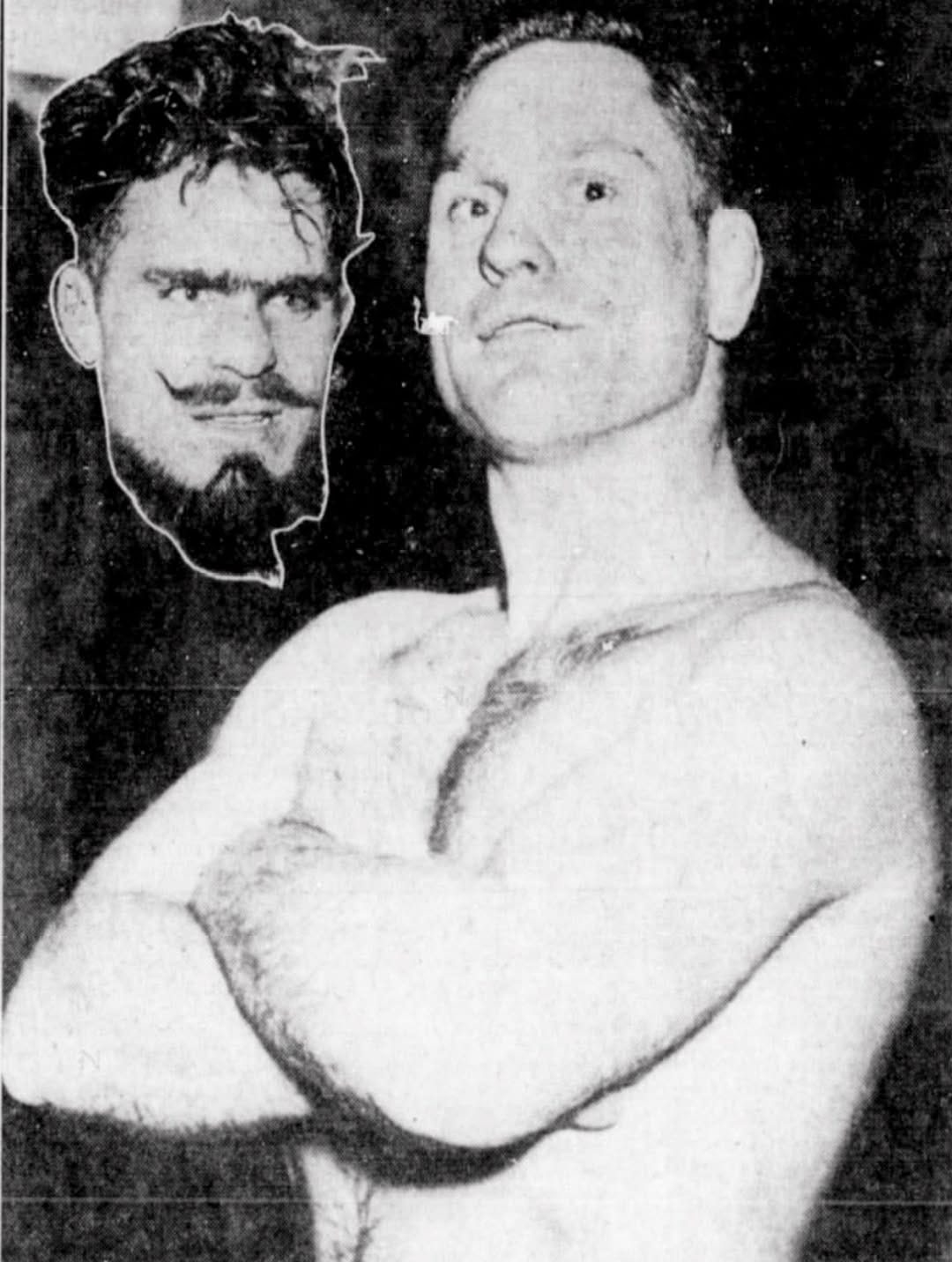
Pictured: A photo of Count Von Bromberg superimposed on a photo of Wild Red Berry to promote their match
Throughout 1938 and 1939, von Bromberg continued to compete actively. In Los Angeles, he appeared on cards at the Olympic Auditorium, facing opponents like Wally Swanson and engaging in multi-man events. A notable loss came on February 16, 1939, in Birmingham, Alabama, where he was defeated by Tetsuro Higami, a Japanese wrestler known for his technical prowess. Another setback occurred against Lon Chaney (not the actor, but a wrestler of the same name) in a 2-out-of-3 falls match. These matches highlight the international flavor of wrestling even then, with performers from diverse backgrounds drawing crowds.
As the 1940s approached, von Bromberg’s appearances seem to fade from records, possibly due to the onset of World War II or retirement. The wrestling industry evolved rapidly post-war, shifting toward more theatrical elements and national promotions, which may have left earlier figures like him in obscurity. Tragically, Count von Bromberg passed away at the age of 78 in 1989.
Count von Bromberg’s career exemplifies the grit of Depression-era wrestling. He was part of a generation that laid the groundwork for later, more-modern professional wrestling, competing in an unregulated, physically punishing environment without the fame or fortune of today’s stars. While his life outside the ring is largely unknown—perhaps intentionally so, as many wrestlers guarded their real identities—his contributions to the sport endure in archival databases and histories.
One Thing I Learned About Giant Baba
He once underwent risky brain surgery during his baseball career to remove a tumor pressing on his optic nerve, which had impaired his vision to the point where he couldn’t see beyond five meters; doctors gave the procedure only a 1% chance of full recovery.

Thank You for Reading
I’m Tony Richards, Pro Wrestling Historian, Author and Storyteller. I share pro wrestling historical items in each issue of the Time Tunnel Pro Wrestling History Newsletter. Thanks for reading! If you enjoy my information on select events, matches and insights, please share it with folks you think might like to be a subscriber!
Remember, premium investors get access to exclusive and special content such as some special issues including a multi-part deep dives on wrestling territories, wrestler bios and championship title histories, special audio and video interviews on territory pro wrestling and more available in the Pro Wrestling Time Tunnel for Premium Investors.
John Bromberg joined the U.S Army Air Corps in 1940 and retired as a Lieutenant Colonel. So he apparently chose a military career over wrestling. He was shot down on a bombing mission and was a P.O.W. for a bit during the war. After the war, he and his wife Doris settled in Redwood City, CA, for a while where he worked for a few different companies and a distributor or salesman.