



Happy Birthday to those who have passed on and to those great wrestlers still with us:
In Memoriam:
Hans Mortier 1924
Happy Birthday:
Dean Roll\Shark Boy (51)
Stephen Farrelly\Shamus (43)
RIP Memorial: We stop & remember those who have passed on this day and gave themselves to the business for us, the fans. We salute you and thank you.
George Bollas 1-28-1977 at the age of 53

Victor Mar\The Black Cat 1-28-2006 at the age of 51
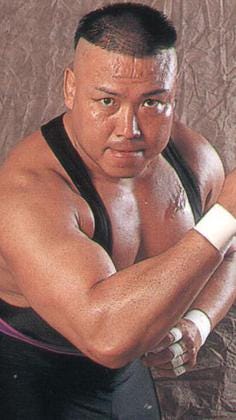
Emory Hale 1-28-2006 at the age of 36

The Life & Career of George Bollas: The Original Zebra Kid and The Original Golden Terror
George Bollas, born on September 19, 1923, in Warren, Ohio, to Greek immigrant parents, emerged as one of professional wrestling’s most colorful and enigmatic figures in the mid-20th century. Known primarily for his masked personas as the original Zebra Kid and the Golden Terror, Bollas combined raw athleticism, theatrical flair, and international appeal to carve out a lasting legacy in the sport. His journey from a high school athlete to a world-traveling wrestler reflects the evolution of professional wrestling from regional spectacles to global entertainment. Bollas passed away on January 28, 1977, at the age of 53, leaving behind a career marked by championships, feuds, and innovative gimmicks that influenced future generations of performers.
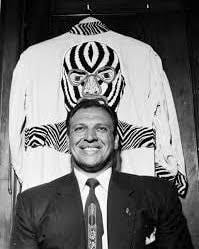
Bollas’s path to wrestling stardom began in his hometown of Warren, where he attended Warren G. Harding High School and excelled in football, graduating in 1939. Standing at 5’11” and weighing around 320 pounds, he possessed a formidable build that would later define his in-ring presence. He enrolled at The Ohio State University, where he joined the Buckeyes wrestling team. As a freshman, he captured the Big Ten Conference heavyweight championship, repeating the feat as a sophomore. His crowning amateur achievement came on March 23, 1946, when he defeated Morris Chitwood of Indiana University to win the NCAA heavyweight title. This victory solidified his reputation as a dominant force in collegiate wrestling, earning him nicknames like “The Mystery Man,” “Greek Hercules,” and “The Intercollegiate Dark Secret.” In recognition of his accomplishments, Bollas was posthumously inducted into the Ohio State University Athletics Hall of Fame in 1998 by his children, and later into the Trumbull County Sports Hall of Fame.
During his college years, Bollas dipped his toes into professional wrestling to supplement his income. In 1946-1947, he worked sporadically for Ohio promoter Al Haft under the alias “The Mystery Man.” This early exposure foreshadowed his full transition to the pro circuit after graduation.

Pictured: George Bollas as The Zebra Kid
Bollas turned professional full-time in late 1947, initially working for Haft in Ohio before heading to New York. In 1948, while wrestling as “The Greek Hercules,” he sparked a riot in New York, leading to a ban from the area. Undeterred, he moved to Charlotte, North Carolina, adopting the “Intercollegiate Dark Secret” moniker. It was here that his most famous persona, the Zebra Kid, was born. The gimmick drew inspiration from the stretch marks on his body caused by dramatic weight fluctuations—resembling zebra stripes—which he accentuated with a striped mask and attire. Weighing up to 350 pounds, Bollas became a “fat man wrestler” archetype, known for his surprising agility, including early use of the dropkick, a move that highlighted his athleticism despite his size.
The Zebra Kid persona propelled Bollas to prominence. On July 7, 1949, he defeated Buddy Rogers to claim Jack Pfeffer’s version of the World Heavyweight Championship in Ohio, a title he would win four times in total. He also adopted other aliases, such as the Golden Terror, Big Zebra, Panzer #3, and Mysterious Mr. X, allowing him to reinvent himself across territories, especially in Texas. The Golden Terror, in particular, emphasized a menacing, hooded or masked villain role, often teaming with partners like Lenny Montana (later known as Luca Brasi in The Godfather) to win tag team titles, including the New Jersey Tag Team Championship in 1953.
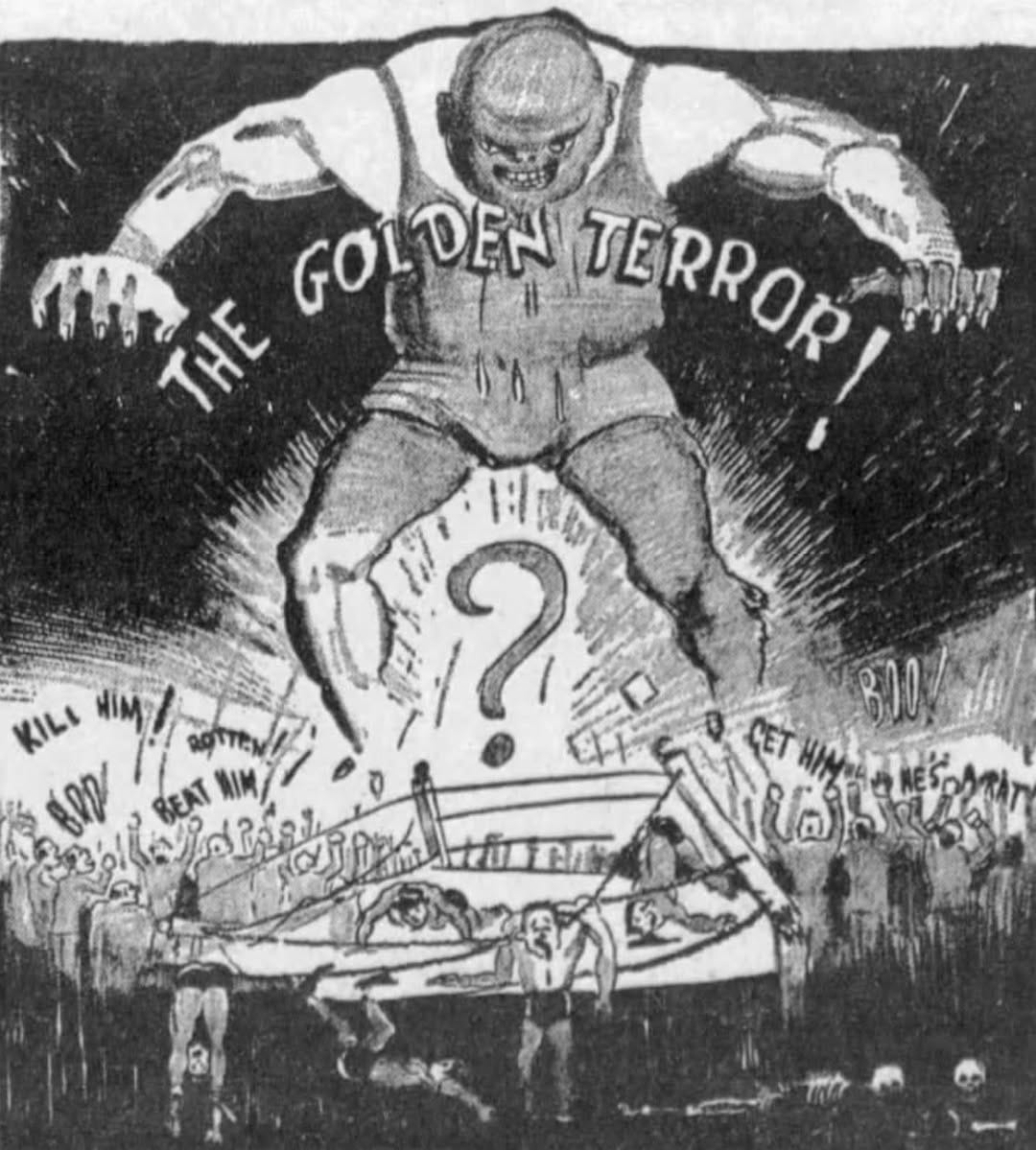
Pictured: The Golden Terror Artwork from the 1950s
Bollas’s career was defined by high-profile feuds and title pursuits. In 1951, he challenged Lou Thesz for the NWA World Heavyweight Championship in Toledo but came up short. That same year, he wrestled Whipper Billy Watson to a curfew draw in Toronto. Moving to San Francisco in 1952, he engaged in a heated rivalry with Japanese star Rikidozan. Alongside Hans Schnabel, he captured the NWA Pacific Northwest Tag Team Championship by defeating Gino Garibaldi and Leo Nomellini in September 1952. Later that year, as the Zebra Kid, he won the “Beat the Champ” International Television Title from Sandor Szabo in Los Angeles.
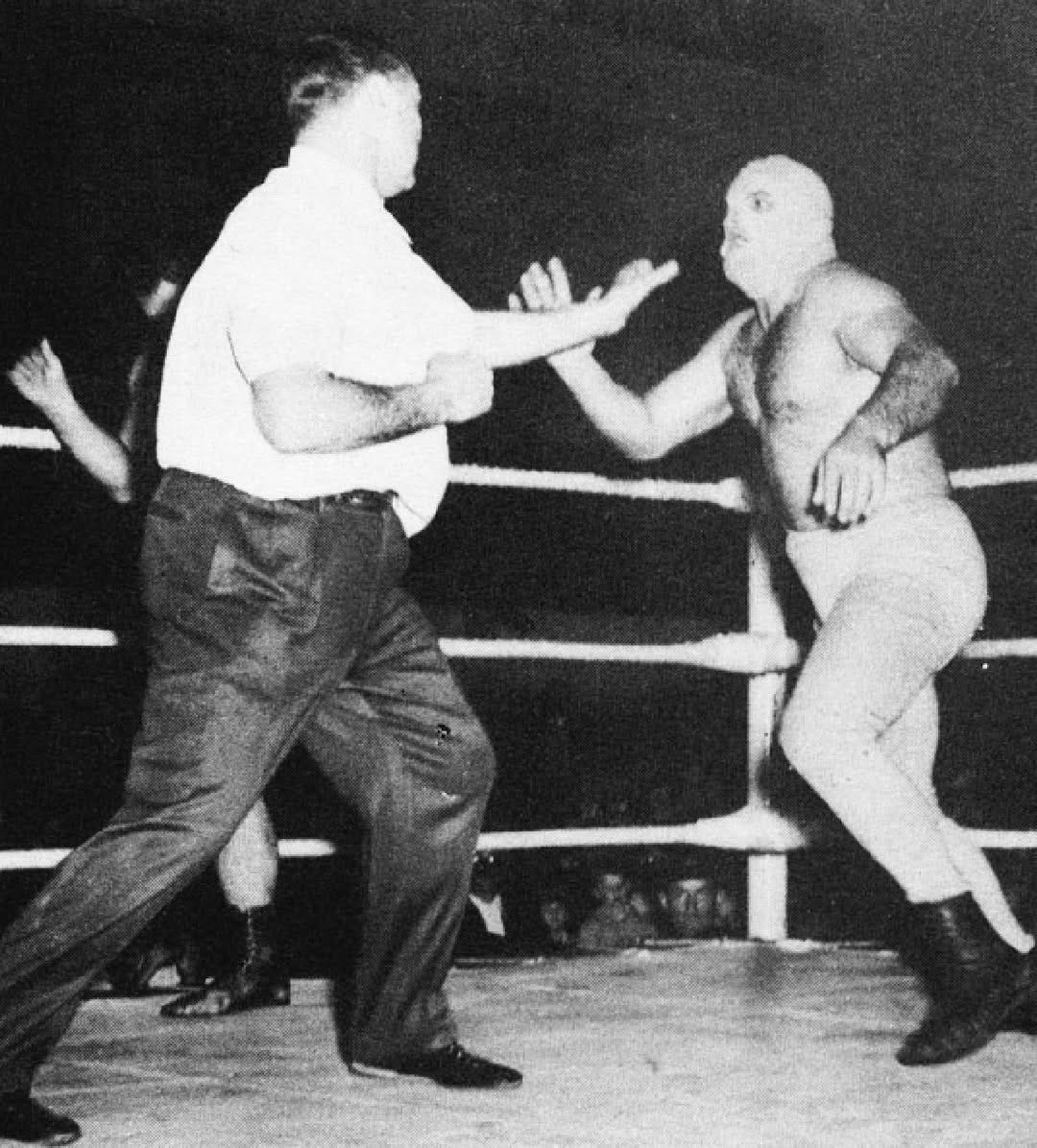
Pictured: The Golden Terror vs former heavyweight boxing champion, Jack Dempsey
His international exploits expanded his fame. In Hawaii under promoter Al Karasick, Bollas won the NWA Hawaii Heavyweight Championship from Lucky Simunovich on April 10, 1955. A infamous angle saw Rikidozan unmask him, leading to Rikidozan’s suspension and Bollas losing the title to Al Lolotai later that year. In 1958-1959, back in the U.S., he formed the Zebra Kids tag team with Jim Austeri for Capitol Wrestling Corporation, feuding with Johnny Valentine. Bollas’s global reach peaked in the 1960s. He toured Australia, New Zealand, Japan, England, France, and Greece. In Athens, he defeated Greek hero Andreas Lambrakis before 43,000 fans in 1960. He won the Texas Brass Knucks Title from The Golden Giant in June 1960 and the WWA International Television Tag Team Championship with Mike Sharpe in 1961. In England, he debuted for Dale Martin’s Promotions in 1963 and relocated his family there in 1964. However, promoting matches in Greece led to financial ruin when a cousin absconded with the earnings.
Video: April 28th, 1961, The Zebra Kid vs Fred Fraley, Hollywood Legion Stadium, Long Beach, California
Bollas retired in 1968 after sustaining a severe eye injury during a match in Germany. He settled in Akron, Ohio, but struggled with health issues, including worn-out knees from years of high-impact wrestling, heart problems, and difficulties maintaining his weight. These complications contributed to his untimely death in 1977.
George Bollas’s career exemplified the grit and showmanship of wrestling’s golden era. As the original Zebra Kid and Golden Terror, he pioneered masked villain roles and demonstrated that size could coexist with agility. His championships across multiple promotions and continents underscore his versatility, while his amateur roots added credibility to his professional exploits.
60 Year Flashback
1-28-1966: The NWA World Tag Team Tournament Began at the City Auditorium in Atlanta, Georgia
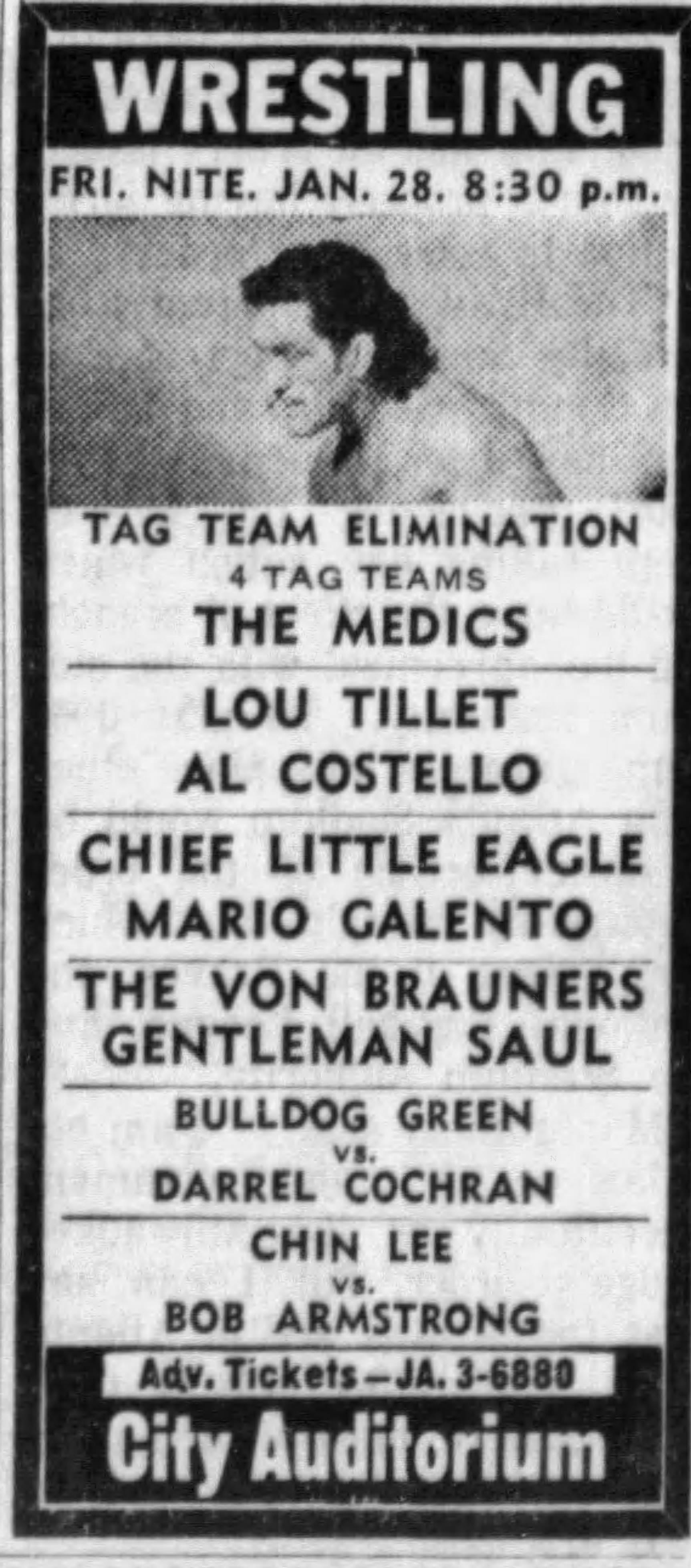
The Georgia Tag Team Tournament that started on January 28, 1966, in Atlanta, GA, was actually a professional wrestling event promoted by Georgia Championship Wrestling (GCW) to determine new holders of the NWA World Tag Team Championship (Georgia version), which had been vacated by Ray Gunkel and Lester Welch, when Welch departed for Florida to become partners in the Florida Territory with Eddie Graham and Welch’s nephew, Buddy Fuller came into Georgia as Gunkel’s partner.
Notably, wrestler Bob Armstrong made his professional debut on the same card as the tournament’s opening night, losing a singles match to Chin Lee.
This Georgia version of the NWA World Tag Team title was active from 1955 to 1969 and was a key championship in the territory. The tournament was a single-elimination bracket featuring four tag teams and spanned multiple GCW shows, starting on January 28 and concluding with the final on February 4, all at the Atlanta City Auditorium. Why they used a photo of The Destroyer in the ad, I am unsure.
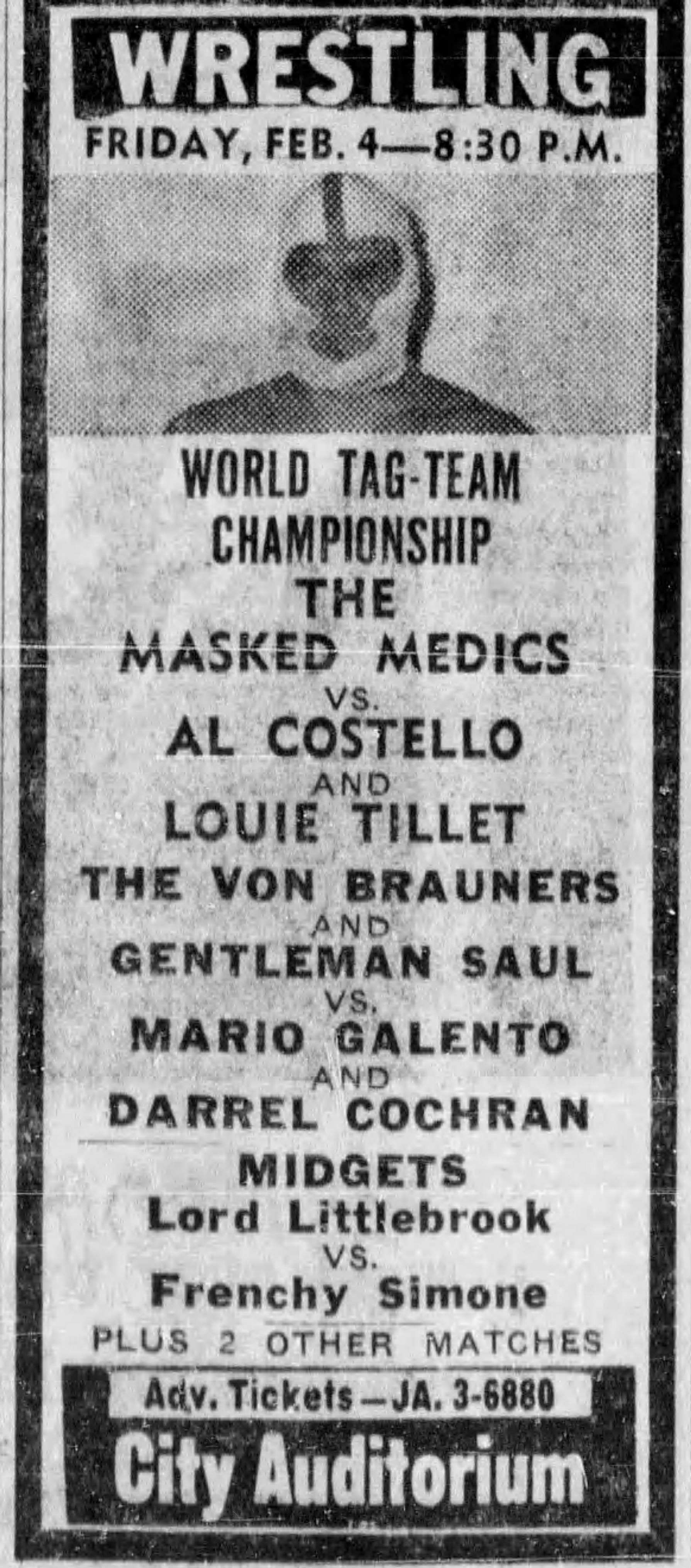
Here were the participants in the tournament:
The Mysterious Medics (Mysterious Medic #1 and Mysterious Medic #2, masked heels known for their aggressive style)
Chief Little Eagle and Mario Galento (a Native American-themed wrestler paired with a veteran brawler)
Al Costello and Louie Tillet (billed as The Globetrotters, an international-themed team with Costello from Australia and Tillet from France)
Kurt Von Brauner and Karl Von Brauner (The Von Brauners, a notorious German heel duo managed by Saul Weingeroff, often using underhanded tactics)
The matches unfolded as follows with the semifinals on January 28 and the final on February 4th:
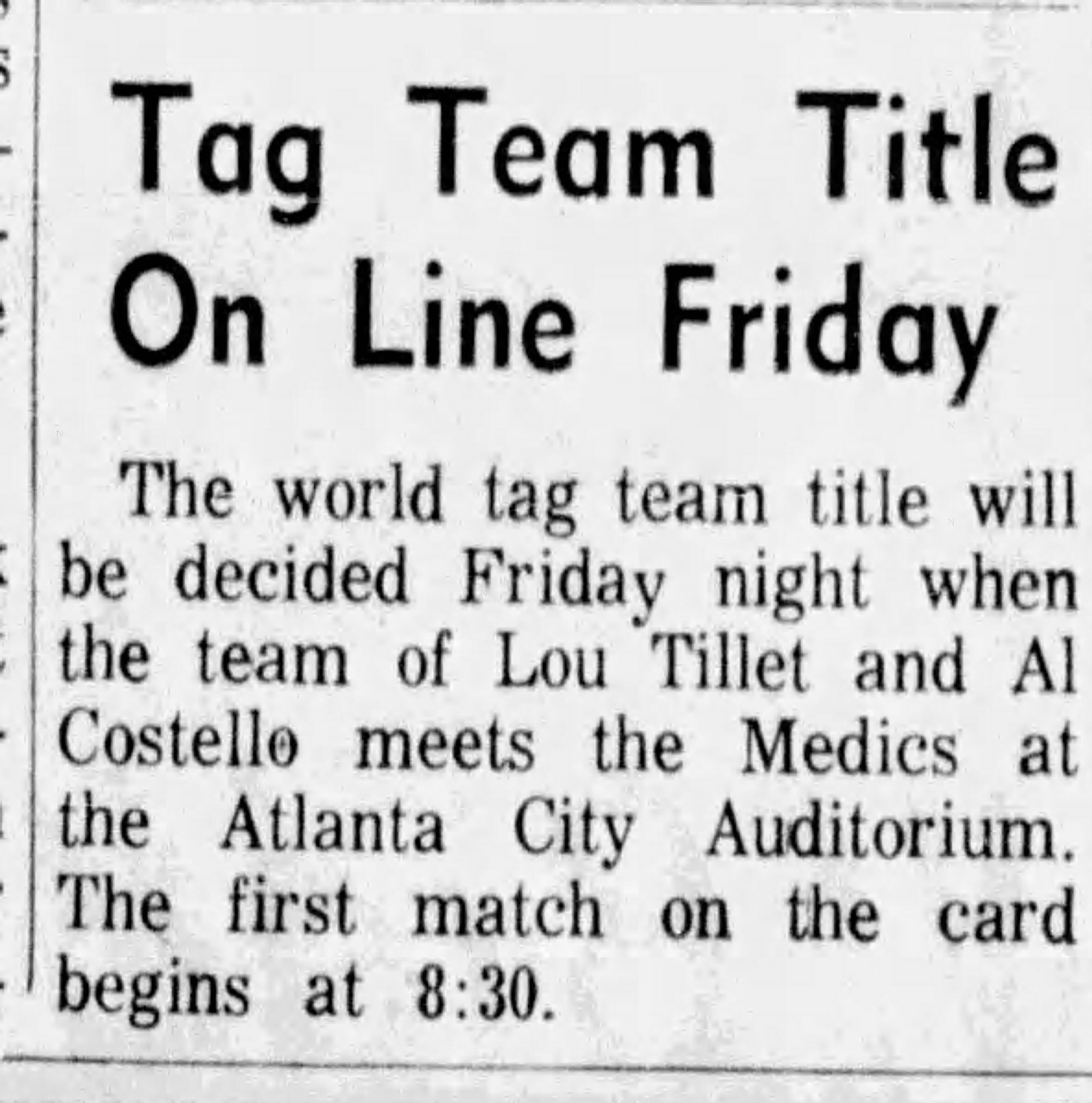
Semifinal 1: The Mysterious Medics defeated Chief Little Eagle and Mario Galento.
Semifinal 2: Al Costello and Louie Tillet defeated Kurt Von Brauner and Karl Von Brauner.
Final: Al Costello and Louie Tillet defeated The Mysterious Medics to win the vacant NWA World Tag Team Championship (Georgia version).
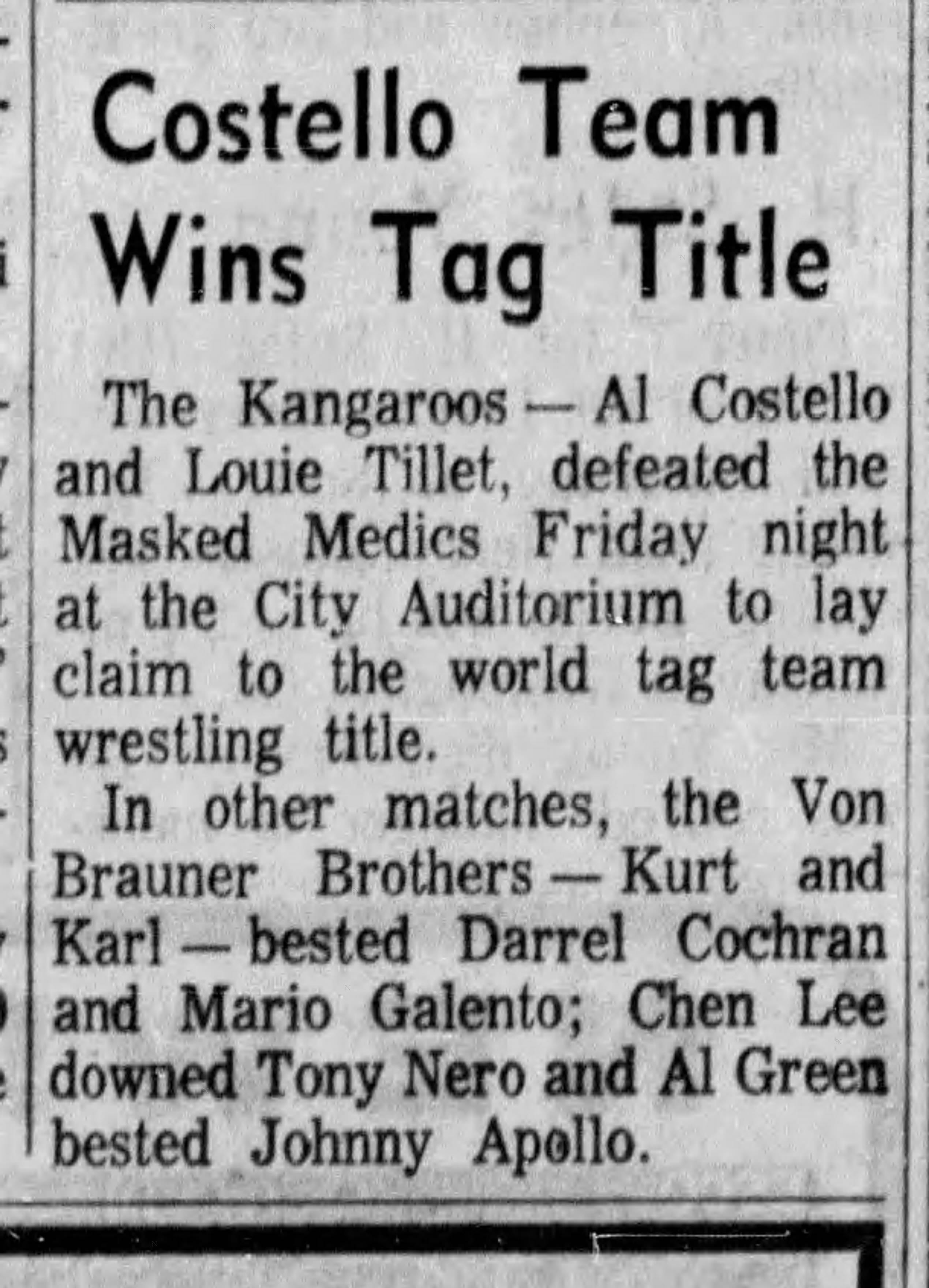
They would change the team’s name from “The Kangaroos” to “The Internationals” when someone noticed Tillet was not Australian, but French.
Costello and Tillet’s reign as champions was extremely brief, lasting only seven days before they lost the titles to the Von Brauners on February 11 in Atlanta. The Mysterious Medics would later regain the belts from the Von Brauners on March 25 in a no-disqualification match, also in Atlanta. This event was part of the vibrant 1960s wrestling scene in Georgia, where GCW drew strong crowds with a mix of local and traveling talent.

Thank You for Reading
I’m Tony Richards, Pro Wrestling Historian, Author and Storyteller. I share pro wrestling historical items in each issue of the Time Tunnel Pro Wrestling History Newsletter. Thanks for reading! If you enjoy my information on select events, matches and insights, please share it with folks you think might like to be a subscriber!
Remember, premium investors get access to exclusive and special content such as some special issues including a multi-part deep dives on wrestling territories, wrestler bios and championship title histories, special audio and video interviews on territory pro wrestling and more available in the Pro Wrestling Time Tunnel for Premium Investors.
Amazing piece. I'd never heard of Bollas before, which is surprising considering his resume. Love this period of wrestling history.