


Written and Produced by Tony Richards
December 11in the Time Tunnel:
Happy Birthday to those who have passed on and to those great wrestlers still with us:
In Memoriam:
Juanita Coffman\Juanita Gallagher 1920
Gene DuBuque\Magnificent Maurice 1927
Doug Furnas 1959
Happy Birthday:
Oscar Rubio\Rey Mysterio (51)
James Ellsworth (41)
RIP Memorial: We stop & remember those who have passed on this day and gave themselves to the business for us, the fans. We salute you and thank you.
Tor Yamato 12-11-1960 age not known

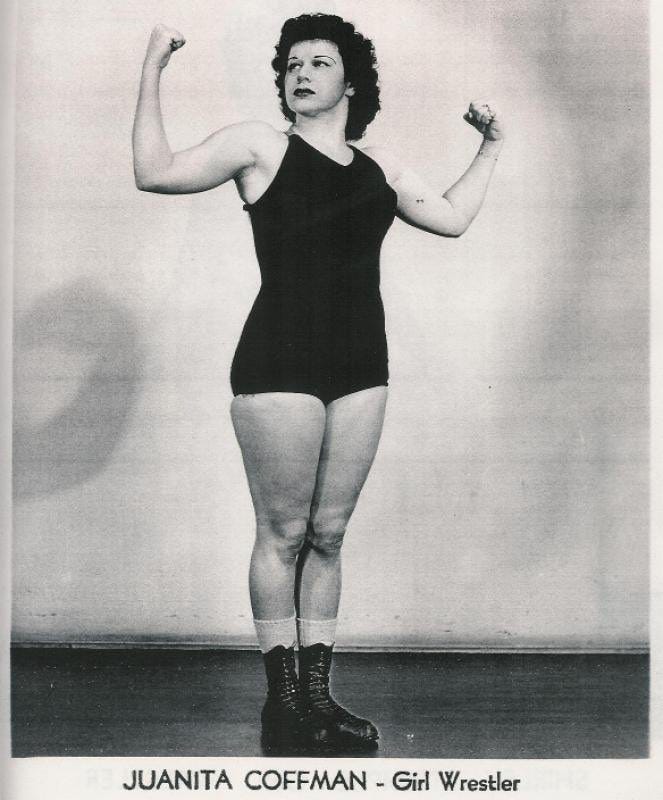
The Life & Career of Juanita Coffman
Juanita Coffman, known in the ring under various aliases including Juanita Gallagher, Juanita Banks, Juanita Little Bear, and Juanita Mendez, born in 1922 in Oklahoma, she emerged as a formidable competitor during a time when women’s wrestling was gaining prominence but still faced significant societal and regulatory challenges.Her career spanned the 1940s and 1950s, marked by high-profile matches, international tours, and a lasting impact on the sport. Inducted posthumously into the Professional Wrestling Hall of Fame in 2021 as a Lady Wrestler, Coffman’s story reflects the grit and determination required to succeed in a male-dominated industry.

She grew up in Cherokee, Oklahoma, a small town that likely inspired some of her ring personas, such as “Cherokee Tomahawk,” despite her being listed as white in the 1940 U.S. census. Little is documented about her childhood, but like many wrestlers of her era, she was drawn to the athletic and performative world of professional wrestling during the post-World War II boom. Women’s wrestling in the United States was largely controlled by promoters like Billy Wolfe, who managed a troupe of female athletes, including the legendary Mildred Burke. Coffman joined this circuit in the mid-1940s, touring extensively and honing her skills in a demanding environment that required both physical prowess and showmanship.
Her early career aliases, such as Juanita Banks, suggest she experimented with different identities to appeal to audiences. By 1946, she was already competing in notable bouts, such as a one-hour time-limit match against Helen Hild at the Armory in Florida, sponsored by the American Legion and the Florida State Guard. The winner of that contest was set to challenge Mildred Burke, the self-proclaimed “World’s Woman Champion,” highlighting Coffman’s rapid rise in the ranks. This period was crucial for women’s wrestling, as it transitioned from carnival sideshows to more structured promotions under the National Wrestling Alliance (NWA).

Coffman’s wrestling career was defined by her technical skill, resilience, and memorable rivalries. She became a favorite adversary of Mildred Burke, the dominant force in women’s wrestling at the time, and the two clashed in several high-stakes matches. One notable encounter occurred around 1947, where Coffman (billed as Dorothy Kauffman in some reports) applied an arm-hold on Burke in a catch-as-catch-can style bout, showcasing her grappling expertise. Their feud was featured in publications like the National Police Gazette, which dubbed such contests “Queens of Wrestling.” Throughout the late 1940s and early 1950s, Coffman competed in various promotions across the United States. In July 1947, she faced Helen Hild again in Greenfield, Massachusetts, as reported in local newspapers. By October 1949, she teamed with Dot Dotson to secure a two-falls-to-one victory over Ellen Olson and Theresa Theis in a tag team match at the North Attleboro Sports Arena in Rhode Island.
Another highlight came on July 19, 1949, when she defeated June Byers (billed as the “Texas Tornado”) under the World Class Wrestling Association banner. Her versatility extended to international borders; in Canada, where women were banned from wrestling until the late 1960s, she served as a “second” or manager for male wrestlers, including the Gallagher Brothers and Chief Lone Eagle. This role allowed her to remain involved in the sport, often drawing heat from crowds as a heel manager in places like Windsor, Ontario.
Coffman also contributed to the next generation by training wrestlers like Morgana Morgan. Her matches in Minnesota, such as a 1950 victory over Romona Rundquist in 18:30, demonstrated her endurance and popularity in regional circuits. While she never held a major world title like Burke, her consistent performances in freelance shows and NWA-affiliated events solidified her reputation as a reliable and tough competitor.
Coffman’s personal life was deeply intertwined with wrestling. She married Doc Gallagher, a professional wrestler, and later Mike Gallagher, Doc’s brother and tag team partner. The Gallagher Brothers were a renowned duo, winning multiple tag team championships and known for their signature moves, like Mike’s thumb to the temple. Juanita often accompanied them ringside, blending her managerial duties with family support. This wrestling dynasty extended to future generations; her grandson publicly celebrated her 2021 Hall of Fame induction, referring to her as “Grandma Juanita Gallagher.”
Her marriages reflected the close-knit nature of the wrestling community, where personal and professional lives often overlapped. After Mike’s death in 1990 from Lou Gehrig’s disease, Coffman’s family continued to honor her contributions. Despite the physical toll of the sport, she maintained ties to wrestling through her relationships and mentorship.
Details on Coffman’s retirement are scarce, but by the 1960s, as women’s wrestling evolved with new stars, she stepped away from active competition. She passed away on August 3, 1987, at the age of 65. Her death marked the end of an era for pioneers who paved the way for modern women’s wrestling. Coffman’s legacy endures through her posthumous recognition. In 2021, she was inducted into the Professional Wrestling Hall of Fame alongside figures like Judy Martin, celebrating her as a foundational Lady Wrestler.
One Thing I Learned About Magnificent Maurice
He was known for his slow, arrogant interviews delivered with an annoying smirk.
Thank You for Reading
I’m Tony Richards, Pro Wrestling Historian, Author and Storyteller. I share pro wrestling historical items in each issue of the Time Tunnel Pro Wrestling History Newsletter. Thanks for reading! If you enjoy my information on select events, matches and insights, please share it with folks you think might like to be a subscriber!
Remember, paid subscribers get access to exclusive and special content such as some special issues including a multi-part deep dives on wrestling territories, wrestler bios and championship title histories, special audio and video interviews on territory pro wrestling and more available in the Pro Wrestling Time Tunnel for Premium Subscribers.
Thank you for this write up Tony. I've found reading about the early history of women's wrestling enriching. The different aliases are hard to keep track of. There was a wrestler around 1940 called Juanita Barnett who once beat Clara Mortensen who I have wondered may have been an early alias of Juanita Coffman (or it could be a shared first name)