

From Conception to Disintegration: The 7 Stages of the Territory Era
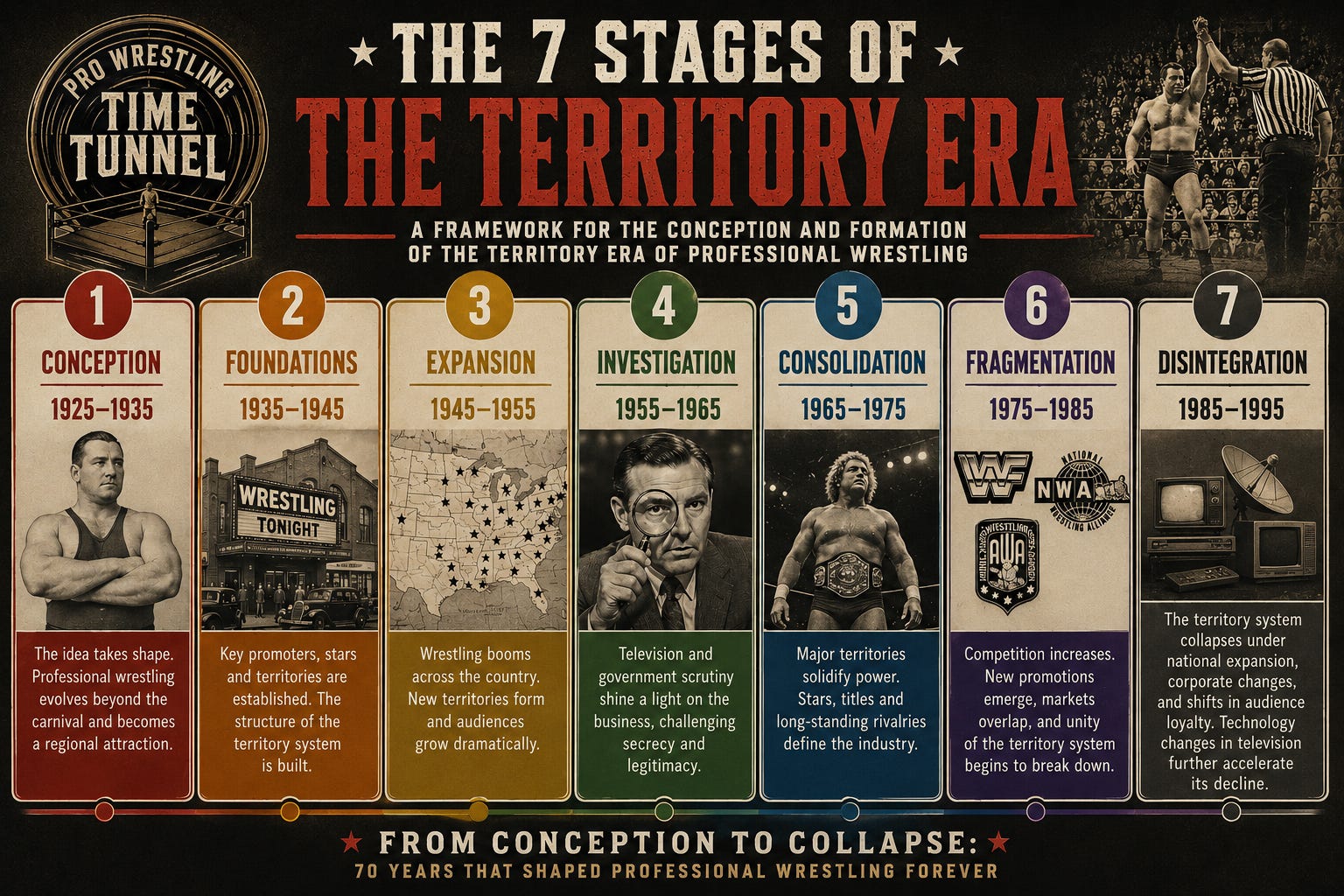
Welcome to the 7 Stages of the Territory Era — a unique historical framework created to help fans and historians understand the full arc of professional wrestling’s territorial system. Spanning from 1925 to 1995, these seven stages chart the birth, growth, challenges, and eventual transformation of the regional wrestling landscape: Conception (1925–1935), Formation (1935–1945), Innovation and Expansion (1945–1955), Investigation (1955–1965), Consolidation (1965–1975), Fragmentation (1975–1985), and Disintegration (1985–1995).
This model, designed by Tony Richards, offers a clear, structured way to examine how independent territories, the National Wrestling Alliance, and the wrestlers who traveled the roads built one of the most influential eras in the sport’s history — and how that system eventually gave way to the national expansion that followed. Step into the Time Tunnel and explore each stage in detail as we break down the key years, pivotal events, and behind-the-scenes stories that defined an unforgettable chapter in pro wrestling.
Every Monday in The Daily Chronicle, I document the history of professional wrestling month by month and year by year, systematically advancing through my 7 Stages of the Territory Era framework. This ongoing series guides readers on a structured journey from the earliest days of Conception in the 1920s all the way through the final Disintegration of the territorial system in the 1990s, highlighting the key events, rivalries, and behind-the-scenes developments that shaped each stage.
Stage One: Conception (1925–1935)
In the decade following World War I, professional wrestling began its transformation from scattered carnival attractions and athletic contests into something resembling an organized industry. Promoters across the United States started establishing regional strongholds, developing business models, and building rosters of talent that could draw consistent crowds in specific cities and towns. This foundational period laid the essential groundwork for the territorial system, as early innovators experimented with scheduling, storytelling, and promotional tactics that would later become standard practice. While the full territorial structure had not yet emerged, the seeds of regional control and the idea of wrestling as a viable, repeatable entertainment product were firmly planted during these years.
Stage Two: Formation (1935–1945)
The years of the Great Depression and World War II marked the true formation of the territorial wrestling system. Despite economic hardship and wartime restrictions, promoters worked to define clear regional boundaries and establish reliable booking networks. This era saw the professionalization of the business, with stronger alliances between offices, the creation of recognized championships, and the development of larger-than-life personalities who could carry territories week after week. As the country emerged from global conflict, wrestling had evolved into a structured network of regional promotions that protected their markets while beginning to coordinate talent and storylines across wider areas.
Stage Three: Innovation and Expansion (1945–1955)
Following World War II, the territorial system entered a period of remarkable innovation and expansion. The arrival of television brought wrestling into living rooms across America, dramatically increasing its visibility and popularity. Promotions experimented with new match styles, dramatic angles, and charismatic stars, while the formation of the National Wrestling Alliance in 1948 created a cooperative framework that allowed territories to share a world champion and exchange talent. This golden age saw record attendance in many regions, the growth of international connections, and the territorial model operating at its most vibrant and organized level.
1946:
Issue 412: Stage 3: Expansion June 1946
Issue 475: 7 Stages of the Territory Era Stage 3: Expansion August 1946
Stage Four: Investigation (1955–1965)
By the mid-1950s, the territorial system had reached its height, yet it also began facing increasing external pressure. Government investigations into monopolistic practices, combined with shifting television landscapes and internal disputes among promoters, created a period of scrutiny and adaptation. While many territories continued to thrive with strong local followings and cooperative booking through the NWA, the era was defined by the need to defend the established order against legal challenges and changing media habits. This stage marked the beginning of the tensions that would later test the long-term stability of the territorial model.
1956:
Issue 384: 7 Stages of the Territory Era: Stage 5: Investigation: May 1956
Issue 419: Stage 4: Investigation: June 1956
Issue 447: Stage 4 Investigation, July 1956
Issue 482: 7 Stages of the Territory Era, Stage 4: Investigation August 1956
Issue 483: 7 Stages of the Territory Era Stage 4: Investigation The August 1956 NWA Convention
Stage Five: Consolidation (1965–1975)
After the challenges of the previous decade, the territorial system experienced a strong period of re-consolidation and renewed stability. Major promotions and the National Wrestling Alliance worked to reinforce territorial boundaries and maintain the cooperative spirit that had defined the era. With consistent booking, reliable talent exchanges, and passionate regional fanbases, many territories enjoyed a second golden period. This stage represented the territorial model operating at peak efficiency, as promoters successfully protected their markets and delivered high-quality wrestling that kept fans returning to arenas across North America.
1966:
Issue 391: 7 Stages of the Territory Era: Stage 5: Re-Consolidation : May 1966
Issue 426: Stage 5: Consolidation June 1966
Issue 454: 7 Stages of the Territory Era, Stage 5 Consolidation: July 1966
Issue 489: 7 Stages of the Territory Era Stage 5: Consolidation August 1966
Stage Six: Fragmentation (1975–1985)
The mid-1970s ushered in a time of fragmentation as cracks began to appear in the once-unified territorial landscape. Economic pressures, the rise of cable television, changing fan preferences, and growing disputes among promoters started to erode the cooperative foundation of the system. While some territories remained strong and innovative, others struggled to maintain their footing. The once-clear lines between regions became less defined, and individual promotions increasingly pursued their own paths rather than working within the traditional NWA framework.
1976:
Issue 398: 7 Stages of the Territory Era: Stage 6 Fragmentation May 1976
Issue 461: 7 Stages of the Territory Era, Stage 6: Fragmentation July 1976
Stage Seven: Disintegration (1985–1995)
The final stage of the territorial era was defined by rapid and irreversible disintegration. The national expansion of the World Wrestling Federation, followed by the rise of WCW, fundamentally altered the business model that had existed for decades. With national television deals, aggressive talent acquisition, and a new approach to promotion, the old regional territories found it increasingly difficult to compete. By the mid-1990s, the classic territorial system had largely collapsed, giving way to the centralized, national, and eventually global wrestling landscape that dominates the industry today.
1986:
Issue 377: 7 Stages of the Territory Era: Stage 7: Disintegration April 1986
Issue 405: 7 Stages of the Territory Era: Stage 7 Disintegration May 1986
Issue 440: Stage 7: Disintegration June 1986
Issue 468: 7 Stages of the Territory Era: Stage 7 Disintegration July 1986
7 Stages of the Territory Era Archive
1926:
1936:
1946:
Issue 412: Stage 3: Expansion June 1946
Issue 475: 7 Stages of the Territory Era Stage 3: Expansion August 1946
1956:
Issue 384: 7 Stages of the Territory Era: Stage 5: Investigation: May 1956
Issue 419: Stage 4: Investigation: June 1956
Issue 447: Stage 4 Investigation, July 1956
Issue 482: 7 Stages of the Territory Era, Stage 4: Investigation August 1956
Issue 483: 7 Stages of the Territory Era Stage 4: Investigation The August 1956 NWA Convention
1966:
Issue 391: 7 Stages of the Territory Era: Stage 5: Re-Consolidation : May 1966
Issue 426: Stage 5: Consolidation June 1966
Issue 454: 7 Stages of the Territory Era, Stage 5 Consolidation: July 1966
Issue 489: 7 Stages of the Territory Era Stage 5: Consolidation August 1966
1976:
Issue 398: 7 Stages of the Territory Era: Stage 6 Fragmentation May 1976
Issue 461: 7 Stages of the Territory Era, Stage 6: Fragmentation July 1976
1986:
Issue 377: 7 Stages of the Territory Era: Stage 7: Disintegration April 1986
Issue 405: 7 Stages of the Territory Era: Stage 7 Disintegration May 1986
Issue 440: Stage 7: Disintegration June 1986
Issue 468: 7 Stages of the Territory Era: Stage 7 Disintegration July 1986
.