



What I’m Reading Now is a Premium Post provided exclusively to our Premium Subscribers.
Here's a daily and weekly re-cap of my reading up to the date of this post and I'll update this as I proceed through each piece of material I'm reading. I haven’t had much a chance to read very much (or write either) in the last two last weeks. The construction crews are now finished inside the house, so now I am starting to crank up the machine again. I'm usually writing the Daily Chronicle, recording the nest few weeks of the podcast and now, I have some time (and quiet) to work on premium content.
Pro Wrestling History Books I'm Reading Now
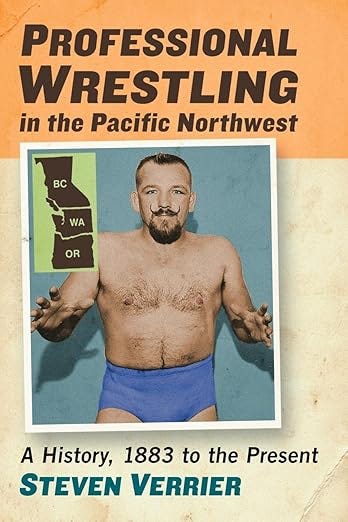
The History of Wrestling in the Pacific Northwest by Steve Verrier
Chapter 5: Golden Age and Connections to the Northwest
Television was fueling the wrestling business, as it always follows the emergence of technology changes and public tastes.
The DuMont Network was where wrestling resided from the late 1940s through 1955. DuMont had over 30 affiliated television stations carrying it's programming. What is interesting is that the East-to-Midwest portion of the United States received mostly live programming, while the South and West stations got kinescope recording, a method that was used to record content shown on a video monitor, sort of like taking a video camera to a movie theater and recording the movie for watching later.
By 1953-54, DuMont had over 200 affiliated stations serving the 48 states at the time.
The wrestlers that appeared on "Wrestling at The Marigold" in Chicago became "stars" on television that then toured the country and fans bought tickets to see them at local arenas.
Buddy Rogers, who had been a star in Texas and then in St. Louis broke through on the network as a huge star. Rogers impact was so profound that numerous wrestlers based their character on him. One of the guys who would be very impactful in the Pacific Northwest would be "Playboy" Buddy Rose who would be star for Don Owen, following in the trends sets years before by Rogers.
Some of the other early television stars of wrestling that were prominent in the Pacific Northwest included Guy LaRose who transformed himself into the snarling, German character, Hans Schmidt, who came years after Kurt Von Poppenheim. Other stars from television who came into the territory included Ed Farhat, better known as The Sheik, Killer Kowalski, Gorgeous George, Yukon Eric, The Crusher, Dick the Bruiser and the great Lou Thesz.
The first African American wrestler to have significant success was Luther Lindsey. In the 1950s, Lindsey was the first African American to wrestle in two southern states, Texas and Tennessee.
