


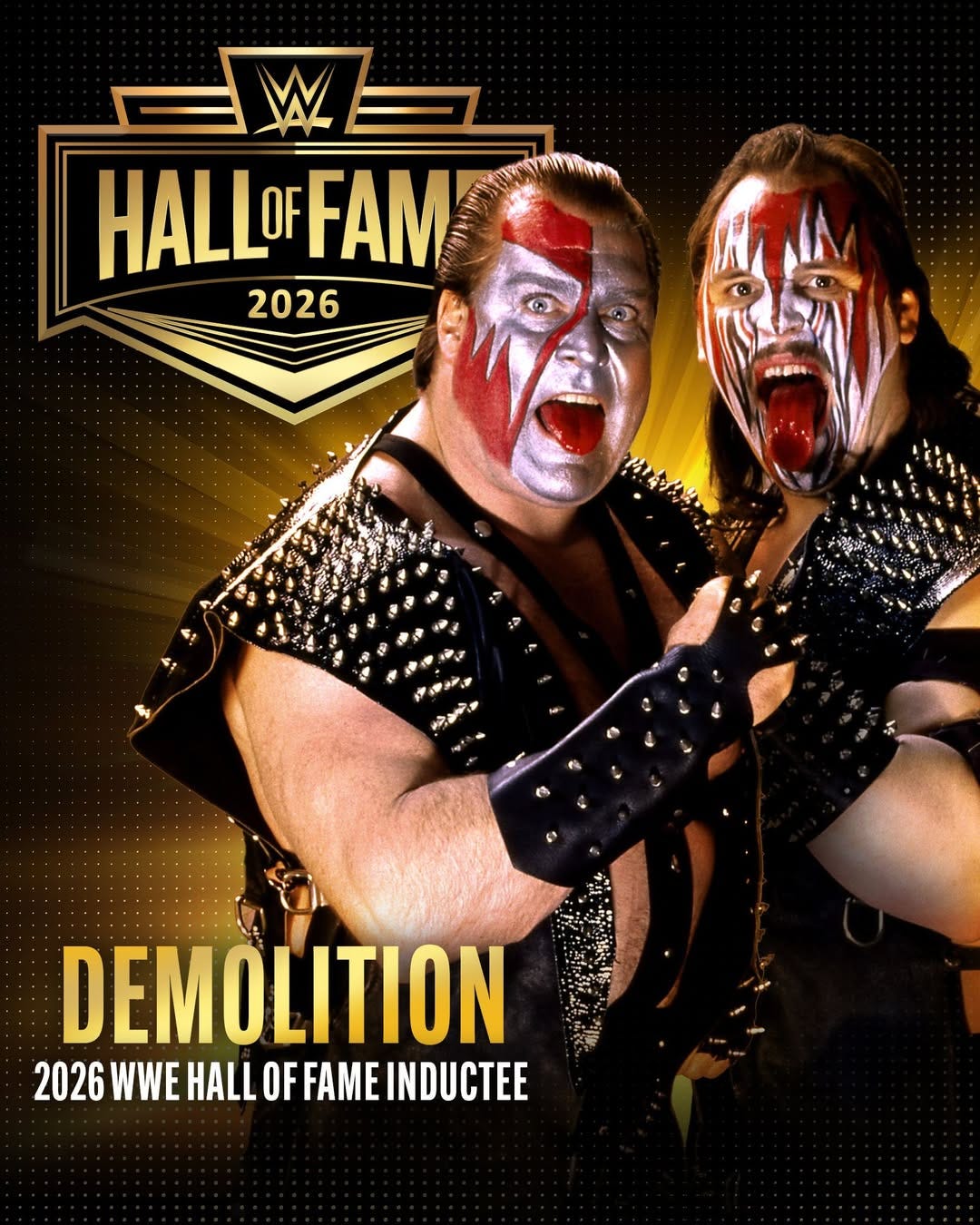
Demolition was one of the most dominant and visually striking tag teams in World Wrestling Federation (WWF, now WWE) history. Debuting in early 1987 as a heel duo with a post-apocalyptic, Mad Max-inspired look—studded black leather, spiked shoulder pads, hockey masks, and distinctive black-and-white (or red/silver) face paint—they quickly became the gold standard for destructive tag-team wrestling in the late 1980s and early 1990s. Consisting primarily of Ax and Smash , and later expanded to a trio with Crush (Brian Adams), the team captured the WWF World Tag Team Championship three times.
Their combined reign total of 698 days stood as a record for that title, while their first reign of 478 days remains the longest single reign in the history of the classic WWF World Tag Team Championship (1971–2010). Billed from “Parts Unknown,” Demolition’s aggressive brawling style, intimidating presence, and signature “Demolition Decapitation” finisher (a backbreaker by one member followed by a diving elbow drop) made them must-see television and pay-per-view attractions during the Golden Era.
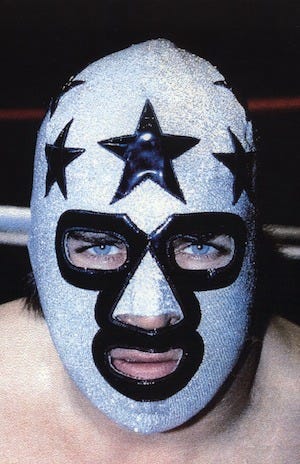
Pictured: Bill Eadie as the Masked Superstar
Bill Eadie was best known as the masked villain The Masked Superstar in the 1970s. A masked wrestler who combined legitimate toughness, veteran savvy, and ring psychology. A former high-school teacher and athletic trainer in East Liverpool and Cambridge, Ohio, he brought real-world discipline to every character. Standing 6 ft 3 in and billed around 290 lb, he trained under Geeto Mongol and debuted on December 15, 1972.
Eadie first rose to prominence in Georgia Championship Wrestling, where he donned the mask as The Masked Superstar. He captured the NWA Georgia Heavyweight Championship four times—defeating stars such as Mr. Wrestling II (January 1979), Wahoo McDaniel (July 1979), and Tommy Rich (December 1979)—and unified it with the NWA National Heavyweight Championship in 1981. He also held the NWA Georgia Tag Team titles with Austin Idol and the NWA Mid-Atlantic Television Championship. His masked persona feuded with top names across the NWA territories, including lengthy programs in Alabama, Florida, and the Mid-Atlantic. In the early 1980s he worked in the World Wide Wrestling Federation (later WWF) as the Masked Superstar, notably becoming one of the first men to body-slam André the Giant and clashing with emerging superstar Hulk Hogan.
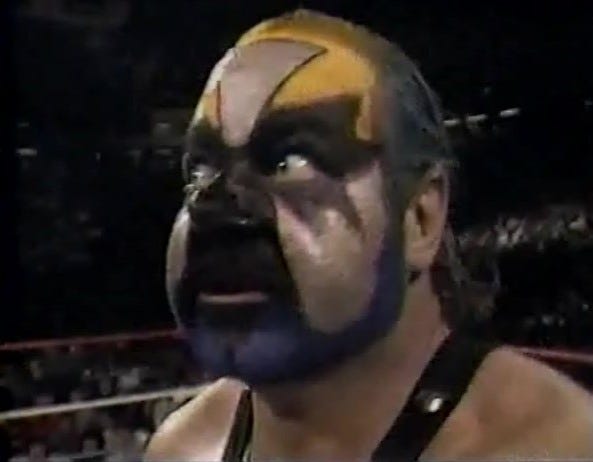
Pictured: Randy Colley performing in the original concept of Demolition
The Demolition gimmick was originally conceived by Eadie and Randy Colley (a former Moondog Rex). Eadie paired up with Colley to create the destructive duo and they debuted on January 4, 1987, at the Springfield Civic Center in Massachusetts, managed initially by Luscious Johnny V (Johnny Valiant). After only a handful of matches, Colley was replaced because fans still recognized him from his previous Moondog gimmick.
Barry Darsow stepped in as the new Smash starting in February 1987. Barry Darsow, who stands 6 ft 2 in and weighing around 280 lb, he found success as the Soviet sympathizer Krusher Khruschev, who brought intensity and charisma to the “third man” Russian role in the team. Darsow debuted in 1983 in Hawaii as Tsar Mongo before brief stints in New Zealand and Georgia Championship Wrestling.
He gained national attention in Mid-South Wrestling in 1984 as Crusher Darsow, a turncoat American aligned with Nikolai Volkoff, then rebranded as the Russian powerhouse Krusher Khruschev. He won the inaugural Mid-South Television Championship in a tournament final against Terry Taylor (May 1984) and later teamed with Ivan and Nikita Koloff in Jim Crockett Promotions, capturing the NWA World Tag Team Championship (recognized in the WCW lineage) and the NWA United States Tag Team Championship. His Soviet heel run positioned him as a top contender in the NWA during the mid-1980s. In February 1987, Darsow moved to the WWF to replace Colley in the Dmeolition team after a payoff dispute for Starracde 1986.
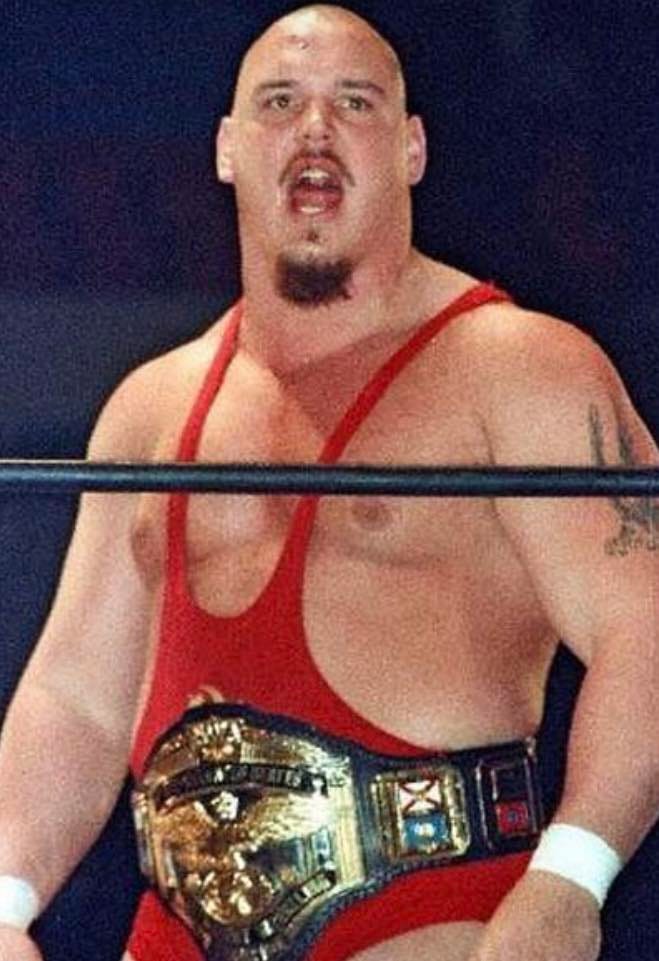
Pictured: Barry Darsow as Khusher Khruschev, NWA Mid-Atlantic Champion
Johnny Valiant soon sold their contracts to Mr. Fuji, who became their longtime manager and even adopted Demolition-style face paint.
As far as their individual contributions to the team, Eadie was known for creating mismatches through power moves like the cobra clutch (a submission he challenged opponents to break for $10,000), corkscrew neckbreaker, and his signature Double Ax Hammer (a double-handed overhead chop/axe handle). Eadie excelled in long, grueling matches—famously participating in the first one-hour and 90-minute cage matches in the NWA—and was one of the earliest wrestlers to body-slam André the Giant. In Demolition, Ax served as the psychological foundation: he controlled the pace, absorbed punishment to sell for opponents, and set up big spots with precise strikes, stomps, and clotheslines. His style was deliberate and punishing—more ground-and-pound than flash—rooted in old-school territorial psychology. Fans and historians often credit his experience with keeping Demolition’s matches structured and believable even during their most dominant squash periods. Health issues in 1990 (including severe allergic reactions) eventually limited his in-ring role, but his ring generalship remained the glue that held the team’s identity together.
Darsow’s background gave him a stiff, aggressive striking style influenced by power-based international and territorial wrestling. In Demolition, Smash was frequently the more dynamic performer: he delivered high-impact moves like the Russian Sickle (a clothesline from hell), pendulum backbreaker, elbow drops, and the diving elbow portion of the Decapitation finisher. Cagematch.net described him as having the “stronger in-ring ability” within the team, noting his all-rounder versatility and ability to generate crowd heat with fiery comebacks and hot tags. Darsow’s style felt more explosive and athletic—shoulder blocks, slams, and relentless offense that showcased his strength (such as body-slamming members of the Twin Towers on SummerSlam 1989). He adapted quickly to the Demolition look and rhythm, evolving his face paint designs match-by-match early on and bringing a chaotic intensity that contrasted Eadie’s more measured approach.
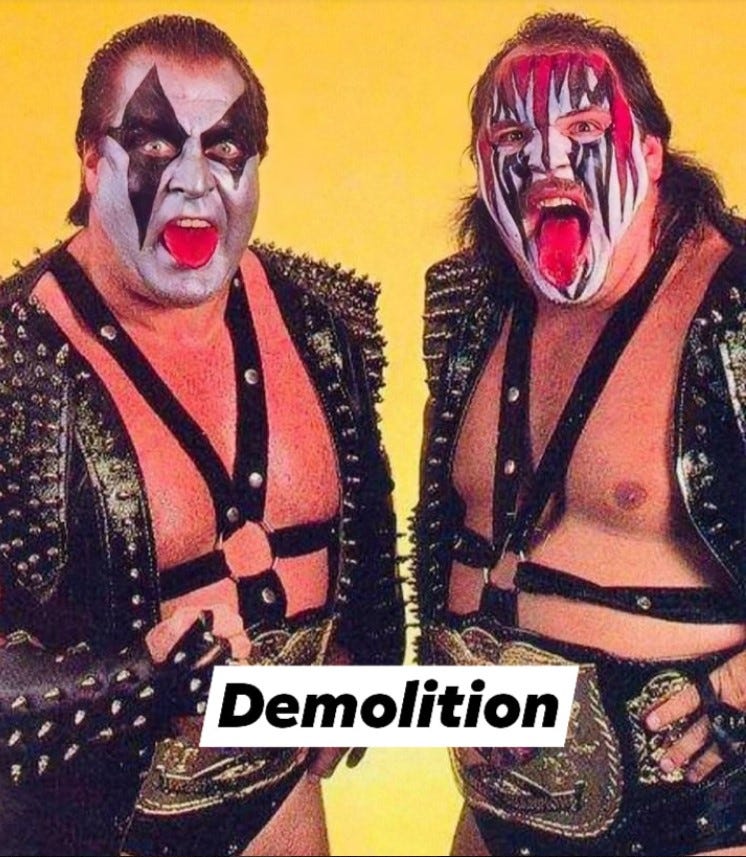
The magic of Demolition came from how their styles meshed. Ax provided the veteran psychology and foundational control—starting matches, wearing down opponents, and calling spots with the wisdom of hundreds of territorial wars. Smash injected the fire, speed, and crowd-pleasing explosiveness that turned those setups into highlight-reel destruction. Their unique brawling style allowed them to dominate opponents of any size or speed (from the Hart Foundation and British Bulldogs to the Powers of Pain and Brain Busters) without ever feeling repetitive. As one retrospective noted, “Ax and Smash were not two singles wrestlers placed together: they were a cohesive pair with a shared style, rhythm and in-ring psychology.” This synergy turned what could have been a generic monster team into something special—intense, raw power executed with flawless timing and mutual trust.
The Demolition team were immediately compared to the original, big-man, face-painted Road Warriors (Road Warrior Hawk and Road Warrior Animal, later known as the Legion of Doom) Both teams shared visually striking, post-apocalyptic aesthetics such as face paint, spiked shoulder pads, leather gear, and an aura of unstoppable destruction. Both teams terrorized opponents with power moves, short squashes, and intimidating entrances, helping elevate tag-team wrestling during the WWF’s explosive Golden Era. Yet while Demolition became WWF’s record-setting powerhouse, the Road Warriors were the originals whose influence spanned multiple promotions and decades.
The Road Warriors’ gimmick and team were the brainchild of Georgia Championship Wrestling (GCW) booker Ole Anderson. Inspired by the Mad Max films (specifically The Road Warrior), Anderson paired Joe Laurinaitis (Animal) — who had briefly wrestled solo as “The Road Warrior” with a biker look — with Mike Hegstrand (Hawk) in 1983. Their very first match as a team took place on April 18, 1983, in Wheeling, West Virginia, against the Sawyer Brothers (Buzz and Brett Sawyer). They quickly became a sensation in GCW, winning the NWA National Tag Team Championship upon arrival (in a storyline tournament that never actually happened) and forming the Legion of Doom stable with manager “Precious” Paul Ellering. Anderson also pushed the now-iconic mohawks and face paint to complete the intimidating look. From there, the Warriors exploded across territories.
The Road Warriors dominated wherever they went: multiple NWA World Tag Team Title reigns in Jim Crockett Promotions, a record year-long AWA World Tag Team Championship run, Japanese success, and later WWF/WWE Tag Team Championships in 1991 and 1997. They became the only team to hold the top tag titles in AWA, NWA/WCW, and WWF—earning the “Triple Crown” distinction. Their explosive, agile power style, signature Doomsday Device (a clothesline-assisted neckbreaker), and “What a Rush!” catchphrase made them global icons.
Demolition arrived in the WWF in January 1987 as a heel wrecking crew. Ax (Bill Eadie, a veteran known as the Masked Superstar) and Smash (Barry Darsow, formerly Krusher Khruschev) debuted with a similar Mad Max-inspired look—black leather, studs, hockey masks, and evolving face paint—but with smaller spikes and a more methodical, ground-and-pound style.

Pictured: Demolition’s Manager, Mr. Fuji
Demolition’s rise was meteoric. They steamrolled through the tag division, defeating teams like the Killer Bees, Rougeau Brothers, British Bulldogs, and Young Stallions. Their undefeated streak ended against the Can-Am Connection in June 1987, but momentum only grew. At WrestleMania IV on March 27, 1988, in Atlantic City, they defeated Strike Force (Rick Martel and Tito Santana) to win the WWF World Tag Team Championship for the first time—Smash pinned Martel after Ax used Fuji’s cane behind the referee’s back. The 478-day reign that followed was historic; they defended successfully against the Hart Foundation, British Bulldogs, and others, breaking previous longevity records along the way.
The Road Warriors were explosive athletes who threw opponents around with raw power and charisma; their matches were often short, brutal finishes that felt like real fights. Demolition, by contrast, emphasized slower, heavier punishment—stomps, clotheslines, and the Demolition Decapitation (backbreaker into a diving elbow). Smash has repeatedly stated that Vince McMahon never pitched them as a direct Road Warriors copy; the gimmick evolved from Eadie’s existing persona, and their wrestling approach was more technical and varied than the LOD’s formulaic dominance. Visually, the Powers of Pain (Warlord and Barbarian) were arguably closer in look to the Warriors than Demolition ever was.
Ironically, it was the pivotal feud with the Powers of Pain that led to their first major storyline twist. At Survivor Series 1988, Fuji betrayed Demolition by aligning with the Powers, turning both teams in the process: Demolition became popular babyfaces while the Powers turned heel. The double turn solidified Demolition’s status as fan favorites. They continued defending the titles until July 29, 1989 (taped July 18), when they lost them to The Brain Busters (Arn Anderson and Tully Blanchard) in a brutal two-out-of-three-falls match on Saturday Night’s Main Event XXII, with interference from André the Giant.
Demolition turned face in 1988 after a double-turn with the Powers of Pain and later added Crush (Brian Adams) as a third member under the Freebird Rule, which then position Demolition to quickly rebound, regaining the titles from the Brain Busters on October 2, 1989 (aired November 4). Their second reign lasted only about two months before they lost to The Colossal Connection (André the Giant and Haku) on December 13, 1989. They reclaimed the gold for a third time at WrestleMania VI on April 1, 1990, in Toronto’s SkyDome, defeating the Colossal Connection when Ax pinned Haku after André’s arms became entangled in the ropes.
By mid-1990, health issues forced changes. Eadie suffered severe reactions (including a shellfish allergy from overseas travel and back problems), leading Vince McMahon to introduce Brian Adams (6 ft 6 in) as Crush in June 1990. The team became a three-man unit under the Freebird Rule, with any two members defending the titles while Ax shifted to a managerial role. They quietly turned heel again. Smash and Crush retained against The Rockers on Saturday Night’s Main Event in July 1990, but the trio lost the belts to The Hart Foundation (Bret Hart and Jim Neidhart) at SummerSlam 1990 in a two-out-of-three-falls match after interference from The Legion of Doom (Road Warriors).
That direct head-to-head in WWF (1990–1991) was the ultimate “dream match” that fans craved—but it underwhelmed. After the Road Warriors debuted as the Legion of Doom, Demolition (now a trio) immediately challenged them as “imposters.” The Warriors dominated nearly every encounter, winning dozens of house shows and key TV bouts (including a Survivor Series 1990 six-man tag with Ultimate Warrior). A full-blown PPV feud never materialized at the peak of either team’s popularity; by 1990, Demolition was past its prime due to Ax’s health issues, and the Warriors had already achieved legendary status elsewhere. The lack of a definitive blowoff left many feeling the rivalry underdelivered.
Much like The Fabulous Ones, another early 1980s team who inspired multiple copies in style, The Road Warriors were trailblazers who influenced an entire generation of teams (including Demolition itself). They main-evented in multiple promotions, won the Jim Crockett Cup, and became pop-culture icons with their catchphrase and theme music. Demolition, while more limited to WWF, were the era’s ultimate house-show and television draw, selling out arenas with their record title reigns and memorable angles against the Hart Foundation, Brain Busters, and Colossal Connection. The concept of that major feud with LOD never fully materialized on television, which many viewed as a missed opportunity.
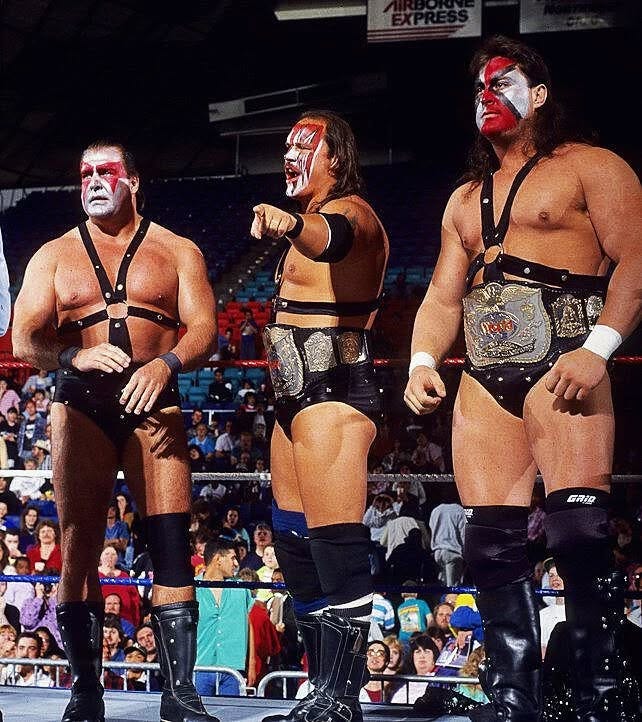
Pictured: The Three-Man Demolition Team of As, Smash and Crush
Actually, the addition of Crush could be considered as marking the beginning of the end of the Demolition team. Their popularity waned, and they lost further momentum. After a final WWF pay-per-view appearance at WrestleMania VII (losing to Genichiro Tenryu and Koji Kitao in a tag match), Demolition disbanded in 1991. Crush briefly continued the gimmick in the Pacific Northwest before returning to WWF as the face “Kona Crush.” Darsow became the villainous Repo Man. Eadie wrestled sporadically on the independents.
In the decades that followed, Ax and Smash reunited on the independent circuit starting in 2007, capturing tag titles in promotions like Universal Xtreme Wrestling and appearing at conventions. They reconciled with WWE over time and were announced for induction into the WWE Hall of Fame Class of 2026 alongside other Golden Era legends.
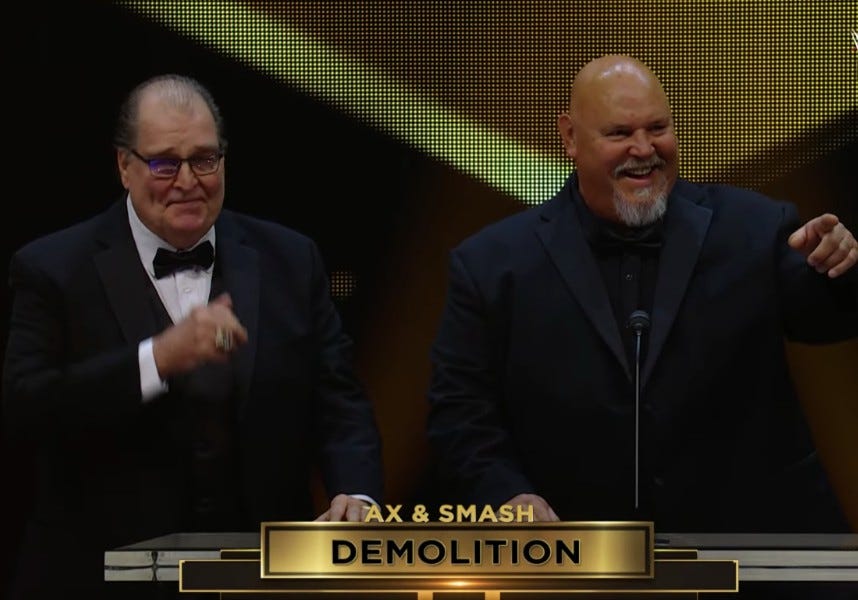
On April 17, 2026—the night before WrestleMania 42—Ax and Smash were formally enshrined as members of the WWE Hall of Fame Class of 2026 during the 27th annual ceremony at Dolby Live at Park MGM in Las Vegas, Nevada, as part of the WrestleMania 42 weekend festivities. WrestleMania 42 itself took place the following two nights (April 18 and 19, 2026) at Allegiant Stadium in Las Vegas. The tag team was inducted by former rivals and occasional allies Arn Anderson, Haku, and The Warlord. In their acceptance speech, the duo reflected on the icons who helped shape them into one of WWE’s greatest tag teams ever and expressed gratitude that the moment had finally arrived under the current leadership.
Demolition’s legacy endures as the ultimate wrecking crew of the 1980s tag scene. Their record-setting reigns, iconic entrance theme by Rick Derringer, and larger-than-life destruction helped elevate the WWF’s tag division during its peak popularity. Though often compared to (and designed partly to capitalize on) the Road Warriors, Demolition carved out their own identity through relentless dominance and memorable storytelling. From their heel debut to their face turn and trio experiment, they delivered pain, destruction, and championship gold night after night—cementing themselves as one of professional wrestling’s most formidable and influential tag teams. Their 2026 Hall of Fame induction during WrestleMania 42 weekend in Las Vegas provided the ultimate validation of that enduring impact.
Thank You for Reading
I’m Tony Richards, Pro Wrestling Historian, Author and Storyteller. I share pro wrestling historical items in each issue of the Time Tunnel Pro Wrestling History Newsletter. Thanks for reading! If you enjoy my information on select events, matches and insights, please share it with folks you think might like to be a subscriber!
Remember, premium investors get access to exclusive and special content such as some special issues including a multi-part deep dives on wrestling territories, wrestler bios and championship title histories, special audio and video interviews on territory pro wrestling and more available in the Pro Wrestling Time Tunnel for Premium Investors.
I have it in my reading pile, but I have not gotten to it yet. Now I’m more excited to read it based on your thoughts
Did you read Barry Darsow’s book? Extremely interesting and entertaining