


This is part 2 of a 7-part series in Evolution of Wrestling to wrap up the year of 2026 and provide analysis of the years in the Pro Wrestling Time Tunnel of 1926, 1936, 1946, 1956, 1966, 1976 and 1986.
My framework for understanding and analyzing the history and growth of Professional Wrestling are the 7 Stages of The Territory Era:
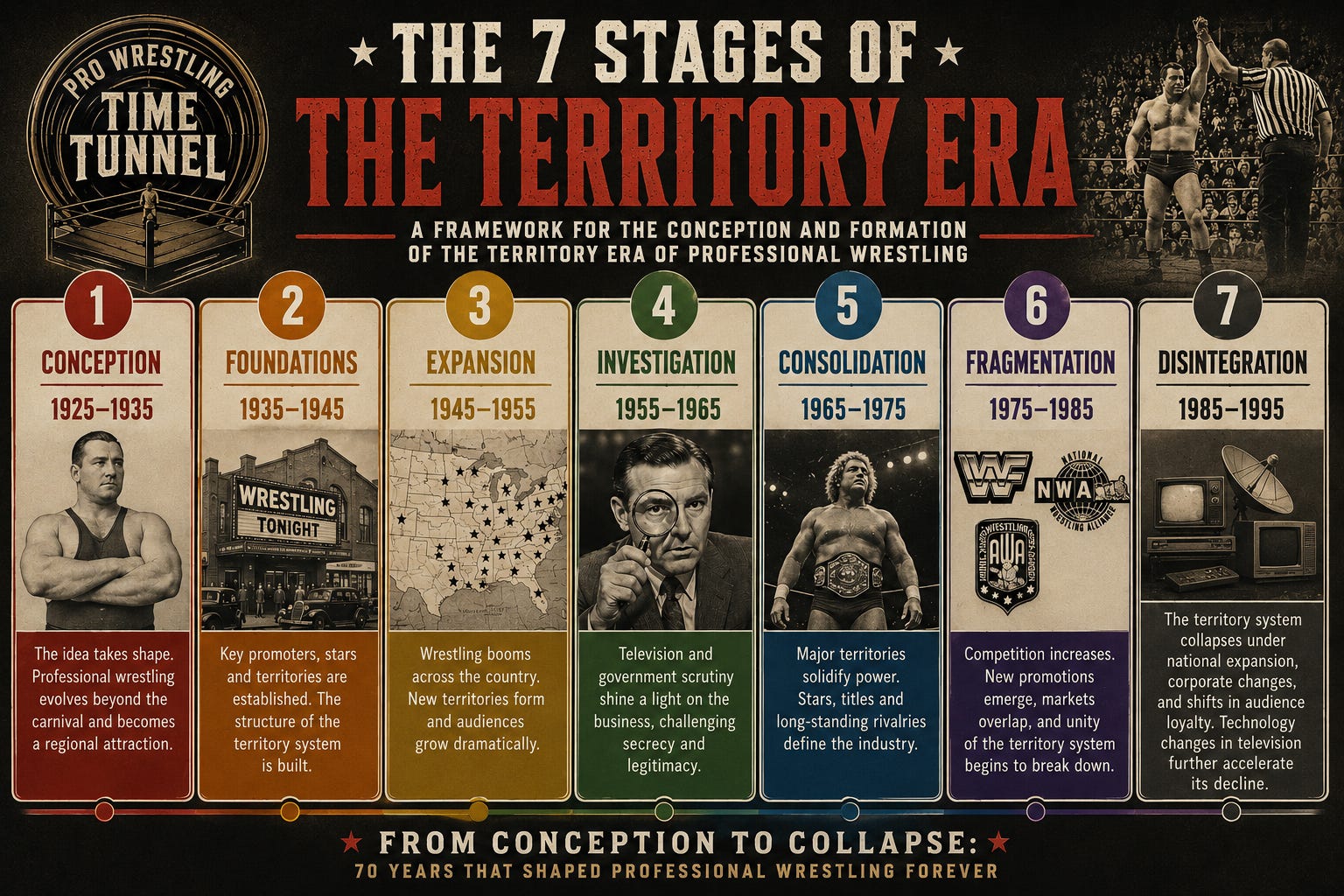
My framework for understanding and analyzing the history and growth of Professional Wrestling are the 7 Stages of The Territory Era:
Stage One: Conception (1925 to 1935)
Stage Two: Formation (1935 to 1945)
Stage Three: Innovation and Expansion (1945 to 1955)
Stage Four: Investigation (1955 to 1965)
Stage Five: Re-Consolidation (1965-1975)
Stage Six: Fragmentation (1975-1985)
Stage Seven: Disintegration (1985-1995)
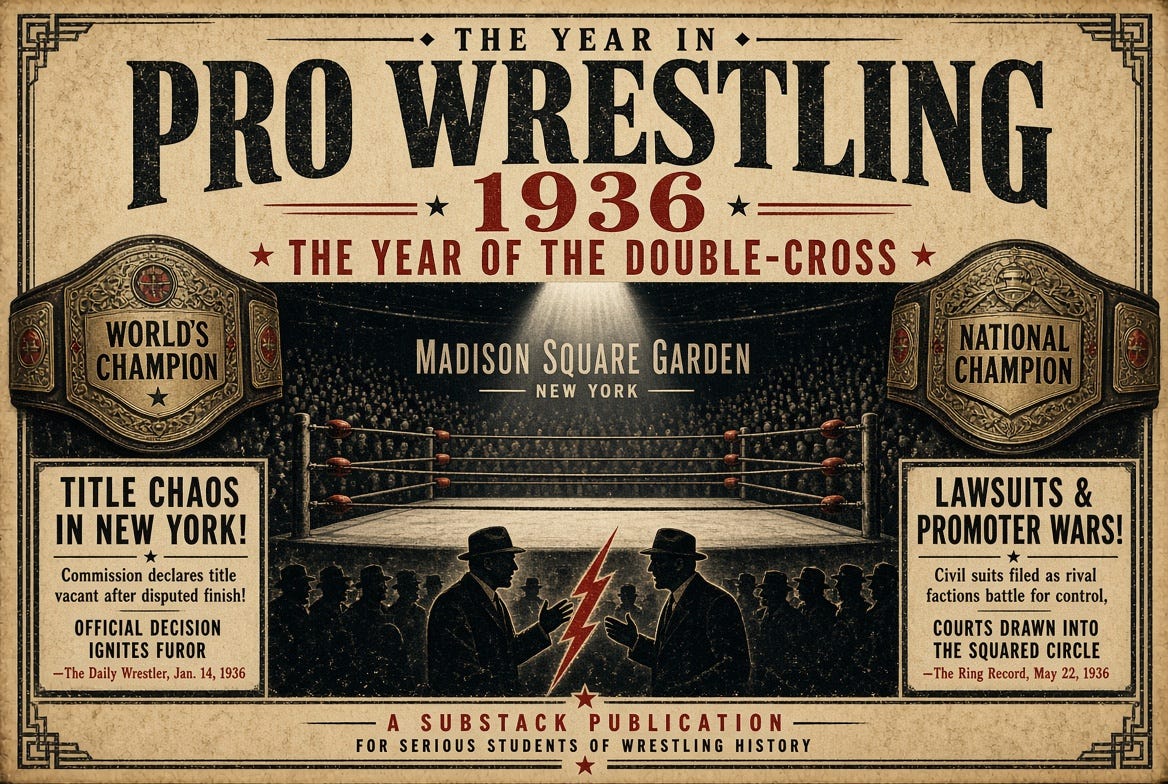
1936 as Year Two of Stage One: Formation in the 7 Stages of the Territory Era
Pro Wrestling in 1936: Fragmentation, Double-Crosses, and the Decline of the Old Order
In the depths of the Great Depression, professional wrestling in the United States and beyond remained a popular, if increasingly theatrical, form of entertainment. Crowds still filled arenas from Madison Square Garden to the Olympic Auditorium in Los Angeles, drawn by the physical spectacle, ethnic heroes, and the lingering aura of legitimate athletic competition. Yet 1936 proved a year of profound instability. The near-unification of world championship claims under the young Irish sensation Danno O’Mahoney unraveled amid a notorious double-cross, multiple title claimants proliferated, major promoters turned on one another, and the sport’s mainstream credibility suffered.
Attendance dipped in the absence of the previous decade’s dominant drawing card, Jim Londos, who spent much of the year touring overseas. What had been a loosely coordinated promotional “trust” fractured, accelerating wrestling’s shift toward more openly gimmicked, regionally controlled presentations that would define the territorial era.
At the start of 1936, Danno O’Mahoney stood as the closest thing to an undisputed world heavyweight champion. The Boston-based Irishman, managed and promoted heavily by Paul Bowser, had defeated Jim Londos for the New York State Athletic Commission and National Wrestling Association versions of the title in 1935 and added the American Wrestling Association recognition by beating Ed Don George. He was a charismatic, heavily hyped figure whose ethnic appeal packed Boston Garden and other eastern venues.
However, O’Mahoney was not a skilled “shooter”—a wrestler capable of controlling a match through genuine catch-as-catch-can ability if it turned real. This vulnerability invited challenges. Early in the year he faced angles and potential hooks, including a January incident involving Yvon Robert that turned O’Mahoney heel in some eyes and an attempted double-cross in Texas that led to his suspension and the National Wrestling Association withdrawing recognition after he failed to defend in Galveston.
