


This is part 1 of a 7-part series in Evolution of Wrestling to wrap up the year of 2026 and provide analysis of the years in the Pro Wrestling Time Tunnel of 1926, 1936, 1946, 1956, 1966, 1976 and 1986.
My framework for understanding and analyzing the history and growth of Professional Wrestling are the 7 Stages of The Territory Era:
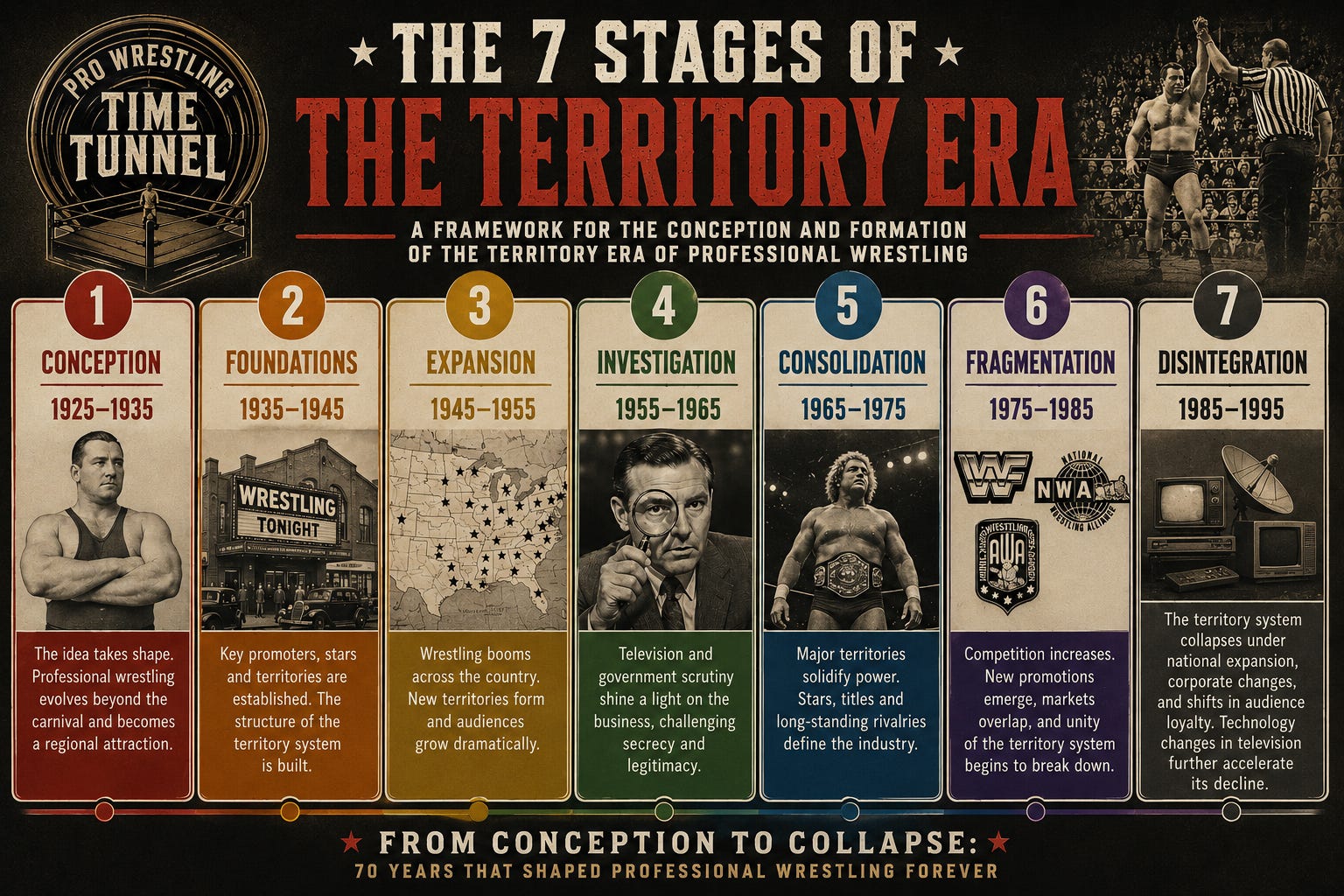
My framework for understanding and analyzing the history and growth of Professional Wrestling are the 7 Stages of The Territory Era:
Stage One: Conception (1925 to 1935)
Stage Two: Formation (1935 to 1945)
Stage Three: Innovation and Expansion (1945 to 1955)
Stage Four: Investigation (1955 to 1965)
Stage Five: Re-Consolidation (1965-1975)
Stage Six: Fragmentation (1975-1985)
Stage Seven: Disintegration (1985-1995)
1926 is year two in Stage One, Conception of The Territory Era of Professional Wrestling
In my 7 Stages of the Territory Era framework, Stage One: Conception runs from 1925 to 1935. This is the decade in which professional wrestling began its transformation from scattered carnival attractions and athletic contests into something resembling an organized industry. Promoters across the United States started establishing regional strongholds, developing business models, and building rosters of talent that could draw consistent crowds in specific cities and towns. The full territorial structure had not yet emerged, but the seeds of regional control and the idea of wrestling as a viable, repeatable entertainment product were firmly planted.
1925 marks Year One of Conception, defined in large part by the Wayne Munn–Ed “Strangler” Lewis title change and the subsequent Stanislaus Zbyszko double-cross in Philadelphia. Those events exposed both the commercial potential of installing a popular figure as champion and the fragility of purely managerial control when a skilled shooter refused to cooperate. 1926, as Year Two, shows the first systematic responses to those lessons.
The defining development of the year was the late-March Omaha conference. Jack Curley (New York), Tom Packs (St. Louis), Lou Daro (Los Angeles), Joe Coffey (Chicago), Ray Fabiani (Philadelphia), Gene Melady (Omaha), Tom Law (Wichita), and representatives from Memphis and Atlanta met with Joe and Tony Stecher. They discussed the movement of talent between cities and a workable formula for touring the recognized world champion.
This was an early, practical experiment in coordinated booking. Individual managers such as Tony Stecher and Billy Sandow still held significant influence, but the promoters were beginning to assert collective leverage over the champion’s schedule and the national storylines built around him. Most of these men already recognized Stecher rather than Lewis, creating a de facto core group that could sequence major matches and pre-position contenders.
