From Trailblazing Pioneers to Regular Card Performers on Territory Era Cards
Women’s tag team wrestling has been a cornerstone of professional wrestling for over seven decades, evolving from a gritty territory-era attraction in the 1950s to a high-profile, athletic showcase in modern promotions like WWE, AEW, and NWA. While men’s tag teams often stole the spotlight with their brawling and high-flying antics, women’s divisions emphasized speed, technical prowess, and storytelling—frequently outdrawing the men in certain eras. From the inaugural NWA World Women’s Tag Team Champions to today’s cross-promotional rivalries, the history reflects broader shifts in the industry: post-war athleticism, territorial booking, Japanese innovation, mainstream neglect, indie resurgence, and finally, full-circle revival.
Tag team wrestling for women emerged alongside the National Wrestling Alliance (NWA), founded in 1948, which unified territories under shared championships. While men’s NWA World Tag Team titles debuted around 1949, women’s followed swiftly. The NWA World Women’s Tag Team Championship was established on September 11, 1952 (sometimes traced to 1951 in early records), with Ella Waldek and Mae Young recognized as the inaugural champions. This duo—Waldek, the tough “Policewoman” fresh from roller derby and bomber mechanic work, paired with the veteran Mae Young—set the template: legitimate shoot-style wrestling mixed with crowd-pleasing slams and submissions.


Pictured: NWA World Tag Team Champions, Ella Waldek and Mae Young
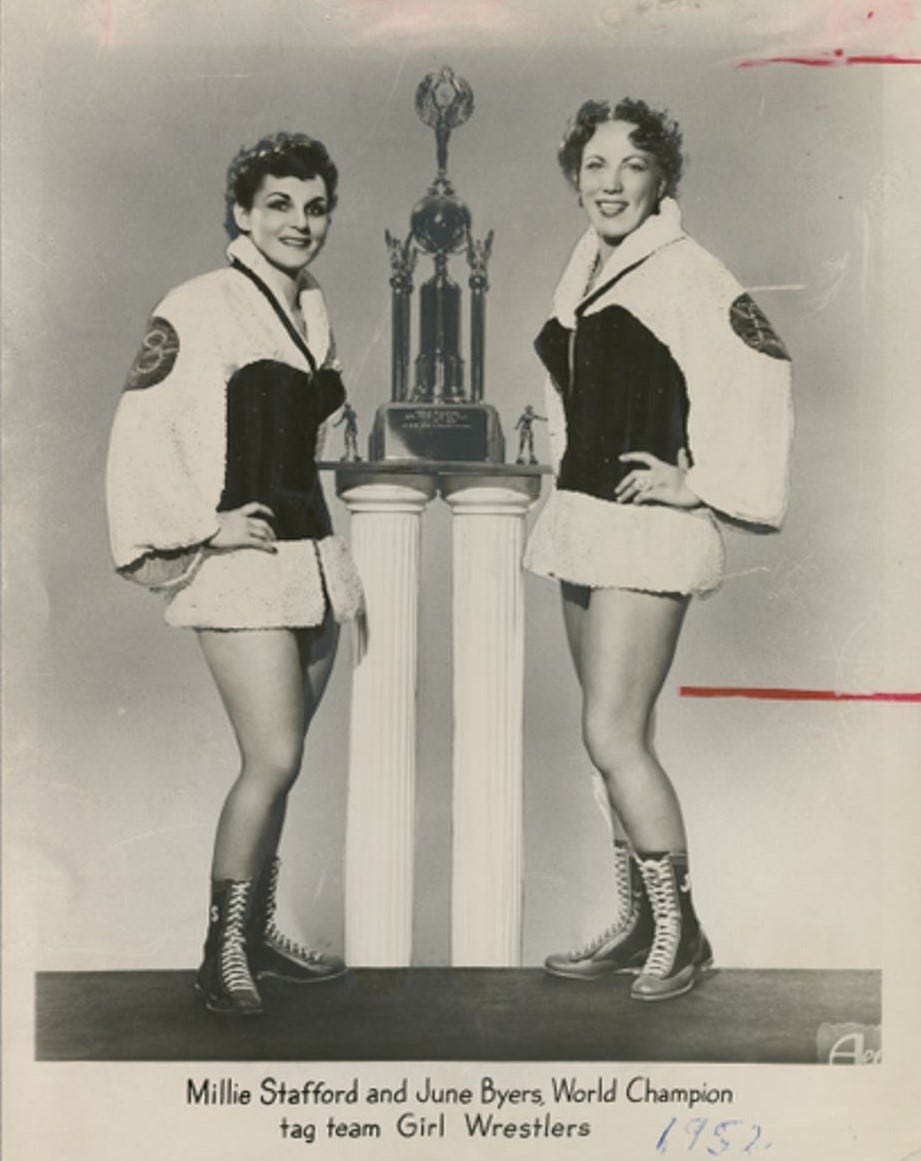
The early 1950s were chaotic and regional. June Byers held the most reigns (seven recognized), teaming with partners like Millie Stafford, Mary Jane Mull, and others in tournaments across Florida, Texas, and Canada. Other pioneers included Penny Banner (with Bonnie Watson, Betty Jo Hawkins, and Lorraine Johnson), who brought charisma and toughness. Matches were defended in NWA territories, often in high-school gyms or armories, with teams like Daisy Mae & Golden Venus or Lolita Martinez & Kay Noble claiming local recognition. The division thrived on athleticism amid post-WWII demand for women’s sports entertainment.
Tragedy struck early, as with the 1951 death of Janet Boyer Wolfe, underscoring the physical risks of professional wrestling. Yet the format endured, producing stars who mixed tags with singles bouts.