


Professional wrestling’s rich history is built on the shoulders of innovators, performers, and visionaries who shaped the industry into the global phenomenon it is today. Among these figures stands George Scott, a Canadian-born trailblazer whose multifaceted career as a wrestler, booker, and promoter left an indelible mark on the sport. Born on August 27, 1929, and passing away on January 20, 2014, Scott’s journey spanned decades, from the territorial era to the national expansion of the 1980s. Despite his profound influence, Scott remains absent from the Wrestling Observer Newsletter Hall of Fame, a prestigious institution that honors those who have excelled in drawing power, in-ring performance, or behind-the-scenes excellence. He became a strong creative leader in taking an in-ring product from a current state to a future state of success. In other words, Scott became a master booker of transition.
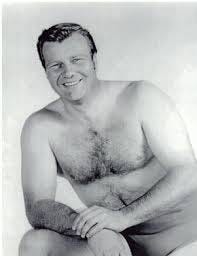
Scott’s foundation in the industry was forged as an accomplished in-ring performer during the 1950s through the 1970s. Teaming with his younger brother Sandy as “The Flying Scotts,” the duo became a staple in tag team wrestling across North America. Their high-flying style and athleticism captivated audiences in promotions like Stampede Wrestling, where George also assisted promoter Stu Hart in matchmaking. This early involvement hinted at Scott’s keen eye for storytelling and talent development, skills that would later define his legacy. As a singles competitor, Scott held regional titles and competed in grueling matches that showcased his toughness, enduring injuries like a broken neck that eventually forced his retirement from active wrestling. While his in-ring career alone might not eclipse that of perennial headliners, it provided the practical experience that informed his transition to booking, where he truly revolutionized the business.
Perhaps Scott’s most celebrated achievement came in 1973 when he assumed the role of head booker for Jim Crockett Promotions (JCP) being brought in by John Ringley, who was running the company at the time. At a time when the promotion was struggling, Scott transformed it into one of the hottest territories in the country by implementing Ringley’s vision of changing the name to Mid-Atlantic Championship Wrestling and by transitioning from a tag team dominant territory to a singles-focused one. He introduced innovative angles, emphasized strong workrate, and built compelling rivalries that drew record crowds. He began the process by bringing in compelling heels, such as Don Jadine under a mask as The Super Destroyer and his dominant heel, Johnny Valentine. He supplemented the heel side by utilizing an almost rookie performer from Minnesota named Ric Flair. He balanced it on the babyface side by using territory regular Paul Jones, along with Sonny King and bringing in one of the biggest draws in wrestling, Wahoo McDaniel.
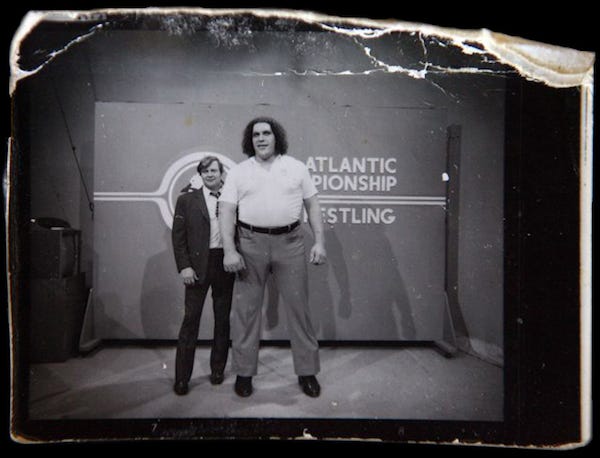
Pictured: George Scott with Andre The Giant on the set of Mid-Atlantic Championship Wrestling at WRAL-TV, Raleigh, North Carolina
The promotion flourished under his guidance, with Scott credited for elevating Flair into a main-event star. His booking philosophy focused on logical storytelling, athletic matches, and fan engagement, turning Mid-Atlantic into a model for success. As one observer noted, Scott “made Mid-Atlantic sizzle,” revitalizing the region and setting the stage for JCP’s national ambitions some 12 to 13 years later. This period alone demonstrates Scott’s drawing power through creative direction, as house shows and TV ratings soared under his tenure as well as recognizing how to use young stars like Flair and Ricky Steamboat, which years later, experts regard as some of the finest performers ever in the game. However, Scott saw them and even more importantly, used and booked them properly to pave the road there for them.
Scott’s influence extended to the World Wrestling Federation (WWF, now WWE) during its explosive growth in the 1980s, proving Scott’s talents in booking promotions through complicated transitions. Joining as a booker in the mid-1980s, he played a pivotal role in the company’s national expansion, retraining audiences accustomed to slower-paced New York-style wrestling by incorporating higher workrates and importing talent from rival promotions like the NWA. From 1984 to 1986, Scott helped orchestrate landmark events, including the first WrestleMania, by blending larger-than-life characters with athletic in-ring action. He brought in stars like Greg Valentine, Tito Santana, Harley Race, The Funks and Ricky Steamboat, enhancing the product and contributing to the WWF’s dominance during the first stage of the Hulkamania era.
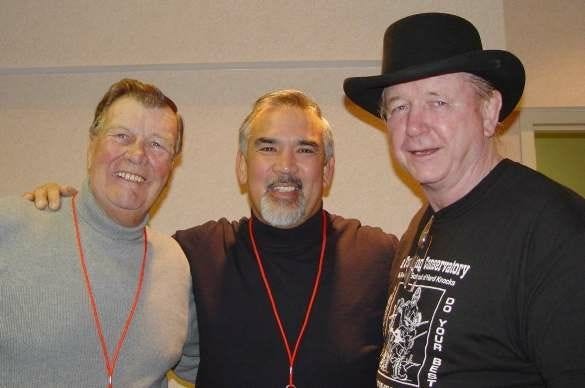
Pictured: George Scott, Ricky Steamboat and Dory Funk Jr
On the converse side, in 1988-1989, Scott returned to JCP (by then under Ted Turner’s WCW umbrella) for a brief stint, though it received mixed reviews amid internal challenges, as the company lacked clarity or direction from the top down, not simply in George’s Scott’s role. Every role in the entire company was unclear and poorly executed from executive management to janitor, which was not totally GEorge Scott’s fault. He already proved what he could accomplished with proper circumstances and clarity in organizations led by Ringley and Vincent K. McMahon. His overall track record as a booker—spanning Stampede, Mid-Atlantic, and WWF—positions him as arguably one of the greatest in his field, with peers and historians alike praising his ability to turn territories into goldmines. Not even Ted Williams’ swing was the same in his later years as it was in his prime, yet not a soul would question Williams inclusion in a Hall of Fame due to the amazing things he accomplished rather than focusing on his early or later years. All bookers in the territory era had slumps in territories where their stuff didn’t work as well and that includes Garibaldi, Renesto, Watts, Rhodes and almost anyone else you could list.
Beyond his direct contributions, Scott’s legacy endures through his roles as a promoter and road agent, where he mentored generations of talent and ensured smooth operations behind the scenes. His induction into other halls, such as the National Wrestling Hall of Fame for his professional achievements, underscores his recognized impact. Critics may point to less successful periods, but as I pointed out, these pale in comparison to his peaks, where he consistently drove revenue and innovation.
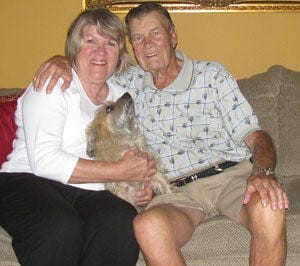
Pictured: George and Jean Scott at home with dog, Princess (Photo credit: Brian Goff)
George Scott passed away on January 20th, 2014 at the age of 84 after a lengthy battle with cancer. His career exemplifies the criteria for Wrestling Observer Hall of Fame induction: he drew crowds as a performer, excelled as a booker by creating must-see programming, and profoundly influenced pro wrestling’s evolution. His absence from the Hall is a gap in acknowledging the architects who built the industry. Inducting Scott would not only honor his individual legacy but also celebrate the often-overlooked role of bookers in crafting the magic that fans cherish. It’s time for the observers of wrestling history to recognize George Scott’s enduring contributions. He was truly a booker who was a master of transition.
Thank You for Reading
I’m Tony Richards, Pro Wrestling Historian, Author and Storyteller. I share pro wrestling historical items in each issue of the Time Tunnel Pro Wrestling History Newsletter. Thanks for reading! If you enjoy my information on select events, matches and insights, please share it with folks you think might like to be a subscriber!
Remember, paid subscribers get access to exclusive and special content such as some special issues including a multi-part deep dives on wrestling territories, wrestler bios and championship title histories, special audio and video interviews on territory pro wrestling and more available in the Pro Wrestling Time Tunnel for Premium Subscribers.