


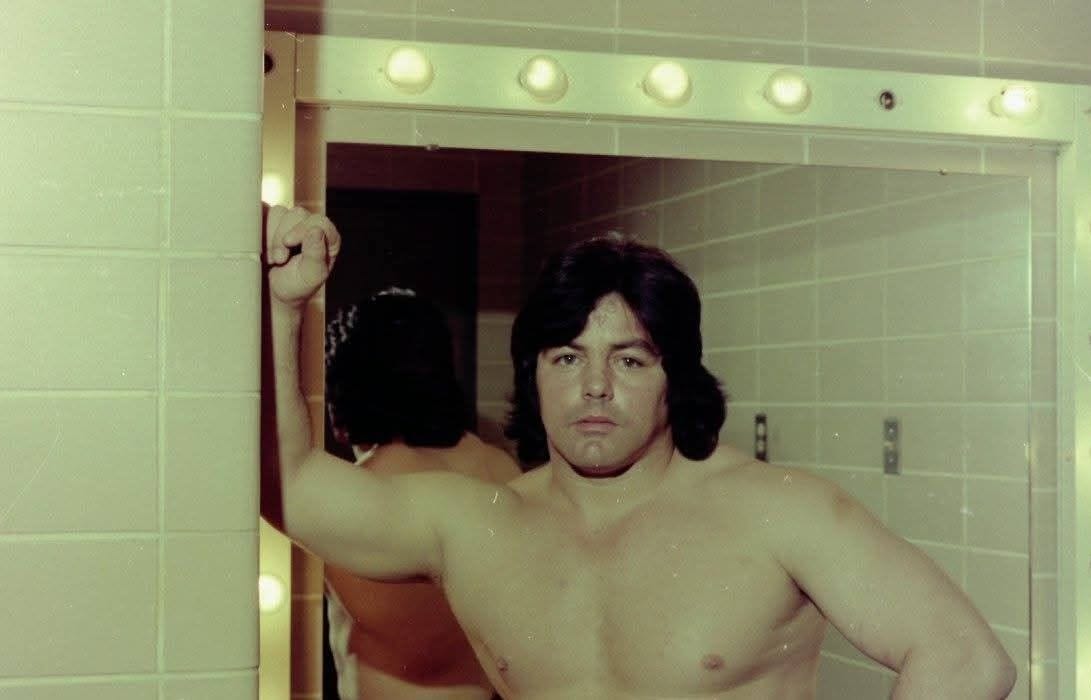
There are wrestlers whose greatness can be measured by championship reigns, others by the size of the arenas they filled, and still others by the number of years they remained in the business. Then there are wrestlers whose importance is almost impossible to measure by statistics alone because they became part of the very fabric of professional wrestling in a particular place and time.
“Superstar” Bill Dundee was one of those men.
Dundee, who died on September 6, 2026, at the age of 82, was one of the most influential performers in the history of the Tenneessee and Memphis wrestling territorirs and one of the great examples of how a wrestler who was physically small by conventional standards could become an enormous star through personality, psychology, timing, athleticism and an extraordinary understanding of professional wrestling. His career stretched across more than five decades, three continents and numerous generations of wrestlers. He was a wrestler, champion, tag-team specialist, booker, manager, promoter, teacher and mentor.
Most importantly, Bill Dundee understood professional wrestling. He understood what made a crowd care. He understood how to make an opponent look good. He understood when to accelerate a match and when to slow it down. He understood the importance of a television interview, a facial expression, a gesture toward the audience or a perfectly timed comeback.
And perhaps more than anything else, he understood that professional wrestling was not simply about who could perform the most spectacular move. It was about creating an emotional connection between the performer and the audience.
That understanding made Bill Dundee a superstar.
From Scotland to Australia
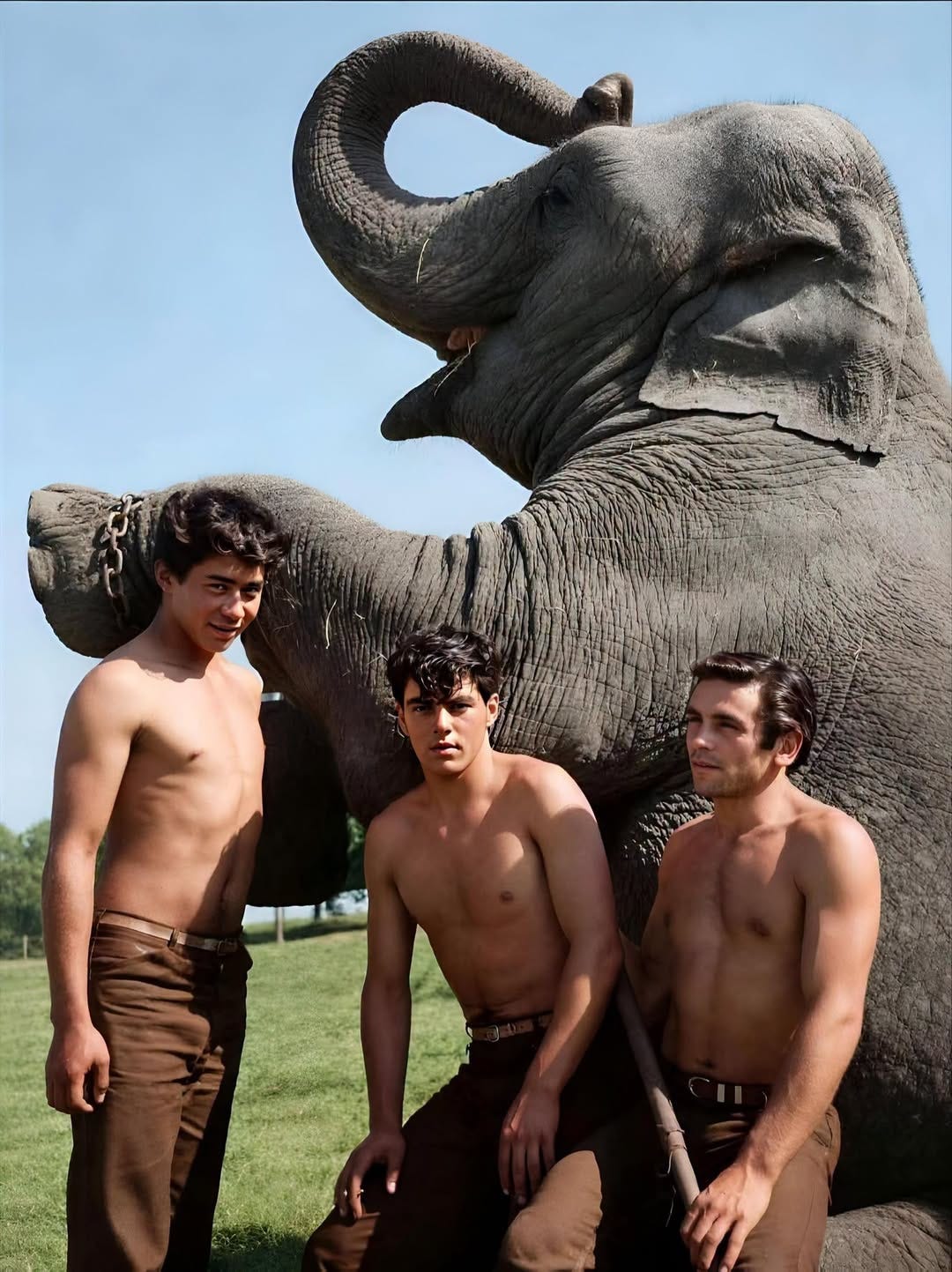
Pictured: Bill Dundee and friends at the circus
William Cruickshanks was born in Kirremuir, Angus, Scotland in 1943, but the man who would become Bill Dundee was shaped as much by Australia as he was by his birthplace. The town he was born in was 20 miles from the town of Dundee, which is the name Cruikshanks wou;d eventually adopt.
His family moved to Australia when he was young, Dundee had his 17th birthday while on the boat and he grew up in Melbourne. Before becoming a professional wrestler, he was involved with the circus, including work as a trapeze performer and elephant trainer, joining the troupe in 1960. The circus experience was beneficial in many ways to young Bill.
The circus taught performers how to entertain an audience. It taught timing. It taught physical coordination. It taught the importance of presentation.
And it taught something else that would become central to Dundee’s wrestling career: the ability to make the audience believe that what they were watching mattered.
Certainly. Dundee’s Australian years are important because they established the wrestling foundation that later allowed him to become such a major American territorial star. After growing up in Melbourne, Dundee entered professional wrestling in the early 1960s and learned his craft in the Australian wrestling scene before making the move to North America. Australia was a demanding environment in which a young wrestler had to learn quickly how to work different opponents, travel, entertain crowds and establish a personality.
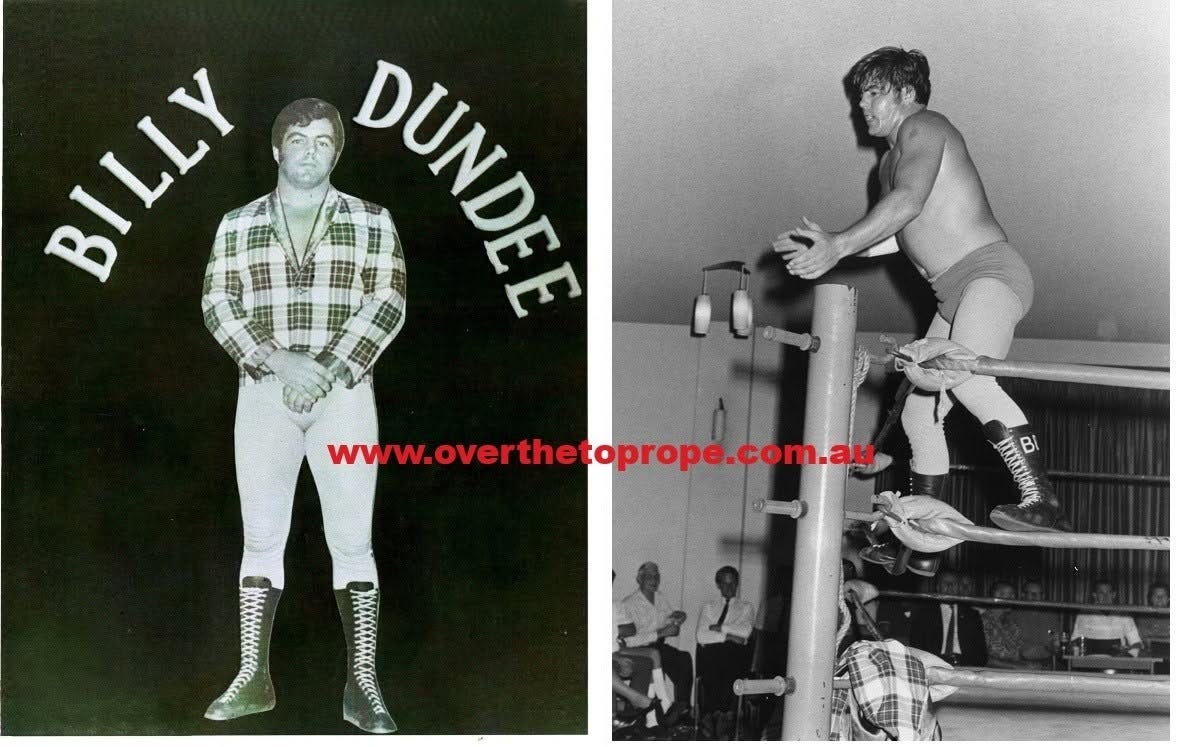
**Photo credit: Libnan Ayoub www.overthetoprope.com.au
Dundee’s small stature made his eventual success particularly impressive. Rather than trying to disguise his size, he developed the aggressive, cocky and highly competitive style that would become his trademark. His background in the circus also gave him an unusual physical education. He had worked as a trapeze performer and had experience as an elephant trainer, experiences that helped develop the coordination, physical confidence and showmanship that became evident in the wrestling ring.
During his Australian career, Dundee worked extensively around Melbourne and throughout the Australian wrestling circuit, gaining valuable experience against many of the country’s established wrestlers. He developed into a capable singles wrestler and tag-team performer, and the Australian scene taught him something that would become essential throughout the rest of his career: how to make a smaller wrestler believable against larger opponents.
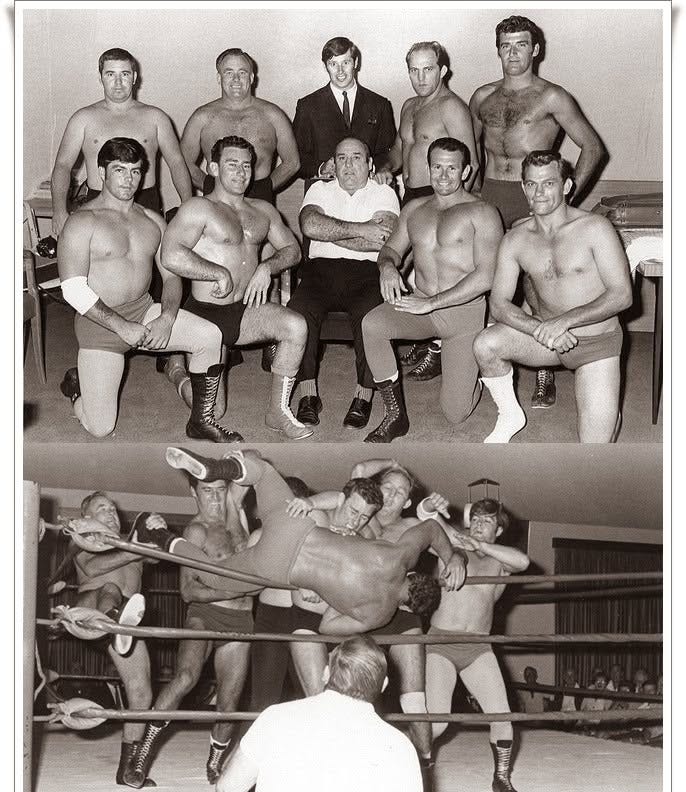
Pictured: Crew of wrestlers from the Capitol Theatre in Sydney, Australia including Bill Dundee and Johnny Gray plus others.
Dundee became an expert at using speed, movement, attitude and ring intelligence rather than relying on physical size. His Australian experience also gave him the opportunity to work in front of audiences who were accustomed to professional wrestling as a legitimate form of live entertainment rather than simply a sporting exhibition. By the time Dundee left Australia for the United States, he was no longer an inexperienced newcomer. He was a seasoned young professional who had already learned the fundamentals of wrestling psychology, crowd control and character development. Those lessons traveled with him to America and became the foundation upon which the “Superstar” Bill Dundee persona would eventually be built. In November of 1971, he would lose a singles match against a guy who he would enounter in his future, Johnny Gray.
The Superstar Arrives in America
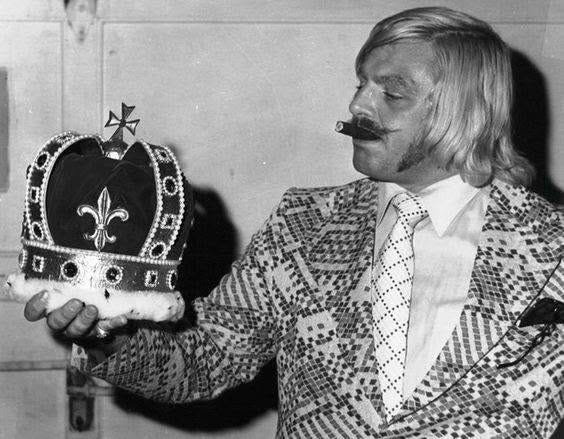
Pictured: Bobby Shane
Bobby Shane played an important role in opening the door to America for Bill Dundee. By the time Dundee was looking to expand his career beyond Australia, Shane was already established in American professional wrestling and had connections within the territorial system. Shane recognized Dundee’s ability and helped provide the connection that ultimately brought the Australian wrestler into the orbit of the Gulas-Welch wrestling operation in Nashville, Tennessee.
That connection was enormously important because getting into the United States was one thing; getting into the right territory, with the right booker, at the right moment was another. For Dundee, the relationship with Shane helped accomplish both. Shane was very clear and specific to both Dundee and Barnes they should connect with Jerry Jarrett and work for his end of the operation, rather than Gulas.
By the time Dundee came to the United States in February of 1975, he had already accumulated considerable experience in Australia. His arrival in America marked the beginning of the chapter for which he would ultimately become famous. He initially came to the United States with George Barnes, and the two developed a reputation as an entertaining and highly effective heel tag team. But Dundee’s destiny was not simply to become another traveling tag-team wrestler.
Dundee’s arrival in Gulas-Welch Wrestling Enterprises and being integrated into Jerry Jarrett’s booking philosophy proved to be a turning point in his career. Jarrett was building a promotion that depended heavily upon television, strong personalities and wrestlers who could make the audience emotionally invested in the matches. Dundee fit that philosophy remarkably well. He arrived with the experience he had gained in Australia, but Jarrett gave him the American platform on which he could turn those skills into stardom.
The connection through Bobby Shane therefore became much more than simply a wrestler helping another wrestler get a booking. It helped bring Dundee into the Tennessee wrestling ecosystem, where his career would eventually become intertwined with Jerry Lawler and where he would become one of the most important figures in the history of Tennessee wrestling..
Bill Dundee and George Barnes: The Australian Connection Comes to Tennessee
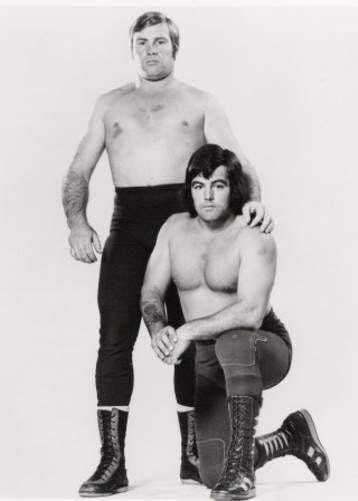
When Bill Dundee arrived, one of the most important chapters of his early American career came through his partnership with fellow Australian George Barnes. The two men brought something different to the Gulas-Welch wrestling office. They were experienced international wrestlers who had learned their trade in Australia and understood how to work as a unit, but they also possessed the kind of colorful personalities and aggressive wrestling styles that could immediately attract the attention of a Southern audience. Their formal arrival as a team in the territory on February 11, 1975, gave Dundee amd Barnes an important platform from which to establish themselves before Dundee’s career would became increasingly identified with Jerry Lawler and the Memphis wrestling tradition.
Dundee and Barnes were presented as heels, and they quickly became an effective combination because they did not need to rely upon size alone to generate heat. Dundee’s compact build and cocky attitude complemented Barnes, while both men understood the fundamentals of tag-team wrestling. They could isolate an opponent, cut off the ring, make frequent tags and frustrate the babyfaces while constantly communicating with the crowd. The Australian identity also gave the team something distinctive. They were outsiders who had come into Southern wrestling believing that they were every bit as good as, and perhaps better than, the local stars. That attitude gave the audience a reason to dislike them while allowing Dundee to establish the personality that would eventually make him one of the territory’s biggest attractions.
One of the team’s earliest important programs was against Eddie Marlin and Tommy Gilbert. That feud placed Dundee and Barnes opposite two wrestlers who represented the established Tennessee babyface wrestling tradition. Marlin was already a respected veteran and important figure within the territory, while Gilbert was a talented babyface who could provide the athletic opposition necessary to make the Australian team look dangerous. The matches gave Dundee and Barnes the opportunity to demonstrate that they were not simply visiting wrestlers passing through town. They were becoming a serious threat to the local tag-team scene. Their willingness to bend the rules, exploit openings and use every advantage available to them made them natural antagonists for Marlin and Gilbert.
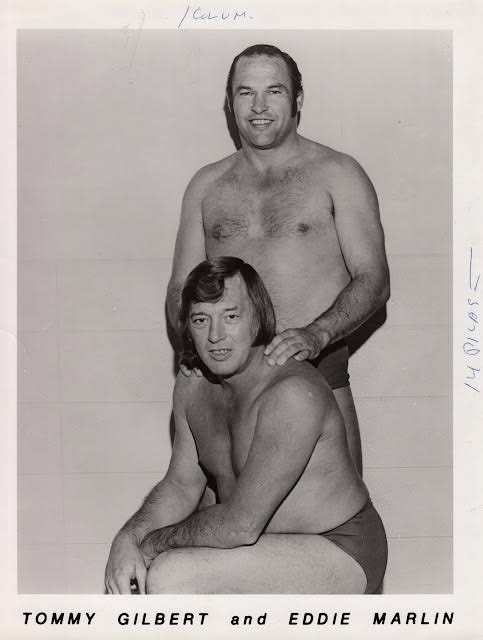
Pictured: Tommy Gilbert and Eddie Marlin
The feud also illustrated the importance of Tennessee tag-team wrestling during the period. A successful heel team did not necessarily have to dominate every match. What mattered was creating enough frustration and anger that the audience wanted to see the babyfaces eventually overcome them. Dundee and Barnes understood that formula. They could lose without being diminished because their heat came from the manner in which they wrestled rather than from simply piling up victories. Dundee in particular was already developing the ability to make an audience believe that something important was happening every time he entered the ring.
The Australian team also became involved with the volatile Tojo Yamamoto, another major Memphis personality whose career was built upon his ability to generate tremendous audience reaction. Tojo was one of the great villains of the Tennessee territory, and putting Dundee and Barnes into programs involving him gave the Australian duo another dimension. The presence of Yamamoto brought an entirely different type of menace to the programs, and Dundee and Barnes were able to function within that environment without being overshadowed. In a territory built around strong personalities, that was an important accomplishment. Dundee was learning how to operate alongside some of the Gulas-Welch’s most established antagonists (heels) while continuing to make his own identity distinctive.
I want to go in-depth on this part of Dundee’s career because the majority of wrestling fans today never got to see them. What made the Dundee-Barnes team particularly effective was their understanding of the classic heel tag-team formula. They were not simply two wrestlers who happened to team together. They had an identity. They were cocky, aggressive outsiders who were willing to antagonize both their opponents and the audience. Dundee had the personality and ring intelligence to become a major individual star, while Barnes provided an experienced partner who understood how to build the team around Dundee’s strengths. Together they helped establish Dundee as a wrestler who could be trusted in an important program, whether he was working singles or tag team matches.
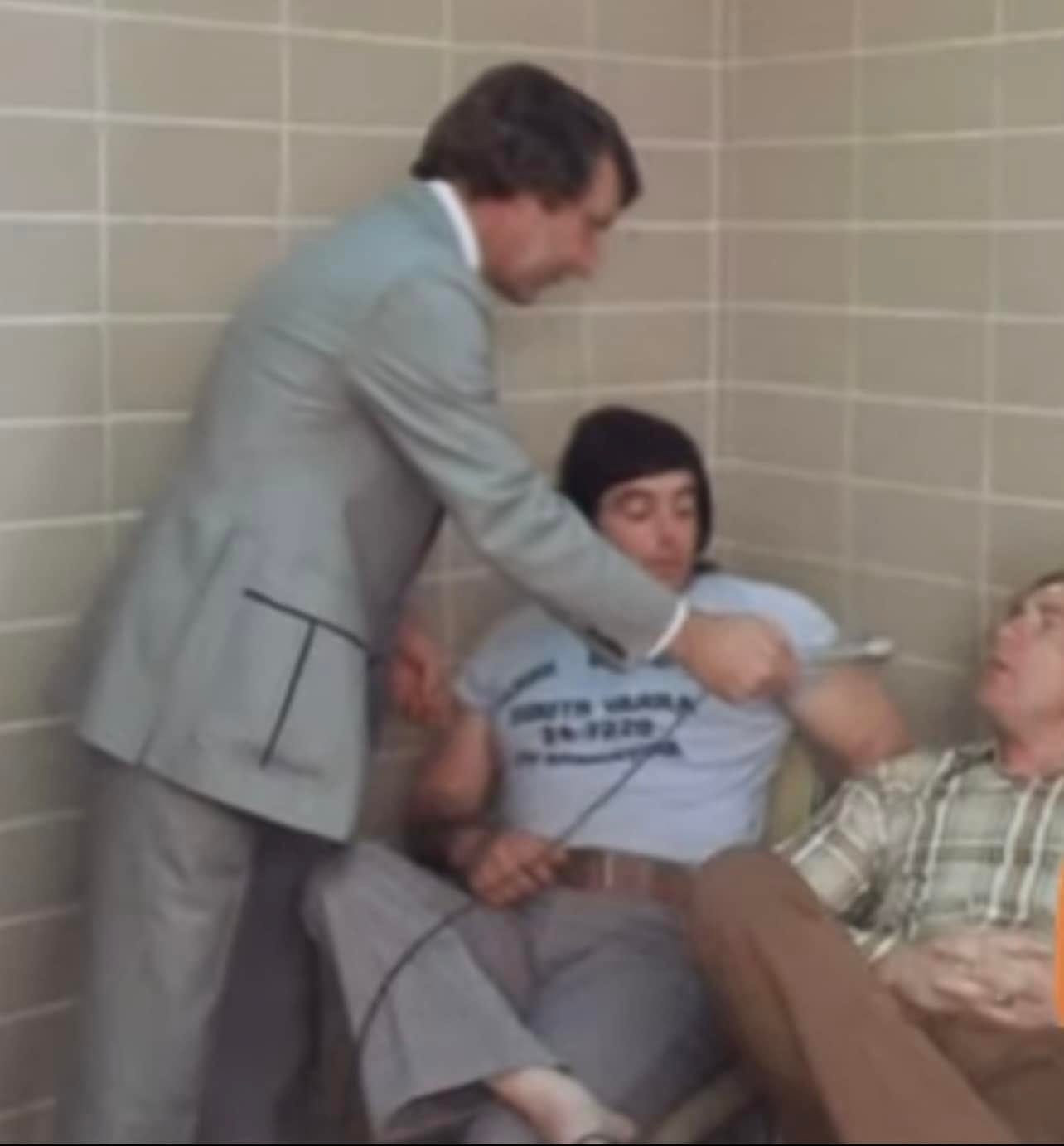
Pictured: Lance Russell interviews Bill Dundee and George Barnes
Their partnership also provided Dundee with an important education in Jerry Jarrett’s wrestling system. The Gulas-Welch Nashville,Tennessee office was the hub of a territory in which television, interviews, angles and arena matches all had to work together. A wrestler could not simply have a good match; he had to help create anticipation for the next match. Dundee and Barnes became part of that process. Their television appearances helped establish their personalities, their matches gave the audience a reason to dislike them, and their continuing feuds created the kind of episodic wrestling that made the promotion so successful.
The Fuller family provided another major chapter in the team’s Memphis run. The Fullers represented one of the great wrestling families of the territorial era, and programs involving the family carried an additional sense of wrestling lineage and toughness. Dundee and Barnes were therefore working against wrestlers who had strong reputations and deep roots within the territorial system. Their heel run increasingly established them as part of the fabric of Gulas-Welch Tennessee wrestling rather than outsiders merely being given television time. The Australian connection was still part of their presentation, but their work was becoming thoroughly integrated into the Tennessee style.
Bill Dundee, George Barnes and the Fuller Family War
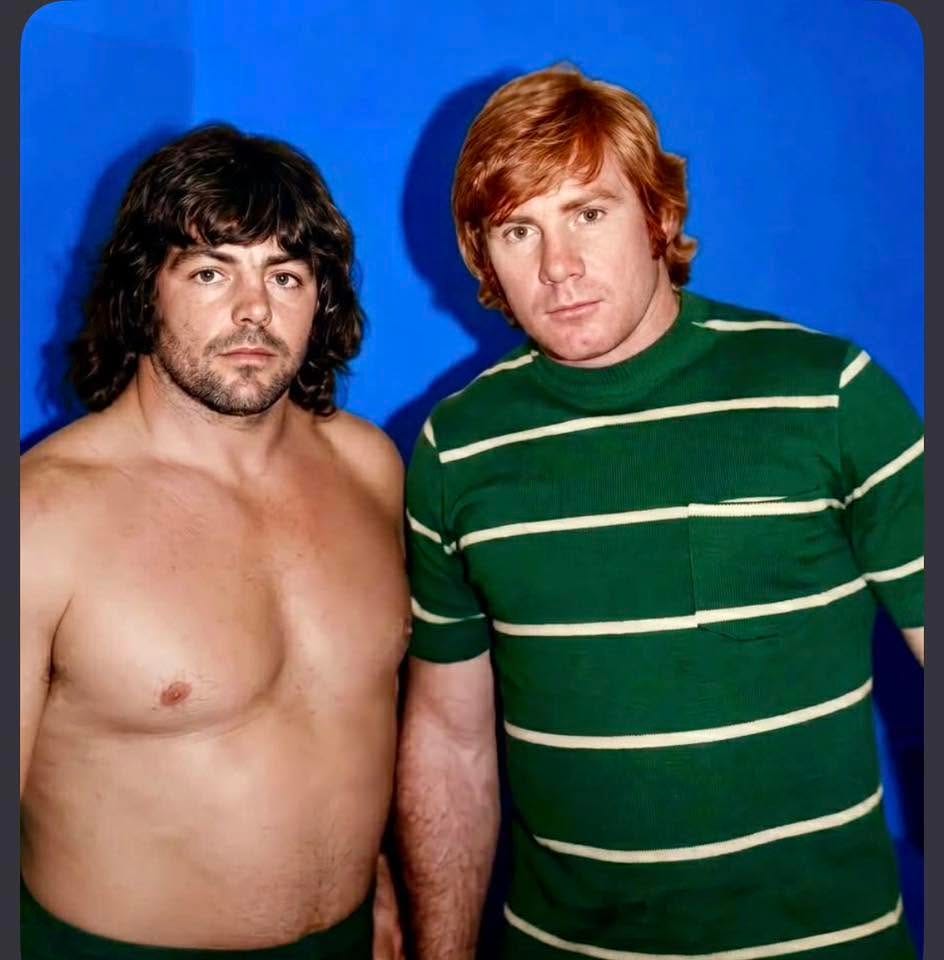
One of the most memorable chapters of Bill Dundee and George Barnes’ early Memphis run came when they became embroiled in a program with the Fuller family. It was a particularly interesting angle because the Fullers were not presented as a completely united babyface family. Ron Fuller was the NWA Southern Heavyweight Champion and was working as a heel, while his younger brother Robert Fuller was a babyface. Their father, Buddy Fuller, was already a familiar and respected figure to Memphis fans, not only because of his own wrestling career but because he was the son of legendary promoter and wrestler Roy Welch. Thus, when Dundee and Barnes targeted Robert Fuller, they were not simply attacking another wrestler. They were attacking one of the territory’s most important wrestling families.
The angle became especially effective on Memphis television when Dundee and Barnes jumped Robert Fuller and beat him down. Robert was the babyface being victimized by the two arrogant Australian heels, and the attack immediately created sympathy for him. The rescue came when Ron Fuller and Buddy Fuller intervened and saved Robert. The scene carried an added layer of intrigue because Ron was himself a heel. His relationship with Robert was stronger than his role as a heel was with the babyface wrestling community. Ron’s concern was not necessarily that Robert had suddenly become his philosophical ally; it was that his brother had been attacked by outsiders who had crossed a line.
That led to one of the most memorable pieces of wrestling psychology in the entire program. Ron told Robert that if he was going to survive against Dundee and Barnes, he was going to have to “change his ways.” In other words, Robert was going to have to become more aggressive and adopt some of the characteristics of a heel in order to combat the Australian team. It was a wonderfully Southern wrestling concept: sometimes fighting the bad guys required becoming a little bit like the bad guys yourself. Robert was still the sympathetic member of the Fuller family, but Ron’s advice suggested that simply being a traditional clean-cut babyface was not going to be enough to deal with Dundee and Barnes.
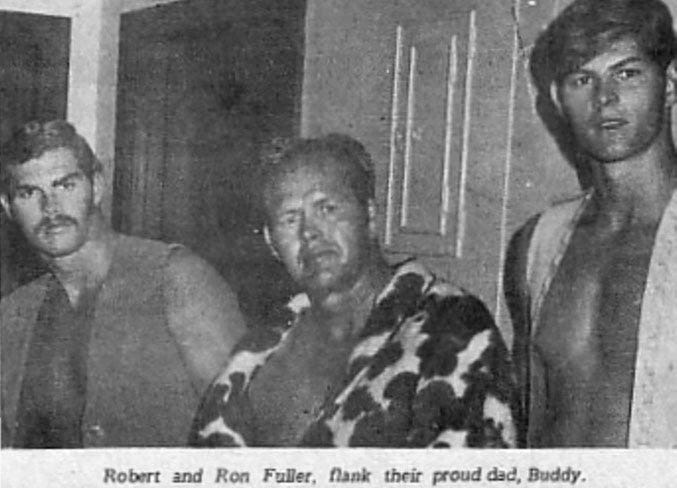
Pictured: The Fuller Family, Ron, Buddy and Robert Fuller
The angle also demonstrated why the Fuller family was such a valuable commodity to the Memphis territory. Buddy represented the previous generation, Ron represented the established championship-level heel, and Robert represented the younger babyface who was trying to establish himself. Dundee and Barnes became the outside force that brought all three generations of the family into the same story. It gave the audience a reason to care about the Fuller family as a unit while still allowing the individual members to have very different personalities and roles.
The wrestling matches reflected that progression. Dundee and Barnes quickly became major players in the Southern Tag Team Championship picture. On March 10, they defeated Tojo Yamamoto and Eddie Marlin to win the Southern Tag Team Championship, and they subsequently defended those championships against a succession of combinations involving the Fullers and other major Memphis wrestlers. Their championship status made the feud with the Fullers more important because Robert and Buddy were no longer simply seeking revenge for a television attack; they were attempting to take the championships away from two of the territory’s hottest heels.
On March 24, Dundee and Barnes defended the Southern Tag Team Championship against Phil Hickerson and Robert Fuller, with the match ending in a disqualification. A week later, on March 31, Buddy and Robert Fuller challenged Dundee and Barnes and defeated the champions by disqualification. The following week, April 7, Dundee and Barnes successfully defended the titles against Buddy and Robert. The back-and-forth nature of the program was classic territorial booking: the heels could remain champions while the babyfaces repeatedly came close to defeating them, keeping the audience invested in the eventual payoff.
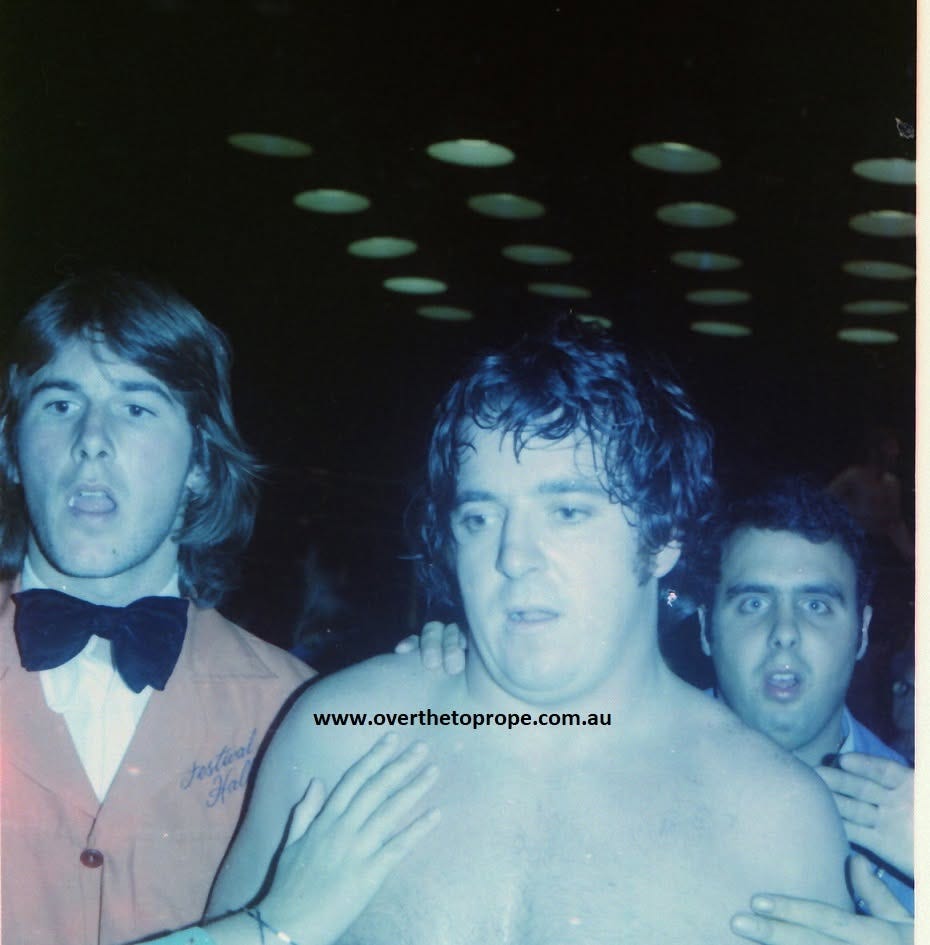
Pictured: Johnnt Gray (center), the 3rd Australian in the Dundee\Barnes team
Photo Credit: Libnan Ayoub www.overthetoprope.com.au
The April 14 match was another significant development. Buddy and Robert Fuller defeated Bill Dundee and Johnny Gray in a Mississippi Chain Match. Barnes was not Dundee’s partner for this particular match, and the use of Johnny Gray demonstrated how the program was expanding beyond a simple two-team rivalry. Gray was becoming part of Dundee and Barnes’ side of the conflict, while the Fullers remained a formidable family unit. The chain match itself naturally added a more violent and personal dimension to the feud, fitting the increasingly heated style of Memphis wrestling.
The following week, April 21, Dundee and Barnes wrestled Ron and Robert Fuller to a no contest after fourteen minutes. This was particularly significant because Ron Fuller, despite being a heel and the Southern Heavyweight Champion, was now directly involved in the conflict with Dundee and Barnes alongside his brother. The boundaries between heel and babyface were becoming deliberately blurred. The audience understood that Ron was still a heel, but there were circumstances in which even a heel would stand beside his family. That kind of moral ambiguity was one of the strengths of territorial wrestling.
On April 28, Dundee and Barnes defeated Robert Fuller and Jimmy Golden to retain the Southern Tag Team Championship. Jimmy Golden’s involvement added another layer to the program and demonstrated how the Memphis territory could continually change the combinations without abandoning the central story, as Golden ws also part of the Welch familly as a grandson of Roy.. Robert remained the principal Fuller babyface in the feud, but his partners could change while Dundee and Barnes remained the common enemy.
On May 5, Ron and Robert Fuller finally defeated Dundee and Barnes in a non-title match, with Robert pinning George Barnes. The victory was particularly meaningful because it gave Robert a personal accomplishment against one of the men who had helped make his life miserable. One week later, the program reached its logical expansion into a six-man tag team match: Buddy Fuller, Ron Fuller and Robert Fuller faced Bill Dundee, George Barnes and Johnny Gray. The Fuller family stood together against the Australian-led combination, while Dundee and Barnes now had Gray as their third man. The match illustrated how far the original television angle had grown. What had begun with Dundee and Barnes attacking Robert Fuller had become a full-scale family war.
The May 12 six-man match is particularly important in understanding Dundee’s place in the program. He was no longer merely one half of an Australian tag team brought into Memphis to work against established local stars. He had become important enough to anchor the heel side of a major six-man program involving three members of the Fuller family. George Barnes remained his principal partner, while Johnny Gray became the third member of their combination. On the other side were three generations of Fuller wrestling identity: Buddy, the son of Roy Welch; Ron, the established Southern Heavyweight Champion and heel; and Robert, the young babyface who had been forced to become more aggressive in order to survive Dundee and Barnes.
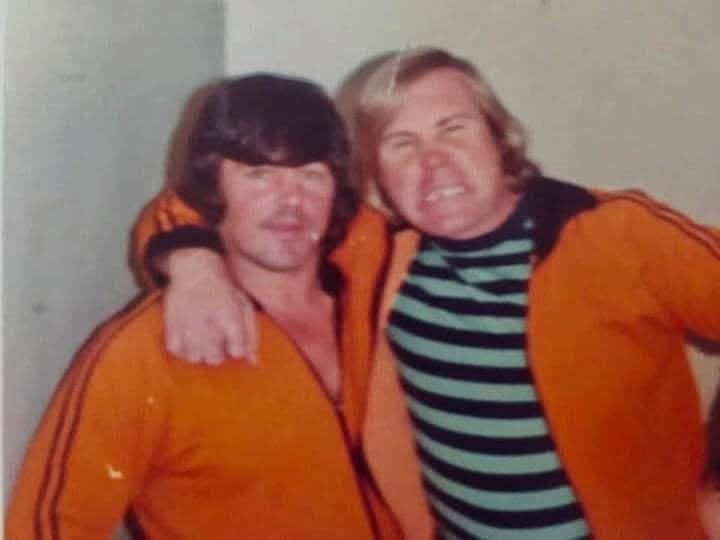
Pictured: Bill Dundee and George Barnes
For wrestling booking and psychology students, there is an almost perfect territorial-wrestling symmetry to the entire angle. Dundee and Barnes arrived as outsiders. They were arrogant, aggressive and disliked. They attacked a member of a famous wrestling family. The family rallied around him. The heel champion brother became involved despite his own alignment. The older generation came out of retirement or semi-retirement to stand beside the younger generation. Partnerships changed. Championships changed hands. Tag matches became chain matches and six-man matches. And through it all, the audience was given a continuing reason to come back the following week.
Dundee was learning an enormous amount from this experience. He was working with some of the most experienced wrestlers in the territory, but more importantly, he was learning the Tennessee method of storytelling. A feud did not have to be based simply upon who could beat whom. The television angle created the emotional foundation, the interviews explained the motivations, the arena matches advanced the story, and the next television program sold the next round of matches.
That was precisely the environment in which Bill Dundee would flourish.
The partnership with Barnes gave him his first major identity in the territory The feud with the Fullers established him as a serious heel. The championship victories demonstrated that Jerry Jarrett trusted him with important business. Working with Ron, Robert and Buddy Fuller gave him experience with one of the most important wrestling families in the territory. And teaming with Johnny Gray showed that Dundee could become the central figure in a larger heel unit rather than simply one half of a tag team.
Perhaps most importantly, the Fuller feud helped establish one of the characteristics that would define Dundee for the rest of his career: he could make almost anyone across the ring from him more interesting. Ron Fuller could remain a heel while defending his brother. Robert Fuller could become more aggressive without completely abandoning his babyface identity. Buddy Fuller could become the patriarch of the family fighting back against the outsiders. Johnny Gray could become part of Dundee and Barnes’ heel force. And Dundee himself could remain the central antagonist throughout all of those shifting relationships.
That was the genius of territorial wrestling at its best—and Bill Dundee was proving that he understood it.
The End of the Dundee-Barnes Tag Team
Eventually, however, the partnership encountered a problem that had nothing to do with wrestling. George Barnes became homesick for Australia. That homesickness ultimately brought an end to his American run with Dundee. For Barnes, America had provided an important professional opportunity, but the distance from home and the demands of life in the American wrestling territory system proved difficult to sustain. His decision to return home meant that the partnership with Dundee could not continue indefinitely.
Barnes’ departure was therefore an important turning point in Dundee’s American career. The Australian tag team had served its purpose. It had established Dundee in the territory, introduced him to the audience, allowed him to demonstrate his ability in major tag-team programs and helped establish him as a legitimate territorial performer. But the end of the partnership also forced Dundee to take the next step. He was no longer simply one half of an Australian team. He was becoming a star in his own right.
In retrospect, the George Barnes partnership is an important but sometimes overlooked chapter in the story of Superstar Bill Dundee. Before Dundee became inseparable from the history of Jerry Lawler and before he became one of Memphis’ defining personalities, he needed a foundation upon which to build his American career. George Barnes provided that foundation. Together they entered Tennessee wrestling as Australian heels, battled Eddie Marlin and Tommy Gilbert, crossed paths with Tojo Yamamoto, became involved with the Fuller family and established themselves as an effective and highly entertaining heel combination.
And when Barnes eventually became homesick and returned to Australia, Dundee’s career continued to rise.
The partnership had ended, but its importance remained. George Barnes had been Dundee’s teammate during the period when the Australian wrestler was establishing himself in one of America’s most demanding wrestling territories. From that point forward, Dundee would increasingly stand on his own—and ultimately become one of the defining figures in the entire history of Memphis wrestling.
Bill Dundee Turns Babyface: The War with Dr. Ken Ramey and the Interns
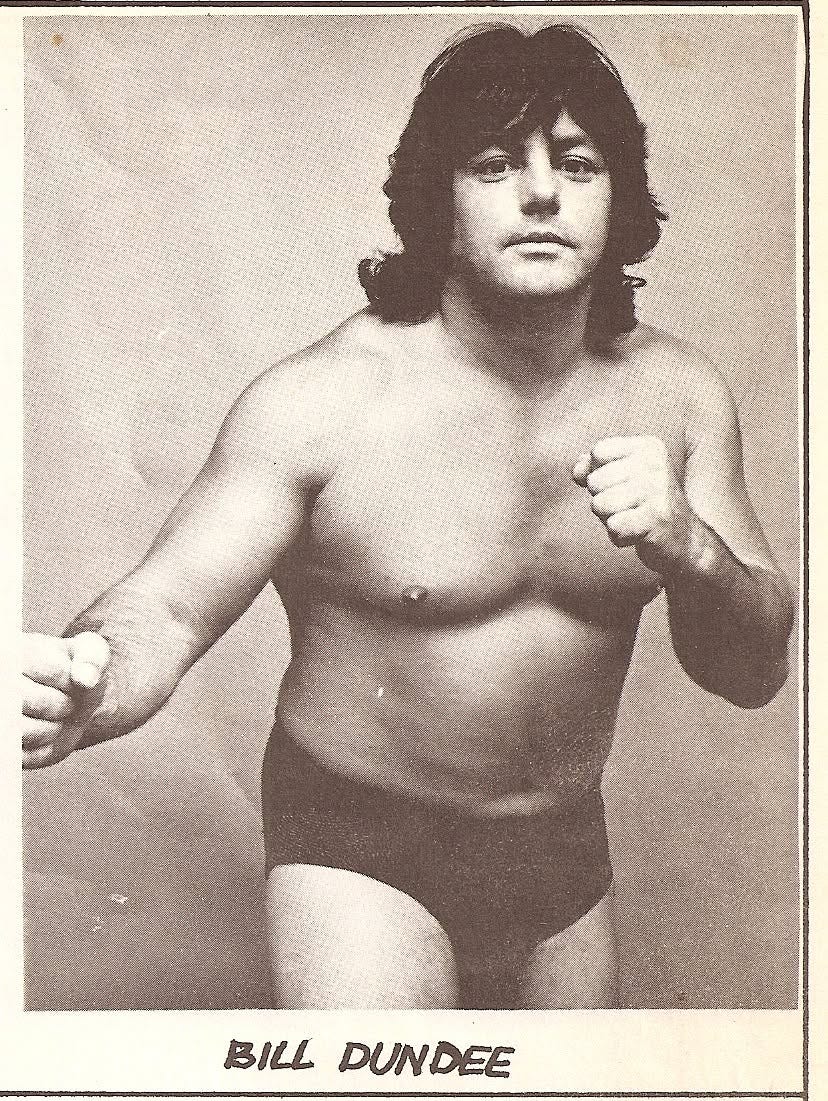
Bill Dundee’s transformation from a hated Australian heel into one of Memphis wrestling’s most popular babyfaces was one of the most important turning points of his early American career. It was not accomplished simply by announcing that Dundee was now a good guy. Instead, Jerry Jarrett’s promotion used one of the most effective formulas in territorial wrestling: a shocking attack, a sympathetic veteran in danger and an unexpected act of courage from a wrestler the audience had previously disliked. Dundee had spent the first portion of his Memphis career establishing himself as an aggressive heel, particularly during his partnership with George Barnes and their feud with the Fuller family.
By late 1975, however, Dundee was ready for a new challenge, and that opportunity came through Eddie Marlin and the Interns.
The Interns had become one of the most recognizable and dangerous heel tag teams in the Memphis territory. Working under the guidance of the sinister Dr. Ken Ramey, the masked wrestlers had a distinctive appearance and presentation that made them immediately identifiable to television audiences. Ramey was every bit as important to the act as the men underneath the masks.
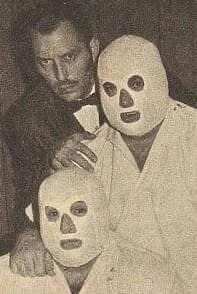
Pictured: Dr. Ken Ramey and The Interns
He presented himself as the mastermind behind the team and was notorious for using ether as a weapon, creating the impression that the Interns could defeat their opponents through deception and underhanded tactics as much as through wrestling ability. The Interns were therefore more than simply a tag team. They were a complete Memphis television act, with the masks, the manager, the distinctive presentation and the willingness to break every rule necessary to win.
By the fall of 1975, the Interns were positioned at the top of the Memphis tag-team scene. Their championship success made them a natural target for the territory’s established babyfaces, and Eddie Marlin became one of their most important opponents. Marlin was a veteran who represented everything that was familiar and respected about Memphis wrestling. He had been around the territory for years and had earned the audience’s trust. Dundee, meanwhile, was still carrying the reputation of the arrogant Australian heel who had spent months antagonizing many of the same fans.
Then the Interns and Dr. Ken Ramey crossed the line.
During a Memphis television program, the Interns attacked Eddie Marlin inside the television studio. The attack was designed to make the audience feel that something more serious than an ordinary wrestling match had taken place. Marlin was not simply another opponent being beaten down before an upcoming match. He was a respected veteran being victimized in front of the television audience.
And then Bill Dundee came to his rescue.
The symbolism of the moment was powerful. The man who had previously been one of Memphis’ heels suddenly stood beside Eddie Marlin and fought the very men who had attacked him. Dundee did not need a lengthy explanation. His actions told the entire story. When he saw the Interns and Ramey attacking Marlin, he could no longer remain on the sidelines.
Bill Dundee had turned babyface.
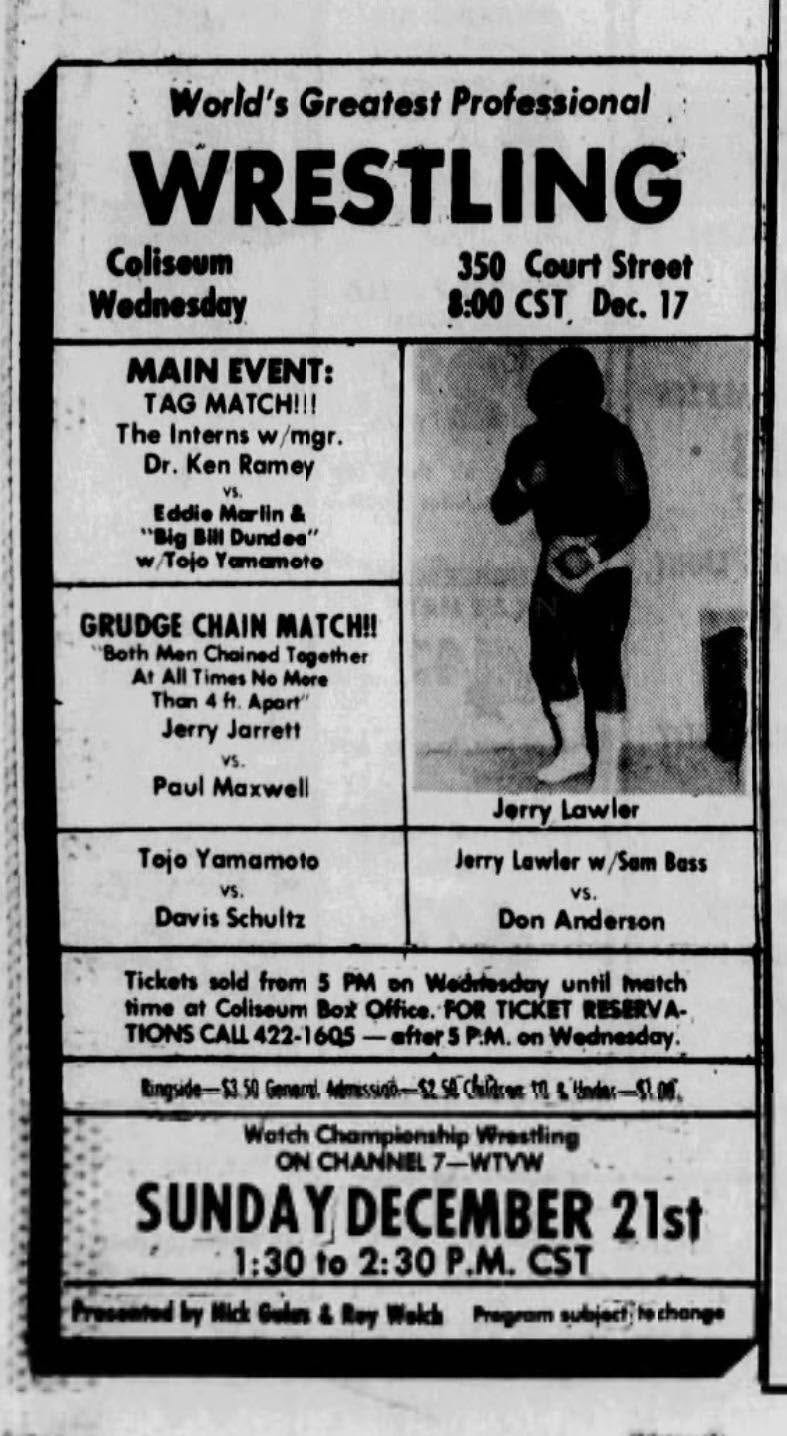
Pictured: The ad for the Coliseum in Evansville, Indiana, December 21st, 1975 featuring “Big Bill Dundee”
The brilliance of the angle was that the audience did not have to forget what Dundee had done as a heel. In fact, remembering his previous career made the turn more effective. The fans knew Dundee had been an antagonist. They knew he had been involved in the Fuller family feud and had spent months establishing himself as an outsider. But they also knew what they had just witnessed. Dundee had put himself in danger to save Eddie Marlin.
The audience could forgive him.
That was the genius of the Tennessee-style wrestling system. A character did not have to change overnight simply because a promoter said he was now a babyface. The audience needed a reason to accept the change. Dundee had been given one.
The Interns immediately became the perfect opponents for the newly established babyface Dundee. The man who had once been part of the heel side of Memphis wrestling was now fighting against one of the territory’s most hated heel combinations. Eddie Marlin remained part of the story, but Dundee increasingly began to emerge as a major attraction in his own right.
The program also represented one of the final major runs of the Interns as a dominant force in Tennessee. Their Southern Tag Team Championship reign placed them in repeated programs with the territory’s top babyfaces, and their matches with Dundee and Marlin helped keep them at the center of Memphis television. The Interns could win through cheating, escape with disqualifications or survive controversial finishes, allowing the promotion to keep the heat on them without prematurely ending their run.
The rivalry produced the kind of repetitive-but-effective territorial booking that made Memphis wrestling work. Dundee and Marlin would challenge the champions, the Interns would find a way to escape, and the issue would continue onto the next television program. The audience was continually given another reason to see what happened the following week.
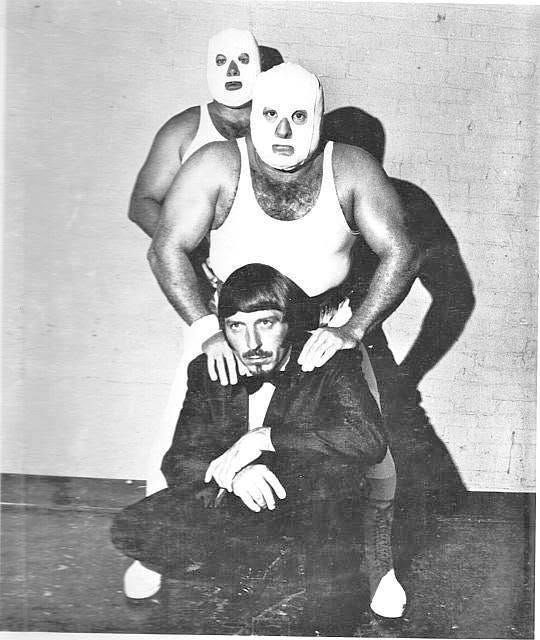
Pictured: The Interns with Dr. Ken Ramey
Dundee also began receiving more singles opportunities during this period. This was an important development because his career was changing on several levels simultaneously. George Barnes was no longer necessary for Dundee to establish his identity. He had proven himself as a heel tag-team wrestler, but now the promotion was beginning to find out what it could do with him as an individual babyface.
The feud with Dr. Ken Ramey was especially valuable in that regard. Dundee was no longer simply fighting the masked Interns. He was now fighting the man responsible for them. A singles victory over Ramey allowed Dundee to receive the kind of personal triumph that could establish him independently from any tag-team championship program. Ramey had helped create the threat of the Interns, and Dundee was now targeting the source of that threat.
The Interns remained a significant presence, but Dundee’s career was moving in another direction.
He began wrestling more singles matches against established opponents and developing a reputation as one of Memphis’ most dependable babyfaces. His smaller physical stature, which had been part of his heel presentation, now became one of his greatest assets. Dundee was the undersized fighter who would take on larger and more dangerous opponents. He could be knocked down, beaten up and seemingly overwhelmed, only to fight his way back into the match.
The Memphis audience understood that story. Dundee was not a giant. He did not look invincible.He looked like someone who had to fight for every victory. That made his victories mean more.
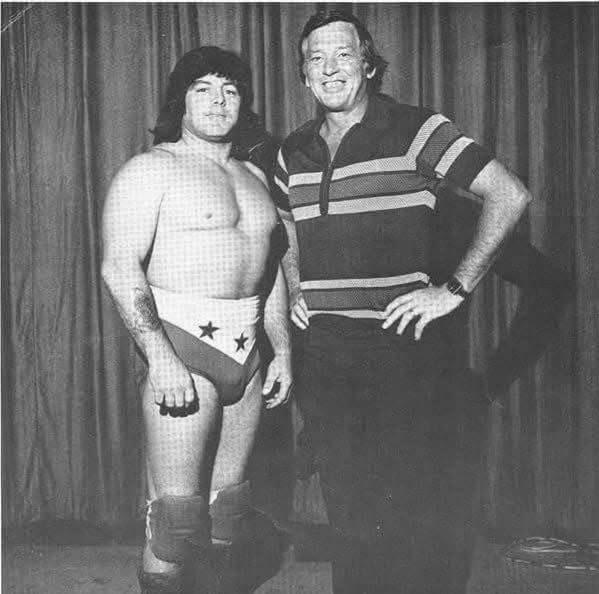
Pictured: Bill Dundee and Eddie Marlin
The timing of the turn was also important because Dundee was entering a new phase of his career just as Jerry Lawler was becoming the central figure around which much of Memphis wrestling revolved. Dundee’s emergence as a popular singles babyface would eventually lead to one of the greatest relationships in the history of the territory. Before Dundee and Lawler could become one of wrestling’s legendary tag teams and before they could engage in their many memorable rivalries, Dundee first had to establish himself as a babyface who could stand on his own.
The Interns program helped accomplish that. It gave Dundee a personal reason to fight. It gave him established opponents. It gave him television exposure. It gave the audience a reason to cheer him.
And it gave him the opportunity to prove that he could carry a singles program.
The feud also illustrated Dundee’s remarkable ability to reinvent himself without losing the characteristics that made him special. The heel Dundee had been aggressive, cocky and willing to fight. The babyface Dundee remained aggressive, cocky and willing to fight. The difference was that he was now directing those qualities against the men the audience hated.
That was one of the secrets of his longevity.
Dundee did not have to become an entirely different person every time his alignment changed. He understood his own personality and knew how to redirect it.
The Interns and Dr. Ken Ramey therefore became the bridge between two distinct chapters of Dundee’s Memphis career. The Australian heel who had arrived with George Barnes was disappearing, and the Superstar Bill Dundee that fans would come to know was emerging.
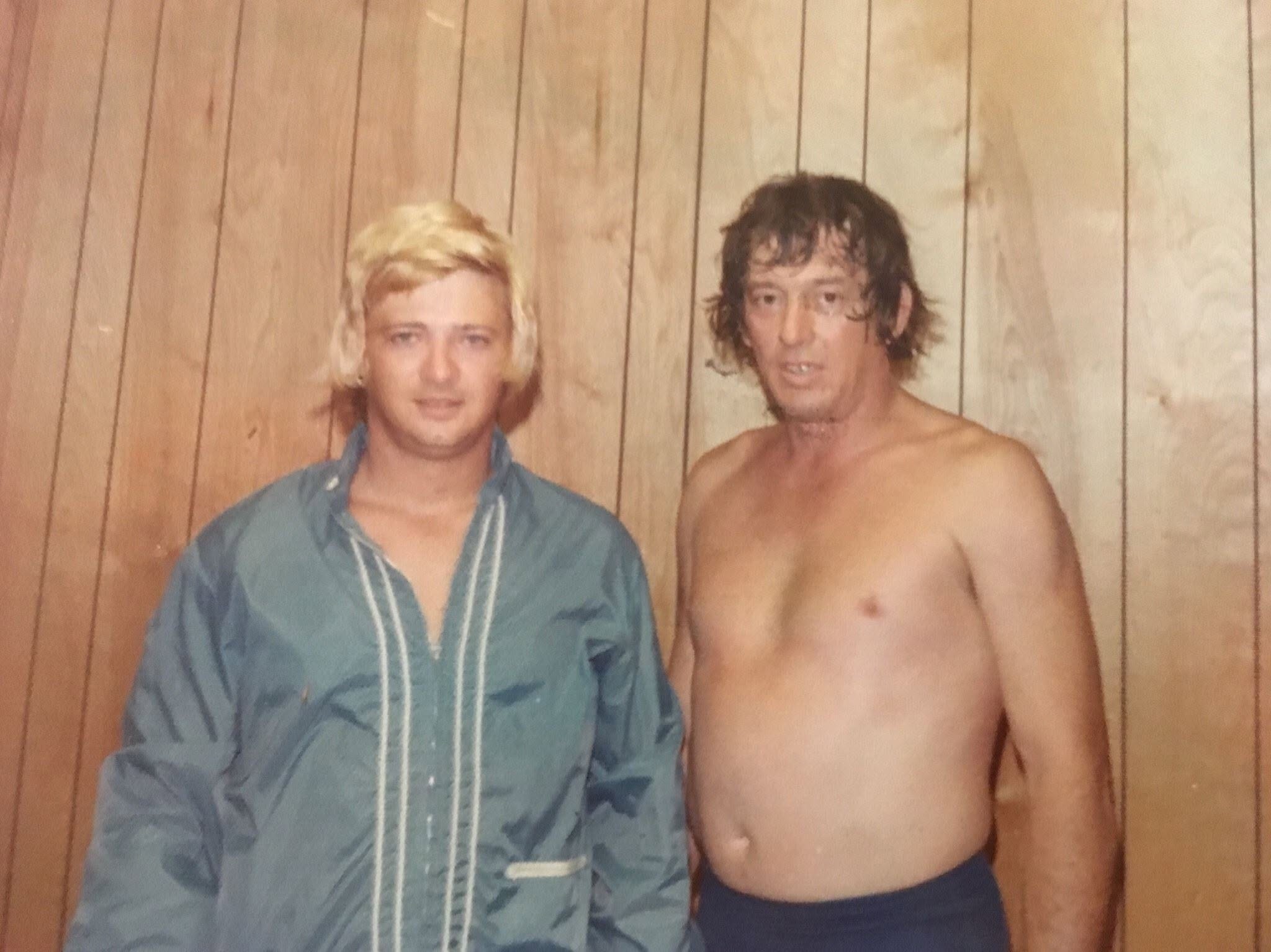
Pictured: Booker Jerry Jarrett and Eddie Marlin
His transition also demonstrated the remarkable effectiveness of Memphis television. The attack on Eddie Marlin happened in the studio, where the audience could see the violence unfold before them. Dundee’s intervention immediately changed the emotional relationship between the wrestler and the fans. The arena matches then provided the continuation of the story.
The Interns would eventually move toward the end of their great Tennessee run, but their importance to Dundee’s career would remain. They were the opponents who helped transform him from an Australian heel into a Memphis babyface. Dr. Ken Ramey became the villain Dundee could fight on a personal level, while Eddie Marlin became the veteran whose rescue provided Dundee with his new identity.
It was one of those simple wrestling angles that, in retrospect, changed an entire career. Bill Dundee entered the television studio as a former heel.
He walked out as a babyface.
And from that moment forward, his career in Memphis wrestling would never be the same. The next chapter would be bigger.
Dundee would establish himself as a major singles performer, become one of Jerry Lawler’s greatest partners, develop one of wrestling’s most enduring friendships and rivalries with Lawler, and ultimately become one of the defining figures in the history of Memphis wrestling.
But it all began with Eddie Marlin being attacked.
And Bill Dundee deciding that he had seen enough.
Bill Dundee Becomes the Superstar: The Big Bad John and Bicentennial Baby Program
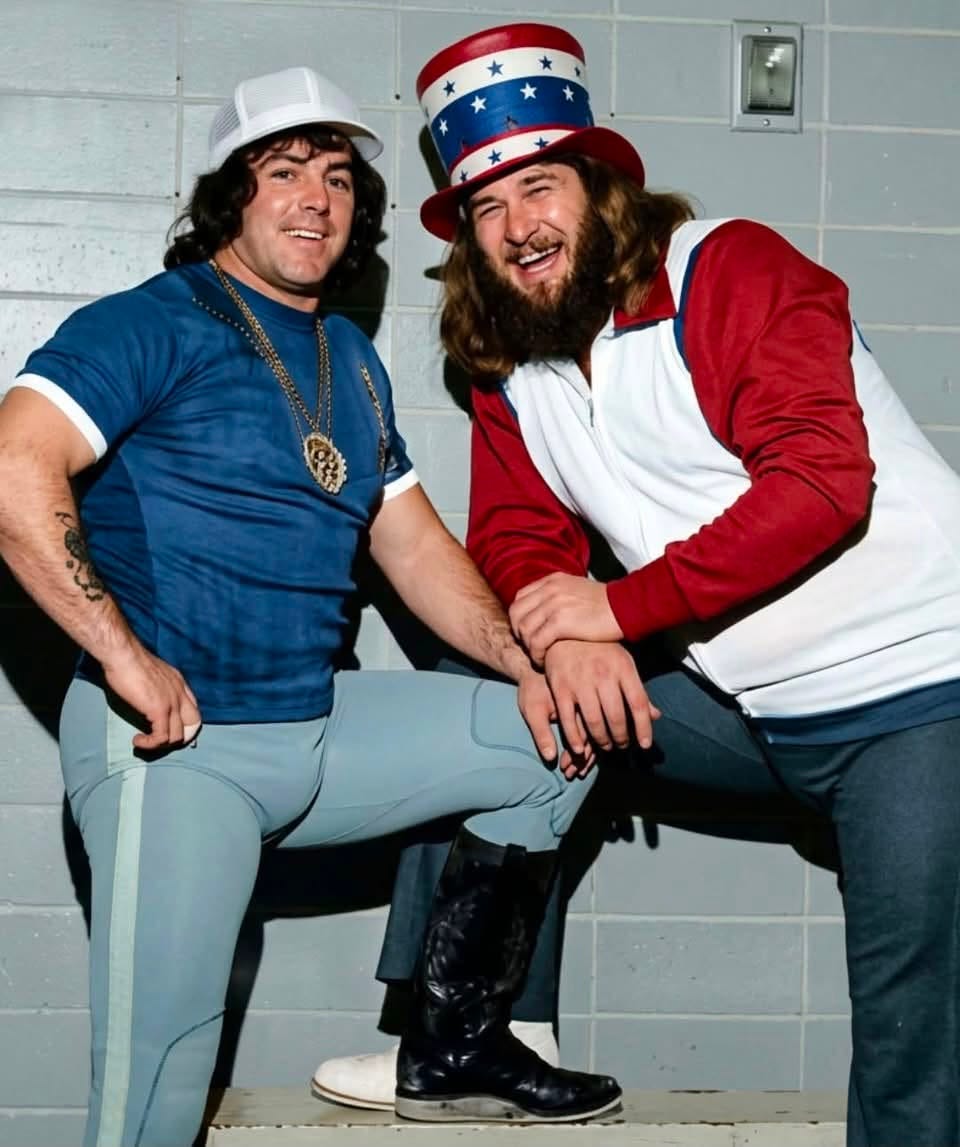
Pictured: Superstar Bill Dundee and The Bicentennial Baby, Big Bad John
The next major chapter in Bill Dundee’s Memphis career came in 1976, when Dundee’s newly established babyface persona was paired with one of the most unusual and entertaining characters in the territory: Big Bad John, who was being presented as the Bicentennial Baby during America’s 1976 celebration of its 200th birthday.
By this point Dundee had successfully completed his transformation from an Australian heel into a popular Memphis babyface. The victory over the Interns and his alliance with Eddie Marlin had given him a new identity, but he still needed something that would elevate him from being simply another popular wrestler into a character the Memphis audience could immediately identify. That came through one of the simplest moments imaginable—a nickname spoken during a television interview.
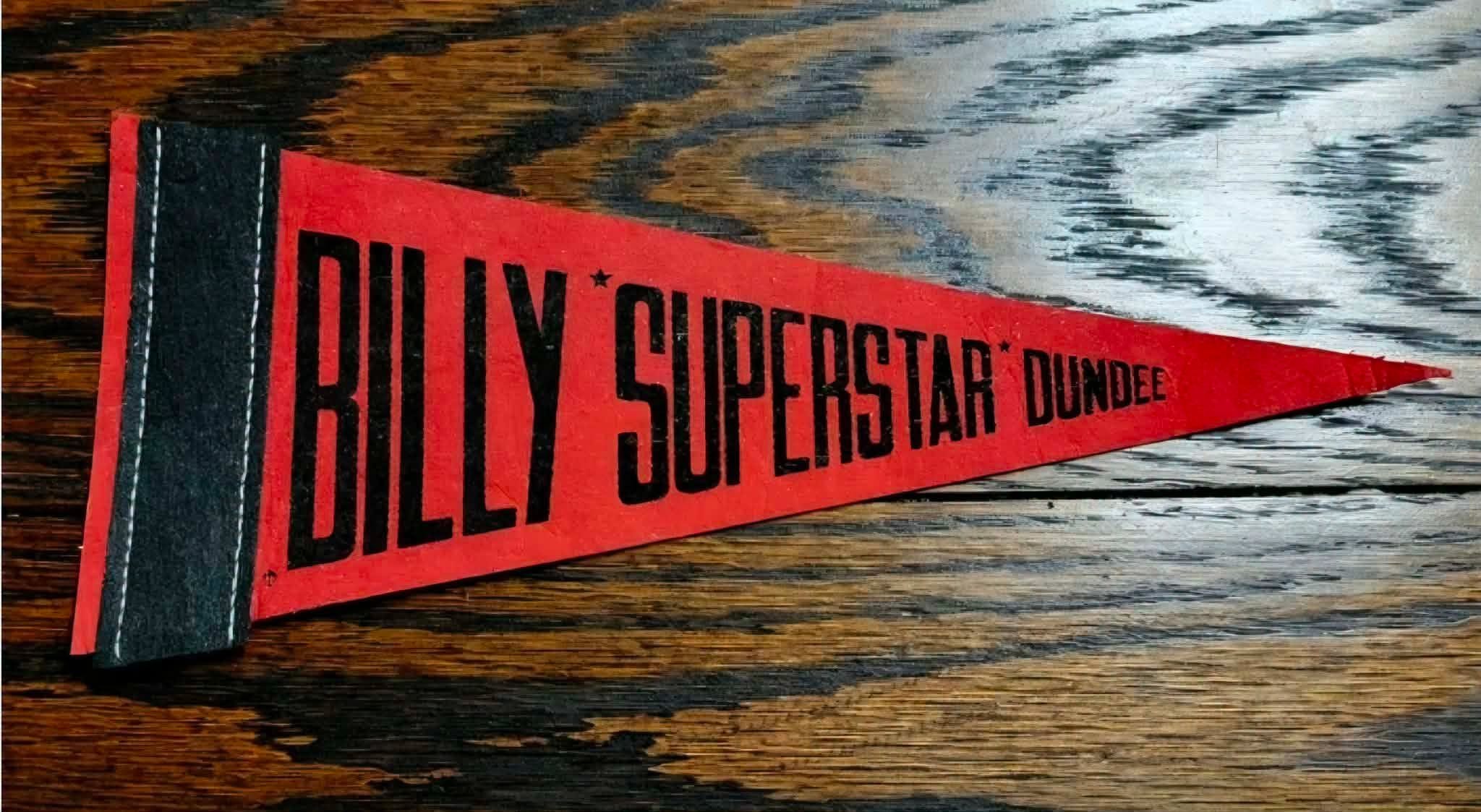
Big Bad John referred to Dundee as “the Superstar.”
The phrase immediately clicked.
There was no elaborate marketing campaign behind it. There was no complicated explanation. Big Bad John simply called him the Superstar, and Memphis television audiences began hearing the name attached to Bill Dundee. It was the kind of spontaneous piece of wrestling magic that the territory system could produce. A nickname was thrown out on television, the audience responded to it, and before long it became permanently attached to the wrestler.
From that point forward, Bill Dundee was “Superstar” Bill Dundee.
The timing could not have been better. Dundee was already becoming one of Memphis’ most popular babyfaces, and the nickname gave the character a larger-than-life quality. There was also a wonderful contradiction in the name. Dundee was hardly built like the traditional image of a superstar. He was a comparatively small wrestler competing in a business dominated by much larger men. But that was precisely what made the nickname work. Dundee carried himself as though he belonged at the top of the card, regardless of how big the man standing across from him might be.
The Big Bad John program also reflected the uniquely colorful nature of Memphis wrestling during the Bicentennial year. The entire country was celebrating the 200th anniversary of American independence, and professional wrestling naturally incorporated the Bicentennial theme into its television characters and angles. Big Bad John became the Bicentennial Baby, a patriotic character designed to capitalize on the national celebration. Jerry Jarrett, as a booker, was particularly adept at taking contemporary events and turning them into wrestling personalities that audiences could immediately understand.
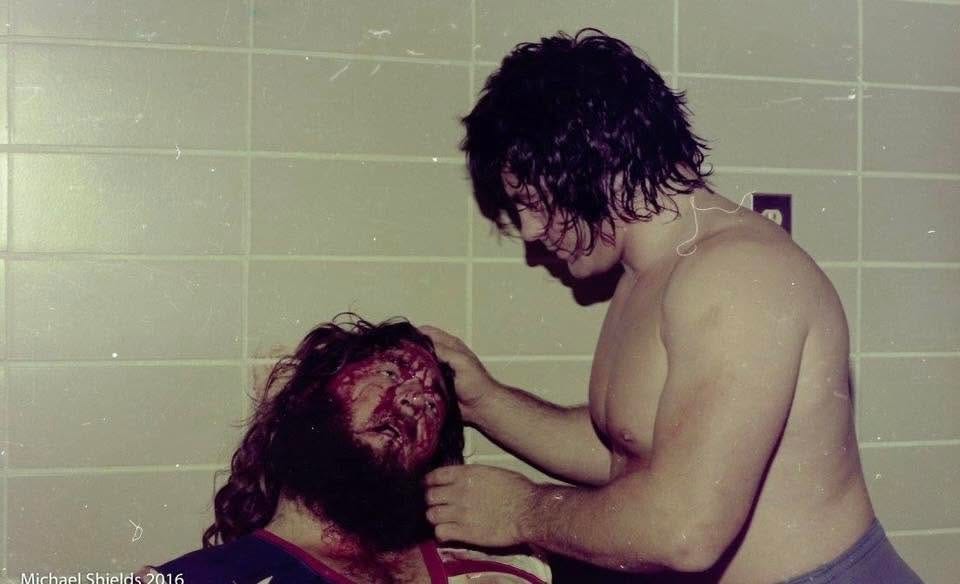
Pictured: Dundee checks on a bloody Big Bad John
Dundee and Big Bad John therefore occupied an interesting place in the territory. Dundee was the newly popular Australian babyface who had become one of Memphis’ rising stars, while Big Bad John represented the larger-than-life patriotic attraction of the Bicentennial period. Their interactions helped Dundee continue building his television personality while giving the audience another memorable character with whom to associate him.
The most historically important part of the relationship, however, remains that television interview.
Big Bad John calling Dundee “the Superstar” was one of those accidental-looking moments that became permanent wrestling history. The wrestling business has produced countless nicknames over the decades, but very few actually become inseparable from the performer. In Dundee’s case, the name fit so perfectly that it eventually became impossible to imagine him without it.
There was another reason it worked.
Dundee had already earned it.
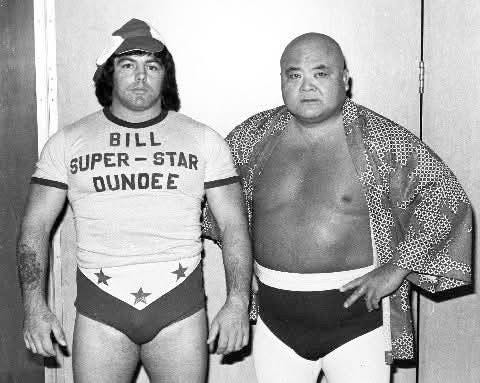
Pictured: Superstar Bill Dundee and Tojo Yamamoto
By 1976 he had survived the difficult transition from Australia to the American territorial system. He had established himself in the Gulas-Welch promotion. He had worked alongside George Barnes. He had been involved in the Fuller family feud. He had turned babyface by coming to Eddie Marlin’s rescue. He had fought the Interns and Dr. Ken Ramey. He had begun establishing himself as a singles performer. He had proven that he could generate a reaction from the wrestling audience.
Now he had a name that captured what he was becoming.
Superstar.
The nickname also became particularly appropriate because Dundee’s career was about to enter its most important phase. He was moving toward the relationship with Jerry Lawler that would define much of his legacy. Dundee would become Lawler’s friend, tag-team partner, bitter rival and one of the few wrestlers who could stand across the ring from Lawler and command an audience’s attention on equal terms.
But before Dundee became “The Superstar” in the full historical sense of the term, he first had to become Superstar Bill Dundee in the minds of the fans.
That happened in 1976.
Big Bad John gave him the name.
And Dundee made it his own.
The story is also a perfect example of why television was so important to the Tennessee territory. In a modern wrestling environment, a nickname might be carefully scripted, trademarked and promoted across every form of media. In the territorial era, some of the most memorable pieces of a wrestler’s identity could emerge organically from a television interview. A wrestler said something. Another wrestler responded. The audience reacted. The booker recognized that it worked. And suddenly a phrase became part of wrestling history.
That is exactly what happened with Dundee.
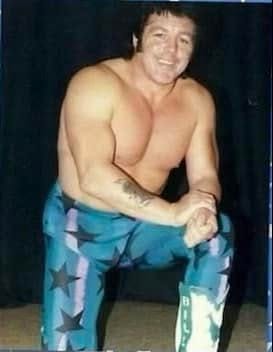
The name “Superstar” fit the personality that had been developing since his babyface turn. Dundee was confident without being physically imposing. He was cocky without necessarily being arrogant. He was a fighter who could take punishment and keep coming. He had the ability to make larger wrestlers look threatening while still convincing the audience that he could defeat them.
The nickname therefore became more than an introduction.
It became a character.
“Superstar” Bill Dundee was no longer simply an Australian wrestler who had come to America looking for work. He was now a Memphis wrestling personality with an identity uniquely his own.
The irony is that the man who gave Dundee the name was not necessarily trying to create one of the most enduring nicknames in wrestling history. Big Bad John was simply being Big Bad John, talking in the colorful and unpredictable manner that made Memphis television so entertaining.
Jerry Jarrett heard it.
And the name stayed.
For the remainder of his career, whether he was wrestling in Memphis, working elsewhere in the territorial system, teaming with Jerry Lawler, managing younger wrestlers or making appearances decades later, Bill Dundee would almost always be introduced by the name that began with that seemingly insignificant television moment:
Superstar Bill Dundee.
The Jerry Lawler Connection
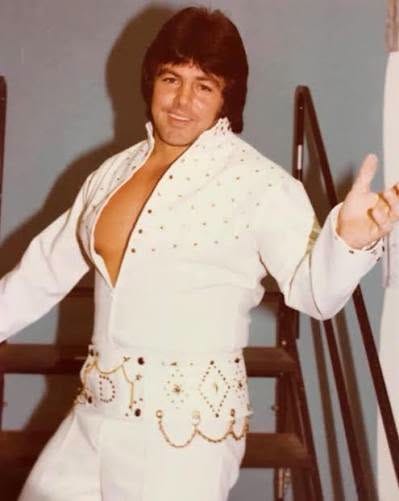
The Interns provided Dundee with some of his earliest important singles opportunities after the turn. He became increasingly involved with Dr. Ken Ramey and the masked team, while also beginning to work regularly with and against many of the territory’s leading wrestlers. The programs gave him something that tag-team wrestling could not provide: the opportunity to establish himself as a personality whose name alone could help sell a match.
At the same time, Dundee’s developing relationship with Jerry Lawler began to take shape.
Lawler was already one of the central figures in the Memphis territory. By this point he was not simply another wrestler on the roster; he was becoming the wrestler around whom the territory increasingly revolved. Dundee’s emergence therefore placed him on a collision course with one of the most important personalities in the promotion. But their relationship was more complicated than a simple babyface-versus-heel rivalry.
Dundee and Lawler represented two very different kinds of wrestling personalities. Lawler was the hometown superstar, a larger-than-life Tennessee character who had developed an extraordinary connection with the Memphis audience. Dundee was the outsider who had arrived from Australia, had worked his way up through the tag ranks and was now establishing himself as a singles wrestler. That contrast gave promoters an almost unlimited number of possibilities.
Initially, the two could work together when circumstances required it. Dundee’s transition did not mean that he immediately became Lawler’s permanent ally, nor did their relationship instantly become the defining rivalry it would eventually become. Instead, they gradually became two of the territory’s most recognizable personalities, sometimes standing on the same side and sometimes standing opposite one another.
That gradual development is important to understanding the eventual Dundee-Lawler relationship. Their chemistry was not created overnight. It was built through repeated encounters, tag-team combinations, six-man matches, television confrontations and the constant movement between alliance and rivalry that was fundamental to Memphis wrestling.
Dundee’s early 1976 programs demonstrate how quickly his position had changed. He was now appearing regularly in important singles and tag matches, working with established babyfaces such as Jackie Fargo and Tojo Yamamoto while also finding himself across the ring from Lawler and other major heels. The difference from the beginning of 1975 was striking. A wrestler who had originally been introduced primarily as George Barnes’ partner was now being positioned as an attraction in his own right.
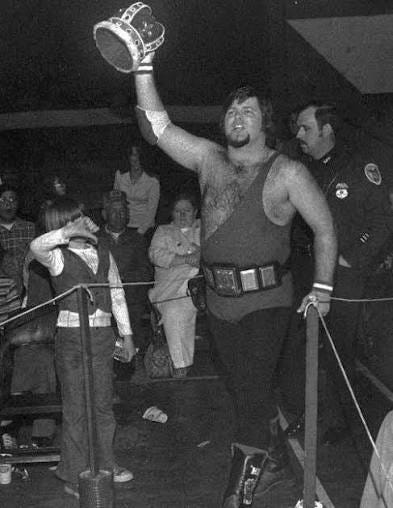
Pictured: Jerry “The King” Lawler withhis crown and the NWA Southern Junior HEavyweight Title Belt
The relationship with Lawler was particularly valuable because it gave Dundee an immediate connection to the territory’s central story. Lawler’s popularity meant that anyone who worked closely with him—either as an ally or an adversary—was automatically brought into the center of the Memphis wrestling universe. Dundee was beginning to occupy that space.
This was also the period in which Dundee demonstrated that he could be a believable main-event wrestler despite not fitting the traditional physical image of one. He was smaller than many of the men he wrestled, but he had extraordinary ring intelligence. Dundee understood timing, psychology and crowd reaction. He knew when to sell an opponent’s power, when to fight from underneath and when to explode with a burst of offense. Those qualities allowed the audience to believe that he could defeat wrestlers who appeared to have obvious physical advantages.
That credibility became one of the foundations of his career.
The first major singles run was therefore about much more than simply finding Dundee new opponents after Barnes returned to Australia. It was the beginning of his transformation from a talented imported wrestler into a Memphis institution. The territory had given him an opportunity, but Dundee had earned the audience’s investment through his work.
More importantly, the emergence of “Superstar” Bill Dundee and the developing relationship with Jerry Lawler marked the beginning of the most important phase of Dundee’s American career. His partnership with Barnes had introduced him to Memphis. His feud with the Interns helped transform him into a babyface. His first singles run established that he could succeed without a partner. And his association with Lawler would eventually place him at the heart of one of the greatest relationships in the history of territorial wrestling.
In professional wrestling, the best rivalries are rarely created simply because two wrestlers decide they do not like one another.
The greatest rivalries develop history. The audience remembers what happened previously. They remember betrayals. They remember friendships. They remember championships. They remember who helped whom and who turned on whom.
Dundee and Lawler accumulated that history over years.
One of the defining moments came in 1977 when Dundee defeated Lawler in Memphis and took $2,000 of Lawler’s money. What might have been merely another wrestling match became the beginning of another chapter in a relationship that would continue to produce major programs for years.
The remarkable thing about Dundee and Lawler was their chemistry. They knew how to work together. They knew how to make one another look good. They knew how to build a match. They knew when to sell. They knew how to make the audience believe.
And they understood that the audience was not simply watching a wrestling match.
The audience was watching a chapter in a continuing story.
Eventually Dundee and Lawler would become one of wrestling’s great tag teams. They captured major championships together, including the AWA World Tag Team Championship, while continuing to maintain the possibility that at any moment they could once again become bitter enemies. That possibility was part of the magic.
The audience never completely forgot the history between them.
76-78 Lawler Program
The 1976–77 Lawler–Dundee program is two stories stacked on top of each other. The first is a pair of late-1975 / early-1976 singles matches that proved they could work. The second is the ten-match summer of 1977 that put Jerry Jarrett’s new Continental Wrestling Association on the map. Newspaper clippings later put the ten Coliseum mains at 85,538 tickets, about 8,500 a night, with one documented sellout of 11,300 on August 1. That is not nostalgia math. That is how a split territory survived its first summer.
Before the war: 1975–76
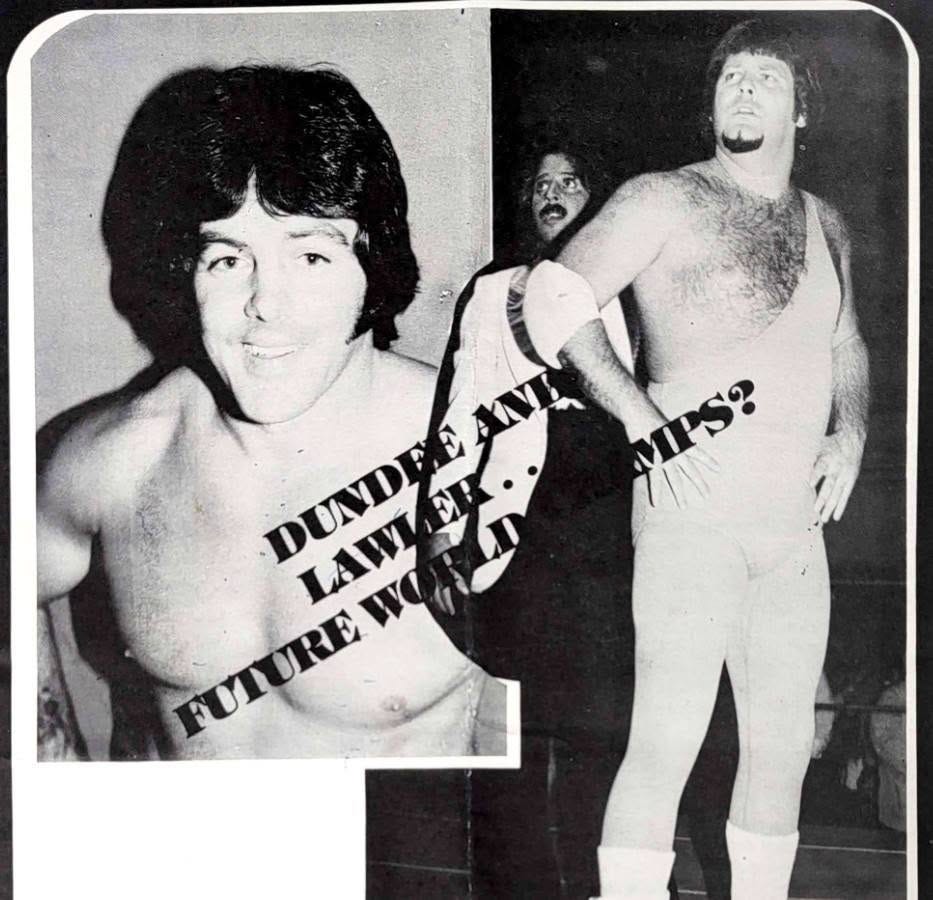
They were not invented as enemies in July 1977.
On a December 1975 Mid-South Coliseum card they went to a no-contest, then Dundee beat Lawler in a no-DQ rematch, then Dundee teamed with Bob Armstrong against Lawler and Sam Bass. Those were NWA Gulas-Welch shows under Nick Gulas as Promoter and Jerry Jarrett as the booker, while both men were still finding their Memphis roles: Lawler the local heel with the mouth, Dundee the imported 5-foot-7 fireplug who had arrived in 1974 with George Barnes.
Through early 1976 and the first half of 1977 they shared cards without being the program. Dundee won Southern Tag gold with Ricky Gibson, worked with Tommy Gilbert and Tommy Rich, and beat men like Leroy Brown in cages. Lawler worked the Mongolian Stomper, Bob Armstrong, Rocky Johnson, Dusty Rhodes, and Paul Orndorff.
They were the two men you could put last. They were not yet the two men you could build a company around. The company changed underneath them. Jarrett broke from Gulas in March 1977 and took the Memphis loop of Louisville, Evansville, Lexington, etc. Lawler came with him as the attraction. Gulas’s last Coliseum houses collapsed so badly that by April 4, 1977, a Gulas Memphis card drew 1,148. Jarrett had the building, the Saturday morning television, and one summer to prove the split was not a vanity play.
By June 1977 the Jarrett Coliseum shows were doing mid-six-thousands: 6,110, 6,784, 7,122, 6,731. Lawler was the hated King. Dundee was the babyface who could go forty minutes and make a building believe a small man had a chance. Jarrett’s move—described later by everyone from Jimmy Hart to Kayfabe Memories—was to point his two biggest stars at each other and let the personal heat do the rest. Lawler heel. Dundee face. Southern Heavyweight Championship as the object.
Money, a Cadillac, hair, a manager’s hair, and finally a wife’s hair as the escalator.
The structure is classic Memphis weekly booking and the rest of the towns following the stories the next week. Saturday TV sells Monday at the Coliseum. Monday’s result writes next Saturday’s interview. You do not blow the whole feud off in one gimmick. You add a stake every time the last stake has been cashed.
The ten-match summer, week by week
July 4, 1977 — 5,371.
Lawler’s dare: he can pin Dundee twice in fifteen minutes. Each man puts up $2,000. Dundee lasts. Lawler does not get the two pins. Dundee leaves with $4,000. The house is still a holiday crowd, not a feud crowd. The insult is the point. The King could not pin the runt twice with a clock running.
July 11, 1977 — 8,044.
Same pin-twice-in-fifteen structure, now inside a steel cage, with Dundee’s $4,000 against Lawler’s Cadillac. Dundee wins again. The car leaving the building with the babyface is the first visual that made the program feel like theft instead of sport. Attendance jumped almost 2,700 in one week.
July 18, 1977 — 8,783.
They do not wrestle each other. Dundee pins Plowboy (Giant) Frazier. Lawler beats Paul Orndorff for the Southern Heavyweight Title. That is not a bye week. That is the booker putting the belt on the heel so the next Dundee match can be title versus property.
July 25, 1977.
Car versus title. Dundee beats Lawler and walks out Southern Champion. The babyface now has the King’s money, the King’s car, and the King’s belt. Kayfabe humiliation is complete. The next ask has to be something Lawler cannot buy back.
August 1, 1977 — 11,300, sellout.
Hair versus car, twenty minutes and one second. Lawler beats Dundee, takes the title back, and takes the Cadillac back. This is the night the Coliseum hits the number everyone cites. It is also the night the feud learns it can sell out on a stipulation. Hair is now live ammunition.
August 8, 1977 — 11,103.
They go again. Dundee beats Lawler on the same card where Lawler, as champion, also beats Orndorff. The house holds at eleven thousand. The program is no longer a curiosity. It is the Monday night business.
August 15, 1977 — 8,397.
Lawler retains in 24:04. The house dips. Elvis Presley would die the next day; Memphis police working the Coliseum that Monday would spend the rest of the week on something else. The dip matters for the booker. A weekly territory that just did back-to-back 11,000s cannot live on a 8,400 hangover. You escalate or you cut.
August 22, 1977.
Dundee’s hair versus Mickey Poole’s hair, title on the line. Dundee beats Lawler in 24:08 and is champion again. Poole, Lawler’s on-screen manager and professional lackey, is shaved in the ring. The next Saturday on television, Poole walks out with a full head of hair. Lawler’s explanation is the late Sam Bass’s “hair-growing tonic.” Beverly Dundee storms the set. Bill has to drag his own wife off camera. That is the moment the feud leaves the ring and sits down in the living room.
August 29, 1977.
Texas Death, car versus hair. Lawler beats Dundee and takes the title back. The Death match is the “we have used every other toy” card. It is also how you put the belt back on the heel before the hair-versus-hair blowoff.
September 5, 1977 — 10,129.
Hair versus hair. Poole locked in a cage so he cannot interfere. Lawler beats Dundee. Dundee is shaved in the middle of the Coliseum. For a lot of paying customers, this should have been the end, but Jarrett realizes there’s another match in this program.
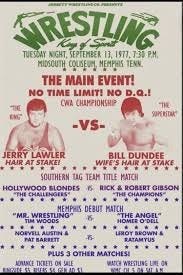
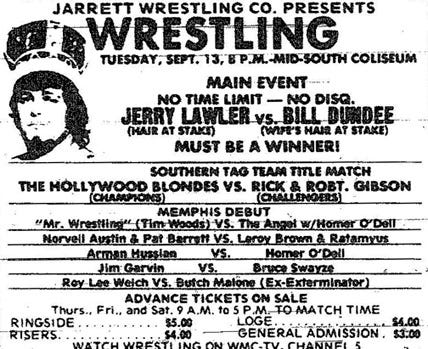
September 13, 1977 — Tuesday show.
Lawler’s hair versus Beverly Dundee’s hair, no disqualification, title at stake. Lawler wins by countout in 29:00. After a barber freezes and the crowd turns, Dundee himself pushes the finish through. Beverly is shaved. Lawler then “retires.” The Southern title is vacated. Jimmy Valiant wins it in a Louisville tournament on September 25. Lawler is back in October.
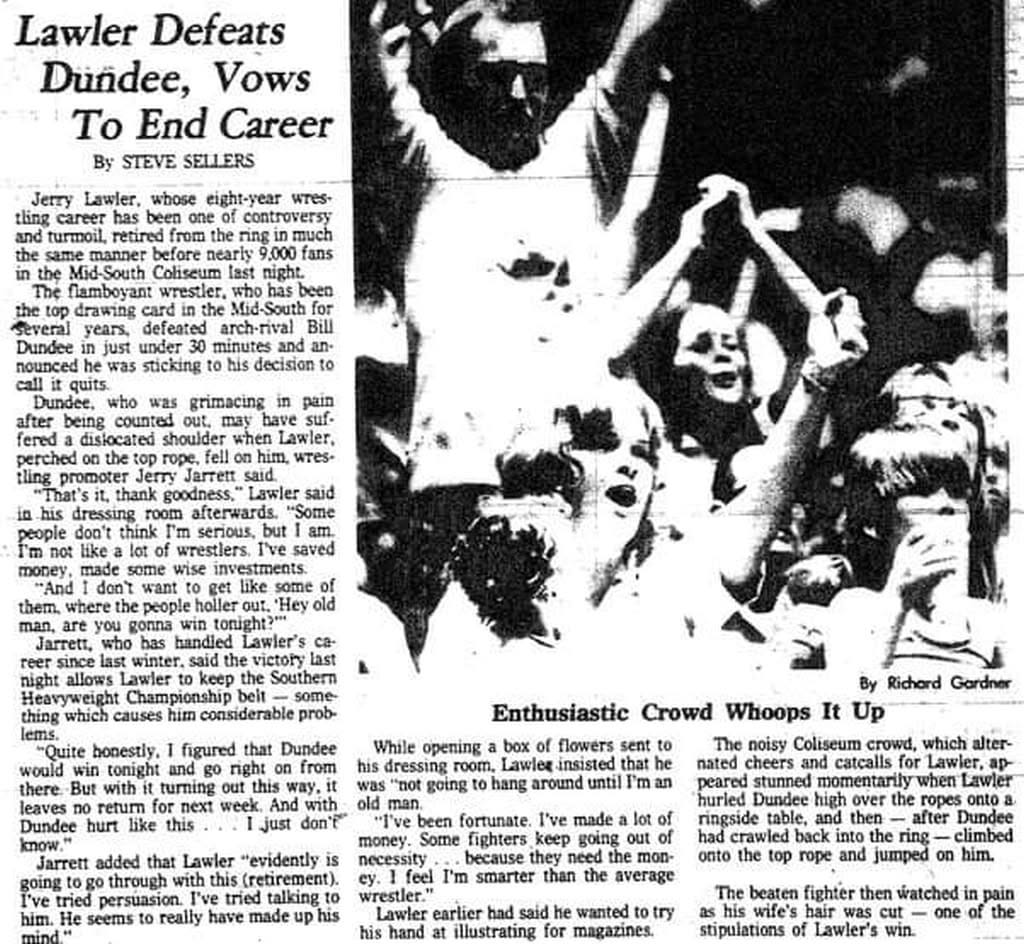
Pictured: Memphis newspaper story on September 14th, 1977, Lawler talks retirement at the end of the first big Lawler-Dundee series in the Summer of 1977
Dundee’s later crack about the two shaves—first one was the down payment on a house, second one furnished it—is the honest accounting of what those nights were worth to the office.
What Jerry Jarrett’s sequence actually does
Read as Jarrett’s actual booking, not as folklore, the summer is a textbook escalation ladder:
Money ($2,000 / $4,000)
Property (Lawler’s Cadillac, then Dundee’s)
Championship (Southern Heavyweight, flipped July 25, August 1, August 22, August 29)
Surrogate hair (Mickey Poole)
The wrestler’s hair (September 5)
The wife’s hair (September 13)
The heel’s retirement as a pressure-release so the territory can pivot to Valiant They met in lights-out, bull-rope, special-referee, and no-DQ finishes along the way. The variety kept the Monday house from feeling like a rerun. The title changing every week or two kept the Saturday interview from being empty talk. The family stipulation is the part modern readers flinch at. In 1977 Memphis it was the last thing you could put on a poster after cars and crowns were already gone. Jarrett’s office did not invent hair matches. It used them as currency when the crowd had already bought everything else.
The win-loss pattern is not “Dundee wins two for every Lawler win,” despite later shorthand. Dundee takes the early money and the car. Lawler takes the blowoffs. That is how you get eleven weeks of business instead of a three-week squash. The babyface has to look like he can end the King. The King has to be standing at the end of summer, because the King is the franchise. Why 1976 belongs in the sentence Without 1975–76, 1977 is a booking experiment. With it, 1977 is two men who already know each other’s timing, already have a no-DQ tape in the building’s memory, and already share the top of the card with everyone else in the locker room watching.
The Lawler and Dundee Gulas-Welch year taught the city they could wrestle. The Jarrett summer taught the city they could draw. After September they tagged. By year’s end they were usable as a team. That is the Tennessee booking strategy in one paragraph: feud them until the building is full, then put them together before the crowd cuts the program off. The 1983 and 1985 revivals—loser-leave-town, hair again, title again—only work because 1977 already taught Mid-South Coliseum customers what those two names on a poster meant. Nothing later quite recaptured the first summer, because nothing later was also the first year of a new promotion trying not to die.
The August 15 / August 22 hair-and-car tapes are mislabeled in circulation; Cagematch and the Southern title lineage are the cleanest way to keep the flips in order. Promos exist. Dundee on Channel 5 recapping the $2,000, the $4,000, and the Cadillac—“it drives real good”—is the feud in one interview. Lawler’s tonic angle with Poole is the feud learning to use television as a second ring.
The business record is not thin. Five thousand on July 4. Eight thousand the next week. Eleven thousand twice in August. Ten thousand for the hair-versus-hair. Eighty-five thousand through the turnstiles for ten mains. Jarrett’s Promotion did not become Memphis Wrestling because of a logo. It became Memphis Wrestling because two men spent eleven weeks taking each other’s money, car, belt, manager, hair, and family on Monday nights, and the city kept buying a ticket to see which piece would come off next.
The 1978-1979 Lawler-Dundee Tag Team
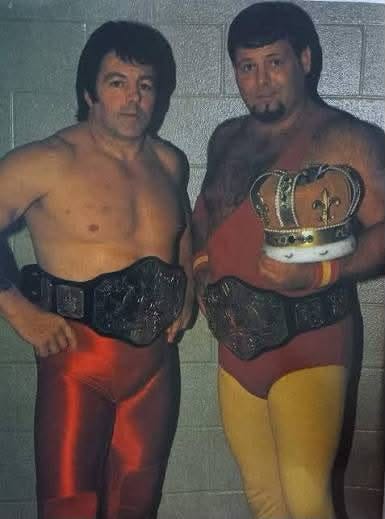
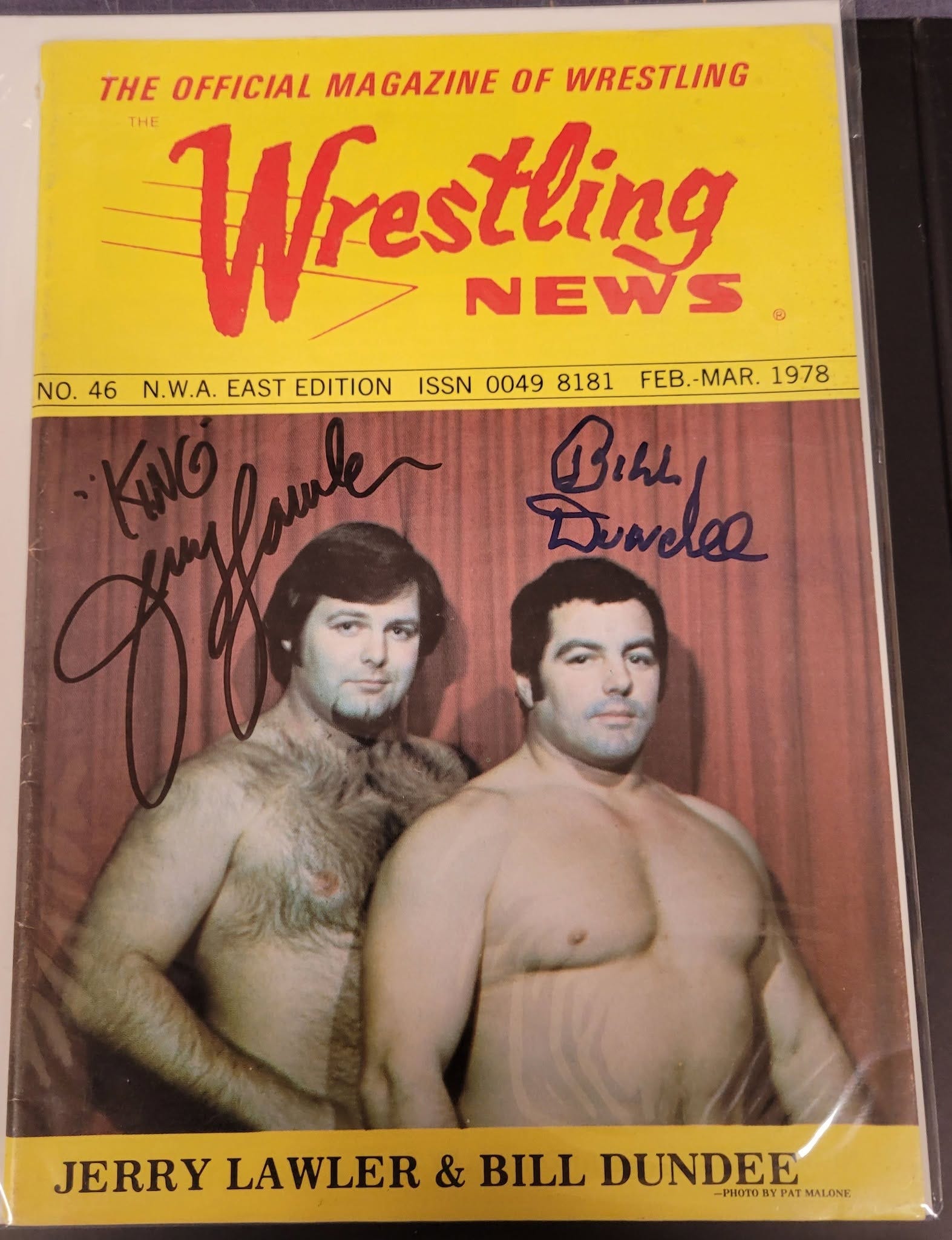
he 1978–79 Lawler–Dundee tag years are the other half of the 1977 war. Jerry Jarrett did not throw the two biggest names in his promotion back at each other the week after Beverly Dundee lost her hair. He put them together, gave them the Southern Tag Team Championship three times, and used the team as the babyface engine of a promotion that was now aligned with the AWA. The pairing worked because the city already believed they hated each other. When they tagged, it looked like a truce with a timer on it. When the timer ran out in the fall of 1979, they were back in singles and trading the Southern Heavyweight Title.
After the shave: why they teamed
By the end of 1977 the feud had done its job. Lawler was the franchise heel-turned-centerpiece. Dundee was the imported workhorse who could main-event without being Lawler. Keeping them apart forever would have wasted the one thing Memphis sold better than anyone: two men the building already knew. Putting them together let Jarrett book six-mans against Jos LeDuc and Jean Louie, give the AWA a recognizable babyface team when Verne Gagne’s champions came through, and rest the singles program until the next time he needed a house.
They had already tagged before they ever feuded—December 1975 and early 1976 cards had them on opposite sides more often than together—but 1978 is when the team becomes a product.
First reign: March 13 to May 1, 1978
On March 13, 1978, at the Mid-South Coliseum, Lawler and Dundee beat Norvell Austin and Sonny King and left as Southern Tag Team Champions. The reign lasts 49 days. The opponents that spring are the Canadian wrecking crew: LeDuc and Louie, with Sonny King as the third man.
The six-man formula of May 1978 is the team at full volume.
• May 1: Lawler, Dundee, and Jimmy Valiant versus LeDuc, Louie, and King goes to a no-contest.
• May 8: the same six-man, babyfaces win. Attendance that night is 6,111.
• May 15: the heels take it.
• May 22: Lawler and Valiant versus LeDuc and Louie ends as a no-contest and the tag titles are vacated.
• May 29: Lawler and Valiant beat LeDuc and Louie and take the belts.
Dundee is not on the title-winning team on May 29. That is the first crack in the 1978 pairing: Jarrett can plug Valiant in beside Lawler and the city still buys it. Dundee works the undercard and the junior-heavyweight scene against Nelson Royal. The team is not a permanent marriage. It is a booking module.
Summer 1978: they split the card, not the city
June through September 1978 is mostly singles and mixed tags. Lawler’s war with LeDuc over the Southern Heavyweight Championship is the A-show. Dundee beats Valiant in a lumberjack match on August 28 and loses to Royal for the NWA World Junior Heavyweight Title. On August 21, billed as the biggest card in Memphis history, 11,000 people watch Lawler go to a DQ with AWA World Champion Nick Bockwinkel.
Dundee is on the same show in an eight-man with Dick the Bruiser, Tommy Gilbert, and Wayne Ferris against LeDuc, Louie, and the Valiant Brothers. That is the office using both men as pillars without forcing them to hold hands every Monday.
On September 18 Lawler wins the tag titles with the Mongolian Stomper. The Stomper turns. The belts are vacated. On October 9 the Bounty Hunters—David and Jerry Novak—win a tournament final over Dundee and Valiant. Lawler had been in the tournament with Wayne Ferris and lost in the first round to Nelson Royal and Don Fargo. The office is shuffling partners on purpose. The next shuffle puts the original pair back together.
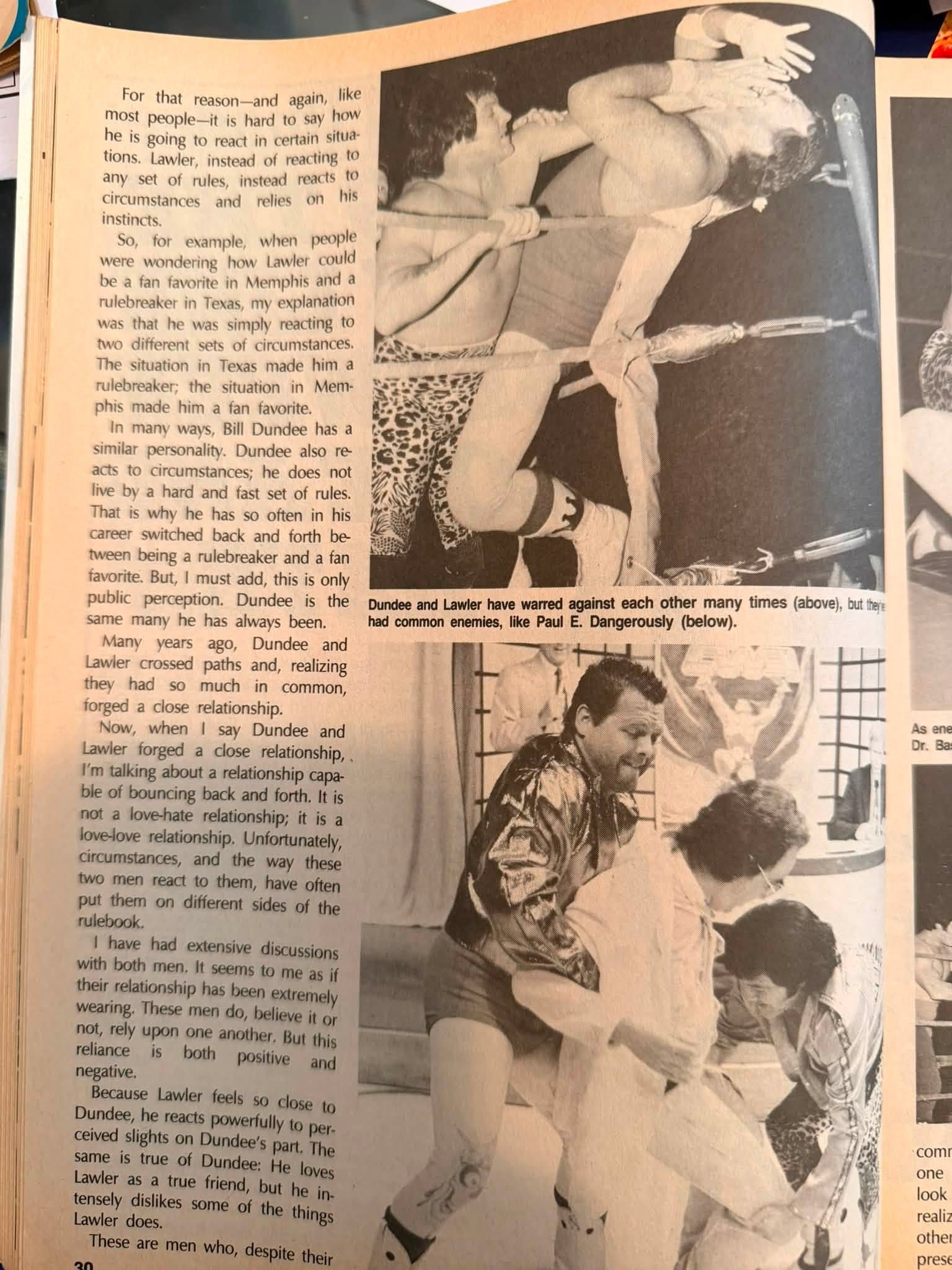
Second reign: November 6 to December 18, 1978
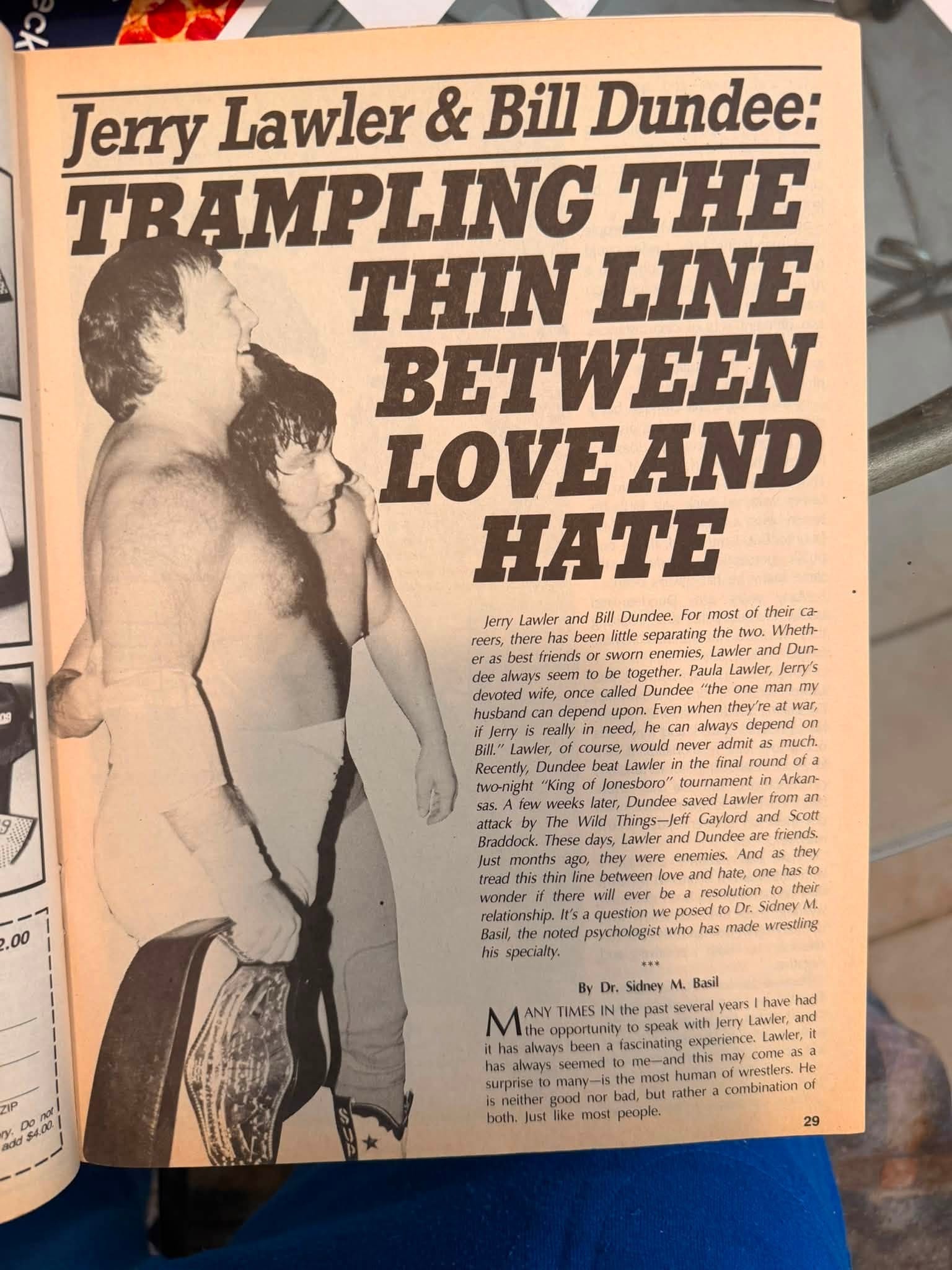
November 6, 1978, Mid-South Coliseum: Lawler and Dundee beat the Bounty Hunters for the Southern Tag Team Championship. That is the cleanest “they are a team again” date of the year.
The next seven weeks are a proper title run:
• November 13: they retain against the Bounty Hunters. Manager Chuck Malone’s hair is on the line. Malone is shaved.
• November 20: no-contest with Jimmy Valiant and Wayne Ferris.
• November 26–27: they beat Valiant and Ferris in Louisville and then in Memphis under no-disqualification.
• Mid-December: Lawler, as Southern Heavyweight Champion, goes sixty minutes to a draw with Dundee. The singles clock is ticking while they still hold the tag belts.
• December 18: Dennis Condrey and Phil Hickerson beat them for the titles in front of about 4,000.
Forty-two days. Hair stipulation on the manager. Valiant and Ferris as the transitional heels. Then Condrey and Hickerson, the most reliable tag heels in the territory, take the belts so Lawler and Dundee can go back to being something else.
1979: the reunion that ends in Tupelo
Winter and spring of 1979, Dundee tags with other people. February 26 he wins the Southern Tag titles with Robert Gibson. May 7 he wins them with Robert Fuller. Lawler is in the singles mix with Ron Fuller, Toru Tanaka, Buzz Sawyer, and the Stomper. The office is stocking the tag division so that when Lawler and Dundee reunite it feels like an event.
June 4, 1979, Memphis: Lawler and Dundee beat Mr. Fuji and Toru Tanaka in 14:20. Lawler pins Fuji. Same night, Robert Fuller beats the Stomper in a loser-leaves-town versus title match to win the Southern Heavyweight Championship. The two top babyfaces have the tag belts; Fuller has the singles belt. That is a loaded Monday.
June 9, on WMC-TV, they defend the look if not the belts against Sputnik Monroe Jr. and Danny Davis. Lance Russell and Dave Brown sell them as a “top-flight tag team” in their second stretch with the gold. Dundee works body scissors and tags. Lawler throws the elbow. Six minutes, seven seconds. Studio match, not a Coliseum war, but it is the television proof that the 1978 team is back.
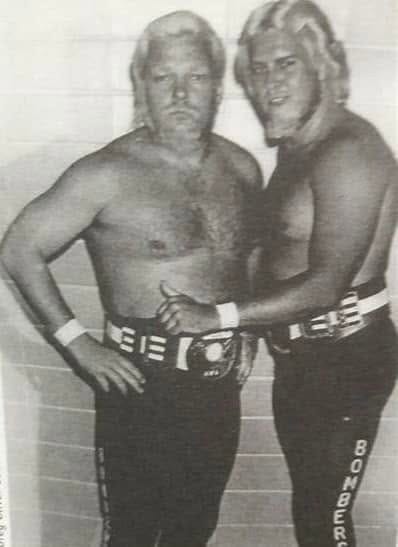
Pictured: The Blond Bombers, Larry Lathan and Wayne Ferris
Eleven days later the proof is gone.: June 15, 1979: the Blond Bombers and the concession stand.
June 15, 1979, Tupelo, Mississippi. The Blond Bombers—Wayne Ferris, later the Honky Tonk Man, and Larry Latham, later Moondog Spot—beat Lawler and Dundee for the AWA Southern Tag Team Championship. The finish is dirty. The fight does not stay in the ring. It spills into the concession area. Everything that can be thrown is thrown. That brawl is the one historians still treat as a parent of hardcore wrestling, and it is a tag team night, not a singles night. The two men who spent 1977 taking each other’s hair are now the faces getting jumped by a pair of young heels who will live off that tape for the rest of their careers.
The Blond Bombers keep the titles into the fall. Lawler and Dundee do not get them back as a team in 1979. Jackie Fargo appears on the June 30 television show offering to get in shape and help them against Latham, Ferris, and a third man. July 14 television puts Lawler and Dundee against Terry Gordy and Michael Hayes. The Freebirds work Dundee over for two falls, the babyfaces make the comeback in the third, and the post-match brawl is pure Memphis: chairs, aisles, nobody keeping time. That is the last great tape of them as 1979 partners.
How the team dies the second time
By late August they are singles again. Dundee wins the Southern Heavyweight Title on August 27 in Memphis. The belt is held up against Ron Bass, Dundee wins the rematch September 17, Lawler takes it September 24, Dundee takes it back October 1, Lawler takes it for good on October 15.
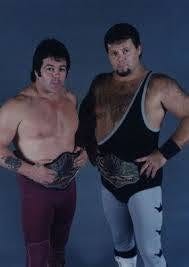
October 15 is the ugly twin of June 4. Same building. Same two men. Dundee beats a blindfolded Lawler. Then Lawler beats Dundee for the Southern Title. That is not a tag team having a bad night. That is the office turning the page.
There was a Lawler turn to December 1979 over an AWA World Title shot Dundee received and Lawler thought should have been his. The October title series already did the work. Jealousy over a world-title opportunity is the story they will reuse for years. In 1979 the concrete version is simpler: the tag belts are on the Blond Bombers, the Southern Title is the only prize left that both men can chase, and Jarrett knows the city will buy Lawler versus Dundee whenever he needs a house.
What the two years actually were: March 13–May 1, 1978, versus the LeDuc/Louie orbit. November 6–December 18, 1978, versus the Bounty Hunters, then Valiant and Ferris, lost to Condrey and Hickerson. June 4–June 15, 1979, versus Fuji and Tanaka, lost to the Blond Bombers in Tupelo.
Three reigns.
Two calendar years.
One concession-stand riot.
One sixty-minute singles draw while they still held the tag belts. One October night with a blindfold match and a title change on the same card.
The team’s job in 1978–79 was not to become the new Eddie Marlin-Tommy Gilbert team. It was to prove that the 1977 war had not burned the territory down. A split promotion in its second year needed a babyface tag team that did not have to be introduced. Lawler and Dundee were already introduced. They could beat Tanaka and Fuji. They could lose to two kids in Tupelo and turn that loss into the most famous brawl in the company’s history.
They could stand next to Jackie Fargo on Saturday morning and look like the passing of a torch that Fargo himself had carried. Then they could wrestle each other again in September and October and the Coliseum would not need a new story. The story was the one from 1977, only now the audience had watched them save each other for a year and a half. That is why the 1979 singles feud lands. The tag years are the evidence that they could have stayed together. The fall of 1979 is Jarrett cashing that evidence back in.
1979-1983 Run
The years between the 1979 tag split and the June 6, 1983, loser-leaves-town match are the stretch that turns Bill Dundee from Lawler’s opposite number into a complete territorial ace. He still needs the King when Jarrett wants a house. He does not need the King to eat. From the last Blond Bombers night in Tupelo to the night Lawler piledrives him out of Memphis, Dundee holds the Southern Heavyweight Title, the CWA World Heavyweight Title, the Mid-America Heavyweight Title, the United States Junior Heavyweight Title, and the Southern Tag Team Championship with Tommy Rich, the Dream Machine, Steve Keirn, and, briefly, Lawler again. That is not a supporting-player résumé. That is the résumé of the second franchise.
Fall 1979: the singles page turns too fast
Once the tag belts sit on Wayne Ferris and Larry Latham, the only prize both men can chase is the Southern Heavyweight Championship. Dundee wins it August 27. It is held up against Ron Bass, he wins the rematch September 17, Lawler takes it September 24, Dundee takes it October 1, Lawler takes it October 15 on a card that also gives Dundee a win over a blindfolded Lawler. Jackie Fargo then beats Lawler for the belt on November 22 in Jackson.
The 1977 summer had averaged about 8,500 and sold out 11,300. The 1979 singles revival does not. One late-October house is reported around 2,100. The city will always buy Lawler versus Dundee. It will not buy the same war twice in two years at the same temperature.
Jarrett’s answer is not to force another hair match. It is to give Dundee other people to beat and other belts to carry.
Lawler, meanwhile, wins the CWA World Heavyweight Title from Superstar Billy Graham on November 8 in Lexington. That belt is held up after a January 21, 1980, match with Dundee and later vacated. Even the “world” strap in Memphis cannot keep them in the same ring every Monday. The office needs both men alive on the same roster.
1980: champion without the King
Lawler’s 1980 is CWA World Title business, then a broken leg from a touch-football game in February that takes him off the road. Dundee’s 1980 is the job of being the babyface the loop can sell when the King is hurt or elsewhere.
He works Larry Latham on television with Sgt. Danny Davis at ringside—the leftover heat from Tupelo, now in singles. He teams with Jimmy Valiant in a handicap match against Ali Hassan, Jimmy Hart, and Paul Ellering. He teams with Ricky Morton against the Blond Bombers. The partners change. The position does not. Dundee is the man you put out to make the heels look like they have a problem.
July 7, 1980, Mid-South Coliseum: Dundee beats Paul Ellering in a hair-versus-title match and wins the Southern Heavyweight Championship. Ellering had been the talking heel of the moment, complete with a “Mr. Bill” doll on Channel 5. Dundee’s first instinct was to make Ellering put his hair up. Ellering refused. Dundee took the match anyway and took the belt. That is a booker’s babyface: he will wrestle the match you need even when the stipulation he wanted is off the table.
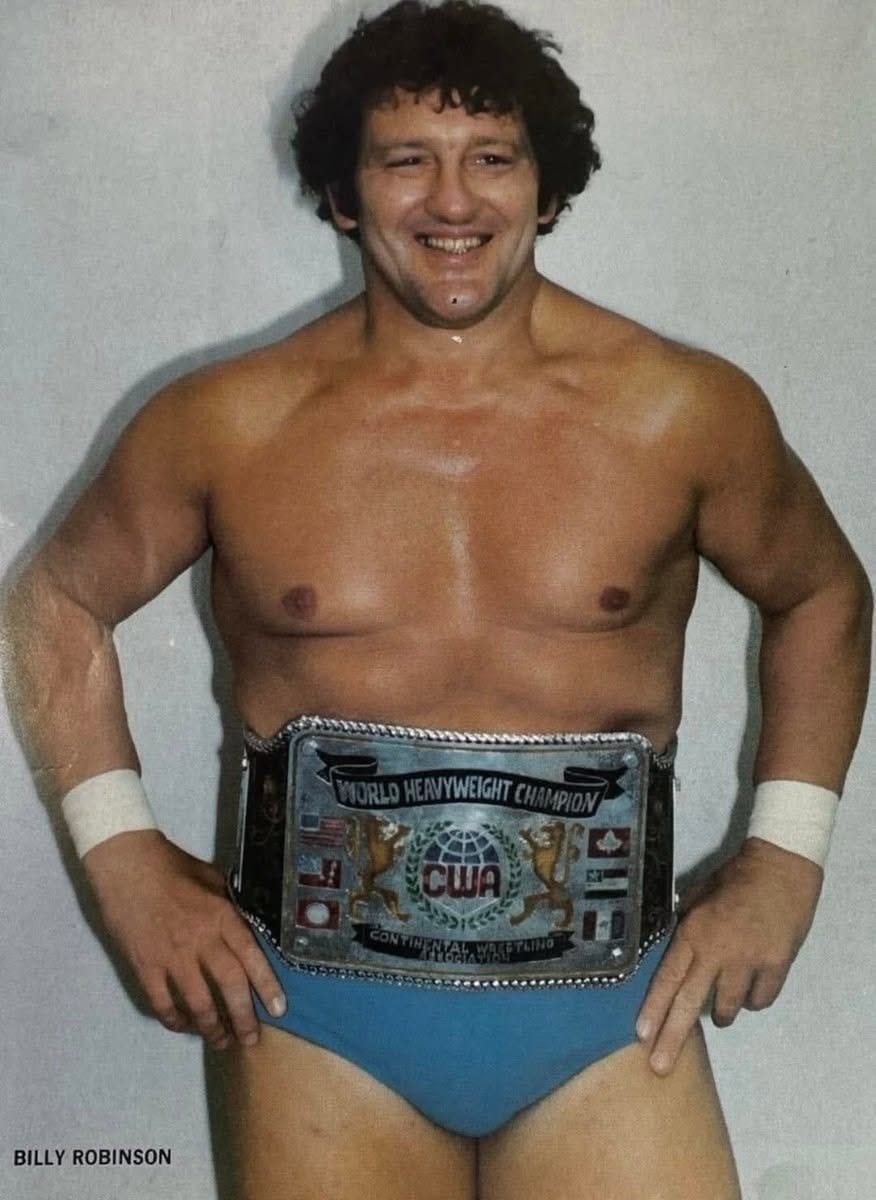
Pictured: Billy Robinson, CWA World Heavyweight Champion
On August 4 he beats Billy Robinson for the CWA World Heavyweight Championship and vacates the Southern Title because the promotion will not let one man hold both. He is world champion for seven days. Robinson takes it back August 11. The week on top is not a reign. It is a receipt. The imported technician who was supposed to be the grown-up champion lost to the 5-foot-7 Superstar, and the office could hang a world strap on Dundee without the building laughing.
The rest of the year he is rebuilt as a tag champion. December 22, 1980: Dundee and Tommy Rich beat Roger Kirby and Guy Mitchell for the AWA Southern Tag Team Championship. Starting back in 1976, Rich was the next top babyface the city was being taught to love. Pairing him with Dundee is how you teach him. The team is still together into February and March 1981. They beat the Bounty Hunters. They beat Jimmy Valiant and Tojo Yamamoto.
1981: the plug-and-play champion
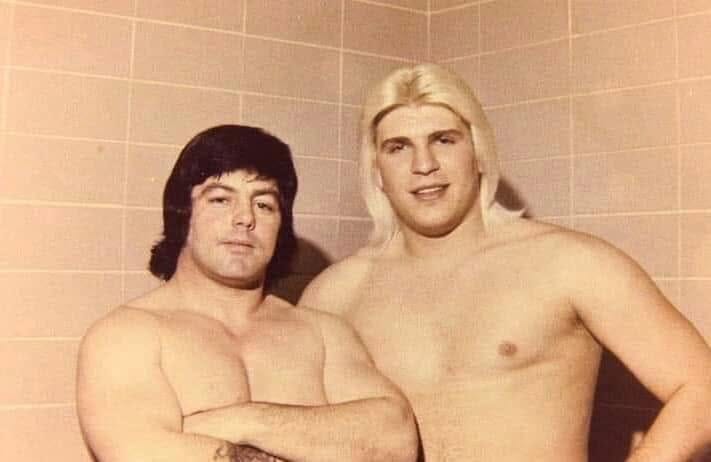
Pictured: Bill Dundee and Tommy Rich
1981 is the year Dundee becomes interchangeable with every good babyface in the territory and still looks like himself.
March 12, 1981, The team of Dundee and Rich beat Austin Idol and Dutch Mantell for the CWA World Tag Team Championship at Rupp Arena in Lexington, Kentucky. Dundee is no longer waiting for Lawler to get healthy. He is the senior partner on the top babyface team in the company.
After Rich, the partner is the Dream Machine. They take the Southern Tag titles on March 16, April 6, and May 18—three reigns in two months against Wayne Ferris and Tojo Yamamoto, Mr. Onita and Masa Fuchi, Ferris and Kevin Sullivan. That is Memphis tag booking at full speed. The belts move so the next television has a reason to exist. Dundee is the constant.
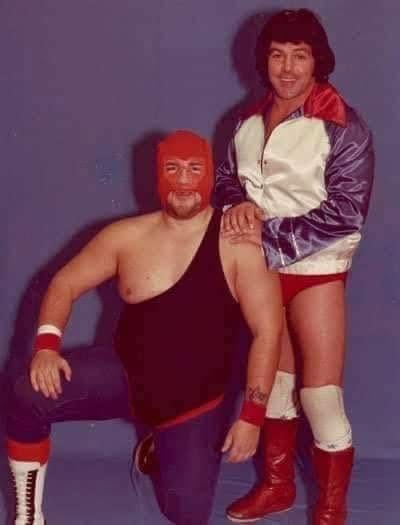
Pictured: Bill Dundee and The Dream Machine
June 1 he beats Stan Lane for the NWA United States Junior Heavyweight Championship. The junior belt is not a demotion. It is the office using the fact that Dundee can wrestle small, fast men as well as he can wrestle Lawler. Lane will be half of the Fabulous Ones in two years. In 1981 he is the pretty kid Dundee can get over or get even with.
July 13, 1981: Dundee and Lawler win the Southern Tag titles from Ferris and Sullivan. The fourth Lawler–Dundee tag reign lasts about a month. It is a reunion, not a restart. Lawler’s 1981 is already pointed at Terry Funk and the long Jimmy Hart / first-family era that will swallow the next two years. Dundee does not get to be the other half of that movie. He gets a month of gold and then another partner.
November 16, 1981: Dundee and Steve Keirn beat Koko Ware and Stan Lane for the Southern Tag titles. This reign lasts 103 days, into February 27, 1982. That is the longest, cleanest tag run Dundee has between the 1978 Lawler years and the 1983 heel turn. Keirn is the worker. Dundee is the name. Together they are the adult babyface team while the office experiments with the 3-man Midnight Express, Ferris, Sullivan, and the first version of what will become the Fabulous Ones.
1982: Booker in the room, Champion on the midcard strap
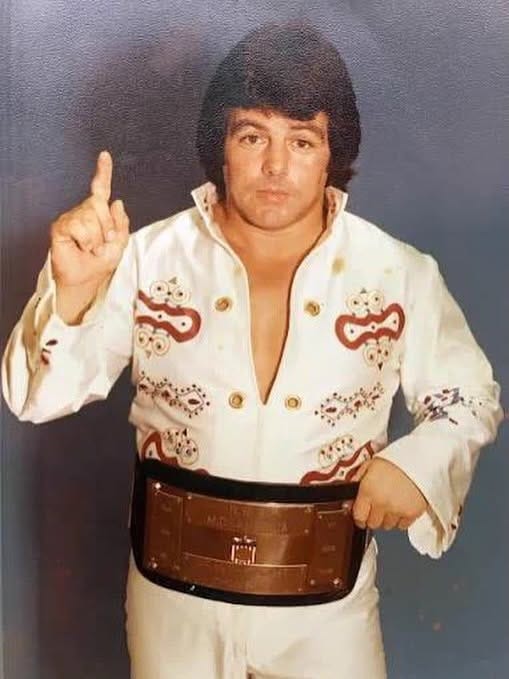
Pixtured: Bill Dundee, NWA Mid-America Champion
The Keirn team wins the belts again on April 26, 1982, and loses them two weeks later. Dundee’s singles year is the NWA Mid-America Heavyweight Championship, taken from Bobby Eaton on July 24 and held until September 6. Eaton is family by marriage and a future Midnight. Putting the Mid-America strap on Dundee against Eaton is both a payday and a teaching match.
This is also the year Dundee later claimed as the real beginning of the Memphis scaffold match. He had seen an older, lower Jerry Jarrett–Don Greene version from 1971. In 1982 he puts Sweet Brown Sugar and Bobby Eaton on a scaffold high enough to scare people. The gimmick will pay off in May 1983 when Dundee himself uses it to get the Southern Title back from Dutch Mantell. The man who bookers called a finish guy is now inventing the finish the territory will steal for a decade.
November 22, 1982, they try the Lawler–Dundee team one more time. The Sheepherders—Jonathan Boyd and Luke Williams—beat them. Same night Dundee goes to a DQ with Sabu the Wild Man over the Southern Title. The team is no longer the hottest thing in the building. The Sheepherders are. Dundee can still main-event. He cannot assume the main event is his.
Behind the curtain his booking reputation is already known. Jarrett has used him as an office mind. Georgia will use him. Watts will hire him at the end of 1983 because of the two years he just spent proving he can structure a card, not only survive one.
Early 1983: heel Superstar, then the door
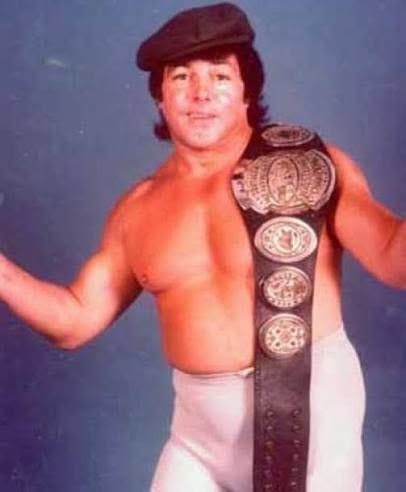
March 21, 1983, Mid-South Coliseum: Dundee beats Terry Taylor for the AWA Southern Heavyweight Championship. Taylor is the young, good-looking champion the loop has been building. Dundee taking that belt is the first move of the spring program that will end with him leaving town.
April and May are Dutch Mantell. Falls count anywhere, no-disqualification, bullwhip, hair. May 9, Mantell wins the title and Dundee’s hair in 11:37. May 16, Dundee wins it back in a scaffold match on a card that also has Lawler versus Ken Patera.
May 30 is chaos even by Memphis standards: Mantell, Lawler, and Dundee all hold or grab the Southern Title on the same date depending on the lineage you trust. The point of the night is not the ledger. The point is that the belt is now a weapon in a three-man war, and two of the three men are Lawler and Dundee.
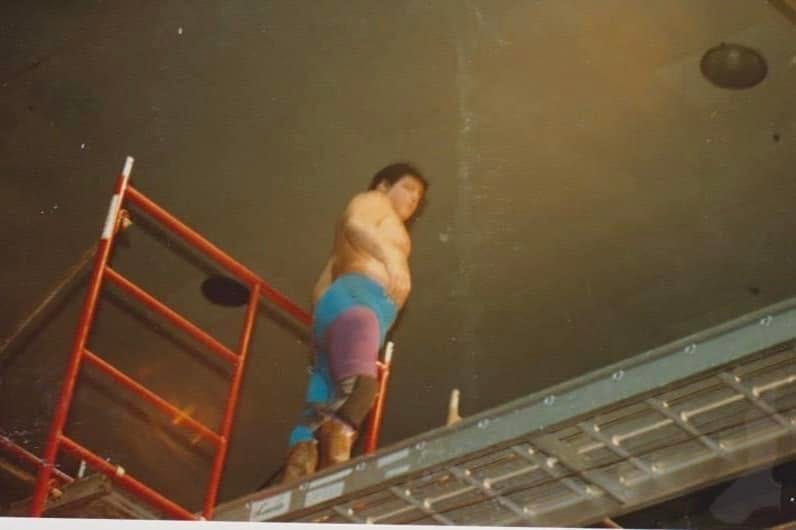
Pictured: Bill Dundee on the scaffold
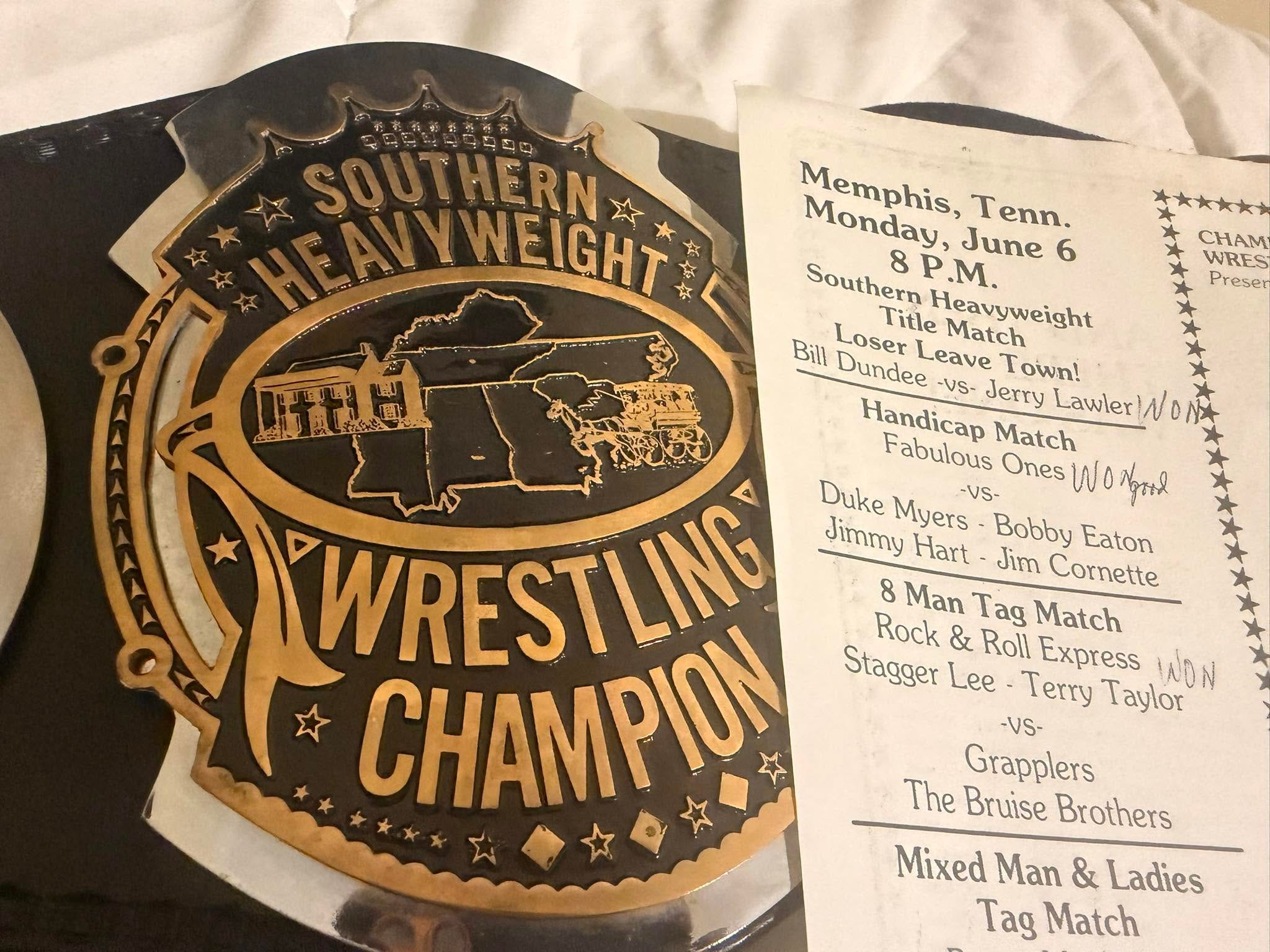
The television of June 4, 1983, is the best thing the company produced that year that was not a match. An entire episode given to a sit-down with Lawler and Dundee. Dundee has dyed the hair jet black and is working as the heel who cost Lawler a Patera match and five thousand dollars. He has counted their matches: seventeen. Lawler does not want another summer of stipulations. He wants one match. Loser leaves town. Title on the line. No disqualification.
June 6, 1983, Mid-South Coliseum. draws about 11,300. That is a 1977 crowd and money. The match is a fight. Hip and knee wrecked. Blade after the post. Strap. Sunset flip that almost steals it when Lawler celebrates early. Uppercut. Piledriver.
Lawler stays. Dundee goes.
He works Augusta and Chattanooga through the summer—Georgia-adjacent towns, not a vacation. He comes back later in the year long enough to lose a loser-leaves-town match to Steve Keirn and leave again, this time for Bill Watts’s Mid-South with the Rock ’n’ Roll Express and the booking pencil. The 1979–83 chapter ends the way a territorial chapter is supposed to end: the second man in the company gets paid to go make another company rich, and the first man keeps the building.
What those four years were for
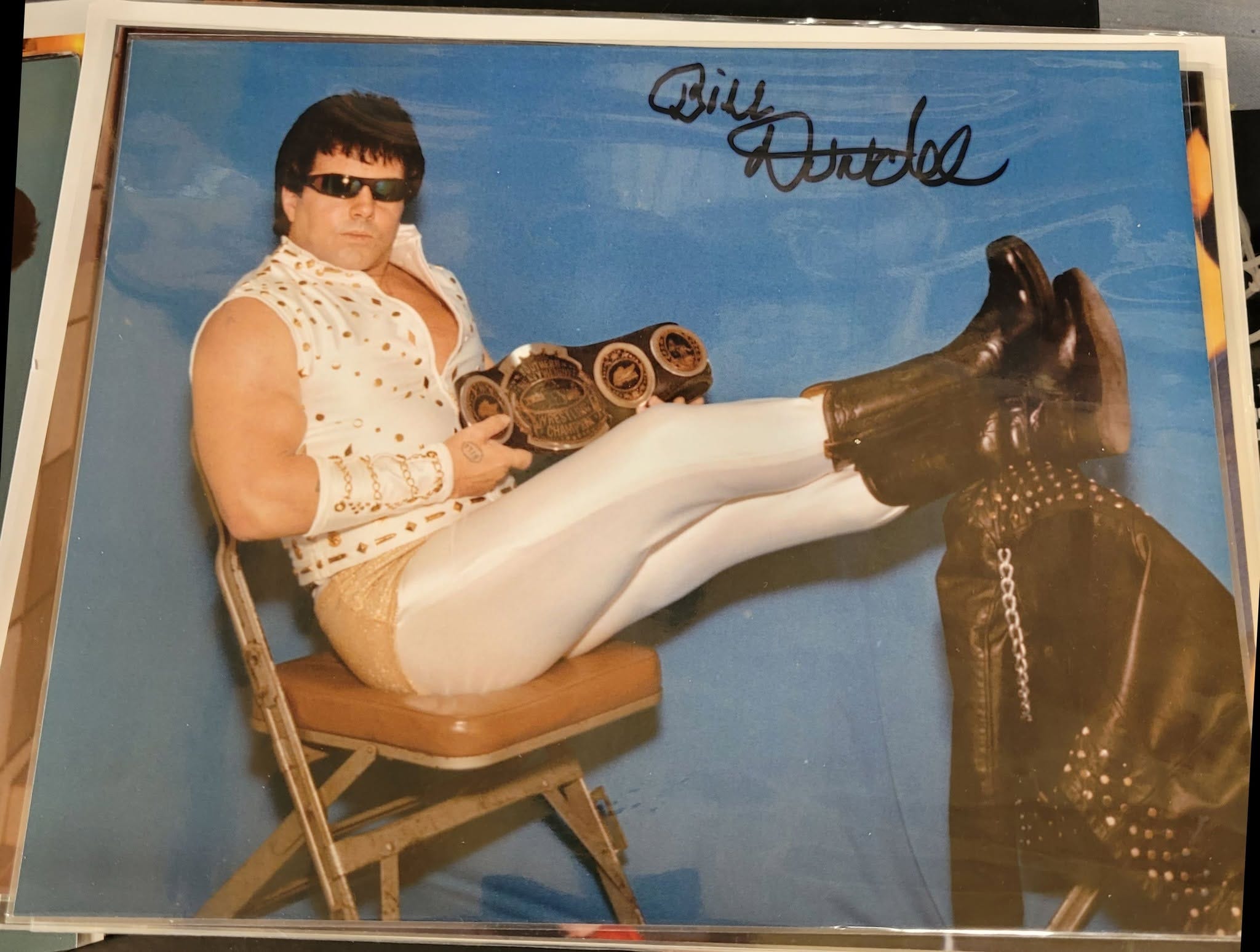
Read as a career, 1979 to 1983 is how you stop being half of a feud.
Dundee learns every babyface partner the office has: Rich, Dream Machine, Keirn, Valiant, Morton, Fuller, and Lawler when the week requires it. He learns every heel the loop can stand: Ellering, Bass, Latham, Ferris, Eaton, Taylor, Mantell, the Sheepherders, Fuji and Tanaka leftovers, Jimmy Hart’s first family at the edges. He holds the world strap for a week so the city knows it can be done. He holds the junior strap so the city knows he can wrestle small. He holds the Mid-America strap so Eaton can be made. He puts men on a scaffold so the next Southern Title change has a picture.
The 1983 heel turn only works because of those years. In 1977 Dundee was the underdog who stole a Cadillac. In 1983 he is the veteran who has been champion often enough that the city will believe he would screw Lawler out of five thousand dollars and a Patera match. Loser leaves town is not a gimmick you use on a midcarder. It is a gimmick you use when both men are the show and one of them has a booking job waiting in Louisiana.
Between the last tag night of June 1979 and the piledriver of June 1983, Bill Dundee became the man Jerry Jarrett could send anywhere on the card and the man Bill Watts would pay three thousand dollars a week to book a territory. That is the analysis. The Lawler matches are the monuments. These years are the construction.
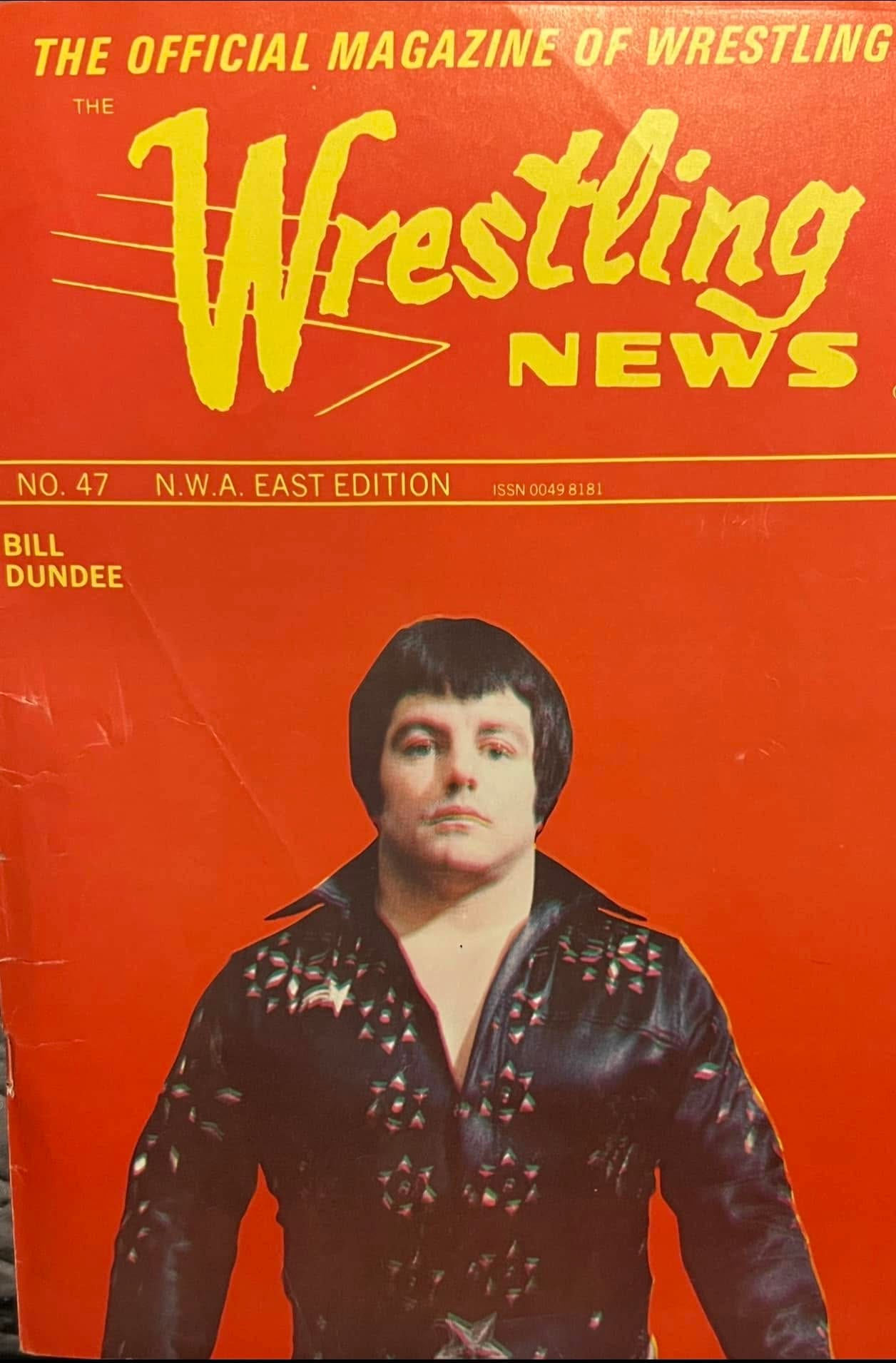
Jerry Jarrett did not treat the Memphis card as a one-city finish. The same weekend Evansville got its own office-set interview selling their loser-leaves-town night. The Jarrett Promotions loop is Memphis, Louisville, Evansville, Lexington, and Nashville—all billed as the night Dundee had to leave that town, all doing sellout or record business.
That is how a territory cashes a stipulation without pretending the rest of the map can still see the man on Monday. Behind the curtain Dundee had already agreed to go book and wrestle for Ole Anderson. The short window is why the television is an hour of talking instead of six weeks of cage matches. They had to get the money before he was physically in Georgia.
Lawler’s post-match promo on the June 11 show even leaves a crack: if Dundee ever gets his head screwed on right, the King himself would advocate letting him back. That sentence is the seed of December.
The Chattanooga experiment: a Booker with nowhere to appear
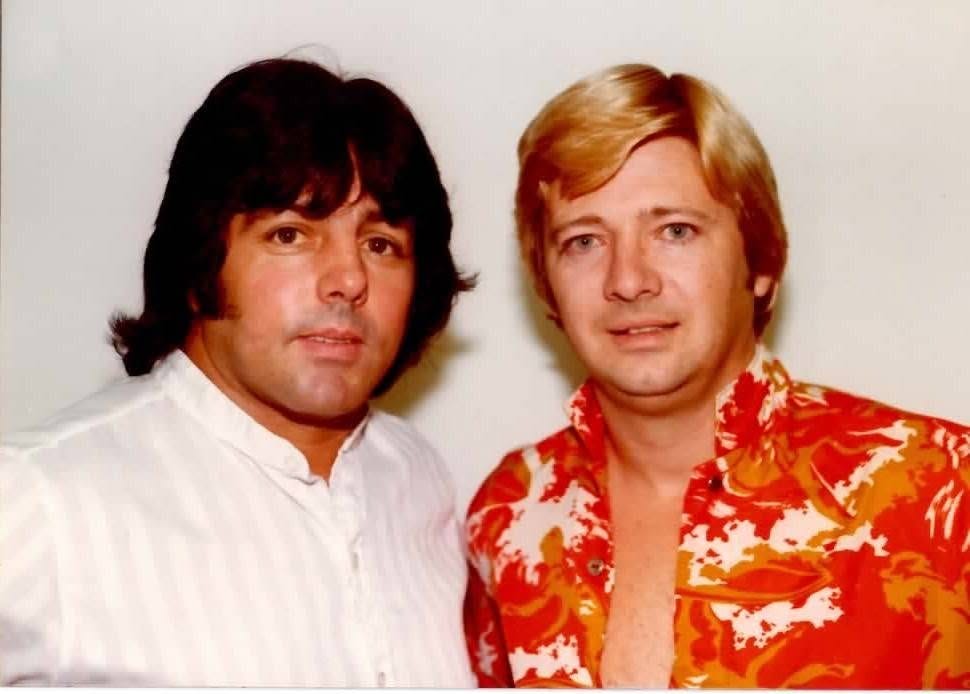
Pictured: Bill Dundee and his mentor and teacher, Jerry Jarrett
Ole Anderson’s Georgia was split. Atlanta and the northern towns still had a pulse. The old Georgia circuit—Columbus, Macon, and the rest—did not have enough bodies after Jim Barnett’s exit. Anderson asked Jarrett for talent and a booker. Jarrett, coming off a fat year and carrying too many men after Lawler’s power play (forty names on the roster, ten-man tags paying fifty dollars a head), sent Dundee as lead heel and booker, plus a crew of Tennessee undercarders and Jim Cornette.
The promotion was called Georgia Championship Wrestling Superstars. Television taped every Saturday at the NBC affiliate in Chattanooga. Michael St. John hosted; Steve O sat in on some weeks. The show started airing across the Georgia circuit in June, the same month Dundee “left” Memphis.
The live dates are mostly Memorial Auditorium in Chattanooga and Augusta.
• June 18, Chattanooga: Dundee beats Dutch Mantell.
• July 2: Mantell beats Dundee in a bullwhip match.
• July 16: Stagger Lee beats Dundee.
• July 23: Dundee beats Stagger Lee.
• July 30: Dundee beats The Stray Cat. The Fantastic Ones—Bobby Fulton and Terry Taylor—work the tag side against Jerry Novak and The Angel with Cornette.
That is not a main-event machine. That is a skeleton crew working a building that had been Georgia’s more than Memphis’s since the late 1970s, when WRCB already carried both the 11 a.m. Memphis show and the 1 p.m. Georgia show on the same Saturday. Chattanooga fans did not need Superstar Bill Dundee explained. They also did not owe him a packed house because he had just sold out the Coliseum.
The structural failure is simple. Anderson could not staff two circuits. The promise to the Tennessee boys was that if it died they could come home. Dundee could not come home. He had lost loser-leaves-town in every major Jarrett city. Two months later he could not walk onto Channel 5 as if June 6 had been a dream. Jim Cornette’s version is that they parked him on spot shows—the dates that did not have to honor the Memphis television contract—while Lawler took the book back, circled everything around Jimmy Hart again, and brought in the Moondogs and Grapplers. Dundee the booker of Georgia Superstars became Dundee the man who could not be on the show that made him famous.
Six weeks is the number Cornette uses for the Georgia run. The July 30 Chattanooga card is near the end of the paper trail. Augusta was the other stop. Neither town became a second Memphis. It was sad. Chattanooga had been a major drawing city for Gulas-Welch, Augusta had been the good drawing stead, Monday night town for Atlanta.
The experiment did not fail because Dundee forgot how to book a finish. The focus for the Georgia end was the old Ed Farhat areas of Michigan, Ohio plus West Virginia. Jarrett had tried before to annex Chattanooga into his loopm but it didn’t work. It failed because the towns were now leftover Georgia dates, the roster was leftovers from a bloated CWA, and the only man who could have drawn Chattanooga on a name was contractually forbidden from being on Memphis television, which was the signal that still reached those living rooms first.
December 26, 1983: the match that closed the loophole
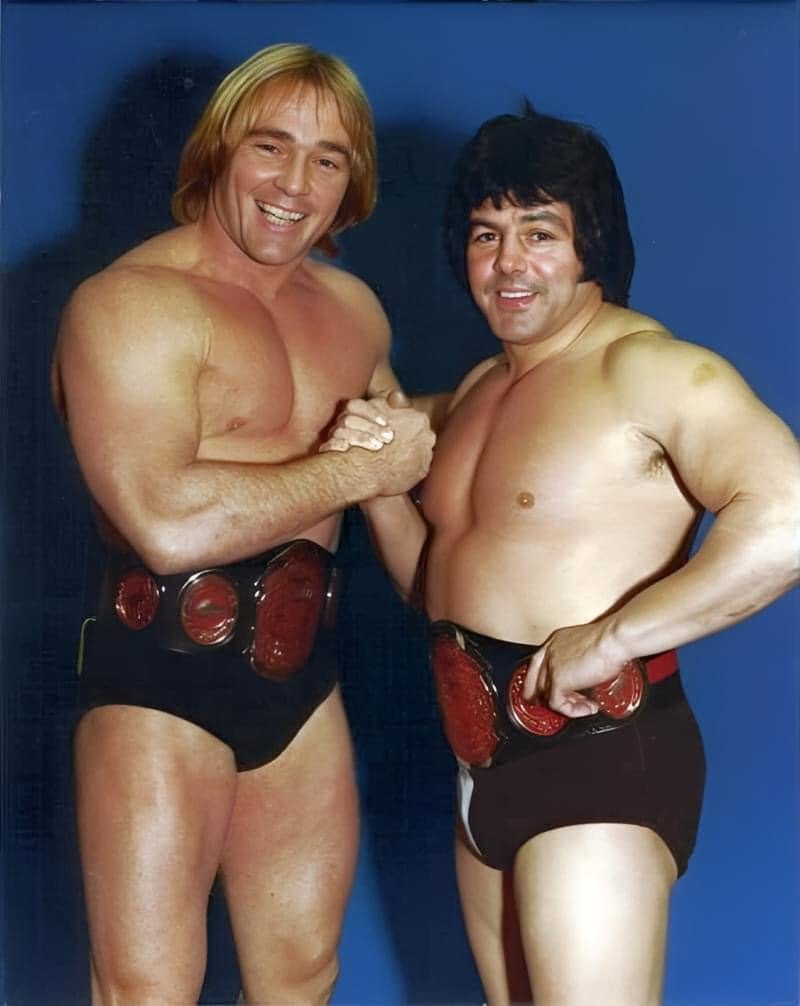
Pictured: Steve Keirn and Bill Dundee
Dundee is back on Memphis television by Christmas week. The cover story is a tournament. Eddie Marlin has to say it out loud on the December 24 show: yes, Dundee already lost a loser-leaves-town match six months ago, and here he is. So the new contract is written for one year. No tournament escape. No “circumstances.” December 26, 1983, to December 26, 1984. Keirn versus Dundee. No Stan Lane. No Jim Morris. Singles. Mid-South Coliseum.
That is the second 1983 loser-leaves-town match in Memphis. It is not with Lawler. It is with the other half of the Fabulous Ones, the partner Dundee had held Southern Tag gold with in 1981 and 1982. Keirn is the babyface whose career is on the line in the promo. Dundee is “Little Billy,” still the giant killer on the microphone, already booked in his head for Louisiana.
The Watts deal is the real finish. Jarrett and Watts trade. Condrey, Eaton, the Rock ’n’ Roll Express, Cornette, Terry Taylor go south. Jarrett tells Watts, before he leaves the office, to talk to the little man in the corner about booking. Watts does not want Dundee as a wrestler. He wants a mind. Three thousand dollars a week guaranteed as the worst week. Dundee takes Ricky and Robert and the rest and walks into Houston with a crew of normal-sized men in a land of monsters. Mid-South’s boom is 1984. That is what December 26 purchased. Not another Lawler haircut. A booking job.
How the three pieces fit
June 6 is the monument: 11,300, strap, piledriver, the King stays. The loop multiplies it across Louisville, Evansville, Lexington, and Nashville so every town gets its own exile. Chattanooga is the parking lot Ole and Jarrett built for the exile—TV in an NBC studio, Memorial Auditorium cards, a booker who could not appear on the show that justified his rate. December 26 is the confession that June had been broken, and the contract that makes the next departure stick long enough for Watts to hire him.
There are not two Lawler–Dundee loser-leaves-town matches in 1983. There is one Lawler match run as a series of city finishes, and one Keirn match run as a one-year lock because the first exile had already been treated as a suggestion. The failed Chattanooga experiment is what happens when you write a man out of the only television that matters and send him to book towns that were never going to replace the Coliseum. Dundee did not fail in Chattanooga. The map failed him. December was how the office admitted it.
Mid-South, late 1983 to September 1985: Booker first, Wrestler second
The years after the December 26, 1983, loser-leaves-town night are the ones that prove Dundee was never only Lawler’s other half. Bill Watts hired the mind, not the body. Jim Crockett rented the name. Jerry Jarrett got the heel back and let him steal Saturday morning. Read in order, 1984 through the Bill and Buddy Show is one job with three letterheads.
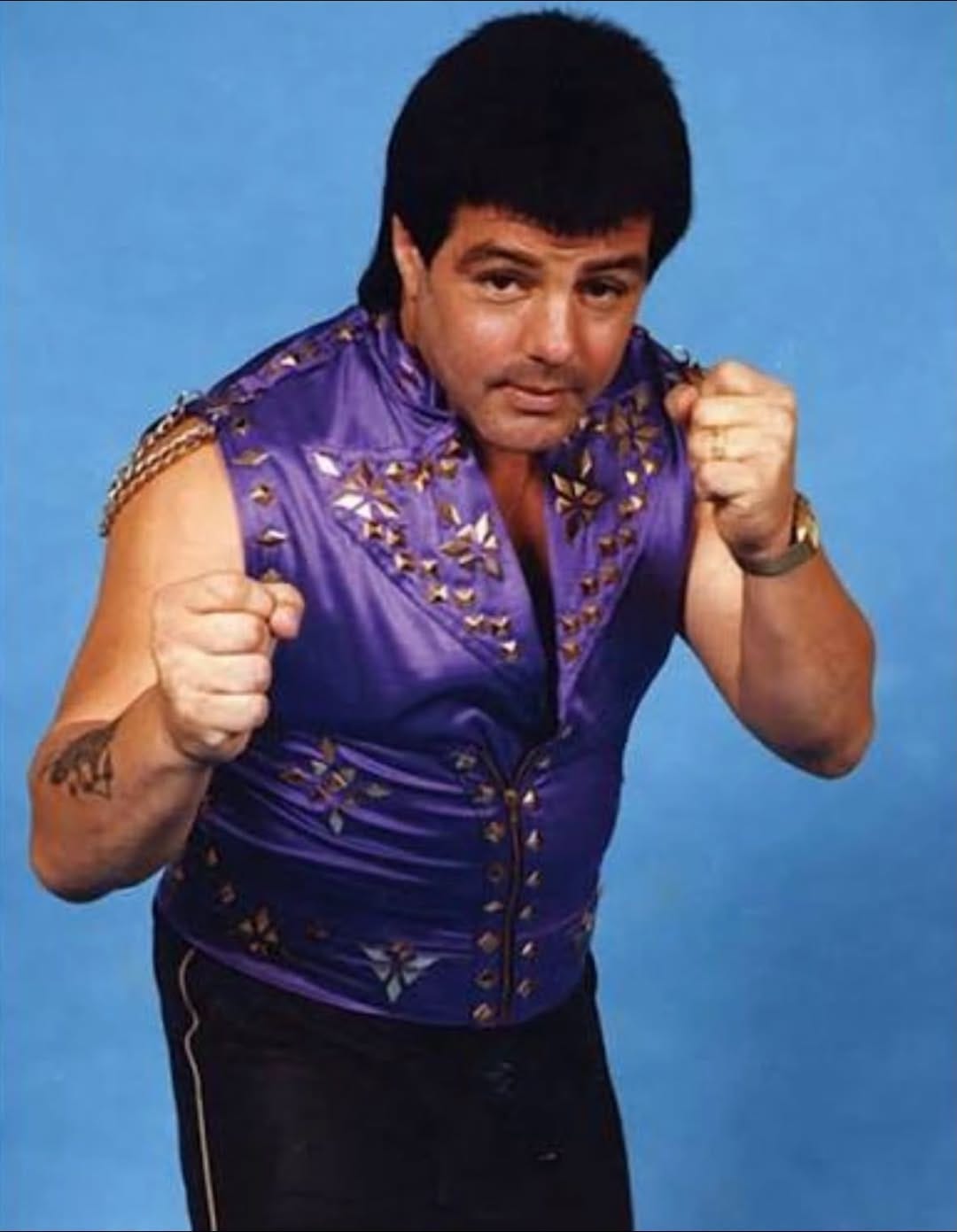
Watts did not want a 5-foot-7 wrestler. He wanted a booker under him after Ernie Ladd. Jarrett, sitting in the same office while the trade was cut, told Watts to talk to the little man in the corner before he left town. Watts offered the job with a floor: no week under three thousand dollars. Twelve thousand a month as the worst month. Dundee took Ricky Morton, Robert Gibson, Terry Taylor, Jim Cornette, Dennis Condrey, and Bobby Eaton and walked into a territory built on Junkyard Dog, Ted DiBiase, and men who looked like they could play football.
Watts kept the last word. Dundee kept the format. Mid-South already leaned Eddie Graham—package shows, not St. Louis main-event-or-nothing. Dundee pushed that further. Seven matches on a card, four or five of them with an angle, a title, or a reason to stay past the opener. Cornette later said that was not hot-shotting. Hot-shotting is blood and chaos with no story left for next week. Dundee’s cards still had next week. The houses went up anyway.
The pairing that made the era was Condrey and Eaton. They had been singles in Memphis. In Mid-South they became the Midnight Express with Cornette, beat Mr. Wrestling II and Magnum T.A. after II walked out on the kid, and spent 1984 as the heel tag team the territory could sell anywhere. The Rock ’n’ Roll Express were the other half of the same trade: good-looking babyfaces for the women Watts had not been drawing. First meeting on television is February 29, 1984, in Shreveport, Russians running in, hair cut, save by Taylor and Magnum. From that tape forward the two Expresses are the engine.
April 7, 1984, Louisiana Superdome, Last Stampede: about 25,000 people and a $176,000 gate. Watts comes out of retirement, teams with Stagger Lee—Junkyard Dog—against the Midnights in a Lights Out match. The angle is Cornette’s face in a cake and the Midnights jumping Watts. They take that match fifteen towns and do $807,000. Dundee is booking it. He also wrestles the card, Porkchop Cash beside him, Midnights working twice. The booker still takes bumps when the show is short a body.
JYD leaves for the WWF that summer with no notice. The promotion does not die. It becomes an ensemble. Duggan turns face on DiBiase. Flair comes through off World Class television. Scaffold matches between the Midnights and the Rock ’n’ Rolls set more records at the end of 1984, including the November 22 Superdome with Cornette’s mother’s $25,000 on the line. Little Rock, which had been a $10,000 town in January, does $22,500 for a cold non-title meeting of the two teams. That is booking that teaches a city a new main event after the old one has gone north.
Dundee puts himself in the ring when it helps the television. November 7, 1984, he beats Adrian Street for the Mid-South Television Title. He drops it December 5. The belt is a tool, not a monument. In 1985 he is still on the show—beating enhancement, getting whipped by Butch Reed for walking into the wrong segment, cutting a promo that his ring gear is better than the Fantastics’ K-Mart. By August the top of the card is wobbling (Nightmare, Watts as Midnight Rider) while the undercard Dundee helped stock is still the best weekly television in the country.
He is gone in September 1985, back to Memphis. Watts later credits that booking stretch, 1984 into September 1985, as the peak of Mid-South business. DiBiase, who missed the first half of it, later called it hot-shotting. The gates in March, April, summer, and the scaffold season do not read like a company that had already spent its heat.
Memphis, winter and spring 1986: the Bill and Buddy Show
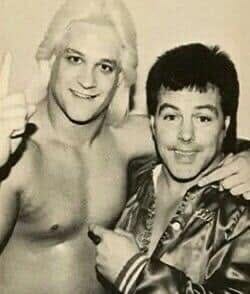
Pictured: Buddy Landel and Bill Dundee
September 1985, home. The office does not wait. The Lawler series starts again. December 30, 1985, Dundee finally wins the “big one”—a loser-leaves-town match—and takes the Southern Heavyweight Title. Lawler is written out into early 1986. The King is off television and off the Monday card. Houses drop into the two- and three-thousand range. Dundee is Southern Heavyweight Champion. Landel is Mid-America Champion. Together they are the office in the ring. The Bill and Buddy Show is not a comedy sketch yet. It is two heels who have the belts, the microphone, and no babyface big enough to stop them.
The company is now three heels: Dundee, Nature Boy Buddy Landel, Dirty Dutch Mantell.
Landel is back January 4, 1986. Mid-America Title ping-pong with Koko Ware and Dusty Rhodes. Dundee holds the Southern. Mantell is the redneck third. The split is class. Landel and Dundee get tired of Dutch. Lance Russell airs Coliseum video of Landel mocking Mantell behind his back.
Jerry Jarrett chooses that moment to write himself out as an in-ring threat. He cuts a piece explaining he has sight in only one eye and he is done wrestling. His son Jeff is coming in as a referee. That is the setup the territory had used for years: put the promoter’s family on camera so the heat has a face the city already knows.
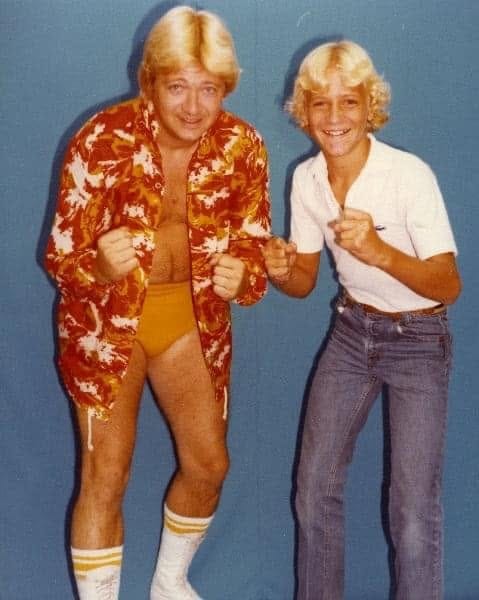
Pictured: Jerry and Jeff Jarrett
March 1, 1986: the television that brought Lawler home
Saturday taping, WMC. Jeff Jarrett’s first night as referee. The match is a squash that is supposed to look like business: Southern Champion Dundee and Mid-America Champion Landel against David Johnson and Jim Jamison. They win. They do not stop. They keep beating Jamison after the bell.
Jeff tries to restore order. Landel turns on the kid. That is the first heat spike. Jerry Jarrett, one good eye, comes through the curtain to save his son. Dundee and Landel go after the eye. Lance Russell is screaming it on the air: they are going for the only eye he has left. Eddie Marlin, Jarrett’s father-in-law and the on-camera authority voice, is in the studio watching his family get taken apart.
Dutch Mantell is the save, and it is booked to look accidental and cheap. He comes out of the shower with shampoo still in his hair and a towel around him. He runs them off. That image is what the city remembered: the Dirty Dutchman half-dressed, the promoter on the floor, the boy referee wrecked, and the two champions standing over the office.
The promo hour after that is the actual finish of the angle. Marlin and Jerry Jarrett say it has gone far enough. The loser-leaves-town stipulation is being ignored. There is one man who can work with Dutch and handle Dundee and Landel. They bring a telephone into the studio and call Lawler at home. He is watching because the leave-town deal means he cannot be in the building. He says he will be there Monday.
Dundee’s follow-up promo is the heel half of the same hour. He rages about politics. 1975 he came here. 1977 it was Lawler, Dundee, and Jarrett. Now he wins a clean loser-leaves-town match and the office puts the King back on a phone call. That speech is what made the return feel dirty instead of patriotic. The babyfaces were breaking their own rule. The heels were the ones talking about a contract.
March 3, 1986: the last sellout
Monday, Mid-South Coliseum. Lawler and Dutch versus Dundee and Landel. That is the card people mean when they say the last sellout. Reported in the eleven-thousand range, standing room, people turned away, windows broken in the usual Memphis way. Lawler’s music hits and the building does what it always did when he came back from a leave-town. Dutch splits the pop with him. The match is the first of a program, not the last. They go over.
The next week, March 10, they run it again. Stopped because Landel is bleeding too much. The office has the return heat and they are going to spend it for a month.
That March 10th at the Coliseum, Lawler and Mantell versus Dundee and Landel is a twelve-minute-forty-five bloodstop, chairs, tables, Lance shoved, Landel cut so badly the referee has to call it. People still call that the last time the Mid-South Coliseum felt sold out in the old way.
What they spent it on
March 24, same building: Texas Death. No disqualifications, pins count anywhere, ten-count after a fall. They go twenty-six falls, somewhere between fifty minutes and an hour and fifteen depending on who is telling it. Lawler and Dutch win. Dutch has always called that night the last true Coliseum sellout for the company. Some house records put the March 3 return as the sellout and March 24 as the blowoff that still did huge. Either way, those two Mondays are the last time that building filled the way it filled in 1977 and 1983.
March 31 they flip it: Texas Death elimination, Dundee and Landel win. Then the program widens. Jeff stays in the mix. Jos LeDuc gets added. Six-mans. Tony Falk as the extra heel. April 26 Lawler, LeDuc, and Jeff draw Dundee, Landel, and Falk on a referee stoppage. The Bill and Buddy Show keeps running on Saturday: they chase Lance and Dave Brown off the desk, scribble out Lawler video spots on the format sheet, and treat Channel 5 like they own the lease. Lance Russell will not stand in the interview area with them due to Dundee’s unthinkable earlier actions of slapping Lance Russell’s face.
They bring their own desk.
The sign says The Bill and Buddy Show.
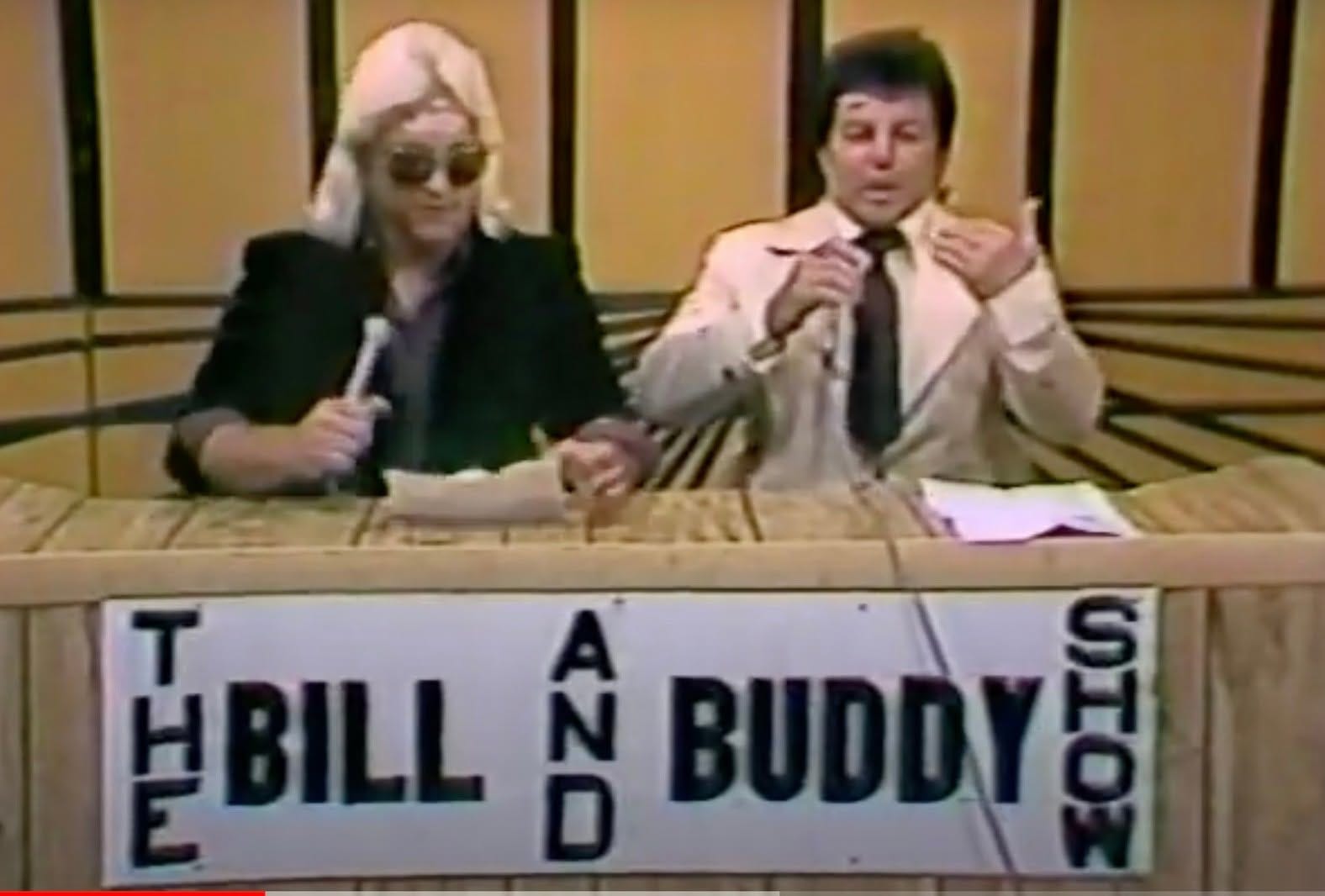
That is the gimmick. They take the Channel 5 studio. They call the matches. They refuse to let people wrestle unless a title shot is attached. They squash David Johnson and Jim Jamison in two minutes of fists before the bell is even a memory. April 5, 1986, is the episode historians still treat as the document: Lawler and Mantell trying to get their building back, Dundee and Landel running play-by-play like they own the station.
April 19, 1986, first Crockett Cup in New Orleans—UWF country, Watts still on the letterhead of the co-promote—Dundee and Buddy Landel go out in the first round to Steve Williams and Terry Taylor. Dundee is listed as CWA. He is already back in Memphis as a heel champion; the Cup is a one-night rental.
June 2, 1986, the partnership eats itself. Landel beats Dundee in a barbed-wire match for the Southern Title. By summer they are booking each other. Lawler beats Dundee on July 14 and sends him out of town again. That is the door to Crockett and Kansas City. The Bill and Buddy Show lasts a season, not a year. It does not need a year. It is two heels who talk better than the announcers, a desk they were not invited to sit at, and a city that will pay to see Lawler tear the desk down.
The long payback is summer. Lawler and Dundee go back to singles. Another loser-leaves-town, no-DQ, July stretch, Lawler wins and takes the CWA International Title off Dundee. The March television is what made that summer possible. Without the Jarretts on the floor and the phone call home, Lawler is still sitting in the house under the December stipulation and the Coliseum is still doing two thousand.
Why the angle worked
It used everything Memphis already believed. Jarrett really did have the bad eye. Jeff really was the promoter’s son getting his first official job. Lawler really was banned. Dundee really had beaten him clean in December. Dutch coming out of the shower is the Memphis version of a run-in: ugly, fast, no music. The phone call is the Memphis version of a contract signing: the authority figure admits he is breaking his own rule because the heels went too far.
Bill and Buddy did not invent taking over the TV. They made it the weekly identity of the heel side while Lawler was gone, then they gave the office a reason the city would accept for bringing him back early. The last sellout is not a mystery card. It is the Monday after the Saturday the office got beaten up on Channel 5. Dundee and Landel did the beating. The Jarretts took it. Dutch made the save. Lawler walked through the curtain two days later and the Coliseum filled one more time.
Jim Crockett, Central States, Florida: 1986–87 as a hired name
The Crockett year is not a booking year. It is a passport year.
After Lawler runs him out again on July 14, 1986, Dundee spends roughly nine months in Mid-Atlantic, Central States, and Championship Wrestling from Florida. He teams with Jimmy Garvin. He feuds with Sam Houston over the NWA Central States Heavyweight Championship and wins it January 3, 1987. He loses it to Bob Brown in another loser-leaves-town match. He manages the Barbarian and the MOD Squad. On Crockett house shows in August 1986 he beats the Italian Stallion while Landel, with Dundee in the corner, beats Randy Barber, Sam Houston, Rocky King.
They cut a challenge to Rhodes and Flair that nobody books as a program. March 1987, Crockett rents the Mid-South Coliseum on a Thursday. Dundee beats Dusty Rhodes in a King of Tennessee match. The building does about 2,500. Monday night that same week Jarrett’s regular show does about 7,000 with Bockwinkel and a Lawler tag. The lesson is not subtle. Dundee draws in Memphis. Dundee on a Crockett Thursday in Memphis is a curiosity.
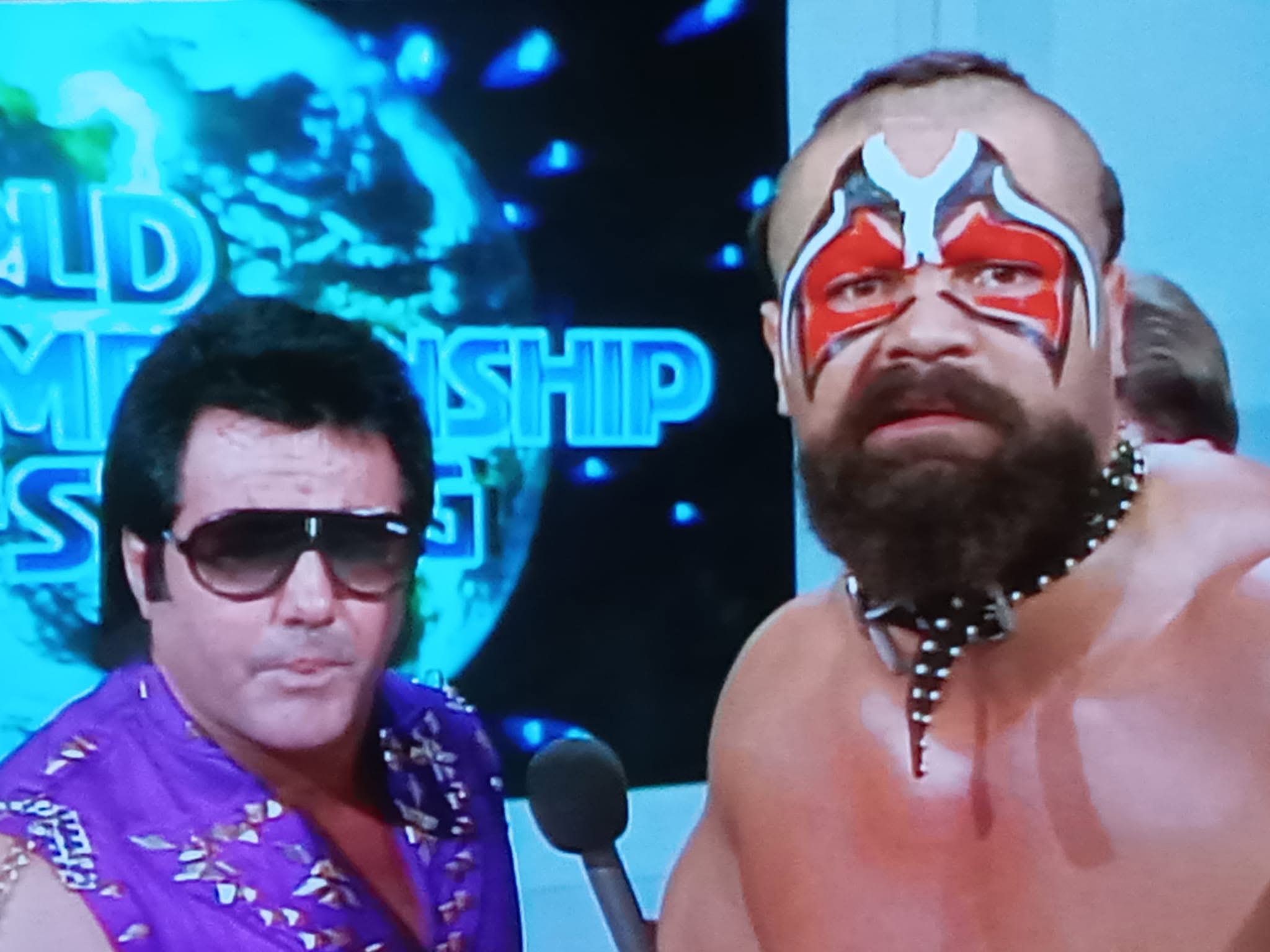
Pictured: Bill Dundee and The Barbarian on WTBS-TV17
He teams with the Barbarian in the 1987 Crockett Cup and is back in Tennessee in April. Crockett got a veteran who could talk and manage. Dundee got dates between Memphis payoffs. Neither side pretended it was Mid-South 1984.
Kansas City and the second Crockett pass, late 1986–April 1987
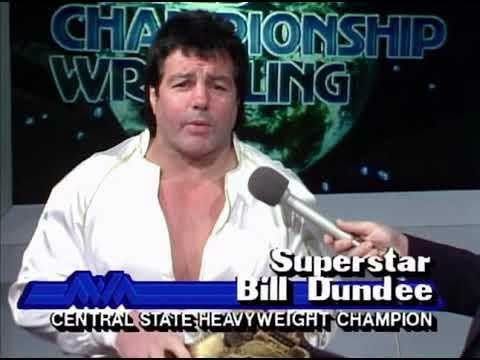
Jim Crockett bought Bob Geigel’s Central States office ton continue to expand JCP’s syndicated television network in September 1986 and used the towns as a mix of his own midcard and the local names that still meant something in Topeka and Kansas City, Kansas. Sam Houston beat Dundee in a tournament final on November 16, 1986, in St. Louis for the vacant NWA Central States Heavyweight Championship. Dundee took it back on January 3, 1987, in Topeka. Fifty-five days. Brad Armstrong goes to a DQ with him at the end of January. On February 27 at Memorial Hall in Kansas City, Kansas, Bulldog Bob Brown beats him in a loser-leaves-town match and takes the belt.
That is the Kansas City run in hard numbers. Houston, Dundee, Brown. Starrcade ’86 had already put Houston over Dundee by disqualification on the undercard. Crockett house dates in August 1986 had Dundee beating the Italian Stallion while Landel, with Dundee at ringside, squashed openers and talked about Flair and Rhodes. None of it became a television program. The Central States strap was the last territorial singles title that still moved in those buildings. Putting it on Dundee told Kansas City the imported Superstar was the man of the hour. Taking it off him in a loser-leaves-town match told them the hour was over.
April 10, 1987, Crockett Cup: Dundee and Konga the Barbarian. They win a first-round match and go out. March of that year Crockett had already rented the Mid-South Coliseum on a Thursday and headlined Dundee over Dusty Rhodes in a King of Tennessee match. JCP drew 2,500. Jarrett’s Monday that week did about 7,000. Dundee was home. Crockett was the visiting office. He was back in Tennessee for good in April.
Memphis 1987: the World Tag Titles that last eleven days
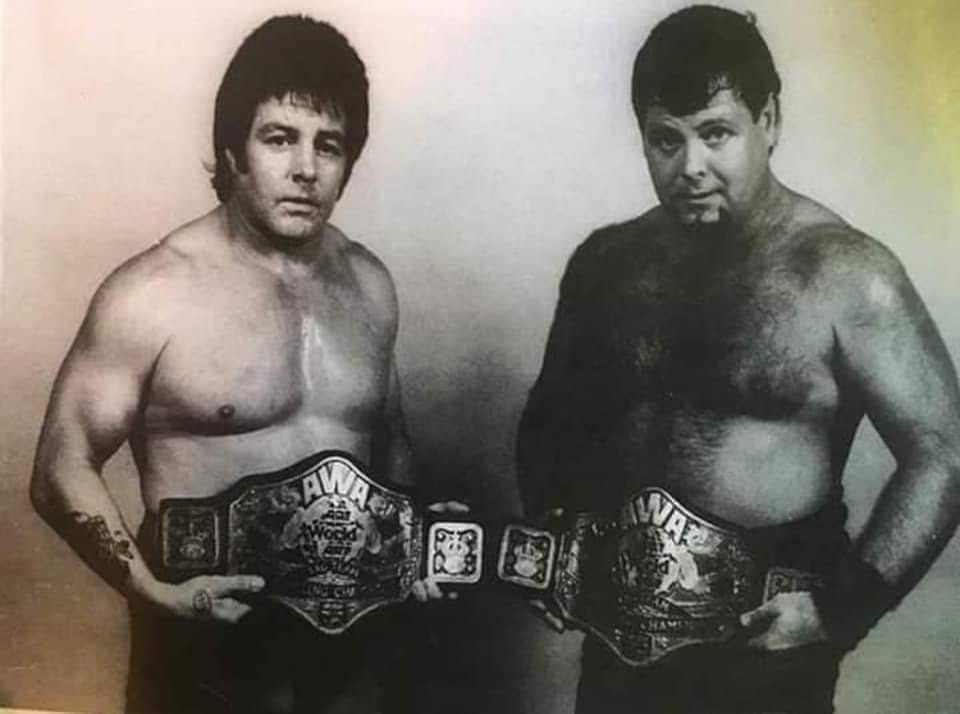
Pictured: Bill Dundee and Jerry Lawler, AWA World Tag Team Champions
The return is not a nostalgia lap. It is the last time Memphis can hang a recognized world tag championship on its two biggest names and have Verne Gagne’s office nod.
Lawler and Dundee work Austin Idol and Tommy Rich through the spring. First blood, tags, a scaffold on June 15. Dundee also holds the AWA International Heavyweight Title in stretches—June 13 to August 17, August 31 to October 11—and tags with Rocky Johnson for the CWA International Tag belts. George Barnes takes the International Title and wants hair. Dundee will not put his hair up again.
October 12, 1987, Mid-South Coliseum: Lawler, thirty-seven, and Dundee, forty-three, beat Soldat Ustinov and Doug Somers for the AWA World Tag Team Championship. Seven days. October 19 they lose to Dr. D—Carl Styles under a hood—and Hector Guerrero. October 26 they win the belts back. Four days. October 30 in Whitewater, Wisconsin, on AWA television, the Original Midnight Express, Dennis Condrey and Randy Rose, take them. Eleven days of gold across two reigns. The first world tag titles Memphis men ever held as a pair. The city treated it as the real thing. The AWA treated it as a two-week stop on a dying circuit.
That is the last time Dundee and Lawler are the world. After that they are still the show in Memphis. They are not the show anywhere else.
USWA, 1988–1997: the belts keep moving because he is still there
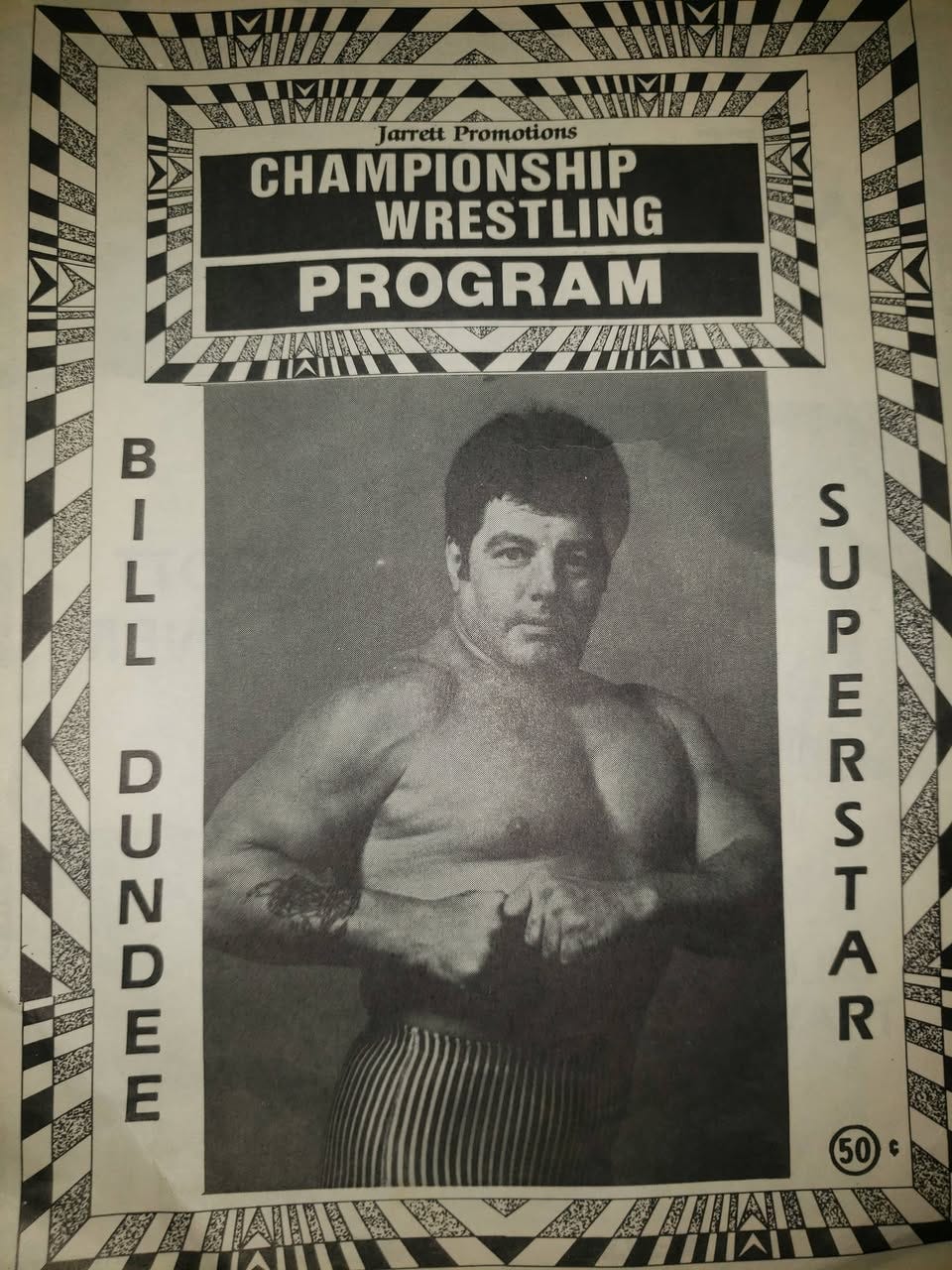
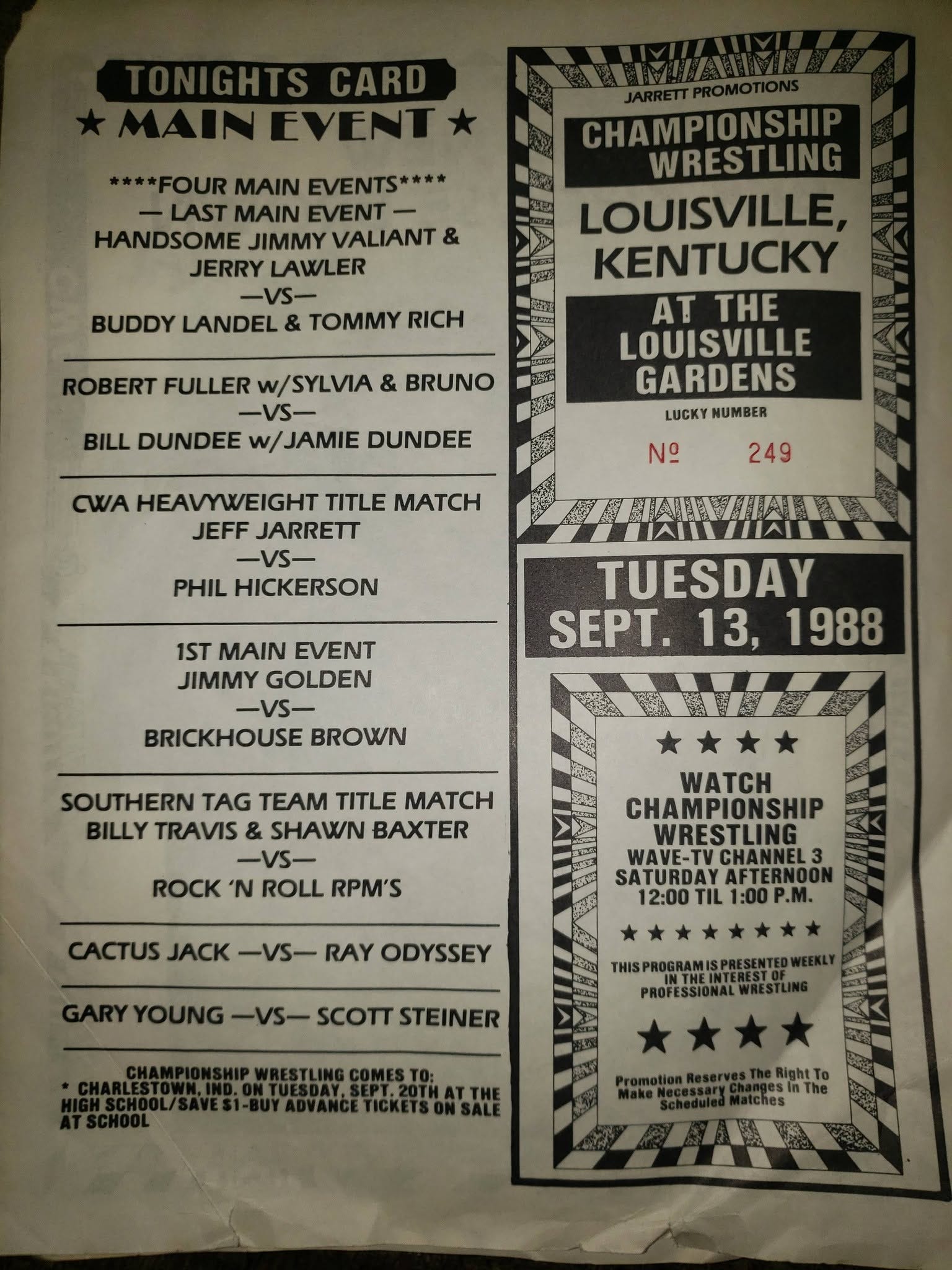
Pictrured: Louisville, Kentucky program, September 13, 1988
When Jarrett folds the CWA into the USWA with World Class leftovers, Dundee becomes what a territory uses when the territory is now a regional promotion with Dallas dates and a thinner roster. He wins the USWA Southern Heavyweight Title on November 19, 1989, and holds it 165 days, into May 1990. He wins it again in May and June 1990. He works John Tatum in Dallas and Memphis, Eddie Gilbert and Tony Anthony in Texas Death tags with Lawler, Dirty White Boy in first-blood. He takes the Texas Heavyweight Title three times in 1991 and the Junior Heavyweight Title twice the same year, because the office will put a junior belt on a forty-seven-year-old if the forty-seven-year-old can still make the finish look like a fight.
Sir William, 1993–1994
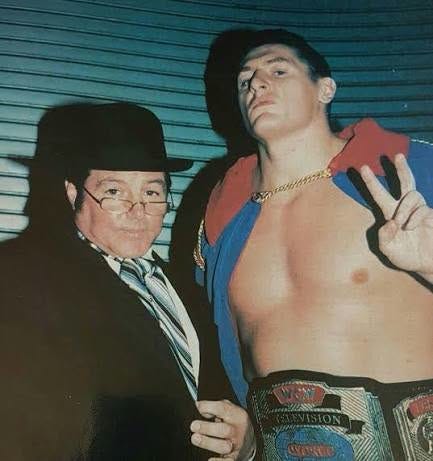
Pictured: Sir William (Dundee) and Steven (William) Regal
WCW does not want Superstar Bill Dundee. It wants a butler. In June 1993, Lord Steven Regal arrives claiming William the Conqueror. Dundee is Sir William: formal clothes, spectacles, top hat, the man who holds the towel and the story. Regal wins the WCW World Television Title from Ricky Steamboat at Fall Brawl on September 18, 1993, with Sir William’s help.
Dundee is on national cable every week as a manager, not as the man who sold out the Coliseum. In October 1994 a contract dispute ends it. Regal drops him and builds the Blue Bloods with Bobby Eaton. Dundee goes home. The gimmick worked because he could play small and precise. It ended because WCW did not need another Memphis mind in a tuxedo.
USWA and OVW
February 25, 1995: Dundee wins the USWA Unified World Heavyweight Championship. He is fifty-one. Thirty-seven days. That is the last world-level singles title of his life.
In 1996 he tags with Lawler twice for the USWA Tag Team Championship, then with his son Jamie from September 3 to October 12. Jamie is J.C. Ice to the rest of the country. In Memphis he is the Superstar’s boy. The seven-day and thirty-nine-day reigns are not monuments. They are the office saying the name Dundee still sells a Monday.
November 16, 1997, he wins the OVW Heavyweight Title for seven days. The Kentucky promotion that will become WWE’s farm is, for one week, another place that will hang a belt on him.
The long last act, 1998–2019
He does not retire. He gets smaller rooms.
1999: Power Pro Wrestling tag titles with Lawler for 168 days. 2003: Corey Maclin’s Memphis Wrestling, Kevin White beats him in a scaffold match on November 29. He owns a bar in Jackson, Tennessee. July 1, 2005, Clash of the Legends, he beats Kamala. November 2005, USWO tag titles with L.T. Falk for three weeks.
In 2011, he writes with Memphis historian, Mark James, his life story in the book: If You Don’t Want the Answer, Don’t Ask the Question.
In 2017, he’s inducted into the Memphis Wrestling Hall of Fame. 2018, a podcast under the same title as the book.
July 13, 2018, he and Rob Royale win Mid-America tag gold for Supreme. April 27, 2019, Scenic City, he and Cabana Man Dan go over. July 20, 2019, Game Changer Wrestling in Tullahoma: seventy-five years old, he beats Tony Deppen for the unofficial WOMBAT Television Championship.
December 14, 2019, Knoxville, a benefit for Bobby Eaton, his son-in-law. Last match. Fifty-seven years after the Australian debut.
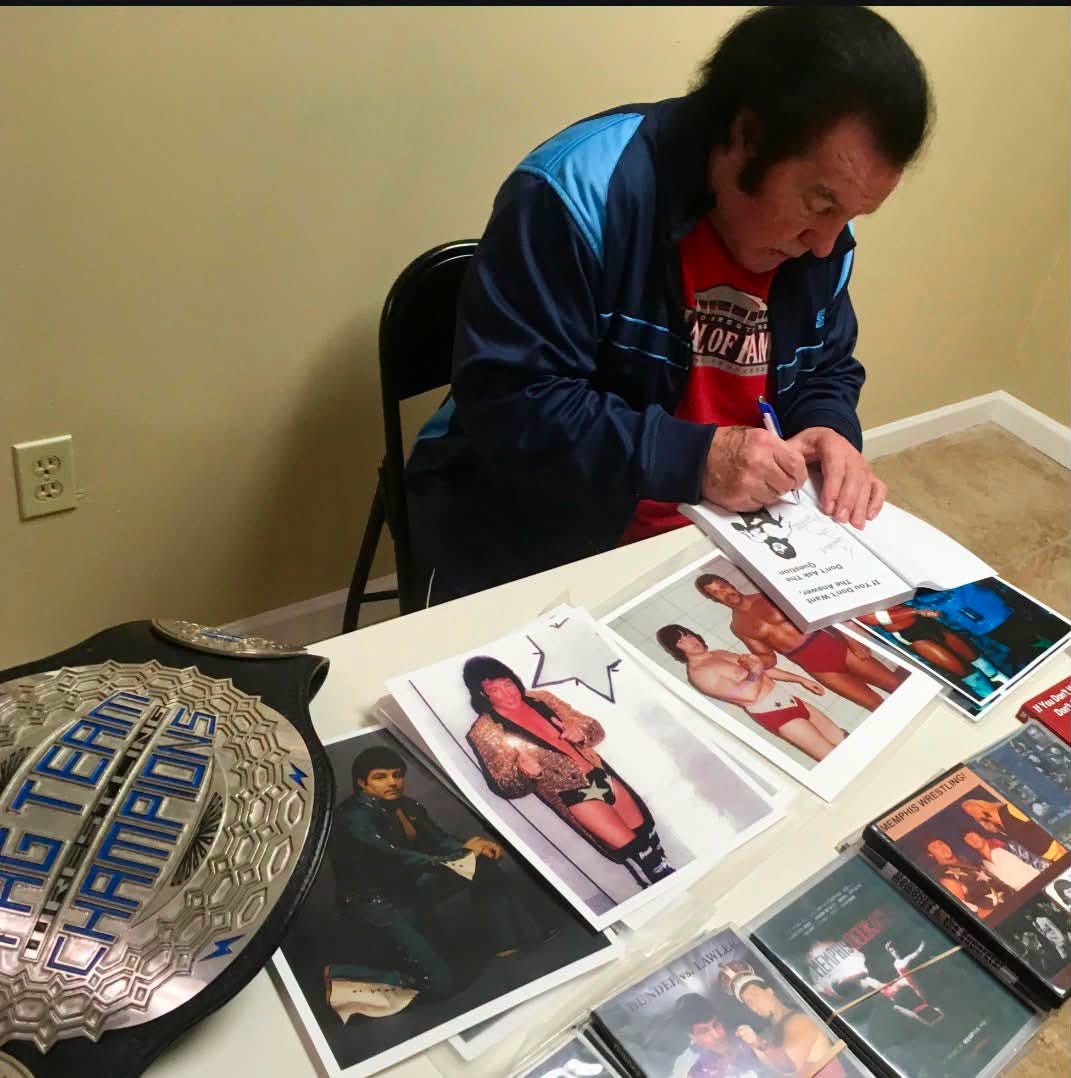
Beverly died in 2016. Eaton died in 2021. Dundee kept making the appearances. A few weeks before September 6, 2026, he sat with Lawler, Jimmy Hart, King Cobra, and Shane Russell for St. Jude. The day before he died, Memphis Wrestling aired a tribute taped earlier: the roster shaking his hand. He died at 3:30 a.m. on September 6, 2026, in Jackson, Tennessee. Jamie announced it. He was eighty-two.
Kansas City was a fifty-five-day championship in a promotion Crockett had already bought. Memphis 1987 was eleven days as world tag champion with the only partner who ever made him look like half of a world team. The USWA years were the Southern Title for half a year, a unified world title at fifty-one, and a tag run with his son so the name would not die on the poster. Sir William was the national television version of a man who had spent twenty years talking on Channel 5. The independents were a scaffold at sixty, Kamala at sixty-one, Deppen at seventy-five.
He never became a WWE Hall of Fame speech. He became the man who was still in the building when the building was a soundstage and a bar in Jackson. The second Crockett run proved he could win a title in someone else’s towns. The 1987 return proved Memphis could still put the world on him for a fortnight. Everything after that proved he would work the next town that asked. That is the final stretch. Not a fade. A man who kept taking the booking until there was no booking left except goodbye
The Dundee Family
William Cruickshanks (Bill Dundee) was born October 24, 1943, in Kirriemuir, Angus, Scotland, and raised by his mother, Helen Stewart, and his grandfather, also named William Cruickshanks. He left Scotland as a teenager, grew up in Melbourne, and at sixteen went into the circus—tightrope, trapeze, elephants—before the ring.
In 1962 he married Beverly Joyce Davis. They had two children, Donna and Jamie. That marriage is the through-line of the public life. The career made the Superstar. The family is what the career kept costing and what it finally paid back.
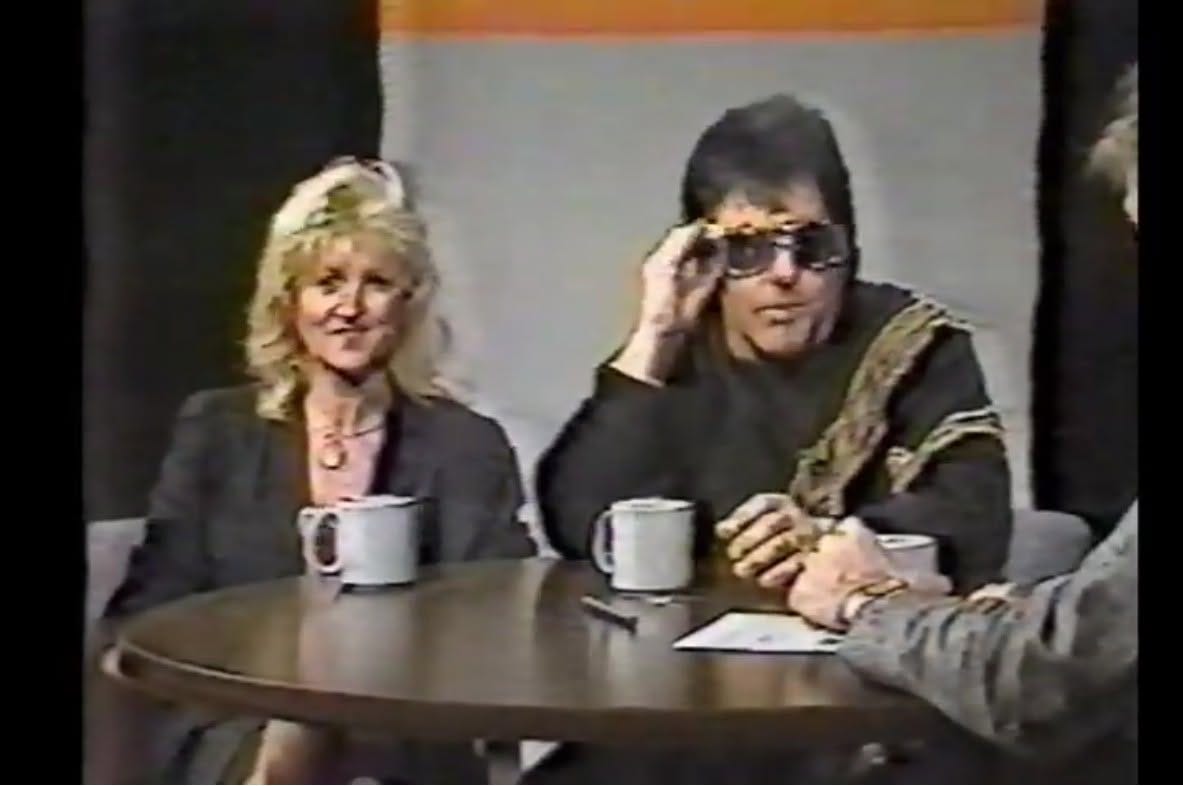
Picrured: Bill and BEverly Dundee on a Nashville call-in sports show
Beverly was not a footnote who happened to get her head shaved. September 1977, after Dundee lost to Lawler and put her hair up, she sat in the Mid-South Coliseum and lost it on camera. That is the most famous thing that ever happened to her in the wrestling press. It is also the crudest measure of what the job asked of a wrestler’s wife in Memphis: the office could put your body on the stipulation list. She stayed. They stayed married more than fifty years. She died in 2016. He outlived her by a decade, most of the last three years inside dementia.
The later-life picture is smaller and more Tennessee than the 1977 tape. A custom-wrapped Mercury Grand Marquis rolling around Memphis. A bar in Jackson. Talk radio on WNWS 101.5. The man who had booked Mid-South and stolen Channel 5 with Buddy Landel became a local who still answered to Superstar.
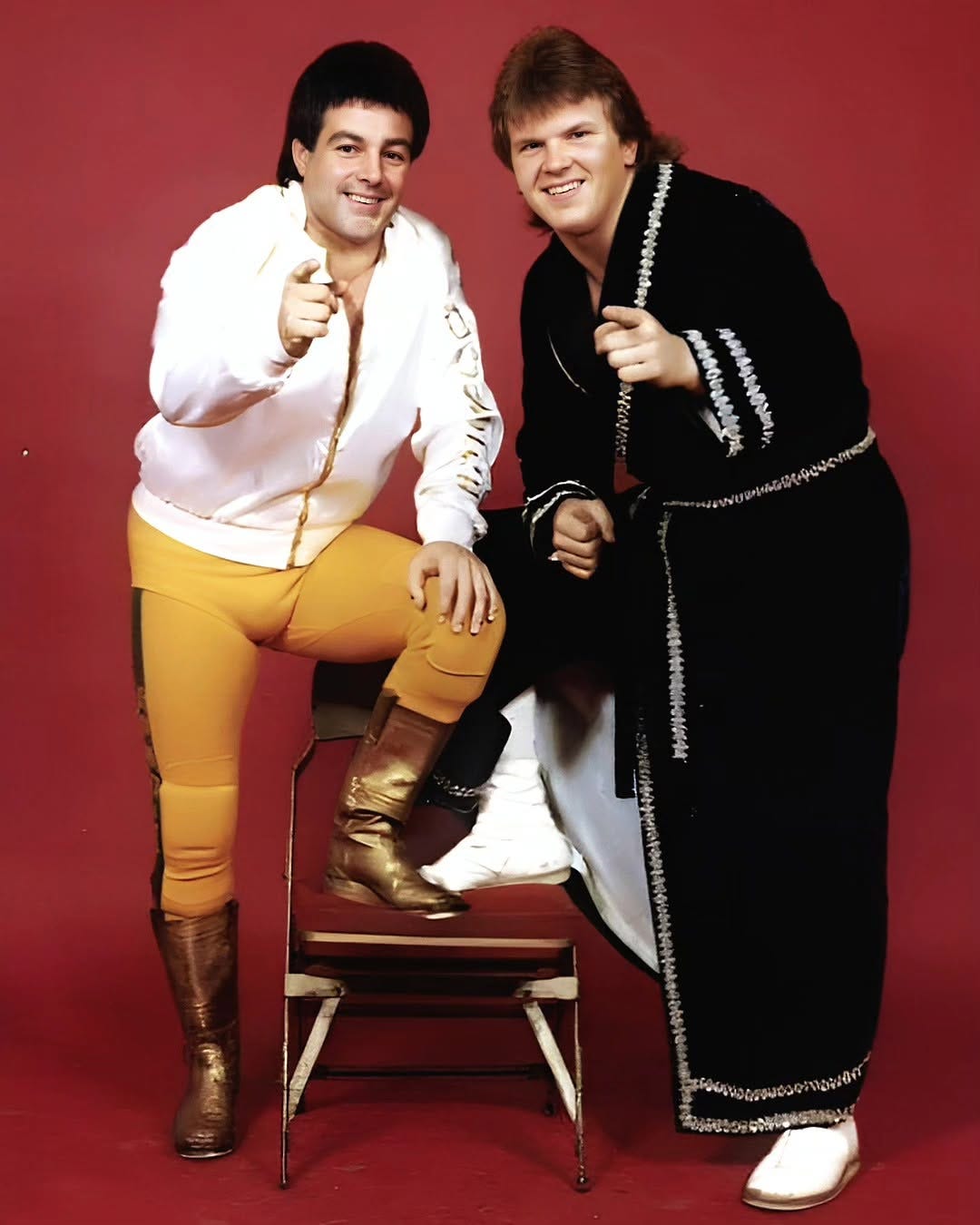
Pictured: Bill Dundee and son-in-law, Bobby Eaton
Donna Joy Cruickshanks Eaton was born October 2, 1963. In 1981 she married Bobby Eaton. They had kept it from her father for months because Dundee, booking the territory, had told her not to date the boys. When she finally said the name at dinner he dropped his fork, swore he would run the man out of the business, then asked who it was. She said Bobby. He picked the fork back up. Out of all of them, he said, she had picked the best.
They had four children: Jason (1982), Dustin (1984), Taryn (1986), and Dylan (1988). Dylan wrestled the Southern independents. Donna died of breast cancer on June 26, 2021, at fifty-seven. Bobby died in his sleep on August 4, 2021, six weeks later. Dundee’s last match, December 14, 2019, in Knoxville, had already been a benefit for Eaton. He sat at Eaton’s memorial in Antioch with Cornette, Arn Anderson, Stan Lane, Tom Prichard, Charles Robinson. The son-in-law he had not wanted in the family became the man whose last payday he worked for.
Donna’s death is the cut that does not have a finish. The 1977 hair match put her mother on television. Forty-four years later the daughter is gone and there is no memorial service, per her wish, only Dundee asking people not to send money.
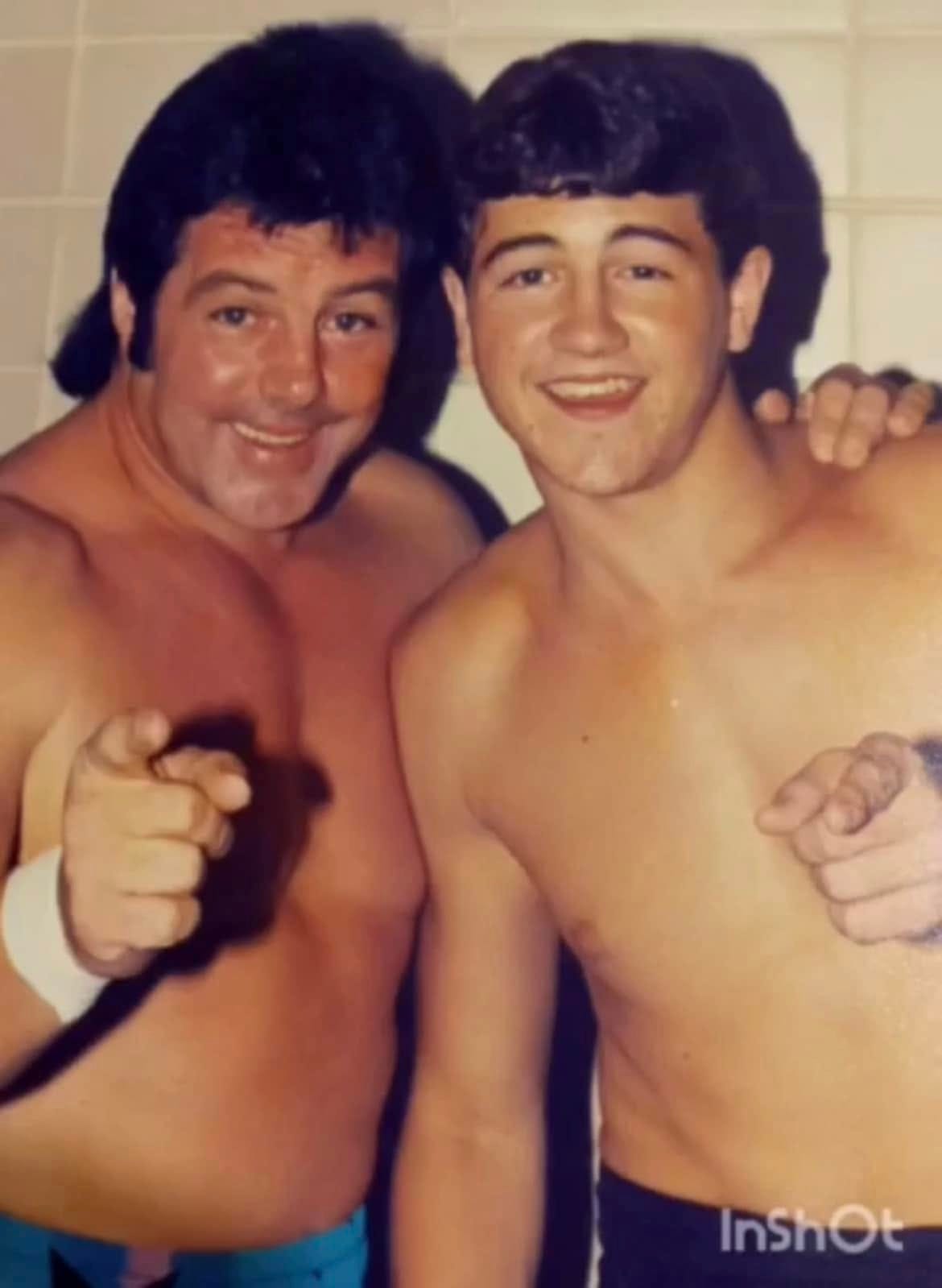
James Cruickshanks (Dundee) was born July 5, 1971, in Sydney. Bill trained him. He debuted in 1988 in Knoxville, managed the Rock ’n’ Roll RPMs, refereed heel in Memphis, then turned on his father in the USWA and became J.C. Ice, a white-rapper gimmick next to Wolfie D as PG-13. They won the USWA tag titles over and over. They worked WWF with the Nation of Domination, ECW, WCW. None of that made him a national star. The turn on his father did what Memphis turns always do: it made the son a heel the building already knew.
In 1996 they tagged as themselves and won the USWA Tag Team Championship. That is the clean version of the family business—the Superstar and his boy with the same belts Lawler had shared with the Superstar nine years earlier. Jamie married Angela. They have six children. One grandson, Austin Dundee, died before Bill did. In September 2023 Jamie went on Dutch Mantell’s show and said his father was in late-stage dementia. On the morning of September 6, 2026, Jamie wrote that his father had died at 3:30 a.m. “I love you Dad. I’ll catch you on the other side.”
The 1977 feud used Beverly as a prop. The 1982 Mid-South year used Bobby Eaton as a Mid-America champion Dundee could beat and then, later, as family. The 1990s USWA used Jamie as both opponent and partner. The 2019 Knoxville show used Eaton’s illness as the reason a seventy-five-year-old still had a last match. None of that is sentimental when you write it as booking. It is how a territorial family works. The office takes what is in the house.
The other side is the list of who died first. Helen Stewart. Grandfather William. Beverly, 2016. Donna, June 2021. Bobby, August 2021. Austin. Then Bill, September 6, 2026, Jackson, after double pneumonia on top of the dementia, a week in the hospital. He is survived by Jamie and Angela, Jamie’s six children, great-grandchildren, Dylan Eaton and the rest of Donna’s line, and the wrestlers who called him a father figure because he had booked them, trained them, or sat in the same dressing room for forty years.
Bill’s Celebration of Life was held September 17, 2026 at Love & Truth Church, 565 Oil Well Road, Jackson. Visitation ten to noon, service at noon. Arrington Funeral Directors. The same West Tennessee towns that had bought his tickets bought the last morning.
The Legacy of Superstar Bill Dundee
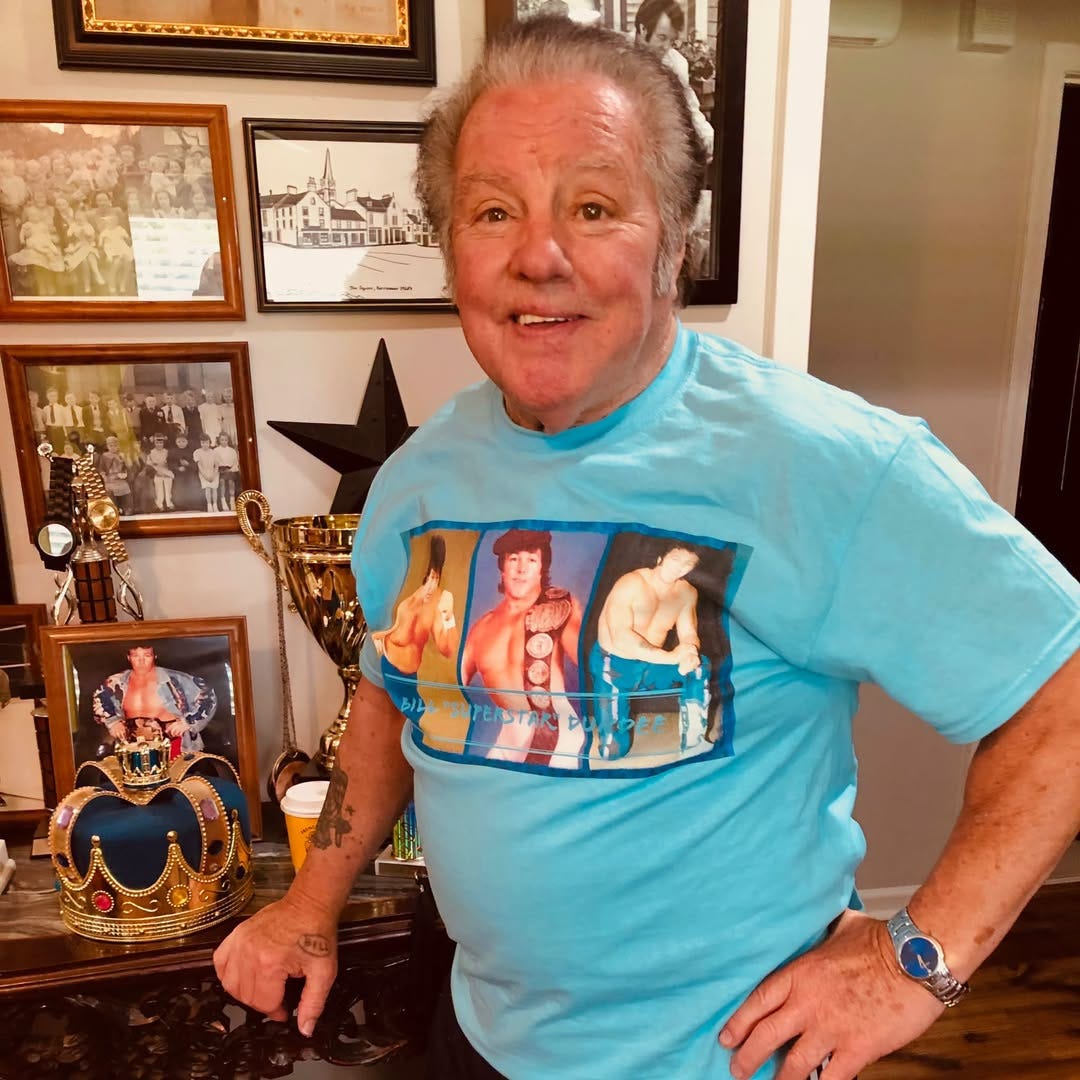
As a wrestler he proved a 5-foot-7 man could main-event the Mid-South Coliseum against Jerry Lawler for a generation, face and heel, singles and tag, and make 11,300 people treat a loser-leaves-town match like civic business. The 1977 summer, the 1978–79 tags, the 1983 piledriver, the 1985–86 Bill and Buddy Show, the 1987 AWA world tag fortnight—those are the tapes. PWI put Lawler and Dundee at number 56 among the hundred best tag teams of the years. That ranking is smaller than the rooms they filled.
As a booker he is the mind Watts hired when Watts did not want the body. Mid-South 1984—Last Stampede, the two Expresses, the scaffolds—is the peak of that company, and Dundee wrote the package while Watts kept the last word. Memphis used him the same way: finishes first, television that corrected last week, stipulations that climbed until the city had to come back. The Chattanooga experiment failed. The Mid-South year did not.
As a father and father-in-law he put two more generations in the ring. Jamie as J.C. Ice and Jamie Dundee. Bobby Eaton as Beautiful Bobby, Midnight Express, Blue Blood. Dylan Eaton on the independents. That is not a dynasty like the Funks. It is a working family that stayed in the South when the South stopped being a territory.
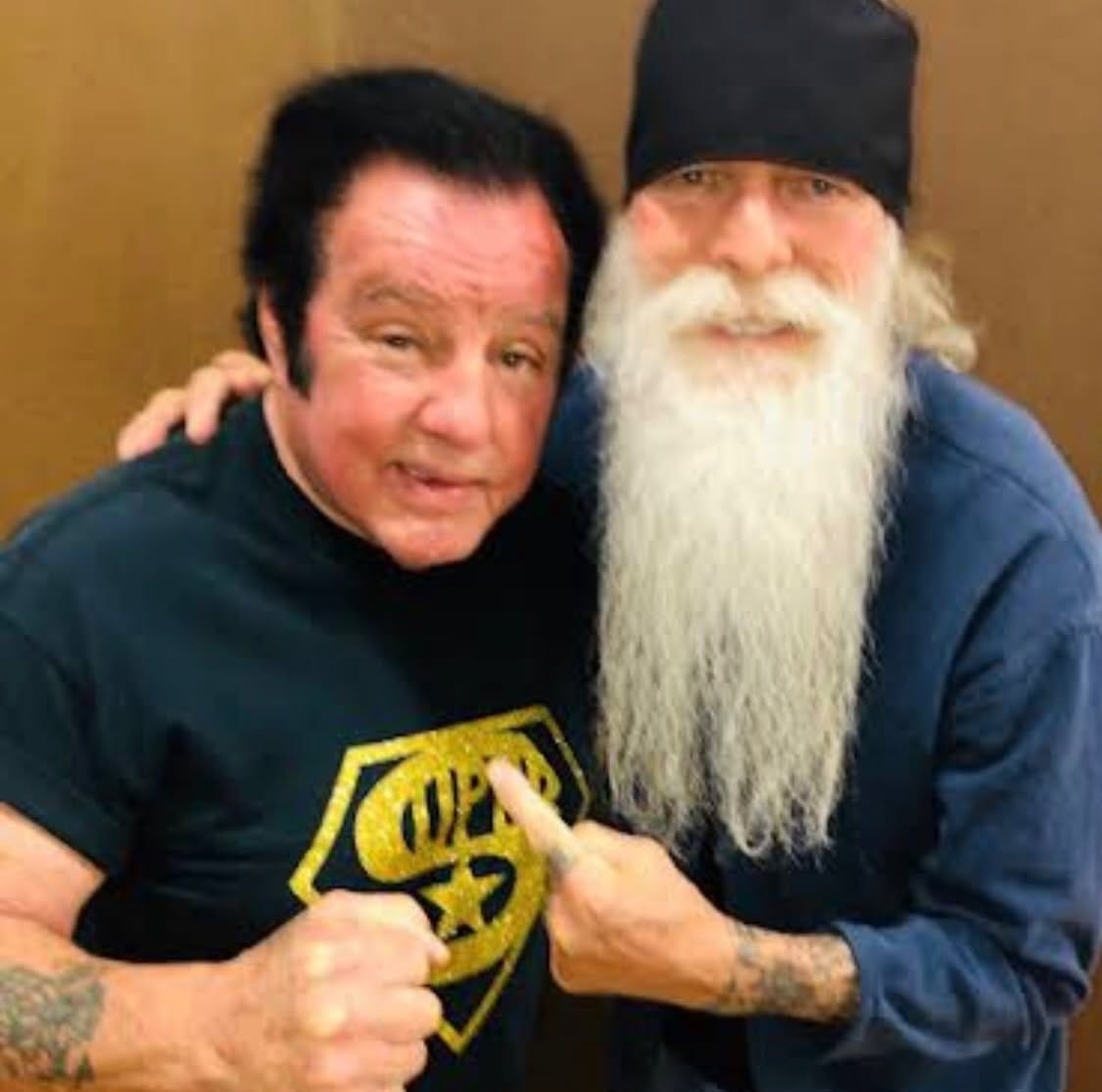
Pictured: Bill Dundee and Jimmy Valiant
As an old man he kept going until December 2019, won a television title at seventy-five, sat for St. Jude with Lawler and Hart a few weeks before he died, and appeared on Memphis Wrestling the night before the morning Jamie had to write the post.
The lasting thing is simpler than the title list. For twenty years in one city he was the second man on the poster, and the city knew the show was not complete without him. He booked other cities well enough that Watts paid him three thousand dollars a week not to wrestle. He trained his son, blessed his daughter’s marriage after the fork hit the plate, and worked a benefit for the son-in-law he had not wanted. The haircut in 1977 is what casual fans remember. The people who bought the tickets remember a small man who talked like he owned the building, punched like he meant it, and was still in Jackson when the building was gone. That is the legacy. Not a monument. A territory that had a Superstar, and a family that paid for it and kept the name.
Bill Dundee’s legacy cannot be reduced to a championship list. His greatest championship was longevity. His greatest accomplishment was influence. His greatest rivalry was perhaps his lifelong wrestling relationship with Jerry Lawler. His greatest contribution may have been teaching the next generation. And his greatest gift was his understanding of professional wrestling as an emotional art form. He proved that a wrestler did not have to look like a superhero to become a superstar.
He proved that personality could overcome size. He proved that intelligence could be as important as athleticism. He proved that a wrestler could remain relevant by understanding how the business was changing. And he proved that a great wrestling career does not end when the wrestler stops winning championships. It continues through the people that wrestler influenced. That is why Bill Dundee’s name will remain important. When future historians discuss Memphis Wrestling, they will talk about Jerry Lawler.
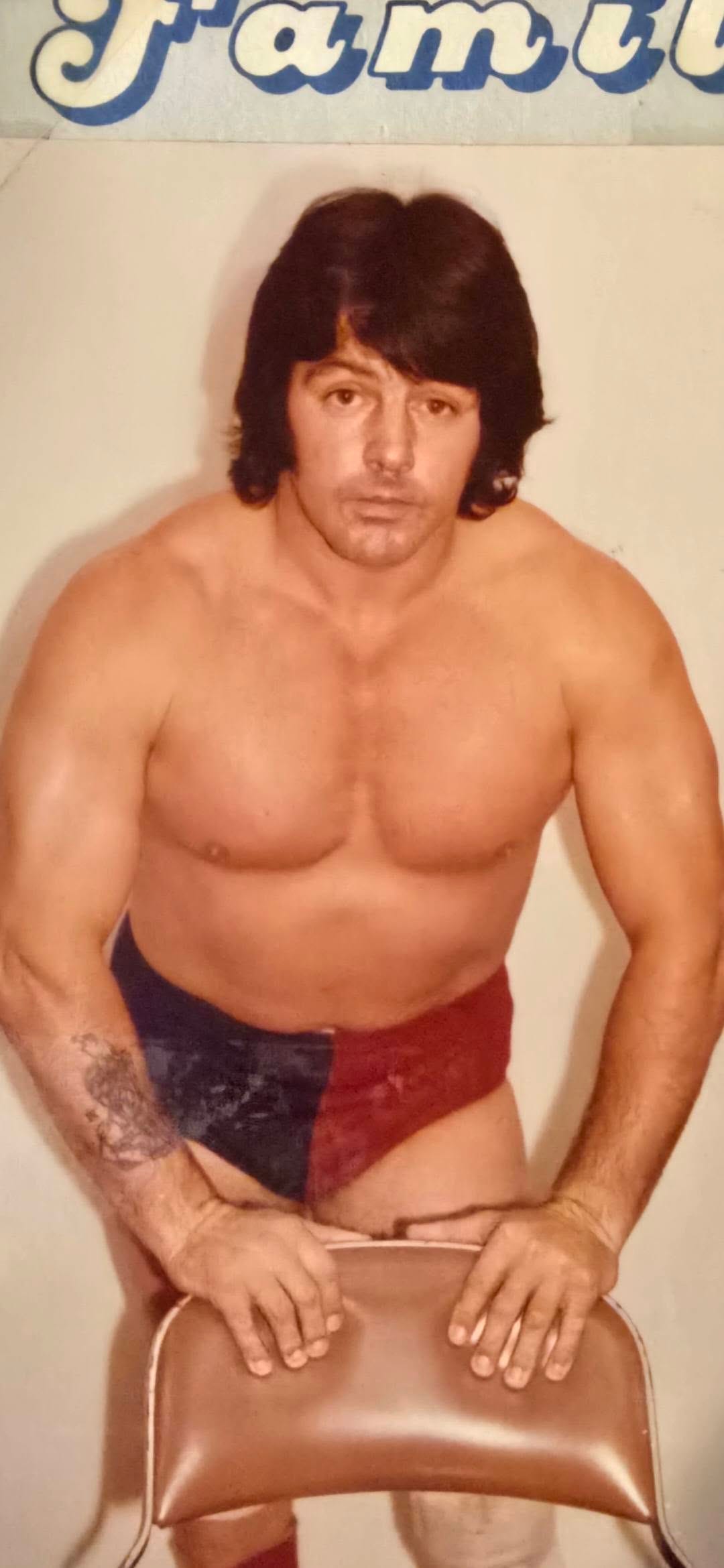
They will talk about Jimmy Valiant. They will talk about the Moondogs, the Fabulous Ones, the Rock ‘n’ Roll Express and the many other stars who passed through the territory. But Bill Dundee will always be there. Because he was not simply another Memphis wrestler. He was one of the men who made Memphis wrestling what it was.
And when the history of the Territory Era is written, Dundee deserves to be remembered not merely as a wrestler who worked within that system, but as one of the extraordinary performers who demonstrated what the system could produce at its very best.
A man who began life in Scotland, grew up in Australia, traveled the world, conquered American wrestling, became one of the defining figures of Memphis, worked beside and against Jerry Lawler, influenced generations of wrestlers and continued performing well into his seventies had earned every syllable of his nickname.
He was the “Superstar.”
And perhaps the most fitting tribute to Bill Dundee is simply this:
He made professional wrestling better because he was in it. He made his opponents better because he worked with them. He made younger wrestlers better because he taught them. He made audiences care because he understood them. And he made the wrestling business feel a little bigger every time he walked through the curtain.
The Territory Era is gone.
The buildings have changed.
The television shows have changed.
The business has changed.
But the memory of the men who made that era special remains.
Bill Dundee is one of those men.
Rest easy, Superstar.
The wrestling business was fortunate to have you.
Thank You for Watching and Listening
I’m Tony Richards, Pro Wrestling Historian, Author and Storyteller. I share pro wrestling historical items in each issue of the Time Tunnel Pro Wrestling History Newsletter and each episode of our podcast show. Thanks for your support! If you enjoy my information on select events, matches and insights, please share with folks you think might like to be a subscriber!
Remember, Premium subscribers get access to exclusive and special content such as some special issues including a multi-part deep dives on wrestling territories, wrestler bios and championship title histories, special audio and video interviews on territory pro wrestling and more available in the Pro Wrestling Time Tunnel for Premium Subscribers. Being a Premium Subscriber also means you support me in my efforts to document Pro Wrestling History through my research, writing, books, vidoes and podcasts. And…I have something very special planned for our Premium Subscribers on the Podcast side of things in 2026! Details soon here in the Pro Wrestling Time Tunnel.