


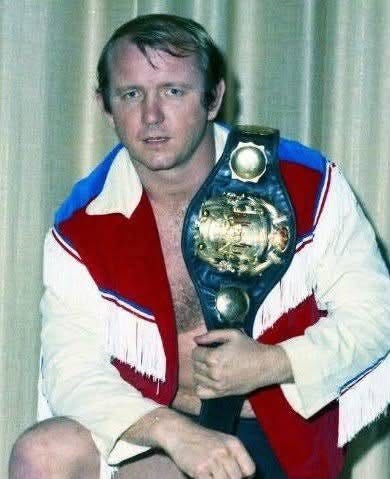
Dorrance Earnest “Dory” Funk Jr. was born on February 3, 1941, in Hammond, Indiana, the oldest son of Dory Funk Sr. and Dorothy Funk. The family relocated to the Texas Panhandle when his father took a position at the Texas Boys Ranch in Amarillo. There, in the dusty, wind-swept landscape that would shape one of professional wrestling’s most enduring dynasties, young Dory absorbed the lessons that defined him: discipline, toughness, and an almost religious reverence for the mat.
He began amateur wrestling at age seven in the program his father ran for the boys at the ranch. More than a hundred kids showed up daily. At Canyon High School, Dory Jr. was a multi-sport athlete who excelled particularly in football. Contemporary and later accounts consistently describe him as a standout football player and amateur wrestler during his high school years. He also played basketball according to some sources.
He developed a strong athletic foundation that carried into college. By the time he graduated, he was larger and more physically mature than his younger brother Terry (who was still relatively small coming out of high school). This helped Dory Jr. attract more college football interest.
He earned the nickname “Dunk” among friends during this period, a moniker that appeared in early wrestling magazine profiles. Growing up in the Funk household meant constant exposure to professional wrestling. His father trained him in holds from a young age (starting around six years old), and the family garage often served as a training space where pros such as Lou Thesz, Verne Gagne, and others worked out. High school sports, especially football, provided the size, toughness, and competitive base that later translated directly into his professional style.Also, Saturdays at the Sports Arena, wrestlers often worked out togther as the Friday night show and the Saturday night shows were booked fairly close by as the wrestlers had television interviews on Fridays and the television show at the studio on Saturdays.
He attended West Texas State University (now West Texas A&M University) in Canyon, Texas, in the late 1950s and early 1960s. He played football as a tackle, competing both on offense and defense in an era when two-way players were still common.
His coach was Joe Kerbel, a former Oklahoma lineman and World War II Marine who arrived in Canyon and transformed the program with a demanding, military-style approach. Funk later described Kerbel’s methods vividly: the coach treated the players “like Marines in basic training.” That toughness and discipline, Funk said, never left him and carried directly into professional wrestling.
Kerbel also integrated the West Texas State football program in 1961, a significant step in the still-segregated Texas Panhandle at the time.
Funk, Jr was a member of the 1962 Buffaloes team that finished 9-2. The highlight came on December 31, 1962, when West Texas State defeated Ohio University 15-14 in the Sun Bowl in El Paso, Texas. The victory remains one of the signature moments of the program’s history on what many agree was the best team in the school’s history. His father, Funk, Sr and the Western States’ ownership group were also big West Texas State boosters and supporters. They did an annual wrestling card on the sports campus fof the athletic department and heklped raise money for a new football stadium to be built in 1957 and 1958.
“We knew when we worked on any kind of benefit show for any cause in Amarillo, especially the football team, everybody knew getting paid for that day, was not happening, all the money was going to the cause” said female performer, Marie LaVerne. That was especially true for the Buffaloes. In addition, Dory Funk, Sr and Doc Sarpolis were season ticket holders for their whole time living in Amaillo, 25 years and 22 years respectively.
Funk repeatedly listed being part of that Sun Bowl championship team as one of his favorite sports memories, alongside winning the NWA World Heavyweight Championship. For the majority of his career from the 1960s through the 1970s, he would often wear a West Texas State letterman’s jacket to the ring or on television promos.
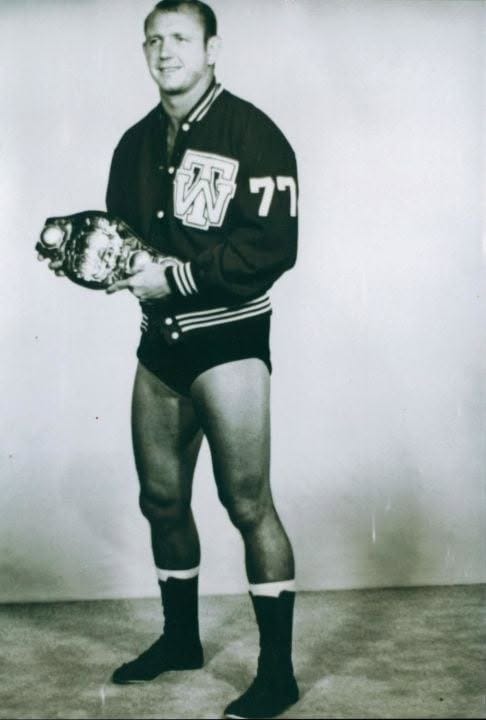
The jacket would also be incorporated into an angle in Houston with Jose Lothario being in possession of the jacket in exchange for a return championship match in the early 1970s. The jacket would be part of the presentation of his gimmick of being an outstanding amateur athlete with the lines being blurred between his actual college football career and his background in wrestling. Funk, Sr really wanted his son to have the brand of a standout amateur athlete, which would later add to the friction with an actual amateur wrestling champion, Jack Brisco.
Funk’s years at the school placed him at the beginning of a remarkable pipeline. West Texas State football produced a long list of future professional wrestlers, including his brother Terry Funk, Stan Hansen, Dusty Rhodes, Ted DiBiase, Tully Blanchard, Tito Santana, Bruiser Brody, Bobby Duncum Sr., and others. The proximity of the Funk family’s Amarillo wrestling territory, combined with Kerbel’s emphasis on toughness, created a natural bridge from the gridiron to the ring.
In 1990, Dory Funk Jr. was inducted into the West Texas A&M University Athletics Hall of Champions in recognition of his football career and later accomplishments.
His college experience provided more than just athletic credentials. The physical demands of two-way play, the discipline instilled by Kerbel, and the competitive environment of a successful independent program helped shape the rugged, fundamental style that defined his professional wrestling career.
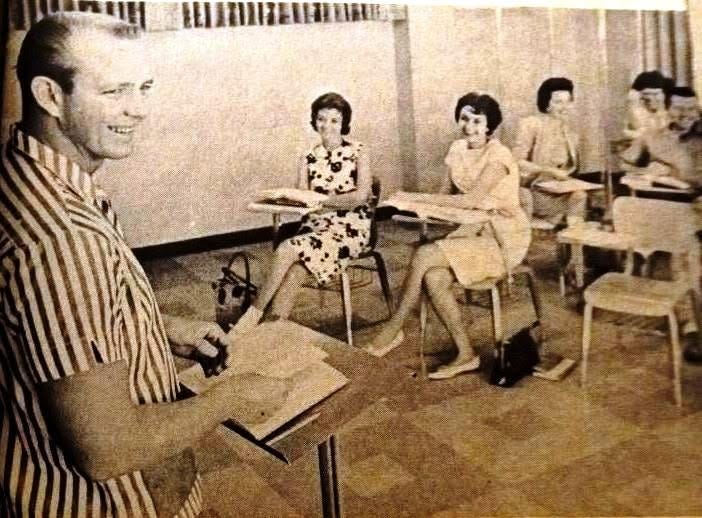
Pictured: Dory Funk, Jr delivers a report to his classmates at West Texas State. (Circa 1962)
Funk graduated in 1963. While completing his studies and doing student teaching (including coaching the amateur wrestling team at Tascosa High School under James Kyle).
Fresh from West Texas State’s Sun Bowl victory and still finishing his student teaching at Tascosa High School, the 21-year-old made his debut on January 10th at the Amarillo Sports Arena against Jack Dalton (Don Fargo). The match carried special local flavor. West Texas State All-American Jerry Logan was handcuffed to Dalton’s brother Jim as a stipulation, and much of the college football team sat in the crowd supporting their former teammate. Funk won cleanly in roughly four and a half minutes. Newspapers noted that his father had been training him since he was six years old.
The booking was careful and protective without being soft. In the opening months Funk worked a steady diet of victories over established names on the Western States circuit—Nelson Royal, Don Duffy, The Viking, and others—while the territory introduced him as the clean-cut local athlete and son of the promotion’s cornerstone. He formed an early tag partnership with Wahoo McDaniel that gave him experience working longer matches and building crowd support.
By mid-March the pace quickened. Funk won a one-night $2,000 tournament in Amarillo, defeating Bud Cody, Iron Mike DiBiase, and Moose Cholak in succession. He also scored a decision victory over Gene Kiniski, a significant early measuring stick. These results established that the young Funk was not simply riding his father’s name. Spring and early Summer, he had a series of hour-long draws and one loss to for NWA World Title contender and AWA World Champion, Verne Gagne.
Summer brought higher-profile tests. On July 9 in Odessa he went to a time-limit draw with NWA World Heavyweight Champion Lou Thesz, an important credibility match for a first-year wrestler. Around the same period he began regular encounters with Sputnik Monroe, a tough, charismatic veteran who could work both singles and tags. Funk also faced The Sheik in a series of heated matches. Their program escalated through the fall and culminated on November 28 in Amarillo when Funk defeated The Sheik in a Texas Death Match, pinning him after a chair shot when Sheik could not continue. It was billed as Sheik’s first loss in the territory.
Harley Race appeared regularly on the same cards. Funk scored singles victories over him, including a win in Lubbock in mid-November, and the two crossed paths in multi-man and tag matches. These early encounters planted the seeds of a rivalry that would stretch across two decades and include multiple world title matches.
The year’s most sustained success came in the tag division. Teaming with his father, Dory Funk Jr. won the vacant NWA Amarillo North American Tag Team Championship on November 7 in Amarillo by winning a tournament. They defeated Harley Race and Rudy Kay in the first round, Fritz von Erich and The Sheik in the semifinals, and Karate Shibuya and Tokyo Tom in the finals. The father-son duo then defended the titles against a string of strong combinations: Sputnik Monroe and The Sheik, Fritz von Erich and Tokyo Tom, Sputnik Monroe and Tokyo Tom, and others. The pairing allowed Junior to work longer, more physical matches while remaining under the protective umbrella of his father’s experience and reputation.
By the end of 1963, Funk had compiled a solid record across the West Texas, New Mexico, and occasional Colorado towns that made up the territory. He had drawn with world champions Thesz and Gagne, defeated established heels including The Sheik and Harley Race, and claimed tag team gold with his father. The presentation was consistent: a hard-working, hard-hitting babyface with legitimate athletic credentials and deep local roots.
The year was never about overnight superstardom. It was about foundation. The matches taught him how to pace a program, how to work with veterans of different styles, and how to carry the expectations that came with the Funk name. By December 1963 the territory already treated him as a main-event-capable talent rather than a prospect. The spinning toe hold, the forearm smashes, and the straightforward, physical approach that would define his career were already visible.
That first year set the template. The football toughness, the family training, and the careful early booking combined to launch a career that would soon reach the highest levels of the National Wrestling Alliance.
NWA Political Support
In 1955 Karl “Doc” Sarpolis purchased the Amarillo-based Western States Sports promotion from Dory Detton. He brought Dory Funk Sr. in as a partner and top babyface, giving Funk a minority ownership stake and the central role in the ring and on the road at a time when, like many state athletic commissions, in Texas, dual licenses as promoter and wrestler were not granted. The arrangement worked. Sarpolis provided the capital, the office infrastructure, and the NWA political relationships. Funk supplied the star power, the local credibility, and the day-to-day booking instincts, under Sarpolis’ mentorship, that turned West Texas, parts of New Mexico, and surrounding towns into a strong, self-sustaining territory.
By the time Dory Jr. debuted, this partnership had already been in place for nearly a decade. Sarpolis remained the majority owner. Cards throughout 1963, 1964, and 1965 still listed him as the promoter. The young Funk was therefore not simply the son of the territory’s top star; he was the son of the minority partner in an office controlled by one of the more influential figures in the Alliance.
Sarpolis’s influence extended well beyond Amarillo. He had long experience booking in Houston and Dallas during the turbulent Texas promotional wars of the 1940s and early 1950s. In 1962 he was elected president of the National Wrestling Alliance—the first president to recognize a champion other than the official NWA titleholder when the Amarillo office briefly supported Gene Kiniski over Buddy Rogers. Even after that episode, he continued paying membership dues and maintained working relationships with Sam Muchnick, Verne Gagne, Bob Geigel, and Jim Barnett.
Those relationships mattered for a young wrestler being prepared for wider exposure. When Dory Jr. began appearing outside the home territory—St. Louis, Vancouver, Australia, and other NWA-affiliated markets—he traveled under the umbrella of an office that already had established lines of communication with the major promoters. Sarpolis’s standing made those doors easier to open.
The Formative Window: 1963–1967
From Junior’s debut until Sarpolis’s death, the structure never changed. Dory Sr. handled the hands-on training, the match psychology, and the protective early booking. Sarpolis controlled the office, the majority ownership, and the broader political relationships that gave the territory its weight inside the Alliance. The rapid elevation of the young Funk—early title opportunities, strong programs against established names, and eventual outside bookings—occurred inside that dual framework.
Sarpolis died of a heart attack on May 28, 1967, following a boating accident. He was 69. His widow sold his shares, and full ownership of Western States Sports eventually passed to the Funk family. From that point forward the narrative becomes almost exclusively a Funk story. The earlier years, however, were shaped by the Sarpolis\Funk Sr. partnership.
It is natural for some historians and podcast hosts to emphasize Dory Funk Sr.’s role. He was the trainer, the in-ring mentor, the father, and the visible face of the territory. Yet the political and structural platform that allowed a 21-year-old former college football player to move so quickly through the territory system belonged in significant part to Doc Sarpolis. As majority owner and a genuine NWA power broker during the precise window of Junior’s apprenticeship, Sarpolis provided the institutional backing that made the accelerated push possible.
Without that backing, the early opportunities, the outside travel, and the eventual positioning for the 1968 championship committee discussions would have looked different. The father trained the wrestler. The majority partner and NWA insider helped clear the path. Both deserve recognition in the story of how Dory Funk Jr. moved from Amarillo prospect to serious contender for the biggest prize in the business.
The Road To The NWA Title
The story of how Dory Funk Jr. became NWA World Heavyweight Champion in 1969 is incomplete without the earlier political fracture that put an Amarillo version of the world title on his waist in 1963—and the role Gene Kiniski played in both moments.
In the early 1960s the National Wrestling Alliance faced a succession question after Pat O’Connor’s reign. Dory Funk Sr. was among the names discussed as a possible successor. The Alliance ultimately chose Buddy Rogers. The decision created a clear and hot rift with the Amarillo office.
Doc Sarpolis and Dory Funk Sr. refused to fall fully in line. Instead of recognizing Rogers as undisputed champion, the Western States territory elevated Gene Kiniski and presented him as their world champion. Sarpolis continued paying NWA membership dues even while operating in open disagreement with the official title picture. In 1962 the Alliance elected Sarpolis NWA President—an outcome some viewed as an attempt at political management, which it totally was. Sarpolis became the first president to promote a champion other than the recognized NWA titleholder, continuing to support Kiniski in Amarillo.
Let’s consider the brilliance of the Sarpolis brilliant political maneuver.
Crucially, Sarpolis did not leave the Alliance. He continued paying membership dues. This dual posture—operating in open disagreement on the title while remaining a dues-paying member—allowed him to maintain formal standing even while asserting territorial independence. In 1962 the NWA elected him president. The election has been interpreted as an attempt at political management, yet Sarpolis used the position to continue recognizing Kiniski. He became the first NWA president to promote a champion other than the official titleholder.
The strategy was calibrated. Full withdrawal from the Alliance would have isolated the territory. Complete submission would have surrendered local control of the championship narrative. By staying inside the organization while running an alternative title claim, Sarpolis preserved both political access and promotional autonomy.
Even during the Rogers dispute, Sarpolis and the Amarillo office maintained working agreements with all the key members and figures in wrestling worldwide . These relationships ensured talent exchange and kept the territory connected to the wider NWA system. When the conflict was finally resolved at the 1963 St. Louis convention and Amarillo returned to recognizing the official champion, those existing lines of communication made the reintegration smoother.
Only after further meetings in St. Louis did the standoff end and the West Texas territory return to recognizing the official champion (Lou Thesz, who had taken the title from Rogers). The episode left a lasting mark: Amarillo had demonstrated both its independence and its willingness to create its own world championship narrative when it felt the Alliance had chosen incorrectly.
Sarpolis’s political position also shaped talent strategy. The early, aggressive push of Dory Funk Jr.—including the March 1963 match in which Junior defeated Kiniski for the Amarillo-recognized world title—occurred under Sarpolis’s mentorship and majority ownership. The territory’s willingness to create its own championship picture gave the young Funk an extraordinary early platform. At the same time, the office’s NWA connections facilitated Junior’s later appearances in St. Louis and other key markets that mattered for long-term championship consideration.
That independent championship story reached a striking early climax on March 28, 1963, at the Amarillo Sports Arena. Only weeks into his professional career, Dory Funk Jr. faced Gene Kiniski, who was still being billed in the territory as world champion. Kiniski won the first fall after more than thirty minutes when Funk refused to break a spinning toe hold. Kiniski was then unable to continue. The referee awarded the match—and with it the Amarillo-recognized world title—to the young Funk.
It was an extraordinary push for a wrestler still in his first months. The local papers treated it as Junior capturing Kiniski’s claim to the world championship. The booking simultaneously elevated the newcomer, settled (for Amarillo purposes) the disputed championship picture, and kept the Funk name at the center of the territory’s identity. The same Gene Kiniski who had been the Amarillo office’s answer to Buddy Rogers had now passed that symbolic title to Dory Funk Jr.
The rest of the 1960s turned that early symbolic victory into genuine championship credentials. Funk Jr. continued to develop in Amarillo and on the road. He worked St. Louis under Sam Muchnick, gained experience in Vancouver and Australia, the Houston and Dallas looops and steadily built the reputation of a reliable, athletic, real-name wrestler who could carry long matches and leave territories stronger than he found them. By the late 1960s he checked the boxes that mattered to the championship committee: college background, shoot real name in promotion, in-ring credibility across multiple territories, and the political support of an established NWA member office.
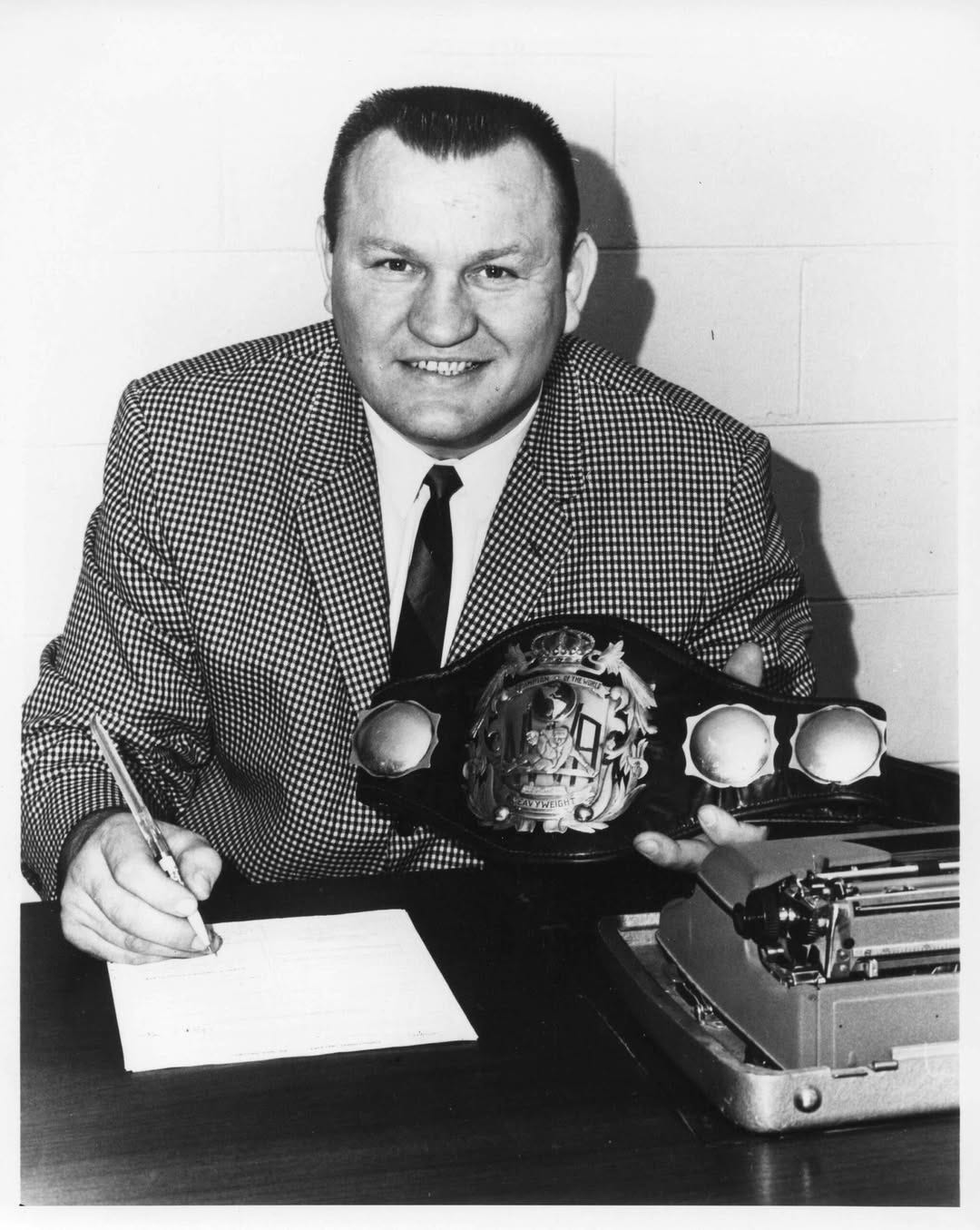
Pictured: Gene Kiniski NWA World Heavyweight Champion
At the 1968 NWA Convention, Gene Kiniski made clear he was ready to drop the actual NWA World Heavyweight Championship. Candidates were discussed. Dory Funk Sr. lobbied for his son. Family conversations beforehand had already aligned the Funks behind Junior. The combination of Junior’s body of work and the office’s political capital proved sufficient.
On February 11, 1969, in Tampa, Florida, history repeated with the same two men. Dory Funk Jr. defeated Gene Kiniski with the spinning toe hold and became the recognized NWA World Heavyweight Champion. Six years earlier Kiniski had dropped the Amarillo version of the world title to the same young wrestler in the same territory’s home arena. Now he dropped the real one.
The 1963 Amarillo title change had been a local political statement born of the Rogers controversy. The 1969 Tampa title change was the culmination of years of deliberate preparation. Between them lay the work that turned a rapidly elevated prospect into a champion the Alliance could trust with the biggest prize in the business. Kiniski’s willingness to do the job both times—first for the territory’s independent claim, then for the official championship—bookended one of the cleaner full-circle stories in NWA history.
The NWA World Championship
Excluding Buddy Rogers, who was more strictly performer than technician, Lou Thesz, Pat O’Connor, Gene Kiniski, and Dory Funk Jr. form a key stretch of NWA World Heavyweight Champions spanning the late 1950s through the early 1970s. Each embodied a version of the “legitimate” traveling champion the Alliance valued, but they differed in style, presentation, length of reign, and how they used the title.
Lou Thesz was the pure technician and “hooker.” Trained in catch-as-catch-can and legitimate submission skills, he innovated or popularized the Thesz Press, STF, early powerbomb, and belly-to-back (German) suplex. His matches emphasized tight chain wrestling, painful holds, and realism. He famously said his gimmick was wrestling. As champion he projected quiet authority and credibility. Thesz set the template: a skilled, legitimate traveler who made the championship the centerpiece of the Alliance through pure wrestling ability. He defended against all styles and helped establish the title’s prestige across territories and internationally.
Pat O’Connor was a smooth, athletic scientific wrestler with a strong amateur background (New Zealand). Fluid, polished, and a classic white-meat babyface, he excelled at making the technical style look effortless and crowd-pleasing. He was a reliable worker who could stretch opponents while remaining a sympathetic champion. O’Connor succeeded as a clean, athletic babyface champion during the rise of television. He was a strong box-office draw and a dependable representative who could work the circuit without controversy. His reign bridged the pure shooter era and the more entertainment-oriented direction that followed (Buddy Rogers).
Kiniski represented a shift toward power and aggression. A former football player, he was stiff, relentless, and forward-moving, with the backbreaker as a signature. Comfortable (and effective) as a heel champion, he contrasted sharply with Thesz’s pure scientific approach. His style was more brawling and physical—tough, mean, and no-nonsense—while still credible enough for the board to trust him with the belt. Kiniski proved a heel could successfully carry the world title for a full multi-year run. He drew heat effectively, traveled extensively (including Japan), and handled a brutal schedule. By the end he was exhausted and asked to step down, but he had shown the Alliance that a tougher, more aggressive presentation could work.
Funk Jr. blended the technical tradition of Thesz and O’Connor with a rugged Texas edge. A second-generation wrestler with a college football background, he was a mat-based technician who used uppercut forearms, suplexes, and leg work. His primary finisher was the spinning toe hold (the same move that won him the title from Kiniski). He could work stiff and scientific while adapting to the more physical demands of late-1960s/early-1970s territories and Japan. Funk Jr. returned the title to a more technical, babyface-leaning orientation after Kiniski’s heel run while incorporating the physicality of the era. He was an outstanding “worker’s champion”—excellent at elevating local talent (especially Jack Brisco) and producing high-quality matches night after night. He traveled tirelessly, performed strongly in Japan, and maintained credibility over a longer continuous period than anyone except Thesz at his peak
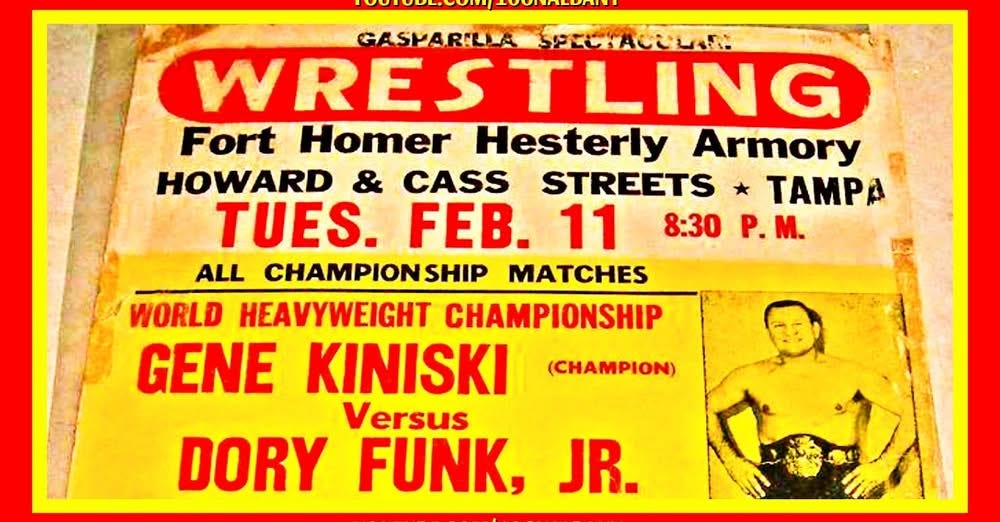
Dory Funk Jr. stepped into the Fort Homer Hesterly Armory in Tampa as another challenger on February 11, 1969, and left as NWA World Heavyweight Champion. He defeated Gene Kiniski with the spinning toe hold in a match that capped years of preparation inside the Funk household and the Amarillo office. His father, Dory Funk Sr., stood in the corner that night. After the victory, the elder Funk offered rare public praise, telling his son that whatever else happened in the business, he had already accomplished a great deal. The moment belonged to more than one man. It belonged to a family that had spent the previous decade building the political capital, the in-ring credibility, and the territorial platform that made the title possible.
What followed was one of the longest uninterrupted reigns in NWA history—more than four years of near-constant travel, defenses across the United States and Japan, and a web of angles that repeatedly pulled father and both sons into the same storylines.
The championship years were never a solo act.
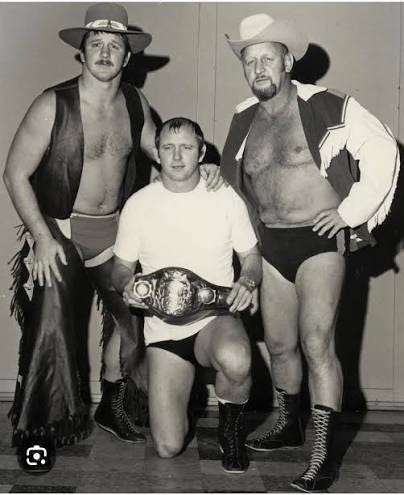
From the beginning, Dory Sr. remained a visible part of the championship presentation. He accompanied his son to many early defenses, offering the same ringside presence and counsel that had guided Junior since childhood. The elder Funk’s own history with the Alliance—years as a top territorial star, minority partner then full owner of Western States Sports after Doc Sarpolis’s death, and long-standing relationships with promoters across the map—gave the new champion institutional backing. When Junior returned home to Amarillo between road trips, the territory continued to run under Sr.’s direction, with the world title used to elevate local programs and reinforce the family’s standing.
The schedule was relentless. In the first year alone Junior faced a wide range of challengers: Harley Race, Johnny Weaver, Fritz von Erich, The Sheik, Hans Schmidt, Johnny Valentine, Wahoo McDaniel, and others. He worked the major NWA towns—St. Louis under Sam Muchnick, Florida, the Carolinas, Texas, and beyond—carrying the belt as the traveling representative of the Alliance. Through it all the father remained a constant, both as advisor and as occasional in-ring participant in the home territory.
NWA in Japan
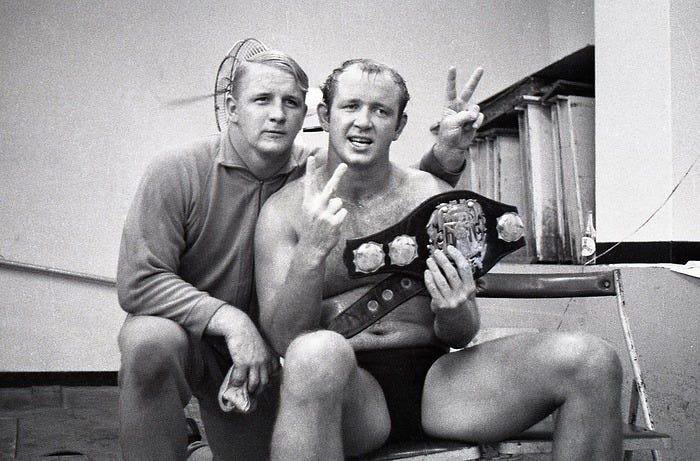
Pictured: Dory and Terry in Japan in 1970
In late 1969 the championship crossed the Pacific. The NWA title had not been defended in Japan for more than a decade. Junior’s first tour for the Japan Pro Wrestling Alliance immediately established him as a major foreign star. On successive nights he wrestled Antonio Inoki and Giant Baba to one-hour draws, performances that cemented both his credibility and the prestige of the NWA belt in Japanese eyes. Dory Sr. traveled with him on that initial trip, reinforcing the family presence on the international stage.
Subsequent tours deepened the connection. Terry Funk joined his brother in Japan, and the two began working as a unit against the top Japanese combinations. In December 1971 in Sapporo, Dory Jr. and Terry defeated Baba and Inoki to capture the NWA International Tag Team Championship—a significant symbolic victory that placed the Funk name atop one of Japan’s most important titles while the world championship still rested with the older brother. The brothers would drop the belts the following year as the JWA began to fracture, but the foundation for their long-term alliance with Baba and All Japan Pro Wrestling had already been laid. The championship years turned the Funks from an Amarillo family into an international attraction.
The Funk and Brisco Feud
The rivalry between Dory Funk Jr. and Jack Brisco stands as one of the purest technical programs in professional wrestling history. It was built on legitimate athletic credentials, contrasting but complementary styles, family involvement on both sides, and political undercurrents that stretched from West Texas to Florida and the Carolinas. What began as a calculated territorial squash series evolved into hundreds of matches—many of them hour-long classics—that defined the NWA World Heavyweight Championship era of the early-to-mid 1970s.
The earliest encounters occurred in the Amarillo territory under promoter Dory Funk Sr. Jack Brisco, the 1965 NCAA wrestling champion at 191 pounds out of Oklahoma, entered the professional ranks with strong amateur credibility. Dory Funk Jr., a former West Texas State football lineman, was being groomed by his father as the next major star.
According to Brisco’s own accounts, Funk Sr. repeatedly booked quick victories for his son over the legitimate collegiate champion. Night after night Brisco would receive a strong buildup only to be pinned in two minutes or less. The booking served to establish Dory Jr. as a superior amateur-style wrestler in the eyes of Texas fans, despite his background being primarily football rather than collegiate wrestling. Brisco found the arrangement demoralizing and the payoffs meager, later saying the experience nearly drove him out of the business early in his career. This early program planted seeds of personal friction that never fully disappeared, even as mutual professional respect grew.
While this early encounter served to frustrate the young Brisco to no end, the more accomplished and confident Brisco said in his book “BRISCO: The Life and Times of a National Collegiate and World Champion”, when Jack was asked about the greatest moment in his career, he said the night Funk, Jr won the world championship because it ushed in a new era of smaller, athletic types such as himself.
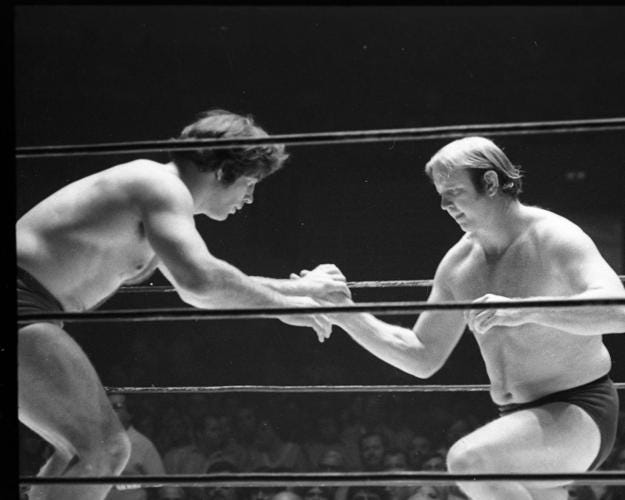
After Funk, Jr won the championship, the first significant title match against Brisco followed on July 30, 1969, in Miami Beach. Funk retained, but the match was strong enough that Florida promoter Eddie Graham immediately booked a rematch that went to a sixty-minute draw, with Funk caught in Brisco’s figure-four leglock at the bell.
Florida became the primary stage. Graham, a master of long-term storytelling, built Brisco as the ultimate athletic challenger. The two men worked dozens of title matches across the state, frequently going the full hour. Their styles meshed perfectly: Funk’s hard-hitting, mat-based Texas style and spinning toe hold against Brisco’s smooth amateur technique, quickness, and figure-four. Dory Jr. later said wrestling Brisco allowed him to work as a heel for the first time as champion and that there was “nobody better” to work with.
Family layers deepened the program. Dory Funk Sr. and Terry Funk made repeated appearances in Florida. Sr., billed as the undefeated King of the Texas Death Matches, put a bounty on Brisco and wrestled him in stiff death matches that helped establish Brisco as tough enough to survive brawling as well as technical wrestling. Terry Funk became a regular antagonist and tag partner. On the other side, Jerry Brisco (often spelled Gerry in contemporary accounts) teamed with his brother, creating Funk Brothers vs. Brisco Brothers tag matches that sold strongly.
Jim Crockett Sr. recognized the drawing power of the program and imported it into the Mid-Atlantic territory. Many of the most memorable Funk-Brisco matches took place in Charlotte, Greensboro, and other Carolina towns. Thanksgiving shows in Greensboro often featured the rivalry in some form. The relationship between Eddie Graham and Jim Crockett Sr. was close and cooperative; the two promoters frequently exchanged talent and ideas. Graham’s willingness to send Brisco (and later the full family program) north helped solidify the feud as a multi-territory attraction rather than a Florida-only story.
Dory Funk Sr.’s relationship with both Graham and the broader NWA board was more complicated. There was an underlying power struggle for influence among the major promoters. When the time came for Funk Jr. to drop the title in 1973, the original plan called for a clean loss to Brisco in Houston. Instead, word came from Texas that Dory Jr. had rolled his truck on the ranch while rounding up cattle, separating his shoulder. The title eventually went to Harley Race as a transitional champion before Brisco defeated Race on July 20, 1973, in Houston. Brisco and others long believed the accident was an angle orchestrated by Funk Sr. to avoid a clean babyface-to-babyface title change that might diminish his son’s credibility. Whether true or not, the episode intensified the personal edge of the rivalry.
There were almost so many highlights to the feud it would be its own feature article. These include things like repeated sixty-minute draws, many estimates range from dozens to over fifty across the years. There were classic encounters in St. Petersburg (Bayfront Center), Jacksonville, Miami Beach, and across the Carolinas.
One famous match in Abilene, Texas, in which the ring collapsed mid-bout; the two continued wrestling because the championship was more important than the broken ring. There were many strong Japan matches, including a notable 1974 contest with Sam Muchnick present.
Of course the tag team extensions that kept the families involved even when the singles program needed fresh life and the continuation after the NWA title changed hands: Brisco defended against both Funks throughout his reign, and Terry Funk ultimately took the title from Brisco on December 10, 1975, in Miami.
The feud never received a formal, definitive conclusion. It continued in various forms through the mid-to-late 1970s and resurfaced as late as 1983 in the Mid-Atlantic territory, where Dory Funk Jr. and Jack Brisco still worked meaningful singles and tag matches. By then the personal heat had largely cooled into professional regard. Both men had moved into different phases of their careers—Funk deeper into Japan and training, Brisco toward retirement and later WWF work with his brother.
The Legendary Pick Up Truck Accident
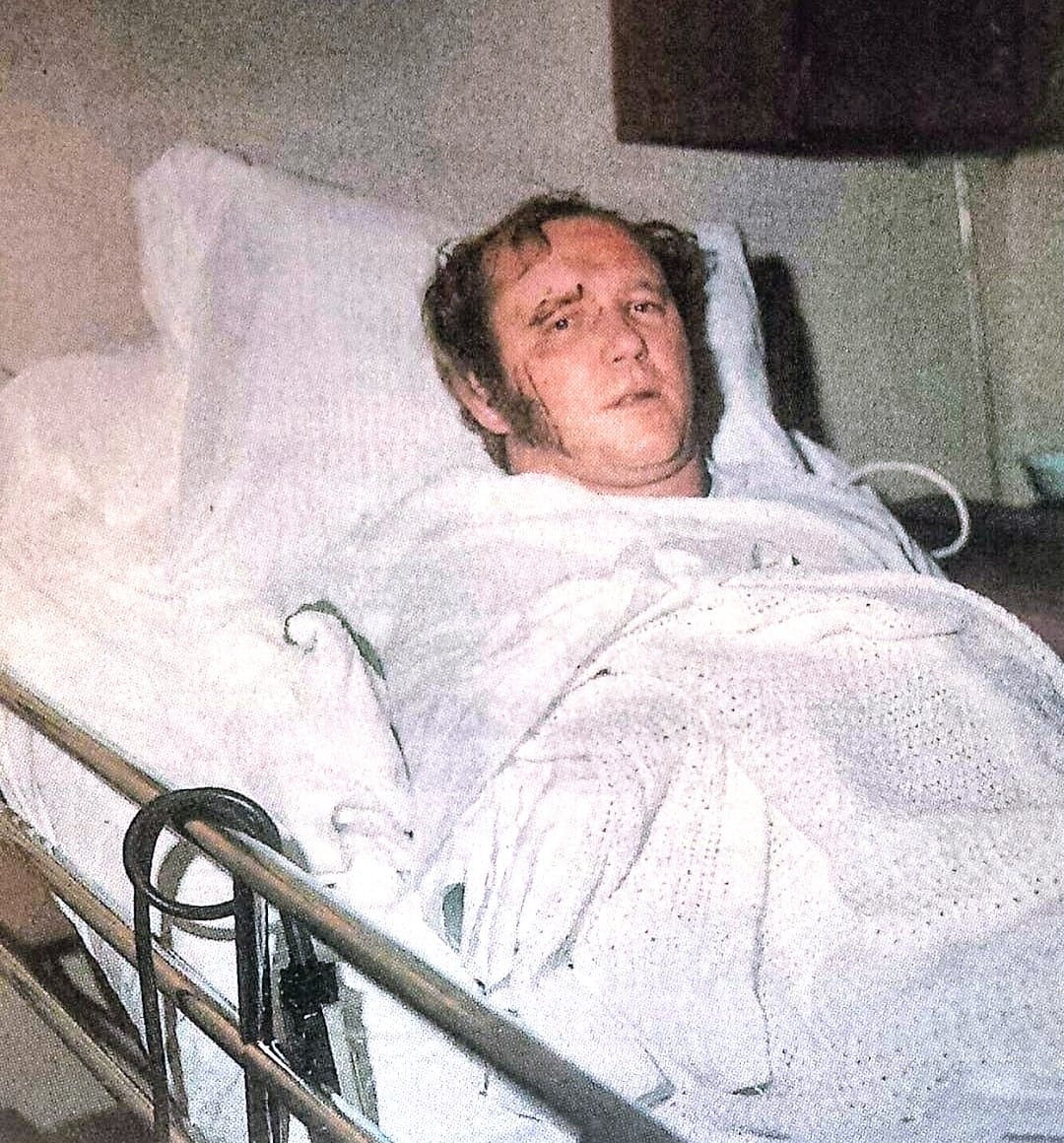
By early 1973 the Alliance was preparing for a transition. Jack Brisco was widely viewed as the logical successor. A title match was scheduled for early March in Houston. Days before that date, Dory Funk Jr. was involved in a pickup-truck accident on the Flying Mare Ranch in Umbarger, Texas. He suffered a shoulder injury that forced the postponement of the planned change. Fritz von Erich substituted in Houston. There are several interesting things arounf the accident that cause doubters about the legitimacy of the incident and many now regard it all as a “worked: accident, but perhaps the most interesting item involved a St. Louis match a few years before involving Senior and his parents in 1965.
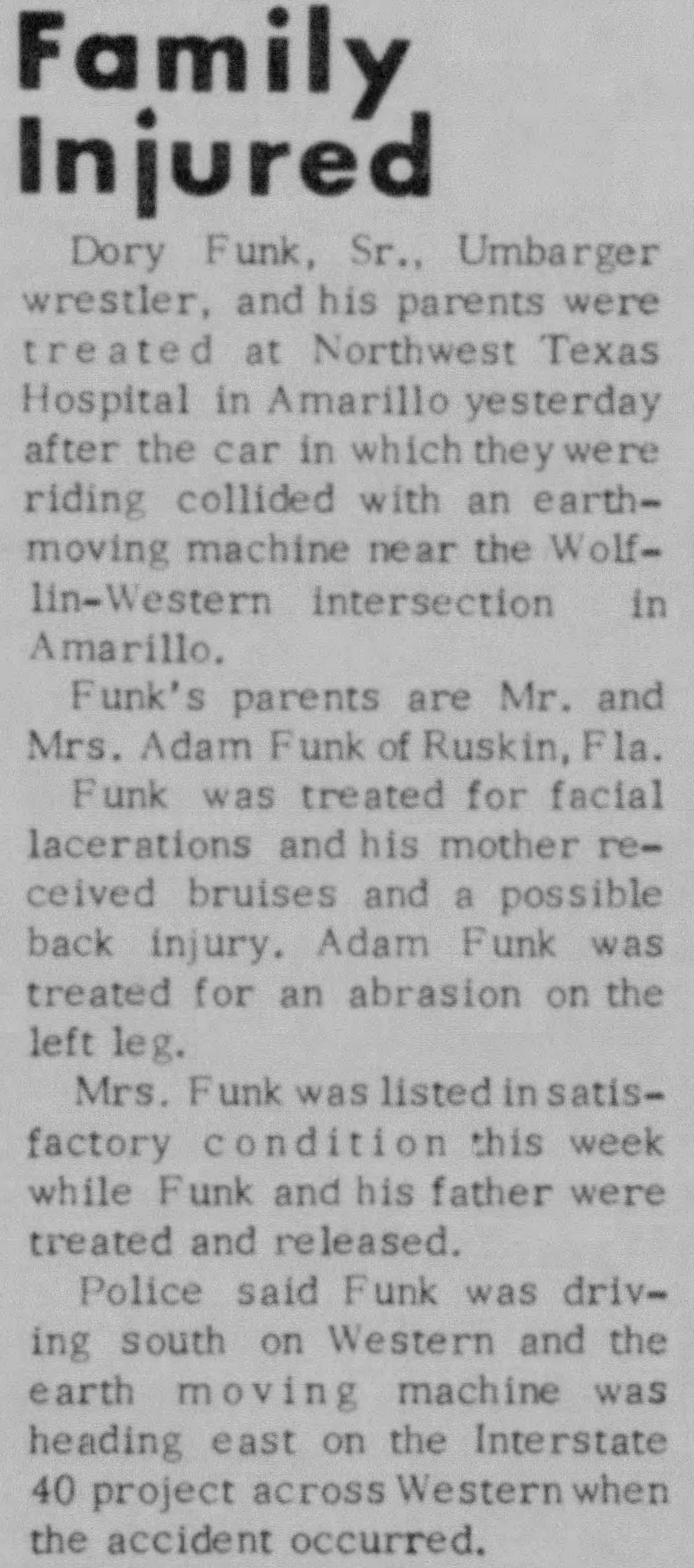
This involved a handicap match with Senior and Junior versus Dick The Bruiser in which the booking favored Bruiser. At any rate it was a story Muchnick had heard before, which may have been he was so incensed over the BRisco title change postponement.
When Junior returned to the ring weeks later, the decision had shifted. On May 24, 1973, at Memorial Hall in Kansas City, he lost the NWA World Heavyweight Championship to Harley Race. Race would hold the belt only briefly before dropping it to Brisco in Houston on July 20, serving as the transitional champion that completed the original succession plan under altered circumstances.
Nine days after the title loss, the family suffered a deeper blow. On June 3, 1973, after a gathering of wrestlers at the ranch, Dory Funk Sr. suffered a heart attack while demonstrating a hold and died at the age of 54. His final matches had come only days earlier, including tag work with his sons. The patriarch who had lobbied for the championship, traveled with the new champion, and remained the anchor of the Amarillo territory was gone just as the title reign ended.
The Family Circle Closes
By late 1975 the National Wrestling Alliance championship committee faced the question of who would succeed Jack Brisco as NWA World Heavyweight Champion. One strong candidate was Harley Race. Another was Terry Funk. Unlike the situation in 1968, when Dory Funk Sr. had actively lobbied for his older son, Terry now needed an advocate of his own. Dory Jr. stepped into that role.
Having already carried the title for more than four years himself, Dory understood both the political realities of the Alliance and the demands of the championship. He worked the committee on his brother’s behalf. Accounts of the period describe a narrow decision—reportedly a 4-3 vote—that approved Terry as the next champion. Dory’s support was widely viewed as decisive in tipping the balance.
The actual title change was then arranged for December 10, 1975, in Miami Beach. Promoters advertised Dory Jr. as Brisco’s challenger. When Dory was unable to make his flight connections that night, Terry was inserted as the substitute opponent. The switch worked perfectly with the earlier political groundwork. Terry defeated Brisco and became the new NWA World Heavyweight Champion, making the Funks the only brothers in history to hold the title.
The episode closed a circle that had begun years earlier. In 1968 Terry had willingly stepped aside so that Dory could receive the championship first. In 1975 Dory returned the favor, using his standing and experience to help secure the same opportunity for his younger brother.
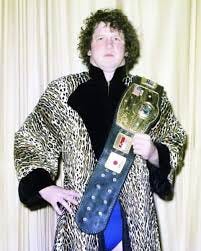
Pictured: Brother Terry Funk, NWA World Heavyweight Champion
From February 1969 to May 1973, Dory Funk Jr. carried the NWA World Heavyweight Championship through more than four years of continuous work. The reign was never isolated from the rest of the family. Dory Sr. provided political support, ringside presence, and the territorial base that made the early years stable. Terry grew from supporting player into full partner, especially on the Japanese tours and in the tag programs that ran parallel to the singles defenses. Together they turned the championship into a family enterprise that stretched from the Sports Arena in Amarillo to the major arenas of the United States and the biggest buildings in Japan.
The end of the reign and the death of Dory Funk Sr. arrived within days of each other. What remained was a body of work that had elevated the Funk name nationally and internationally, established a lasting connection with Japanese wrestling, and set the stage for the brothers to assume full control of both the Amarillo territory and the foreign booking pipeline into All Japan.
Continued Japan Success
Dory Funk Sr. died of a heart attack on June 3, 1973, at age 54. After a show, he was at his Flying Mare Ranch in Umbarger, Texas (near Amarillo), demonstrating a wrestling hold to visitors when he collapsed. He was taken to the hospital but did not survive.
His death came at a pivotal moment. The brothers were already deeply connected to Japan, and Sr. had been a foundational supporter of Shohei “Giant” Baba’s new promotion.
Dory Funk Sr. had strong ties to Japanese wrestling dating back to the Japan Wrestling Association (JWA) era. When Baba left the JWA amid the political fallout involving Antonio Inoki and launched All Japan Pro Wrestling in October 1972, Sr. was a key American ally. He helped Baba secure NWA recognition and served as an early overseas booker and liaison. The Funk family (including the sons) appeared on All Japan’s early tours and provided credibility through their NWA connections.
Dory Jr. had first worked Japan as NWA World Champion in 1969. Terry also built a strong presence there. By the early 1970s the family was firmly aligned with Baba rather than the emerging New Japan side.
With Sr. gone, Dory Jr. and Terry stepped into dual responsibilities. Domestically they assumed control of the Amarillo territory (Western States Sports) and ran it until selling in 1978. Internationally they inherited and expanded their father’s role as the primary bookers and coordinators of American (gaijin) talent for All Japan.
This position gave the brothers significant influence during the intense competition between All Japan and New Japan for top foreign stars. American wrestlers could earn substantial guaranteed money in Japan—often far more than territorial U.S. pay—with expenses covered and high status. Access to those spots frequently ran through the Funks.
They served as the main pipeline for American talent into All Japan throughout the 1970s and into the 1980s.
Notable examples include facilitating or helping bring in Stan Hansen (most famously helping convince him to jump from New Japan to All Japan in 1981, a major coup), Bob Backlund, Ted DiBiase, and others. They maintained and strengthened All Japan’s NWA ties, which provided legitimacy and access to the world champion for defenses in Japan. Beyond pure booking, they trained Japanese prospects sent by Baba to Amarillo. The most prominent were Jumbo Tsuruta and Genichiro Tenryu, both of whom launched their careers under Funk guidance before returning to become cornerstone stars for All Japan. Dory Jr. later spoke highly of Tsuruta’s athleticism and rapid learning curve, noting he could execute the spinning toe hold and forearm strikes in Funk’s style.
While booking, the brothers themselves became major babyface attractions—unusual for foreign talent, who were often cast as heels. Their tag team work, especially the bloody, hard-hitting programs against teams like Abdullah the Butcher and The Sheik, cemented their popularity. They won the Real World Tag League (and its predecessor) multiple times (notably 1977, 1979, and 1982) and remained central figures for years.
The Missouri Heavyweight Title
In St. Louis, under Sam Muchnick’s promotion, Dory captured the NWA Missouri Heavyweight Championship from Harley Race on May 24, 1974. He held the title for roughly nine months (into February 1975). The Missouri title carried significant prestige in the Central States region and served as a de facto number-two championship behind the NWA World title. Winning it from Race—the man who had ended his world title reign the previous year—carried symbolic weight and kept Dory positioned as a top singles attraction in one of the Alliance’s most respected territories.
Dory continued challenging for the NWA World Heavyweight Championship on multiple occasions after 1973, including matches against Jack Brisco, Harley Race, and later Ric Flair (notably in Toronto in 1982). He also made limited film appearances, including roles in The Wrestler (1974) and Paradise Alley (1978).
The NWA International Tag Team Championship Run
Dory Funk Jr. and Terry Funk’s most significant run with the NWA International Tag Team Championship began on December 7, 1971, in Sapporo, Japan. That night at the Nakajima Sports Center, the brothers defeated the dominant team of Giant Baba and Antonio Inoki—known as the BI Cannon—in a best-of-three-falls match to capture the titles. The victory ended a long reign by Japan’s top duo and marked one of the biggest foreign upsets of the Japan Pro Wrestling Alliance era.
The win carried heavy symbolic weight. Baba and Inoki had controlled the International Tag titles for most of the previous several years, establishing them as the premier tag championship in Japanese wrestling and a key NWA-sanctioned prize. Dory Jr. was still the reigning NWA World Heavyweight Champion at the time, so the double achievement placed the Funk family at the absolute center of both the American and Japanese title pictures simultaneously.
The brothers held the belts for 164 days. Contemporary reports and results from the December 1971 JWA tour show them working a full schedule of tag and singles matches across Japan in the days surrounding the title change. Dory Jr. continued defending the world title on the same tour, including a successful defense against Seiji Sakaguchi in Osaka shortly after the tag win.
They dropped the International Tag titles on May 19, 1972, to Giant Baba and Seiji Sakaguchi. Sources differ slightly on the exact location (some list Los Angeles, others Tokyo-area reporting), but the change is consistent across title histories. The loss came as the JWA was entering its final turbulent period. Inoki had already been forced out of the promotion amid political conflict; Baba would leave later that year to form All Japan Pro Wrestling. The Funks’ reign therefore sat at a pivotal transitional moment in Japanese wrestling history.
When the Japan Pro Wrestling Alliance collapsed in the spring of 1973, the physical NWA International Tag Team Championship belts did not remain in Japan. They passed into the hands of foreign wrestlers who worked the Amarillo territory—most notably Killer Karl Krupp, who had held them with partners including Fritz von Erich and later Karl von Steiger. Because Krupp was a regular in Western States Sports and the Funks controlled that office after their father’s death, the titles effectively came under Funk family custodianship.
Dory Jr. and Terry won the belts (or the recognized Amarillo version of them) on multiple occasions in 1973 on May 26th in Amarillo, defeating Karl von Steiger and Killer Karl Krupp and then later regaining them in the fall of 1973 after a short reign by Killer Karl Kox and Ciclon Negro.
They defended the titles in the West Texas towns through 1973 and 1974, treating them as legitimate NWA International Tag Team Championships. This period kept the lineage alive on American soil while All Japan was establishing itself.
The belts finally returned to Japanese control on February 5, 1975, in San Antonio, Texas and recorded for television. Giant Baba and Jumbo Tsuruta, whom the Funks had helped train and develop, defeated Dory Jr. and Terry to reclaim the NWA International Tag Team Championship for All Japan Pro Wrestling. From that point forward the titles became a cornerstone of AJPW, with Baba and Tsuruta establishing the most dominant reigns in the championship’s history.
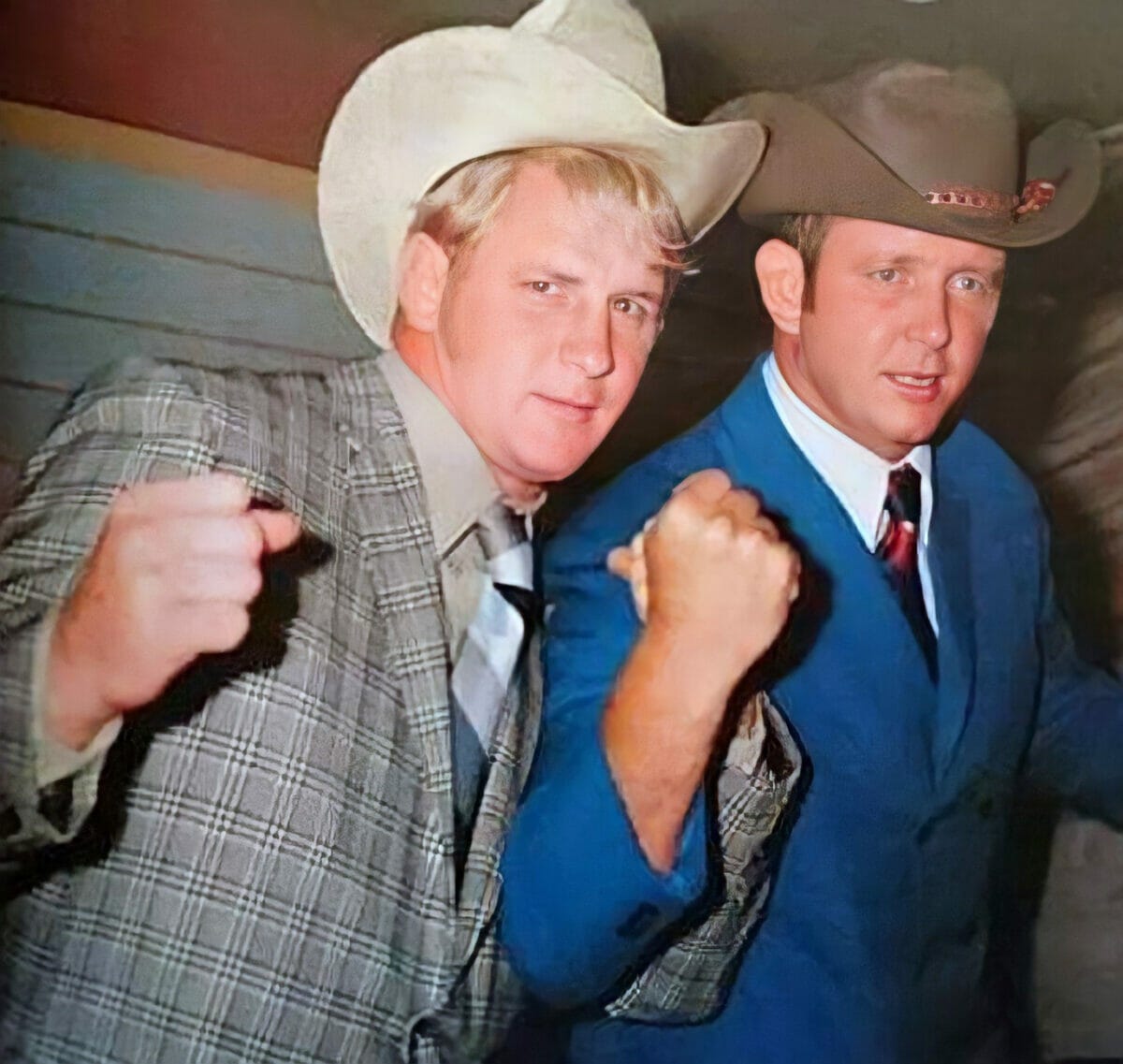
Beyond their high-profile NWA International Tag Team Championship reigns, Dory Funk Jr. and Terry Funk accumulated an extensive record as a tag team across multiple NWA territories and international promotions. Their combined success stretched from the mid-1960s through the early 1980s and reinforced their status as one of the premier brother combinations of the territorial era.
Beginning in the mid-1960s, the two captured the NWA Amarillo North American Tag Team titles on multiple occasions, including a notable reign that started in August 1966. They followed those successes with the more prestigious NWA World Tag Team Championship of the Amarillo and Texas versions. On June 18, 1968, they defeated Karl and Kurt von Brauner for the belts, then regained them later that year on October 17 by beating the Infernos. These early title runs cemented the Funks as the top team in West Texas while both men were still building their individual reputations.
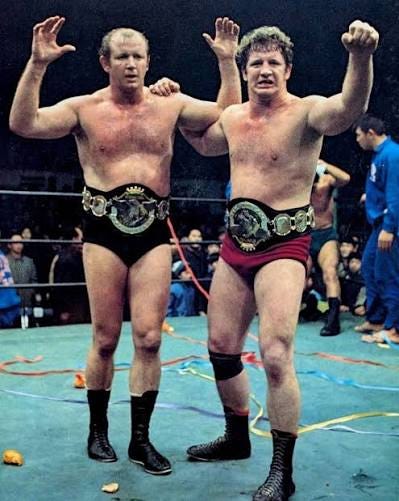
As their careers expanded beyond Amarillo, the brothers carried their tag success into other major NWA territories. In Championship Wrestling from Florida they engaged the Brisco brothers in a family rivalry that spilled over into the tag division. On March 30, 1971, Dory Jr. and Terry defeated Jack and Jerry Brisco for the NWA Florida Tag Team Championship. The reign proved short-lived; the Briscos regained the titles roughly two weeks later on April 13 in Tampa. More than a decade later the same two teams met again for the NWA North American Tag Team Championship in Florida. The Funks captured those belts on January 9, 1982, only to drop them later the same month.
The pattern of facing the Briscos continued in Georgia Championship Wrestling. On November 23, 1978, the Funk brothers defeated Jack and Jerry Brisco in a tournament final to win the NWA Georgia Tag Team Championship. They held the titles for approximately five to six weeks into early 1979, adding another chapter to the long-running family feud that had already played out in Florida, the Carolinas, and Texas.
One of the most substantial and longest-lasting of their tag title runs came in Puerto Rico under the World Wrestling Council banner. On April 6, 1979, in San Juan, Dory Jr. and Terry defeated The Invaders to capture the WWC World Tag Team Championship. They held the belts for roughly 232 days before losing them back to the Invaders on November 24. Less than a month later, on December 22 in Bayamón, the Funks regained the titles. This second reign stretched an extraordinary 861 days until May 1, 1982, when they finally dropped the championship to the Fabulous Kangaroos. The extended Puerto Rican run stands as one of the longest continuous tag title reigns of either brother’s career.
In the early 1980s the brothers continued collecting regional gold. In February 1980 they defeated the Twin Devils for the NWA World Tag Team Championship recognized in Los Angeles. Around August of the same year they were awarded or won the Southwest Championship Wrestling World Tag Team titles while working the San Antonio-based territory.
Taken together, these reigns illustrate the breadth of the Funk brothers’ tag team accomplishments. From the dusty arenas of West Texas in the late 1960s through Florida, Georgia, Puerto Rico, Los Angeles, and the Southwest in the years that followed, Dory Jr. and Terry repeatedly proved they could succeed as a unit in widely different promotional environments. Their ability to win and hold titles against elite opposition—most consistently the Brisco brothers—helped establish them as one of the most accomplished and widely traveled brother combinations of the territorial era.
Dory Funk Jr. and Terry Funk almost never wrestled each other in singles competition. Across decades of teaming in the United States, Japan, and elsewhere, they built their reputation as partners rather than opponents. The most significant—and for many the only fully documented—brother-versus-brother singles match took place on April 30, 1981, in Matsudo, Chiba, Japan, during All Japan Pro Wrestling’s International Champion Series.
All Japan was running a tournament to fill the vacant NWA International Heavyweight Championship, a historic title that traced its lineage back to Rikidōzan. The field included top talent of the era: the Funks, Giant Baba, Jumbo Tsuruta, Abdullah the Butcher, Bruiser Brody, Jack Brisco, and others.
Dory advanced to the final. The scheduled opponent was Bruiser Brody. In the semi-finals, however, Brody suffered an ankle injury (reported as a sprain or break depending on the source) that forced him out of the tournament. Dory was declared the winner by forfeit and awarded the vacant championship.
That left All Japan without a proper main event for the final night. To salvage the situation, the promotion had the remaining participants draw lots to determine who would challenge the new champion in his first defense. Terry Funk drew the winning slip. The brothers, who had long avoided singles matches against each other, found themselves booked in a high-stakes title bout.
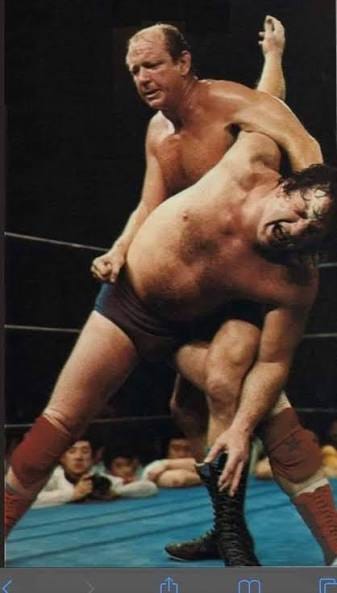
The contest went 54 minutes. It was a methodical, technical, babyface-versus-babyface affair built around the contrast between the more measured, experienced older brother and the higher-energy younger one. Contemporary accounts and later reviews describe a slow-building scientific match in which neither man wanted to inflict real damage on the other. Holds, counters, and gradual escalation dominated rather than high-impact brawling.
Dory retained the title by reversing a sunset flip attempt into a folding press (or double-leg pin, depending on the description) for the three-count. After the bell the brothers showed no lingering animosity, consistent with their real-life relationship and the respectful presentation of the match.
The bout is widely regarded as the only singles match of consequence between the two during their primes (some accounts mention an earlier tournament meeting in Fukuoka around 1980, but the 1981 International title defense is the one consistently documented and discussed). It remains a rare example of two major stars and actual brothers working a long, clean, prestige singles match in Japan at a time when such family confrontations were uncommon.
The match also marked the beginning of Dory’s first reign with the NWA International Heavyweight Championship. He would go on to hold the title multiple times and use it as a centerpiece of his All Japan work throughout the early 1980s, including notable programs with Bruiser Brody.The bout is widely regarded as the only singles match of consequence between the two during their primes (some accounts mention an earlier tournament meeting in Fukuoka around 1980, but the 1981 International title defense is the one consistently documented and discussed). It remains a rare example of two major stars and actual brothers working a long, clean, prestige singles match in Japan at a time when such family confrontations were uncommon.
Dory Funk Jr. spent significant portions of his career on the other side of the curtain as a booker and promoter, in addition to his work as a wrestler and trainer. His booking roles spanned the Amarillo territory, All Japan Pro Wrestling, Championship Wrestling from Florida, and a pivotal stretch with Jim Crockett Promotions in the Mid-Atlantic.
After the death of his father, Dory Funk Sr., in June 1973, Dory Jr. and Terry assumed control of the family’s Western States Sports promotion based in Amarillo, Texas. They ran the territory for roughly five years, handling the day-to-day booking, talent decisions, television production, and the traditional weekly circuit of towns across West Texas, New Mexico, Colorado, and surrounding areas.
The brothers maintained the office’s reputation as a tough, working-man’s territory that produced strong wrestlers and served as a training ground for talent. Notably, Giant Baba sent young Japanese prospects—including Jumbo Tsuruta and later Genichiro Tenryu—to Amarillo to be trained and seasoned under the Funks. The brothers sold the territory around 1978 to Blackjack Mulligan and Dick Murdoch.
In the early 1980s, Dory booked for Eddie Graham’s Championship Wrestling from Florida. After moving more heavily into Championship Wrestling from Florida, Dory became a multi-time NWA Florida Heavyweight Champion beginning in late 1980. He first won the title from Dusty Rhodes on November 4, 1980, in Tampa. Subsequent reigns followed in 1981 (one by forfeit after Barry Windham was injured in an auto accident, and another after defeating Charlie Cook). These runs established him as a central figure in the Florida territory during a strong period for the promotion and gave him extended programs with local stars while he continued traveling to Japan. He was involved in the creative direction during a period when the territory still featured strong cards mixing local stars, NWA champions, and talent connected to All Japan. His dual role as active wrestler and booker gave him access to a wide pool of names, which showed in stacked house show lineups that sometimes included international stars.
One of his most notable short-term booking assignments came in 1983 with Jim Crockett Promotions. After George Scott departed and Ole Anderson became overextended booking both Georgia and the Mid-Atlantic territory, Dory stepped in to book Mid-Atlantic for a key stretch. While working and booking for Jim Crockett Promotions, Dory won the NWA Mid-Atlantic Heavyweight Championship from Jack Brisco on January 30, 1983. He held it for approximately six months. The reign renewed the long-standing Funk–Brisco rivalry in the Carolinas and included hard-hitting matches across the territory (including a Texas Death Match in South Carolina). He later held a version of the title again in 1984 while working under a mask as “The Masked Outlaw.”
During this period he helped organize the territory’s cities and talent assignments. More significantly, he contributed to the creative foundation of the first Starrcade. The success of earlier big shows (including “The Final Conflict”) helped lead to the concept of a major closed-circuit Thanksgiving event. Starrcade 1983 became a landmark for the NWA and a precursor to the national pay-per-view era. Dory’s booking work that year is frequently cited as an important contribution to that inaugural event.
Beyond these primary roles, Dory occasionally took on smaller or temporary booking duties later in his career, including a short stint helping with The Sheik’s Detroit operation. His primary focus shifted toward training through the Funking Conservatory in Ocala, Florida, and continuing his long relationship with All Japan in an advisory and coaching capacity.
Overall, Dory Funk Jr.’s booking work reflected the same practical, wrestler-centered approach that defined his in-ring career. He moved between promoting his family’s territory, serving as a bridge to Japan, and contributing to major American offices during transitional periods, leaving a quieter but meaningful mark on the business side of professional wrestling.
In other championship success, in Puerto Rico, Dory captured the WWC Universal Heavyweight Championship from Carlos Colón on February 27, 1985. He held the promotion’s top singles title for roughly two and a half months before dropping it back to Colón. This added another major regional world title to his résumé late in the territorial era and extended the Funk family’s strong history in the World Wrestling Council, where the brothers had already enjoyed long tag-team success.
The WWF Run
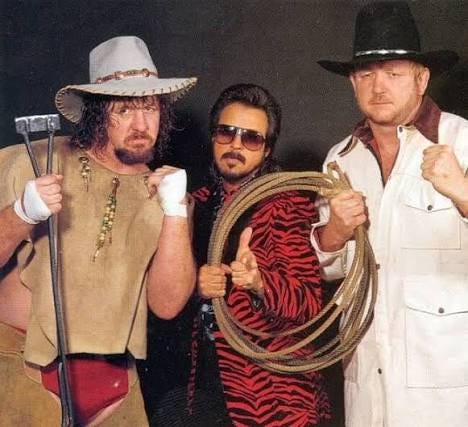
Funk, jr arrived in early 1986, shortly after his brother Terry had already established himself there as a top heel. Vince McMahon rebranded him Hoss Funk, a name drawn from a childhood nickname that Dory himself suggested and liked. The character was presented as a tough, cowboy-style Texan from the “Double Cross Ranch,” managed by Jimmy Hart.
Hoss debuted alongside Terry as the Funk Brothers. Their highest-profile appearance came at WrestleMania 2 on April 7, 1986, in the Los Angeles portion of the three-venue event. They defeated the Junkyard Dog and Tito Santana when Hart interfered with his megaphone.
A month later the brothers faced an even bigger stage on Saturday Night’s Main Event, losing to Hulk Hogan and the Junkyard Dog. The match drew a strong 9.3 television rating on NBC and remains one of the more notable national exposures of Dory’s late career.
Terry grew tired of the WWF’s demanding travel schedule and left the company relatively quickly after WrestleMania (accounts note he eventually exited by claiming he needed to return home to care for a sick horse). Dory stayed on and was given a new storyline partner: Jimmy Jack Funk, portrayed as a younger, unstable third brother. In reality, Jimmy Jack was Jesse Barr, a wrestler Dory had worked with and helped develop.
The new “Funk Brothers” continued as mid-card heels under Jimmy Hart’s management. They feuded primarily with the Junkyard Dog and challenged the British Bulldogs for the WWF World Tag Team Championship on several occasions, including matches at Madison Square Garden and other major venues. They also worked house-show programs against teams such as the Killer Bees, the Rougeau Brothers, and various enhancement talent. Dory’s full WWF tenure lasted roughly six to seven months, from February through late August 1986. His final recorded matches included losses to Pedro Morales, including a first-round exit in the Sam Muchnick Memorial Tournament in St. Louis on August 29. He left the promotion shortly thereafter.
The WWF road schedule—constant travel, short matches, and a more entertainment-driven style—did not suit the veteran who had spent decades working longer, more technical matches across territories and Japan. After exiting, Dory returned to his established circuits in All Japan and other promotions.
The 1986 WWF run was brief but visible. It featured a WrestleMania victory with his real brother, a high-rated national television match against Hulk Hogan, and a subsequent mid-card tag-team program with a fictional sibling. It remains a short but distinctive chapter that introduced one of the NWA’s longest-reigning world champions to the expanding national audience of the mid-1980s WWF.
Dory quickly resumed regular tours with All Japan. He and Terry re-entered the Real World Tag League in later years, including a strong showing in 1990. After Terry scaled back his All Japan schedule in the early 1990s, Dory continued competing in the Tag League with partners such as Al Perez (earning a Teamwork Award in 1991) and later others including Tsuyoshi Kikuchi, Johnny Smith, and Masa Fuchi. He remained a respected “player-coach” figure, working with younger Japanese talent and maintaining his long relationship with the promotion through the mid-1990s. Occasional returns continued into the 2000s and 2010s, including tag matches with Terry as late as 2013.
In the 1990s Dory made selective appearances on the U.S. independent scene. He reunited with Terry in Extreme Championship Wrestling in 1994, where they feuded with The Public Enemy. Their most notable encounter was a No Rope Barbed Wire match at Heatwave ’94. Dory returned to ECW briefly in 1997, losing to champion Shane Douglas. He also worked for Smoky Mountain Wrestling under Jim Cornette and made a one-off appearance for WCW at Slamboree 1993 against Nick Bockwinkel. In 1996 he entered the WWF Royal Rumble as himself, a brief nostalgia cameo.
The Funking Conservatory
Training became the central focus of Dory’s later career. In the late 1990s he and his wife Marti brought the “Dory Funk Method” to the WWF as the Funking Dojo, an early developmental system. Students who passed through the program or worked under Dory’s guidance included Edge, Christian, the Hardy Boyz, Lita, Kurt Angle, Mark Henry, Mickie James, Val Venis, Test, Rhino, and others who became key figures in the Attitude Era and beyond.
In late 1999 the operation moved to Ocala, Florida, and became the Funking Conservatory (also associated with the !BANG! promotion and television show). Dory continued teaching for years, emphasizing fundamentals, ring psychology, and the technical style that had defined his own career. He remained active in the ring on a limited basis well into his seventies and eighties to keep his skills sharp and to work with students and peers.
Dory was inducted into the WWE Hall of Fame in 2009 alongside Terry. He continued occasional matches in Japan and on the independents, including a 2008 “retirement” match for All Japan with Osamu Nishimura and later returns. His final in-ring appearance came on August 24, 2024, at age 83, in a Double Hell Current Explosion Death Match in Japan. Teaming with Nishimura, he defeated Atsushi Onita and Raijin Yaguchi, applying the spinning toe hold for the finish.
Personal Life and Family
From his first marriage to Jimmie, which began in 1960 and ended in divorce in 1983, Dory Funk Jr. had three children who largely pursued paths outside the professional wrestling business. Their oldest son, Dory Funk IIIn (Dink), followed an academic and professional route into medicine and established a practice in Colorado. Their daughter Penny built a family of her own, raising three children while her husband worked in the concrete business. The youngest of the three, Adam Dirk Funk, settled into a career in technology and education, serving as a technology facilitator for the Amarillo Independent Schools system.
Although none of the children made wrestling their primary profession, the family connection continued into the next generation. One of Dory’s grandsons, Dory IV, trained under his grandfather at the Funking Conservatory, carrying a piece of the family tradition forward. Across both marriages Dory and his former wife Jimmie shared five grandchildren in total.
Among his other family survivors are included Terry’s two daughters, his neices, Stacy and Brandee Funk. When Stacy relected about some of her favorite memories of her Uncle, she remarked, “Many great family memories yet he was always so laid back and wanted us to all enjoy. Dad and Mom were driving to Florida because the territory in Amarillo was becoming depleted. Dad could make money in Florida. He and Mom packed up and headed there. They put us on a plane so we wouldn’t have to endure the drive. I was 12. Jr was picking us up and keeping us until they arrived. He told Brandee and I we could take his boat out in the inner coastal water way. No problem. Seriously I was 12 and she was 8. He was perfectly fine with that. So passionate about life and allowing youth to learn and grow.”
Dory’s second marriage to Marti produced no children of their own. Instead, Marti became a full partner in his later professional life, helping operate the school and television projects in Ocala while the couple maintained close ties with Dory’s children and grandchildren from his first marriage.
After years based in Texas and extensive travel, Dory and Marti settled in Ocala, Florida, in the mid-to-late 1980s. There they ran the Funking Conservatory wrestling school and the associated !BANG! promotion and television program. Dory continued limited in-ring work well into his later years while focusing primarily on training. He and Marti were active in local charitable efforts, including support for animal causes and youth-related wrestling events.
Dory Funk Jr. died on August 4, 2026, at age 85 while under hospice care in Ocala. Marti confirmed the news. A private family ceremony was planned, for Friday, August 14th.
The Funk family legacy remains defined by three generations connected to professional wrestling: Dory Sr. as promoter and wrestler, the championship careers of both sons, and Dory Jr.’s long second act as a trainer who helped shape modern talent while maintaining deep roots in the Amarillo ranch culture and the Florida home he shared with Marti.
Thank You for Watching and Listening
I’m Tony Richards, Pro Wrestling Historian, Author and Storyteller. I share pro wrestling historical items in each issue of the Time Tunnel Pro Wrestling History Newsletter and each episode of our podcast show. Thanks for your support! If you enjoy my information on select events, matches and insights, please share with folks you think might like to be a subscriber!
Remember, Premium subscribers get access to exclusive and special content such as some special issues including a multi-part deep dives on wrestling territories, wrestler bios and championship title histories, special audio and video interviews on territory pro wrestling and more available in the Pro Wrestling Time Tunnel for Premium Subscribers. Being a Premium Subscriber also means you support me in my efforts to document Pro Wrestling History through my research, writing, books, vidoes and podcasts. And…I have something very special planned for our Premium Subscribers on the Podcast side of things in 2026! Details soon here in the Pro Wrestling Time Tunnel.
Thanks for sharing this.
Can’t thank you enough for all of your research, writing and podcasts.