



Today’s Favorite Quote: I’ve loved wrestling from the first moment I stepped between the ropes. Don’t know where I’d be without it - Terry Funk
Happy Birthday to those who have passed on and to those great wrestlers still with us:
In Memoriam:
Abe “King Kong” Kashey 1903
Tim Woods\Mr. Wrestling 1934
Ernie Ladd 1938
Smith Hart 1948
Lee Marshall 1949
Happy Birthday:
Earl Maynard (91)
Rob Conway (54)
Brent Allbright\Gunner Scott (48)
Joseph Ruud\Erick Rowan (45)
Danielle Moiner\Summer Rae (43)
RIP Memorial: We stop & remember those who have passed on this day and gave themselves to the business for us, the fans. We salute you and thank you.
Kazuharu Sonoda\Magic Dragon 11-28-1987 at the age of 31

Don Evans 11-28-2005 at the age of 88

Stan Lisowski\Stan Neilson 11-28-2015 at the age of 82

Pat Barrett 11-28-2021 at the age of 85

The Life and Career of Velvet McIntyre
The Irish-Canadian Pioneer Who Flew Higher Than the Era Allowed
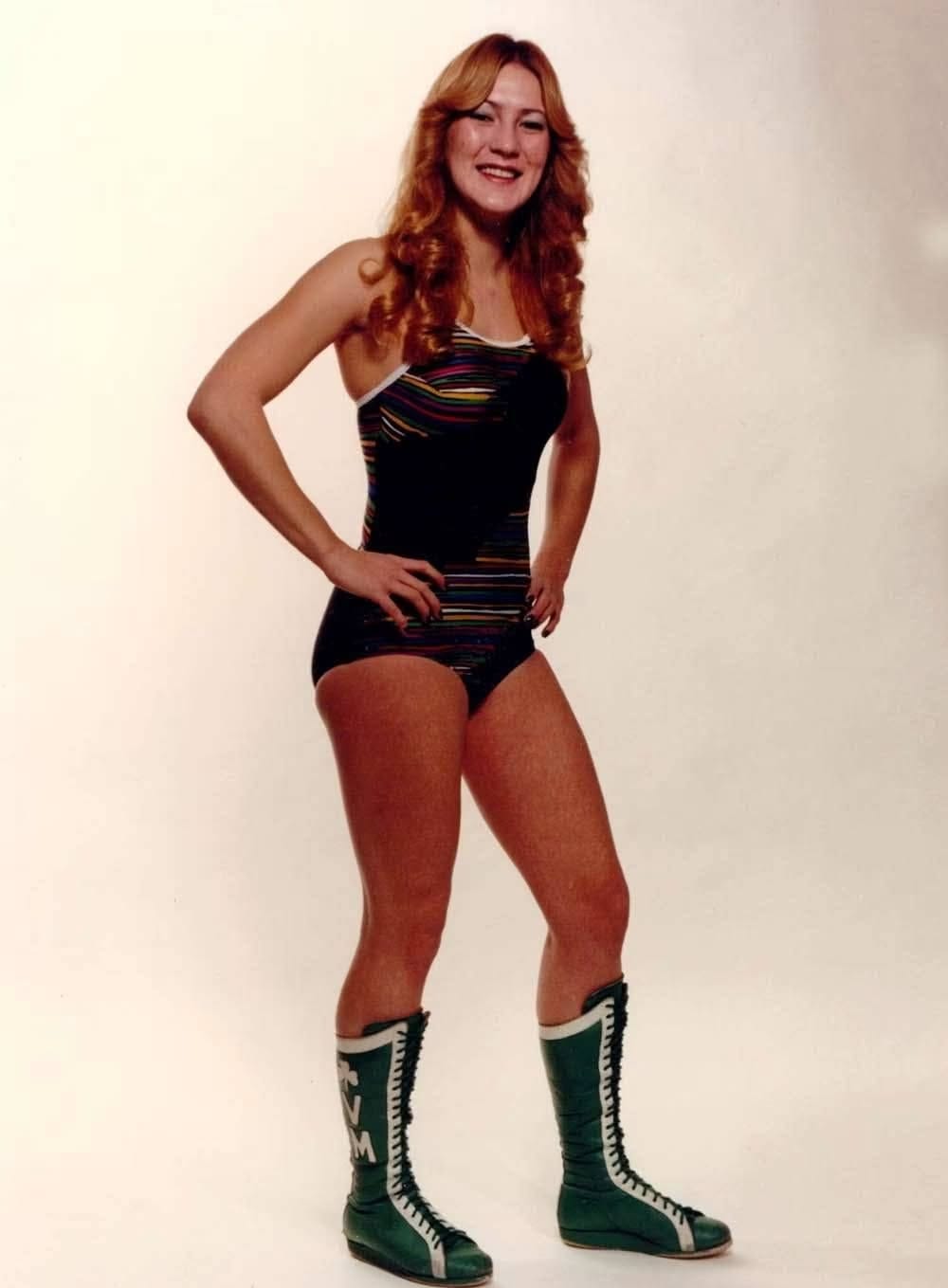
Velvet McIntyre entered professional wrestling at a moment when the women’s division in North America was still tightly controlled by a handful of promoters and veterans, most notably The Fabulous Moolah. From her 1980 debut until her retirement in 1998, McIntyre distinguished herself as one of the most athletic, well-traveled, and versatile women of her generation. Billed from Dublin, Ireland, and raised in Vancouver, British Columbia, she combined high-flying ability, technical skill, and a distinctive barefoot style into a career that took her to Japan multiple times, across every U.S. state and Canadian province, and to distant stops including Australia, Egypt, India, Peru, Singapore, and Thailand. Though she captured the WWF Women’s Championship and served as a foundational WWF Women’s Tag Team Champion, her achievements have often been under-recognized relative to her talent and longevity.
Born on November 24, 1962, McIntyre grew up in an active household with three brothers. She was competitive and physical from a young age. After finishing high school she moved to Oregon in 1980 upon learning that promoter Sandy Barr was seeking women to train. Barr’s school was old-school and demanding: hours of ring work, calisthenics, and running to and from the arena each day. McIntyre later recalled that her head felt like a watermelon for the first month. Her primary training partner was Vickie Otis, who would become Princess Victoria. The two women debuted together in Idaho later that year. McIntyre began working more regularly within three months and quickly gained experience in Vancouver’s All Star Wrestling and Don Owen’s NWA Pacific Northwest territory, where she and Victoria initially feuded before becoming partners.
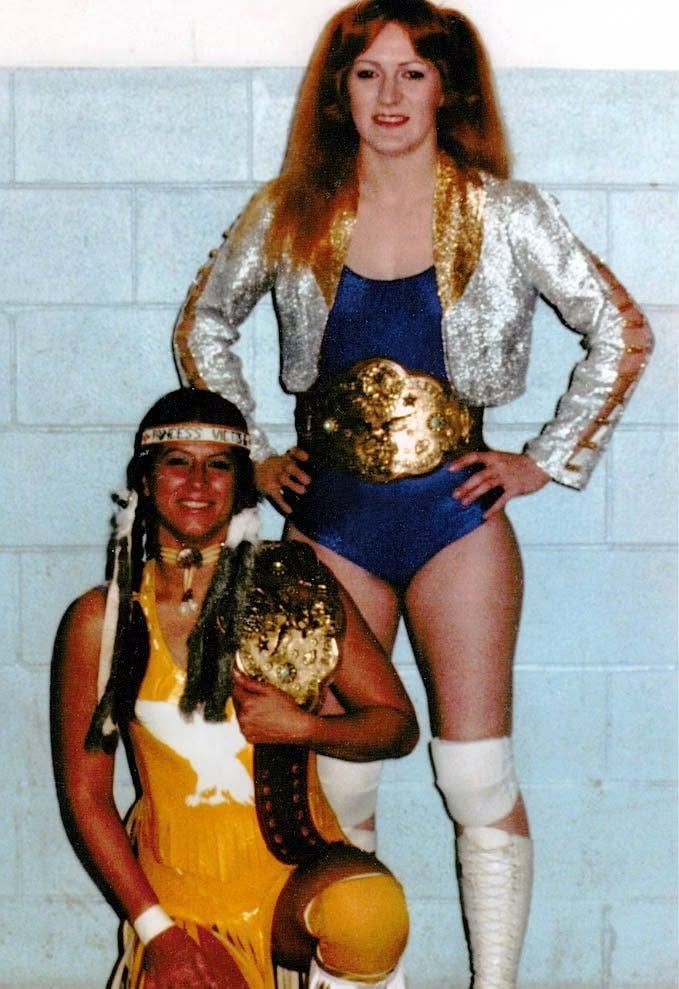
Pictured: Velvet McIntyre and Princess Victoria
By 1982 McIntyre was appearing in the World Wrestling Federation (then still affiliated with the National Wrestling Alliance) as well as Stampede Wrestling, Mid-South, the AWA, and other territories. In May 1983 she and Princess Victoria defeated Joyce Grable and Wendi Richter to win the NWA Women’s World Tag Team Championship in Calgary. When the WWF withdrew from the NWA, the promotion recognized the pair as the inaugural WWF Women’s Tag Team Champions. They defended the titles successfully against teams that included Wendi Richter and Peggy Lee, including a notable match at Madison Square Garden.
Their partnership ended abruptly on September 1, 1984, when Victoria suffered a career-ending neck injury in Philadelphia. McIntyre continued with Desiree Petersen; the team is credited with holding the titles until a disputed change to Judy Martin and Leilani Kai (The Glamour Girls) in 1985. McIntyre’s total consecutive time as a tag champion stretched across more than 800 days, a significant achievement in an era when women’s titles changed hands far less frequently than the men’s.
As a singles wrestler McIntyre challenged for the WWF Women’s Championship against both Moolah and, later, Sensational Sherri. At WrestleMania 2 on April 7, 1986, she lost to Moolah in a short match marked by controversy: a broken strap interrupted a top-rope splash, and the referee counted a pin while McIntyre’s foot was on the rope. Later that summer, during the WWF’s Australian tour, she defeated Moolah (appearing under a mask as the Spider Lady) on July 3, 1986, at Brisbane Festival Hall to win the WWF Women’s Championship.
Pictured: Velvet McIntyre, WWF World Women’s Champion
She held the title for six days before dropping it back to an unmasked Moolah in Sydney on July 9. These remain the only two times the WWF Women’s Championship changed hands in the Southern Hemisphere. Although the reign was not heavily promoted in official WWF media, photographs of McIntyre with the belt exist, and Moolah herself later spoke highly of her. In a 2003 interview Moolah called McIntyre “a very good wrestler” who was “full of energy,” “forever training,” and “the best Canadian wrestler.”
McIntyre’s in-ring style set her apart. For the first four years of her career she wore boots. During a match against Leilani Kai, someone took one of her boots as a practical joke. Forced to work barefoot, she discovered that the change improved her footing, leverage, and ability to execute high-flying moves. She never went back to boots. The barefoot presentation, combined with her long blonde hair and athletic frame (billed at 5’10” and 150 pounds), gave her a distinctive look.
She openly credited Japanese women’s wrestling for expanding her repertoire, noting that she would travel to Japan, observe the local competitors, and bring new moves back to North America at a time when such high-flying techniques were still uncommon in women’s matches on this continent. Her signature maneuvers included the McIntyre (or Victory) Roll, single-leg dropkicks, swinging hurricanranas, and running crossbodies. She also worked effectively as the sympathetic babyface in tag matches, taking extended heat before making the hot tag.
Beyond the WWF she continued to collect championships. She held NWA United States and Texas Women’s titles, the Canadian Wrestling Alliance Women’s Championship, the ECCW Women’s Championship, the WWWA Women’s Championship, and the ICW Women’s Championship. In the mid-to-late 1990s she worked primarily in Canadian independent promotions, trading titles with competitors such as Iron Maiden and defeating Bertha Faye for the WWWA Women’s title in 1997. She remained active on a part-time basis into 1998.
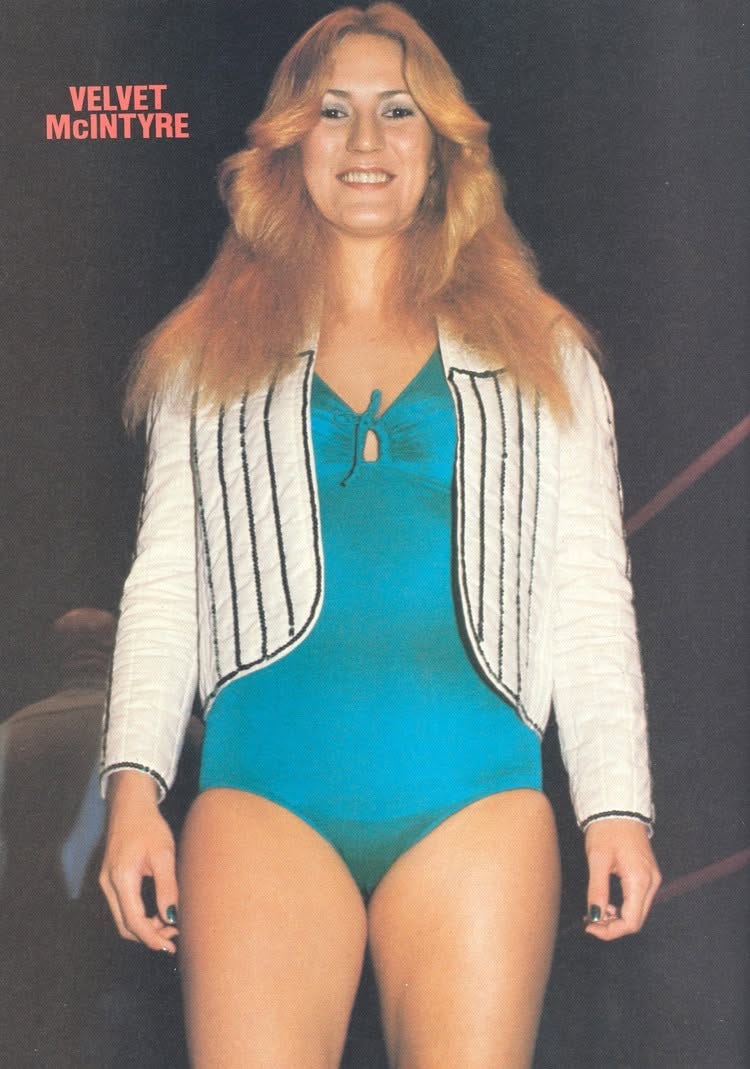
By the late 1980s the WWF’s women’s division had largely gone dormant, and opportunities for established women wrestlers narrowed. McIntyre continued to work where she could, but she grew frustrated with the erosion of kayfabe and the limited roles available. In 1998, while working occasionally for a Vancouver-based promotion, she discovered she was pregnant—with twins. She retired immediately. In later interviews she stated that her priorities had changed: “If I didn’t have the kids, I’d probably still be doing it. But your priorities change. Now it matters if I break my neck!” She has since focused on raising her children and selling handmade crafts.
A persistent rumor claimed that McIntyre was the daughter of wrestler Moose Morowski (Stan Mykietowich) and that her real name was Velvet Mykietowich. Multiple sources, including Online World of Wrestling, have explicitly stated that this is false; her real name is Velvet McIntyre and there is no familial connection.
McIntyre’s career illustrates both the possibilities and the constraints of women’s wrestling in the 1980s. She was athletic enough to hold her own against the best available competition, international enough to work on multiple continents, and adaptable enough to turn an accidental boot theft into a lasting trademark. She helped establish the modern WWF Women’s Tag Team Championship lineage and briefly held the singles title on the other side of the world.
Yet, like many talented women of her era, she operated in a division that was frequently treated as secondary. Moolah’s high praise and the length of McIntyre’s tag-title reign suggest that contemporaries recognized her ability; broader recognition has been slower to arrive. Her story remains one of the clearer examples of a wrestler who was ahead of her time in style and ambition, even if the business of the day was not always prepared to reward it.
ONE Thing I Learned Today About Rita Cortez
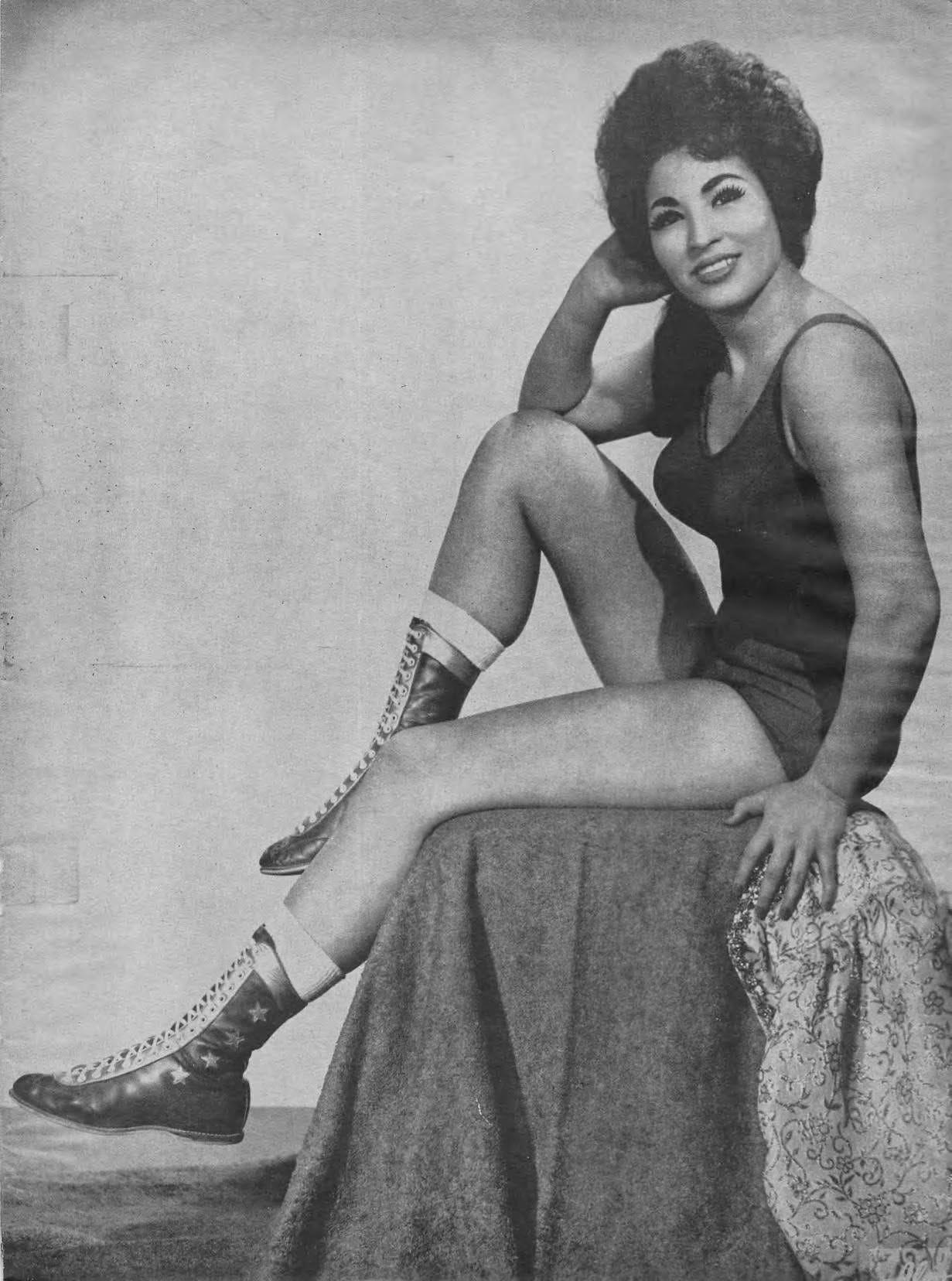
Rita Cortez (the professional wrestler known as the “Mexican Spitfire”) co-founded and helped build Buddy Lee Attractions, which became Nashville’s oldest and largest privately owned country music talent agency.
Born Yolanda Gutierrez around 1938–1939 in Guadalajara, Mexico, she trained under Buddy Lee (then married to the Fabulous Moolah) and wrestled in the late 1950s and 1960s. After an affair with Lee that contributed to Moolah’s divorce and long-term control of women’s wrestling, Cortez and Lee married in 1967. She stepped back from full-time wrestling and focused on the agency side of the business.
They established Buddy Lee Attractions in 1964 (initially as Aud-Lee Attractions with Audrey Williams, widow of Hank Williams Sr.). The company booked major country acts including George Strait, Willie Nelson, Garth Brooks, and the Dixie Chicks, and it also handled hundreds of fair bookings and events such as Farm Aid. Cortez was deeply involved in day-to-day operations and social aspects of the business—artists and musicians were constant visitors to their home.
One lesser-known personal anecdote: she once cooked for Sammy Davis Jr. around 2 a.m. when he stopped by. He repaid the favor by inviting her and her son to a closed recording session the next day.
While remembered in wrestling circles for her ring work (including the “Mexican Bounce Hold”) and her role in the Moolah/Lee saga, her lasting behind-the-scenes impact was arguably greater in Nashville’s country music scene. She died in 2012 in Hermitage, Tennessee.
Thank You for Watching and Listening
I’m Tony Richards, Pro Wrestling Historian, Author and Storyteller. I share pro wrestling historical items in each issue of the Time Tunnel Pro Wrestling History Newsletter and each episode of our podcast show. Thanks for your support! If you enjoy my information on select events, matches and insights, please share with folks you think might like to be a subscriber!
Remember, Premium subscribers get access to exclusive and special content such as some special issues including a multi-part deep dives on wrestling territories, wrestler bios and championship title histories, special audio and video interviews on territory pro wrestling and more available in the Pro Wrestling Time Tunnel for Premium Subscribers. Being a Premium Subscriber also means you support me in my efforts to document Pro Wrestling History through my research, writing, books, vidoes and podcasts. And…I have something very special planned for our Premium Subscribers on the Podcast side of things in 2026! Details soon here in the Pro Wrestling Time Tunnel.