


Today’s Favorite Quote: He that can have patience, can have what he will - Benjamin Franklin
Happy Birthday to those who have passed on and to those great wrestlers still with us:
In Memoriam:
(none)
Happy Birthday:
(none)
RIP Memorial: We stop & remember those who have passed on this day and gave themselves to the business for us, the fans. We salute you and thank you.
Ib Slovang Hansen\Eric The Red 11-16-1978 at the age of 44

Arteen Kizian\Ali Baba 11-16-1981 at the age of 80

Ello Carlo Drazich\Colosso Colosetti 11-16-2024 at the age of 76
7 Stages of the Territory Era
Stage 5: Consolidation
Year Two, Month Eleven
November 1966
November 1966: The Territory Map Holds
By November 1966 the territory system had settled into the shape it would keep for the better part of the next decade. Gene Kiniski was the NWA World Heavyweight Champion, Bruno Sammartino held the WWWF title in the Northeast, and Mad Dog Vachon carried the AWA championship through the Midwest. The big offices ran strong houses, the television stations stayed loyal, and the talent exchanges still worked. The realignment that had shaken Texas in September was already beginning to look permanent rather than temporary.
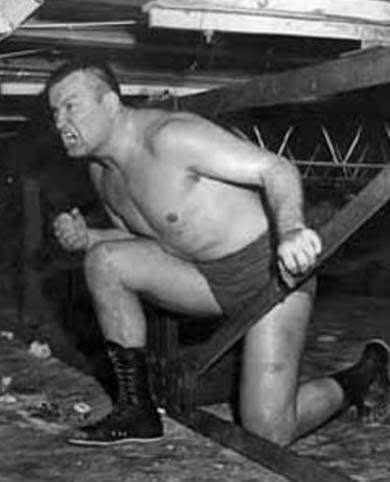
Pictured: Gene Kiniski, NWA World Heavyweight Champion
In St. Louis, Sam Muchnick’s Friday night cards at the Kiel Auditorium remained the national measuring stick. On November 25 the building drew 11,892 for a sellout that featured Kiniski defending the NWA title against Dick the Bruiser. Kiniski took the match two falls to one. The undercard showed the depth of the circuit: Lou Thesz beat Hercules Graham, the Crusher and Waldo Von Erich beat Dory Funk Jr. and Terry Funk, Wilbur Snyder beat Chris Markoff, and Dory Funk Sr. handled Joe Tomasso. Earlier in the month on the Chase Hotel television show, Bruiser had already gotten physical with Kiniski at the broadcast table, so the live rematch carried real heat. St. Louis still moved the national picture.
Dallas had finished its brief exile. Ed McLemore and Jack Adkisson (Fritz Von Erich) Southwest Sports had moved shows to the Bronco Bowl after the September break from the Houston-linked Dallas Wrestling Club. On November 15 the operation returned to the Sportatorium. Cards that month featured Fritz Von Erich, Waldo, Bearcat Wright, Joe Blanchard, Cowboy Bob Ellis, Kinji Shibuya, and the newly arrived Skandor Akbar. Kiniski himself appeared on November 8 and wrestled Fritz to a double count-out. The office was booking its own talent and drawing its own crowds. The partnership that would become World Class was already in place.
Houston continued under Morris Sigel. He would die on December 26, but in November the Sam Houston Coliseum cards still ran under his name. San Antonio’s Frank Brown kept booking independently at the Wrestlethon, bringing in name talent on his own. Amarillo stayed outside the Houston dispute entirely. Karl “Doc” Sarpolis remained the principal promoter of Western States Sports with Dory Funk Sr. as top star; the Funk family would not take full control until after Sarpolis’s death in May 1967.
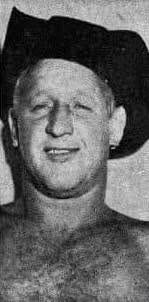
Pictured: Dory Funk, Sr
The AWA title changed hands twice in Omaha in the space of a week. On November 12 Dick the Bruiser defeated Mad Dog Vachon for the championship. Seven days later Vachon took it back. The quick turnaround kept the Midwest hot without disrupting the larger cooperative structure. In the Northeast, Bruno Sammartino returned to Madison Square Garden on November 7 for the first time in eight months. He submitted Bulldog Brower in front of roughly 14,000 fans and continued the long, unbroken reign that defined the WWWF.
Canada ran its own version of the same system. In Toronto, Frank Tunney’s Maple Leaf Gardens cards featured Kiniski (who had defended against Edouard Carpentier and Whipper Billy Watson in late October), Johnny Rougeau, Sweet Daddy Siki, the Singhs, Rocky Johnson, and local favorites. Attendance stayed in the 4,000–6,000 range on the bigger nights—solid for the market and consistent with the rest of the NWA circuit.
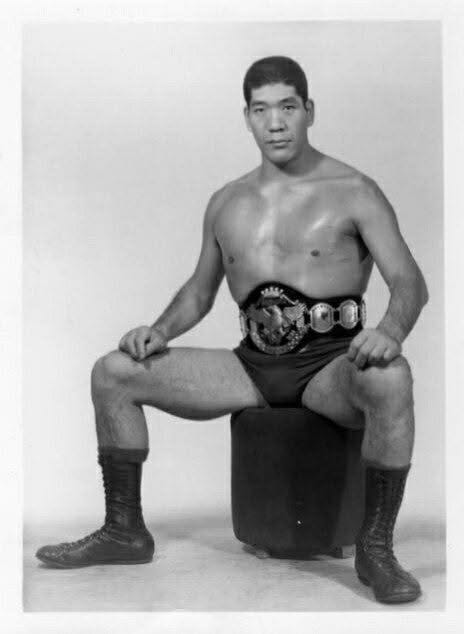
Pictured: Shohei Giant Baba, International Champion
Japan was in a transitional but still profitable phase. In the Japan Pro Wrestling Alliance, Giant Baba defended the International Heavyweight Championship and teamed with Michiaki Yoshimura to hold both the International and Asian tag titles. On November 28 in Osaka he went to a count-out with Fritz Von Erich while retaining the singles title. Nihon TV began regular Friday broadcasts from Korakuen Hall that month. Meanwhile Antonio Inoki, working for the short-lived Tokyo Pro Wrestling, defeated Johnny Valentine for a version of the U.S. Heavyweight title on November 19 in Osaka. Tokyo Pro would fold early in 1967, but the bout showed the growing appetite for high-profile international matches.
Mexico’s EMLL continued its regular Super Viernes cards at Arena México. National title activity was steady; Polo Torres captured the Mexican National Heavyweight Championship early in the month. The promotion’s structure remained stable, with the usual mix of local stars, mask-versus-mask stakes, and occasional American talent.
Taken together, November 1966 illustrated Stage 5 Consolidation in practice. Territorial boundaries were clear and mostly respected. The NWA coordinated the world title without major challenges. Independent operators (AWA and WWWF) thrived alongside the Alliance offices. Local television stations delivered weekly product to loyal regional audiences. The Texas offices that had broken from Houston in September were already operating as self-contained promotions that still traded talent when it benefited both sides. The system was not expanding aggressively; it was running efficiently inside the lines it had drawn. Houses were strong, the top champions were working regularly across multiple territories, and the business looked, from the inside, like it had found its equilibrium. That equilibrium would hold for several more years before the pressures of national television and changing ownership began to test it.
Thank You for Watching and Listening
I’m Tony Richards, Pro Wrestling Historian, Author and Storyteller. I share pro wrestling historical items in each issue of the Time Tunnel Pro Wrestling History Newsletter and each episode of our podcast show. Thanks for your support! If you enjoy my information on select events, matches and insights, please share with folks you think might like to be a subscriber!
Remember, Premium subscribers get access to exclusive and special content such as some special issues including a multi-part deep dives on wrestling territories, wrestler bios and championship title histories, special audio and video interviews on territory pro wrestling and more available in the Pro Wrestling Time Tunnel for Premium Subscribers. Being a Premium Subscriber also means you support me in my efforts to document Pro Wrestling History through my research, writing, books, vidoes and podcasts. And…I have something very special planned for our Premium Subscribers on the Podcast side of things in 2026! Details soon here in the Pro Wrestling Time Tunnel.