



Today’s Favorite Quote: The only thing that stands between a man and what he wants from life is often merely the will to try it and the faith to believe it is possible - Richard M. DeVos
Happy Birthday to those who have passed on and to those great wrestlers still with us:
In Memoriam:
Suni War Cloud 1914
Rikidozan 1924
Shirley Crabtree, Jr\Big Daddy 1930
Steven Beresford\Sir Dudley Clements\Steve Clements 1947
Happy Birthday:
Steven Petitpas\Sheik Ali (69)
Matt Bloom\Prince Albert (54)
Emanuel Rodriguez\Kalisto (40)
RIP Memorial: We stop & remember those who have passed on this day and gave themselves to the business for us, the fans. We salute you and thank you.
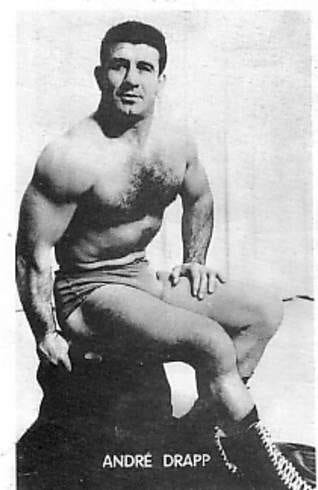
Andre Drapp 11-14-2009 at the age of 89
Nick Bockwinkel 11-14-2015 at the age of 80

The Life and Career of Dump Matsumoto
Dump Matsumoto, born Kaoru Matsumoto on November 11, 1960, in Kumagaya, Saitama Prefecture, Japan, stands as one of the most transformative figures in the history of Japanese women’s professional wrestling. Known as the “Queen of Villains,” she rose from poverty and early struggles to become the defining heel of All Japan Women’s Pro-Wrestling (AJW) during its 1980s boom.
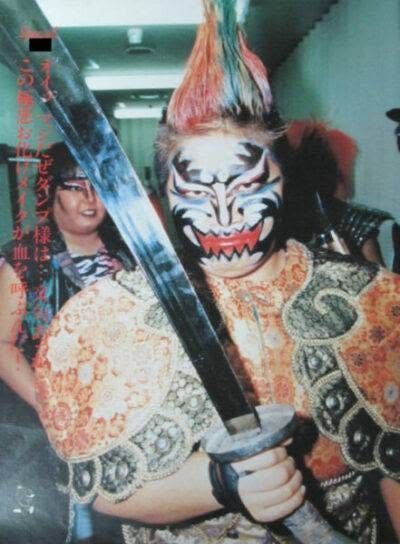
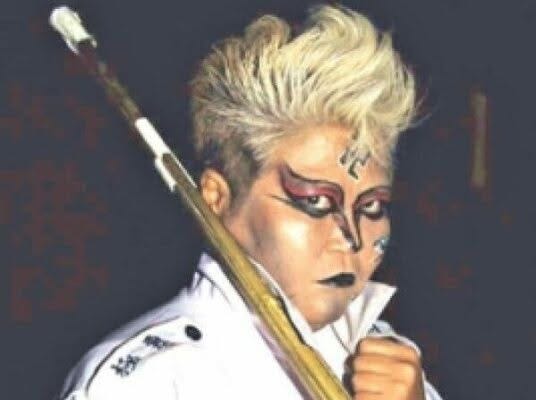
With her stocky, powerful build (around 164 cm tall and often billed near 90–100 kg), dyed blonde hair, stark face paint inspired by KISS, black leather, and willingness to wield chains, forks, kendo sticks, chairs, and other weapons, she embodied a new kind of monstrous, rule-breaking antagonist. Her long-running wars with the idol-like Crush Gals—Chigusa Nagayo and Lioness Asuka—drove some of the highest television ratings and sold-out arenas of the era, helping redefine joshi puroresu as a space of intense physicality, emotion, and cultural spectacle. She remains active as a semi-retired freelancer and media figure into her mid-60s, her legend amplified by the 2024 Netflix series The Queen of Villains.
Kaoru Matsumoto’s childhood was marked by hardship. She grew up in a one-room apartment with her sister Hiromi, dependent on relatives because her father was frequently unemployed and struggled with alcoholism and other issues, while her mother took irregular work. Poverty sometimes forced survival measures like stealing food. Family instability was acute; her mother left for a period when Kaoru was young, though they later reunited, and her father had a child outside the marriage.
These experiences fueled a desire for strength and independence. She was inspired by the sight of Mach Fumiake singing tearfully after a loss in AJW and by Fumiake’s early championship success. After failed AJW auditions in 1976 and 1978, she succeeded in 1979. She participated in sports such as archery, basketball, and swimming in school. Her goal upon entering wrestling included earning enough to buy a house for her mother.
She debuted for AJW around August 8, 1980 (some accounts place it in December), wrestling under her real name as part of the Class of 1980 (or 55年組), which also included future stars like Chigusa Nagayo, Lioness Asuka (Tomoko Kitamura), Crane Yu (Yukari Honjo), and Yukari Omori. Early on she was an unremarkable rookie, sometimes overlooked or treated poorly in the dojo and on the road. Her fortunes shifted in late 1982 when she joined Devil Masami’s Devil Corps and turned heel. On January 8, 1983, she defeated Lioness Asuka for the AJW Championship, holding it nearly six months before losing it back on June 1, 1983. This established her as a credible threat.
In January 1984 she reinvented herself as Dump Matsumoto—the name supposedly reflecting her stocky power, like a dump truck. She dyed her hair blonde (a striking break from norms in Japan at the time), applied gruesome face paint, and adopted a black leather jacket and kendo stick, drawing on sukeban (delinquent girl) subculture and KISS. She symbolically “killed off” the old Kaoru in a note to her mother. As leader of the Gokuaku Domei (Atrocious Alliance or Extreme Evil Alliance), which featured Crane Yu, Condor Saito, and the young Bull Nakano, she became AJW’s premier monster heel. The stable specialized in brutal, weapon-filled brawling that contrasted sharply with the clean, charismatic babyface appeal of the Crush Gals.
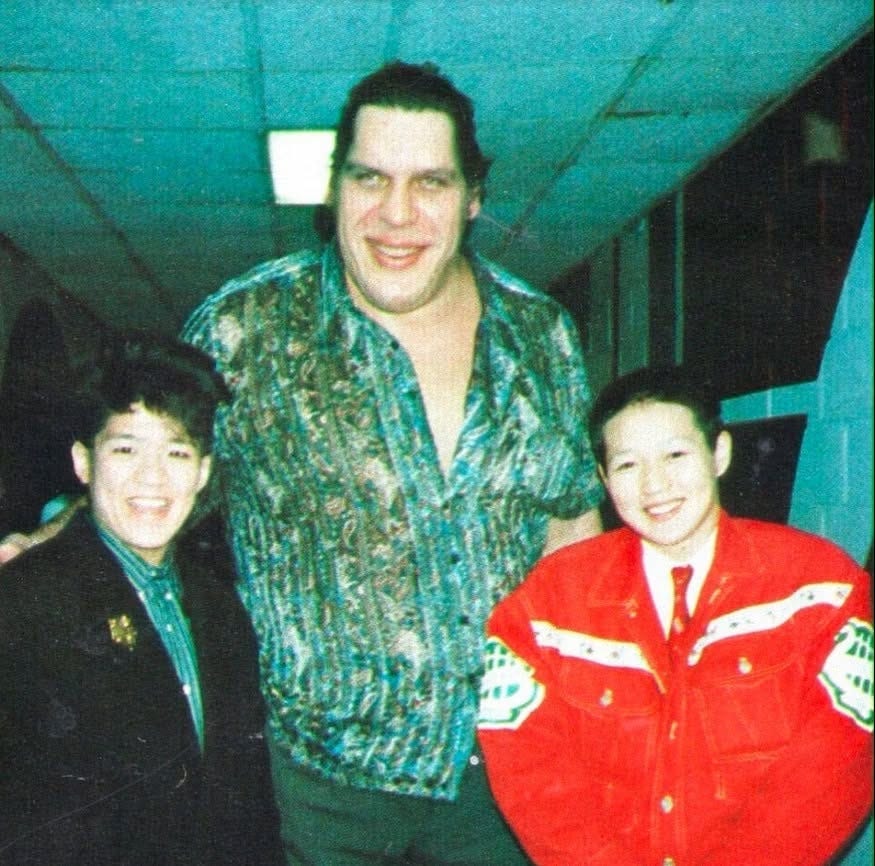
Pictured: Andre The Giant backstage at MSG in New York City with The Crush Gals
The feud between Dump’s alliance and the Crush Gals became the engine of AJW’s popularity. Televised matches frequently rated around 12 on Fuji TV (roughly 12 percent of the viewing audience), and arenas sold out. Dump’s style—lariat, superplex, relentless power, and foreign objects—drew visceral heat; crowds reacted with tears, screams, and sometimes real-world hostility. In 1985–1986 the personal rivalry with Chigusa Nagayo produced two landmark hair-versus-hair matches at Osaka-jo Hall.
The Crush Gals formed in 1983 when Chigusa Nagayo and Lioness Asuka (Tomoko Kitamura) were paired after a standout singles match on January 4 that year. Both had debuted around 1980 as part of the same generation as Matsumoto. Their chemistry was immediate: they combined athletic ability, charisma, and a youthful, relatable image that resonated especially with teenage girls. After early struggles against teams like the Dynamite Girls, they captured the WWWA World Tag Team Championship in August 1984. Beyond the ring, they crossed into pop culture, releasing music (their first single sold over 100,000 copies) and appearing in mainstream media. Their appeal has been compared to the level of Hulk Hogan’s in the United States at the time.
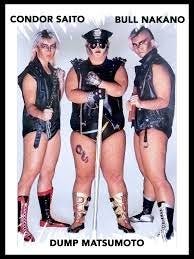
Dump Matsumoto led the Atrocious Alliance alongside Crane Yu, Condor Saito, and the young Bull Nakano. The stable’s style was the perfect contrast: power, cheating, weapons (chains, forks, scissors, chairs, kerosene cans), and unrepentant villainy against the Crush Gals’ never-say-die spirit and cleaner presentation. Early tag matches in 1984 usually saw the Gals win, but Dump rarely took the fall and consistently battered her opponents, building heat.
The feud escalated into AJW’s main attraction. Matches regularly drew 12.0 ratings on Fuji TV—meaning roughly 12 percent of Japan’s television audience, or around 14 million viewers on peak nights. Arenas sold out, and the storyline turned both sides into national stars. On February 25, 1985, Dump and Crane Yu defeated the Crush Gals for the WWWA World Tag Team titles (though the reign was short-lived due to Yu’s subsequent retirement). The Gals regained the belts but continued trading blows with the Alliance, including losses to Dump and Bull Nakano in key matches and tournament settings.
The emotional peak arrived on August 28, 1985, at Osaka-jo Hall in a hair-versus-hair match between Chigusa Nagayo and Dump Matsumoto. More than 11,000 fans filled the building. Dump controlled the bout through sheer physicality and weapons, including industrial scissors that opened Nagayo up. A chairshot led to a ten-count finish. Afterward, with Nagayo restrained (accounts describe a chain around her neck held by allies), Dump shaved her head in the ring. The crowd reacted with screams, tears, hyperventilating, and near-riots; young fans were shown sobbing uncontrollably. Roughly 500 people later surrounded and assaulted Dump’s transport outside. She also faced a bar stabbing by a drunk fan seeking “revenge” for Nagayo and dealt with a stalker that summer. Dump later recalled that she had not wanted to cut the hair and that her hand shook; she also noted internal Crush Gals tensions, claiming Asuka had not fully agreed to the matchup. The image of the shaving became an iconic, traumatic moment in joshi history.
WATCH VIDEO: August 28th, 1985 Dump Matsumoto vs Chigusa Nagayo (Hair vs Hair)
The war continued into 1986. Nagayo got her revenge in the November 7, 1986 hair-versus-hair rematch at the same venue, defeating Dump and forcing the shaving of Dump’s distinctive hair. Tag title changes and other matches (including ones involving Nakano) kept the Alliance as the Gals’ primary antagonists. The feud helped launch both Nagayo and Asuka into major singles roles; Nagayo in particular rose as a top ace after the hair matches.
WATCH VIDEO: November 7th, 1986: Dump Matsumoto vs Chigusa Nagayo (Hair vs Hair)
By 1986–87 the Crush Gals had begun to split for singles work, though they still teamed on occasion (including against Dump’s side). AJW’s mandatory retirement age around 26 forced the main run to end: Dump retired in February 1988 (with a chaotic tag match involving the Gals), while Nagayo and Asuka followed in 1989. The rivalry’s intensity was amplified by kayfabe rules that kept babyfaces and heels from publicly interacting; despite being dojo contemporaries (Matsumoto and Asuka had even been roommates early on), they largely avoided speaking during the feud. Later interviews reveal company management sometimes stoked tensions with gossip.
The cultural footprint was enormous. It drove AJW’s golden age of popularity, blended wrestling with idol fandom, and produced matches that still circulate as essential viewing. The hair matches in particular are studied for their spectacle, crowd reaction, and emotional weight. In later decades the participants reconciled; recent images (including a 2026 hospital visit by Nagayo to Matsumoto after knee surgery) show the old rivals as friends. The story was dramatized in the 2024 Netflix series The Queen of Villains, which used the feud as its central engine and featured real-life involvement from Nagayo and Matsumoto as consultants.
In essence, the Crush Gals–Atrocious Alliance rivalry succeeded because it offered perfect opposition: glamorous, resilient heroes against a terrifying, rule-breaking villain who made their victories feel earned. It turned weekly television into national theater, left lasting scars and legends, and remains the benchmark for how personal, physical, and cultural conflict could define an entire era of women’s wrestling.
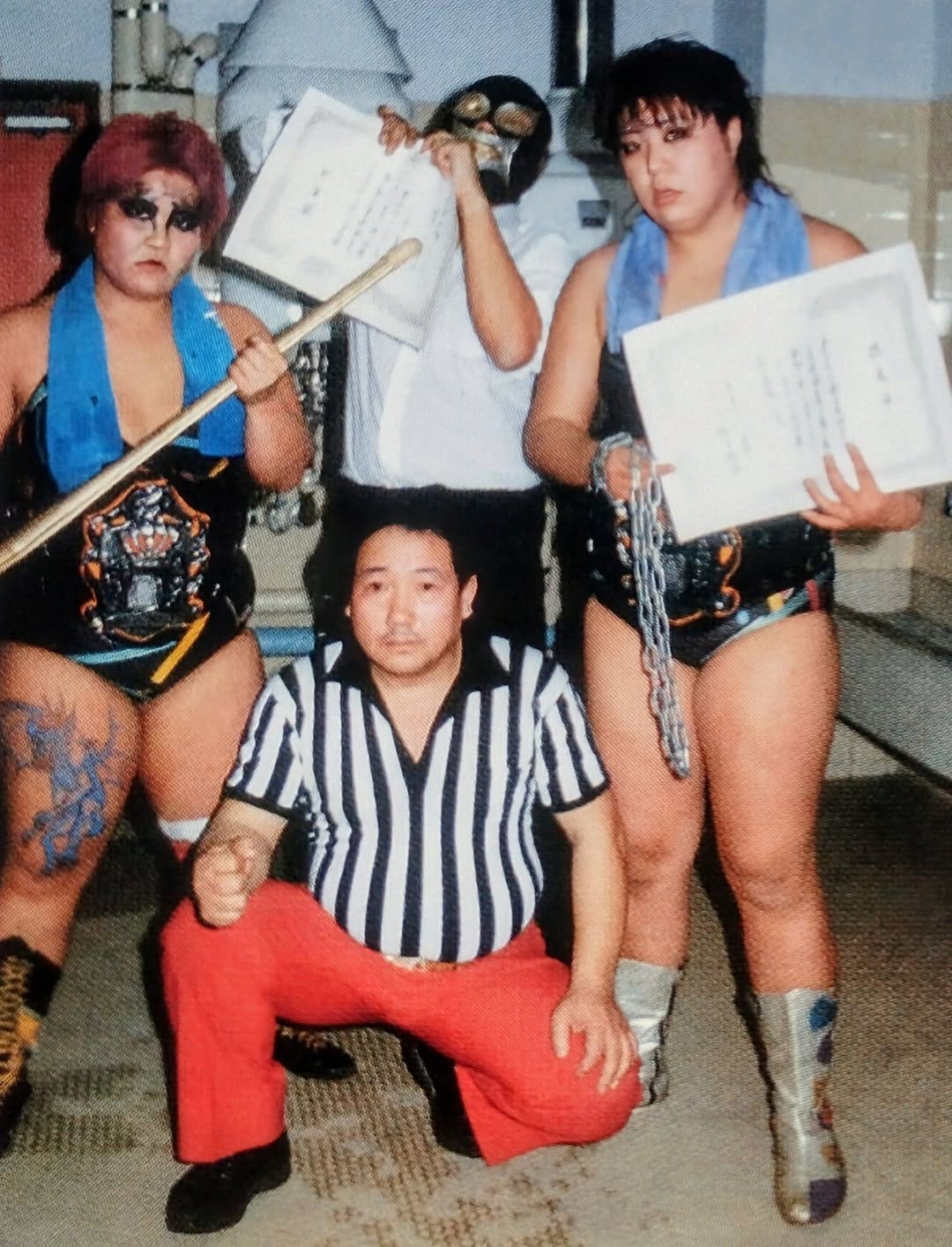
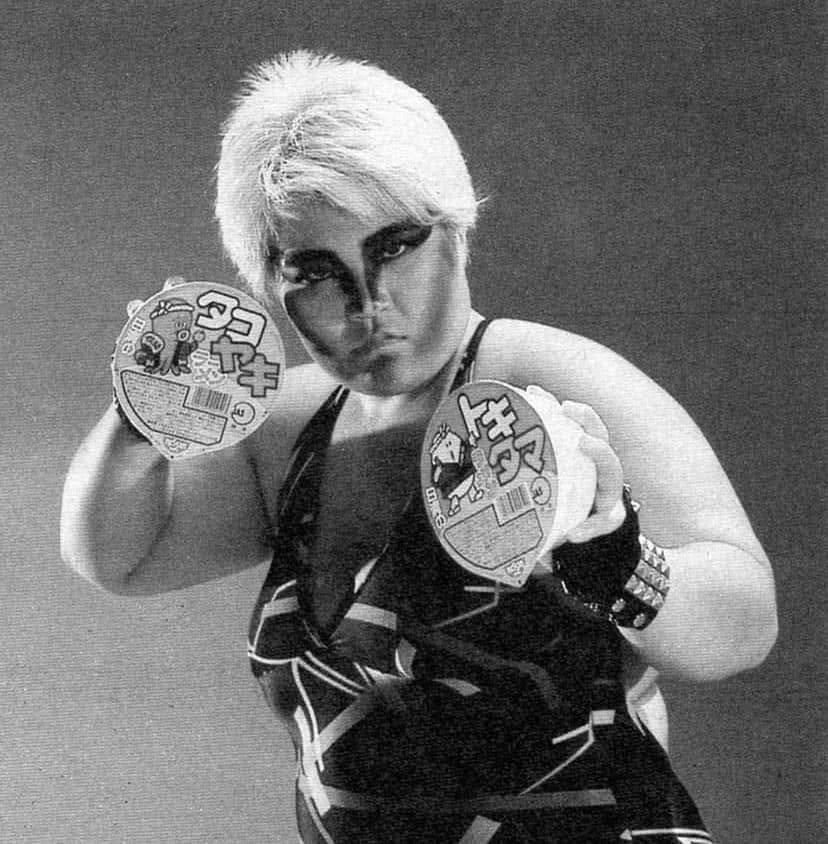
Pictured: Dump Matsumoto and Crane Yu, WWWA World Tag Team Champions
Championship success followed. With Crane Yu she captured the WWWA World Tag Team Championship from the Crush Gals on February 25, 1985 (vacated shortly afterward due to Yu’s retirement). She and Bull Nakano won the same titles on August 23, 1986 (from Asuka and a substitute), and they took the 1985 Tag League the Best. In early 1986 Dump and Nakano appeared briefly in the World Wrestling Federation as “The Devils of Japan,” competing in a few matches (including losses and wins against teams featuring Velvet McIntyre). Back in Japan she continued terrorizing the faces until AJW’s mandatory retirement age (around 25–26) and personal factors prompted her exit. On February 25, 1988, she announced her retirement during a tag match with Yukari Omori against the Crush Gals, turning on her own partner mid-match in classic heel fashion; her final match came February 28 against Nakano and Condor Saito. She had achieved her goal of providing for her mother and left at the peak of the boom.
After retirement Dump pursued acting, appearing in films including entries in the Crying Freeman series (as Bái Yá-Shàn), Scorpion Woman Prisoner: Death Threat (1991), and Okoge (1992). She made occasional wrestling returns starting in the late 1990s, including a 1998 exhibition with Crane Yu, appearances for GAEA Japan, and her own Gokuaku Domei Produce shows. From around 2003 she freelanced more actively, working promotions such as Major Girl’s Fighting AtoZ, Ladies Legend Pro-Wrestling, Marvelous, and others while balancing talent work. She has remained semi-active into the 2020s, producing events, guiding younger wrestlers, and appearing publicly despite knee issues that led to surgery discussions in 2026; she has stated she has no intention of fully retiring. She is unmarried and has focused on family care and her public persona.
Her cultural impact is lasting. She pioneered a face-painted, leather-clad, weapon-using monster heel aesthetic that influenced later acts (Dave Meltzer noted parallels to the Road Warriors). Inducted into the Wrestling Observer Newsletter Hall of Fame in 1996 and the AJW Hall of Fame in 1998, she is widely regarded as one of joshi’s greatest villains. The 2024 Netflix five-episode series The Queen of Villains (original title Gokuaku Joou), starring Yuriyan Retriever as Matsumoto and featuring Chigusa Nagayo as a consultant and trainer, dramatized her rise from shy, impoverished girl to national antihero. Matsumoto herself has praised the portrayal and used the renewed attention to share her story of perseverance.
Dump Matsumoto’s career illustrates how personal hardship, physical power, and deliberate theatrical villainy can reshape a sport. In an era when AJW blended athleticism with idol culture, she supplied the necessary darkness—brutal, unapologetic, and crowd-drawing—that made the heroes shine brighter. Her matches with the Crush Gals remain emotional high points of 1980s wrestling, and her enduring presence as both legend and active figure keeps the memory of that golden, chaotic period alive.
ONE Thing I Learned Today About Bette Boucher

On September 17, 1966, in Seattle, she defeated The Fabulous Moolah to win the NWA World Women’s Championship—one of the rare times anyone took the title from Moolah in the ring during her long period of dominance.
She held it for roughly 16 days before Moolah regained it (around October 3 in Vancouver). Because Moolah was heavily promoted as having an essentially uninterrupted multi-decade reign, short title changes like Boucher’s were often minimized or omitted in later historical accounts (including some WWE lineage versions), even though the NWA recognizes it. Standing only about 5’0” and 110 lbs, Boucher was trained by Moolah herself after being introduced by Pat Patterson, which makes the win even more notable.

Thank You for Watching and Listening
I’m Tony Richards, Pro Wrestling Historian, Author and Storyteller. I share pro wrestling historical items in each issue of the Time Tunnel Pro Wrestling History Newsletter and each episode of our podcast show. Thanks for your support! If you enjoy my information on select events, matches and insights, please share with folks you think might like to be a subscriber!
Remember, Premium subscribers get access to exclusive and special content such as some special issues including a multi-part deep dives on wrestling territories, wrestler bios and championship title histories, special audio and video interviews on territory pro wrestling and more available in the Pro Wrestling Time Tunnel for Premium Subscribers. Being a Premium Subscriber also means you support me in my efforts to document Pro Wrestling History through my research, writing, books, vidoes and podcasts. And…I have something very special planned for our Premium Subscribers on the Podcast side of things in 2026! Details soon here in the Pro Wrestling Time Tunnel.