


Today’s Favorite Quote: I don’t have any time to stay up all night worrying about what someone who doesn’t love me has to say about me - Viola Davis
Happy Birthday to those who have passed on and to those great wrestlers still with us:
In Memoriam:
Al Mills 1910
Happy Birthday:
Allison Kay\Sienna (39)
Roxanne Perez (25)
RIP Memorial: We stop & remember those who have passed on this day and gave themselves to the business for us, the fans. We salute you and thank you.
(none)
The Top 5 Gimmick Matches Ever Presented Under Sam Muchnick in St. Louis
Sam Muchnick’s St. Louis product treated gimmick matches as rare special attractions, not regular features.
Muchnick, through his St. Louis Wrestling Club Office built the territory’s reputation on credible, sports-like wrestling. Drawing from his sportswriting background, he emphasized athletic competition, long matches (including hour-long draws), clean or believable finishes, and respect for the audience’s intelligence. He largely avoided the outlandish gimmicks, constant stipulation matches, foreign-object chaos, referee bumps, and circus-style elements common in other NWA territories.
His approach treated wrestling more like a baseball pennant race—steady competition built around the title—rather than short-term spectacle. Special attractions (women’s matches, midgets, the occasional Texas Death Match or lumberjack match, handicap matches) appeared sparingly so they retained impact. Steel cages were extremely rare. He instructed bookers to use special stipulations only when a feud fully justified a blow-off, and he enforced rules against compromising the referee or using silly finishes.
This restraint helped make St. Louis one of the most respected “payoff towns” and a gold standard in the NWA. When the product strayed—such as the 1973 Wrestling at the Chase taping where Terry Funk openly used a chair on Johnny Valentine in front of the referee for the Missouri title, the 1974 Sheik pre-match ambush on Pat O’Connor that nearly caused a riot, or the 1975 Harley Race–Johnny Valentine Missouri title match with a questionable rope-assisted pin that led to bottles and near-chaos—Muchnick viewed it as damaging the town’s credibility and long-term trust.
Top 5 Gimmick Matches Presented in St. Louis
These stand out for historical significance, rarity under Muchnick, feud payoff value, and documentation in contemporary results and later histories:
1. Gene Kiniski vs. Whipper Billy Watson – Texas Death Match
March 4, 1960, Kiel Auditorium.
Widely noted as the first Texas Death Match in St. Louis. It served as a major blow-off in a heated rivalry between two Canadian stars. Kiniski won after multiple falls (Watson had taken several earlier), with the finish coming when Watson could not continue following a series of backbreakers. The match lasted 29:16. The television era of St. Louis ‘“Wrestling At The Chase” had just begun the previous year in 1959 on KPLR-TV and the treated the match as a legitimate, hard-hitting special attraction that might not ever be seen again rather than gimmick.
2. Jack Brisco vs. Baron Von Raschke – Texas Death Match
October 15, 1971, Kiel Auditorium Attendance 9,100.
Culmination of a prolonged, intense program. Brisco defeated Von Raschke in approximately 23 minutes across multiple falls under Texas Death rules (falls create rest periods; the match ends when one man cannot continue). It was brutal and a classic example of using the stipulation sparingly for a major payoff. Von Raschke won the first fall in 5:00. Brisco won the second fall in 2:35. Von Raschke won the third on 5:42. and the fourth fall in 4:53. Brisco won the fifth fall in 4:55. Brisco won the sixth and final fall when Von Raschke suffered a knee injury and could not answer the count.
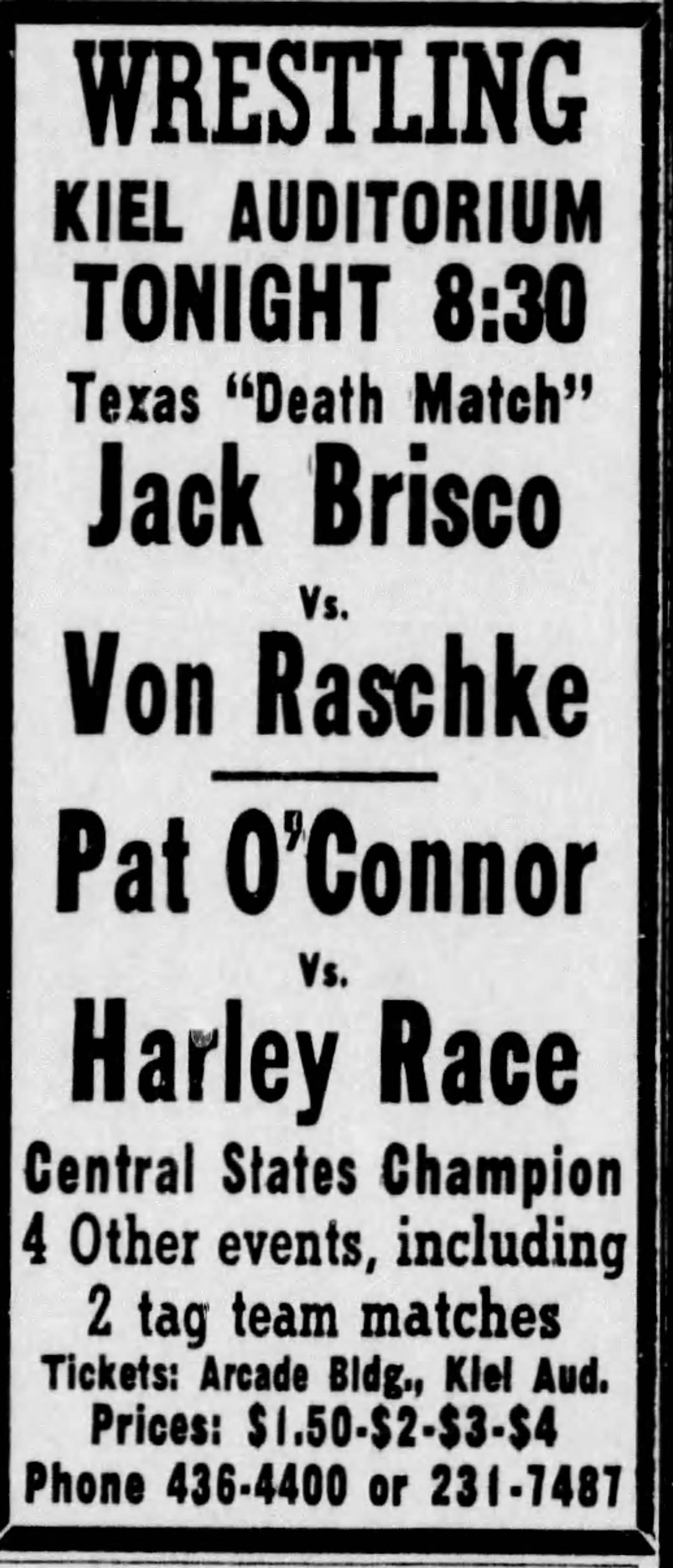
Pictured: St. Louis MO Post Dispatch, October 15th, 1971
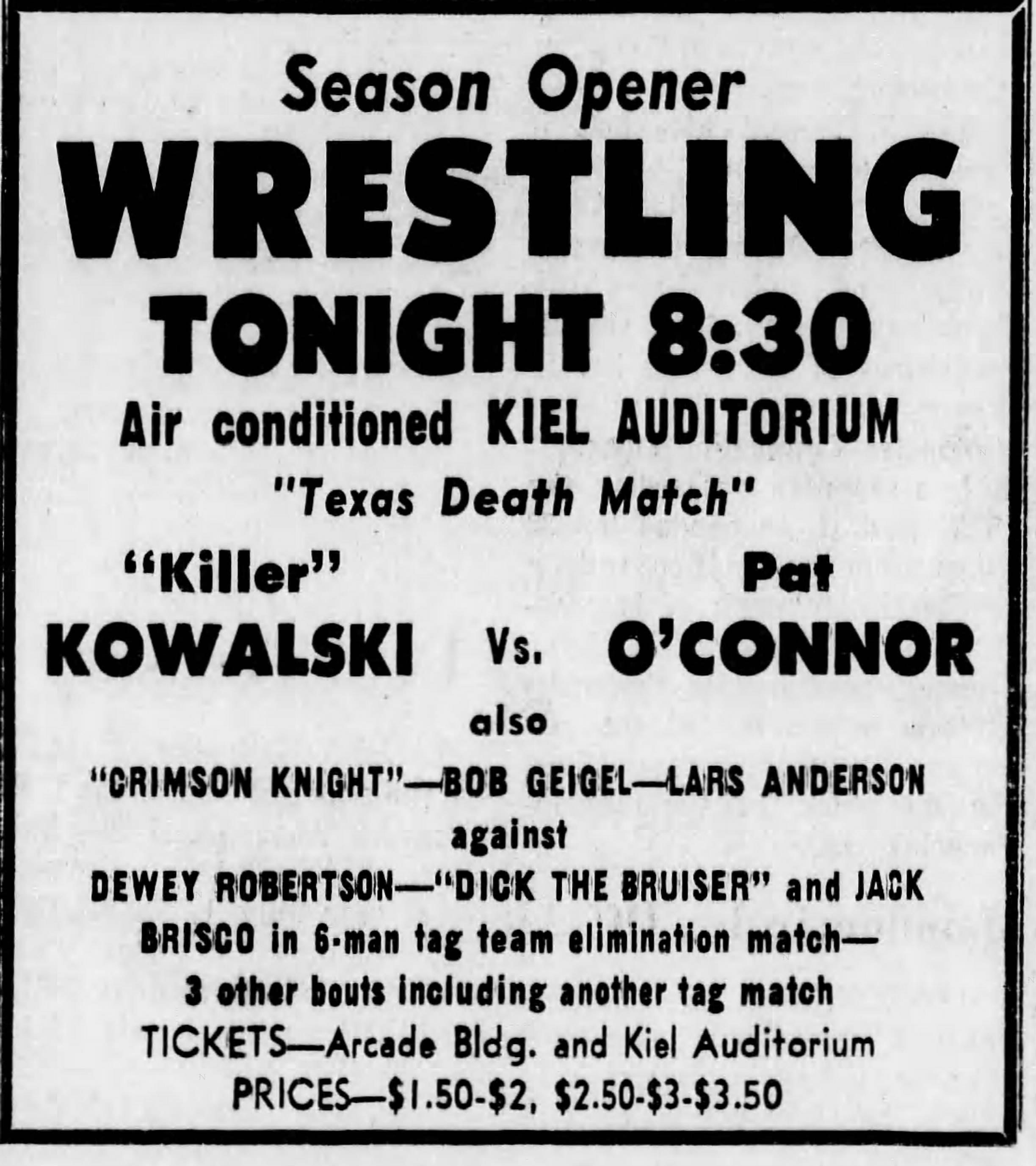
Pictured: St. Louis MO Post Dispatch, August 21st, 1970
3. Pat O’Connor vs. Killer Kowalski – Texas Death Match
August 21, 1970, Kiel Auditorium Attendance: 10,580.
Billed as a no-falls, no-time-limit match in which the winner was the man who could continue when the other could not. O’Connor defeated Kowalski. It was promoted as a special-attraction blow-off rooted in long-standing animosity and drew strongly. Kowalski won the first fall in 9:08. O’Connor took the second fall in 6:50. Kowalski took the third fall at 2:20. O’Connor the fourth fall in 25 seconds and the fifth in 10 seconds when Kowalski could not answer the count.
4. Harley Race vs. Bob Backlund – Lumberjack Match
September 10th, 1976, Kiel Auditorium.
A rare use of the lumberjack stipulation in St. Louis. It stood out in discussions of 1976 cards because such matches were uncommon under Muchnick. Backlund was a wrestler Muchnick valued and helped elevate, was involved in a key program with Race; the lumberjack format was used as a special device rather than a routine booking. The match was booked as a one-hour time limit, 2 out of 3 falls match with Lumberjack Rules. Backlund won the match winning two out of three falls.
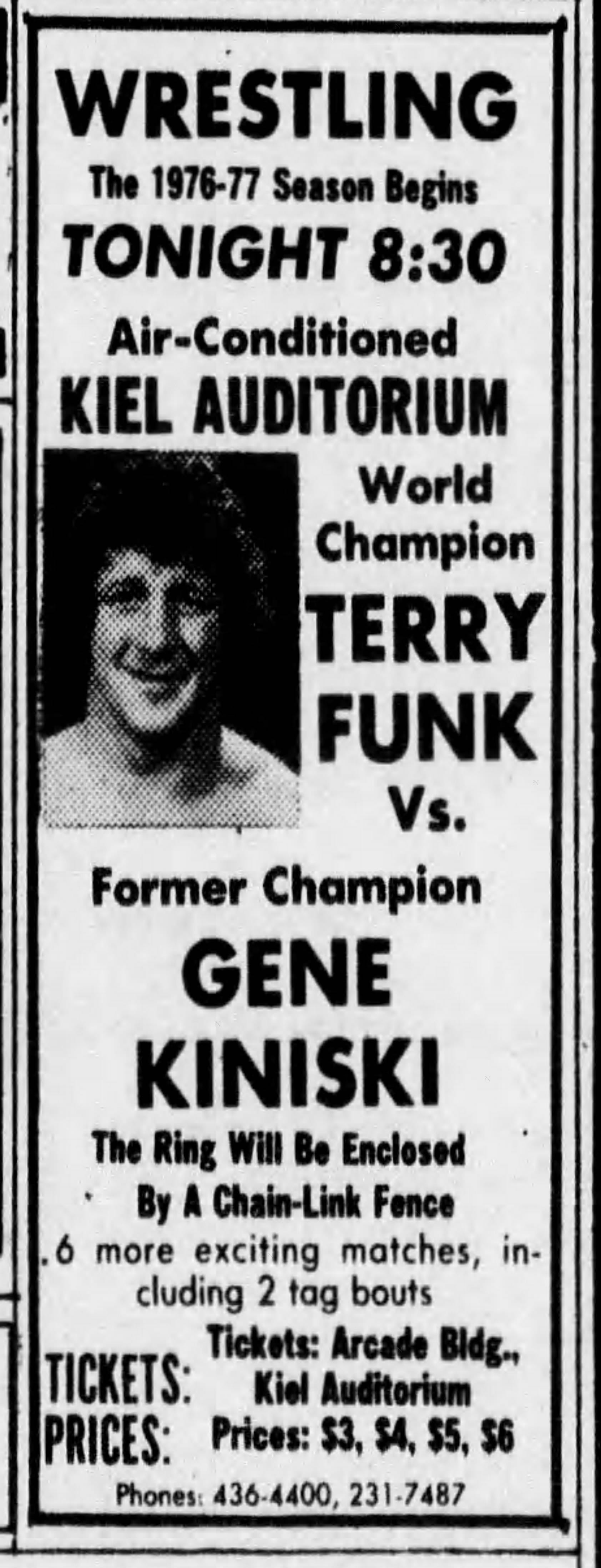
5. Terry Funk vs. Gene Kiniski – Steel Cage Match
August 13th, 1976 (NWA World Title context) Attendance: 9,996
Extremely rare under Muchnick. Cage matches were almost never used in St. Louis; this one is specifically recalled in territory histories and podcast discussions of the 1976 year as an unusual special attraction. Funk defeated Kiniski inside the cage.
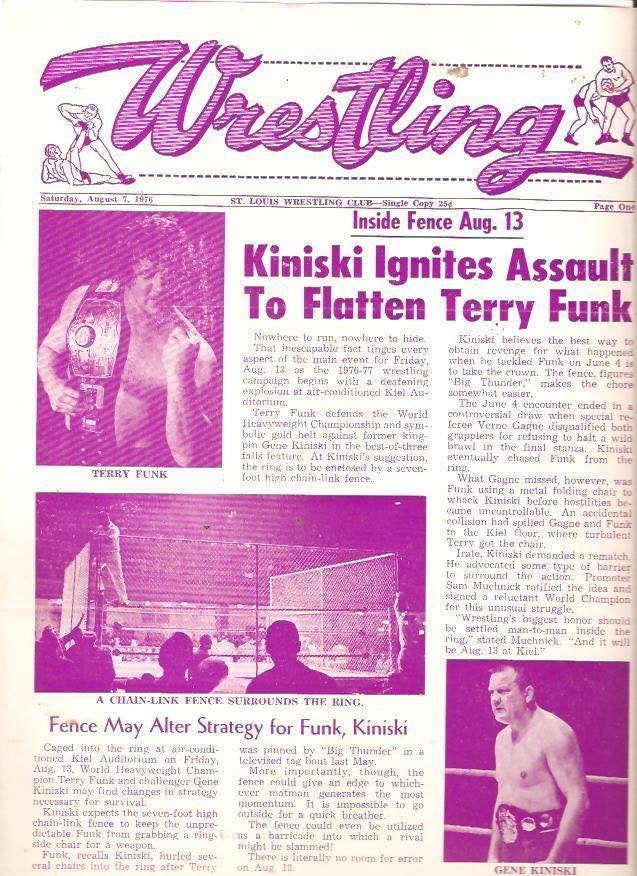
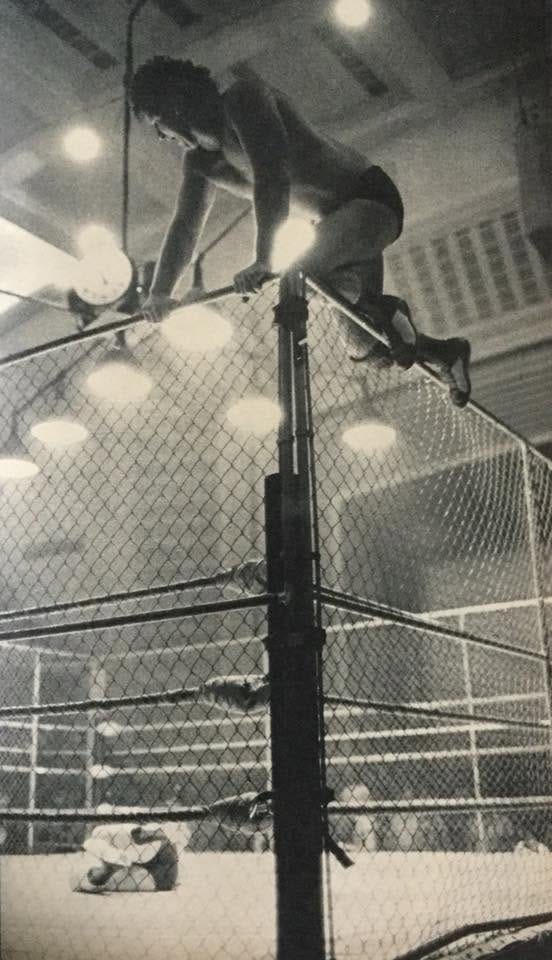
Pictured: Terry Funk on top of the cage in Kiniski match, Kiel Auditorium, St. louis, MO, August 13th, 1976
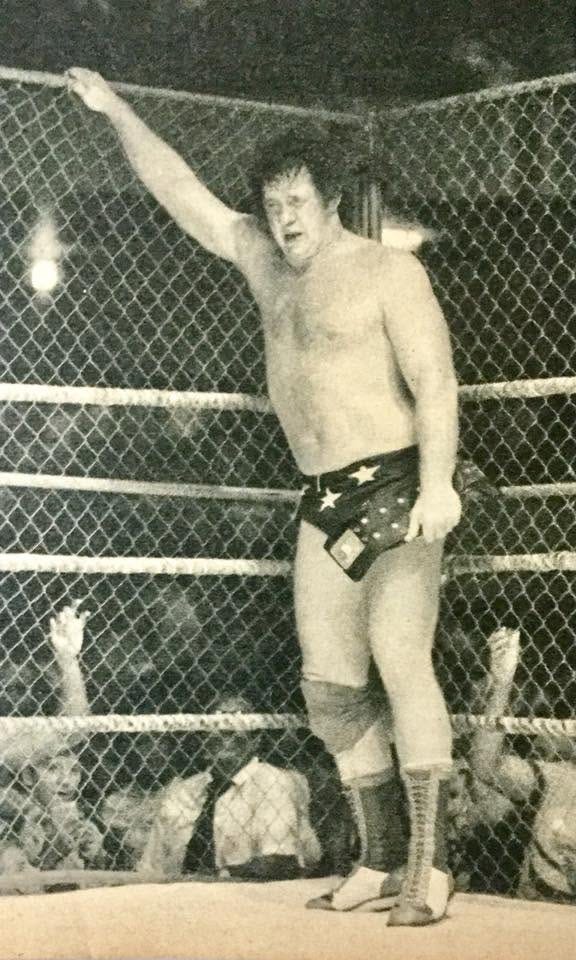
Pictured: Terry Funk wins, survives and retains the NWA World Title against Gene Kiniski inside a steel cage at the Kiel Auditorium, St. Louis, Missouri, August 13th, 1976
Other occasional stipulations included handicap matches (sometimes used with stars like Dick the Bruiser), battle royals or elimination matches, and women’s or midget attractions treated as infrequent draws. True hardcore or high-gimmick styles such as heels throwing fire, regular chair shots, frequent cage matches, or death matches were avoided or quickly corrected when they appeared.
In short, gimmick matches existed in St. Louis under Muchnick, but they were deliberate exceptions reserved for feud culminations rather than the product’s foundation. The emphasis remained on credible singles wrestling and title competition., which, because Muchnick was such a baseball fan, were treated more like pennant races.
In St. Louis under Sam Muchnick, even a gimmick match had to earn its place — booked with the same eye for credibility, competition, and respect for the audience that made Kiel Auditorium the gold standard of the territory era.
Thank You for Watching and Listening
I’m Tony Richards, Pro Wrestling Historian, Author and Storyteller. I share pro wrestling historical items in each issue of the Time Tunnel Pro Wrestling History Newsletter and each episode of our podcast show. Thanks for your support! If you enjoy my information on select events, matches and insights, please share with folks you think might like to be a subscriber!
Remember, Premium subscribers get access to exclusive and special content such as some special issues including a multi-part deep dives on wrestling territories, wrestler bios and championship title histories, special audio and video interviews on territory pro wrestling and more available in the Pro Wrestling Time Tunnel for Premium Subscribers. Being a Premium Subscriber also means you support me in my efforts to document Pro Wrestling History through my research, writing, books, vidoes and podcasts. And…I have something very special planned for our Premium Subscribers on the Podcast side of things in 2026! Details soon here in the Pro Wrestling Time Tunnel.