


Today’s Favorite Quote: Life is not a dress rehearsal—this is probably it. Make it count - Sam Altman
Happy Birthday to those who have passed on and to those great wrestlers still with us:
In Memoriam:
Primo Carnera 1906
Ron Wright 1938
Kevin Sullivan 1949
Troy Graham\The Dream Machine 1949
Nicole Bass 1964
Happy Birthday:
Austin Idol\Mike McCord (77)
Daniel Lopez\El Satanico (77)
Robert Maillet\Kurrigan (57)
Taka Michinoku (53)
Brent Brashear\Ice Train (50)
Phil Brooks\CM Punk (48)
Portia Perez (39)
Wheeler Yuta (30)
RIP Memorial: We stop & remember those who have passed on this day and gave themselves to the business for us, the fans. We salute you and thank you.
S.D. Jones 10-25-2008 at the age of 63
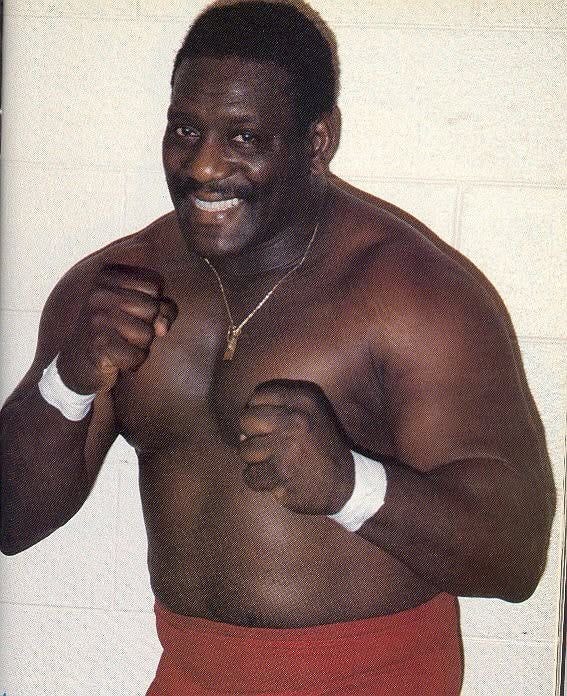
7 Stages of the Territory Era
Stage 7: Disintegration (1985-1995)
Year Two Month Ten
October 1986
October 1986 is the month Stage 7 stopped being theoretical and became physical. The national expansion of the World Wrestling Federation continued without pause. Jim Crockett Promotions kept concentrating talent and television. Bill Watts’ Universal Wrestling Federation still tried to act national while the oil states that paid its gates kept contracting. World Class staged a stadium show and discovered the building no longer believed in it. The American Wrestling Association ran cards in front of numbers that once would have been considered preliminary. And on a rainy night in Charlotte, the man Crockett had been building as the next NWA World Heavyweight Champion wrapped a Porsche around a telephone pole and removed himself from the business in one hydroplane.
The territorial system did not die in a single month. It lost the ability to pretend the old rules still governed. October supplied the clearest evidence yet.
The World Wrestling Federation
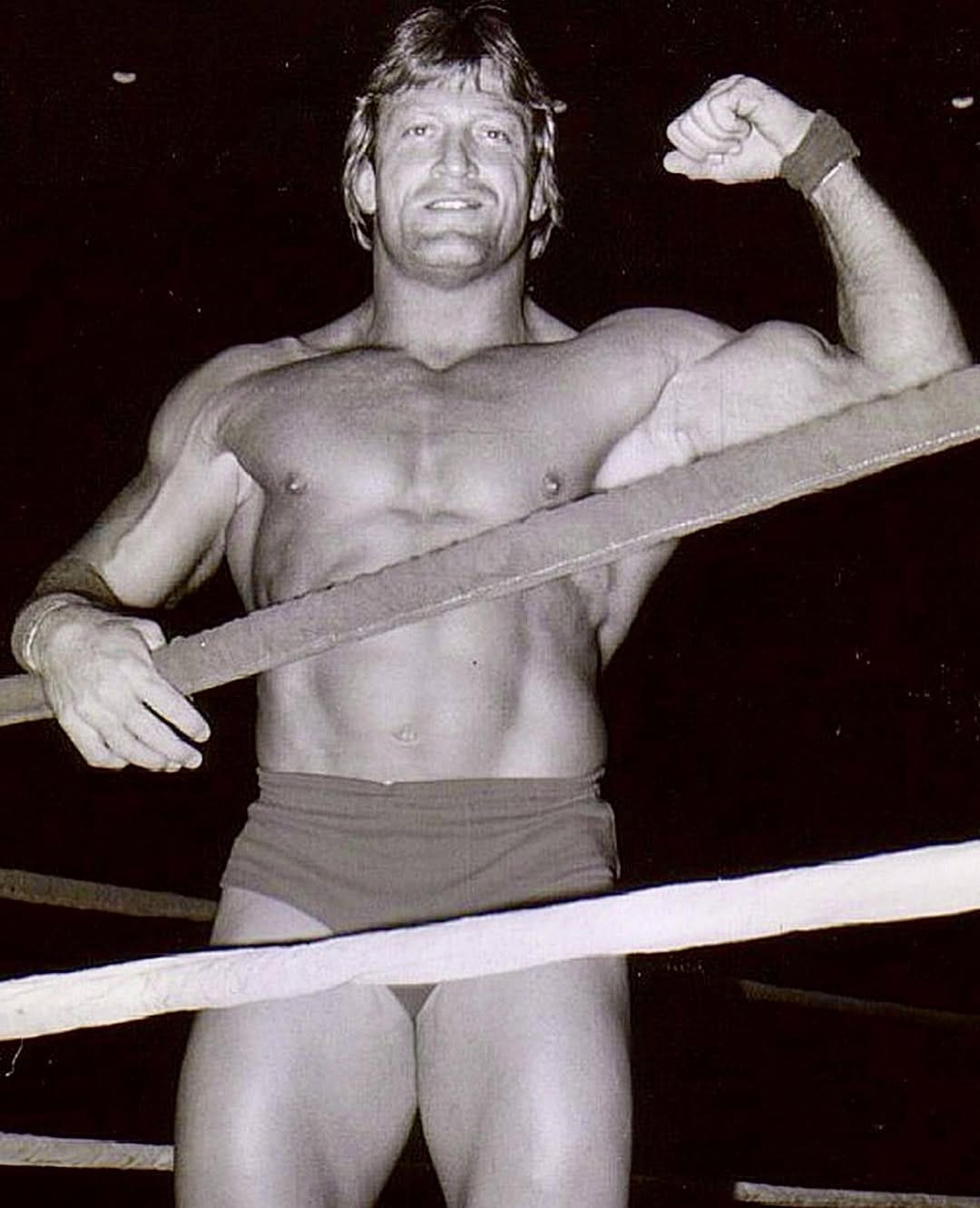
Pictured: Paul Orndorff
Hulk Hogan remained World Champion. The program that still dominated the company was his feud with Paul Orndorff. Orndorff had turned in the summer, stolen Hogan’s music and poses, and signed with Bobby Heenan. By October the match was the main event on nearly every major house show and the centerpiece of national television.
Saturday Night’s Main Event #7 aired October 4 from the Richfield Coliseum in Ohio (taped September 13). Hogan defeated Orndorff by disqualification. The match itself was the usual combination of brawling, Heenan interference, and a finish designed to protect the champion while keeping the heat. Roddy Piper, already working on crutches after the September 27 Superstars attack, came out and became involved. The segment reinforced two things at once: the Hogan-Orndorff program still sold tickets, and Piper’s recovery angle was now part of the same national hour.
House shows remained strong where the company chose to run. On October 25 in Detroit, Hogan beat Orndorff in a steel cage in front of a reported sellout of 21,000. Other October dates showed the same pattern that had defined the company all year: the champion could still fill the buildings that mattered, while the undercard was filled by the traveling roster of Randy Savage, the British Bulldogs, the Machines, Jake Roberts, Ricky Steamboat, and the rest. The Machines angle continued as a device to keep André the Giant on the road without revealing the eventual WrestleMania III program. Piper’s feud with Adrian Adonis, Bob Orton, and Don Muraco kept receiving television time after the destruction of the Piper’s Pit set. The company was already converting that program into the hair-versus-hair match that would close the card at the Pontiac Silverdome the following March.
What mattered for Stage 7 was not any single October match. It was the distribution. WWF Superstars of Wrestling and Wrestling Challenge were now the standard syndicated product. A local office could still run a Friday or Saturday night, but it could not control what the audience had already seen that morning. Orndorff mocking Hogan on national television reached more households in a single weekend than most remaining territories reached in a month of house shows.
Jim Crockett Promotions and the Magnum T.A. Accident
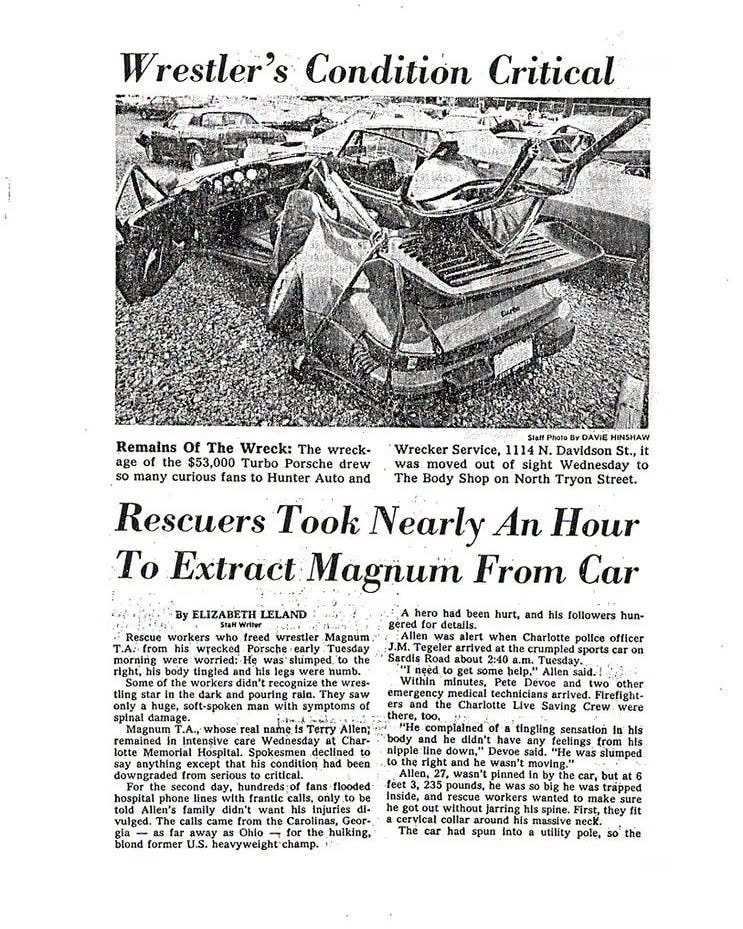
The single most consequential event of the month happened outside a ring. On October 14, 1986, Magnum T.A. (Terry Allen) drove home from a Greenville, South Carolina date in heavy rain. His Porsche hydroplaned on Sardis Road in Charlotte, struck a telephone pole, and left him with an exploded C-4/C-5 injury. He was paralyzed from the chest down. Doctors initially doubted he would walk again. He survived because of his conditioning. His career as an active wrestler ended at 27.
Crockett had been building Magnum as the company’s next world-title contender and, in the eyes of many observers, its next long-term face of the company. The United States title program with Nikita Koloff had been the centerpiece of the summer and early fall. Starrcade ’86, already scheduled for November 27 as a Greensboro/Atlanta double-shot, had Magnum penciled in as Ric Flair’s opponent. The accident forced an immediate rewrite.
Dusty Rhodes, still television champion and booker, turned Nikita Koloff. The story told on television was that Koloff had been in Japan when he heard the news, called Rhodes, and the two men found common ground. The on-screen version of the turn arrived in real time. On October 18 in Philadelphia, Rhodes brought Koloff to ringside for a steel-cage match against Ole Anderson and J.J. Dillon. The crowd reaction was the sound of a territory absorbing a shock. Days earlier the Horsemen (Blanchard, Dillon, Arn, and Ole) had attacked Rhodes in the parking lot outside the Crockett office in Charlotte, filmed by a paid cameraman, and worked his arm with a baseball bat. Rhodes worked with a cast. The new pairing—Rhodes and Koloff as the Super Powers—became the company’s answer to the missing Magnum.
Starrcade was rebooked. Flair would defend the NWA World title against Koloff instead of Magnum. The Road Warriors versus the Midnight Express was already signed as a scaffold match (“Night of the Skywalkers”). Dusty was booked against Tully Blanchard in a first-blood match. The Rock ’n’ Roll Express continued their war with the Andersons. The company still had depth. What it no longer had was the specific babyface it had spent months positioning as the future. In Stage 7 terms, an individual injury became a structural problem because the remaining offices had fewer and fewer independent stars who could carry a national-level program without being absorbed into Crockett’s own loop.
World Class Championship Wrestling
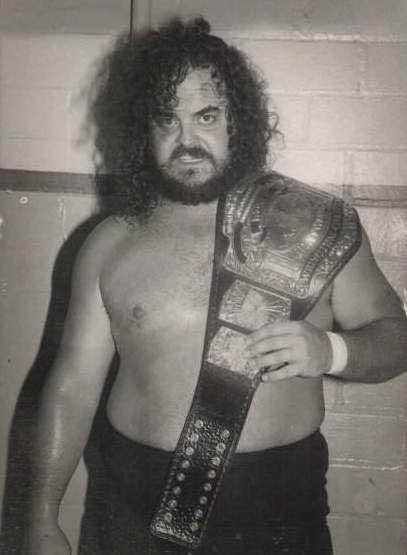
Pictured: Black Bart
On October 12, World Class ran its third Cotton Bowl Extravaganza in Dallas. Attendance was reported at 5,835. The previous year’s version of the same show had drawn roughly 25,000. Kevin Von Erich defeated Black Bart to win the World Class World Heavyweight title. Bruiser Brody beat Abdullah the Butcher in a steel cage with Fritz Von Erich as special referee. Ricky Steamboat worked the undercard with WWF permission. Buzz Sawyer and Matt Borne retained the tag titles. The card was not empty of names. The building was empty of belief.
World Class was already living with the aftermath of David Von Erich’s death in 1984 and Mike’s health issues. Kerry’s motorcycle accident earlier in the year had removed another active draw. The Cotton Bowl number was not an outlier. It was confirmation that the family name and the Star Wars branding no longer automatically filled a stadium. ESPN exposure had given the promotion a cable window, but cable did not replace the local television monopoly the territory had once held. Fans who had once treated the Cotton Bowl as an annual ritual now had other options on Saturday morning.
Universal Wrestling Federation, Memphis, and the AWA
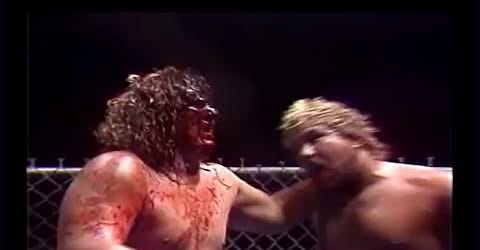
Pictured: A bloody Terry Gordy and Ted DiBiase in a cage in Houston, TX October 17th, 1986
Bill Watts’ UWF continued to run strong in-ring cards while the economic base underneath it kept eroding. Terry Gordy was the Heavyweight Champion. Ted DiBiase worked cage matches against him; one October 17 Houston date produced a disputed title change that was later voided because DiBiase had not signed a contract for a title match. Sting and Eddie Gilbert remained a regular tag team. The Fantastics, One Man Gang, Jim Duggan, Terry Taylor, and the Freebirds filled out the mid-card. Jim Ross was already the voice. The product was still one of the best in North America. The towns that had paid for it were not. The oil glut that had begun earlier in the year did not reverse in October.
Memphis under Jerry Lawler and Jerry Jarrett continued its local resilience. Lawler held the AWA Southern title. Feuds with Bam Bam Bigelow, the various Fire-Flame-Torch combinations, and the usual parade of invaders kept the Mid-South Coliseum viable. Jeff Jarrett was already a regular. The office still drew when the local product felt urgent. It could not prevent the WWF from using the same building when it chose.
The AWA was the clearest example of an office that had already lost the argument. Nick Bockwinkel was champion by award after Stan Hansen’s June walkout and the subsequent belt-return drama. October cards in the Midwest produced attendances that would have been considered unacceptable five years earlier. The Midnight Rockers (Shawn Michaels and Marty Jannetty) were rising on the undercard. Curt Hennig and Scott Hall were still in the company. None of it reversed the direction. Verne Gagne’s office no longer set the price of a house show in its own strongest towns.
Canada, Mexico, and Puerto Rico
Stampede Wrestling in Calgary continued under the Hart family. Owen Hart was still a regular and had already worked WWF tryout dates earlier in the fall. The promotion remained a functional regional office because Calgary was far from the weekly WWF loop and because the Harts could still produce talent the national companies would later buy. Maple Leaf Wrestling in Toronto was, in practice, a WWF date.
In Mexico, Empresa Mexicana de Lucha Libre continued its regular calendar. The 53rd Anniversary Show had already happened in September. October was ordinary business for a promotion whose television market, mask culture, and annual apuestas calendar were not dependent on the American territorial compact. The Universal Wrestling Association remained a separate circuit. Talent crossed the border. The offices did not.
Puerto Rico’s World Wrestling Council remained one of the few remaining territories that could still book a traveling NWA champion and a Japanese star on the same card. On October 12 in San Juan, Stan Hansen defeated Carlos Colón for the WWC Universal Heavyweight Championship. Flair had worked the September Aniversario. The island office still functioned as a true territory in the old sense: it imported stars, protected its own champion, and sold the result locally. That model was becoming rare on the mainland.
Japan
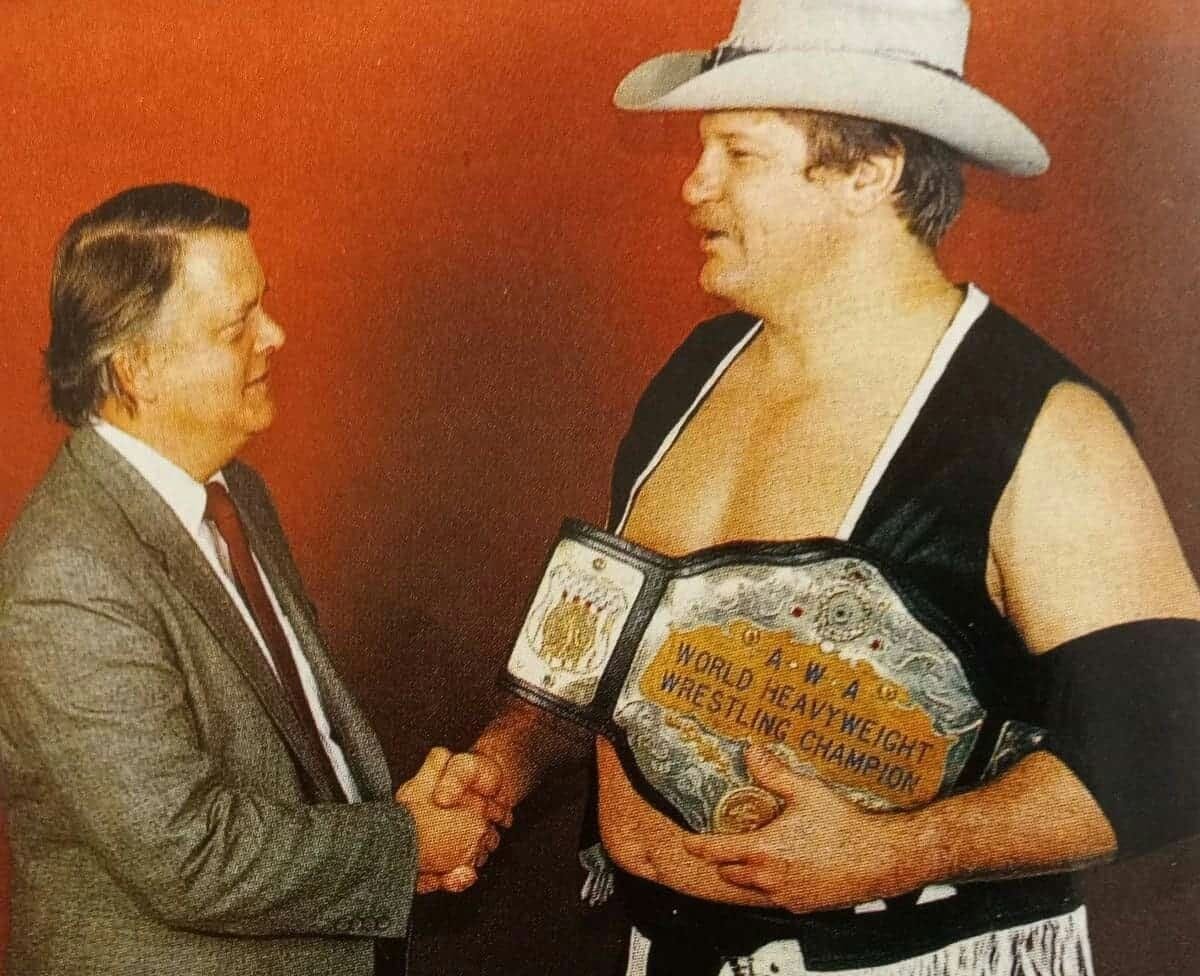
Pictured: Jim Crockett, Jr and AWA World Champion, Stan Hansen
All Japan Pro Wrestling’s Giant Series ran through the month. On October 21 at Ryogoku Kokugikan in Tokyo, Jumbo Tsuruta defeated Stan Hansen to win the NWA International Heavyweight Championship in front of a reported 10,600. Hansen had left the AWA title situation behind and remained a top foreign draw for Baba’s office. The Road Warriors appeared. Genichiro Tenryu and Jumbo continued as the company’s top tag combination. The promotion did not need American territorial politics. It needed Korakuen Hall, the sports papers, and foreigners who could bump.
New Japan’s Toukon Series (tied to Inoki’s 25th anniversary) ran concurrently. Antonio Inoki worked against Steve Williams, Bad News Allen, and various combinations. Tatsumi Fujinami continued as the company’s technical ace. Young talent—Keiji Muto, Shinya Hashimoto—were already on the cards. The civil-war elements that had defined earlier 1986 tours (Maeda, Fujiwara, the UWF-style faction) were still visible in the undercard and tag matches. Japan’s two major men’s promotions operated as independent national industries. The American disintegration did not reach them except as a source of imported talent.
Business Analysis: Stage 7 in the Tenth Month of Year Two
Disintegration in this framework is the breakdown of the rules that made regional monopoly possible. October 1986 illustrated four of those rules collapsing at once.
The first was the idea that a territory could control its own future through long-term booking. Crockett had spent months building Magnum T.A. as the company’s next world champion. One rainy night removed the plan. The company adapted by turning Koloff and creating the Super Powers, but the adaptation itself proved the point: even the strongest remaining office could no longer protect its own succession plan from chance. Smaller offices had even less margin.
The second was television exclusivity. WWF syndication was no longer new. By October the Superstars and Challenge hours were the default product in most markets. A Cotton Bowl show that once felt like the biggest night of the Texas year now competed with a national hour that had already shown Hogan, Orndorff, and Piper that morning. World Class’s attendance collapse was not only a local story. It was the local story of a national product arriving first.
The third was geographic protection. Crockett had already absorbed Central States. The WWF continued to run dates in buildings that still belonged, on paper, to other offices. The UWF could still produce excellent matches in Houston and Tulsa. It could not prevent the national brands from treating those same towns as optional stops. The old NWA agreement that protected a promoter’s towns had become unenforceable once one member decided the agreement no longer applied to him.
The fourth was the shared champion as a public good. Flair still toured. He still worked towns outside Crockett’s core. The value of that tour now accrued primarily to Crockett. Hansen’s AWA belt had already demonstrated what happened when an office could no longer enforce a finish. In October, Hansen was winning and losing titles in Japan and Puerto Rico while the AWA champion in Minnesota worked in front of diminishing crowds. The title that once traveled as a cooperative asset had become inventory belonging to whoever could still pay the date fee or the television clearance.
Japan and Mexico remained outside this particular collapse because their markets were not built on the American territorial compact. Their television, their language, and their annual calendars gave them insulation. On the North American mainland the pattern was consistent: one company setting the production standard, one company concentrating the remaining NWA talent, and a ring of older offices discovering that a full house in Memphis or a packed Ryogoku did not constitute a system that could protect them.
October 1986 did not close any major office. It removed the illusion that the offices still controlled their own clocks. Magnum’s accident rewrote Starrcade. The Cotton Bowl number rewrote World Class’s self-image. The continuing strength of Hogan-Orndorff on national television rewrote what a local special event was worth. The territory system was still producing cards. It was no longer producing a coherent industry.
Thank You for Watching and Listening
I’m Tony Richards, Pro Wrestling Historian, Author and Storyteller. I share pro wrestling historical items in each issue of the Time Tunnel Pro Wrestling History Newsletter and each episode of our podcast show. Thanks for your support! If you enjoy my information on select events, matches and insights, please share with folks you think might like to be a subscriber!
Remember, Premium subscribers get access to exclusive and special content such as some special issues including a multi-part deep dives on wrestling territories, wrestler bios and championship title histories, special audio and video interviews on territory pro wrestling and more available in the Pro Wrestling Time Tunnel for Premium Subscribers. Being a Premium Subscriber also means you support me in my efforts to document Pro Wrestling History through my research, writing, books, vidoes and podcasts. And…I have something very special planned for our Premium Subscribers on the Podcast side of things in 2026! Details soon here in the Pro Wrestling Time Tunnel.