


Today’s Favorite Quote: I almost never get the question “what’s not going to change in the next 10 years”? The answer to that is way more important than what will change - Jeff Bezos
Happy Birthday to those who have passed on and to those great wrestlers still with us:
In Memoriam:
William Demetral 1886
Tom Jones 1939
Pedro Morales 1942
Allan Coage\Bad News Brown 1943
Happy Birthday:
Bill Apter (81)
Pork Chop Cash (79)
D’Lo Brown (53)
Kira Forester\Taya Valkyrie (43)
RIP Memorial: We stop & remember those who have passed on this day and gave themselves to the business for us, the fans. We salute you and thank you.
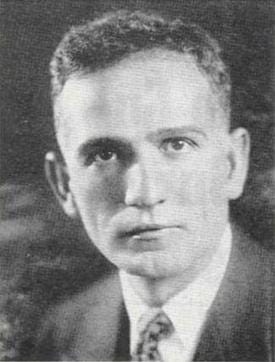
Tom Packs 10-22-1964 at the age of 70
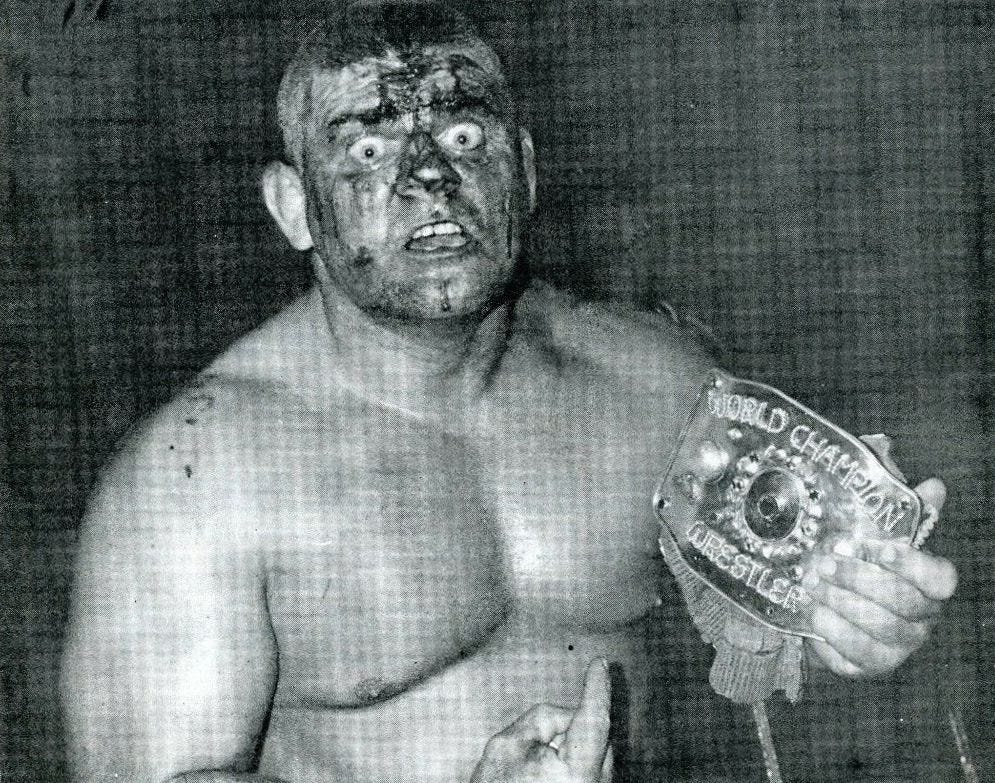
Reggie “Crusher” Lisowski 10-22-2005 at the age of 79
Significant Wrestler Debut
10-22-1973: Bob Backlund vs Ron Starr at the Municipal Auditorium in Shreveport, Louisiana in Backlund’s debut
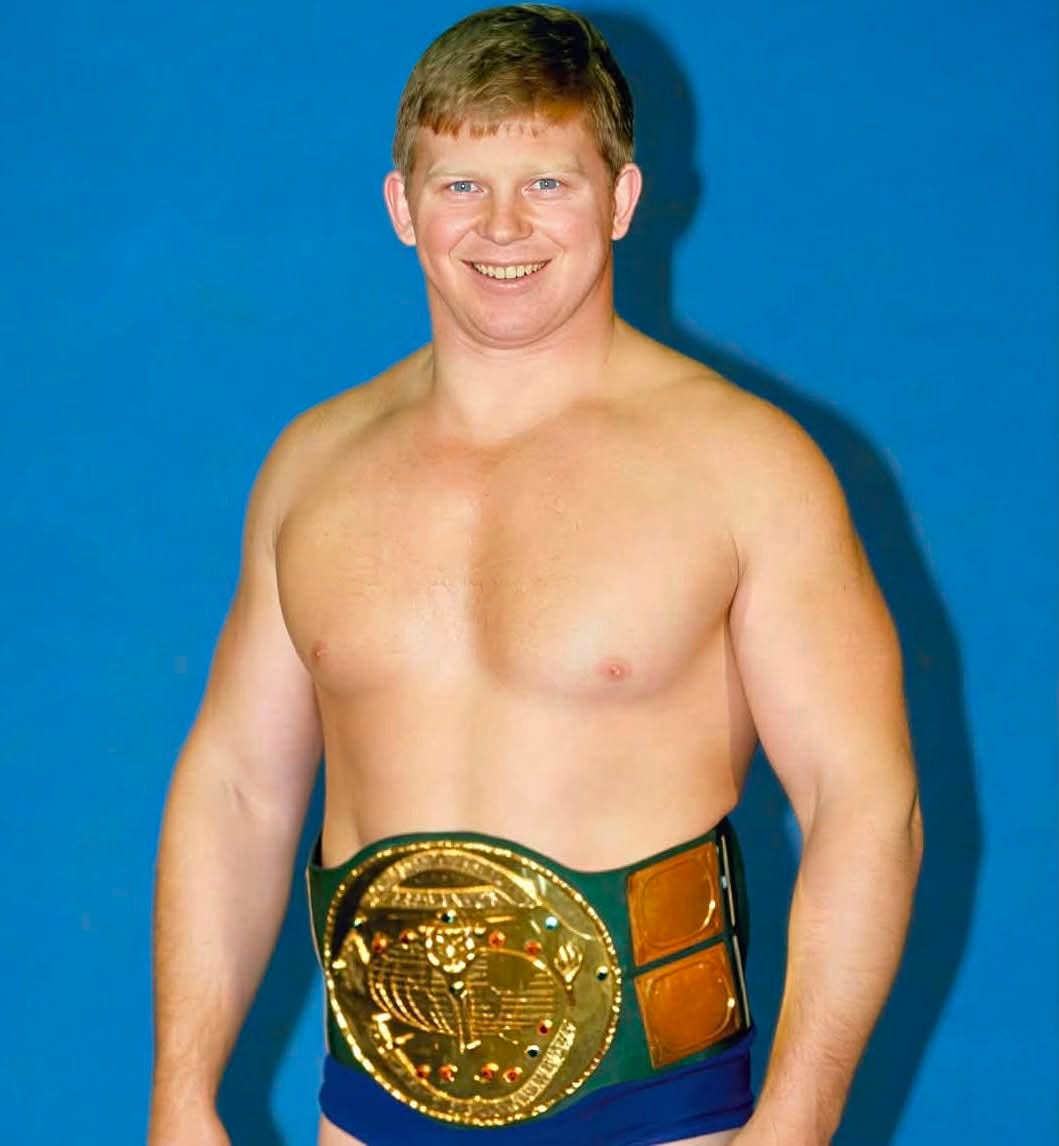
Backlund’s debut opponent was Ron Starr, a fellow rookie at the time who would later go on to have a solid career in various NWA territories, Japan, Puerto Rico, and Canada, including winning the NWA World Junior Heavyweight Championship twice. The match result isn’t documented in available records—likely due to it being a low-card opener in a regional promotion—but Backlund described it as a rough outing where he felt completely lost. He got tangled in the ropes entering the ring, struggled to follow the flow, and drew laughs from the sparse crowd on multiple occasions.
Contextually, this debut came amid harsh early career conditions for Backlund. As a clean-cut babyface rookie, he was paying his dues in the southern U.S. territory system, often opening shows and facing “marks” (local fans pulled from the crowd) in unadvertised pre-match bouts to prove wrestling’s legitimacy. The Tri-State area (covering Oklahoma, Arkansas, and Louisiana) was run by promoter Leroy McGuirk and booker Grizzly Smith. Backlund traveled alone in his beat-up 1968 Chevy Impala, living out of his car due to minimal pay— he earned just $5 for this debut match, far less than expected, forcing him to sleep in parking lots and subsist on canned tuna. He credited his positive mental attitude and Sharkey’s advice for persevering through the heat, isolation, and doubts about his career choice. This period marked “rock bottom” for him, but it built toward better opportunities, including a connection with Terry Funk that led to work in Amarillo, Texas.
My 2026 Wrestling Observer Hall of Fame Ballot
This is how I cast my votes this year, with the reasoning behind each choice. I do not vote in the MODERN Wrestler Category because I just have trouble voting in categories with wrestlers who are still active. I feel like I either have to do a lot of research and vote accoringly or not vote at all. I don’t feel that voting for wrestlers in the category but are no longer active and not considering wrestlers are are still active, so i choose the latter and abstain from the category.
Below is how I voted this year along with a simple overview of why I voted for the candidate. I did a lot more research than is published here inclding drawing power and other factors. Just so you can get a feel for how much I research each canidate, you can see the case studies I wrote for Bob Ellis amd June Byers and listen to my appearance on The Flagship: Patreon The Ballot Show with Rich Kraetsch and Joe Lanza.
Historical Category (7 votes max)
Cowboy Bob Ellis — One of the great traveling main-event babyfaces of the 1950s and 1960s. A Texas cowboy who became a consistent world-title challenger (including multiple high-profile shots at Buddy Rogers), a multi-time regional champion, and the man widely credited with inventing the bulldog. He drew money across the Midwest, West Coast, Florida, and beyond while bleeding and fighting in a way that defined the era.
June Byers — The standard-bearer of the NWA World Women’s Championship after the famous 1954 match with Mildred Burke. A legitimate shooter from the Billy Wolfe camp, a major draw in Texas and the South, and one of the few women who could hold a territory on skill as well as personality. Her long reign and the controversy surrounding the title only add to her historical importance.
Junkyard Dog — The biggest babyface of the Mid-South territory in the early-to-mid 1980s and a true crossover star. He helped define the modern Mid-South style, drew huge houses, and carried the promotion as its top attraction before moving on. His impact on regional wrestling and his connection with fans remains under-appreciated in national Hall of Fame discussions.
Wild Bull Curry — The originator of the hardcore style. In Texas he became so popular that promoters created the NWA Texas Brass Knuckles Championship for him; he held it 20 times. His brawling, riots, and ability to sell violence made him one of the biggest draws of the 1950s and early 1960s in the Lone Star State.
Sputnik Monroe — A revolutionary figure in Memphis and the Mid-South. He used his charisma and willingness to integrate audiences to change how wrestling was presented and who was allowed to sit where. A major drawing card whose cultural impact went beyond the ring.
Bob Armstrong — The quintessential Southern babyface hero of the 1970s and 1980s. He headlined across Georgia, Alabama, Tennessee, and other Southern territories for years, won countless regional titles, and remained a trusted top attraction long after most of his peers had slowed down.
Ole Anderson — One of the most important tag-team wrestlers and bookers of the territory era. As half of the Minnesota Wrecking Crew he helped define the heel tag team, and his later work as a booker and promoter in Georgia and the Mid-Atlantic left a lasting mark on how the business was run.
Japan Category (5 votes max)
Yoshiaki Fujiwara — First graduate of the New Japan dojo, Karl Gotch student, and a key figure in both traditional strong-style and the shoot-style movement. He trained future stars, co-founded the UWF scene, and remained a respected technician and character for decades.
Tiger Jeet Singh — One of the great foreign heels in Japanese wrestling history. His long run as a top villain for Antonio Inoki and others made him a consistent box-office attraction across Japan in the 1970s and 1980s.
Antonio Inoki & Seiji Sakaguchi — The foundational tag team and promotional partnership that helped build New Japan. Their work as both competitors and business partners shaped the modern Japanese wrestling landscape.
Hayabusa — The most charismatic and athletic star of Frontier Martial-Arts Wrestling in the 1990s. His high-flying and hardcore style, combined with his tragic injury, made him one of the most memorable figures of that era.
Yoshihiro Takayama — A versatile heavyweight who excelled in both traditional wrestling and shoot-style. His size, striking, and willingness to work different styles made him a valuable main-eventer across promotions.
Mexico Category (3 votes max)
Sangre Chicana — One of the greatest brawlers and technicians in lucha libre history. A multi-time national and world champion, famous for his intensity, punching, and long-running feuds. He worked both EMLL/CMLL and the independent scene and remains an iconic figure.
El Hijo del Santo & Octagon — The defining babyface tag team of the 1990s AAA boom. Their chemistry, athleticism, and ability to carry major matches helped define modern lucha libre on a national level.
Mascarita Sagrada — The most famous and successful mini-estrella of his generation. He elevated the minis division into a legitimate drawing attraction and became a household name across Mexico.
Europe / Australia / New Zealand / Pacific Islands / Africa (5 votes max)
Jose Tarres — The biggest star in Spanish professional wrestling for roughly 20 years. He regularly headlined bullrings and stadiums for 10,000–20,000 fans, held multiple national and European titles, and was the top attraction in Barcelona and beyond from the late 1940s into the 1960s.
Otto Wanz — The dominant figure of Austrian and German catch wrestling for decades. He built a successful promotion, held European titles, and remained a top draw in his region long after most American-style promotions had faded.
Billy Joyce — A major British and European star of the 1950s and 1960s whose technical skill and drawing power made him a consistent main-eventer across the continent.
George Gordienko — A highly respected Canadian/European technician who worked extensively overseas and was regarded as one of the better pure wrestlers of his generation.
(Left blank on your ballot)
Non-Wrestler Category (7 votes max)
Roy Welch — Co-founder and longtime operator of the Tennessee / Mid-America territory with Nick Gulas. He built one of the most consistent and profitable Southern offices of the territory era and helped develop countless stars. One of the most innovating and influential wrestling influencers of his prime years of 1935-1965 including live studio television, syndicated television, booking and talent systems and mergers and acquisitions including Missouri, Alabama, Arkansas, Louisiana, Mississippi in addition to the majority of Tennessee, Kentucky, Southern Illinois and Southern Indiana. It was driven by weekly wrestling in Nashville, Chattanooga, Birmingham and in 1956 the adiditon of Memphis and Jackson, Mississippi.
George Scott — One of the most important bookers in NWA history. His work in the Mid-Atlantic and later with Jim Crockett Promotions helped create the national-expansion style that defined the 1980s.
Gorilla Monsoon — Legendary WWWF/WWF announcer and later executive. His voice and presence defined New York wrestling for a generation, and he remained a trusted figure behind the scenes for decades.
Morris Sigel — The longtime Houston promoter who controlled one of the most important Texas territories for decades. His office was a major NWA member and a training ground for countless stars.
Ted Turner — His decision to put wrestling on TBS/TNT and later support WCW changed the industry. The national television platform he provided accelerated the end of the territory system and created the 1990s boom.
Grand Wizard — One of the most memorable managers of the 1970s WWWF. His work with Superstar Billy Graham and others helped define the modern heel manager role.
Jesse Ventura — Charismatic wrestler, color commentator, and later political figure. His announcing work in the 1980s AWA and WWF remains some of the most entertaining of the era, and his larger cultural impact is undeniable.
Thank You for Watching and Listening
I’m Tony Richards, Pro Wrestling Historian, Author and Storyteller. I share pro wrestling historical items in each issue of the Time Tunnel Pro Wrestling History Newsletter and each episode of our podcast show. Thanks for your support! If you enjoy my information on select events, matches and insights, please share with folks you think might like to be a subscriber!
Remember, Premium subscribers get access to exclusive and special content such as some special issues including a multi-part deep dives on wrestling territories, wrestler bios and championship title histories, special audio and video interviews on territory pro wrestling and more available in the Pro Wrestling Time Tunnel for Premium Subscribers. Being a Premium Subscriber also means you support me in my efforts to document Pro Wrestling History through my research, writing, books, vidoes and podcasts. And…I have something very special planned for our Premium Subscribers on the Podcast side of things in 2026! Details soon here in the Pro Wrestling Time Tunnel.