


Today’s Favorite Quote: People succeed when they realize that their failures are the preparation for their victories - Ralph Waldo Emerson
Happy Birthday to those who have passed on and to those great wrestlers still with us:
In Memoriam:
Hot Gilliam 1902
Con Bruno 1916
Billy Hines 1934
Black Cat 1954
Steve McMichael 1957
Happy Birthday:
(none)
RIP Memorial: We stop & remember those who have passed on this day and gave themselves to the business for us, the fans. We salute you and thank you.
Ron DuPree 10-17-1975 at the age of 35

Frank Dalton 10-17-1995 at the age of 54

Leo Nomellini 10-17-2000 at the age of 76
Mike Fever 10-17-2009 at the age of 53
Dr. Ken Ramey 10-17-2014 at the age of 83
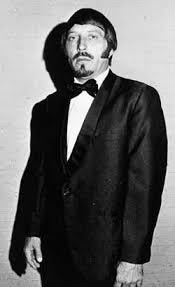
The Life and Career of Mae Weston
Betty Mae Garvey, better known throughout a remarkable career as Mae Weston, embodied the grit and adaptability of women’s professional wrestling from its carnival roots through the territorial era and into the modern independent scene. Born January 30, 1923, in Leavenworth, Kansas, she lived a life shaped by early hardship, physical daring, and an uncommon longevity in the ring. Over roughly fifty-six years she competed under numerous names, challenged the sport’s greatest champions, forged personal ties with rivals, and in later decades reinvented herself as one of the most effective heel managers of the 1970s. She died on October 14, 1999, in Westerville, Ohio, at age seventy-six, leaving a legacy as both a resilient competitor and a vivid character who helped keep women’s wrestling visible across decades of change.
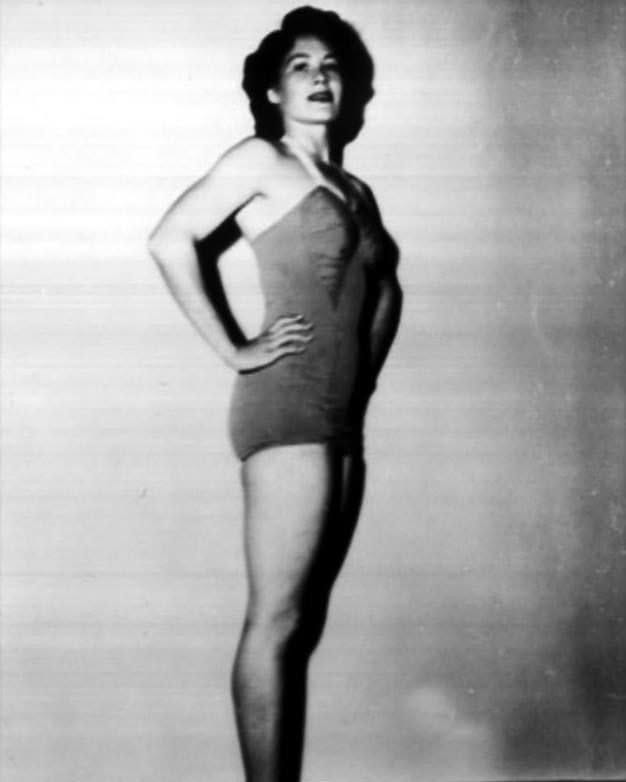
Her early years were marked by instability. When she was eight, her mother, Rachel A. Arnold, died. A custody struggle followed between her father, William I. Gordon, and her grandmother; ultimately the father took his three children to a small mining town in Missouri that offered schooling only through the sixth grade. Garvey later described teaching herself with the aid of a dictionary. An older sister, Wilma Gordon, had already sought escape from an unhappy marriage by joining a carnival, where she performed as an acrobat alongside promoter Billy Wolfe and the emerging star Mildred Burke. When the carnival returned to Leavenworth, the teenage Garvey joined it at age thirteen. She worked as an acrobat and took carnival challenges as a boxer, experiences that toughened her and prepared her for the physical demands of wrestling.
Billy Wolfe trained her and gave her the ring name Mae Weston, a deliberate nod to the glamorous Hollywood star of the era. She made her official professional debut in 1938 at age fifteen. One of her early significant matches that year pitted her against her own sister Wilma Gordon in Birmingham, Alabama, a bout that marked a transition from fairground and carnival stages into larger indoor halls. Wolfe’s shows often featured women against both female and male opponents in the rough “AT” (athletic show) style of the period.
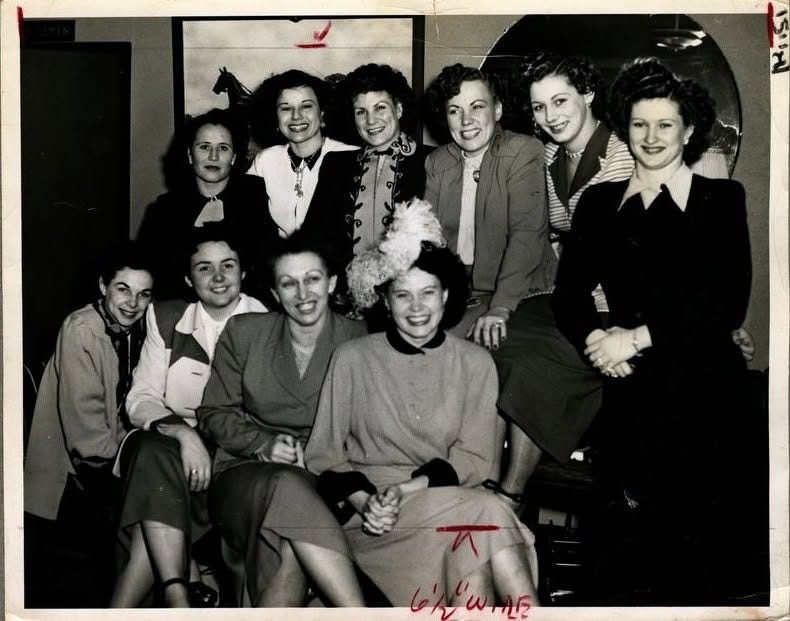
Back Row - Cecelia Blevins, Juanita Coffman, Violet Viann, June Byers, Theresa Theis and Dot Dotson.
In Front - Lillian Ellison, Catherine Simpson, Elvira Snodgrass, and Mae Weston
These were classic carnival midway attractions: spectators paid to watch (or challenge) the athletes, often under crude conditions with an emphasis on toughness, spectacle, and drawing crowds rather than formal rules or record-keeping.
This mirrored the path of Mildred Burke herself, who had begun by wrestling men at carnivals under Wolfe before rising to prominence. For the teenage Garvey, the work combined acrobatics, boxing challenges, and early wrestling. Wolfe later gave her the ring name Mae Weston (a nod to the Hollywood star Mae West). Her official professional wrestling debut came in 1938 at age 15, including an early match against her sister Wilma Gordon in Birmingham, Alabama, as the business shifted from fairgrounds and carnival stages into larger indoor halls.
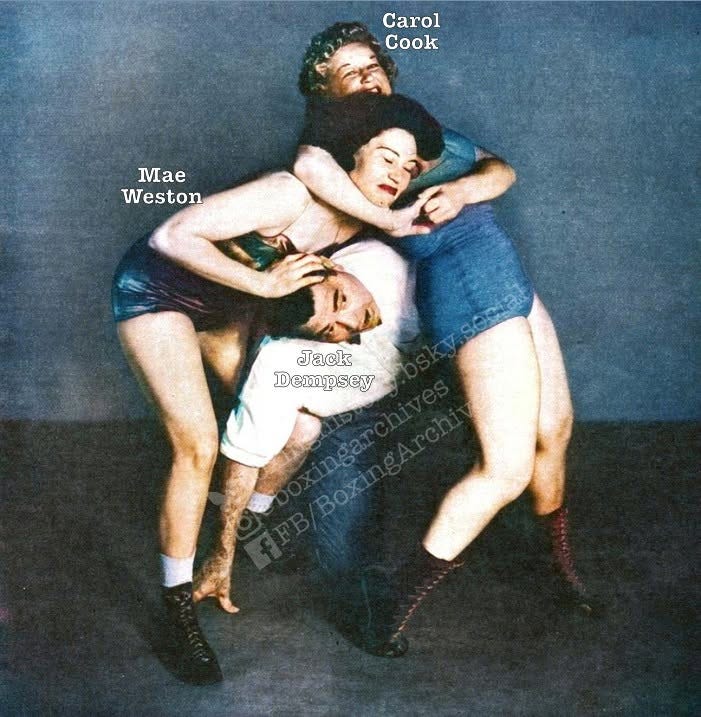
Pictured: Mae Weston, Carol Cook and boxing champ, Jack Dempsey
This period of her life is constantly described as the foundation that “positioned her nicely to become a wrestler when the sport became popular among women.” She later credited her boxing background as a useful complement to wrestling, noting that skills from those carnival challenges helped alongside training from figures such as Everett Marshall.
No detailed bout records, opponents, or outcomes from the pure boxing phase appear in available public sources. These were informal carnival challenges rather than sanctioned professional boxing matches, typical of the era’s traveling athletic shows before women’s wrestling fully moved into established promotions. The experience built the physical resilience and adaptability that supported a career spanning from 1938 into the mid-1990s (including her later work as Maw Bass).
In short, the carnival boxing days were the gritty entry point—acrobatics plus taking all-comers challenges in Wolfe’s athletic shows—that hardened a teenager from a disrupted Kansas-Missouri upbringing and launched her into the squared circle alongside the leading women of the era.
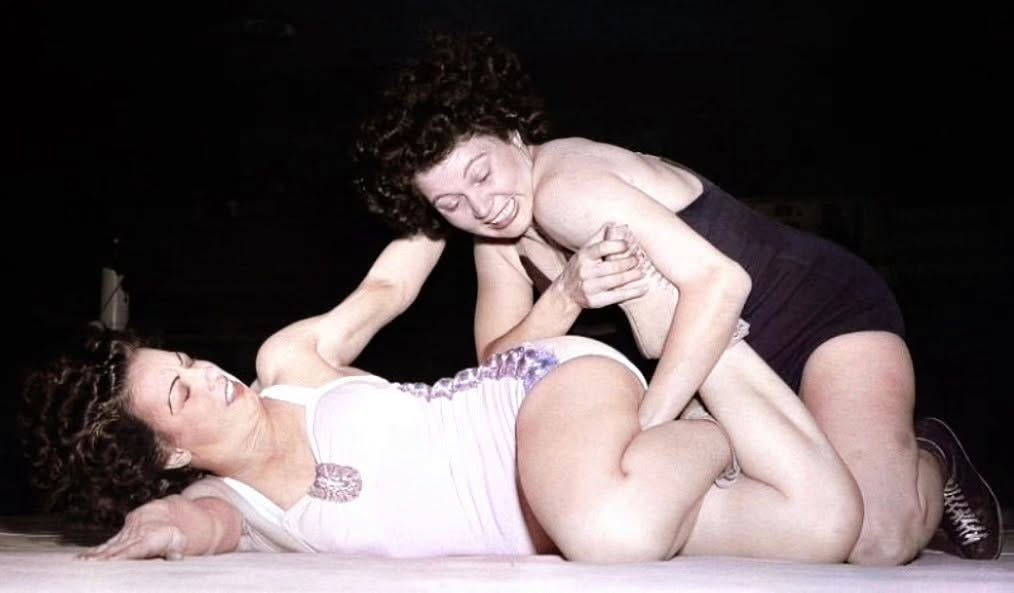
Pictured: Mae Weston vs Mildred Burke
Weston quickly proved capable of working with the top talent of the day. She was frequently booked against Mildred Burke in title matches, and the two developed a lasting friendship; decades later they even operated a restaurant together in the 1960s. Contemporary accounts captured the spectacle of her work. Oscar Elder of the Washington Post, describing a match against Mae Young, wrote that Weston “could double for Superman’s little sister” and that the pair “started off in a whirl of mascara like a pair of bargain-basement commandos at a remnant sale,” with the crowd thoroughly engaged.
Throughout the 1940s and 1950s Weston traveled widely, appearing under various aliases including Mae Gordon, Astroette, and Purple Flash. She faced June Byers, Gladys Gillem, Therese Theis, and others while contending for recognition in an era when women’s wrestling was both popular and precarious. She credited veteran wrestler Everett Marshall with important instruction that refined her skills, and she noted that her carnival boxing background proved a useful complement in the ring. After marrying and putting down roots in the Columbus, Ohio, area, she took a day job as a hotel credit manager yet continued to wrestle, a dual life common among many territory performers who balanced steady employment with the road.
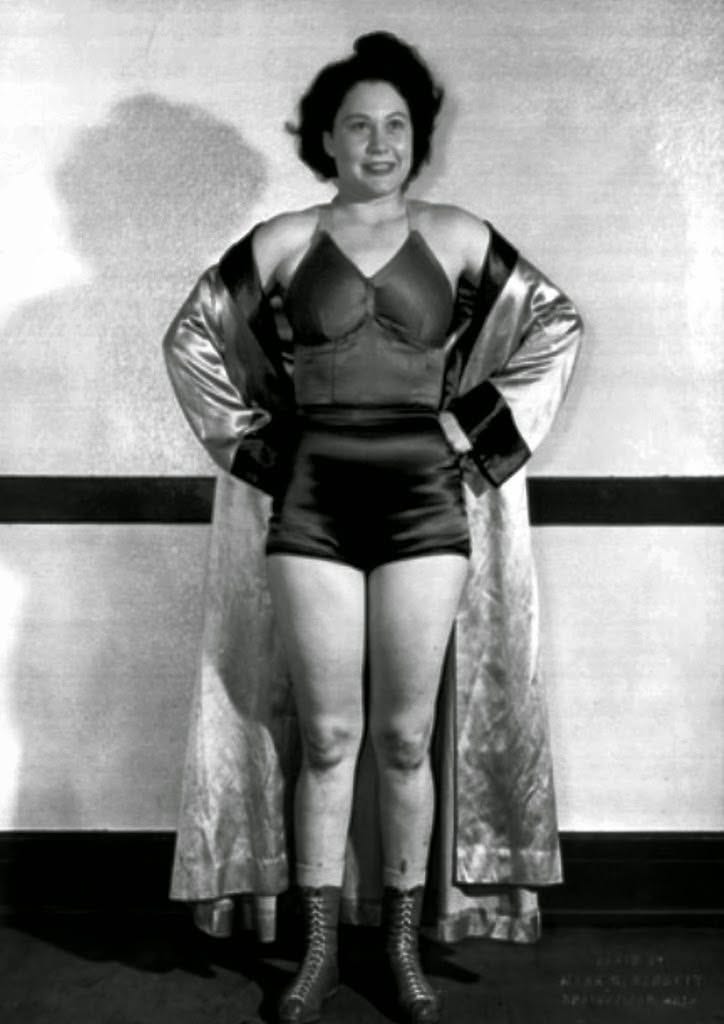
In 1967 Weston captured the California Women’s Championship by defeating Mae Young, the only title widely credited to her in contemporary records. By then she had already logged nearly three decades in the business. Her career took a memorable turn in the early 1970s when she portrayed Maw Bass, the heel mother and manager of the Bass Brothers (Ron Bass and Don Bass) in Gulf Coast Championship Wrestling.
In the early 1970s Mae Weston, then in her late forties and early fifties, stepped into one of her most memorable roles as Maw Bass, the heel mother and manager of the Bass brothers. The character proved especially effective in two territories: Phil Golden’s All-Star Wrestling in western Kentucky (roughly 1972–1973) and Lee Fields’ Gulf Coast Championship Wrestling based in Mobile, Alabama (primarily 1973–1974).
Phil Golden’s All-Star Wrestling in Western Kentucky
Phil Golden (brother of Bill Golden and uncle wrestler Jimmy Golden) launched All-Star Wrestling in Kentucky in the fall of 1972, operating as a regional competitor to Nick Gulas. The promotion ran in towns across western Kentucky and maintained a television presence out of Paducah on WDXR Channel 29. Among the regulars were Angelo Poffo, the Von Brauners with manager Saul Weingeroff, Paul Christy, and various others.
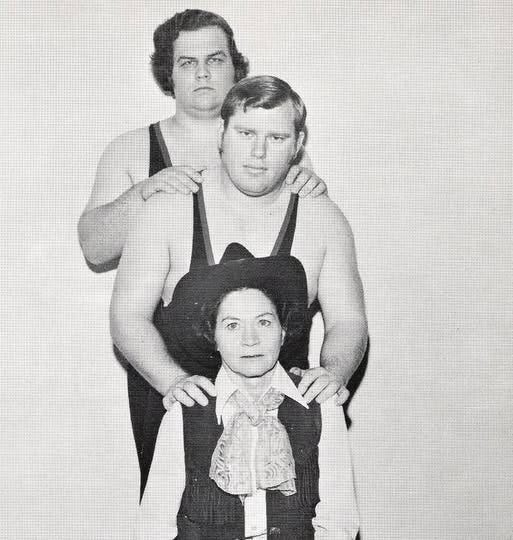
In 1972–73 Maw Bass managed Roy Bass (Roy Klein, billed as Roy “Big Mouth” Bass) and Donnie Bass. The unit worked the circuit as heels, with Maw generating heat through interference. I first saw them at an appearance at Salem Elementary School Gymnasium, in Salem, Kentucky, where Maw accompanied Don Bass and Roy “Big Mouth” Bass; the loaded purse containing a brick, produced strong heat, and the match left a lasting impression on me as a young fan in the building. Because of the popularity of the Land Between the Lakes are of Lake Barkley and Kentucky Lake, besides the recreational water sports, fishing was huge in our area, so the “Big Mouth” Bass moniker was perfect for Roy Klein, one of the loud mouthed Bass Brother heels.
I’ll never forget those vivid impressions of her ringside antics and the emotions they produced. I was hooked and glued to my television every Saturday afternoon at 430 on WDXR-TV, channel 29 from Paducah, Kentucky.
The promotion continued in some form into late 1974, with Saul Weingeroff involved on the Paducah end after Phil Golden’s health declined, though the Bass family’s primary Kentucky run with Maw appears concentrated in 1972–73 before they moved south.
Gulf Coast Championship Wrestling (Lee Fields)
By mid-1973 the same act had shifted to Lee Fields’ NWA Gulf Coast Championship Wrestling, which covered southern Alabama, the Florida Panhandle (including Pensacola and Panama City), and parts of Mississippi. The Bass Family—initially Ronnie Bass (Ron Heard) and Donnie Bass (Donald Hollis Welch), later joined by Bobby Bass after injuries—debuted around June 1973.
Their early matches often ended in disqualifications after Maw’s interference. In June they lost by DQ to Ricky Starr and Rick Gibson in a debut bout; Maw argued the decision and shoved the referee. Similar DQ finishes followed against Starr and Buddy Atlas, and against Ken Lucas and Dick Dunn, after which Maw attacked the opponents with her purse. Opponents quickly adapted by recruiting female partners for mixed six-person tags in an effort to neutralize her.
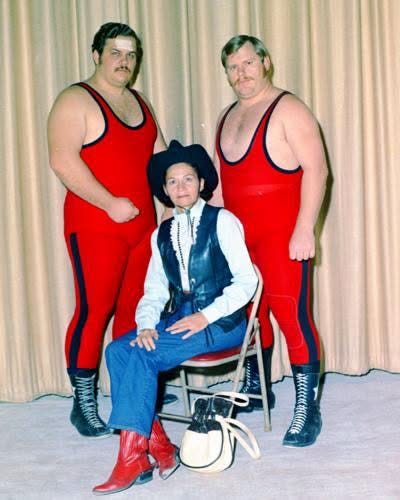
Key documented activity includes:
• July 3, 1973 (Mobile “Firecracker Wrestling Spectacular”): Maw, Ronnie, and Donnie defeated Ken Lucas, Dick Dunn, and Bobbie Peterson in a six-person mixed tag. Maw later attacked Lucas.
• Additional July 1973 mixed tags against Lucas and Starr, with partners such as Ann Casey and Susan Green. In one, Maw pinned Casey; in another she attacked Green after a pin. A third involved Vicki Williams and ended in DQ after Moolah became involved and sustained a bloody head.
• August 1973: Maw demanded and received matches against The Fabulous Moolah for the NWA World Women’s Title. She lost by DQ in one of the territory’s better-remembered women’s matches. In a rematch she left the ring and refused to return. Moolah then stipulated a wire-fence match in which she promised to beat Maw within 15 minutes or surrender the title and retire; Moolah won in 1 minute 7 seconds.
• Title picture: Ronnie won the Gulf Coast Heavyweight Championship in July 1973 by defeating the Mighty Mongol in Pensacola. The family later worked U.S. Tag Team title programs (with Donnie and Bobby Bass) against Rocket and Flash Monroe. Maw’s purse became a flashpoint—she once beat a referee with it after a Monroe win. Moolah returned as the Monroes’ manager specifically to counter Maw. A October 1973 title match included a pre-match stipulation that the winner of a Maw-vs.-Moolah bout could accompany her team; Moolah won, Maw was barred from ringside, and the Monroes took the titles.
The unit remained active into 1974. Records show continued Gulf Coast matches involving Maw and the Bass Brothers (including a May 9, 1974 no-contest six-person match with Moolah, Ken Lucas, and Ricky Fields in Panama City). They were also involved in a heel-versus-heel program with J.C. Dykes and the Mighty Yankees. Maw was known to physically discipline her “sons” at ringside when results disappointed her. Wrestler Rock Riddle later wrote of spending extensive road time with Ronnie, Donnie, and Maw in the Gulf Coast territory, describing them as a tight, fully committed working unit.
By late 1973–1974 the act had run its course in Gulf Coast as injuries, title losses, and the arrival of counter-measures, especially Moolah, reduced their effectiveness. Maw’s presence as the older, unapologetically physical manager—armed with the loaded purse and willing to brawl with anyone from opponents to referees—remained the defining element of the family’s heat in both territories through 1974. The character bridged a brief but vivid chapter in western Kentucky under Phil Golden and a more extensively documented run under Lee Fields in the Gulf Coast.
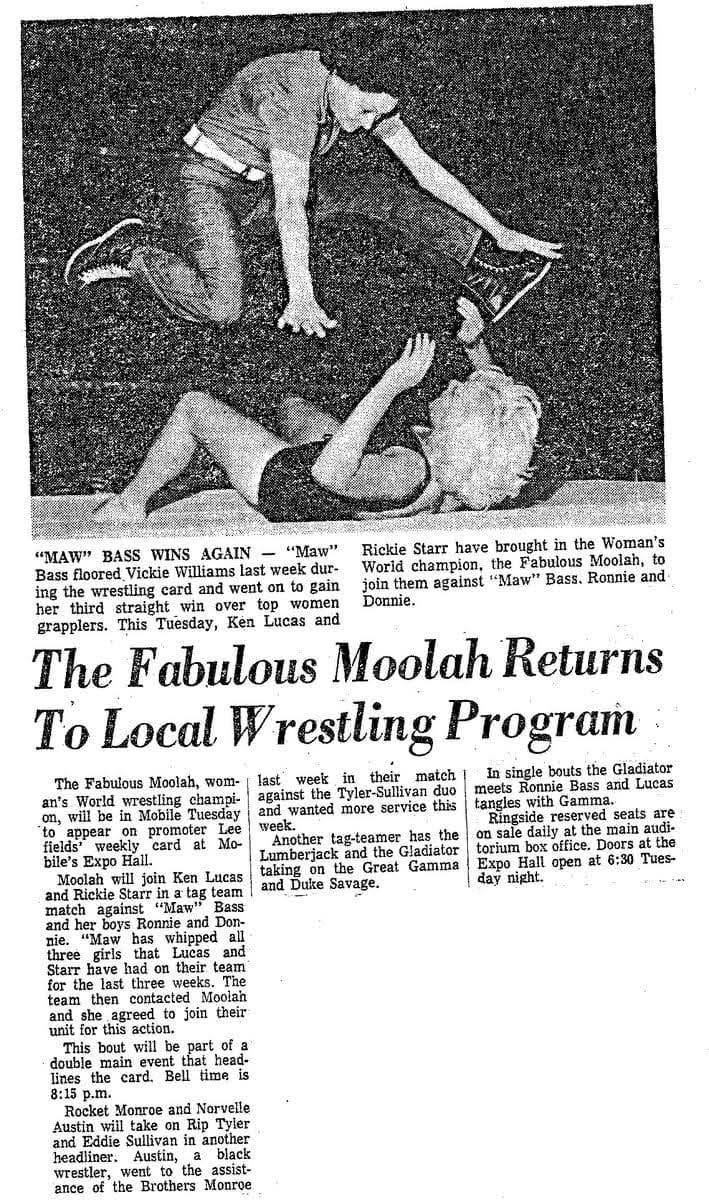
The confrontation between Maw Bass (Mae Weston) and The Fabulous Moolah was a short but intense chapter in Lee Fields’ Gulf Coast Championship Wrestling in 1973. It arose directly from the Bass Family’s heat-drawing interference tactics and was used by babyface opponents as a deliberate countermeasure. Moolah, the long-reigning NWA World Women’s Champion and the dominant figure in women’s wrestling, was brought in as a babyface specifically to neutralize Maw and her loaded purse.
Build-up through mixed tags
After the Bass Family (Ronnie and Donnie Bass with Maw) debuted around June 1973 and began winning or drawing through Maw’s purse interference, opponents adapted. Ken Lucas and Ricky Starr recruited female partners for mixed six-person tags so someone could match Maw physically.
Documented mixed-tag results from July 1973 in Mobile’s Expo Hall include:
• July 3: Maw, Ronnie, and Donnie defeated Ken Lucas, Dick Dunn, and Bobbie Peterson.
• Follow-up mixed tags against Lucas and Starr (with partners such as Ann Casey and Susan Green). In one, Maw pinned Casey; in another she attacked Green after a pin.
• A third mixed tag involving Vicki Williams ended in disqualification after Moolah became involved and sustained a bloody head.
These matches established that Maw could not be contained by ordinary means and set the stage for a direct women’s confrontation.
Direct title matches
In August 1973 Maw demanded a shot at Moolah’s NWA World Women’s Title. Moolah agreed. In what local accounts described as one of the best women’s matches seen in Mobile, Moolah defeated Maw by disqualification and retained the title. Unsatisfied with a DQ finish, Moolah demanded a rematch. In that bout Moolah was beating Maw soundly when Maw left the ring, went to the dressing room, and refused to return.
This led to a stipulated wire-fence match. Moolah promised she would beat Maw inside 15 minutes or surrender the title and retire. Moolah won in 1 minute 7 seconds, decisively ending the direct singles series.
Moolah as manager for the Monroes
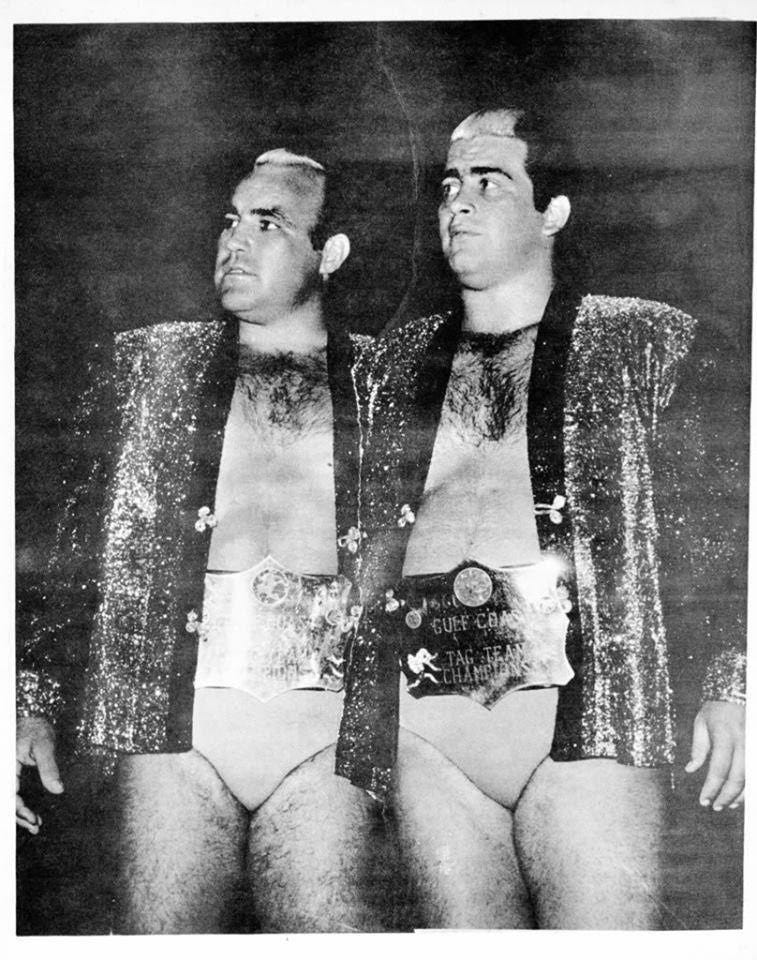
Pictured: Rocket and Flash Monroe
The feud continued in a managerial capacity. Rocket and Flash Monroe, feuding with the reformed Bass team (Donnie and Bobby Bass), brought Moolah in as their manager to counter Maw. Even with Moolah at ringside the Monroes initially struggled for a clean win. In one match Moolah took Maw’s purse, only for Maw to use her belt on the Monroes. A return bout saw Moolah and Maw handcuffed together; the Monroes finally secured a clean victory, followed by a six-person melee.
In October 1973 the Monroes received a U.S. Tag Team title match against Donnie and Bobby Bass with a pre-match stipulation: the winner of a Maw-versus-Moolah bout could accompany her team to the ring while the loser had to stay in the dressing room. Moolah defeated Maw. With Maw barred from ringside, the Monroes won the titles. The Bass Family soon left the territory.
Later crossover
There was a May 9, 1974 six-person match in Panama City, Florida (Rainbow Garden) in which Ken Lucas, Ricky Fields, and Moolah went to a no-contest against Maw Bass and the Bass Brothers (Don and Ron). This appears to be a residual or return appearance rather than a continuation of the intensive 1973 program.
Context of the feud
Moolah was already the established champion and booking power in women’s wrestling; her appearance in Gulf Coast as a babyface was a practical response to Maw’s effectiveness as a heel manager and occasional competitor. The program highlighted Maw’s physical toughness and willingness to brawl (purse, belt, refusing to return to the ring) against the territorial standard-bearer. Contemporary write-ups on kayfabememories.com treat the Mobile title matches and the wire-fence bout as notable local highlights. The feud effectively checked the Bass Family’s momentum in Gulf Coast and demonstrated that even a veteran carnival-trained wrestler like Weston, working in her early fifties as Maw, could generate enough heat to require the top woman in the business as a counter.
No extensive period newspaper coverage or filmed footage of the specific matches has surfaced in public sources, but the sequence of mixed tags, title challenges, the wire-fence stipulation, and the managerial crossover with the Monroes is consistently reconstructed from territory records and local memory.
Weston’s commitment to the ring did not end with the Maw Bass run. She continued to accept bookings into her seventies. On June 16, 1994, at age seventy-one, she wrestled her final documented match in Las Vegas for the Ladies International Wrestling Association, teaming with Stormy Apple in a loss to Josie Navarro and Margaret Garcia. Some accounts also place her in a 1993 “Golden Girls Extravaganza” battle royal. Her career thus stretched from the late Depression-era carnivals to the 1990s independent scene, a span matched by few of her peers.
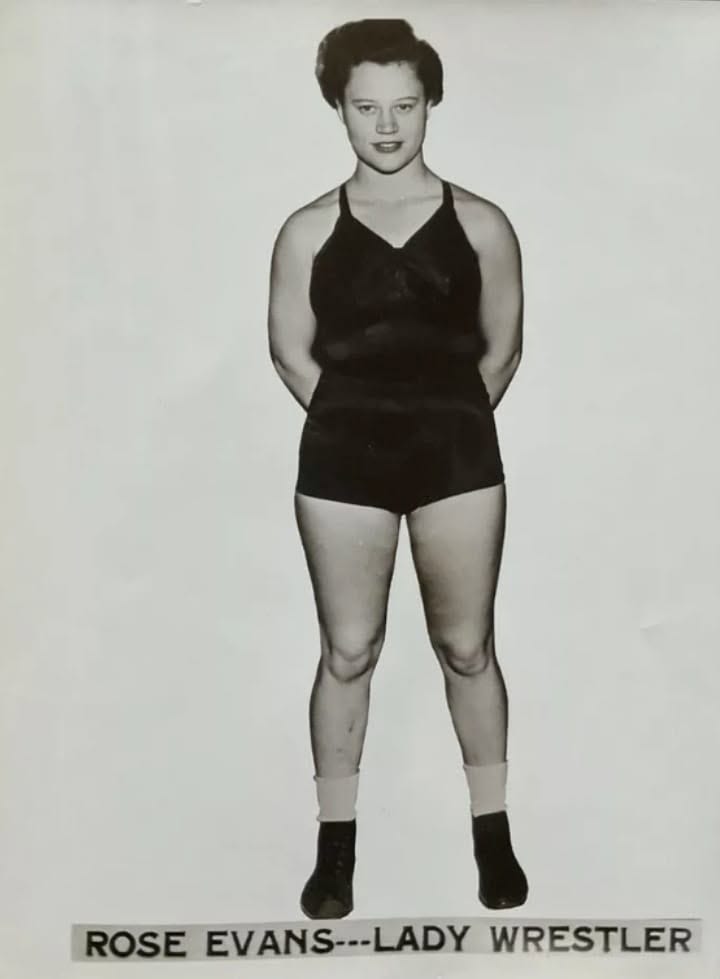
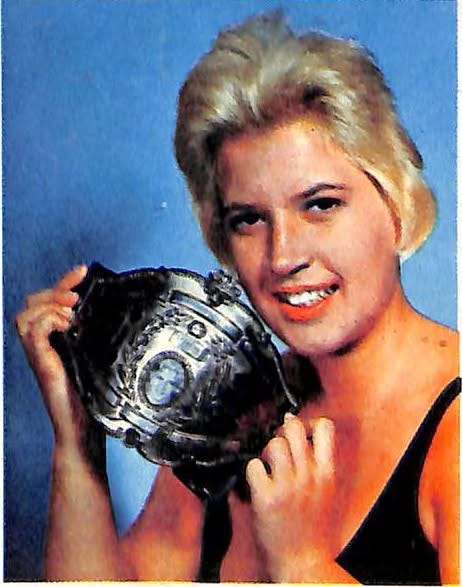
Pictured: Rose Evans (top) and Marie Vagnone (bottom)
Family ties further embedded her in the sport. Her younger sister Rose Evans wrestled, as did her niece Marie Vagnone. Trained by Mildred Burke, Vagnone became the first WWWA World Singles Champion after Burke in the All Japan Women’s era, carrying the family’s influence into the Japanese promotions that would shape the next generation of women’s wrestling.
A short 2016 eBook biography by Robert Grey Reynolds Jr., Mae Weston: Acrobat, Boxer and Wrestler, collected many of these threads, emphasizing her carnival origins and title challenges against Burke. While detailed contemporary records remain incomplete for much of her early career, the available match listings, press descriptions, and firsthand recollections paint a consistent picture: a tough, versatile performer who adapted from acrobat and carnival boxer to main-event challenger, working mother, and finally a heat-drawing manager.
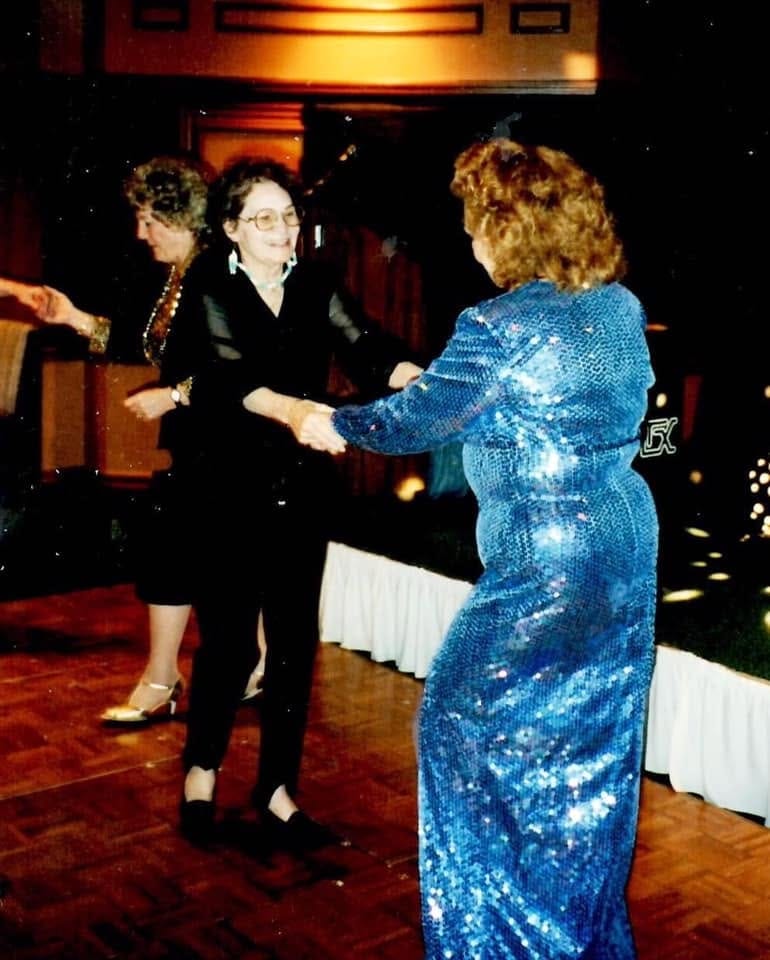
Pictured: Later in life, Mae Weston and Moolah dancing and having fun togther at a gathering in Las Vegas
Mae Weston’s life illustrates the endurance required of women in professional wrestling across the twentieth century. She entered the business as a teenager seeking opportunity and stability, competed against its dominant champions, maintained friendships amid the industry’s rivalries, and reinvented herself in her later years as Maw Bass, a character remembered for the sheer volume of heat she generated with a loaded purse.
Her final matches in her seventies stand as a testament to physical durability and professional pride. In an era when women’s wrestling was often marginalized, she remained a constant presence, connecting the carnival athletic shows of the 1930s to the territorial circuits of the 1970s and the independent revivals of the 1990s. Her story is one of resilience, versatility, and the quiet accumulation of decades spent in the squared circle.
Weston herself was the mother of two sons, William A. Garvey and James Garvey, and was survived by grandchildren and great-grandchildren. Social Security records reflect several name changes over the years—Weston, Murphy, Mahaffey, Garvey—consistent with multiple marriages. Mae Weston (Betty Mae Garvey) passed away on October 14, 1999, at the age of 76. Though specific circumstances surrounding her death were not widely reported, her long life and enduring presence in the ring left a lasting mark on the women who followed her and on the fans who saw her work.
One Thing I Learned About Sky Low Low
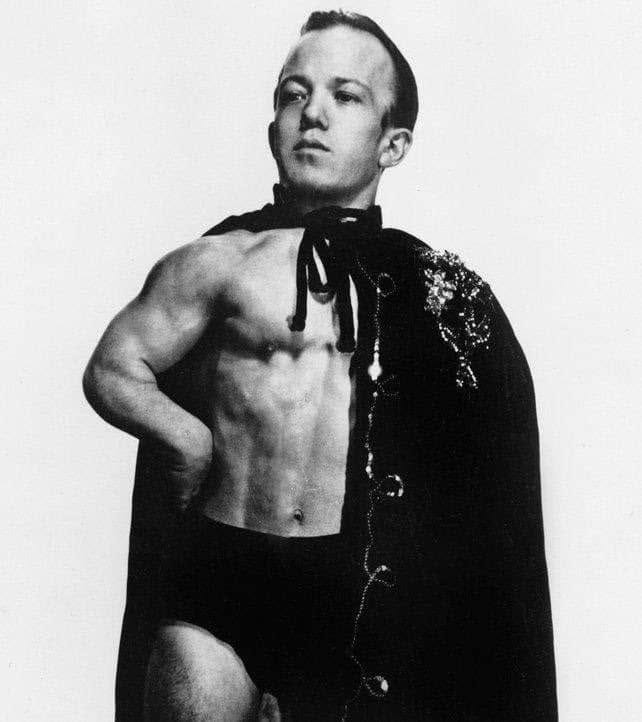
He and fellow midget wrestler Little Beaver once squared off in a match performed for Queen Elizabeth II of the United Kingdom and King Farouk of Egypt.
Thank You for Watching and Listening
I’m Tony Richards, Pro Wrestling Historian, Author and Storyteller. I share pro wrestling historical items in each issue of the Time Tunnel Pro Wrestling History Newsletter and each episode of our podcast show. Thanks for your support! If you enjoy my information on select events, matches and insights, please share with folks you think might like to be a subscriber!
Remember, Premium subscribers get access to exclusive and special content such as some special issues including a multi-part deep dives on wrestling territories, wrestler bios and championship title histories, special audio and video interviews on territory pro wrestling and more available in the Pro Wrestling Time Tunnel for Premium Subscribers. Being a Premium Subscriber also means you support me in my efforts to document Pro Wrestling History through my research, writing, books, vidoes and podcasts. And…I have something very special planned for our Premium Subscribers on the Podcast side of things in 2026! Details soon here in the Pro Wrestling Time Tunnel.