



Today’s Favorite Quote: Where do many hours have been spent in convincing myself that I am right, is there not some reason to fear I may be wrong - Jane Austen
Happy Birthday to those who have passed on and to those great wrestlers still with us:
In Memoriam:
Walter “Killer” Kowalski 1926
Happy Birthday:
Don Callis (63)
RIP Memorial: We stop & remember those who have passed on this day and gave themselves to the business for us, the fans. We salute you and thank you.
Sandor Szabo 10-13-1966 at the age of 60
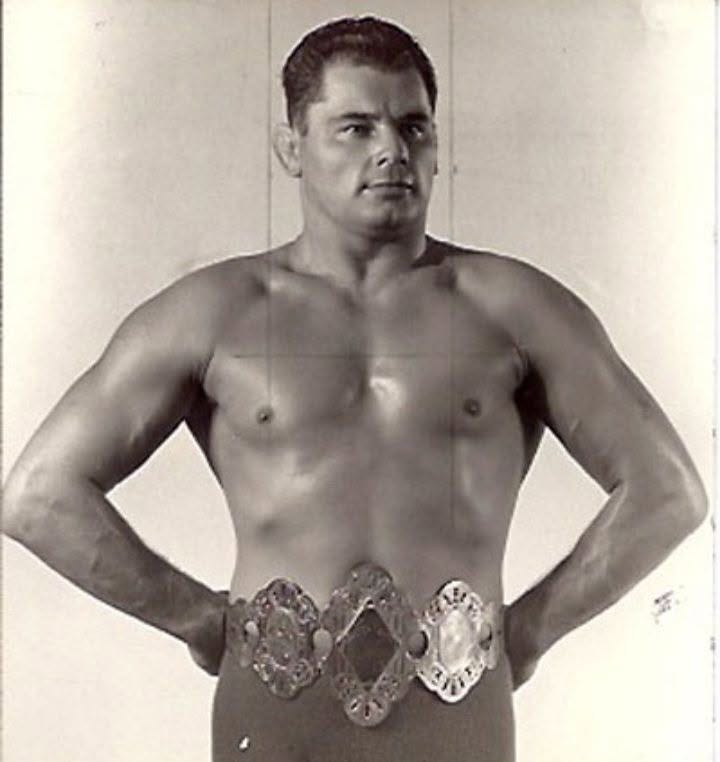
Eric Pederson 10-13-1990 at the age of 62

Don Leo Jonathan 10-13-2018 at the age of 87
7 Stages of the Territory Era
Stage 5: Consoldiation (1965-1975)
Year Two Month Ten
The 1966 Texas Wrestling Realignment
In September 1966, a set of simultaneous breaks from Morris Sigel’s long-dominant Houston booking office reconfigured the major Texas territories. For decades Sigel’s office had functioned as the central booking agency for much of the state, supplying talent to Dallas–Fort Worth, San Antonio, and other markets while maintaining significant influence. The September moves ended that centralized role and produced more independent local offices that continued to exchange talent cooperatively. These developments have been examined in detail in Episodes 16 and 17 of the Texas Wrestling Series on Stories with Brisco and Bradshaw, where the timeline and ownership distinctions were clarified against the compressed versions that often appear in secondary accounts.
Dallas–Fort Worth
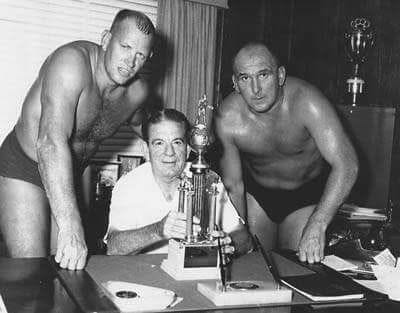
Pictured: Ed McLemore (center) with Fritz Von Erigh and Killer Karl Kox
In the first week of September 1966, Ed McLemore broke from the Dallas Wrestling Club, Inc., an entity partly owned by Sigel. He temporarily shifted his Dallas cards from the Sportatorium to the Bronco Bowl Arena. A rival show scheduled by the Dallas Wrestling Club for the Sportatorium on September 20 (matchmaker Les Wolfe) was canceled amid legal entanglements. On September 23, McLemore and Jack Adkisson (Fritz Von Erich) formally established Southwest Sports, Inc., the parent company of what became known as Big Time Wrestling (and later World Class Championship Wrestling). McLemore and Adkisson co-promoted through the end of the year. After McLemore’s health declined and his death in January 1969, Adkisson assumed sole control of the Dallas office and the Sportatorium. The partnership transferred operational control away from Houston influence and positioned Adkisson as the ascending force in North Texas. This sequence was reviewed at length in the Texas Wrestling Series episodes covering the mid-1960s transition.
San Antonio
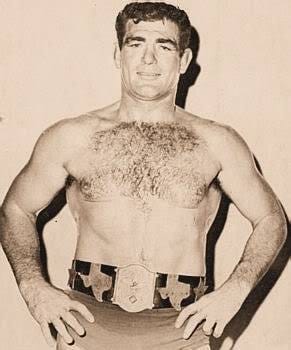
Pictured: Joe Blanchard, Texas Heavyweight Champion
At the same time, Frank Brown, promoter of the Wrestlethon, which he operated with his wife Dorathy Livengood, broke from the Houston booking agency. Contemporary reporting, including Johnny Janes’ “Don’t Quote Me” column, described Brown booking his own shows at the Wrestlethon and bringing in name talent—Gene Kiniski, Fritz Von Erich, Dick the Bruiser, and others—at his own expense rather than accepting Houston’s supply. The same column noted that Dallas and Fort Worth promoters acted concurrently, leaving Sigel with wrestlers but fewer outlets. The Wrestlethon had been San Antonio’s primary venue since 1948; Brown continued there until the building’s final show in late 1967, affected by expressway construction, after which the operation moved to the Municipal Auditorium.
Joe Blanchard, an active wrestler on the Texas circuit in 1966 and a former Edmonton Eskimos teammate of Gene Kiniski and Wilbur Snyder, was already based in San Antonio and later became the city’s dominant promoter, founding Southwest Championship Wrestling in 1978. The 1966 break itself belonged to Brown. The distinction between Brown’s 1966 action and Blanchard’s later independent operation was among the points clarified in Episodes 16 and 17 of our History of Texas Wrestling Series.
Houston
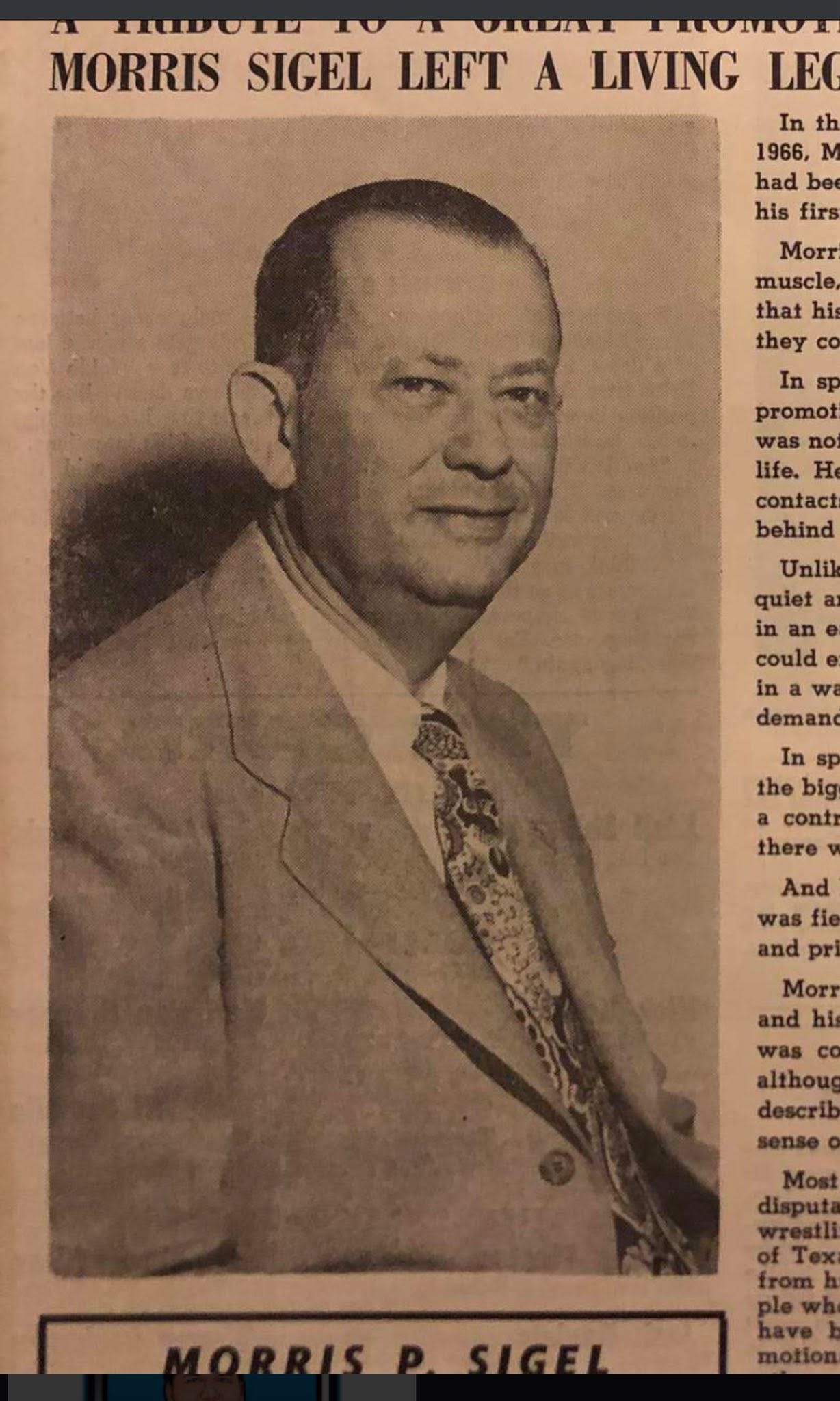
Pictured: Morris Sigel
Morris Sigel died on December 26, 1966.
Sigel was the powerful and pioneering Houston-based promoter who helped establish and stabilize professional wrestling across Texas for nearly four decades. He and his older brother Julius were New York natives who moved to Houston as teens and became involved in local wrestling and boxing promotions in the mid-1910s, shortly after Houston Wrestling began with irregular shows around 1916. Julius initially took a lead role, but by the late 1920s (around 1929), he left for promotions in Louisiana (New Orleans and Shreveport), leaving Morris in charge of Houston.
Morris had worked other jobs, including as an invoice clerk at a lumber company and in the office of the Houston Post, before turning to full-time promoting, especially after losing his lumber-yard job during the Depression. He became the first person licensed to promote both wrestling and boxing in Texas after the state created its athletic commission in 1933. His Houston promotion, operating as the Gulf Athletic Club, grew into one of the most stable and successful big-market operations in the U.S. from the 1930s through the 1960s.
He staged thousands of cards, estimated at least 7,500 by the early 1950s, drawing roughly six million customers), brought in national stars, mixed styles of matches (including tags and battle royals), and was noted for strong business practices, prompt payment, and honesty—even if matchmaking was not always his personal strength. He surrounded himself with capable people for that side of the business.
In the 1930s, Sigel, along with Karl “Doc” Sarpolis and Frank Burke, helped establish the Texas Wrestling Agency and Texas circuit. This booking office supplied talent and coordinated promotions across a large stretch of Texas (from places like Corpus Christi to Wichita Falls). Houston served as the primary booking office for much of the state for roughly four decades under his leadership. He joined the National Wrestling Alliance in September 1949. His promotion faced occasional challenges, including the Texas wrestling war of the 1950s which involved efforts by Dallas promoter Ed McLemore and others to seize the booking office), but an NWA-brokered truce helped resolve the conflict. He also ran charity-benefit shows and was later honored by proclamation of the Texas state legislature for his contributions.
Key figures who worked with or were developed under Sigel included future stars and promoters. After a 1947 car accident ended Paul Boesch’s in-ring career, Sigel hired him as an advisor, radio announcer, and from 1949, the promotion’s first television commentator. Boesch worked closely with Sigel for nearly two decades. The promotion ran regular shows on Fridays at venues such as the City Auditorium and later the Sam Houston Coliseum, and it developed a strong local television presence.
Sigel continued promoting until his death on December 27, 1966, in Houston at age 68 after a prolonged illness. In early 1967, Paul Boesch purchased the promotion from Sigel’s widow and carried Houston Wrestling forward successfully for another two decades. Historians and writers have described Sigel as a foundational figure in Texas wrestling—the “forefather” or “grandfather” of the territory—whose long, stable run and business approach shaped the careers of people like Boesch and influenced the broader regional landscape, even as later figures (such as the Von Erichs in Dallas) became more widely remembered.
Without talent or NWA support, Boesch and Houston then became the Friday night town in the Dallas territory and booking loop for the next ten years or more.
Amarillo
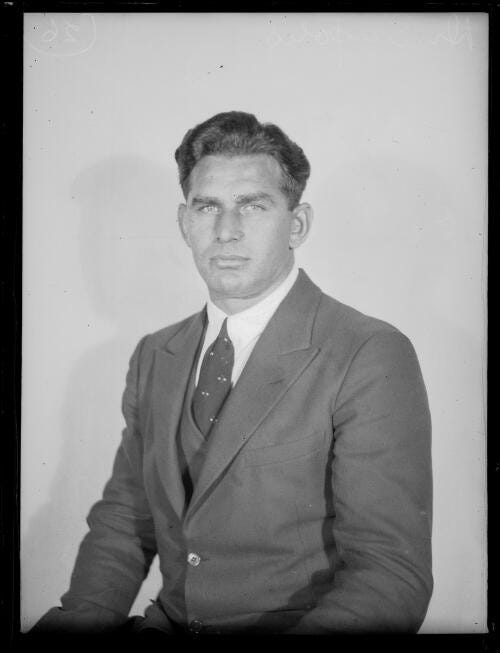
Pictured: Karl “Doc” Sarpolis in the 1940s
Western States Sports, headquartered in Amarillo, operated as a separate NWA office throughout 1966 and was not part of the Houston-centered realignment. Karl “Doc” Sarpolis had purchased the territory from Dory Detton in 1955. Sarpolis remained the principal promoter and majority stakeholder; Funk Sr. served as the primary booker and top star. The partnership continued through 1966 and into 1967. Sarpolis died of a heart attack on May 28, 1967, following a boating accident.
After his death, his widow sold his majority shares to Dory Funk, Sr. and Dory Funk Jr.. Only then did the Funks assume full ownership and operational control. In September 1966 the Amarillo office was still the Sarpolis–Funk partnership and remained outside the breaks occurring in Dallas–Fort Worth and San Antonio. This ownership timeline—Sarpolis as principal promoter until May 1967, with full Funk control only afterward—has been a recurring point of clarification in Episodes 16 and 17 of the Texas Wrestling Series, correcting the common compression that treats the territory as a pure Funk operation earlier than the transfer actually occurred.
Overall Effect
The September 1966 realignment ended Houston’s role as the primary statewide booking office. Dallas–Fort Worth consolidated under the McLemore–Adkisson partnership (Southwest Sports), San Antonio asserted independent booking under Frank Brown at the Wrestlethon, Houston transitioned to Paul Boesch after Sigel’s death, and Amarillo continued under the existing Sarpolis–Funk partnership until Sarpolis’s death the following spring.
The offices continued to share talent on a cooperative basis when mutually beneficial. This structure—stronger local control within protected boundaries, continued exchanges, and reduced reliance on a single central booker—fit the pattern of Stage 5 Consolidation. It set the framework that defined Texas wrestling into the 1970s: Dallas under Fritz Von Erich and his booker, Houston with Boesch adjustments to his cards, San Antonio, under Dallas booking but slowly evolving toward Blanchard’s later independent operation in the late 1970s, and Amarillo remaining the Sarpolis–Funk partnership until the 1967 transfer ans finally the 1981 closure. These points, including the precise timing of the Amarillo ownership change, were examined in The History of Texas Wrestling Series episodes 16 and 17 on Stories with Brisco and Bradshaw.
Thank You for Watching and Listening
I’m Tony Richards, Pro Wrestling Historian, Author and Storyteller. I share pro wrestling historical items in each issue of the Time Tunnel Pro Wrestling History Newsletter and each episode of our podcast show. Thanks for your support! If you enjoy my information on select events, matches and insights, please share with folks you think might like to be a subscriber!
Remember, Premium subscribers get access to exclusive and special content such as some special issues including a multi-part deep dives on wrestling territories, wrestler bios and championship title histories, special audio and video interviews on territory pro wrestling and more available in the Pro Wrestling Time Tunnel for Premium Subscribers. Being a Premium Subscriber also means you support me in my efforts to document Pro Wrestling History through my research, writing, books, vidoes and podcasts. And…I have something very special planned for our Premium Subscribers on the Podcast side of things in 2027! Details soon here in the Pro Wrestling Time Tunnel.