


Today’s Favorite Quote: Don’t smother anyone. Nothing grows in the shade - Leo Buscaglia
Happy Birthday to those who have passed on and to those great wrestlers still with us:
In Memoriam:
Mickey Baarnes 1918
Stu Gibson 1925
Benny Matta 1928
Hans Schnabel 1932
Happy Birthday:
Mark Starr\Blue Yankee #2 (90)
Victor Barajas\Black Gordman (90)
Terri Runnels (60)
Michael Paris]Joaquin Wilde (40)
RIP Memorial: We stop & remember those who have passed on this day and gave themselves to the business for us, the fans. We salute you and thank you.
Rocky Smith 10-5-1977 at the age of 40
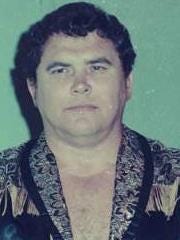
Brian Pillman 10-5-1997 at the age of 35
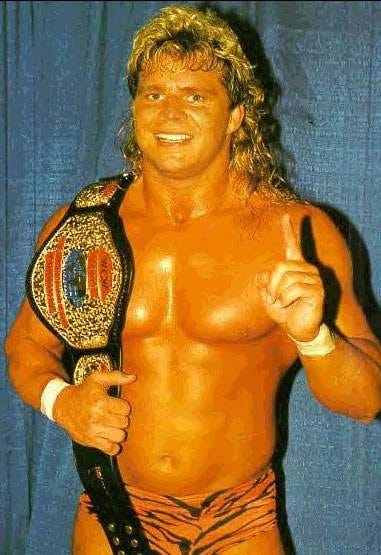
Antonio Pena 10-5-2006 at the age of 55
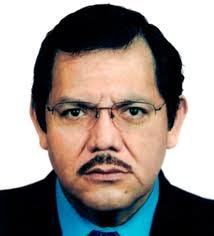
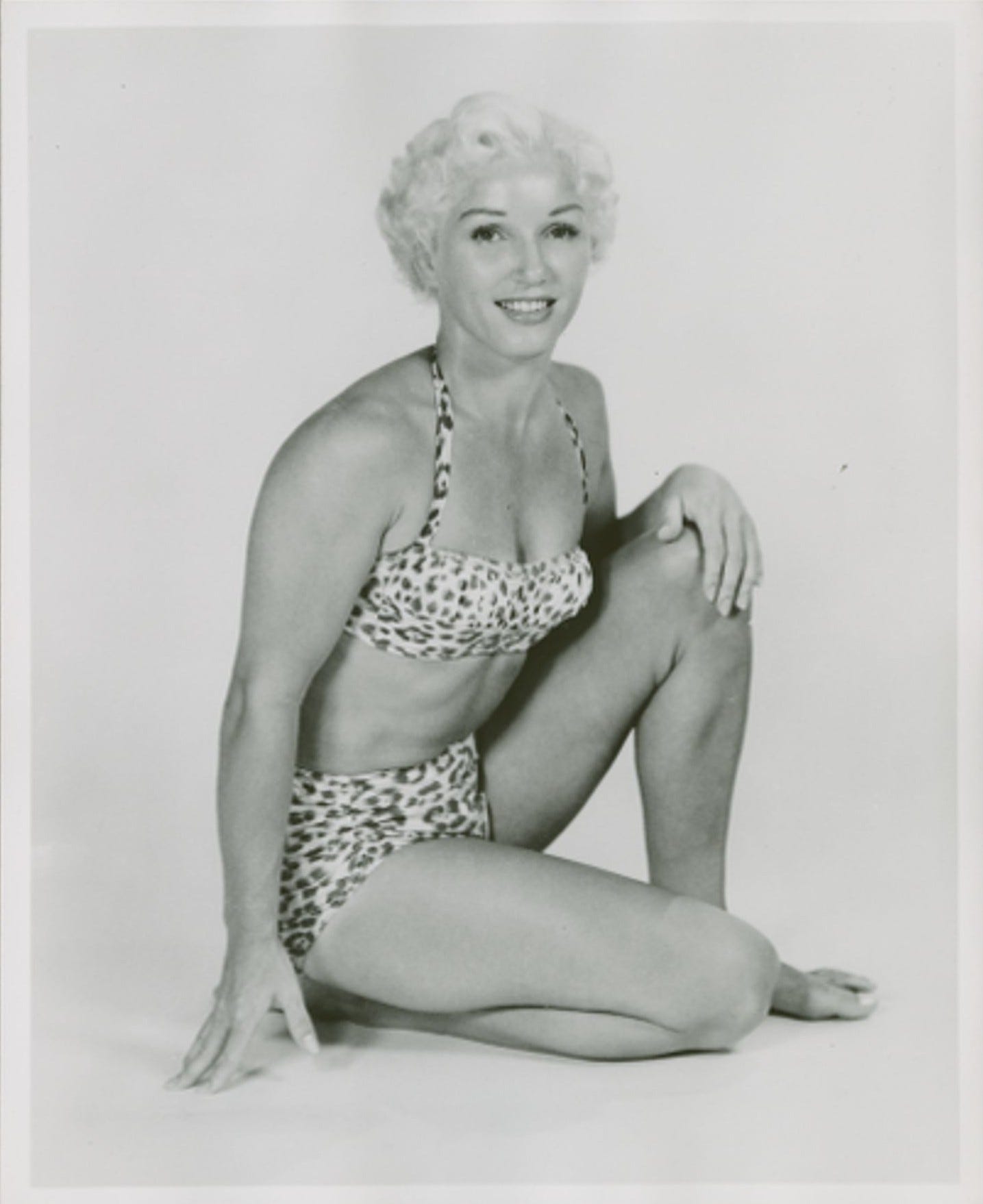
Lorraine Johnson 10-5-2020 at the age of 90
Significant Pro Debut
10-5-1984: Keiji Muto defeated Masahiro Chono on Day 1 of the Fighting Spirit Series at Koshigaya, Saitama, Japan
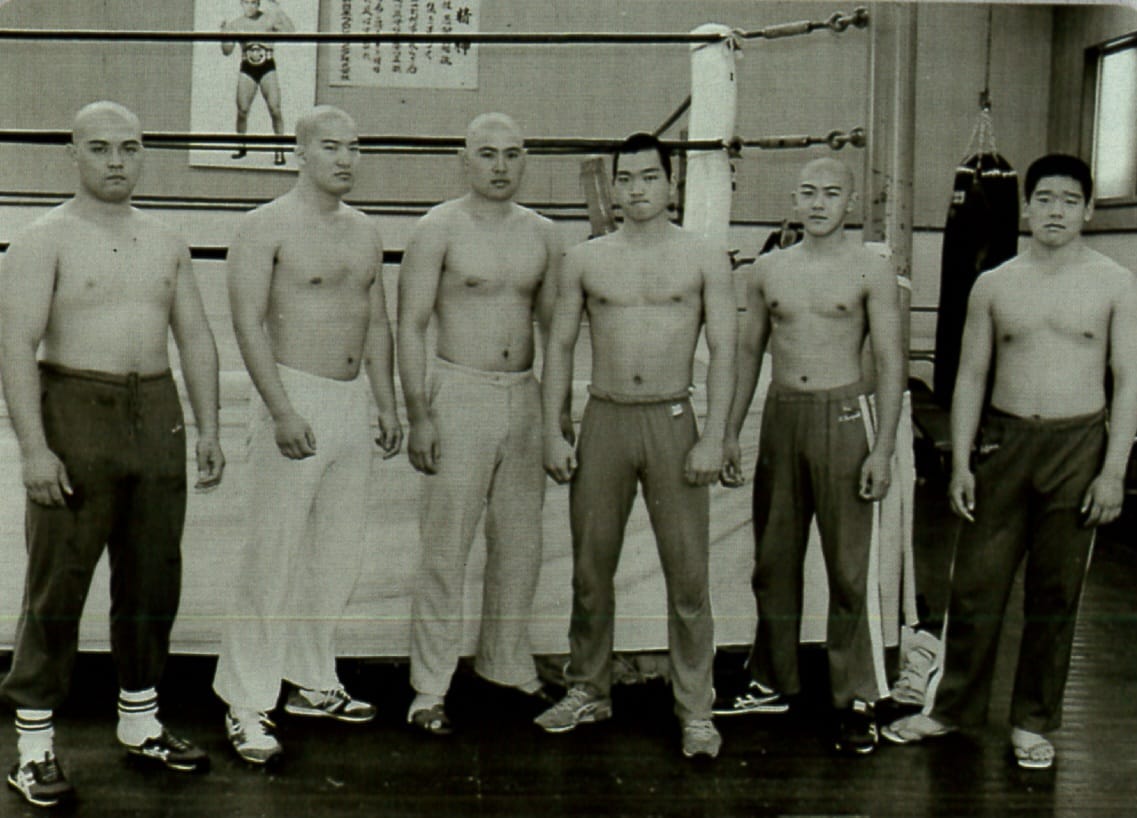
Pictured: 1984 Young Lions Class New Japan Pro Wrestling: Hashimoto, Chono, Muto, AKIRA, Funaki & Sasazaki
Muto, born December 23, 1962, in Fujiyoshida, Yamanashi Prefecture, was a former amateur wrestler who joined NJPW after high school. Following this debut, he was sent on a “learning excursion” to the United States in 1985, wrestling in promotions like Championship Wrestling from Florida and developing his iconic Great Muta persona—a painted, mist-spewing heel that blended Japanese mysticism with high-flying athleticism. He would go on to become a multi-time world champion across NJPW, All Japan Pro Wrestling (AJPW), and even WCW, innovating moves like the Shining Wizard and Moonsault.
Chono, born September 17, 1963, in Seattle, Washington (but raised in Mitaka, Tokyo), had a background in amateur wrestling and karate. After losing his debut, he remained in NJPW, building a reputation as a tough, charismatic heel. He later led the Japanese branch of the nWo (New World Order) in the 1990s, feuding extensively with Muto and winning titles like the IWGP Heavyweight Championship.
Their 1984 debut symbolized the start of NJPW’s “Three Musketeers” era (alongside Shinya Hashimoto, who debuted shortly after), a golden period that elevated Japanese wrestling globally. The two faced off numerous times over the decades, including high-profile matches in the G1 Climax and tag team scenarios, with their final encounter coming in 2023 at Muto’s retirement show in Tokyo Dome—nearly 39 years after their first bout.
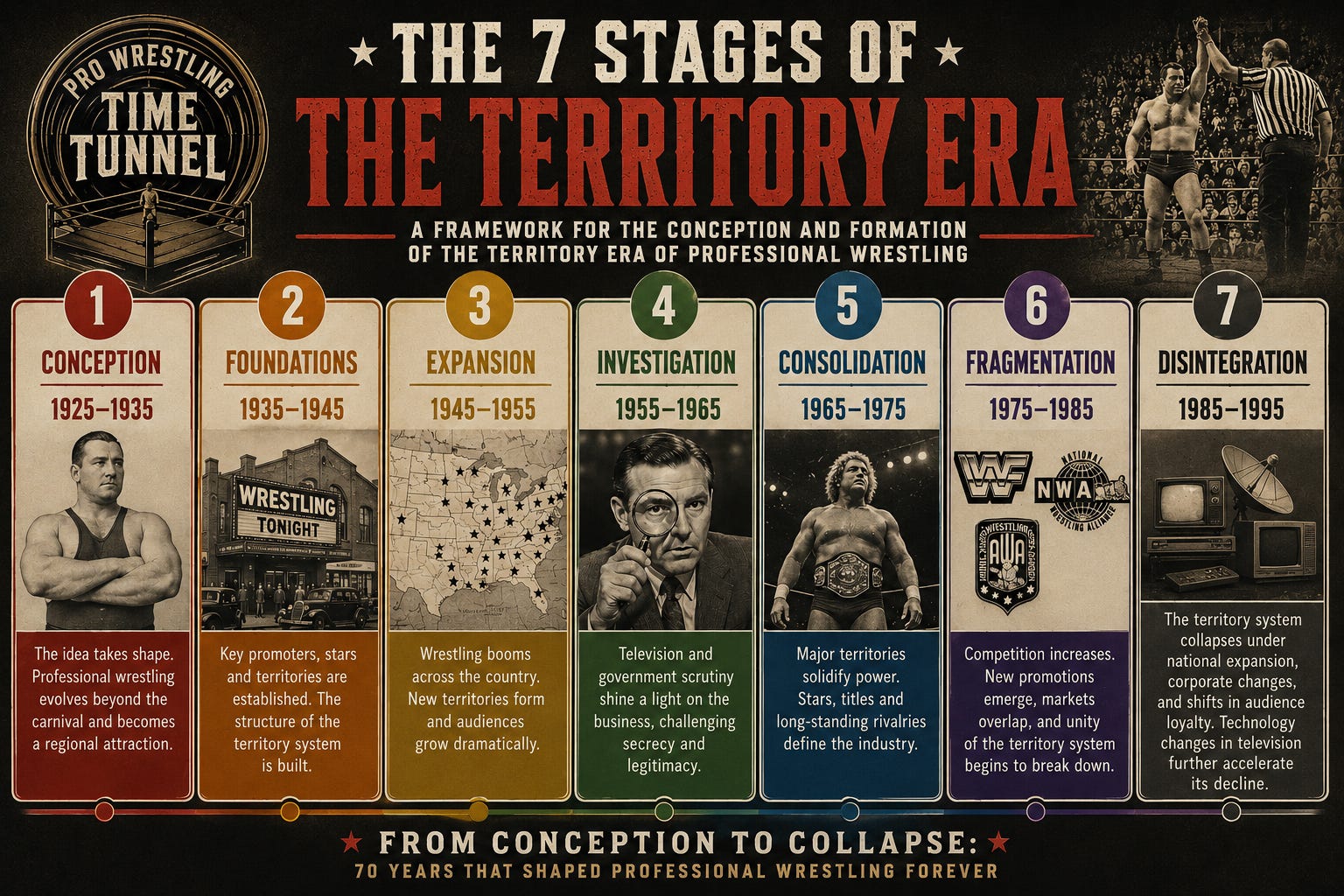
7 Stages of the Territory Era
Stage 4: Investigation (1955-1965)
Year Two Month Ten
October 1956
October 1956: The Month the Investigation Became a Judgment
October 1956 is the hinge of Stage 4. For eight years the National Wrestling Alliance had booked the continent as a club. For three years the Department of Justice had been reading the club’s mail. On October 15, in Des Moines, the reading stopped and a judgment went on the books. The same week the recognized world champion was defending the belt in Cincinnati, Toronto, St. Louis, Canton, Minneapolis, Buffalo, and Columbus. The live business did not pause for the law. That is the month.
The paper that landed on the 15th
Civil Action No. 3-729, United States of America v. National Wrestling Alliance, was filed October 15, 1956, in the Southern District of Iowa, Central Division, before Judge William F. Riley. The complaint and the final judgment went in together. No testimony was taken. The Alliance answered by denying the material allegations and consenting to the decree. The judgment said, in the language every consent decree uses, that it was not an admission and was not evidence of any issue of fact or law.
Attorney General Herbert Brownell’s office put a short version on the Associated Press wire the same day. The National Wrestling Alliance, accused of monopolizing the booking of wrestlers for professional exhibitions, had agreed to end the practices that brought the complaint. The story ran in afternoon papers on the 16th. It did not run as a sports scandal. It ran as a trade-association settlement. Sam Muchnick would later tell Wrestling Life that the Alliance had been fortunate in the coverage. A trial with bookers under oath about towns and blacklists would have been a different headline.
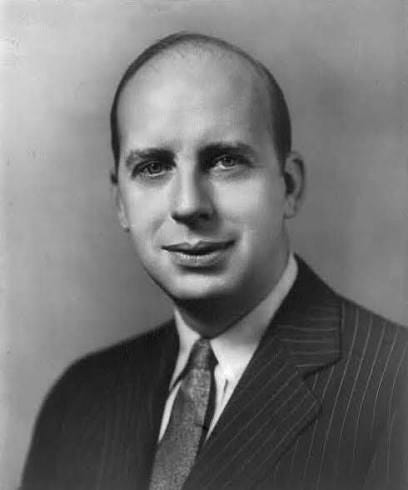
Pictured: Attorney General Herbert Brownell
The charging theory was Sections 1 and 2 of the Sherman Act: a conspiracy to restrain and monopolize the booking market. The government’s list of practices, already negotiated through the late summer, named exclusive territories, the blacklist, the refusal to book a member’s towns against him, control of the recognized champion as a booking instrument, and the use of membership itself as a license to work. The remedy was conduct, not divorcement.
The Alliance was ordered to cancel its existing rules, regulations, and bylaws and to adopt new ones consistent with the judgment. A member who violated the judgment, or the new bylaws written to obey it, was to be expelled. Consenting members submitted to the court’s jurisdiction. By the September convention in St. Louis, 33 of 36 had already signed. Joe Malcewicz, said to be critically ill, and Rod Fenton were told they would be banished if they did not. Their names came on after the Iowa filing. Al Karasick signed.
The file, in the Antitrust Division’s own later note, closed in early January 1957. Stanley Disney in Los Angeles told the Bureau that the complaint and the decree had been filed the same day and that the matter was finished. Investigation, as a government project, ended in October. Investigation, as a condition of the business, was just starting.
What the decree did not do is the business fact of the month. It did not take a town from a booker. It did not stop a champion from traveling. It did not open the arenas to a rival card on the 16th. It rewrote the bylaws of an Iowa membership corporation and left the box office where it was
The belt that paid the towns
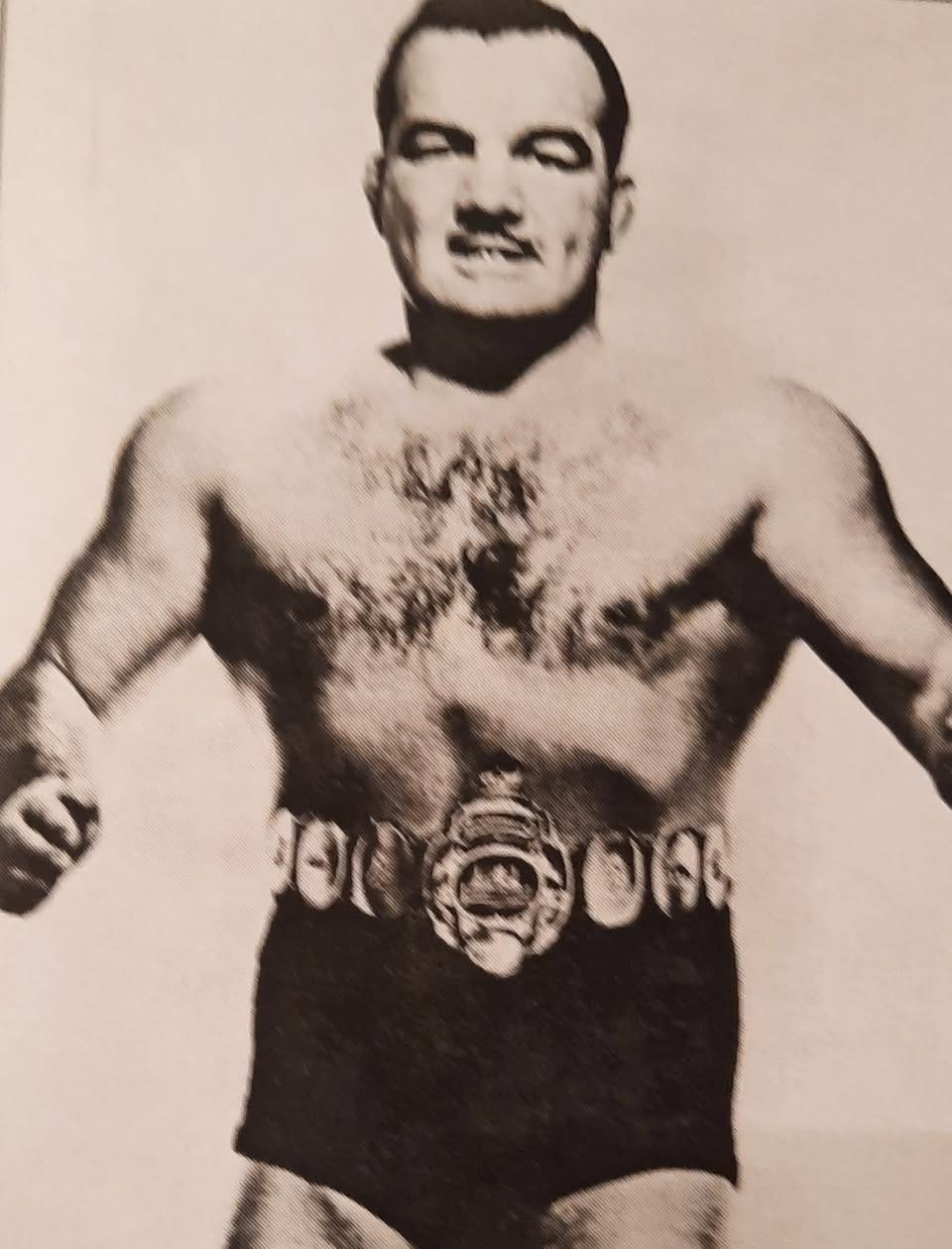
Whipper Billy Watson of Toronto was the National Wrestling Alliance World Heavyweight Champion. He had taken the title from Lou Thesz on March 15 at Maple Leaf Gardens, in front of about 15,000, with Jack Dempsey as the special referee, winning on a count-out. Through October he was still the traveling premium product the decree had just been written to stop the Alliance from rationing.
The October swing shows what “world champion” meant in 1956. It was not a monthly title match. It was a man on a train.
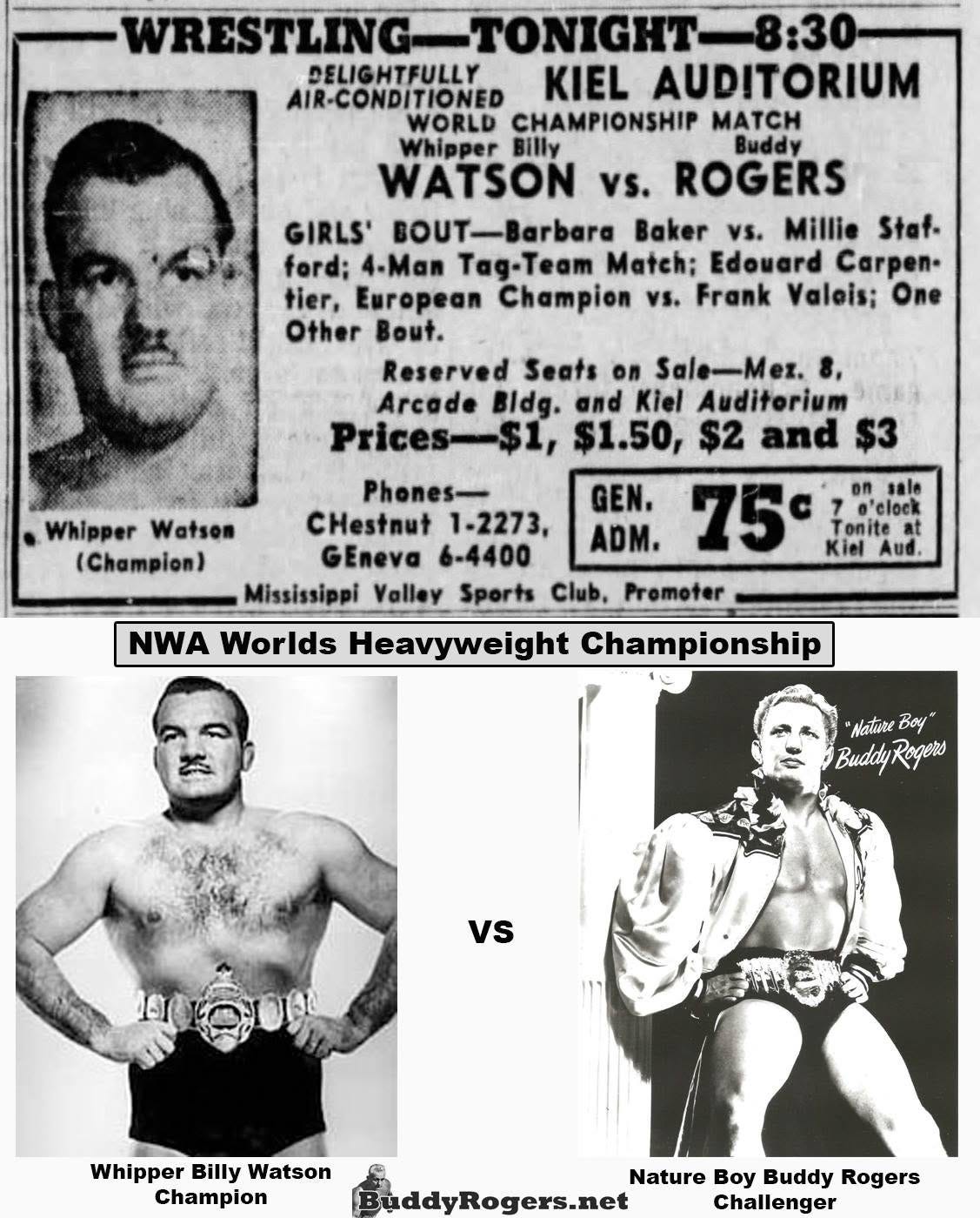
October 4, East York Arena, Toronto: Watson beat The Mighty Ursus in a title match. October 5, Kiel Auditorium, St. Louis: Watson against Buddy Rogers went to a no-contest in 11 minutes and 21 seconds, the Nature Boy doing what he had done in September in the same building, ripping at the rules until the match could not be finished. October 11, Maple Leaf Gardens: Watson beat Mr. Hito by disqualification in a title match, about 9,500 in the house. October 12, Cincinnati Music Hall: Watson beat Barney Bernard, two falls to one. October 18, Maple Leaf Gardens again: Watson beat Hito and Moto in a handicap, by disqualification. October 19, Kiel: Watson beat Wladek Kowalski in a title match. October 20, Canton Memorial Auditorium: Watson beat Buddy Rogers by disqualification, two falls to one. October 26, Buffalo Memorial Auditorium: Watson beat Mr. Hito by disqualification. October 27, Columbus: Watson beat Rogers by disqualification again.
The Minneapolis Armory date of October 23 was advertised in Sports Facts as a world-title match against Yukon Eric, the 280-pound “Mr. Torso,” with Fritz Von Erich and Karl Von Schober in the semi-final of a tag elimination against Roy McClarity and Don Pollack. Watson had defended there in the summer against Lord Athol Layton.
The program sold the champion’s second Minneapolis appearance of the reign as the biggest night the club had booked in some time. Whether the recorded main event that night was Eric or a handicap against the Germans, the advertisement is the business document. The local office sold the belt. The belt sold the armory.
Pictured: Buddy Rogers
Rogers was the other traveling name, and he was not the champion. He worked the Watson title matches as the man who could not be allowed to win clean, and he worked his own towns in between. October 15, Boston Arena, Paul Bowser: Killer Kowalski beat Rogers by disqualification. October 17, Montreal Forum, Eddie Quinn: Rogers beat Ramon Torres. October 19, St. Louis, undercard of the Watson–Kowalski title match: Rogers beat Tex McKenzie in six minutes. October 24, Montreal Forum: Rogers and Kowalski against Paul Baillargeon and Yvon Robert, double disqualification. October 25, Maple Leaf Gardens: Rogers beat Maurice LaPointe in two minutes. October 29, Boston Garden: Rogers and Lou Thesz went an hour to a draw. October 30, Burlington, Vermont, on a Quinn date: Rogers and Thesz, double knockout. October 31, Montreal Forum: Rogers beat Billy Darnell.
Thesz, six months off the belt, was already being placed back in the title picture. The Boston draw and the Burlington double knockout were not title matches. They were the return of the man the Alliance still considered the reliable champion, working the Northeast while Watson carried the strap through Ohio and the Gardens. Thesz would take the title back on November 9 at Kiel, by count-out, in front of about 9,000. October is the last full month of the Watson reign.
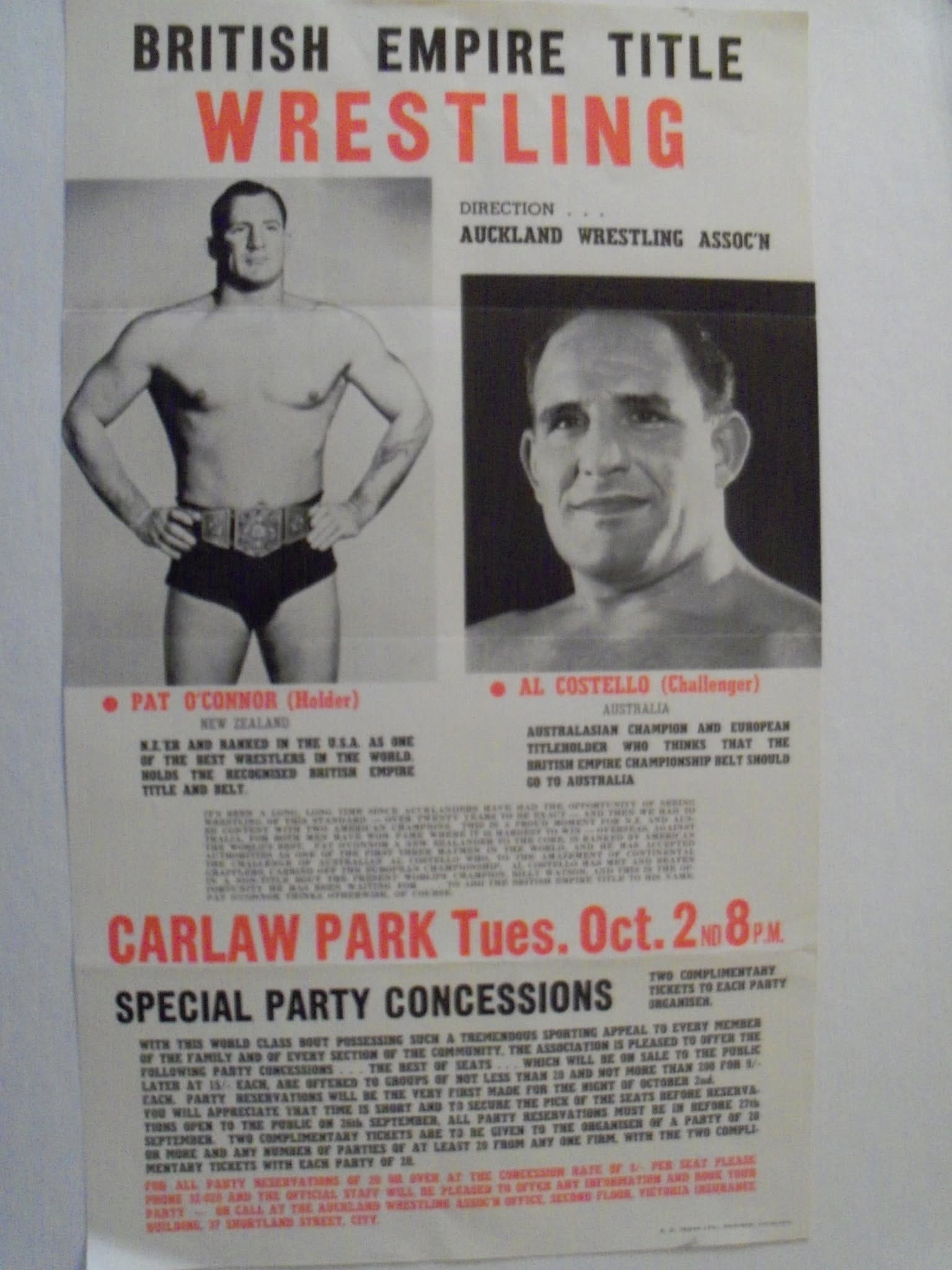
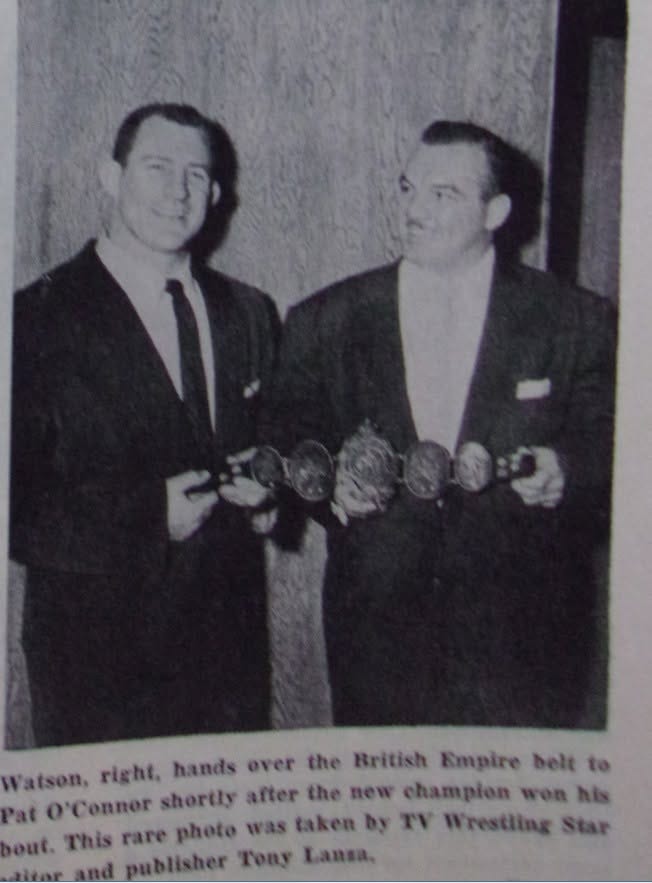
Pictured: Pat O’Connor, British Empire Champion and Billy Watson, NWA World Champion
Pat O’Connor was the British Empire champion and the clean scientific challenger the members liked. Verne Gagne was the television name in the upper Midwest, no longer the United States television champion — that belt had gone from Gagne to Wilbur Snyder to Hans Schmidt — and working Omaha and Lincoln as the local hero against Angelo Poffo, the Volkoffs, and Schmidt. Dick the Bruiser, Bobo Brazil, Hard Boiled Haggerty, Don Leo Jonathan, Killer Kowalski, and the Dusek brothers filled the towns the champion was not in.
Women’s wrestling was on the same cards, not a separate business. June Byers held the recognized women’s world title. Penny Banner, Barbara Baker, Millie Stafford, Lorraine Johnson, and Judy Grable worked the preliminaries and the occasional feature. The decree did not mention them. The offices booked them anyway.
The United States map in the month the bylaws died
The territorial grid of October 1956 is the grid the decree had just declared illegal to enforce. It was also the grid that ran the towns.
St. Louis was two promotions and one arena. Sam Muchnick’s Sports Attractions had Kiel on the 5th and the 19th, Watson both nights, Rogers on both cards. Bill Longson’s Mississippi Valley Sports Club was the rival office Muchnick had outlasted; by 1956 the championship dates were Muchnick’s.
The Missouri Athletic Commission, Charles W. Pian, was still fining Rogers and assigning substitute referees when a bout got out of the script. That commission oversight is what the Alliance had always pointed to when it called itself a sport. The decree treated the same office as a booking combine.
Toronto was Frank Tunney’s Maple Leaf Wrestling, Thursday nights at the Gardens when the ice allowed, East York Arena when it did not. Watson was the local champion of the world, which is why the reign existed. A Toronto man with the Alliance belt was a booking decision as much as a match result. The decree said the Alliance could not allocate the champion. Tunney’s October cards show what allocation looked like from the arena: Hito, Moto, Ursus, Rogers, Kowalski, the champion on top.
Montreal was Eddie Quinn at the Forum, running into Burlington and Ottawa, French-language star power in Yvon Robert and Paul Baillargeon, Rogers imported for the English and the American side of the gate. Quinn was a member. His October loop is a territory with a passport.
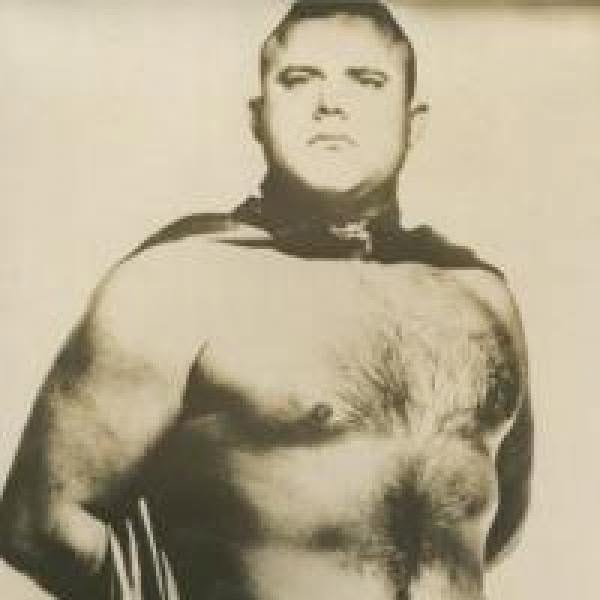
Pictured: Karl Von Schober
Boston was Paul Bowser, old-line, Arena and Garden, Kowalski against Rogers on the 15th as a season piece. Ohio was Al Haft’s Midwest Wrestling Association, Cincinnati, Canton, Columbus, the Watson–Rogers disqualifications as the protected title finish. Chicago was Fred Kohler, Marigold and the International Amphitheatre, Milwaukee as a loop town; the October 27 Milwaukee date sat on the same weekend Watson was in Columbus. Minneapolis was the Stecher–Karbo club, armory wrestling, Sports Facts as the program, Von Erich already a German heel tag act with Karl Von Schober. Omaha was Max Clayton, Gagne against Poffo on October 1st, the Volkoff brothers as the foreign menace, Schmidt circling the television belt. Lincoln, Tom Novak, opened the fall season October 2 with the Volkoffs over Gagne and Bill Melby, and ran a United States title match, Schmidt against Woody Strode, on the 15th — the same day the decree was filed.
Texas was still several offices. Doc Sarpolis in Amarillo and the western towns, Southwest Sports in Dallas–Fort Worth, Houston on its own card, Ed McLemore’s Dallas office the one that had blacklisted Jack O’Brien and Roy Graham in 1953 and thereby helped open the government file. The western loop had an October 25 Amarillo date. The champion was not in Texas in October. The towns ran without him
California was two members and a television habit. Los Angeles and San Francisco both taped and ran house shows through the last week of the month — Hollywood Legion, Pasadena, Santa Monica, Bakersfield, Sacramento, Modesto, Stockton, Santa Rosa. Ad Santel still had Oakland. Cal Eaton and Joe Malcewicz were the men the Los Angeles antitrust lawyers had been reading about since 1955. Hugh Nichols in Hollywood was the independent whose exclusion had given the Division its clearest victim. None of that stopped the October 31 Los Angeles taping.
The Southeast was Jim Crockett in the Carolinas, Cowboy Luttrall’s Championship Wrestling from Florida taping in Tampa on the 31st, Nick Gulas and Roy Welch in Tennessee and Alabama. The Northeast beyond Boston was Pedro Martinez in upstate New York, Toots Mondt and the Capitol Wrestling towns that were not yet a separate world. Hawaii was Al Karasick’s Mid-Pacific office, October 28 in Honolulu, the same Karasick who had signed the consent. The Pacific Northwest was still a member town. The prairie offices — Omaha, Lincoln, Minneapolis, Kansas City under Orville Brown and George Simpson, St. Joseph under Gust Karras — were the central-states knot that would spend the next eight years in Myers v. George.
Pinkie George, founder, was still the Iowa name and already the Iowa problem. Sonny Myers’s private suit, filed in August 1955 in the same district that took the government case, had not yet gone to a jury. The decree and the Myers complaint sat in the same courthouse. One was a settlement. The other was a wrestler asking for money.
Canada, beyond the Gardens
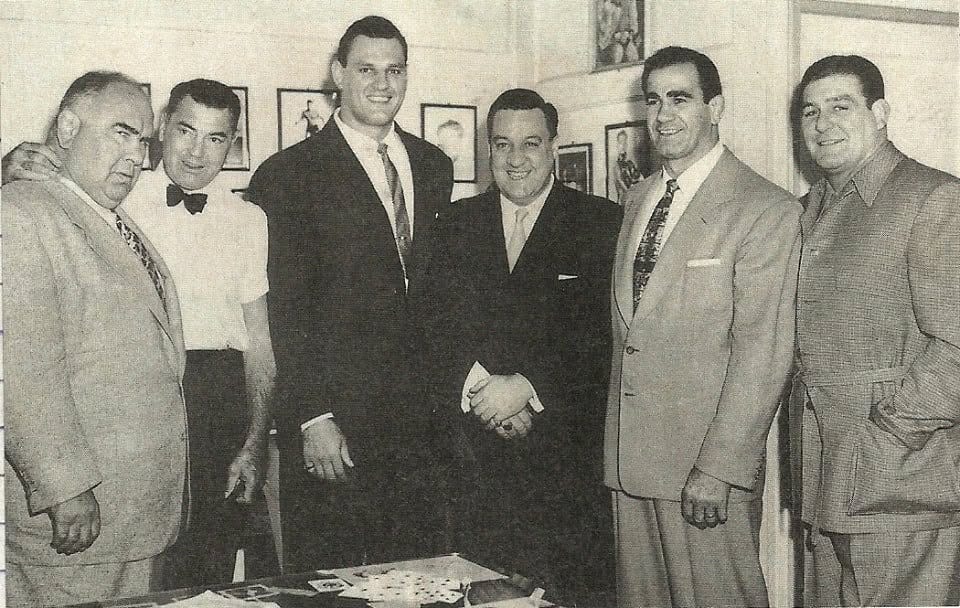
Pictured: Ed "Strangler" Lewis, Jack Dempsey, Killer Kowalski, promoter Eddie Quinn, Lou Thesz, and Yvon Robert
Canada in October 1956 was not a branch of Toronto. It was four businesses.
Tunney’s southern Ontario loop — Toronto, Hamilton, Niagara Falls — had the champion and the Gardens. Stu Hart’s Big Time Wrestling had Calgary, Edmonton, Regina, and Saskatoon; Watson had just finished a prairie title swing in late September, Gallagher and Henning and Foti, and the October cards in Edmonton and Calgary ran without the belt. Winnipeg was its own office. Vancouver was a member town with an October 31 card. Montreal and Quebec City were Quinn, linguistically and commercially separate from Toronto, importing Rogers and Kowalski rather than living off Watson.
The decree’s territorial clause did not distinguish a province from a state. Exclusive booking rights in Alberta were the same offense as exclusive booking rights in Ohio. Hart, Tunney, and Quinn did not reorganize in October. They ran the towns they had run in September. The champion’s passport was Canadian. His October work was American as often as it was not. That split — a Toronto man, an Alliance belt, American arenas paying the shot — is the international version of the booking instrument the judgment had just forbidden the Alliance to ration.
Mexico: the mask, the middleweight, and a different monopoly
Mexico was not a defendant. Empresa Mundial de Lucha Libre in Mexico City, the northern arenas, and the masked economy sat outside the Iowa judgment. They did not sit outside the month.
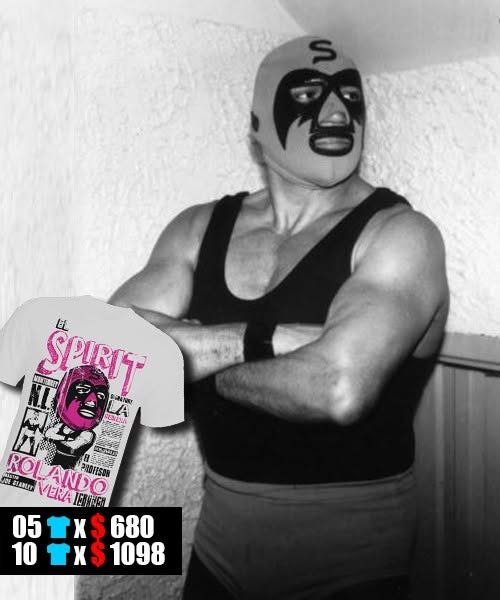
Pictured: Rolando Vera
The title change that belongs to October is the NWA World Middleweight Championship. El Santo had held it since January 1, 1954. On August 19 at Arena Coliseo Monterrey, Rolando Vera beat him in a finish the Mexico City commission did not like — Santo lost his head in the third fall, threw punches, and Vera pulled him into the reinera. The house was full, about 6,000, with thousands more outside. The commission tried to hand the belt back. Santo refused it. The recognized change came on October 19, 1956, in Monterrey, Vera over Santo. Vera would hold the title until October 13, 1960, when René Guajardo, Vera’s student, took it from him in the same city. Guajardo is the later reign. October 1956 belongs to Vera.
The same week in Mexico City, the Santo–Blue Demon feud was a tag feud, not a mask match. October 19, Arena México, Super Viernes: Blue Demon beat Cavernario Galindo. October 26, Arena Coliseo: El Santo and Espectro beat Blue Demon and Rolando Vera. The masked rivalry that had started in 1952, when Demon stopped Santo from taking Black Shadow’s mask himself, was four years old and still the main-event grammar of the capital. EMLL’s Friday and Sunday cards at Arena México and Arena Coliseo were the equivalent of Kiel and the Gardens: a building, a weekly habit, a championship that meant a booking.
The business difference from the Alliance is structural. Mexico’s monopoly, such as it was, ran through a commission, a building, and a mask, not through an Iowa membership list. A wrestler who lost his mask lost his name. A wrestler who lost his Alliance town lost his dates. Both were exclusions. Only one of them was in the Sherman Act complaint. October 1956 is the month an American court told bookers they could not own a state, while a Monterrey arena transferred a world middleweight title under a commission that had already tried to unwind a finish it disliked. Two systems of control. One lawsuit.
Japan: tournaments, not a foreign invasion
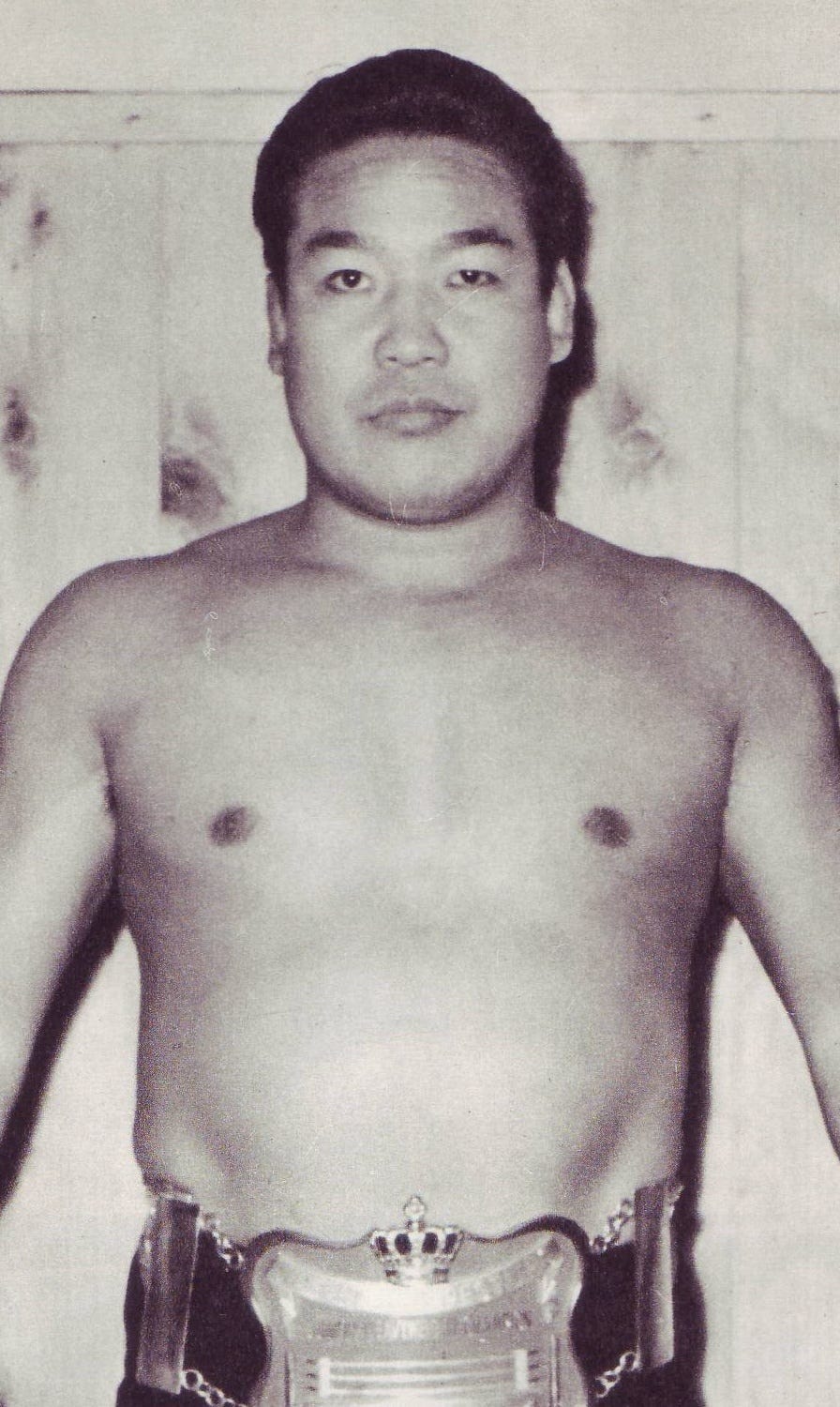
Pictured: Junzo Yoshinosato
Japan in October 1956 was between import tours. The spring international series, Rikidozan and Kokichi Endo against the Sharpe brothers for the tag belts, was months gone. The autumn 1957 meetings with Thesz, the ones that would draw the enormous television audience, were a year away. October was domestic.
On October 15 at Nihonbashi in Tokyo — the same calendar day as the Des Moines filing — a tournament for the Japanese light-heavyweight title opened. Hideo Higashi, Isao Yoshihara, Kanji Higuchi, Yoshinosato, Toshiichi Higa, Hakutozan, Kiyotaka Otsubo. On October 23 and 24 at International Stadium, Rikidozan refereed rather than wrestled the finals. Yoshinosato beat Isao Yoshihara for the light-heavyweight title. Surugaumi beat Michiaki Yoshimura for the junior heavyweight. In the heavyweight tournament Azumafuji and Toshio Yamaguchi fought to a double count-out in the final, Rikidozan the referee, after Azumafuji had beaten Toyonobori and Yamaguchi had beaten Shiro Tsukikage.
This is the other end of the world the decree was written about. The Alliance’s champion was a booking chip in Cincinnati. Rikidozan’s office was building a national style out of sumo names, Korean-born star power, and American visitors used when they served the house. Japan Wrestling Association was not a consenting member of an Iowa corporation. It was a promoter who had already learned that a foreign name on top of a Japanese hero was the gate. October 1956 did not need a foreign name. It needed a tournament bracket and a referee the crowd already believed.
The business lesson for Stage 4 is that the investigation was geographically partial. The Sherman Act reached Des Moines, St. Louis, and Los Angeles. It did not reach the International Stadium. The territorial system the decree tried to unwind was a North American booking club. The Japanese promotion of 1956 was already something else: a national office with a television future, using the Alliance’s champions as guests rather than as governors.
Storylines in October 1956
The month did not have a single angle. It had a champion’s tour and a set of local feuds that used him when he arrived
Watson against Rogers was the protected title program. Three meetings in October — St. Louis no-contest, Canton disqualification, Columbus disqualification — and no title change. Rogers was the box-office heel who could be beaten only by the referee. That finish kept the belt on the Toronto man and kept Rogers strong for Montreal, Boston, and the return date. It is the 1956 version of a program that cannot end because both men are worth more unfinished.
Watson against the Japanese heels, Hito and Moto, was the Toronto program: disqualification, handicap, the local champion standing up to a pair. Kowalski was the monster for St. Louis and Boston. Yukon Eric was the body for Minneapolis. Ursus was the strongman for the Gardens’ smaller building.
Gagne against the Volkoff brothers, and Gagne against Poffo, was the upper-Midwest television feud, amateur credibility against foreign rule-breakers and a sneering scientist. Schmidt’s United States television title was the belt the Chicago and Omaha offices could book without asking Muchnick for the world champion.
Santo against Vera was a title program with a commission attached. Santo against Blue Demon was a mask-code feud that had already produced a kick, a welterweight title match, and a tag war, and had not yet produced a mask match. It would not. The offices had more use for both men masked.
None of these programs mentioned the decree. The wrestlers were not told, in the ring, that the booking office had signed a judgment. Kayfabe and the Sherman Act occupied different sentences. That separation is the investigation’s central trick, and its central limit. The government could rewrite the bylaws. It could not rewrite the finish.
Business analysis: Stage 4, the month the file closed
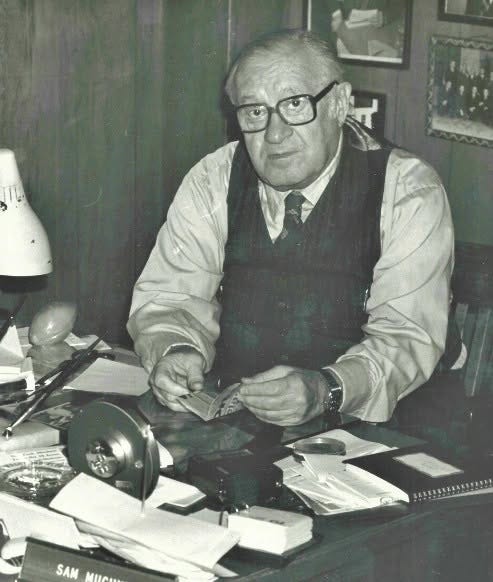
Pictured: The bealeagured President of the NWA, Sam Muchnick
Stage 4 is the investigation. October 1956 is the month the investigation stopped being a file and became a judgment, while the gates proved the file had been about a thriving business.
The numbers that can be stood on are small and local, which is how this business kept its books. Maple Leaf Gardens on October 11, about 9,500 for a title match against Mr. Hito. Minneapolis Armory advertised as the biggest night in some time. Monterrey in August, the preview of the October title change, a 6,000 full house and 3,000 outside. Kiel would do about 9,000 for the Thesz return in November; the October Watson defenses in the same building were championship cards in a house Muchnick had spent a decade building. Boston, Cincinnati, Canton, Buffalo, Columbus, Montreal Forum, Arena México — weekly or biweekly habits, not spectacles. The spectacle had been March 15 in Toronto. October was the reign spending itself.
The champion’s economics, visible in Thesz’s November letter but already the custom in October, were a percentage of the gate after tax, with a slice back to the Alliance for the president’s office and for Ed Lewis. Watson’s October tour is that custom on the road. Each town paid for the shot. The Alliance, until the 15th, claimed the right to decide which town got him. After the 15th the claim was illegal and the tour continued.
Membership math is the decree’s delayed bill. Muchnick would tell Raymond Hunter of the Department of Justice, in a May 1959 interview, that membership had fallen by more than fifteen because the Alliance could no longer offer promoters anything of value for their fees. Before the judgment, promoters respected contracts and territories. After it, the Alliance could do nothing in a dispute over a town. October 1956 is the month that sentence became true on paper. It is not the month the towns changed hands. George was still talking as if he owned Iowa. Bruns would book Des Moines later, and Muchnick would report that to the Division as proof the decree was working. In October the proof was a signature sheet.
The political economy of the settlement is the part Stage 4 has to hold onto. The Alliance consented. It did not confess. It voided bylaws it could rewrite in quieter language. It kept the champion, the arenas, the athletic commissions, and the habit of not invading. The government kept a judgment and visitorial rights and closed the file. Brownell got a wire story. Muchnick got a survivable headline. The wrestler who had sued in the same courthouse, Sonny Myers, got a pretrial order that the decree could not be mentioned to his jury.
Television is the other business fact sitting under the month. Kohler’s Chicago tape, the Los Angeles tape, the Tampa tape, Bowser’s Boston cards, Tunney’s Gardens shows — all of them were already using the box as the advance man for the armory. The decree regulated booking among members. It did not regulate the sale of time to a station. The investigation had been aimed at the 1948 model, a club of bookers. The 1956 business was a club of bookers that had also become a collection of television producers. The judgment hit the club. It missed the camera.
Mexico and Japan measure the limit of the case. Vera’s middleweight win in Monterrey and Yoshinosato’s light-heavyweight win in Tokyo happened the same week as the Des Moines filing. Neither result was booked by the consenting members. Both businesses would spend the next decade taking American names when they wanted them and ignoring Alliance law when they did not. The territorial system under investigation was real. It was not universal.
What October 1956 settles
September 1956 was the convention and the signature sheets. October 1956 was the filing. The distinction matters. A bylaw signed in a hotel is a private promise. A final judgment entered by Judge Riley is a federal order. The Alliance crossed that line on the 15th, denied everything, agreed to everything that had been negotiated, and sent the champion to Canton five days later to beat Buddy Rogers by disqualification.
The live month is Watson’s. Toronto, St. Louis, Ohio, Minneapolis, Buffalo. Rogers as the man the title could survive. Thesz in Boston and Burlington, waiting. Gagne in Omaha and Lincoln, Schmidt holding the television belt, the Volkoffs and Poffo as the heels a local office could book without a world title. Vera over Santo in Monterrey. Demon and Santo still tagged against each other in Mexico City. Rikidozan in the referee’s shirt while his own tournament crowned Yoshinosato, Surugaumi, and a heavyweight draw.
The business month is the decree. Exclusive territory, blacklist, and champion-as-instrument became illegal to write down. They did not become impossible to practice. Stage 4 ends, as a government investigation, when Disney closed the file. Stage 4 continues, as a condition of the territory, for as long as a booker could still tell a fair board that the Alliance had given him the state. Pinkie George was still saying it. The judgment said he could not. The October gates said the crowd had not been told.
Thank You for Watching and Listening
I’m Tony Richards, Pro Wrestling Historian, Author and Storyteller. I share pro wrestling historical items in each issue of the Time Tunnel Pro Wrestling History Newsletter and each episode of our podcast show. Thanks for your support! If you enjoy my information on select events, matches and insights, please share with folks you think might like to be a subscriber!
Remember, Premium subscribers get access to exclusive and special content such as some special issues including a multi-part deep dives on wrestling territories, wrestler bios and championship title histories, special audio and video interviews on territory pro wrestling and more available in the Pro Wrestling Time Tunnel for Premium Subscribers. Being a Premium Subscriber also means you support me in my efforts to document Pro Wrestling History through my research, writing, books, vidoes and podcasts. And…I have something very special planned for our Premium Subscribers on the Podcast side of things in 2026! Details soon here in the Pro Wrestling Time Tunnel.