


Today’s Favorite Quote: Old minds are like old horses, you must exercise them regularly if you want to keep them in working order - John Adams
Happy Birthday to those who have passed on and to those great wrestlers still with us:
In Memoriam:
Skandor Akbar 1934
Ann Casey 1938
Happy Birthday:
Stacey Carter\The Kat (56)
Yoshiro Tojeri (56)
Candace LaRue (41)
Rush (38)
RIP Memorial: We stop & remember those who have passed on this day and gave themselves to the business for us, the fans. We salute you and thank you.
Sheik Ali 9-29-1976 at the age of 49
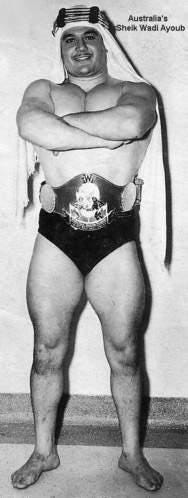
Steve Kovacs 9-29-1998 at the age of 62
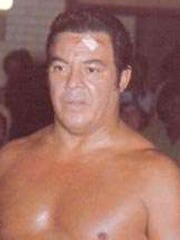
Mike York\The Alaskan 9-29-2002 at the age of 61
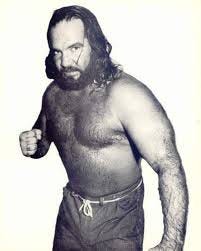
Stan Vachon 9-29-2012 at the age of 79
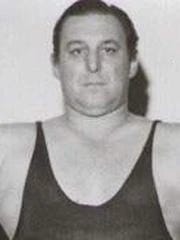
Cousin Luke 9-29-2013 at the age of 64
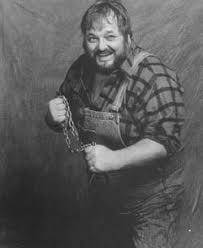
Eddie Crawford\The Snowman 9-29-2021 at the age of 74
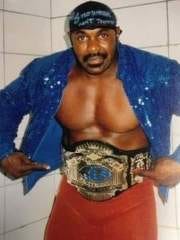
Joyce Grable 9-29-2023 at the age of 70
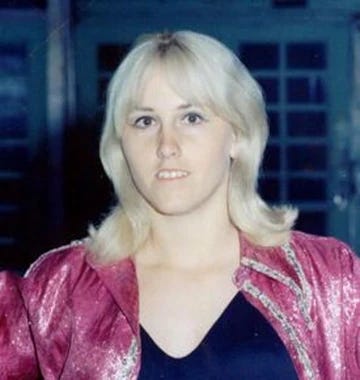
7 Stages of the Territory Era
Stage 7: Disintegration
Year 2 Month 9
September 27th 1986
The Night Two Talk Shows Occupied One Ring
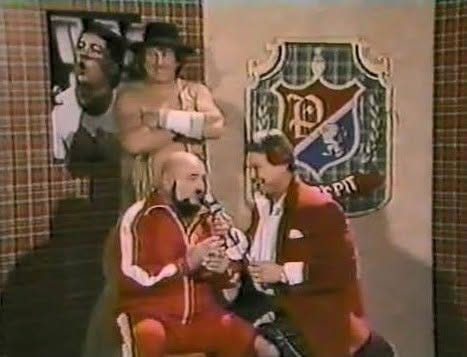
Pictured: Roddy Piper with Bob Orton, Jr on Piper’s Pit with Maurice “Mad Dog” Vachon
The Baltimore Arena taped it on September 16. America saw it eleven days later, on September 27, 1986, the fourth episode of a syndicated hour that had not existed at the start of the month. Vince McMahon, Bruno Sammartino, and Jesse Ventura were on the call. The undercard was the usual Superstars diet: King Harley Race, Superstar Billy Graham’s return squash, Kamala, Butch Reed with Slick, Tito Santana over Jimmy Jack Funk. None of that is why the date still lives.
Two interview sets sat side by side on the same floor. On one side, Piper’s Pit. On the other, The Flower Shop. “Adorable” Adrian Adonis had Jimmy Hart and a microphone wrapped in flowers. His guest was Cowboy Bob Orton, in a pink hat, the man who used to walk Roddy Piper to the ring. Piper’s guest was Don Muraco. The crowd was already Piper’s. The segment was billed as a duel between hosts. It ended as a three-on-one beating, a wrecked set, lipstick on a face, and a chair across a leg that the company would sell as injured for months.
That is the object. Everything else in September 1986 — Hogan and Orndorff looping the country on disqualifications, Crockett buying Central States, Watts chasing Los Angeles television, World Class putting a Star Wars banner on a half-full Fort Worth building — is context. This segment is the thing Stage 7 actually looked like on a living-room set.
How Two Shows Got on the Same Floor
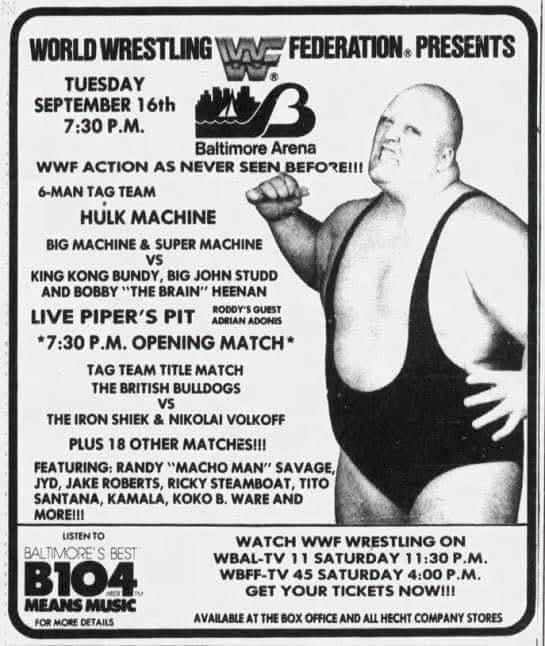
Pictured: Advertising for Baltimore Arena, September 16th, 1986, Baltimore, maryland
Piper had taken a leave after WrestleMania 2. In the vacuum, Titan handed the interview franchise to Adonis. The Flower Shop was not a parody of Piper’s Pit. It was a replacement. Flowers on the tables. Hart’s introduction every week. Adonis needling Paul Orndorff about living in Hogan’s shadow — the same Flower Shop that helped walk Orndorff into the hottest singles program in the country. When Piper came back in August as a babyface, the first argument was not about a title. It was about airtime. Who owned the chair. Who owned the camera.
Orton chose money and stayed with Adonis. That defection mattered more than any title change on the September loop. In a territory, a bodyguard switching sides was a local heat angle. On national syndication it became a weekly character fact in every market that still had a local office trying to explain why its talker was not on the screen.
By the September 20 episode the Flower Shop was already under siege: Adonis, Orton, and Hart trying to tidy the set while the building chanted for Piper. A week later the company stopped pretending the two shows could coexist. They put both desks in the same shot and let the crowd pick.
The Segment
WATCH HERE:
Pictured: Roddy Piper Cleans Up The Flower SHop
Adonis asked Orton who the better host was. Orton said Adonis had class, and that Piper had needed him as a backbone. Piper crossed onto the Flower Shop floor and took the camera with him. Orton, he said, could not hold his jockstrap. Piper put a “girly hat” on the Cowboy and snatched it back when Orton tore it off. He told the audience he did not want his kids watching Adonis. He told Muraco he was fat.
Muraco had come out as Piper’s guest and spent the segment auditioning for the other show. That was the tell. The Magnificent One was not there to interview. He was there to complete the three. When the words ran out, Adonis broke a flower pot over Piper’s head. Muraco held him. Adonis worked the leg with a chair. Orton took the Pit apart. They put lipstick on Piper’s face and left him in the wreckage. Nobody from the babyface locker room walked out. The new flagship show did not need a save. It needed a picture that would still be in the building the following Saturday.
The picture worked. Piper on crutches. The Pit gone. The Flower Shop still standing — until Piper came back with a baseball bat and erased it. That destruction aired on the October 4 Superstars, the last Flower Shop that ever existed. On the Saturday Night’s Main Event taping around the same window, Piper hit Adonis with the crutch. Titan briefly lost Adonis off television, discovered that Piper versus Muraco and Orton did not draw the same, and brought Adonis back. The hair-versus-hair match at WrestleMania III was already the destination. The September 27 beating is the night the destination became inevitable.
Why It Belongs to Stage 7
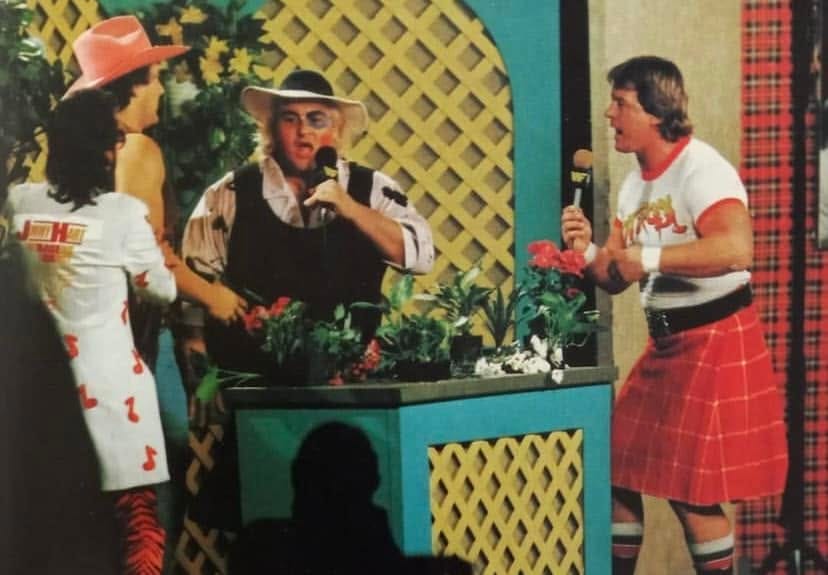
Pictured: Roddy Piper shows up to make the confrontation
Disintegration is not only offices closing. It is the moment a local form stops being able to answer a national one.
A talk segment was an old territorial tool. Promoters had been putting a wrestler in a chair beside a desk since television found the sport. Piper’s Pit itself was a Mid-Atlantic and Portland instinct scaled up: let the heel talk until the town wants him dead, then let him talk some more. What changed in September 1986 was not the desk. It was the desk’s distribution.
WWF Superstars of Wrestling had replaced Championship Wrestling and All-Star Wrestling on September 6. Three weeks later the new hour was already strong enough to stage a two-set war and beam it into every market that still ran a Friday night. A kid in Tulsa, Charlotte, Fort Worth, or Memphis did not need the local office to tell him who had been humiliated. He had seen the lipstick. He had seen the chair. He had seen Orton choose the pink hat.
That is the Stage 7 problem in a single object. Jim Crockett could put Dusty Rhodes and the Horsemen in a bunkhouse match in Greensboro and do $67,000. Bill Watts could put Steve Williams in a cage in Houston. Jerry Lawler could still draw the Mid-South Coliseum on a Monday. None of those cards could occupy the same cultural space as a ten-minute wreck on a show that now defined what wrestling looked like. The territory system had been built on exclusive local television. Titan’s answer was not a better local show. It was one show that made every other show look like a preliminary.
The talent logic followed the camera. Orton’s switch, Muraco’s heel slide, Adonis’s entire “Adorable” redesign — none of that required a world title. It required a weekly hour and a company willing to spend set pieces like they were disposable. A territory protected its interview franchise because it only had one. Titan could burn the Pit, burn the Shop, build a new Pit, and sell the ashes through March. That is not booking in the old sense. That is inventory management on a national loop.
There is a second Stage 7 read, and it is less comfortable. Adonis’s gimmick was the joke the 1986 WWF wanted the country to laugh at: the tough New Yorker in makeup, fragrance in a spray bottle, Hart on the stick. Piper’s heat in the segment is the heat of a man telling the audience that this is not wrestling. The crowd agreed with him. The company still needed Adonis enough to bring him back when the substitutes did not draw. The Flower Shop was disposable. The draw was not. That is the same arithmetic that let Hogan and Orndorff finish by disqualification in Philadelphia in front of 14,500 and call it a disappointment. The program was bigger than the building. The segment on September 27 was bigger than the match that would eventually close it.
What the Rest of the Map Was Doing While the Set Came Down
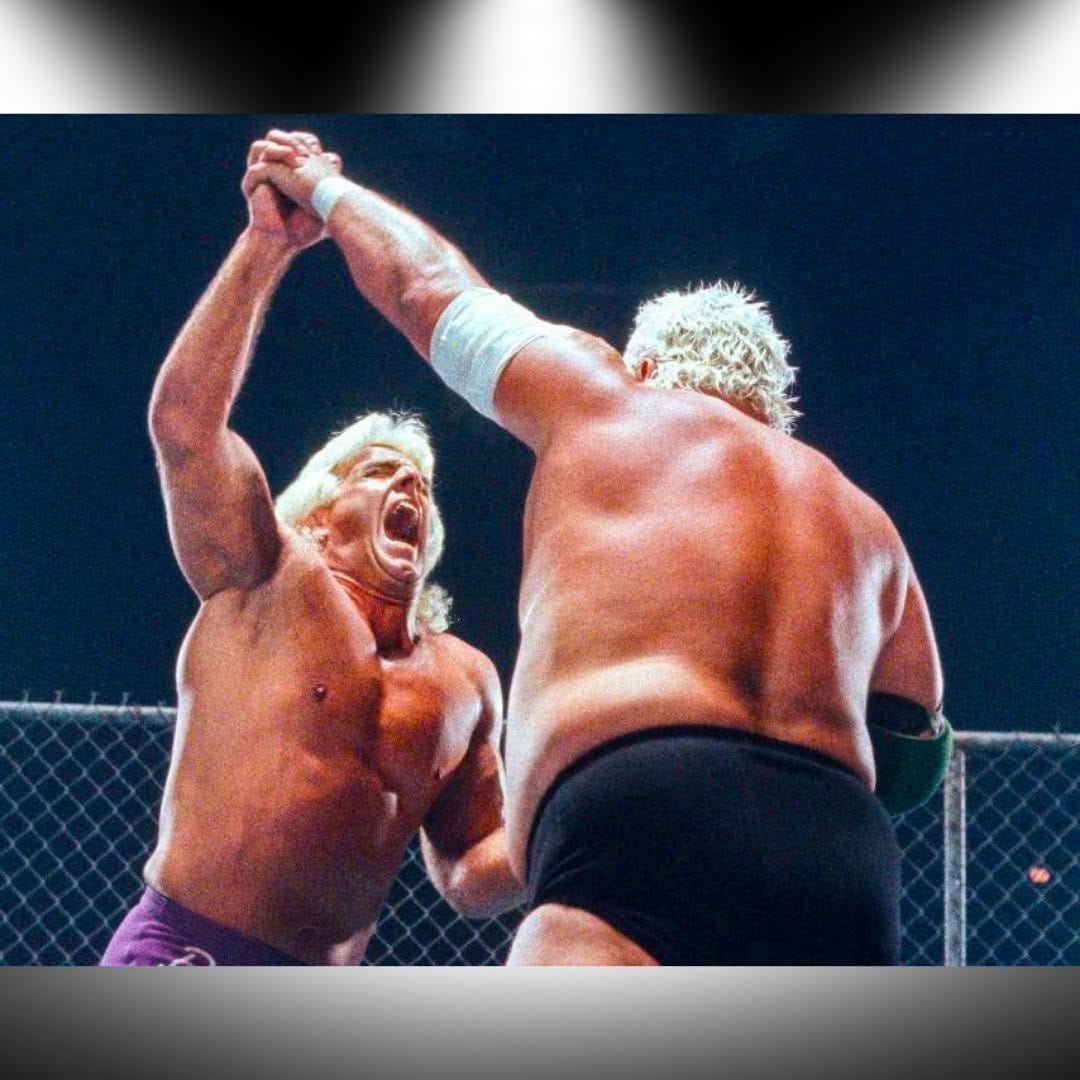
Pictured: Dusty Rhodes vs Ric Flair, Greensboro Coliseum, July 26th, 1986, Greensboro, North Carolina
The same month Flair was still the traveling NWA champion. Magnum T.A. was still in the United States title picture with Nikita Koloff; the wreck that would end that future was seventeen days after this episode aired. World Class had already staged Labor Day Star Wars in Fort Worth and come in light. The Fantastics were taking the UWF tag titles back from Eddie Gilbert and Sting in Tulsa. Nick Bockwinkel, champion by award after Stan Hansen left the belt on a Minnesota driveway, was working towns that no longer filled. Owen Hart was International Tag Champion in Calgary and, on the side, Owen James on a WWF West Coast look-see. Arena México packed 15,000 for an anniversary hair match the week before. Shiro Koshinaka took the IWGP junior title from Nobuhiko Takada in Fukuoka.
None of that appears in the Baltimore tape. That is the point. The new national hour did not have to argue with those offices. It only had to arrive first in the living room. Once it did, the local special event became a comparison, not a destination.
The Line Forward
From the wreckage of the Pit the company took a straight road: crutches, the bat, the crutch shot, the count-out on Saturday Night’s Main Event in December, the hair match in Pontiac, Brutus Beefcake with the shears, Piper’s billed retirement. André would use a later Piper’s Pit to walk into WrestleMania III on the other side of Hogan. The interview franchise survived the furniture.
Adonis would be gone from Titan by the following May, officially for “dress code,” and dead in a Wisconsin van wreck in July 1988. The 1995 line he threw in the Flower Shop — the future he claimed — is the detail people remember now because he never saw the year. In September 1986 he was not an elegy. He was the man who took the other chair and made the champion talker bleed on television.
Stage 7 does not require a territory to close in the same week a set comes down. It requires the set to matter more than the territory. On September 27, 1986, two desks occupied one ring, one of them was destroyed, and the office that taped it did not need Greensboro, Tulsa, or Fort Worth to tell the country what had happened. That is disintegration with flowers still on the table.
Thank You for Watching and Listening
I’m Tony Richards, Pro Wrestling Historian, Author and Storyteller. I share pro wrestling historical items in each issue of the Time Tunnel Pro Wrestling History Newsletter and each episode of our podcast show. Thanks for your support! If you enjoy my information on select events, matches and insights, please share with folks you think might like to be a subscriber!
Remember, Premium subscribers get access to exclusive and special content such as some special issues including a multi-part deep dives on wrestling territories, wrestler bios and championship title histories, special audio and video interviews on territory pro wrestling and more available in the Pro Wrestling Time Tunnel for Premium Subscribers. Being a Premium Subscriber also means you support me in my efforts to document Pro Wrestling History through my research, writing, books, vidoes and podcasts. And…I have something very special planned for our Premium Subscribers on the Podcast side of things in 2026! Details soon here in the Pro Wrestling Time Tunnel.