


Today’s Favorite Quote: If you believe in what you are doing, then let nothing hold you back in your work. Much of the best work of the world has been done against seeming impossibilities. This thing is to get the work done - Dale Carnegie
Happy Birthday to those who have passed on and to those great wrestlers still with us:
In Memoriam:
Ali Baba 1901
Guy Brunetti 1929
Dick Steinborn 1933
Emily Dole\Mt. Fuji 1957
Happy Birthday:
Atlantis (64)
Steve Blackman (63)
La Diabolica (61)
Shoji Akiyoshi\Jado (58)
Jinny Hahn (37)
Nathan Everhart\Jason Jordan (38)
RIP Memorial: We stop & remember those who have passed on this day and gave themselves to the business for us, the fans. We salute you and thank you.
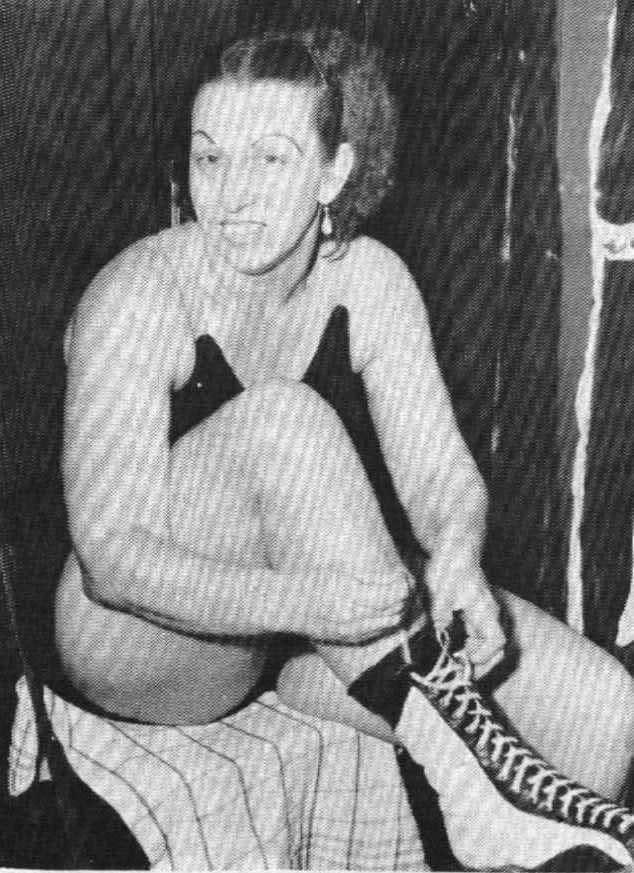
Elvira Snodgrass 9=28-1956 at the age of 44
7 Stages of the Territory Era
Stage 7: Disintegration
Year 2 Month 9
September 1986
September 1986 sits in the second year of Stage 7, the decade in which the territorial system did not merely weaken but came apart as a working order. The old NWA compact — protected geography, talent exchanges, a shared world champion touring on a handshake — still existed on paper. On the ground it was already a fiction. Cable and first-run syndication had broken the exclusive local television slot that had been the territory’s oxygen. Vince McMahon’s World Wrestling Federation had finished converting that oxygen into a national machine. Jim Crockett Promotions answered by concentrating stars, buying dying offices, and trying to become a super-territory.
Bill Watts tried to go national under a new name while the oil patch that paid his gates collapsed. Verne Gagne’s AWA and Fritz Von Erich’s World Class were still running cards and still losing the argument with the living room. Mexico and Japan, insulated by language, style, and their own television economies, continued as if the North American map were someone else’s problem. That contrast — frantic American reorganization against stable foreign systems — is the month in miniature.
The WWF National Machine
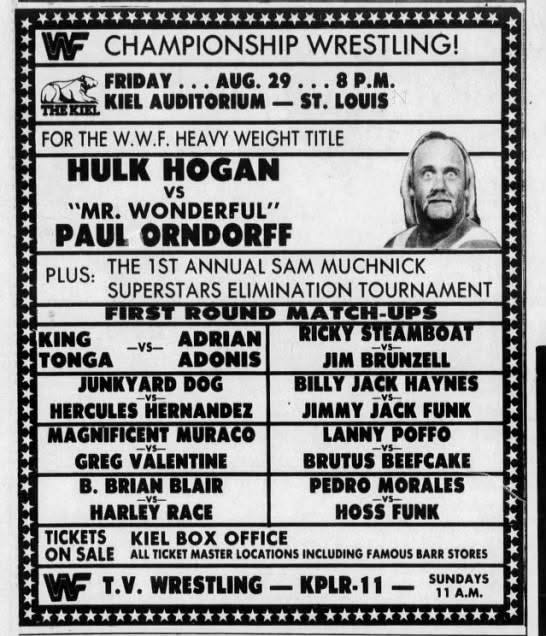
Pictured: Promo ad for August 29th, 1986, Kiel Auditorium, St. Louis, Missouri
By September the WWF was no longer expanding. It was operating. The August 28 Big Event at Exhibition Stadium in Toronto had just put more than sixty thousand people in a football stadium for Hogan against Paul Orndorff. That number hung over every building the company entered in September. The feud itself — Orndorff’s July turn, the “Real American” entrance used as mockery, Bobby Heenan at ringside — was the hottest program in American wrestling. House-show main events almost always ended in disqualification or count-out so the loop could be sold again the next night. On September 13 the company taped Saturday Night’s Main Event at the Richfield Coliseum in Ohio in front of a reported 21,000. Hogan and Orndorff again finished by disqualification.
On September 20 the Philadelphia Spectrum drew 14,500, a strong number that still registered as a disappointment against the heat of the program. On September 26 Los Angeles Sports Arena sold out at 16,000 and did a reported $190,000. Madison Square Garden on September 22 drew 12,000 and featured the Machines — Super Machine, Big Machine, and Hulk Machine, the last of them Hulk Hogan in a mask, with André the Giant as Giant Machine on other dates — against King Kong Bundy, Big John Studd, and Heenan. The mask was a booking device to keep André on the road while protecting a later reveal, and it was also a joke the live crowd understood.
Television changed shape this month. On September 6 the first episode of WWF Superstars of Wrestling aired in syndication, replacing Championship Wrestling and All-Star Wrestling with a single upgraded flagship. Wrestling Challenge launched as the second syndicated hour. The production jump was the point. Titan was no longer sharing the look of a territory show. Gene Okerlund’s updates, the Piper’s Pit set, Jesse Ventura opposite Vince McMahon and Bruno Sammartino — this was a national brand speaking in one voice into every market that still had a local office trying to sell tickets.
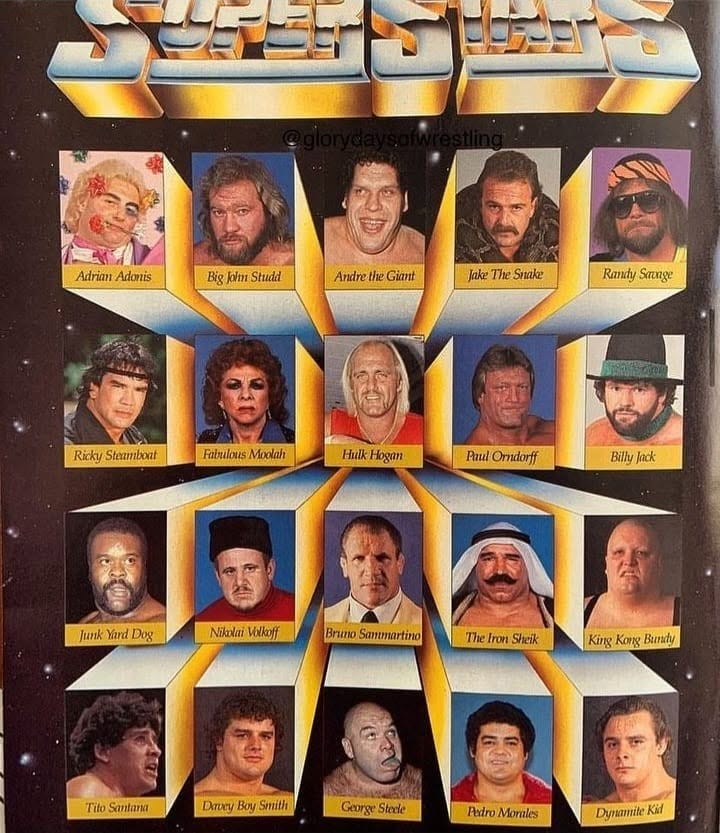
The rest of the roster was a traveling circus built to fill those hours and those arenas at once. Randy Savage, Intercontinental Champion, worked George “the Animal” Steele over Miss Elizabeth in a program that mixed comedy, jealousy, and genuine heat. The British Bulldogs held the tag titles and cycled through the Hart Foundation, the Iron Sheik and Nikolai Volkoff, and the Dream Team of Greg Valentine and Brutus Beefcake. Jake Roberts and Ricky Steamboat were mid-card gold, including a Snake Pit match on the SNME taping. Harley Race had been crowned King. Kamala returned with the Wizard and Kimchee. Koko B. Ware had just arrived with the bird. Roddy Piper was officially hurt and kept off matches, which only made the September 27 Superstars angle land harder: Adrian Adonis destroyed the Piper’s Pit set, put makeup on Piper with Bob Orton’s help, and turned a talk-show segment into the next WrestleMania program.
The machine also raided and tested. Owen Hart, already International Tag Team Champion in Stampede with Ben Bassarab, worked a handful of West Coast WWF dates billed as Owen James and was said to have looked better than many of the established babyfaces.
The company ran Memphis on September 11 at the Mid-South Coliseum — Jerry Lawler’s building — and drew 6,000 with Hogan, Piper, Savage’s orbit, Steamboat, and the Bulldogs. That date was not a courtesy appearance. It was a statement that no building was local anymore.
Toronto on September 7 still belonged to the WWF in practice: 13,000 at Maple Leaf Gardens, Hogan and Piper against Orndorff and Adonis. Australia got a Melbourne date.
The geography of the old Northeast territory had become a route map.
Jim Crockett Promotions and the NWA Super-Territory
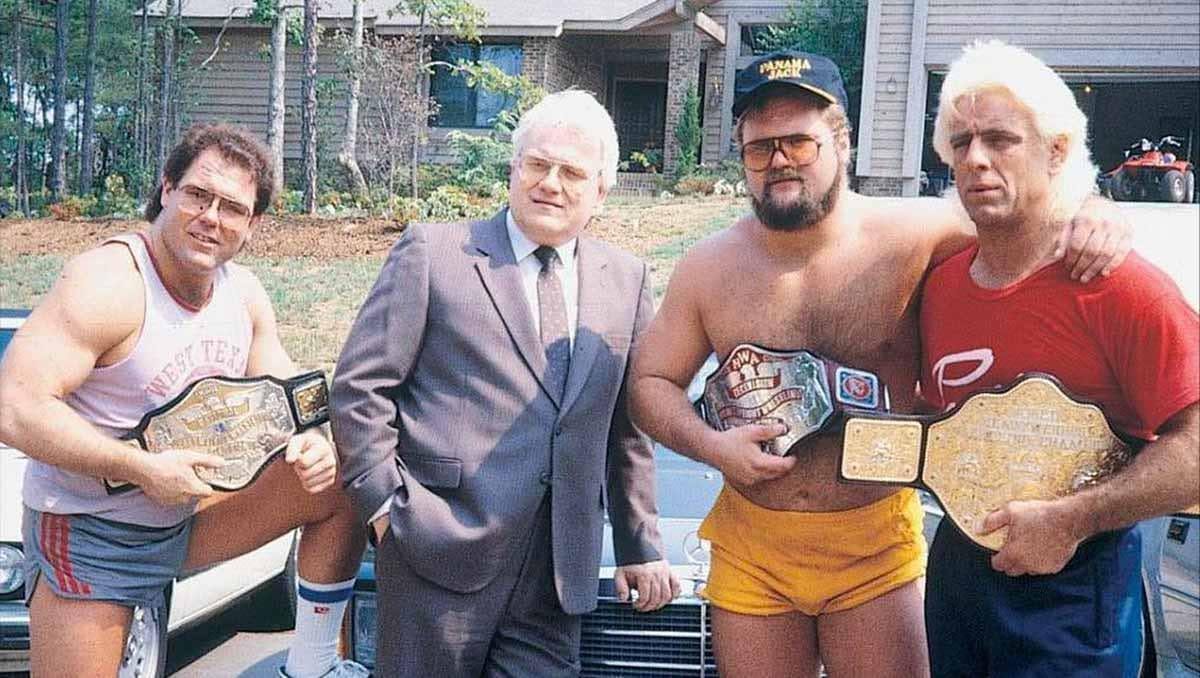
If Titan was the national product, JCP was the concentrated Southern counter-argument. Ric Flair was NWA World Heavyweight Champion and the center of the Four Horsemen with Arn Anderson, Ole Anderson, Tully Blanchard, and J.J. Dillon. Dusty Rhodes was television champion and booker. The Rock ’n’ Roll Express held the World Tag Team titles. Nikita Koloff held the United States title and spent the month in a brutal series with Magnum T.A. — two-out-of-three-falls, steel cage in Cleveland on September 14, Greensboro on September 20. Magnum was still the company’s chosen future. His car wreck was three weeks away. September is the last full month in which that future still existed on the cards.
Houses told two stories at once. Baltimore Civic Center on September 6 drew 9,000 with Flair over Dusty, Tully over Ron Garvin in two-of-three, and the Andersons over the Express in a non-title. Charlotte Coliseum on September 13 did about $67,000: Flair over Dick Murdoch, a bunkhouse six-man of Dusty and the Express over the Midnight Express and Big Bubba Rogers, Koloff over Magnum.
Greensboro Coliseum on September 20 drew 8,223 and another $67,000.
The Omni in Atlanta on September 28, hosting an NWA United States Tag Team Championship tournament, drew only 3,000.
Ivan Koloff and Krusher Khrushchev won the vacant titles. The same company that could fill Greensboro could not automatically fill Atlanta on a tournament night.
That is Stage 7: Disintegration in a single weekend: strength where the brand was dense, thinness where it was only visiting.
The most important business move of the month was quiet. In September 1986 Jim Crockett Promotions took over Bob Geigel’s Central States office — Kansas City and the surrounding Midwest towns. Geigel’s group was folding more than being conquered. Crockett’s people sent production into a one-camera television operation and began using the towns as a vehicle for JCP talent. It was absorption presented as affiliation. The NWA’s old logic said member promotions remained sovereign. The new logic said a dying office was inventory. Central States was still using Bulldog Bob Brown vs Sonny Myers in main events as late as May 1986.
Dusty Rhodes’s booking style — bunkhouse matches, street fights, count-out finishes, the Horsemen as a traveling heel corporation — was designed to make every house feel like a supercard. It worked in the Carolinas and in Baltimore. It also concentrated so much television time on one faction and one babyface that smaller NWA offices had nothing left to sell except the touring world champion. Crockett’s own circle, including comments later preserved in the Observer, treated Bill Watts, not Titan, as the real 1987 competitor. That judgment itself was a Stage 7 symptom: the remaining regional powers were now measuring each other for a national fight while Vince already occupied the national shelf.
The Universal Wrestling Federation
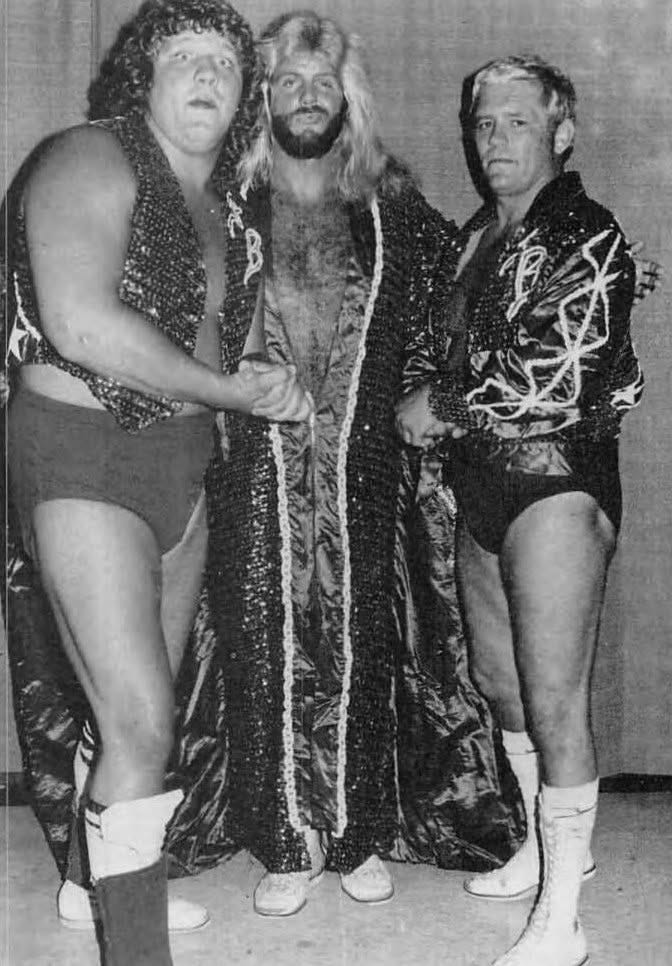
Bill Watts had rebranded Mid-South as the Universal Wrestling Federation in March. September was the month the rebrand met the oil glut. The states that had paid for Mid-South’s boom — Oklahoma, Louisiana, parts of Texas — were in economic contraction. Watts still had the best in-ring roster outside JCP.
Terry Gordy was UWF Heavyweight Champion. “Dr. Death” Steve Williams and Ted DiBiase were the company’s physical identity. Terry Taylor held the Television title for most of the month and lost it to Buddy Roberts in Oklahoma City on September 28. Eddie Gilbert and Sting held the tag titles, dropped them, won them back, and lost them again to the Fantastics in Tulsa on September 27. Sting was still a blonde heel with face paint, not yet a franchise. One Man Gang, Jim Duggan, Michael Hayes, Buddy Roberts, Chavo Guerrero, John Tatum, Missy Hyatt, Dark Journey, and Rick Steiner filled out a card that could have traveled nationally if the towns could still pay.
Sam Houston Coliseum on September 5 drew about 5,000: Williams beat Roberts in a cage, Taylor went to a disqualification with the Gang, the Fantastics and Gilbert/Sting went double disqualification.
Television added KCOP in Los Angeles and a computer-generated top-ten list. Jim Ross was already the voice. The product was excellent. The timing was fatal. Watts was trying to become a third national company at the exact moment his home economy and Titan’s syndication were moving in opposite directions.
World Class, Memphis, Florida, and the Remaining American Offices
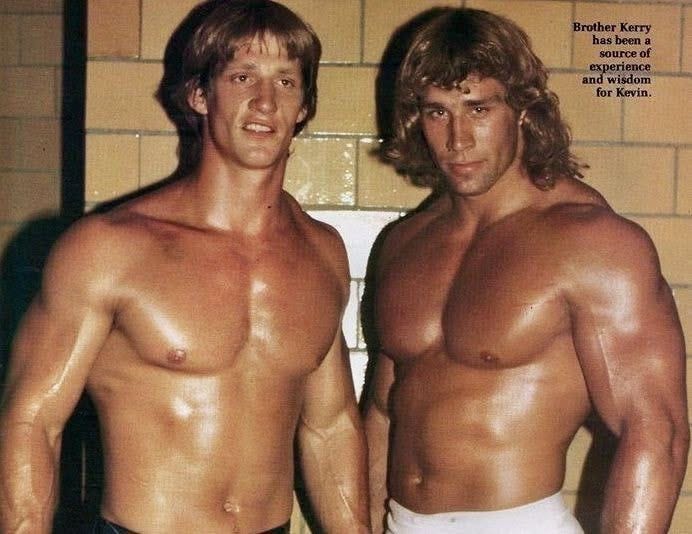
World Class Championship Wrestling opened the month with Labor Day Star Wars on September 1 at the Fort Worth Convention Center. Attendance was reported between 5,000 and 7,500 — a building that had once been automatic now looked half-full in the Star Wars chronology. Chris Adams was World Heavyweight Champion and retained over Rick Rude by disqualification. A one-night tournament filled the vacant World Tag Team titles; Buzz Sawyer and Matt Borne beat Lance Von Erich and Adams in the final. Abdullah the Butcher and Bruiser Brody went to a disqualification. The Dingo Warrior — later the Ultimate Warrior — and Socko worked the tournament. Kevin and Mike Von Erich were counted out in the first round. Kerry was largely absent from the top of the card, still living with the aftermath of the 1986 motorcycle accident and the longer shadow of David’s death in 1984. World Class debuted on ESPN around this month, a cable foothold that looked like progress and functioned like a last broadcast window. The Von Erich family name still sold nostalgia. It no longer sold out Fort Worth.
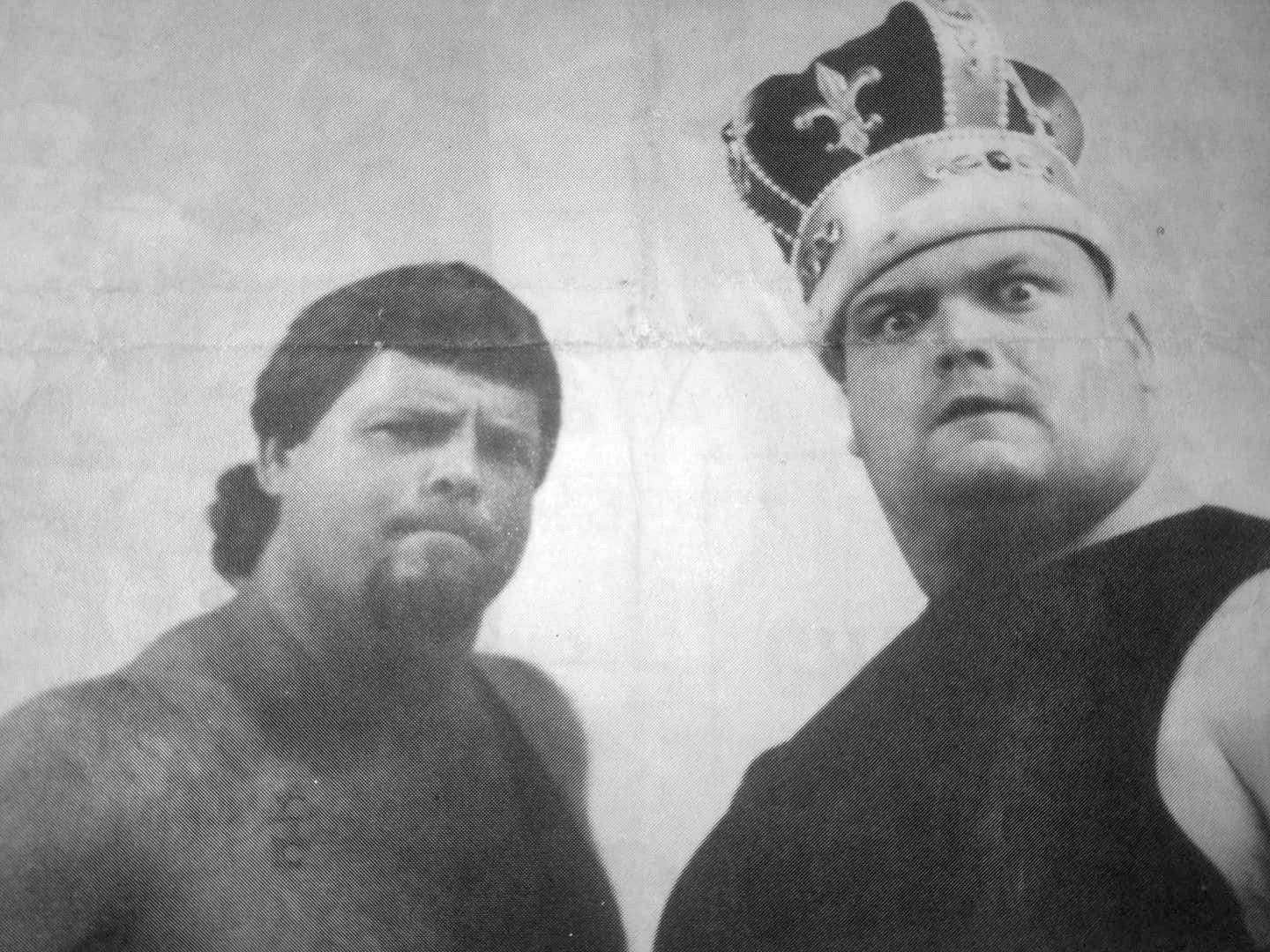
Memphis remained the most stubborn local culture in the country. On September 8 at the Mid-South Coliseum, Jerry Lawler beat Bam Bam Bigelow in a Texas Death match and walked out with the AWA Southern Heavyweight Championship. Fire and Flame held the Southern Tag titles after taking them from Giant Hillbilly and Cousin Junior. Tracy Smothers was Mid-American Champion. Jeff Jarrett was already a regular. The Great Kabuki returned. On September 26 the same building reportedly drew 9,000. Three days after the WWF had used the Coliseum, the local office still had a crowd. That resilience would keep some version of Memphis alive longer than almost any other territory. It would not stop the national brands from treating the building as a date on a route.
Championship Wrestling from Florida staged Battle of the Belts III on September 1 at the Ocean Center in Daytona Beach and drew 8,000. Ric Flair and Lex Luger went to a two-out-of-three-falls time-limit draw for the NWA World title in a little over half an hour. Barry Windham beat Ron Bass for the Florida Heavyweight Championship in the actual main event. Nick Bockwinkel, AWA champion by award after Stan Hansen’s June walkout, retained over Kendo Nagasaki by disqualification. The Fabulous Ones kept the Florida U.S. Tag titles over the Sheepherders. The Road Warriors appeared. It was a good supercard in a territory that no longer had a secure future. Eddie Graham was gone. The Florida office would be among those Crockett eventually absorbed.
Elsewhere the map was thinning in place. Pacific Northwest under Don Owen still ran Portland and Seattle on a weekly rhythm that looked like 1978. Continental in Alabama kept Birmingham dates. Puerto Rico’s World Wrestling Council staged its 13th Aniversario across Ponce, Mayagüez, and San Juan from September 19 to 21. Flair defended the NWA title against Miguel Pérez Jr. in Mayagüez on the 20th. Terry Funk worked Barry Windham. Carlos Colón’s office still functioned as a true island territory, using the traveling world champion the way the mainland offices once had.
The AWA was the clearest domestic corpse that was still booking towns. Stan Hansen had taken the belt to Japan, refused the drop, and mailed the hardware back after running it over. Nick Bockwinkel was champion because Verne Gagne needed a champion who would return phone calls. On September 21 the St. Paul Civic Center, once an AWA fortress, drew 1,435 for Bockwinkel against Colonel DeBeers. Sherri Martel was Women’s Champion. The Midnight Rockers, Curt Hennig, and Scott Hall were the future the office could not finance.
Pro Wrestling USA, the anti-Titan coalition, was already dead. September’s AWA cards were what disintegration looks like when the owner will not admit the office is closed.
Canada
Canada in September 1986 was two countries. In Toronto the WWF was the product: Maple Leaf Gardens on the 7th, 13,000, the same Hogan-Orndorff-Piper-Adonis alignment that filled American buildings. Maple Leaf Wrestling as an independent idea was finished.
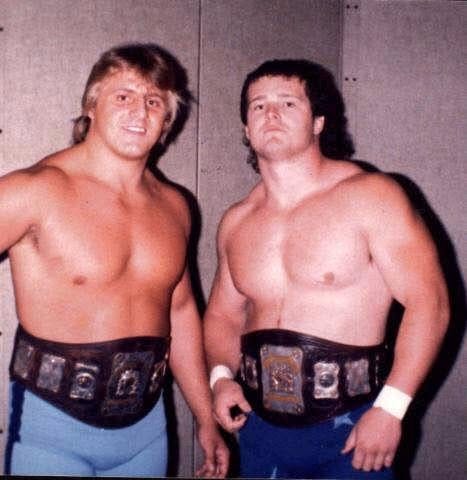
Pictured: Owen Hrt and Ben Bassarab, International Tag Team Champions
In Calgary, Stampede Wrestling still behaved like a territory. Owen Hart and Ben Bassarab were International Tag Team Champions and spent the month in a string of no-contests and double count-outs against the Viet Cong Express — Hiroshi Hase and Fumihiro Niikura, Japanese juniors learning the Alberta towns. Owen also slipped onto those WWF West Coast dates as Owen James. The Hart Dungeon was still graduating workers the national companies would later buy. Stu Hart’s last match had been in July. The office was a family business running on family labor, exactly the model Stage 7 was extinguishing everywhere else. It would survive a few more years because Calgary was far from Titan’s weekly loop and because the Harts could still put on a show without a syndication contract.
Montreal’s Lutte Internationale was fading. The Canadian map, like the American one, was becoming a WWF corridor with a few stubborn interior pockets.
Mexico
Empresa Mexicana de Lucha Libre treated September 19 as it had treated mid-September for half a century. The 53rd Anniversary Show at Arena México drew 15,000. The main event was a triple hair versus triple hair lucha de apuestas: Américo Rocca, Tony Salazar, and Ringo Mendoza against Los Misioneros de la Muerte — El Signo, Negro Navarro, and El Texano. The técnicos kept their hair. Los Brazos — El Brazo, Brazo de Oro, Brazo de Plata — retained the Mexican National Trios Championship over Rayo de Jalisco Jr., Atlantis, and Ultraman.
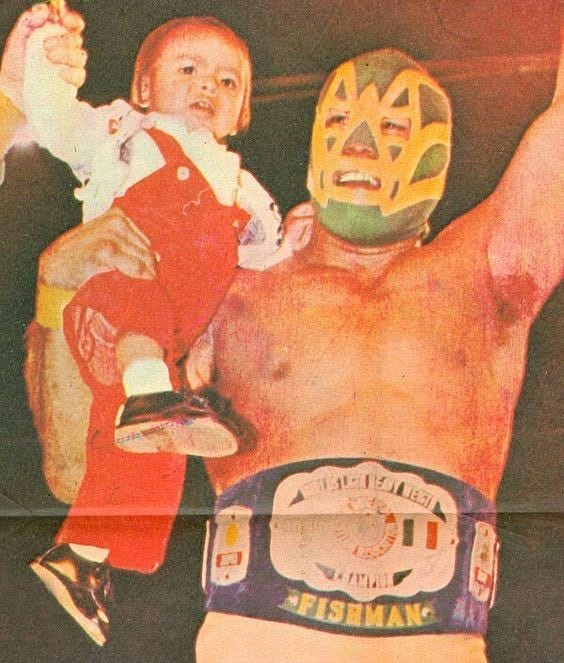
Pictured: Fishman, Light Heavyweight Champion
Fishman retained the light heavyweight championship, billed in some records as the WWF Light Heavyweight title and in others as the UWA World Light Heavyweight title, over Pirata Morgan. Early in the month Eddie Guerrero debuted at Arena México. The Anniversary Show remained the oldest annual wrestling supercard in the world. Nothing about WrestleMania or the Great American Bash changed the logic of apuestas, trios, and Arena México on Friday night.
The Universal Wrestling Association continued as a separate circuit, with El Toreo de Cuatro Caminos as its cathedral. Mexico in 1986 was not a territory in the NWA sense. It was a parallel industry. Language, mask culture, and a domestic television market kept it outside Stage 7’s blast radius. Talent crossed the border in both directions. The offices did not.
Japan
New Japan’s Challenge Spirit 1986 tour ran through the month. The September 19 card in Fukuoka drew 5,110 and was the tour’s television centerpiece. Shiro Koshinaka took the IWGP Junior Heavyweight Championship from Nobuhiko Takada in 18:31, a match later widely regarded as one of the year’s best. Bruiser Brody and Tatsumi Fujinami went to a double count-out. Antonio Inoki beat Hacksaw Jim Duggan in 4:35. The undercard was a generation turning over in public: Masahiro Chono and Keiichi Yamada (the future Jushin Liger) together, Shinya Hashimoto already working, Akira Maeda and Yoshiaki Fujiwara carrying the UWF-style shoot flavor inside New Japan’s own civil war. Inoki still closed the shows. The young heavyweights and juniors were already the next company.
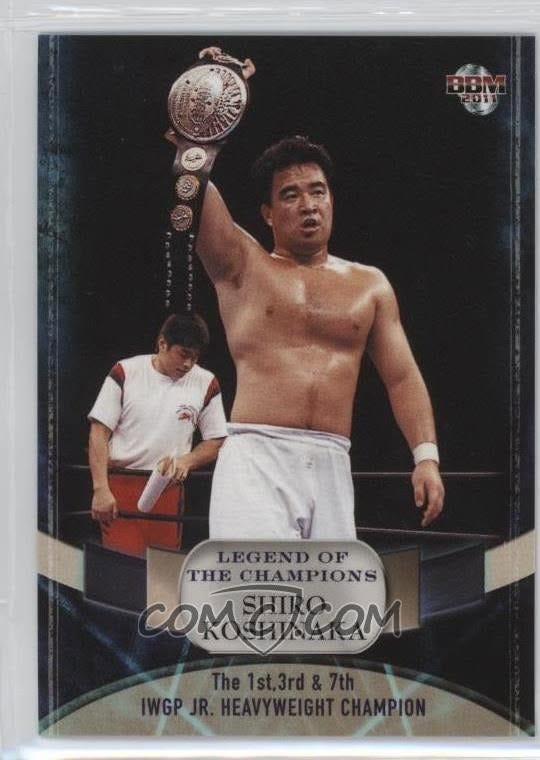
Pictured: Shiro Koshinaka, IWGP Junior Heavyweight Champion
All Japan was in the back half of Summer Action Series II. Stan Hansen, no longer AWA champion in any way that mattered in Minneapolis, was NWA International Heavyweight Champion in Tokyo and Osaka. On September 3 at Osaka-Jo Hall he and Jumbo Tsuruta went to a 22-minute double count-out for that title. Tenryu and Jumbo worked as the ace tag. Tiger Mask II — Mitsuharu Misawa under the mask — was on the cards. Giant Baba’s office did not need a national American war. It needed Korakuen Hall, the real sports newspapers, and foreigners who could bump. Hansen’s entire 1986 arc is Stage 7 in one body: an American world title that had become a prop, abandoned for a Japanese title that still meant something in a building that still sold out.
All Japan Women’s was in its own boom and does not belong to the men’s territorial collapse except as a reminder that “professional wrestling in 1986” was several businesses sharing a vocabulary.
Wrestlers as a Labor Market
September’s rosters read like a single talent pool being sorted by who could pay.
Hogan, Orndorff, Savage, Piper, Steamboat, Roberts, the Bulldogs, the Hart Foundation, André in a mask — Titan.
Flair, Rhodes, Magnum, Koloff, the Horsemen, the Expresses, the Road Warriors — Crockett.
Gordy, Williams, DiBiase, Taylor, Gilbert, Sting, Duggan — Watts.
Adams, Rude, Brody, Abdullah, Sawyer, Borne, the remaining Von Erichs, the Dingo Warrior — World Class.
Lawler, Bigelow, Jarrett, Smothers — Memphis.
Windham, Luger, Ron Bass, Keiji Muto — Florida
Bockwinkel, Hennig, Hall, the Rockers, Sherri Martel — AWA on life support.
Owen Hart commuting between Calgary and a WWF tryout loop.
Hansen, Brody, DiBiase, Williams, Duggan, Gordy appearing in Japan as foreigners while their American offices fought over scraps.
Koshinaka, Takada, Chono, Yamada, Hashimoto, Maeda — New Japan’s future already in the ring.
Rocca, the Brazos, Atlantis, the Misioneros, Fishman — Mexico’s present, unchanged.
The old talent-exchange courtesy was gone. If a wrestler could draw on national television, he was no longer available for a two-week swing through Kansas City. Central States found that out when Crockett took the office. Florida found it when the world champion arrived for Battle of the Belts and left. World Class found it every time ESPN introduced a viewer to Adams and Rude and then offered Hogan an hour later.
Business Analysis: Stage 7 in the Ninth Month of Year Two of Disintegration of the Territory Era
Disintegration in this framework is not a single bankruptcy. It is the breakdown of the rules that had made regional monopoly possible.
The first rule to go was television exclusivity. WWF Superstars and Wrestling Challenge did not merely add hours. They standardized the look of wrestling in every market that still had a local show. A kid in Tulsa, Fort Worth, or Tampa could now compare production values on Saturday morning. Local offices lost the ability to define what wrestling looked like. ESPN’s World Class window and UWF’s KCOP clearance were attempts to play the same game with weaker distribution. They were not equivalent.
The second rule to go was geographic protection. WWF in the Mid-South Coliseum, WWF in Los Angeles, WWF in Toronto, JCP in Kansas City, JCP in Baltimore, Watts chasing Los Angeles television — none of this is a territory system. It is competing national and sub-national firms overlapping on purpose. Crockett’s acquisition of Central States is the defensive version of the same logic: if you cannot protect a border, you buy the office on the other side and put your own production in.
The third rule to go was the shared champion as a public good. Flair still toured. He worked Daytona Beach, Baltimore, Charlotte, Greensboro, Mayagüez. That tour no longer enriched a brotherhood of promoters equally. It enriched Crockett first and whoever paid the date fee second. Hansen’s AWA belt, run over by a tractor and replaced by decree, showed what a “world” title became when the office behind it could not enforce a finish. Inoki’s IWGP and EMLL’s anniversary apuestas did not have this problem because they were never part of the NWA’s American bargain.
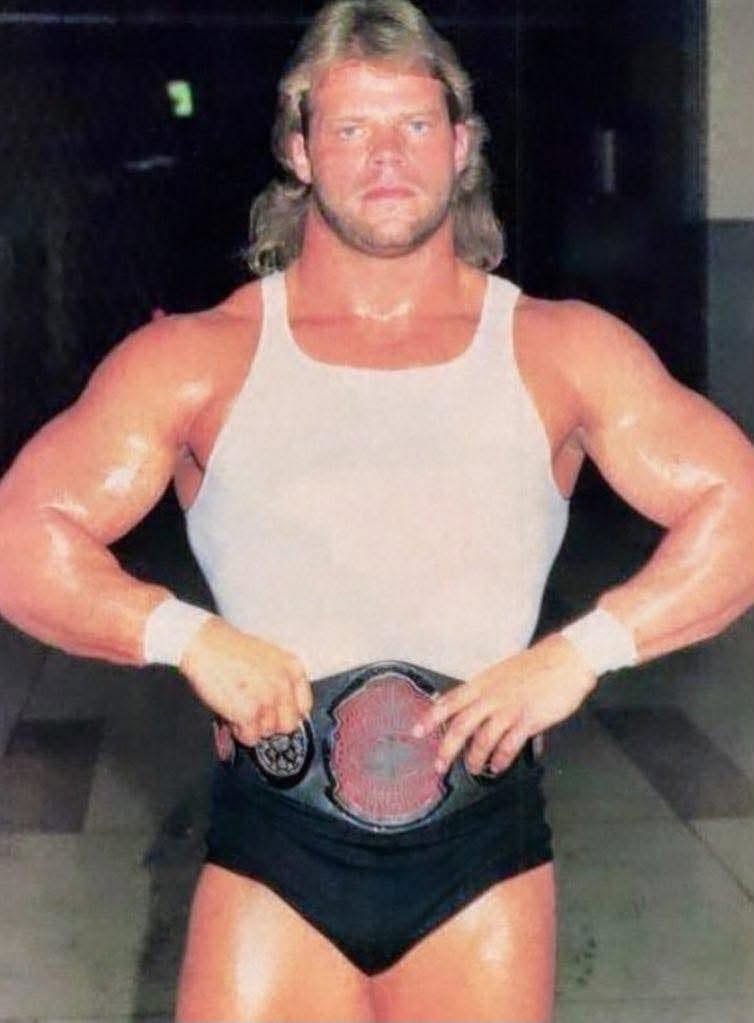
Pictured: Lex Luger, NWA Southern Champion in 1986
The fourth rule to go was house-show arithmetic. Titan could do 21,000 in Richfield, 16,000 and $190,000 in Los Angeles, 13,000 in Toronto, 12,000 at the Garden, and still hear “disappointment” at 14,500 in Philadelphia because the feud was supposed to burn the building down. JCP could do $67,000 in Charlotte and Greensboro and 3,000 at the Omni a week later. World Class could put a Star Wars banner on Fort Worth and draw a third of the building. The AWA could put the world champion in St. Paul and draw 1,435. Memphis could still do 9,000 because Memphis was a culture, not a TV market. Those numbers cannot be averaged into a single industry health index. They are a distribution: one national firm capturing the right tail, two or three regional firms capturing the middle where their television still mattered, and everyone else living on the left tail.
The fifth rule to go was labor pricing. Owen Hart’s September is the tell. A twenty-one-year-old tag champion in Calgary could already be more useful to Titan as a nameless enhancement on the West Coast than he was as a local star, and the local office could not stop the look-see. Magnum T.A. was still being built as Crockett’s next Ric Flair. Sting was still a UWF tag heel. Lex Luger went half an hour with Flair in Daytona and passed a test. The talent that would define the next ten years was already visible. The offices that had developed that talent were not going to be the offices that harvested it.
Watts versus Crockett versus McMahon is the strategic triangle of the month. Observer commentary from the period is explicit: Crockett saw Watts as the 1987 problem. Watts saw a national syndication footprint and a roster that could wrestle. McMahon saw both of them as regional companies with good workers and bad distribution. The oil glut made Watts’s bid a bad bet regardless of quality. Crockett’s bid was a better bet and a more expensive one. Every territory he absorbed added dates, talent costs, and production overhead. The Horsemen made the television feel rich. They also made every other NWA town feel like a B-show. That concentration delayed death in the Carolinas and hastened it everywhere Crockett did not physically appear.
Mexico and Japan matter in the analysis because they prove the cause was not “wrestling got worse.” EMLL’s anniversary and New Japan’s junior title change were flourishing traditional businesses. All Japan’s Hansen-Jumbo program was a serious heavyweight feud in a serious building. The American territorial system died of a specific industrial change: national television plus a promoter willing to ignore the NWA’s gentlemen’s agreement plus a generation of fans who no longer needed a local office to tell them who the world champion was.
By the last week of September the next shocks were already scheduled even if nobody in the offices knew the dates. Magnum’s wreck would remove Crockett’s chosen ace in October. The Cotton Bowl would give World Class one more stadium night. Starrcade would still be closed-circuit, not a true national pay-per-view. WrestleMania III was already the destination of the Hogan-André story that the Machines angle was protecting. None of that is visible as newsprint in September. What is visible is the pattern: one company setting the production standard, one company buying the remaining map, one company running out of oil money, and a ring of older offices discovering that a full house on a Monday in Memphis no longer constituted a system.
Stage 7 does not end in 1986. It ends around 1995, when even Memphis is a ghost. September 1986 is the month you can watch the middle of the process without hindsight rhetoric. The cards are still good. The Horsemen are still over. Hogan and Orndorff are still the talk of every bar that has a satellite dish. Stampede still has a tag title picture. Arena México still shaves heads. Korakuen still cares who holds the junior belt. And the territorial system, as a system, is already gone. The remaining offices are either becoming national firms, being eaten by national firms, or performing the old ritual in buildings that no longer believe the ritual can protect them.
Thank You for Watching and Listening
I’m Tony Richards, Pro Wrestling Historian, Author and Storyteller. I share pro wrestling historical items in each issue of the Time Tunnel Pro Wrestling History Newsletter and each episode of our podcast show. Thanks for your support! If you enjoy my information on select events, matches and insights, please share with folks you think might like to be a subscriber!
Remember, Premium subscribers get access to exclusive and special content such as some special issues including a multi-part deep dives on wrestling territories, wrestler bios and championship title histories, special audio and video interviews on territory pro wrestling and more available in the Pro Wrestling Time Tunnel for Premium Subscribers. Being a Premium Subscriber also means you support me in my efforts to document Pro Wrestling History through my research, writing, books, vidoes and podcasts. And…I have something very special planned for our Premium Subscribers on the Podcast side of things in 2026! Details soon here in the Pro Wrestling Time Tunnel.