


Today’s Favorite Quote: There are so many people who don’t know what they want. And I think that, in this world that’s the only thing you have to know-exactly what you want-Agnes Martin
Happy Birthday to those who have passed on and to those great wrestlers still with us:
In Memoriam:
(none)
Happy Birthday:
Sione Vallai\The Barbarian (67)
Wendi Richter (64)
Brandon Silverstry\Low-Ki (46)
Jillian Hall (45)
Adam Scherr\Brawn Strowman (42)
RIP Memorial: We stop & remember those who have passed on this day and gave themselves to the business for us, the fans. We salute you and thank you.
LeRoy Brown 9-6-1988 at the age of 38
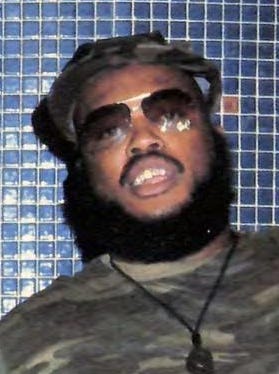
Mike Gallagher 9-6-1990 at the age of 56

Little Tokyo 9-6-2011 at the age of 70
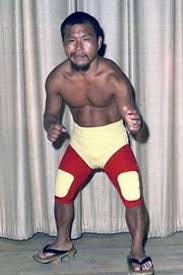
Sheik Adnan Al-Kaissey 9-6-2023 at the age of 84

Flashback 1976
Q3 Analysis (July-September)
St. Louis, Missouri Office
In the summer and early autumn of 1976, the St. Louis Wrestling Club still looked like the model NWA office. Sam Muchnick, only months removed from his long NWA presidency, ran a city rather than a circuit. He did not barnstorm midweek towns. He sold two Kiel Auditorium cards a month when the calendar allowed, fed them with Wrestling at the Chase on KPLR, and treated the Missouri Heavyweight Championship as a local crown that was supposed to mean something next to the world title. The third quarter of that year shows the office at its most characteristic: a July dark period, a near-sellout world-title return in August, a tightly written Missouri-title feud that used television to force special stipulations, and then a September slide that revealed how dependent St. Louis gates were on the world champion and on weather, baseball, and the school year.
What follows is an analysis of the wrestlers, matches, angles, storylines, and business of July, August, and September 1976.
The office and the calendar
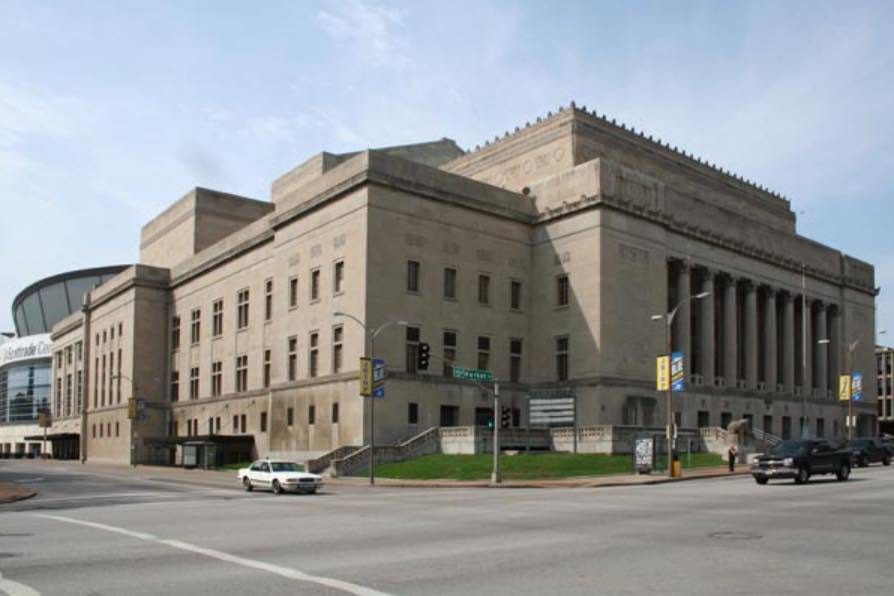
Pictured: The Kiel Auditorium, St. Louis, Missouri
St. Louis was not a conventional territory. There was no St. Louis tag-team title. Undercard bodies came largely from Heart of America / Central States in Kansas City—Bob Geigel, Bulldog Bob Brown, Mike George, Skip Young, Rick Gibson, Tank Patton, and later Bob Slaughter—plus veterans Muchnick trusted: Pat O’Connor, Dick the Bruiser, Wilbur Snyder, Rufus R. Jones. The NWA World Heavyweight Champion, Terry Funk, was a touring attraction, not a local. The Missouri title, created in 1972 and already worn by Race, Terry Funk, Kiniski, Dory Funk Jr., and others, was the office’s own prestige belt. Bob Backlund had taken it from Harley Race at Kiel on April 23, 1976, and he still held it when the third quarter opened.
Muchnick’s summer habit was well known. He was a Cardinals fan, and July house shows were often skipped. After the June 25 Kiel closed-circuit of Muhammad Ali versus Antonio Inoki (with Andre the Giant versus Chuck Wepner added), which drew only 3,027 to watch television in a building built for live sport, KPLR ran imported wrestling from June 26 through July 24. Live St. Louis television did not resume until July 31. There was no Kiel card in July at all.
That decision was economic as well as personal. A Kiel date required imported main-eventers, arena rent, and a mailed program. Television could keep names warm at far lower cost. The third quarter therefore has a lopsided shape: one month of TV maintenance, then four Kiel cards whose gates tell the story more clearly than any press release.
Reported Kiel attendances:
• August 13: 9,996
• August 27: 4,785
• September 10: 5,262
• September 24: 3,540
Kiel’s listed capacity was in the mid-nine-thousands; wrestling crowds of ten thousand were possible with extra chairs. The August 13 figure is a near-sellout. Everything after it is a mid-card house by St. Louis standards.
July: television as holding pattern
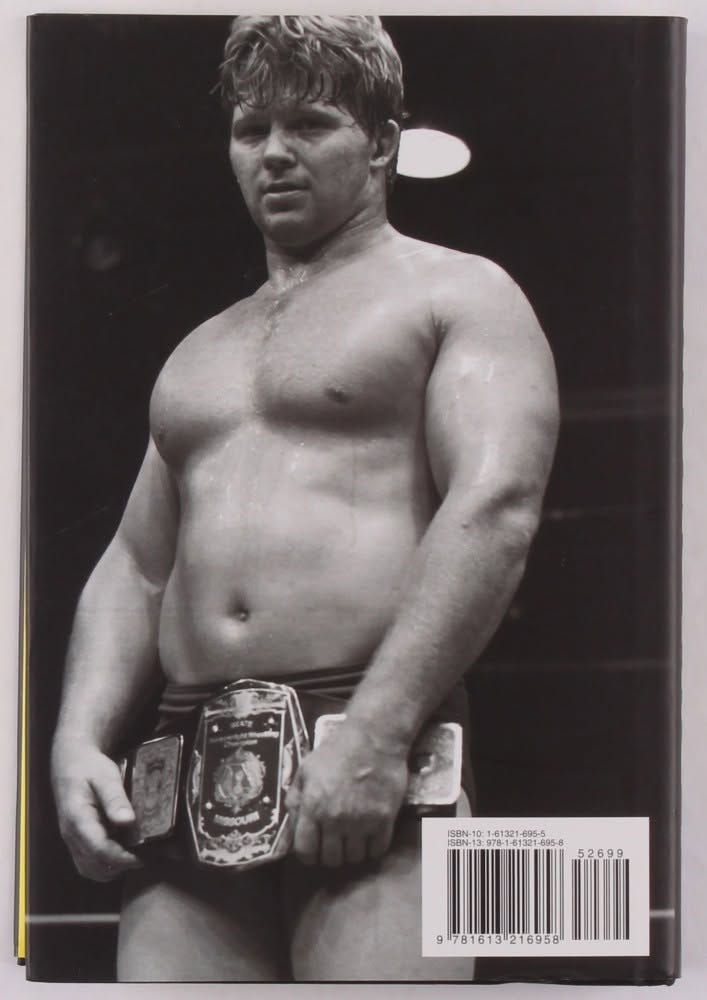
Pictured: Bob Backlund, NWA Missouri Heavyweight Champion
The July 31 Wrestling at the Chase taping is the first local program after the import weeks. The card is small but pointed.
Pat O’Connor beat Seki. Bob Geigel beat Joe Palardy. Gary Nevins and John Foley went to a draw. The meat was a tag: Bob Backlund and Guy Mitchell versus Harley Race and Ox Baker, ruled a no-contest when Race and Backlund were both disqualified.
That finish is the first public heat of the quarter’s central program. Race had lost the Missouri title to Backlund in April after a long reign. He was the Kansas City ace, a former NWA World Champion, and a man with ownership ties to the Central States office that also held a piece of St. Louis thinking. Backlund was the amateur-style babyface Muchnick and, behind the scenes, Vincent J. McMahon were both studying. Putting them in a tag with a double disqualification told the audience the April result had not settled anything. Ox Baker, with the heart-punch gimmick, was the monster on Race’s side. Guy Mitchell was a local-style babyface used to fill the other corner.
July, then, is not empty. It is a booking month with no ticket revenue. The office spent July reminding viewers that Backlund was champion, Race was not done, and O’Connor still belonged in the building.
August: the world title returns, then the Missouri title takes over
August 7 television and the Muchnick restart
The August 7 Chase taping is the quarter’s most important television angle.
The advertised singles match was Pat O’Connor versus Harley Race. Backlund demanded the match instead and put the Missouri title up. Muchnick approved it on camera, which in St. Louis was not a small thing. The promoter was part of the civic presentation. When Race pinned Backlund with his feet on the ropes, Muchnick came to ringside, told referee Bobby Whitlock the pin was illegal, and ordered the match restarted. Backlund then threw both Whitlock and Race over the top rope and was disqualified. He kept the title because the Missouri championship, like the NWA world title in this office, did not change hands on a disqualification.
The sequence does several jobs at once. It makes Muchnick the honest commissioner. It makes Race a cheat. It makes Backlund a champion who lost his composure after being robbed—a useful babyface turn of temperature without a heel turn. It also creates an unfinished match that Kiel can sell twice.
The rest of the taping filled the undercard: Ox Baker over Gary Nevins; Geigel over Foley; Black Gordman and Great Goliath over Mitchell and Palardy, with Goliath taking the only fall before curfew. Gordman and Goliath, the veteran Mexican and California heel team, would work almost every Kiel and Chase show in August and September. St. Louis did not need a tag title to use a heel team as a running antagonist.
August 13 at Kiel: 9,996 for a fence (cage) match.
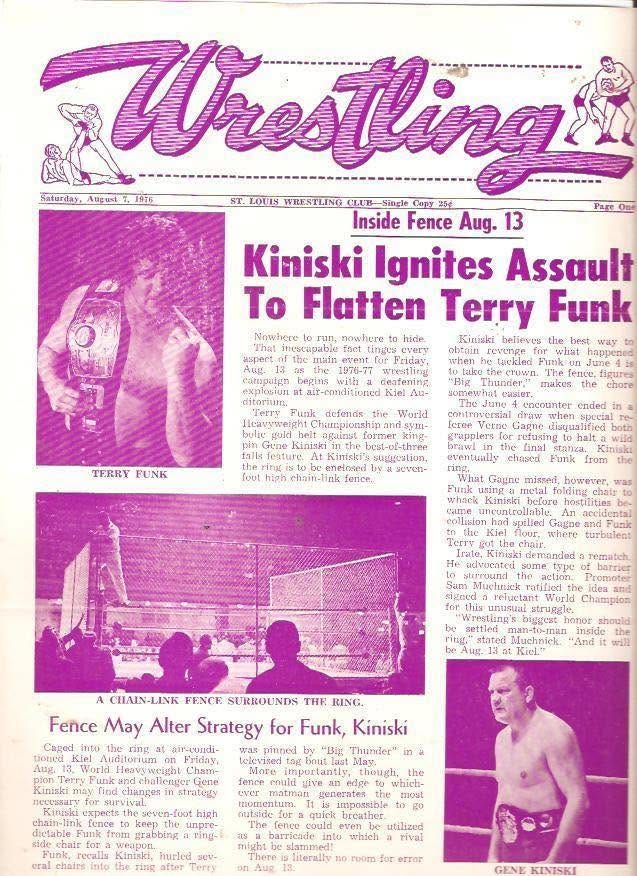
The first house show after the summer break was built as an event.
NWA World Heavyweight Champion Terry Funk defeated Gene Kiniski, two falls to one, inside a chain-link fence. That match was a rematch of the June 4 Kiel main event, when special referee Verne Gagne had declared a draw after a chair shot and a brawl—unusually chaotic for Muchnick’s building. The fence was the office’s way of promising a finish without turning St. Louis into Detroit. Gimmick matches were rationed here. When they appeared, they were advertised as the exception that proved the rule.
Kiniski, a former world champion and a credible heavyweight, was the right opponent for a “we will settle June” return date. Funk, the touring champion since December 1975, was still in the first year of a reign that asked St. Louis fans to accept a more unruly champion than Jack Brisco had been. The fence let Funk work his style without asking the crowd to watch another sixty-minute Broadway that might end in a draw.
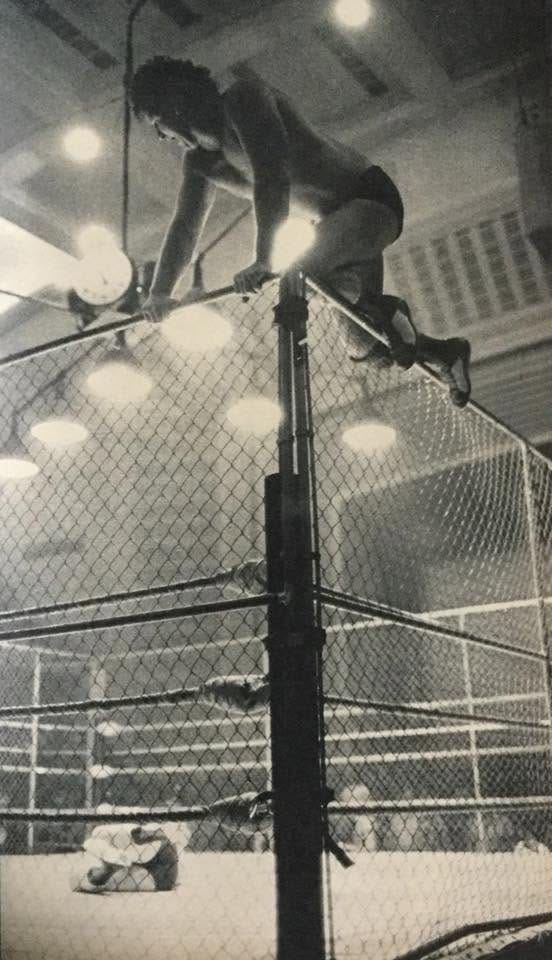
Pictured: NWA world Champion Terry Funk on top of the cage as Gene Kiniski tries to recover in the rung, August 13th, 1976, Kiel Auditorium, St. Louis, Missouri
The undercard was a St. Louis card in miniature:
• Missouri Champion Bob Backlund beat Ox Baker.
• Dick the Bruiser and Pat O’Connor beat Baron von Raschke and Blackjack Lanza by disqualification.
• Guy Mitchell beat Harley Race by disqualification after Race continued after a pin and the referee reversed the decision.
• Bob Geigel beat Hubert Gallant.
• Bulldog Bob Brown drew Mike George.
• Gordman and Goliath beat Akio Sato and Chief Thundercloud, two falls to one.
The Mitchell–Race disqualification kept Race’s heat alive the same night Backlund beat Baker clean. Bruiser and O’Connor versus Raschke and Lanza was the imported-heel formula: Indianapolis’s Bruiser as the local-adjacent tough guy, O’Connor as the scientist, two Central States / AWA-adjacent heels to get heat. Sato, already a useful junior-heavyweight style worker on the Kansas City loop, and Thundercloud were there to lose to the heel team in two-out-of-three.
Nine thousand nine hundred ninety-six paid. That is the quarter’s business peak and the proof that a world-title specialty match still filled Kiel after a month off.
August 14 and 22 television
Chase on August 14 continued the same names: Mitchell over Seki, Race over Palardy, Backlund over Foley, Gordman and Goliath over Nevins and O’Connor. August 22, a Saturday taping after a preemption, added a new beat. Skip Young drew Bulldog Brown. Backlund beat Roger Kirby by disqualification when Race jumped him. Race then beat Hubert Gallant. Gordman and Goliath beat Palardy and Mike George.
Race interfering in Backlund’s TV match is the second chapter after the August 7 restart. The office was no longer hinting. Race was stalking the champion between Kiel dates.
August 27 at Kiel: 4,785 and another DQ
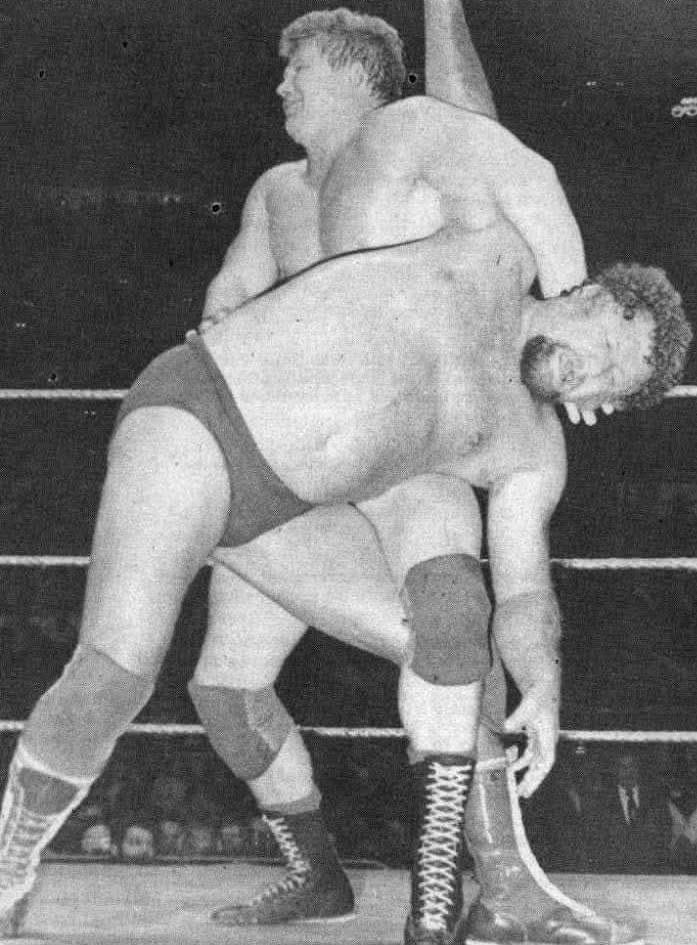
Pictured: Bob Backlund with Harley Race in an abdominal stretch at the Kiel Auditorium in St. Louis, Missouri, August 27th, 1976
The second August Kiel card is the Missouri title match the television had been building. Harley Race defeated Bob Backlund two falls to one, but Backlund kept the title because special referee Pat O’Connor disqualified Backlund in the third fall. The same rule applied: the Missouri prize could not change on a disqualification in the deciding fall.
Using O’Connor as special referee was booking with memory. O’Connor was a former NWA World Champion, a St. Louis fixture, and a man the crowd would accept as an authority figure. The finish protected both men. Race “won” the match. Backlund “kept” the belt. The audience was told, in effect, that these two could not get a clean decision under ordinary rules.
The undercard was thinner than August 13 and the gate showed it:
• Rufus R. Jones and Mike George beat Ray Clark (a substitute for Roger Kirby, also billed at times as Tom Andrews) and Bulldog Brown.
• Geigel beat Mitchell.
• Rick Gibson beat Wayne Hammer (substitute).
• Skip Young beat John Foley.
• Gordman and Goliath beat Sato and Palardy, two falls to one.
Four thousand seven hundred eighty-five is less than half the August 13 crowd. Several explanations sit together. Funk was not on the card. The main event was a rematch the TV audience had already seen end in controversy. Mid-to-late August in St. Louis competed with baseball and late-summer heat. And Muchnick’s audience had been trained to treat the world title as the reason to buy the expensive seat. A Missouri-title program, even a good one, was a different product.
August 28 Chase kept Race and Backlund on separate singles (Race over Palardy, Backlund over David Novak), with Young over Foley and Gordman and Goliath drawing Sato and George at curfew.
September: the lumberjack payoff and a falling house
September 4 television
The September 4 Chase six-man is a babyface show of force: Backlund, Skip Young, and Akio Sato beat Goliath, Gordman, and John Foley when Young pinned Foley. George beat Novak, Brown beat Gallant, Kirby beat Palardy. Young and Sato were being moved up as a team that could hang with the imported heels. That paid off on the next Kiel card.
September 10 at Kiel: 5,262, lumberjacks, and a finish
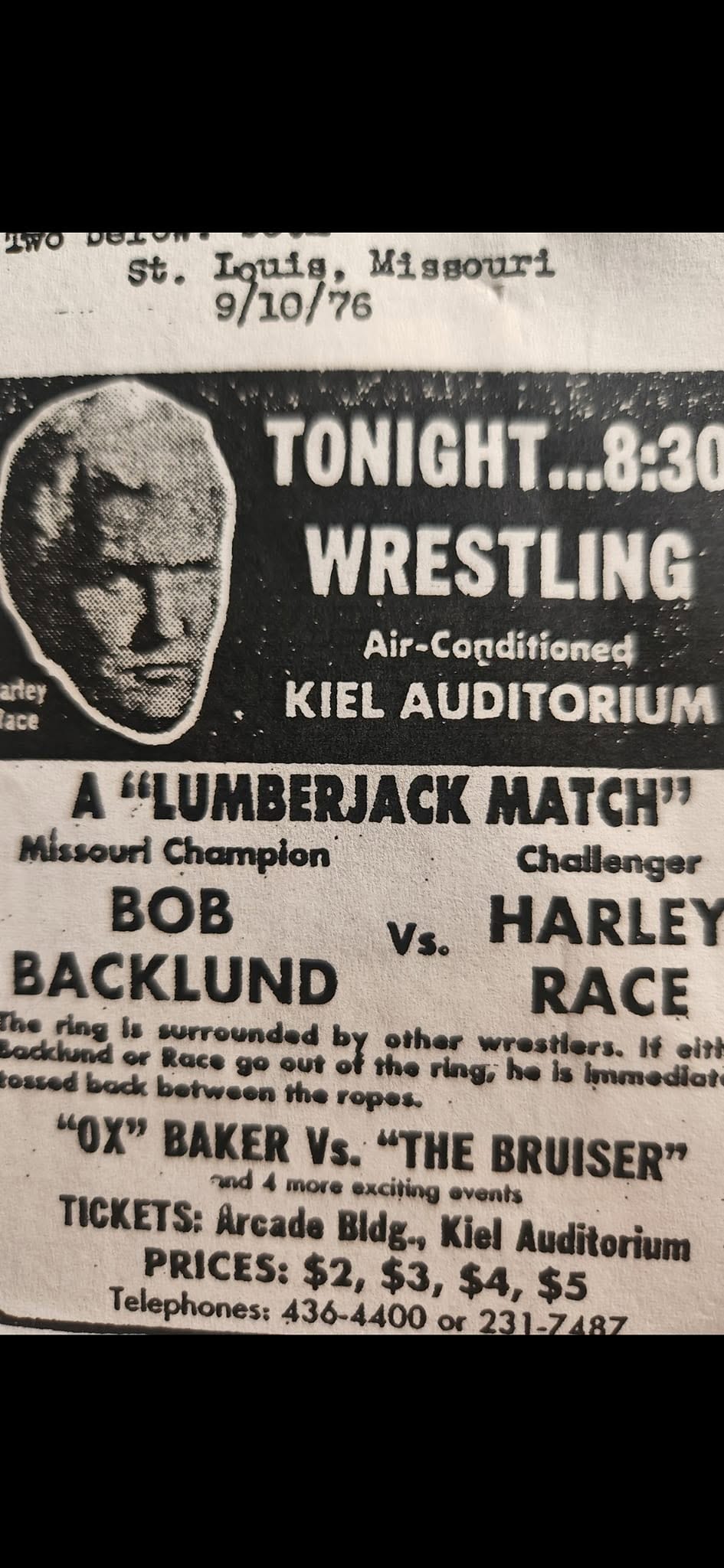
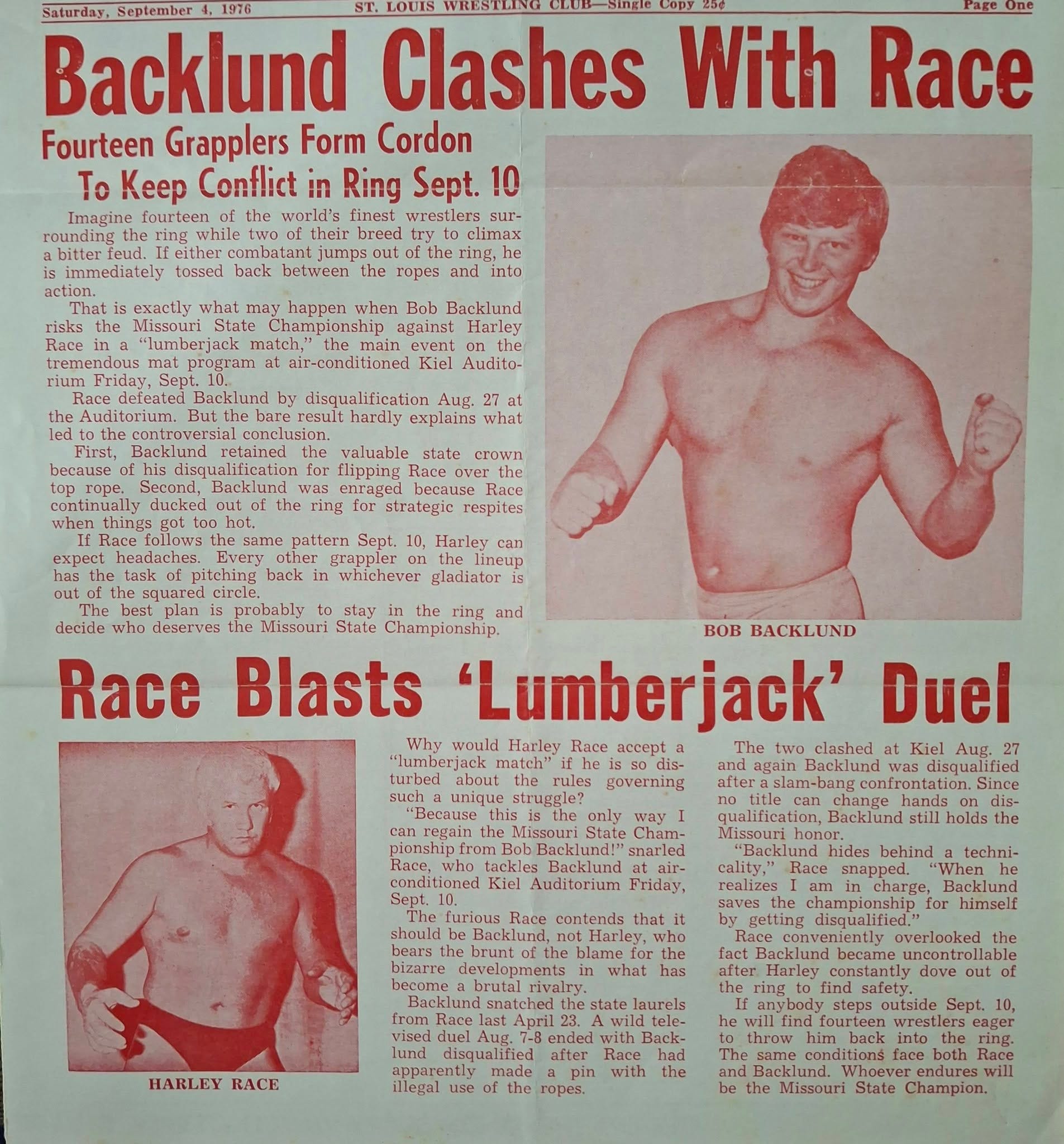
Missouri Champion Bob Backlund defeated Harley Race two falls to one in a lumberjack match. The stipulation was the logical end of two months of rope-assisted pins, promoter restarts, special referees, and outside interference. If the problem was people at ringside and illegal leverage, put a ring of wrestlers around the ring.
Fall order, as recorded: Race took the first at about ten minutes; Backlund evened it; Backlund took the third. Seventeen minutes and change for the whole match in some reports. Silent film of the bout that later circulated shows the style contrast the office was selling: Backlund’s amateur slams and pace against Race’s weight, fists, and veteran meanness.
The rest of the card mixed St. Louis regulars with two notable imports:
• Dick the Bruiser beat Ox Baker.
• Rufus R. Jones and Pat O’Connor beat Moose Cholak and Bulldog Brown.
• Bob Geigel drew Mike George in twenty minutes.
• Skip Young beat Mitsu Hata.
• Pedro Morales and Rick Gibson beat Gordman and Goliath, two falls to one.
Morales, former WWWF champion, was a short-term attraction. Pairing him with Gibson against the heel team gave the midcard a name St. Louis did not see every month. Bruiser versus Baker was a short, violent singles that needed no title. Geigel versus George was a Central States scientific draw of the kind Muchnick liked in the middle of a card.
Five thousand two hundred sixty-two is only a modest bump from August 27. The lumberjack finish “solved” the feud on paper. It did not restore August 13 business. Race versus Backlund had been stretched across TV and two Kiel mains. The third Kiel chapter, even with a gimmick, was a conclusion more than a new event.
September 11–18 television
Chase on September 11: Young over Mike Hammer (the same man billed as Wayne Hammer on August 27), Backlund over Hata in a title defense, Baker over Ruben Gold, George over Foley. September 18: Baker drew George; Backlund beat Palardy; Brown beat Dave Barker; Young and Gibson beat Hammer and Hata.
These are maintenance shows. The champion looks strong against enhancement and midcard heels. Young and Gibson stay in the tag mix. Baker remains a singles threat for the next Kiel undercard.
September 24 at Kiel: 3,540 and a change of main event
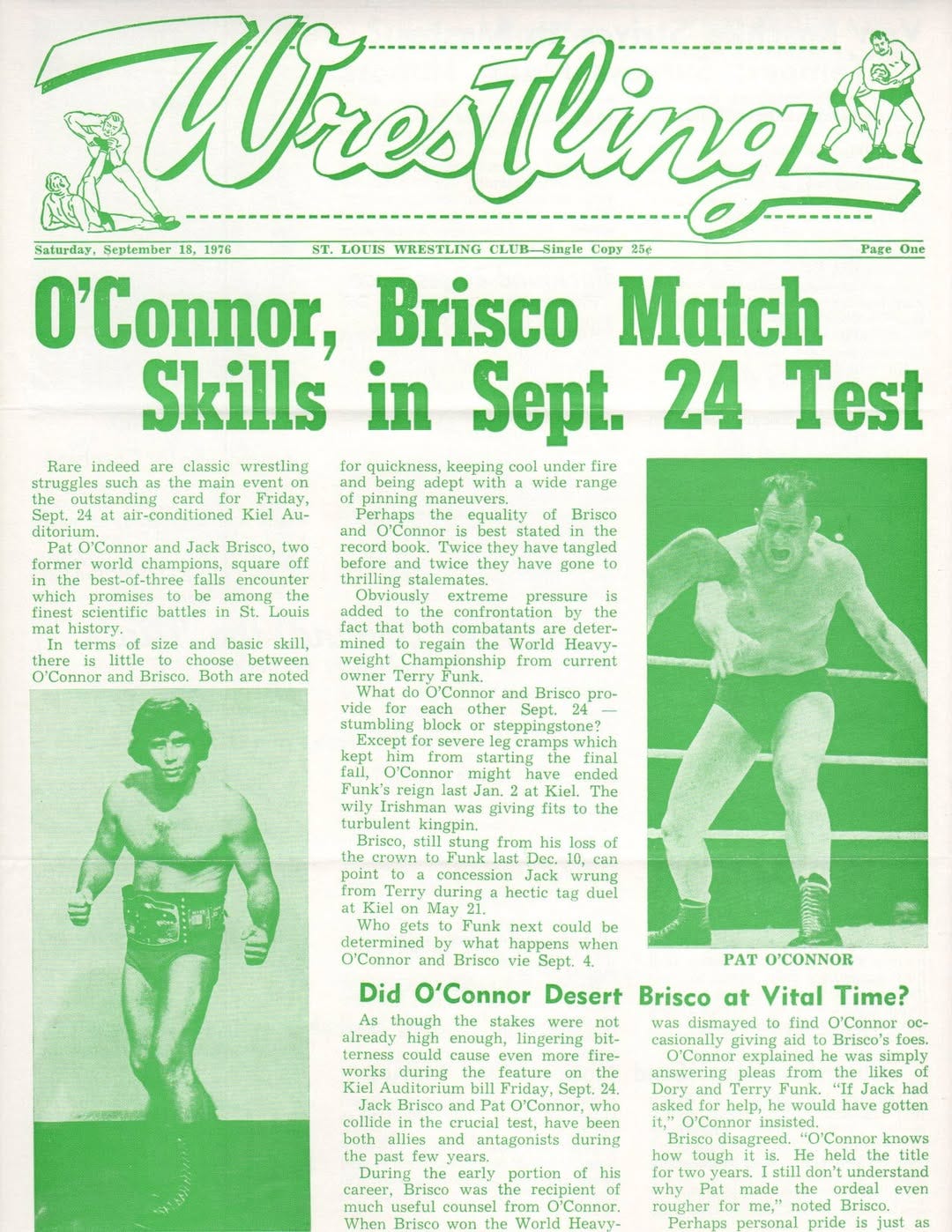
The last house show of the quarter did not main-event the Missouri title. Jack Brisco defeated Pat O’Connor two falls to one in twenty-nine minutes. That is a former world champion against a former world champion, scientific wrestling in the St. Louis house style. It is also a match without a belt and without a television angle that had been boiling for eight weeks. The crowd was 3,540.
The undercard tried to compensate with names:
• Pedro Morales, Bob Backlund, and Wilbur Snyder beat von Raschke, Bob Geigel, and Tank Patton when Backlund pinned Patton.
• Ox Baker beat Guy Mitchell.
• Bob Slaughter beat Buddy Wolfe in 7:44.
• Akio Sato and Skip Young beat John Foley and Mike Hammer, two falls to none.
Bob Slaughter is Robert Remus, soon to be better known as Sgt. Slaughter. In 1976 he was being introduced on the Kansas City loop as an ex-Marine drill instructor type, still working under the Slaughter name rather than the later full gimmick. A Kiel win over Buddy Wolfe is a debut placement: not a main event, not enhancement, a new heavyweight the office could use. Morales and Snyder in a six-man with the Missouri champion was the “stars in the second match” structure Muchnick used when the main event was a wrestling match rather than a title match.
September 25 Chase: Brown drew Gibson; Backlund beat Steve Sybert (also rendered Sypert) in a title defense; Young beat Hata by disqualification; Baker, Hammer, and Foley beat George, Ruben Gold, and Dave Barker.
By the end of September the Missouri title was no longer the advertised Kiel main event. Backlund was still champion. Race had been beaten in the lumberjack match. Brisco, who would take the Missouri title from Backlund on November 26, was being reintroduced as a singles headliner against O’Connor. The quarter’s story was already turning toward autumn.
Wrestlers: who mattered and why
Bob Backlund. The axis of the quarter. An amateur champion’s body language in a town that still wanted to believe wrestling was a contest. Muchnick had put the Missouri title on him in April; the third quarter was the defense tour that was supposed to make the win look earned. He worked television almost every week, put the belt up on TV against Race, survived two Kiel controversies, and won the lumberjack match. He also beat Baker at Kiel and a string of enhancement wrestlers on Chase. The booking never turned him heel. When he threw the referee on August 7, the story was frustration, not villainy. Within two years he would be WWWF champion; in St. Louis in 1976 he was being tested as a regional champion who could carry a feud with Harley Race.
Harley Race. The other half of the program. Race could work as a heel in St. Louis without becoming a cartoon. Ownership ties to Kansas City and a previous Missouri-title reign gave him legitimacy. He lost clean to Mitchell only by a reversed decision, never clean to Backlund in this quarter until the lumberjack third fall, and he stayed on television even when he was not booked in the Kiel main. He is the reason the Missouri title feud had weight. A lesser heel could not have made two DQ finishes and a lumberjack match feel necessary.
Terry Funk. Present only on August 13 in this quarter, and that one night did more business than the other three Kiel cards combined. Funk versus Kiniski inside the fence was the attraction booking Muchnick still did better than almost anyone: a world champion, a former champion, a rematch of a messy June finish, and a rare stipulation. Funk’s 1976 St. Louis work sits in a line from the January win over O’Connor through the February win over Race. By August the office needed him to close the Kiniski chapter so the local title could occupy September.
Gene Kiniski. A short, expensive booking. He was there to lose the fence match and to make Funk look like a champion who had survived a peer. That is classic NWA world-title use of a former champion.
Pat O’Connor. Authority figure, special referee, tag partner, and finally September main-eventer. O’Connor’s value in 1976 was institutional. Fans believed him. Using him as the referee for Race–Backlund on August 27 let the office keep the belt on Backlund without making the referee look like a fool. Putting him against Brisco on September 24 was a “wrestler’s wrestling match” that, on this evidence, did not sell tickets the way a world title or a heated local title did.
Jack Brisco. The September 24 main is a placement match. Brisco had dropped the NWA title to Funk in December 1975. He was still a main-event name. The O’Connor match reestablished him in St. Louis before the autumn program that would put him across Backlund for the Missouri title in November.
Dick the Bruiser. Not the quarter’s story, but a reliable Kiel attraction. He and O’Connor got a DQ win over Raschke and Lanza on August 13; he beat Baker on September 10. Bruiser was the outlaw Muchnick would book because the crowd already knew him from Indianapolis and from years of St. Louis dates. He did not need weeks of Chase television.
Ox Baker. House monster. He lost to Backlund and Bruiser at Kiel, beat Mitchell and various enhancement wrestlers, and tagged with Race and later with Foley and Hammer. The heart punch was a television visual. Muchnick did not build a long Baker program; he used Baker as a measuring stick.
Black Gordman and Great Goliath. The quarter’s tag-team engine. They worked Chase and Kiel repeatedly, usually winning or going to curfew, dropping a two-out-of-three to Morales and Gibson on September 10. In an office without a tag title, a heel team that can wrestle a two-out-of-three and go off television at curfew is a structural necessity.
The Central States midcard. Mike George, Skip Young, Rick Gibson, Bulldog Brown, Bob Geigel, Akio Sato, Mitsu Hata, Tank Patton, John Foley, Joe Palardy. These men made weekly television possible. George could draw with Geigel. Young was being pushed as a babyface who could pin people. Sato gave the cards a different style. Palardy and Foley lost to almost everyone and thereby made winning look like winning. This is how a non-territory office filled a one-hour TV show without a thirty-man roster living in St. Louis.
Pedro Morales and Wilbur Snyder. Spot attractions. Morales in particular is a reminder that Muchnick could still pick up a former New York champion for a tag and a six-man. Snyder’s presence on September 24 next to Backlund was veteran insurance.
Bob Slaughter. One Kiel match in the quarter, a win over Buddy Wolfe. Historically it is a footnote with a future. In September 1976 it was Central States sending a new heavyweight through the St. Louis building.
Sam Muchnick. Not a wrestler, but a character on the August 7 taping. Walking to the ring to restart a title match is the St. Louis version of an authority angle: no shouting, no contract signing, a promoter acting like a sports commissioner. That image is part of why the office’s storylines read as “angles” rather than soap opera.
Matches and the St. Louis style
Two-out-of-three-falls remained the language of important Kiel matches. Funk–Kiniski, Race–Backlund on August 27, Backlund–Race in the lumberjack, and Brisco–O’Connor all used it. Television used curfew and single falls because Wrestling at the Chase was an hour with commercials.
Disqualifications were not cheap in this office; they were rationed and then explained. Race’s feet on the ropes, Backlund throwing the referee, Race jumping Backlund on August 22, O’Connor’s third-fall DQ on August 27—all of them point at the same problem (Race will not wrestle fair; Backlund will not be pinned clean) until the lumberjack match removes the excuse.
The chain-link fence on August 13 and the lumberjacks on September 10 are the quarter’s only major stipulations. That scarcity is policy. St. Louis sold the idea that a regular match should be enough. When it was not enough, the building changed the rules once.
Workrate, in the modern sense, is hard to grade from results lists. What the records show is match length as a signal of status: Brisco–O’Connor at 29:17, Race–Backlund around 28 minutes on August 27, Morales and Gibson versus Gordman and Goliath at 22:35, the September six-man at 21:08. Enhancement matches sat between six and eleven minutes. That spread is the old main-event economy.
Storylines and angles, read as a single arc
The quarter has one primary story and several supporting ones.
The primary story is Backlund versus Race for the Missouri title. April’s title change created the rivalry. July’s tag double DQ reopened it. August 7’s promoter restart and Backlund DQ made it personal and public. August 13 kept Race on the card without giving him the champion, via the Mitchell DQ. August 22’s run-in said Race would not wait for the next Kiel date. August 27’s special-referee DQ said even O’Connor could not get a clean title change. September 10’s lumberjack match ended the chapter with the champion winning under the stricter rule set.
That is booking backward from a finish, the way this office liked to work. Each television segment justifies the next Kiel stipulation. The belt never changes in the quarter. The point is not a title change; the point is to make Backlund’s reign look like a fight.
The supporting stories:
Funk versus Kiniski is the leftover from June, closed in a fence so it cannot leak into September.
Gordman and Goliath versus whoever is available is a running heel-team program that gives Chase a two-out-of-three every week and gives Kiel an opening or midcard falls match.
Bruiser, Raschke, Lanza, Baker, and Jones are the “tough guy” layer: short matches, DQs, no titles required.
Brisco versus O’Connor is the September attempt to sell prestige without a belt after the Race feud had been concluded. The gate suggests the attempt failed relative to the world-title card, not that the match was booked as a throwaway.
Morales is a guest chapter, not a program.
Slaughter is an introduction.
Through all of it, Muchnick’s on-screen approval of matches and his August 7 intervention keep the office itself inside the story. St. Louis angles often worked that way. The promoter was not a manager. He was the league.
Business analysis
The third-quarter ledger is simple and unkind.
Television continued. That is the fixed cost and the fixed asset. Wrestling at the Chase at the Chase Park Plaza, on KPLR, with Mickey Garagiola and the rest of the regular presentation, was how St. Louis stayed a “wrestling city” in weeks with no Kiel date. July’s import weeks and the July 31 return show that the office would rather show someone else’s matches than go dark on Channel 11.
Live business depended on the world title. August 13 with Funk in a fence match did 9,996. The next three Kiel cards, all locally logical, did 4,785, 5,262, and 3,540. Average of those three: about 4,529. That is a strong mid-size town and a weak St. Louis. Early 1976 Kiel cards had done 10,290 (January 2, Funk versus O’Connor), 9,132 (February 6, Funk versus Race), and other houses in the seven-to-ten range when the world title or a special attraction was advertised. The third quarter reproduces that pattern in miniature: one big Funk date, then a slide.
Seasonality is real. Muchnick’s July dark period avoided competing with the Cardinals at the worst of the summer. Late August and September still compete with baseball’s stretch drive, back-to-school, and, in St. Louis, heat that makes a Friday night downtown less automatic. The Time Tunnel-style later commentary on 1976 notes a fall lull and a rebound toward Thanksgiving. The September 24 figure of 3,540 fits that lull. October 8, just outside the quarter, with Funk versus Backlund in a one-hour world-title match, jumped back to 7,830. That rebound is the same lesson as August 13: put the world champion on and the town answers.
The Missouri title was valuable as television and as a stepping-stone narrative. It was not, in this quarter, a substitute world title at the ticket window. Race versus Backlund is a better feud than most territories had in the summer of 1976. It still lost more than five thousand fans from the Funk fence match to the first title Kiel date.
Cost structure favored the Muchnick model when the big match landed. He did not pay a full-time local roster. He paid for Chase tapings, Kiel rent, and imported mains. A 10,000 house covers a lot of those costs. A 3,540 house does not cover them as comfortably, especially if Brisco, Morales, Snyder, and Bruiser are all on the same unused-capacity card.
There was no competing promotion of consequence in St. Louis in 1976. The AWA appeared on cards when Muchnick wanted a name (Gagne as referee in June; Bockwinkel earlier in the year). WWWF names appeared as guests. The office’s problem in Q3 was not opposition. It was product mix and season.
The Ali–Inoki closed-circuit experiment in June is part of the third-quarter context even though it sits on June 25. Three thousand people paid to watch a fight that did not look like a fight. That number is a warning about novelty without a St. Louis finish. Muchnick’s own product on August 13—fence, two-out-of-three, former champion, current champion—did more than three times the business.
Longer-term, the quarter is a snapshot of an office still healthy and already showing its limits. Backlund’s push is the future leaking in: McMahon Sr. wanted him, Muchnick was willing to make him a champion in the most conservative big town in the NWA, and Race was willing to do the honors in stages. Brisco’s September return is the past remaining useful. Funk’s one-night sellout is the present tense of the alliance. The September gates are the reminder that St. Louis was a special-event town pretending, two Fridays a month, to be a weekly sport.
What the quarter leaves behind
By October 1, 1976, the St. Louis picture was this:
Bob Backlund was still Missouri champion and had just gone through the most complete program of his St. Louis run. Harley Race had been used correctly and was free to return to Kansas City mains and future St. Louis television. Terry Funk was still world champion and would be back on October 8 to wrestle Backlund for sixty minutes, the natural next step after Backlund survived Race. Jack Brisco was reestablished. Bob Slaughter had a Kiel win on his record. Gordman and Goliath had been run hard enough that a fresh heel team would soon be needed. Dick the Bruiser had done his usual damage. Pat O’Connor had been referee, partner, and opponent.
The artistic record of the quarter is strong. The Backlund–Race television angle, with Muchnick in the aisle and a referee over the top rope, is as coherent as 1970s sports-entertainment gets without calling itself that. The fence match is a justified rematch. The lumberjack match is a justified third Kiel meeting. The Brisco–O’Connor match is the office’s idea of a main event when it wants wrestling more than heat.
The financial record is a pyramid with a wide top and a narrow base. One night near ten thousand. Three nights that average below five thousand. Weekly television that keeps the language of the town intact while the live crowd thins.
That is St. Louis in the third quarter of 1976: still the NWA’s showpiece city, still booked as if the audience were a sports audience, still able to sell a world champion in a fence, and already discovering that a well-told local title feud, in August and September, would not by itself fill Kiel Auditorium.
Thank You for Watching and Listening
I’m Tony Richards, Pro Wrestling Historian, Author and Storyteller. I share pro wrestling historical items in each issue of the Time Tunnel Pro Wrestling History Newsletter and each episode of our podcast show. Thanks for your support! If you enjoy my information on select events, matches and insights, please share with folks you think might like to be a subscriber!
Remember, Premium subscribers get access to exclusive and special content such as some special issues including a multi-part deep dives on wrestling territories, wrestler bios and championship title histories, special audio and video interviews on territory pro wrestling and more available in the Pro Wrestling Time Tunnel for Premium Subscribers. Being a Premium Subscriber also means you support me in my efforts to document Pro Wrestling History through my research, writing, books, vidoes and podcasts. And…I have something very special planned for our Premium Subscribers on the Podcast side of things in 2026! Details soon here in the Pro Wrestling Time Tunnel.