



Today’s Favorite Quote: If we value the pursuit of knowledge, we must be free to follow wherever the search may lead us. The free mind is no barking dog to be tethered on a one-foot chain-Theodor Adorno
Happy Birthday to those who have passed on and to those great wrestlers still with us:
In Memoriam:
Billy Sandow 1884
Jerry Kozak 1934
Pat Barrett 1941
Jerry Jarrett 1942
Happy Birthday:
Kia Stevens\Awesome Kong (49)
Austin Watson\Xavier Woods (40)
Cory Weston\Westin Blake (39)
RIP Memorial: We stop & remember those who have passed on this day and gave themselves to the business for us, the fans. We salute you and thank you.
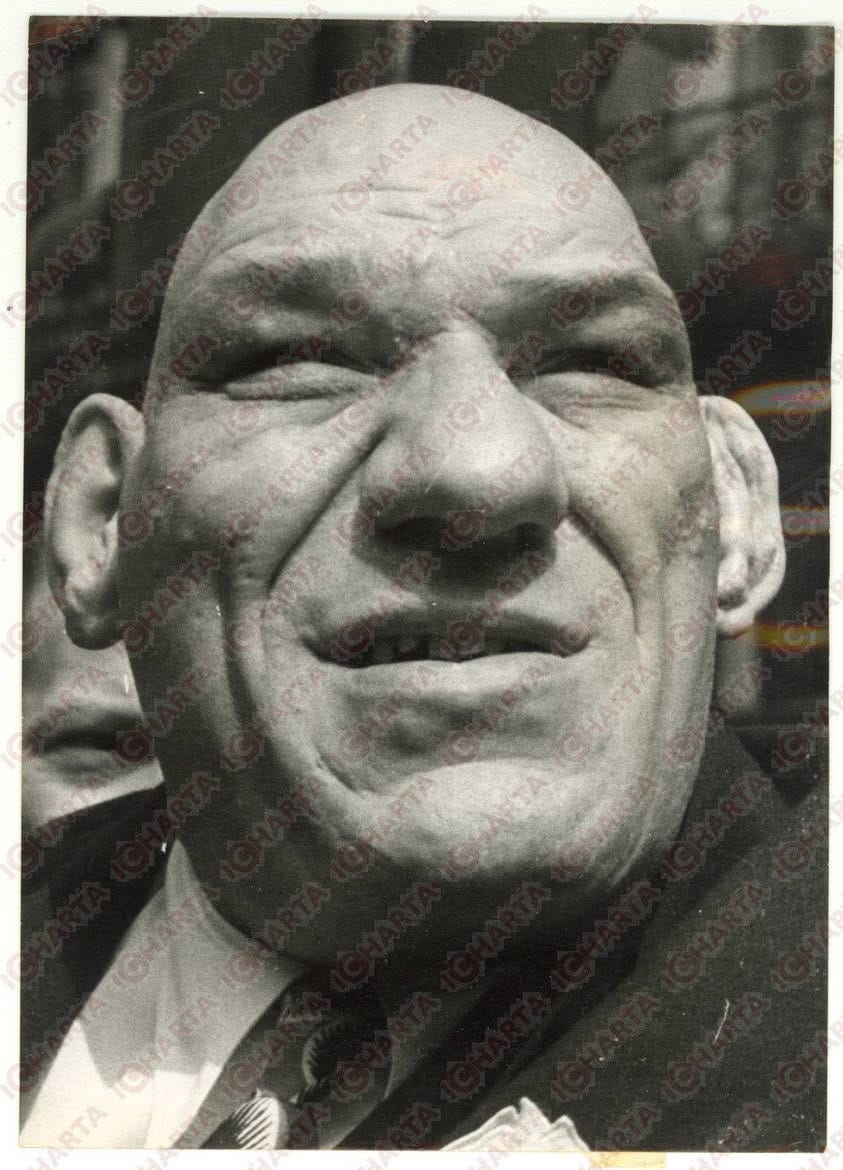
Maurice Tillet\The French Angel 9-4-1954 at the age of 50
Jess Westergaard 9-4-1956 at the age of 74

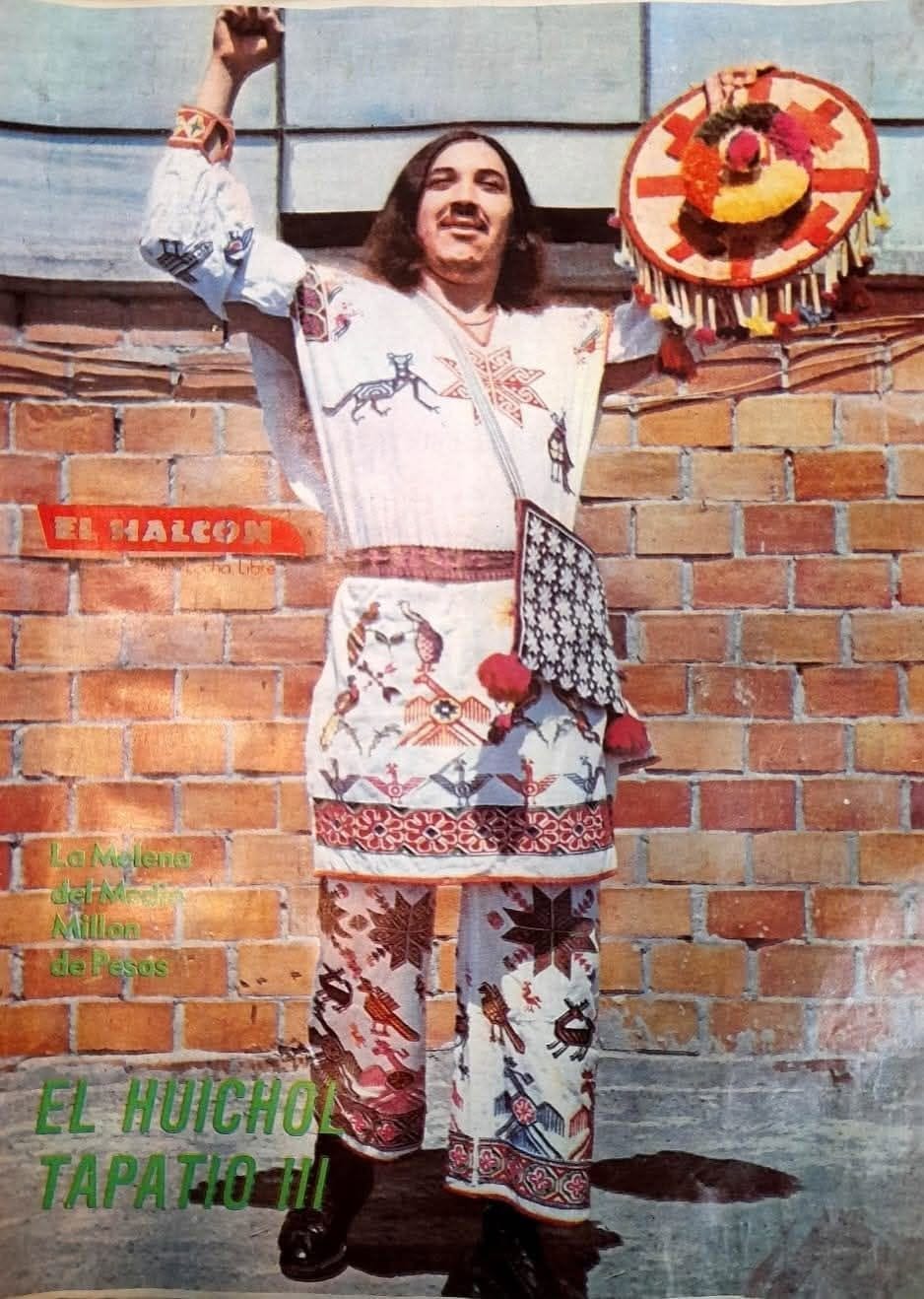
Huichol (Saúl Carrillo), 9-4-2025 at the age of 67
The Life and Career of The French Angel
Maurice Tillet was born on October 23, 1903, in the Ural region of the Russian Empire, to French parents whose work had carried them far from home. His father was a railroad engineer; his mother was a teacher of languages. The boy they raised was, by every surviving account, ordinary in the most fortunate sense: slim, fair-haired, quick-minded, with a face so regular and gentle that those around him called him “the Angel.” That childhood nickname would follow him for the rest of his life, first as affection, later as irony, and finally as the brand under which he became one of the most recognizable professional wrestlers of the early 1940s.
His father died while Maurice was still young. In 1917, as revolution tore through Russia, his mother took him west to France and settled in Reims, where she taught at a women’s college. The move saved them from the collapse of the old order and placed the boy in a world of classrooms, languages, and Catholic schooling. He absorbed languages with unusual ease; later publicity would claim he spoke as many as fourteen, a figure that may be inflated but that at least reflects a genuine polyglot gift inherited from his mother. He attended Saint-Stanislas in Paris and later studied law at the University of Toulouse. He was also an athlete. Rugby suited him: he played well enough to be named to an all-France side in 1926 and, after a match in London, shook the hand of King George V, a memory he liked to mention.
Then the body he had taken for granted began to change. In late adolescence—accounts vary between seventeen and twenty—he noticed swelling in his hands, feet, and head. Physicians diagnosed acromegaly, almost always the result of a benign pituitary tumor that floods the body with growth hormone after the long bones have already closed. Height does not explode; bone thickens. The forehead advances. The jaw lengthens and juts. The nose and ears enlarge. The hands become massive. The voice deepens and roughens as the vocal cords thicken. Tillet’s head grew so large that later observers measured it at more than seven inches from ear to ear; his hands, it was said, could shuffle three decks of cards at once. The disease is not only a matter of appearance. It brings pain, joint damage, sleep disturbance, and, over time, strain on the heart.
The diagnosis closed the career he had prepared for. A law degree in hand, he judged that courts and clients would not accept a man whose face and voice so violently contradicted the image of a avocat. He entered the French Navy instead and served about five years as an engineer on surface ships and in the submarine service, rising to chief petty officer. When he left the service he tried acting, working as a studio doorman and taking small parts, including a bit as a bar patron in Princess Tam Tam with Josephine Baker. He later said, with characteristic dryness, that film success required luck, money, and talent, and that he had been short of all three.
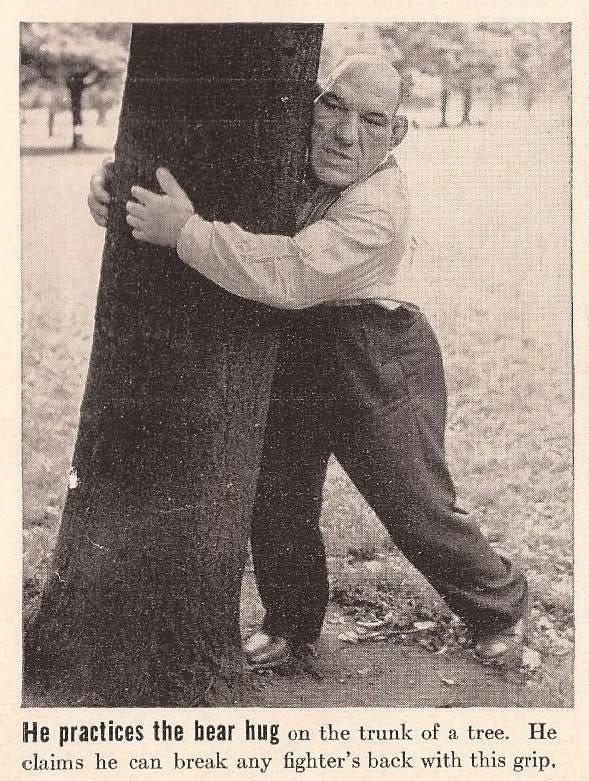
In February 1937, in Singapore, he met Karl Pojello, a Lithuanian wrestler of real skill and even greater commercial instinct. Pojello saw in Tillet’s face not a misfortune but a fortune. Professional wrestling in that era lived on contrast: handsome heroes against grotesque villains, science against brute force, civilization against something older and darker. Tillet, who knew Greco-Roman wrestling but not the catch-as-catch-can style of the professional rings, was taken to Paris and trained. Pojello beat him easily in their first gym session. The pupil learned quickly. His finishing hold became the bear hug, a simple, crushing clasp that made use of his strength and unusual bulk. He stood only about five feet seven or five feet eight and weighed in the neighborhood of 270 pounds, a compact, barrel-chested figure rather than a giant. The disproportion of head and hands did the rest of the work.
He wrestled in France and England as “The Angel,” reclaiming his mother’s name. Crowds came as much to look as to watch. In Nottingham and Manchester, tens of thousands paid to see the face that publicity compared to a horse’s head or a remnant of prehistory. Then war closed the European circuit. In 1939 Tillet and Pojello crossed to the United States.
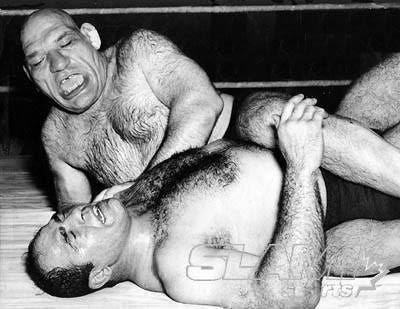
Boston promoter Paul Bowser understood immediately what he had. In 1940 he billed Tillet as The French Angel and put him in the main event. The American debut at Boston Garden, against Luigi Bacigalupi, was theater as much as sport: Tillet came down the aisle, leaned over the ropes, and roared at the crowd. Harvard scientists measured his head. Newspapers called him the world’s ugliest man, the ogre of the ring, a living Neanderthal. The bookings treated him as unstoppable. For nineteen months he did not lose. From May 1940 to May 1942 he held the American Wrestling Association World Heavyweight Championship in Boston; he also held the Montreal version in the spring of 1942 and recaptured the Boston belt briefly in August 1944. He worked against the era’s names—Ed “Strangler” Lewis, Man Mountain Dean, Joe Savoldi, Lou Thesz, Steve Casey—and he drew. In a business that had been softening, he filled buildings.
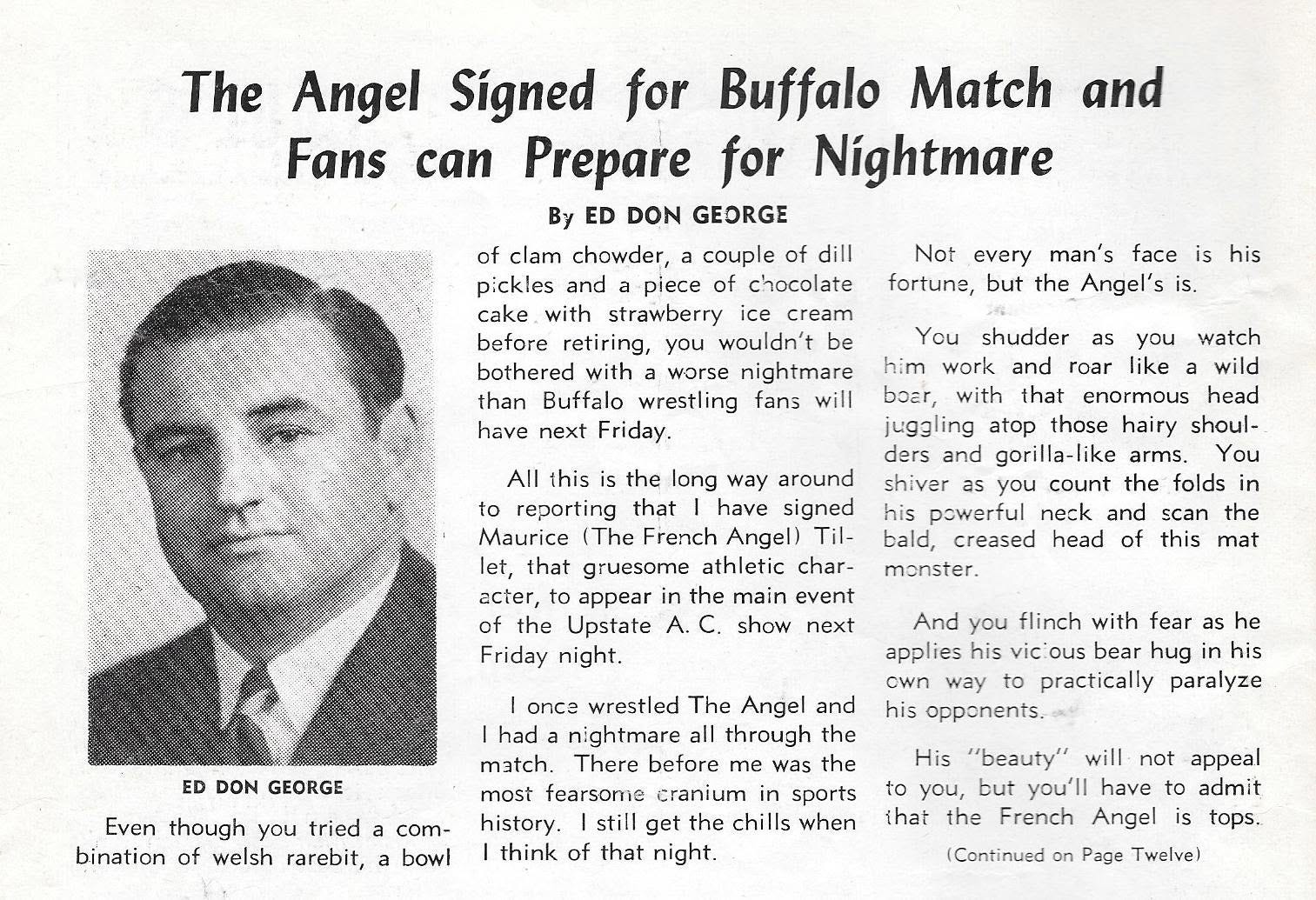
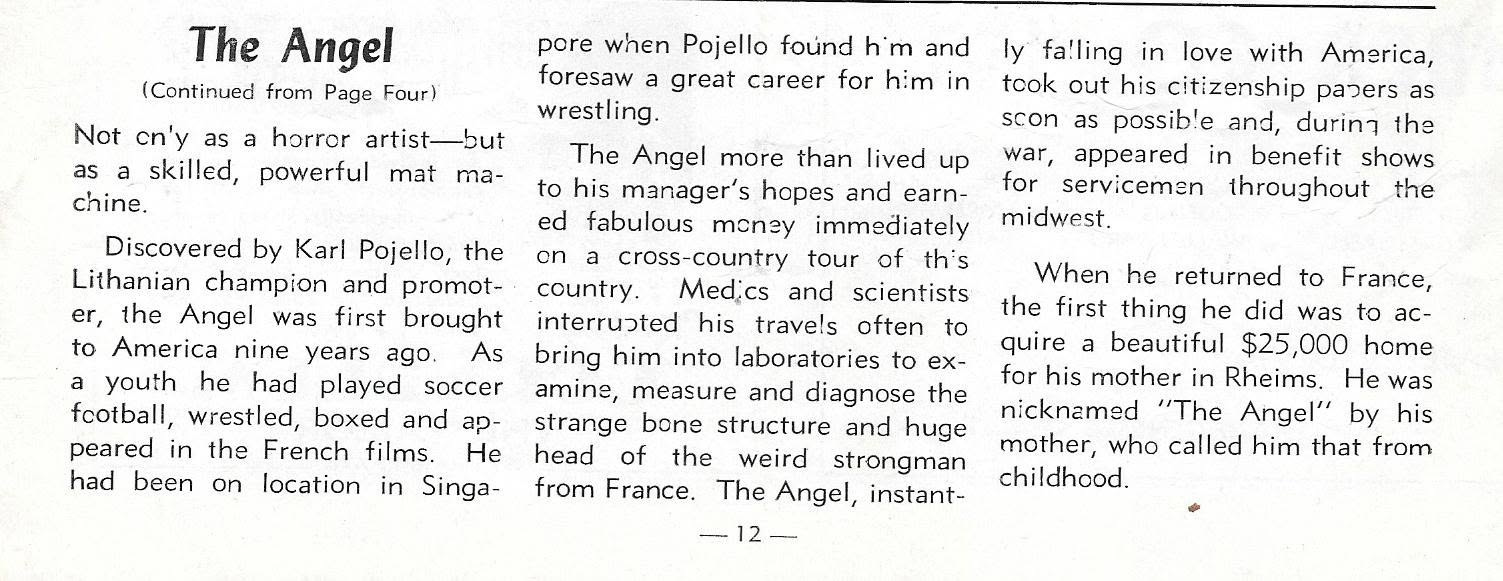
Success produced imitators. Promoter Jack Pfefer in particular flooded the territory with other “Angels”: a Swedish Angel (Phil Olafsson, who also had acromegaly), a Super Swedish Angel (Tor Johnson, later famous for Plan 9 from Outer Space), Russian, Canadian, Polish, Czech, Irish, Golden, and Black Angels, even a Lady Angel. Tillet, who regarded “Angel” as his mother’s gift rather than a gimmick to be licensed, was angry enough that one meeting with Pfefer ended with a slap. He became The French Angel to distinguish himself from the copies.
The man inside the billing was not the monster on the posters. Contemporaries who knew him off camera described a shy, bookish, sensitive person who read widely, spoke several languages, wept at opera, and preferred a small circle of friends. A Chicago sportswriter in 1949 called him an apelike creature whose mind “soars to the higher planes, leaving his face on a Cro-Magnon cave floor,” and noted that he could cry over Marguerite in Faust as readily as he cauliflowered an opponent’s ear. Lou Thesz remembered him as stiff and slow in the ring but “a lovely man.” He played chess with a Massachusetts businessman named Patrick Kelly. He was a practicing Catholic and, in 1947, was received in audience by the Pope. That same year he became a United States citizen. He had tried to enlist in the U.S. Army in 1942 and was turned away on the ground that he would be a curiosity and a distraction. When he learned that the French Navy had scuttled a ship to keep it from the Germans, he wept.
Chicago became home. Tillet, Pojello, and Pojello’s wife Olga lived in a mansion at 726 West Garfield Boulevard, occupying adjoining rooms and renting out the rest. The arrangement was both household and business. Wrestler Tony Borne later said that fifty cents of every dollar Tillet earned went to Pojello; Tillet, he added, did not seem bitter. The two men were bound by more than money. Pojello had invented the career; Tillet had made it pay. They stayed together until the end.
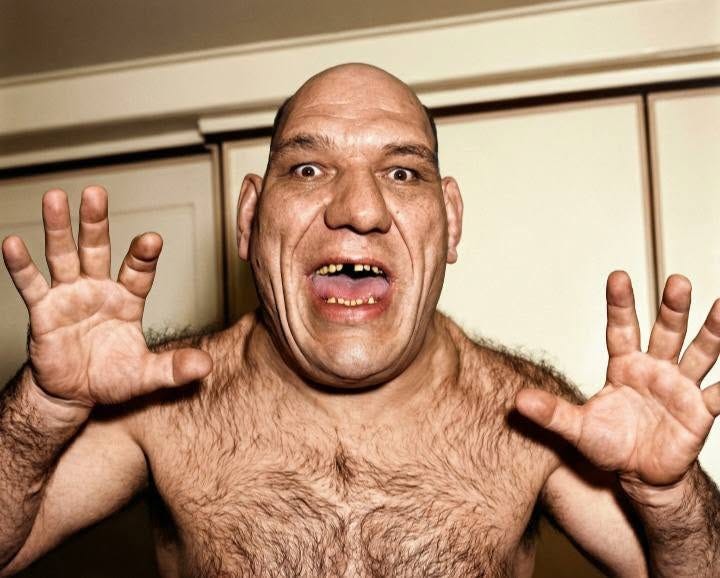
By 1945 the body that had been an asset was failing. Acromegaly does not pause. Tillet was no longer advertised as unbeatable. He jobbed to younger stars, traveled on diminishing strength, and coached partners to help him up if he went to a knee. His last match was on February 14, 1953, in Singapore, a loss to Bert Assirati that he accepted as the close of the act. In 1950 the French-born Chicago sculptor Louis Linck, a friend, made plaster busts of him. One stands today in the International Museum of Surgical Science in Chicago, dedicated to “my old friend, Maurice (The Angel) Tillet.” Near the end of his life, fellow wrestler Bobby Managoff took death masks—three casts of the face. One went to the York Barbell collection; others passed through Patrick Kelly to wrestling museums.
On September 4, 1954, Karl Pojello died of lung cancer. Tillet, already weakened by pneumonia and an enlarged heart, was told the news, collapsed, and died of a heart attack about thirteen hours later, at fifty. They were buried side by side in the Pojello family plot at the Lithuanian National Cemetery in Justice, Illinois. The stone reads, “Friends Whom Even Death Couldn’t Part.” Tillet’s face is on the marker.
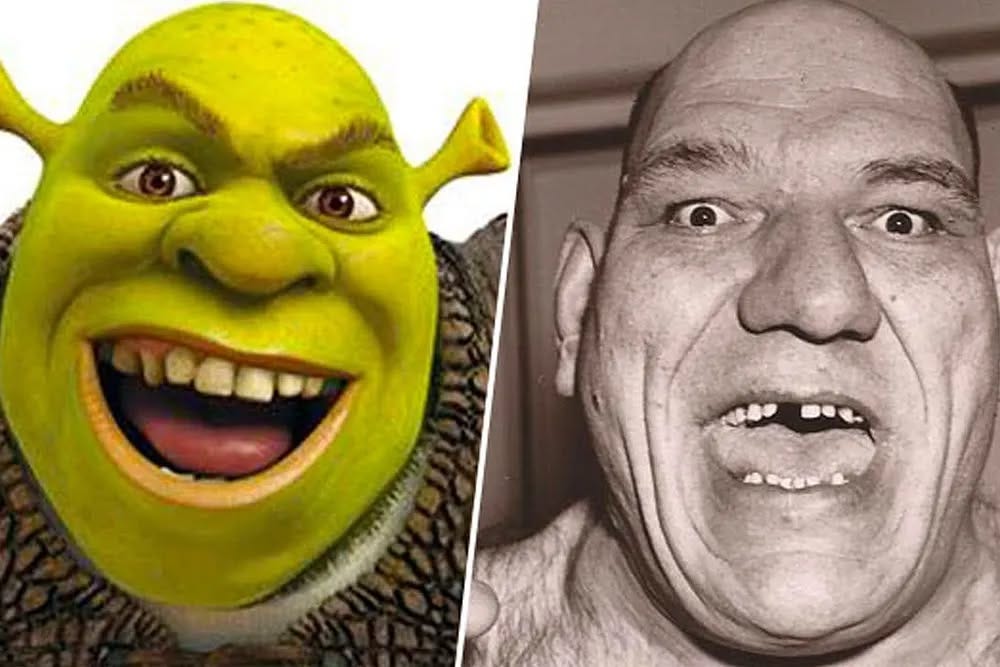
After 2001 a new afterlife attached itself to the old photographs. When DreamWorks released Shrek, viewers noticed the heavy brow, broad nose, rounded skull, and almost tender ugliness of the ogre and set them beside pictures of Tillet. A story grew that animators had seen a death mask at the York museum and used it as a model. DreamWorks has never confirmed the claim. William Steig’s 1990 picture book, the source of the film, predates any such studio visit, and fact-checkers have found no documentary link. The resemblance is real enough to keep the rumor alive; the evidence is not. What the comparison does reveal is how completely Tillet’s face escaped the ring and entered a kind of folk iconography, standing in for the idea that a monster can be gentle, and that gentleness can wear a monstrous face.
His proper legacy is narrower and more solid. He was a two-time world heavyweight champion in a major American territory, a box-office engine in the years before television remade the sport, and the prototype for a whole school of “freak” attractions that wrestling has never abandoned. In 2012 he was inducted into the Professional Wrestling Hall of Fame. The bust in Chicago remains a medical specimen and a portrait of a friend. The grave in Justice remains a statement about loyalty.
Tillet’s life is easy to reduce to a moral: do not judge by appearances; the angel was inside the ogre. That reading is not false, but it is incomplete. He was also a man who used the very thing that had closed his first professions as the instrument of a second. He studied law and could not practice it; he acted and could not star; he served at sea and was later told he was too strange for an army. Wrestling paid him to be looked at and, for a few peak years, paid him handsomely. He accepted the contract without pretending it was dignity, and he kept, offstage, the privacy, the books, the languages, and the one friendship that defined his adult life. When that friendship ended, so did he. The French Angel was a gimmick. Maurice Tillet was the person who survived inside it for as long as the body allowed.
One Thing I Learned About Jerry Jarrett
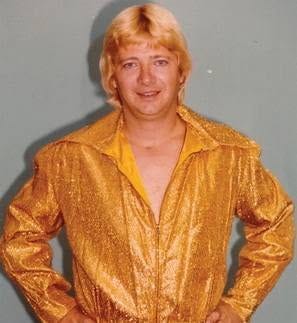
One of the more surprising and little-known details about Jerry Jarrett is that, according to wrestler Steve Keirn, while working as a purchasing agent at the Murray Ohio Manufacturing Company (a bicycle and lawn-equipment maker) in the mid-1960s, he played a role in developing the extended “banana seat” that became a signature feature of many popular bikes of that era.

Thank You for Watching and Listening
I’m Tony Richards, Pro Wrestling Historian, Author and Storyteller. I share pro wrestling historical items in each issue of the Time Tunnel Pro Wrestling History Newsletter and each episode of our podcast show. Thanks for your support! If you enjoy my information on select events, matches and insights, please share with folks you think might like to be a subscriber!
Remember, Premium subscribers get access to exclusive and special content such as some special issues including a multi-part deep dives on wrestling territories, wrestler bios and championship title histories, special audio and video interviews on territory pro wrestling and more available in the Pro Wrestling Time Tunnel for Premium Subscribers. Being a Premium Subscriber also means you support me in my efforts to document Pro Wrestling History through my research, writing, books, vidoes and podcasts. And…I have something very special planned for our Premium Subscribers on the Podcast side of things in 2026! Details soon here in the Pro Wrestling Time Tunnel.