


Today’s Favorite Quote: The greatest pleasure in life is doing what people say you cannot do - Walter Bagehot
Happy Birthday to those who have passed on and to those great wrestlers still with us:
In Memoriam:
Nick Gulas 1914
Ike Eakins 1916
Jim LaRock 1924
Steve Rickard 1929
Kat LaRoux 1964
Happy Birthday:
Spiros Arion (86)
Tj Perkins (42)
Mariana Komlos\Mrs Cleavage (37)
RIP Memorial: We stop & remember those who have passed on this day and gave themselves to the business for us, the fans. We salute you and thank you.
Samuel Thomas Hesser\Mighty Jumbo 9-3-1974 at the age of 51

The Life and Career of Spiros Arion
Spiros Arion, born Spyridon Manousakis, was one of the great international drawing cards of mid-century professional wrestling: an Egyptian-born Greek powerhouse who became a folk hero to Greek immigrant crowds in Australia, a Madison Square Garden main-eventer opposite Bruno Sammartino, and, after decades of relative obscurity among English-language fans, a 2025 Wrestling Observer Newsletter Hall of Fame inductee.
His career stretched from a 1961 Paris debut through Australia’s World Championship Wrestling, two distinct World Wide Wrestling Federation runs, stadium shows in Athens, and a late British claim to a world heavyweight title. He was billed around 6 ft 5 in and 285 pounds, worked as both a charismatic babyface and a vicious heel, and carried the nicknames “The Golden Greek” and “The Iron Greek.”
What follows is a full account of that life and career, including the persistent confusions over his real name, his mentor, and even whether he was still alive.
Early Life: Cairo, Athens, and the Greco-Roman Mat
Spyridon Manousakis was born on September 3, 1940, in Cairo, Egypt, to Greek parents Stavros and Konstantina. He spent his early childhood in Egypt’s large Greek expatriate community and, as a teenager in the 1950s, migrated with his family to Athens as part of the broader repatriation of Greeks from Egypt after the Suez Crisis and Egyptian nationalization policies.
In Athens he excelled in Greco-Roman amateur wrestling. Sources describe a naturally large, strong, and charismatic young man who made an early mark on European mats. Some later write-ups claimed he competed at the 1960 Rome Olympics; that claim appears in secondary wrestling histories but is not corroborated by standard Olympic records and should be treated as unverified ring lore.
His professional path ran through two mentors. In Greece he trained under veteran Greek heavyweight champion Andreas Lambrakis, a dominant figure in Athenian wrestling from the 1930s through the mid-1960s. Promoters billed the young Manousakis as Lambrakis’s “son,” sometimes as Arion Lambrakis, a kayfabe relationship that later caused lasting identity confusion. He then went to Paris for professional training under French wrestler André Bollet (also spelled Andre Bollet or André Bolet) and debuted in 1961.
The billing as Lambrakis’s son, plus later database aliases such as Andres Labrakis and Arion Manousakis, is why older directories sometimes list the wrong legal name. The best-supported identity is Spyridon Manousakis, ring name Spiros Arion.
Europe and Greece, 1961–1965
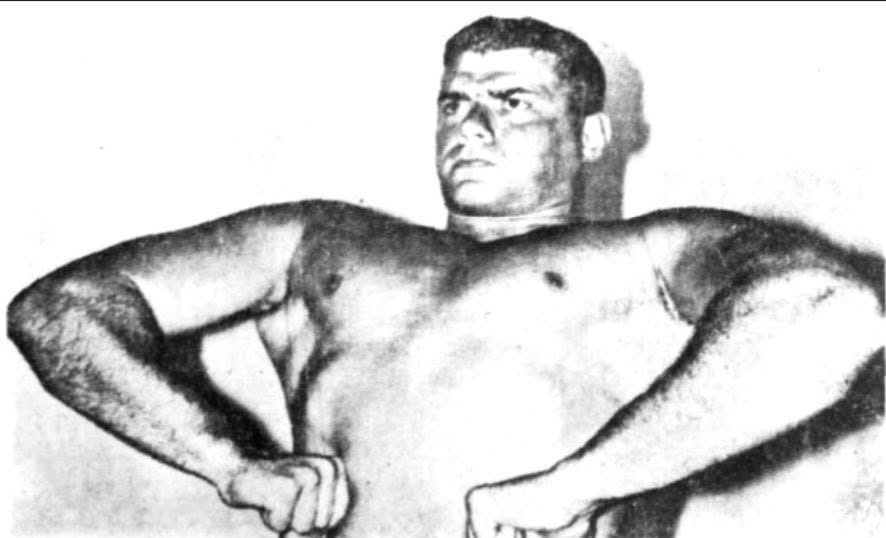
Pictured: Arion in 1963
After the Paris debut Arion worked the European circuit for several years. Parallel to those tours, research by historian Phil Lions shows he was already a significant attraction in Greece by 1963—two years before his Australian explosion. By 1965 he was co-headlining stadium cards; a May 30, 1965, show at Apostolos Nikolaidis Stadium that included Arion versus Ski Hi Lee is recorded at 15,000 fans, tying for one of the largest Greek and European crowds of the 1960s.
By 1966 he was positioned as Greece’s top homegrown star and drawing houses comparable to his Australian averages. In 1969 a heated program with George Gordienko produced attendances of 10,000, 12,000, and 10,000, and culminated in what Lions identifies as the first cage match in Greek wrestling history. He continued returning: a 1974 main event with Mark Lewin drew 10,000, and a July 1979 Athens card featuring Arion and Kostas Safakas against Stan Polanski and Monty Swan also drew 10,000, among the largest Greek houses of the late 1970s.
Those numbers matter because they undercut the idea that Arion was “only” an Australian territorial star. He was a stadium attraction in his ancestral country as well.
Australia: The Golden Greek, 1964–1978
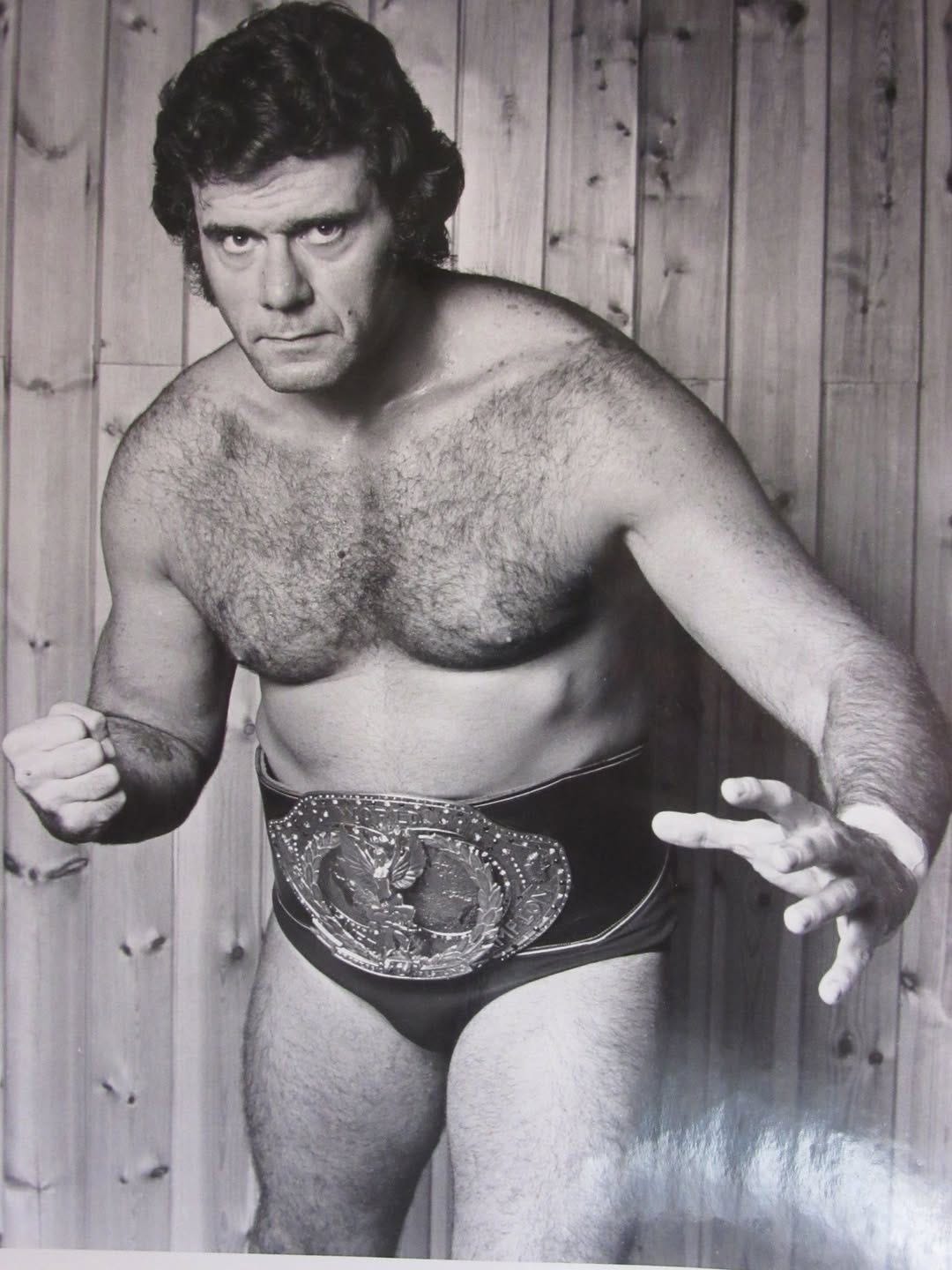
Jim Barnett and Johnny Doyle signed Arion to World Championship Wrestling specifically to reach Melbourne’s large postwar Greek community. He arrived in July 1964 (some Australian listings date the first tour to 1965) as “The Golden Greek” and became one of the most beloved wrestlers in the country’s history.
Thousands of Greek Australians packed Festival Hall in Melbourne on Saturday nights. The Greek-Australian newspaper Neos Kosmos later compared his local stature to that of Hulk Hogan in a later era. Historian Libnan Ayoub, in 100 Years of Australian Professional Wrestling, recorded average arena attendances around 9,000 during Arion’s early WCW stints, an increase over the already strong houses of Dominic DeNucci’s first run. Dave Meltzer, citing conversations with Barnett, later ranked Arion as WCW’s second-biggest long-term draw under Barnett’s ownership, behind DeNucci and ahead of Mario Milano.
In 1965 he captured the IWA World Heavyweight Championship, defeating Killer Kowalski on August 6 in one of the documented title changes, and also won the IWA World Tag Team Championship. He finished 1965 as champion, dropped the belt to Kowalski, and regained it. In 1966 he defended against the 400-pound King Kong Czaja. Other documented IWA world title wins came over Karl Gotch, The Destroyer, Gorilla Monsoon, and Killer Karl Kox.
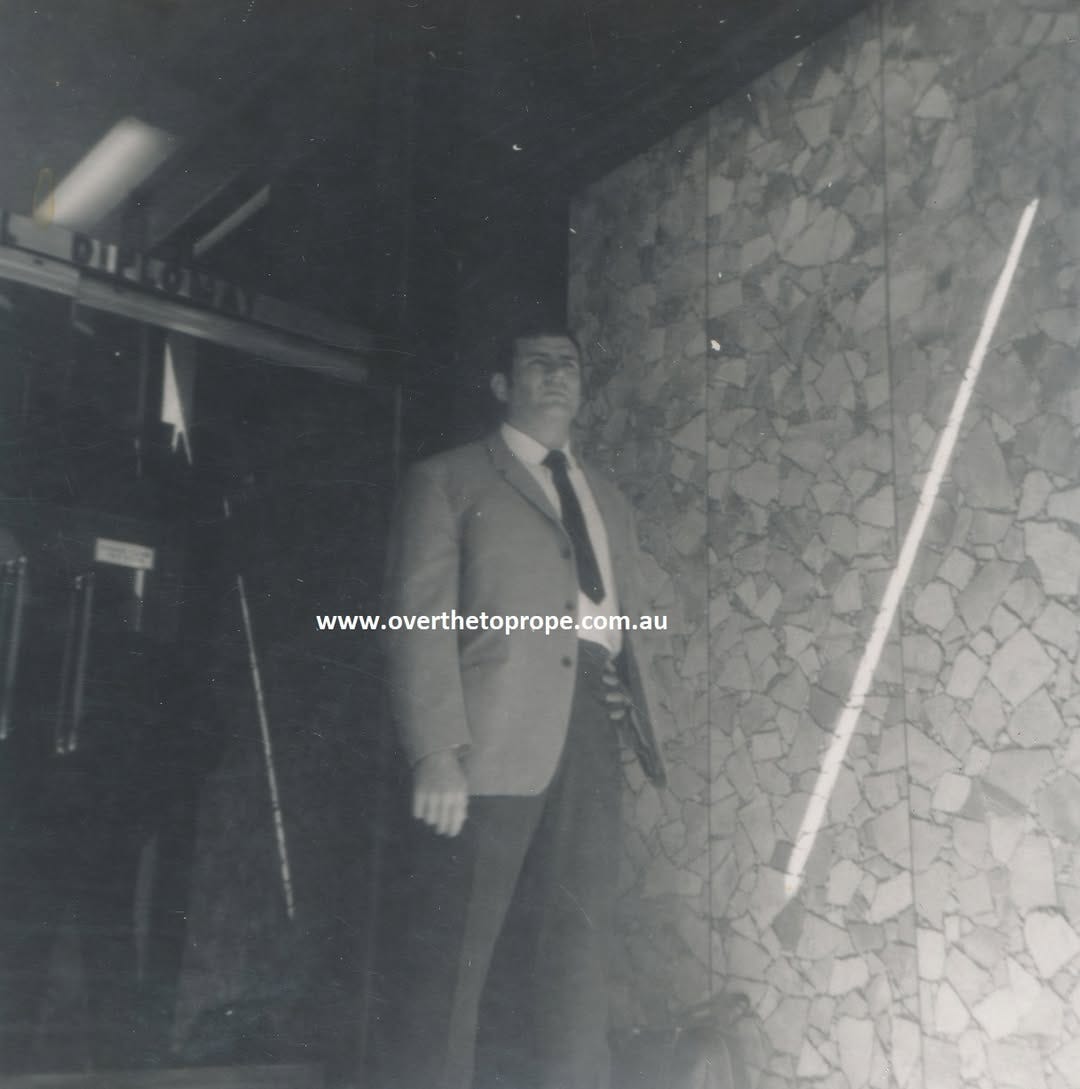
Pictured: Spiros Arion outside the Diplomat Hotel in Kings Cross, Sydney, Australia
**Photo credit: Libnan Ayoub
Title counts vary by database. Cage Match and Wikipedia list six IWA World Heavyweight reigns; AustralianWrestling.org lists five; some narrative histories say he held “the World title about ten times” across the first fourteen years of Australian WCW. The safest statement is that he was a multiple-time, and likely record, IWA World Heavyweight Champion, with five or six well-documented reigns and additional short or poorly dated changes in older Australian records.
He also held the IWA World Tag Team Championship twice, with Mario Milano and with Mark Lewin.
When Barnett aligned with the NWA and abandoned the IWA World title around 1971, WCW created the Austra-Asian Heavyweight Championship. Arion was recognized as the inaugural champion in 1972 and held that belt multiple times (Cage Match lists four Austra-Asian heavyweight reigns; Australian sources often say three), defeating names such as Killer Karl Kox, Bulldog Brower, and Brute Bernard. He and Lewin also held the Austra-Asian Tag Team Championship.
His Australian peak as a talking, bloody main-event babyface came in 1973 during “The War”: the People’s Army versus Big Bad John’s Army. The angle produced violent arena and television matches and, by multiple accounts, WCW’s most profitable year. Arion was one of the principal faces of the People’s Army. In 1974 he wrestled NWA World Heavyweight Champion Jack Brisco to a double count-out.
A brief 1966 jump to George Gardiner’s rival Big Time Wrestling, while Arion was still a WCW champion, still drew about 9,000 in Sydney without television—evidence that his name alone moved tickets. He continued touring Australia into 1976 and made a later appearance listed for 1985.
First WWWF Run: Tag Champion with Sammartino, 1966–1967
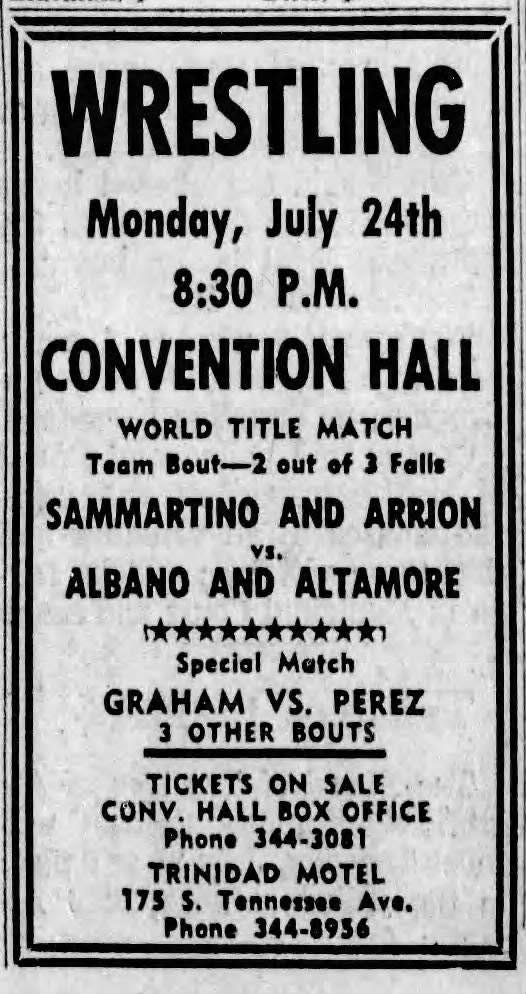

Pictured: July 24th, 1967 Atlantic City, New Jersey
Arion’s Australian heat translated immediately in Vincent J. McMahon’s World Wide Wrestling Federation. He debuted in 1966 and, in only his second match on U.S. soil, won the WWWF United States Tag Team Championship with Tony Parisi (Antonio Pugliese) by defeating Baron Mikel Scicluna and Smasher Sloan on Washington, D.C., television.
They were never beaten for the belts. When Parisi left, his half of the title went to Arnold Skaaland in June 1967, beginning Arion’s second reign. On July 10, 1967, The Sicilians—Lou Albano and Tony Altomare—took the titles. Arion then teamed with world champion Bruno Sammartino; on July 24 they beat The Sicilians in two straight falls and became the final U.S. Tag Team Champions before the belts were deactivated because WWWF policy would not allow Sammartino to hold both the world and tag titles.
As a babyface Arion defeated or main-evented against Dr. Bill Miller, Bob Orton Sr. (as Cowboy Rocky Fitzpatrick), Gorilla Monsoon, Johnny Valentine, Crazy Luke Graham, The Sheik, George Steele, and others. With Sammartino he main-evented Madison Square Garden twice against Monsoon and Professor Toru Tanaka: a disqualification loss, then a Texas Death rematch won two falls to one. In this period he was the clear number-two babyface under Sammartino and a particular draw among Greek fans in the Northeast.
His finishing sequence in this era included the atomic drop and a backbreaker variously called “the hotseat” or “the Greek backbreaker.” Later databases also list a diving knee drop and a bear hug.
Heel Turn, Blassie, and the Sammartino Trilogy, 1974–1978
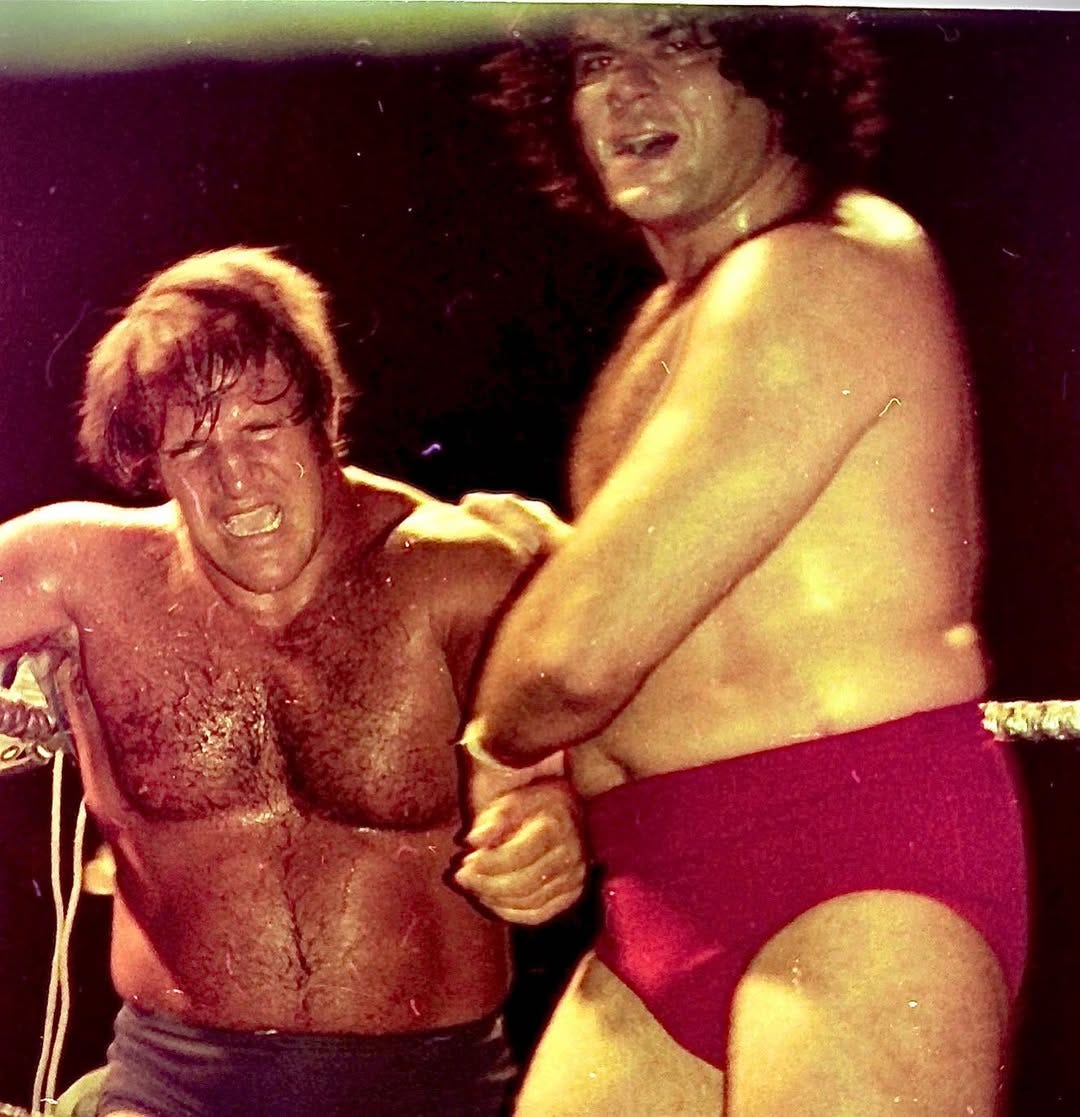
After years back on top in Australia, Arion returned to the WWWF in 1974, again as a babyface, this time partnered with Chief Jay Strongbow. They were building toward a tag title shot at the Valiant Brothers when the angle flipped. During a singles match in which Arion lost by disqualification to Killer Kowalski after Strongbow’s interference, Arion turned on his partner, aligned with “Classy” Freddie Blassie, and became one of the most hated men in New York.
The heat was physical and theatrical. Arion and Blassie attacked Strongbow, ripped his ceremonial headdress, and shoved feathers in his mouth. Arion then pinned Strongbow in arenas across the territory. To get Sammartino’s attention he destroyed Bruno’s protégé Larry Zbyszko in minutes at Madison Square Garden; Sammartino ran in afterward to stop further punishment.
The resulting program with Sammartino produced three Madison Square Garden matches in 1975:
• February 17, 1975: a non-title or disputed finish (count-out/disqualification accounts vary) with no title change.
• March 17, 1975: a Texas Death Match that Pro Wrestling Illustrated named Match of the Year. Sammartino won.
• A third “Greek Death Match” in which Sammartino forced Arion to submit to punches in the corner.
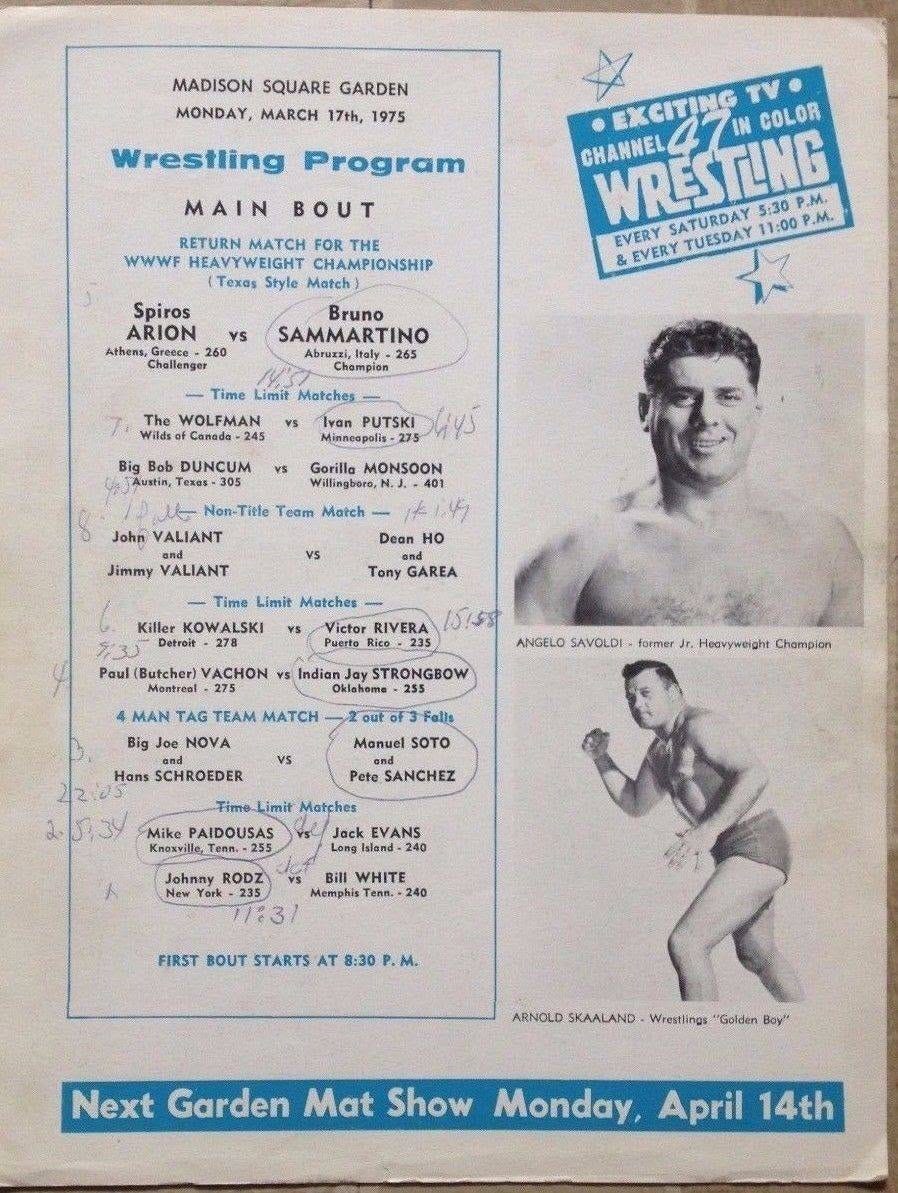
All three Garden shows sold out. One also overflowed into the Felt Forum, making it the biggest wrestling attendance of 1975 and, according to Meltzer, an indoor professional wrestling attendance record at the time. Meltzer has argued that, for a stretch, the Arion program was Sammartino’s biggest New York feud before the later Superstar Billy Graham and Larry Zbyszko programs.
Arion left the WWWF in early 1976, returned late in 1977, and in 1978 teamed with fellow Blassie charge Victor Rivera. After a television taping in Hamburg, Pennsylvania, a male spectator stabbed Arion in the chest as he left the ring with Blassie—an ugly measure of how thoroughly the heel run had worked. He also figured in the famous angle in which High Chief Peter Maivia turned on Bob Backlund during a tag match involving Arion and Rivera.
LISTEN AND WATCH:
More about the Bruno Sammartino\Spiros Arion matches in 1975, check out Episode 11 of The Pro Wrestling Time Tunnel History Shows with me and Steve Gennerelli:
Episode 11, WWWF 1975 with Steve Gennerelli
Episode 22: WWWF Territory Summer 1975
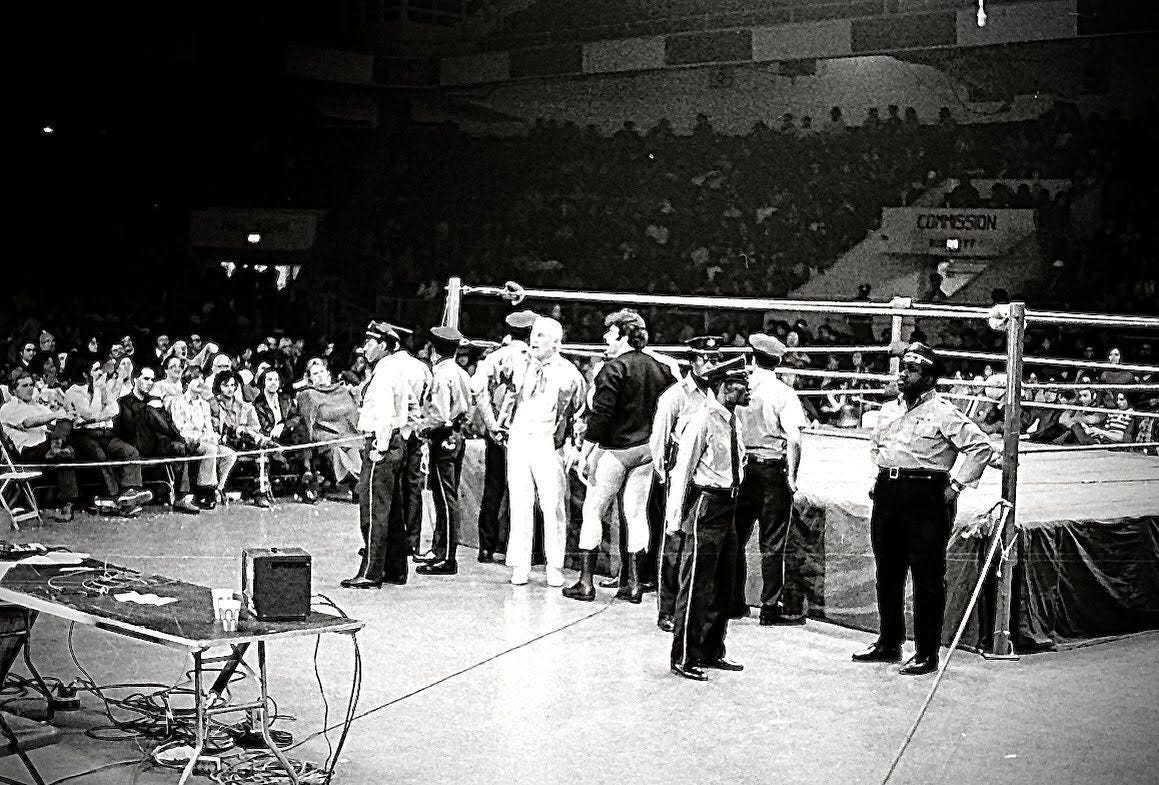
Pictured: Freddie Blassie and Spiros Arion surrounded by police and security at a TV Tapin at the Philadelphia Arena in 1975
Britain, South Africa, and the End of the Line
Arion left the WWWF for good in 1978 and worked England and South Africa. In 1979 Joint Promotions billed him as “The Iron Greek” and as holder of a Mountevans Rules World Heavyweight Championship—the British press treating him as the first foreign world heavyweight champion in the territory since Lou Thesz in the 1950s. He made televised defenses against Colin Joynson, Lee Bronson, and Romany Riley, then lost the title to Wayne Bridges at a sold-out Royal Albert Hall. The original plan had been to put over Big Daddy; when that fell through, the loss built Bridges as a British-born world champion. The title continued in Joint Promotions and All Star Wrestling until Bridges retired with it in 1990.
Most sources place his effective retirement in 1979 or 1980, at about age 39. AustralianWrestling.org lists a 1985 Australian tour and a 1985 retirement date, suggesting at least one late appearance.
Style, Persona, and the Problem of the Record
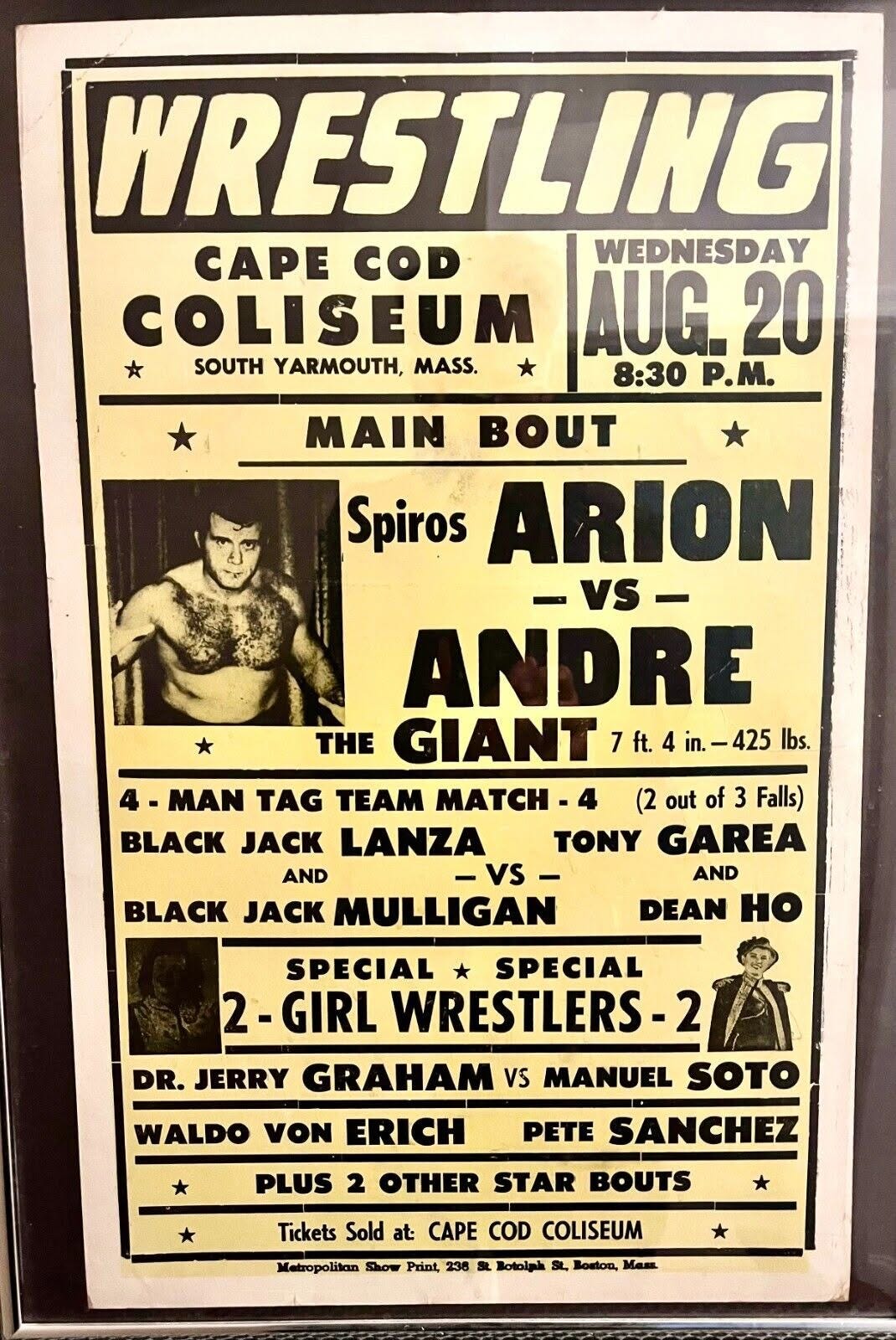
Pictured: Card promoting Arion vs Andre the Giant at the Cape Cod Coliseum, August 20th, 1978
Arion’s appeal was a blend of Greco-Roman legitimacy, size, and promo skill. Australian and American writers both note that he could talk, which made him unusually valuable in a bloody 1973 war angle and as a Blassie heel. Footage that survives is weighted toward his slower mid-1970s WWWF work; the peak Australian title matches and the reported 60-minute draws with Jack Brisco are largely lost, which long hurt his reputation among voters who judge by tape.
Identity problems compounded the neglect. Because he had been billed as Andreas Lambrakis’s son, some encyclopedias and even a Greek-language page treated “Andres Labrakis” as his real name. When Lambrakis died in 1997, several English-language sources—including the Phantis wiki—incorrectly reported that Arion had died in May 1997 at age 57. Historian Libnan Ayoub dispelled that by speaking with Arion in Australia.
A later independent wrestler, Alex Arion (“The Golden Greek”), adopted the tribute name on the New England independent scene and in early Ring of Honor; he is a different person.
Later Life and Hall of Fame Recognition
After leaving the ring Arion kept a low public profile. Ayoub confirmed he was living in Australia; other summaries place him in Greece. Online comments attributed to a Spiros Arion in Hobart, Tasmania, have been noted but not independently verified as the wrestler. Wikipedia, updated into 2026, still lists him as living, age 85 as of September 2025.
His championship ledger, compiled across sources, includes:
• IWA World Heavyweight Championship (Australia) — multiple times (commonly 5–6 documented; some Australian accounts say as many as 10)
• IWA World Tag Team Championship — 2 times (Mario Milano, Mark Lewin)
• NWA Austra-Asian Heavyweight Championship — inaugural champion; 3 or 4 reigns
• NWA Austra-Asian Tag Team Championship — 1 time (with Mark Lewin)
• WWWF United States Tag Team Championship — 3 times (Tony Parisi, Arnold Skaaland, Bruno Sammartino); final champions
• Joint Promotions Mountevans Rules World Heavyweight Championship — 1 time
• Pro Wrestling Illustrated Match of the Year — 1975, versus Bruno Sammartino, March 17
• Wrestling Observer Newsletter Hall of Fame — Class of 2025
The Observer induction was not a courtesy nod. After 15 years on the ballot, Arion led the entire 2025 class with 78.0 percent of the vote in the Rest of the World category, a 32-point year-over-year jump, and would have fallen off the ballot had he failed to reach 50 percent. The same class included CM Punk, Cody Rhodes, Sabu, Gran Hamada, Dorrell Dixon, Bobby Bruns, and Raoul Paoli.
That vote finally aligned the historical record with what Australian live crowds, Greek stadium crowds, and three sold-out Madison Square Garden houses had already said in the 1960s and 1970s: Spiros Arion was not a footnote to Sammartino or a regional curiosity.
He was a transnational main-eventer whose drawing power held up in Melbourne, Athens, and New York, and whose heel turn remains one of the most effective mid-1970s WWWF angles on record.
The Golden Greek’s career is a reminder of how much wrestling history still lives outside the surviving television libraries. The titles, the houses, and the late Hall of Fame vote are what remain when the tapes do not.
One Thing I Learned About Nick Gulas
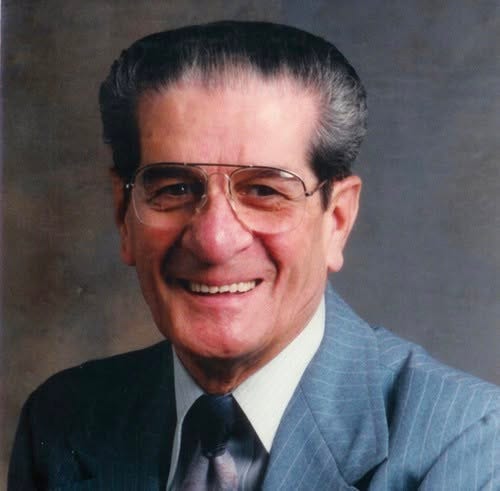
Early in his career, when Gulas was still a low-level “gopher” running errands for the Birmingham office and traveling with the wrestlers, the boys would make him lie on the floorboard of the car and put their feet on him during the long drives between towns.
Some old-timers later claimed this humiliation stuck with him and helped explain why, once he became the powerful “King of the Mid-South,” he earned a legendary reputation for being extraordinarily tight with the payoffs.
Thank You for Watching and Listening
I’m Tony Richards, Pro Wrestling Historian, Author and Storyteller. I share pro wrestling historical items in each issue of the Time Tunnel Pro Wrestling History Newsletter and each episode of our podcast show. Thanks for your support! If you enjoy my information on select events, matches and insights, please share with folks you think might like to be a subscriber!
Remember, Premium subscribers get access to exclusive and special content such as some special issues including a multi-part deep dives on wrestling territories, wrestler bios and championship title histories, special audio and video interviews on territory pro wrestling and more available in the Pro Wrestling Time Tunnel for Premium Subscribers. Being a Premium Subscriber also means you support me in my efforts to document Pro Wrestling History through my research, writing, books, vidoes and podcasts. And…I have something very special planned for our Premium Subscribers on the Podcast side of things in 2026! Details soon here in the Pro Wrestling Time Tunnel.
Excellent write up on Arion Tony