


Today’s Favorite Quote: : It’s impossible to defeat an ignorant man in an argument-William G. MacAdoo
Happy Birthday to those who have passed on and to those great wrestlers still with us:
In Memoriam:
Karl “Doc” Sarpolis 1897
Jos LeDuc 1944
Happy Birthday:
Heigo “Animal” Hamaguchi (78)
Jeff Hardy (48)
Mickie James (46)
Adrienne Palmer\Athena (37)
RIP Memorial: We stop & remember those who have passed on this day and gave themselves to the business for us, the fans. We salute you and thank you.
George “Farmer” Bailey 8-31-1950 0at the age of 67

Billy Raborn 8-31-1968 at the age of 50

Bert Assiratii 8-31-1990 at the age of 82

Karloff LaGarde 8-31-2007 at the age of 79
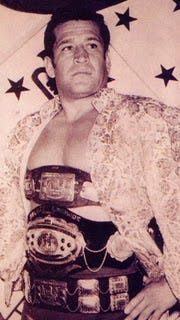
7 Stages of the Territory Era
Stage 7: Distintegration
Year 2 Month 8
August 1986
Stage 7, 1986: August in the Ring
August 1986 was not a quiet month between WrestleMania II and Starrcade. It was the month the World Wrestling Federation proved a single outdoor card in Canada could outdraw most territorial years; the month Jim Crockett Promotions finished a thirteen-city summer tour, flipped the NWA World Heavyweight Championship twice in two weeks, and crowned a new United States Champion in the seventh match of a blood feud; and the month the rest of the North American map kept running while the ground under it shifted. Hulkamania was no longer a New York phenomenon. It was a touring industrial system. Everything else was either adapting to that system or dying in its shadow.
What follows is a territory-by-territory and nation-by-nation account of the wrestlers, programs, and gates that defined those thirty-one days, closed by a business reading of the month as Stage 7 of 1986.
The WWF: Orndorff, Savage, and a Stadium in Toronto
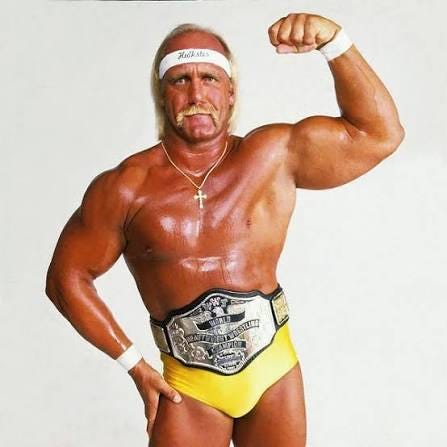
Hulk Hogan entered August as undisputed WWF World Heavyweight Champion. The angle that sold the month was not a new challenger from outside the company. It was betrayal from inside it. Paul Orndorff, “Mr. Wonderful,” had spent the first half of the year as Hogan’s friend and tag partner. By late July he had turned, aligning with Bobby Heenan. House-show main events through August were built almost entirely on Hogan versus Orndorff, usually ending in disqualification so the title stayed put and the rematch stayed hot. They wrestled that way in Minneapolis, Landover, Cincinnati, Rosemont, St. Louis, and, most famously, Toronto.
Randy Savage was Intercontinental Champion, Miss Elizabeth at ringside, already the most complete midcard attraction the company had. Pedro Morales, Tito Santana, and Ricky Steamboat were the men asked to make him look like a problem Hogan would eventually have to solve. The British Bulldogs, Davey Boy Smith and the Dynamite Kid, held the tag titles they had won at WrestleMania 2 and were still defending them in cages against Greg Valentine and Brutus Beefcake. Harley Race, having won the King of the Ring tournament in July, was being crowned on television in August, a royal heel in Heenan’s court. Jake Roberts was moving from novelty (the snake) to featured worker. Roddy Piper, after the boxed circus of WrestleMania 2, was sliding toward the face side of the ledger even as the Saturday-morning cartoon still treated him as a villain.
Two other pieces of August television matter. Championship Wrestling taped its last episode on August 5 in Poughkeepsie. Superstars of Wrestling would replace the old syndicated format in September; the tapings for that changeover happened in Providence and Hartford at the end of the month. And the Machines angle was in full flower: André the Giant, hidden under a mask as Giant Machine, teaming with Super Machine and Big Machine while Heenan insisted everyone could see it was André. It was silly. It also kept André on the road without putting him in a conventional singles program before the company was ready.
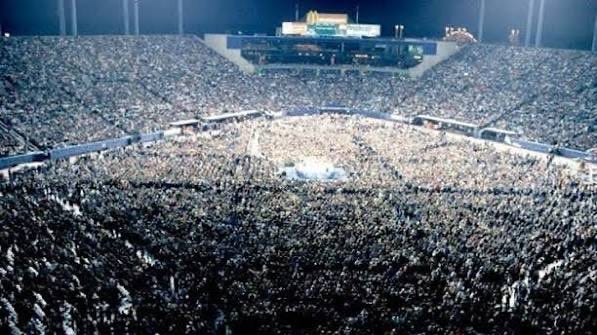
Pictured: Exhibition Stadium, The Big Event, Toronto, Ontario, Canada, August 28th, 1986
The month’s monument was The Big Event on August 28 at Exhibition Stadium on the grounds of the Canadian National Exhibition. Paid attendance was 61,470. Total crowd estimates ran from the mid-sixties to the low seventies. The gate was reported around eight hundred thousand to a million Canadian dollars. Hogan beat Orndorff by disqualification in eleven minutes. The undercard was a touring WWF house show blown up to stadium scale: Killer Bees over the Funks, Muraco drawing with King Tonga, Junkyard Dog against Adrian Adonis, a Snake Pit match for Steamboat and Roberts, Hercules against Billy Jack Haynes, the Dream Team against the Bulldogs, King Kong Bundy against Big John Studd in a sideshow of giants, Harley Race against Pedro Morales. It was not booked like a modern premium live event. It was booked like proof that Hulkamania could fill a football stadium on a Thursday night in another country.
WATCH VIDEO: The Big Event, August 28th, 1986:
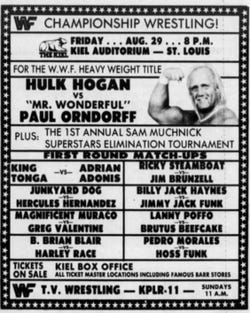
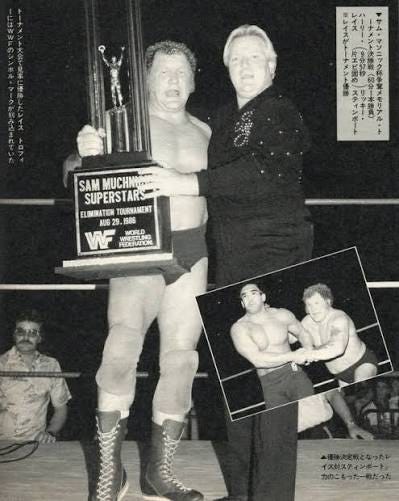
The next night, August 29, the company ran the Sam Muchnick Memorial Tournament at Kiel Auditorium in St. Louis. Harley Race won the tournament over Ricky Steamboat in the final. Hogan and Orndorff went to another disqualification. Race, who always said he would never give in to the WWF machine, found himself working for them in the Summer of 1986 after admittedly losing over six figures trying to stay afloat with the Central States promotion in Kansas City. After taking suck a hit in his bank account, Race gave in and was rewarded by going over in the Muchnick tournament in the second well known market he was identified with, St. Louis.
Its also worth noting as well in New York City, Madison Square Garden on August 25 had drawn more than 22,000. The machine was not resting between television tapings.
It was printing money on the road.
Jim Crockett Promotions and the NWA: Two Title Changes and a Battle for St.Louis
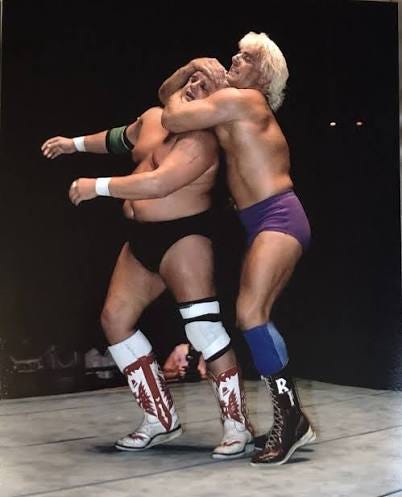
If the WWF’s August was about scale, Crockett’s August was about density. The Great American Bash tour that had begun July 1 in Philadelphia ended August 2 at Fulton County Stadium in Atlanta in front of about 12,000. Ric Flair had defended the NWA World Heavyweight Championship against a murderers’ row of challengers across thirteen cities. Dusty Rhodes had taken the belt from him in a steel cage on July 26 in Greensboro. In Atlanta, Rhodes went over Flair again to close the tour. One week later, on August 9 in St. Louis, Flair got the title back.
In the finish to the match, Rhodes appeared to have the pin, the referee noticed Flair’s foot on the rope, the match continued, and the figure-four ended the reign after two weeks. Gene Ligon was the referee. The angle was done in conjunction with an angle in Kansas City on the same tour where Tully Blanchard injured Rhodes’ knee to re-ignite thier series as the World title series between Rhodes and Flair, that began back at Starrcade 1984 came to a close in August of 1986. The stage was set for the new chapter between Flair and Magnum TA to begin.
Jim Crockett Promotions had the first crack at the St. Louis market in August of 1986 and they fired a major bullet, an NWA World Title change that drew 6,300 fans. When the WWF came to The Gateway City for the Sam Muchnick Tournament later in the month on August 29th, they drew 10,612. The battle had been closer in 1985, but as the Summer of ‘86 rolled on, the gap became substantial especially with Harley Race in the WWF arsenal.
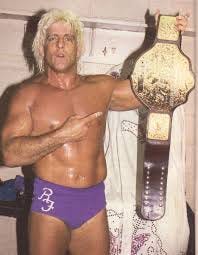
Pictured: Ric Flair backstage with the NWA World Title Belt after winning the championship from Dusty Rhodes, August 9th, 1986 in St. Louis, Missouri
WATCH VIDEO: HIghlights of Ric Flair NWA World Title win over Dusty Rhodes August 9th, 1986 in St. Louis, Missouri:
The Four Horsemen—Flair, Arn Anderson, Ole Anderson, Tully Blanchard, with J.J. Dillon—were the most coherent heel faction in American wrestling. They did not need a stadium. They needed television and a building that hated them.
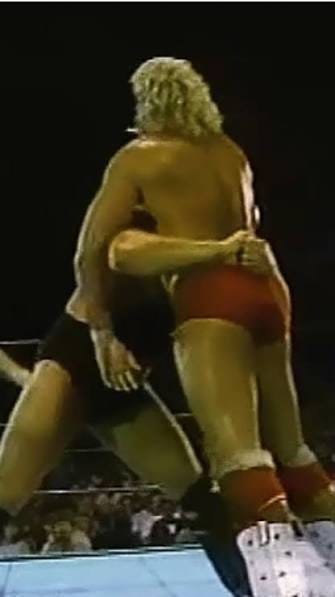
Pictured: Nikita Koloff locks in a bearhug on Magnum TA during their final match in the Best of 7 Series for the US Title in Charlotte, North Carolina in August 1986
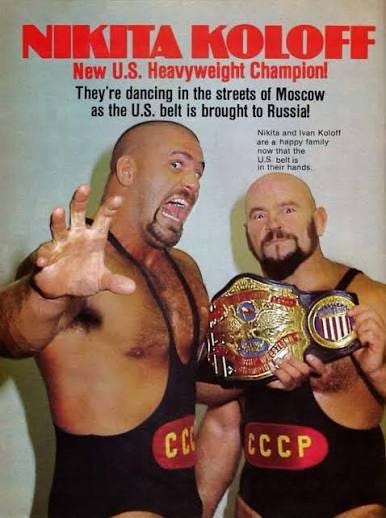
The other championship program that defined the month was Magnum T.A. versus Nikita Koloff for the vacant United States Title. Magnum had been stripped earlier in the year. NWA president Bob Geigel ordered a best-of-seven. The series ran through the Bash and past it. By mid-August they were tied 3–3. On August 17 in Charlotte, Nikita won the seventh match and the title.
Magnum was still the company’s clearest homegrown future world champion. And that program was going to start along with a new series with Jimmy Garvin. The business with Nikita was finished for now. Six weeks later a car wreck would end that future. In August nobody in the territory was booking around absence. They were booking around a man who could main-event against Flair and against the Russians and against the Horsemen and still look like the one who should win.
Magnum TA was the heri apparent.
WATCH VIDEO: Nikita Koloff wins the Best of 7 Series to win the NWA United States Championship over Magnum TA in Charlotte< north Carolina, August 17th, 1986
Tag team wrestling was not a midcard afterthought. On August 16 in Philadelphia, the Rock ’n’ Roll Express—Ricky Morton and Robert Gibson—beat the Midnight Express, Bobby Eaton and Dennis Condrey, two falls to one, and took the NWA World Tag Team Championship. Jim Cornette and Big Bubba Rogers were the heat. The Road Warriors were the wrecking crew that made six-man tags feel like riots. Baby Doll was still in Dusty’s corner, though the television in the second half of the month was already planting the idea that her loyalty was not permanent. World Championship Wrestling on TBS, with Tony Schiavone and David Crockett and Cornette as a guest host who could not stop talking about himself, was the national alternative to Vince McMahon’s product. It looked like a different sport: longer matches, more blood, more factions, less cartoon.
WATCH VIDEO: The Rock N Roll Express defeat THe Midnight Express for the NWA World Tag Team Titles. August 16th, 1986 Philadelphia, Pennsylvania
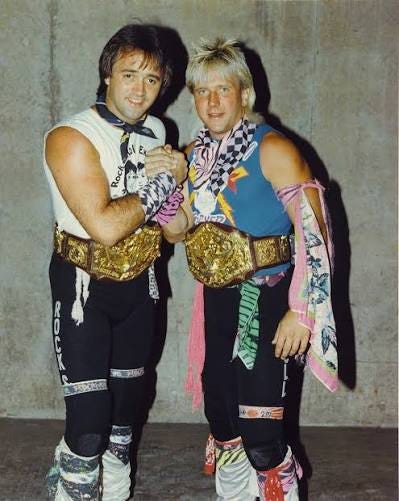
Pictured: The Rock N Roll Express, NWA World Tag Team Champions
Crockett was also running Mid-Atlantic towns on a grind that would have looked familiar in 1978: Greensboro, Norfolk, Fayetteville, Asheville, Roanoke, Macon, Greenville. The difference was that the same wrestlers were now also the faces of a cable show seen far outside the Carolinas.
The Rest of the American Map
The American Wrestling Association was still a name. It was no longer a threat. Nick Bockwinkel held the AWA World Heavyweight Championship after Stan Hansen’s messy departure in June. Verne Gagne’s last match had been June 29. ESPN gave the company a national window it did not have the roster or the production to fill. The talent worth watching was young and already looking at the exits: Curt Hennig, Scott Hall, the Midnight Rockers—Shawn Michaels and Marty Jannetty—Sherri Martel as women’s champion. House shows in Green Bay and Las Vegas at the end of August were not events that moved the industry. They were a promotion spending its inheritance.
World Class in Dallas had left the NWA in February and restyled itself the World Class Wrestling Association. The Von Erich myth was still the product, but the family was broken. Kerry had wrecked a motorcycle on June 4. Mike, back from toxic shock syndrome, had returned July 4 and been plugged into the six-man titles with Kevin and Lance. Lance Von Erich was not a Von Erich. The crowd was asked to pretend. Chris Adams was WCWA World Heavyweight Champion, having beaten Rick Rude on July 4. Buzz Sawyer held the Texas title for part of the month. Bruiser Brody still meant something when he walked through the curtain. On the August 30 television taping, Ravishing Rick Rude worked the Dingo Warrior—Jim Hellwig, not yet the Ultimate Warrior, already moving like a problem. Ken Mantell had already left for Bill Watts and taken bodies with him. World Class in August 1986 was a great television territory living on fumes and family names.
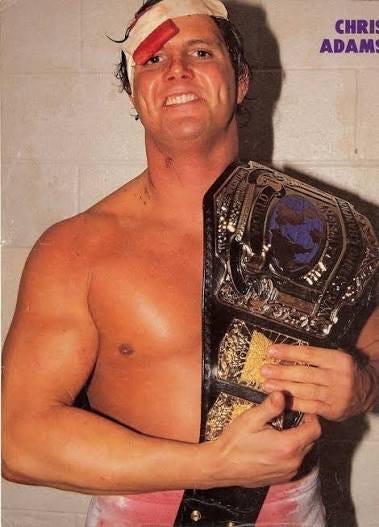
Pictured: Chris Adams, World Class Wrestling Association World Champion
Watts had rebranded Mid-South as the Universal Wrestling Federation in March and was trying to go national on syndication. August was Freebirds month: Michael Hayes, Terry Gordy, and Buddy Roberts against Watts, Ted DiBiase, Terry Taylor, and whoever else the Cowboy threw in. Jim Duggan versus the One Man Gang was the working-class brawl. The tag titles told the future more clearly than the heavyweight picture. The Fantastics, Bobby Fulton and Tommy Rogers, had lost the belts to Eddie Gilbert and Sting on July 20. The titles were held up after an August 17 match. Gilbert and Sting won the rematch on August 31 in Tulsa. Steve Borden was not yet a franchise. He was a painted young heel with a great look and a manager who could talk. Jim Ross was on the calls. Missy Hyatt and Dark Journey gave the shows a soap-opera sheen Watts both used and resented. The UWF was the last serious attempt by an old territorial promoter to beat McMahon at distribution. It would last until the 1987 sale to Crockett.
Memphis, under Jerry Jarrett and Jerry Lawler, kept doing what Memphis did. Lawler was the king of the Mid-South Coliseum. Bam Bam Bigelow was in the mix by early September; the August television and house-show grind still ran on Lawler, Austin Idol, Dutch Mantell, the local tag scene, and the Saturday morning WMC-TV show with Lance Russell and Dave Brown.
Florida Championship Wrestling was a Gordon Solie territory in late middle age, with Lex Luger as the 1986 rookie of the year in the magazines, Barry and Kendall Windham, the Fabulous Ones, and a Battle of the Belts III booked for September 1 in Daytona Beach. Portland, Hawaii’s Polynesian promotion, and the remnants of Central States and Continental still ran towns. They were no longer setting the agenda.
Canada: A Stadium Win and Two Territories in Retreat
The Big Event was a Canadian show in the sense that it happened in Toronto. It was a WWF show in every other sense. Maple Leaf Wrestling as a distinct Tunney promotion had already been absorbed. Ten days after the stadium date the WWF would put 13,000 back into Maple Leaf Gardens for Hogan and Piper against Orndorff and Adonis. That is what a conquered market looks like: the invader runs the fairgrounds and the old building in the same fortnight.
Stampede Wrestling, sold to the WWF in 1984 and bought back in 1985, was in its second life under Bruce Hart. August cards filled the prairie circuit—Calgary, Edmonton, Regina, Lethbridge, Medicine Hat, Red Deer—and the undercard was the point. Owen Hart and Ben Bassarab held the International Tag Team titles. The Viet Cong Express, which included a masked Hiroshi Hase, were the foreign heels. Gama Singh’s Karachi Vice gave the shows a stable. Brian Pillman was in the mix. Chris Benoit was coming. Stampede in August 1986 was a developmental territory that did not yet know it was a developmental territory. It still thought it was a business.
Lutte Internationale in Montreal was in worse shape. The Rougeau brothers and King Tonga had already gone to the WWF. Dino Bravo was preparing to sell his piece and follow. Rick Martel and Gino Brito were trying to hold a French-language promotion together while the Forum dates and the television window slipped. Late-August cards at the Paul Sauvé Arena still had Abdullah the Butcher, Samu, Steve Strong, and the occasional Japanese junior. The direction of traffic was one way.
Mexico: Arena México on Friday Nights
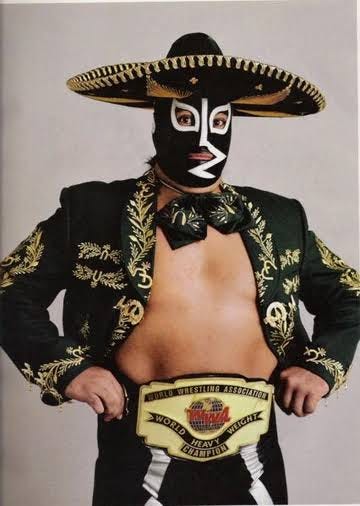
Pictured: Rayo de Jalisco, Jr. NWA World Light Heavyweight Champion
Empresa Mexicana de Lucha Libre did not pause because Hulkamania was selling out Toronto. Friday nights at Arena México and Tuesdays and Sundays at Arena Coliseo were the calendar. On August 15 at Arena México, Rayo de Jalisco Jr. retained the NWA World Light Heavyweight Championship against Máscara Año 2000 with a martinete. The same card, La Fiera beat Babe Face in a hair-versus-hair match. Los Misioneros de la Muerte—El Signo, Negro Navarro, El Texano—were the rudo trio the building wanted to see lose their hair, which is exactly the match EMLL would book for the 53rd Anniversary Show on September 19. El Dandy took the NWA World Welterweight Championship on August 24. Fuerza Guerrera had left the company; the Mexican National Welterweight Title was vacated on August 1. Alfonso Dantés would pick up the Mexican National Heavyweight Title in Acapulco on August 20.
The Universal Wrestling Association ran its own circuit the same month, with Dos Caras as the heavyweight face of that rival office. Lucha libre in August 1986 was not an export product in the WWF sense. It was a capital-city ritual with its own championship lineages, its own anniversary calendar, and a deep enough roster that a title change and a cabellera in the same week did not empty the building.
Japan: Summer Tours, Title Changes, and Two Companies
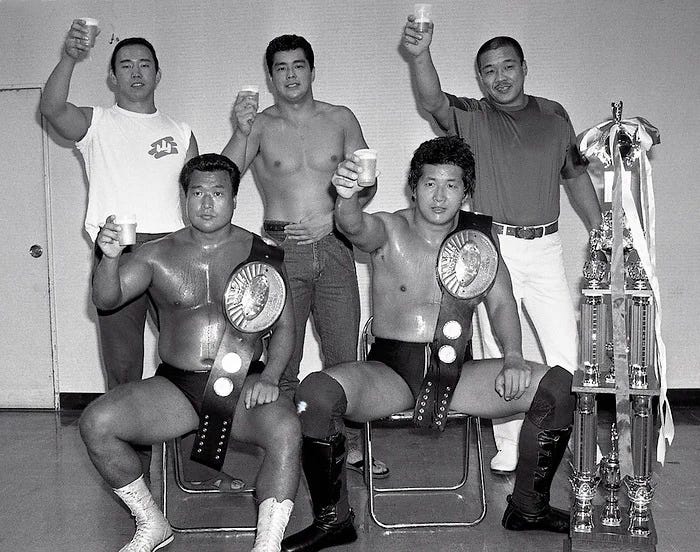
Pictured: Akira Maeda and Osamu Kido, IWGP Tag Team Champions
New Japan’s Burning Spirit in Summer tour spilled into the first week of August and closed in Nagoya on August 7. Antonio Inoki beat Steve Williams in Sakai on August 5. That same night, Akira Maeda and Osamu Kido took the IWGP Tag Team Championship from Tatsumi Fujinami and Kengo Kimura. Nobuhiko Takada was IWGP Junior Heavyweight Champion and defending against Shiro Koshinaka and, later in the month, Black Tiger. Challenge Spirit opened August 29 at Korakuen Hall. The foreign side of the tours included Williams, Bad News Allen, Alexis Smirnoff, and the usual midcard Americans. Keiji Mutoh was on the cards. The junior division was already a second main event.
All Japan was in the middle of Summer Action Series II. Jumbo Tsuruta and Genichiro Tenryu were the heavyweight spine. Riki Choshu, now in All Japan with Yoshiaki Yatsu after the Ishin Gundan exodus from New Japan, was the rival pole. Stan Hansen had taken the NWA International Heavyweight Championship from Tsuruta on July 31 and was the gaijin wrecking ball for the summer. Giant Baba’s office did not chase American television. It chased Budokan and the provinces and the idea that a tag match between Tsuruta and Tenryu and Choshu and Yatsu was a sufficient reason to buy a ticket.

Pictured: Stan Hansen defeats Jumbo Tsuruta to win the NWA International Heavyweight Championship in a title vs title match wih Hansen’s AWA World Title at stake as well
All Japan Women’s ran its own August, including Devil Masami defending the WWWA World Title against Yukari Omori in Kawasaki on August 23. Joshi was a parallel industry with its own champions and its own audience. It barely registered in the American magazines that still treated “wrestling” as a synonym for the WWF and the NWA.
Stage 7: Business Analysis
August 1986 is the month the industry’s new economics became visible without a WrestleMania logo on the poster.
First, scale had separated from tradition.
The Big Event was a house show with a fairground landlord, local radio and beer sponsors, and a world champion who won by disqualification. It drew a paid crowd larger than most territorial promotions would see in a year and a gate that approached a million Canadian dollars. WWF revenue for the full year 1986 would land around $77 million, up from $63 million in 1985 and $29.5 million in 1984. Those numbers were not produced by better wrestling. They were produced by national television, a Saturday-morning cartoon that turned wrestlers into toys, a merchandising operation that sold the T-shirt as hard as the ticket, and a touring loop that could put Hogan in Detroit on the 1st, the Meadowlands on the 4th, Miami on the 6th, and a Toronto stadium on the 28th without changing the match.
Second, the only American promotion that looked like a peer competitor was Crockett, and even Crockett was a different business.
TBS gave JCP a national signal. The Bash tour was an attempt to turn that signal into stadium and ballpark gates in the South and Mid-Atlantic. Twelve thousand in Atlanta to close the tour was a good night and not a Toronto night. The product was superior as wrestling—Flair versus anyone, Magnum versus Nikita, Midnight Express versus Rock ’n’ Roll Express, the Horsemen as a unit—and inferior as a consumer-goods company. Crockett still thought like a territory that had gotten rich. McMahon thought like a company that had gotten national.
Third, the territorial middle was in liquidation even when the buildings were full.
Watts spent real money to put the UWF on stations outside the old Mid-South footprint. Sting and Gilbert as tag champions in late August is a creative success and a financial warning: the promotion was building stars on a national idea it could not afford. The AWA had ESPN and not enough live gates. World Class had syndication and a dying family business. Memphis and Florida could still draw locally because Lawler and Solie’s towns still believed in their local champions. Belief is not a distribution strategy. When the WWF or Crockett wanted a body, they took it. The Rougeaus, Tonga, eventually Bravo, the Road Warriors’ freelance appearances, Magnum’s entire ceiling—every one of those stories is a labor-market story. The old NWA courtesy of not raiding a brother’s city was gone.
Fourth, Canada was not a foreign market. It was the WWF’s easiest annexation.
Toronto proved the stadium model. Montreal proved the talent-raid model. Calgary proved that a promotion could survive as a feeder if it accepted a smaller ceiling. The Hart house still produced wrestlers. It no longer produced a regional monopoly.
Fifth, Mexico and Japan were not behind. They were elsewhere.
EMLL’s August was a championship defense, a hair match, and a runway to the anniversary show. New Japan’s August was an IWGP tag title change and Inoki against a young American who could actually wrestle. All Japan’s August was Hansen and the Tsuruta–Choshu war. Those companies did not need Hulkamania to sell out. They also did not have a path to the American child’s allowance. The globalization of wrestling as a single television product was still decades away. In August 1986 the world was still three worlds that traded talent and ignored each other’s television.
Sixth, risk was concentrating.
Magnum T.A. was the NWA’s next world champion in every conversation that was not about Flair. The seventh match in Charlotte made Nikita the U.S. Champion and left Magnum as the wounded hero who would come back. He would not, not as a wrestler, after October 14. Kerry Von Erich was already on a motorcycle and a clock. Mike Von Erich was back from an illness that should have ended the act. The WWF’s risk was different and mostly legal and medical in slow motion: steroid culture, a crushing travel schedule, a children’s brand built on men who did not live like cartoons. August did not expose those risks. It papered them over with gates.
Seventh—and this is the Stage 7 point—the summer of 1986 was the last moment when a serious person could still argue that the territory system and the national system would coexist.
By Labor Day the evidence was in. One company could put 60,000 people in a football stadium for a disqualification. One company could run thirteen cities in a month and change the world title twice. Everyone else was either a cable alternative, a local habit, a foreign tradition, or a liquidation sale that had not been announced yet. Starrcade in November would be Crockett’s answer, a closed-circuit double site in Greensboro and Atlanta. WrestleMania III was already the next mountain McMahon was going to climb. August was the month in between, when the numbers got too large to ignore and the smaller offices kept taping television as if the map had not changed.
The wrestlers who mattered that month were the ones who could work both maps: Hogan, who had become a consumer product; Flair, who had remained a wrestler; Savage, who was about to become both; Magnum, who was about to be removed from the board; Sting, who did not yet know what he was; Owen Hart and Pillman, who were still learning in Calgary; Rayo de Jalisco Jr., who was defending an NWA title the American offices barely mentioned; Inoki and Tsuruta, who did not need the American offices at all. Professional wrestling in August 1986 was bigger than it had ever been and smaller than it pretended. The big part was in Toronto and on TBS and on Saturday morning. The small part was everywhere else, still selling tickets, still telling stories, already on borrowed time.
Thank You for Watching and Listening
I’m Tony Richards, Pro Wrestling Historian, Author and Storyteller. I share pro wrestling historical items in each issue of the Time Tunnel Pro Wrestling History Newsletter and each episode of our podcast show. Thanks for your support! If you enjoy my information on select events, matches and insights, please share with folks you think might like to be a subscriber!
Remember, Premium subscribers get access to exclusive and special content such as some special issues including a multi-part deep dives on wrestling territories, wrestler bios and championship title histories, special audio and video interviews on territory pro wrestling and more available in the Pro Wrestling Time Tunnel for Premium Subscribers. Being a Premium Subscriber also means you support me in my efforts to document Pro Wrestling History through my research, writing, books, vidoes and podcasts. And…I have something very special planned for our Premium Subscribers on the Podcast side of things in 2026! Details soon here in the Pro Wrestling Time Tunnel.