


Today’s Favorite Quote: Repetition is the mother of learning, the father of action, which makes it the architect of accomplishment-Zig Ziglar
Happy Birthday to those who have passed on and to those great wrestlers still with us:
In Memoriam:
Don Greene 1930
Professor Dale Lewis 1933
Happy Birthday:
Stan Hansen (77)
RIP Memorial: We stop & remember those who have passed on this day and gave themselves to the business for us, the fans. We salute you and thank you.
Steve Gabrukovich\Original Nicoli Volkoff 8-29-2001 at age of 86

Mickey Garagiola 8-29-2010 at the age of 88
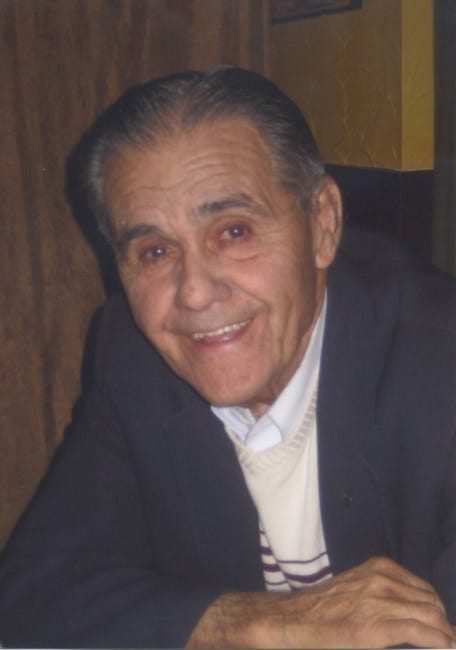
Rey Mendoza, Jr 8-29-2024 at the age of 61

The Life and Career of Mars Bennett
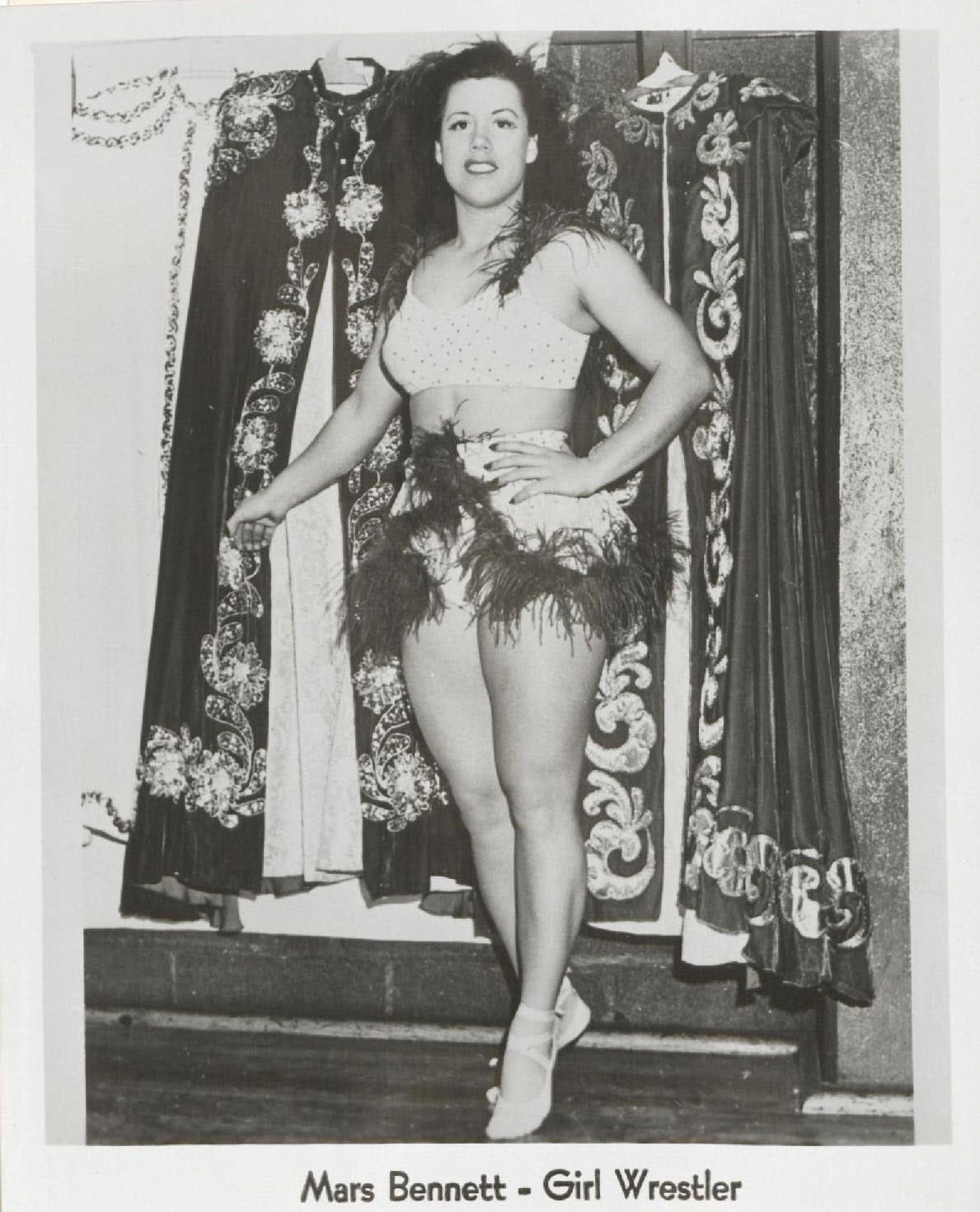
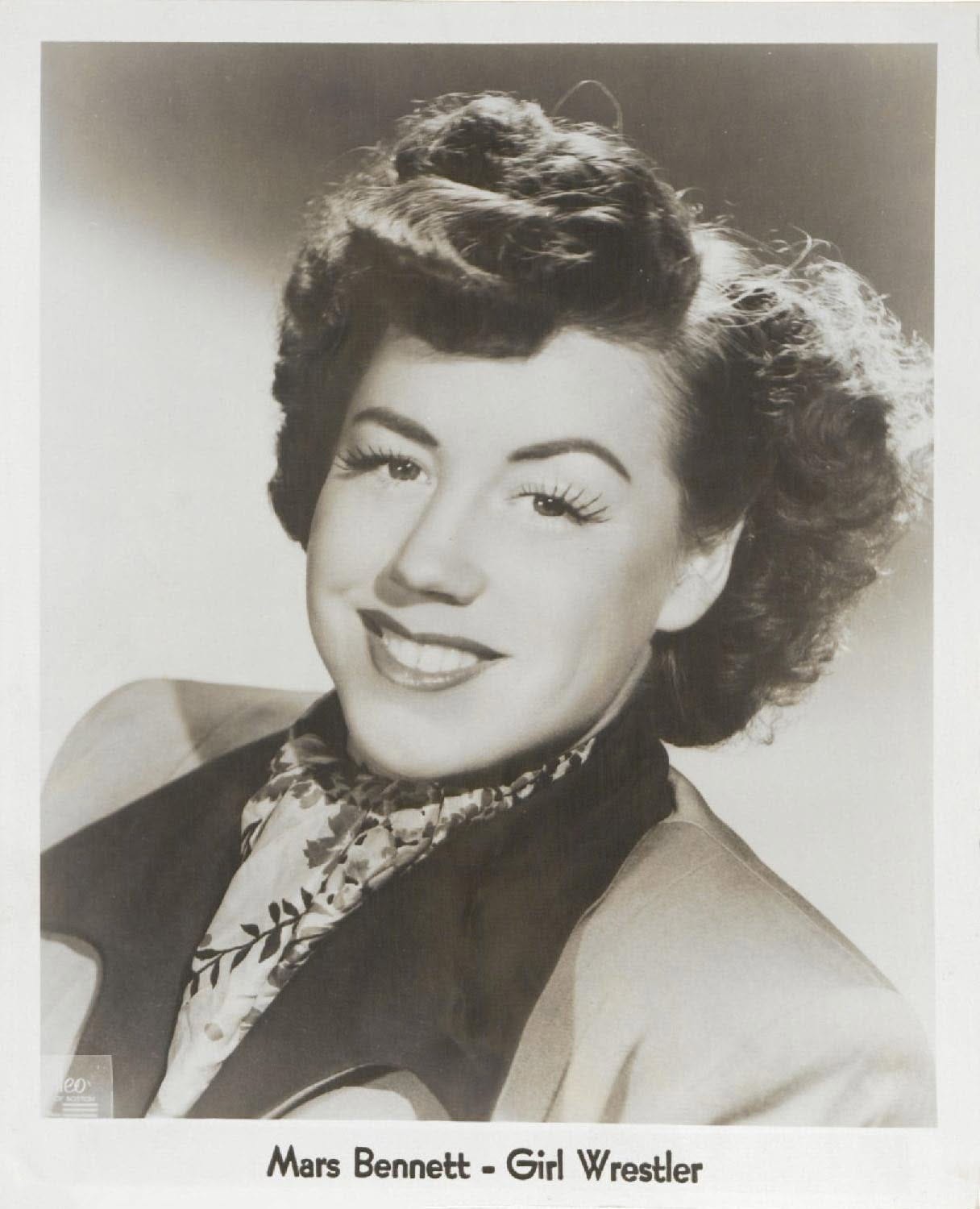
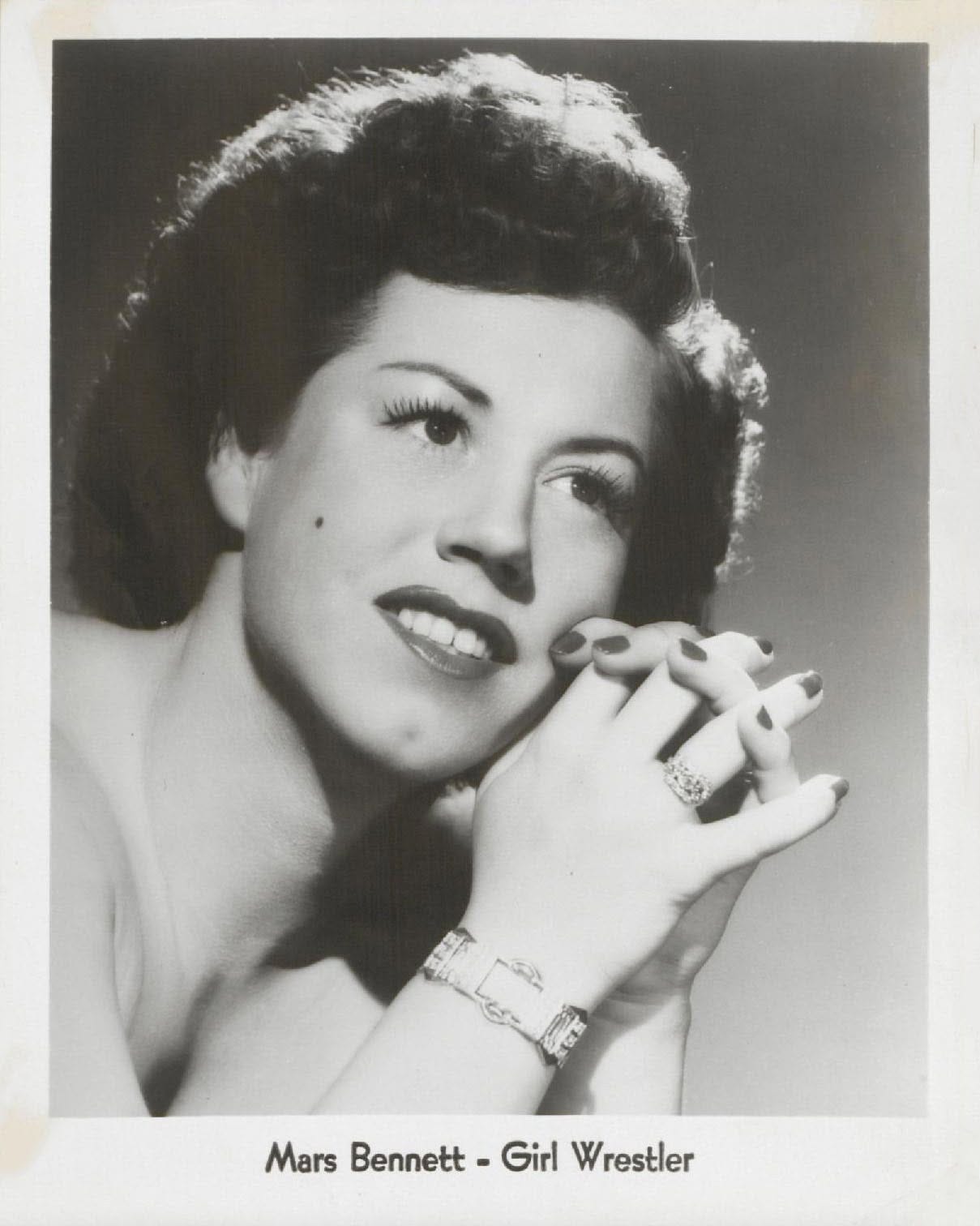
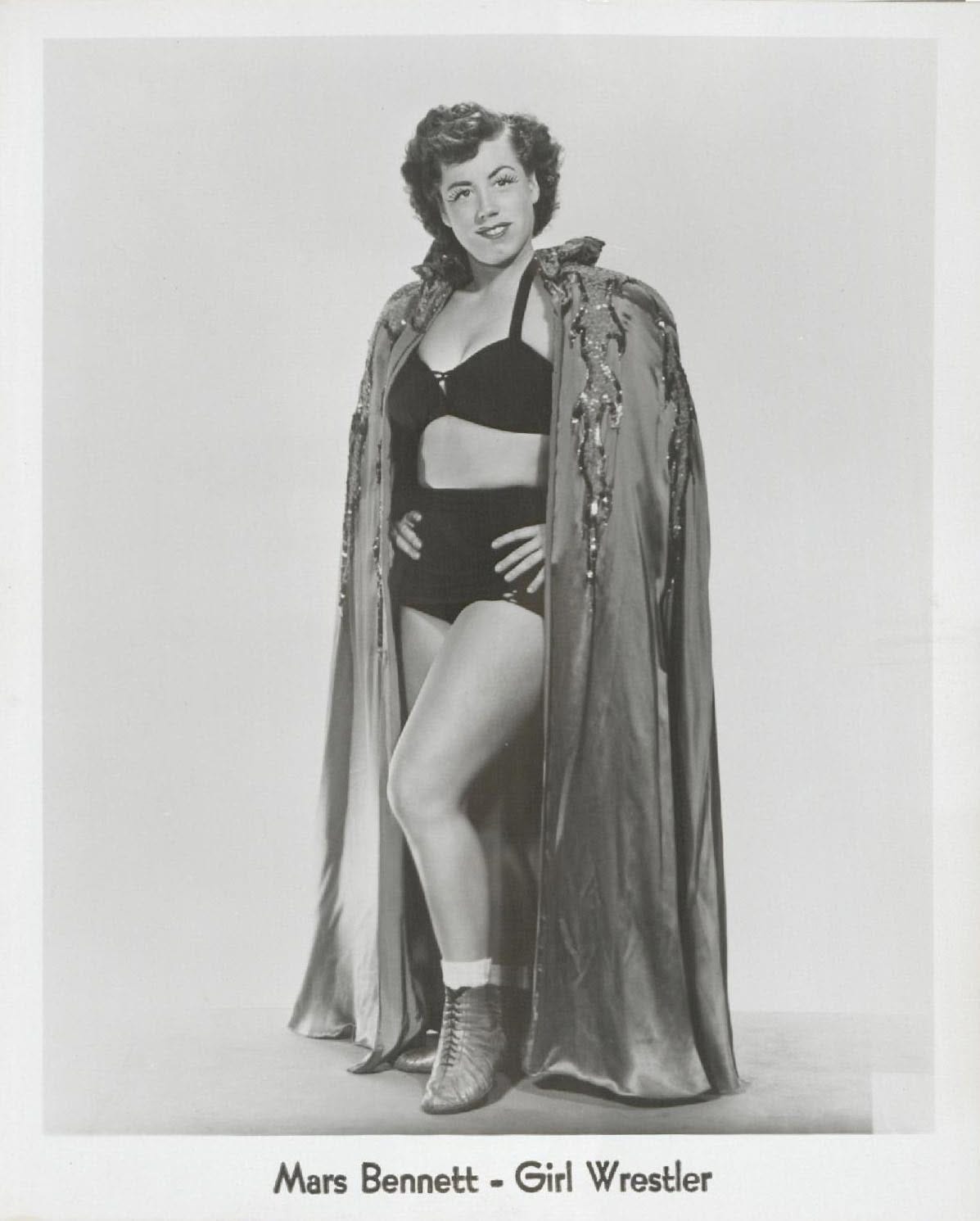
Mars Bennett, born Maude Audrey Foreit on August 3, 1922, in Michigan, lived a life that compressed more adventure into thirty-five years than most people experience in a lifetime. A high-school athlete, wartime factory worker, circus performer, pin-up model, bodybuilder, and professional wrestler, she became known as “The Girl with the Iron Jaw.” Her career ended abruptly on a Tennessee highway in the late summer of 1957, yet the intensity and range of her experiences left a distinctive mark on the women’s wrestling scene of the territorial era.
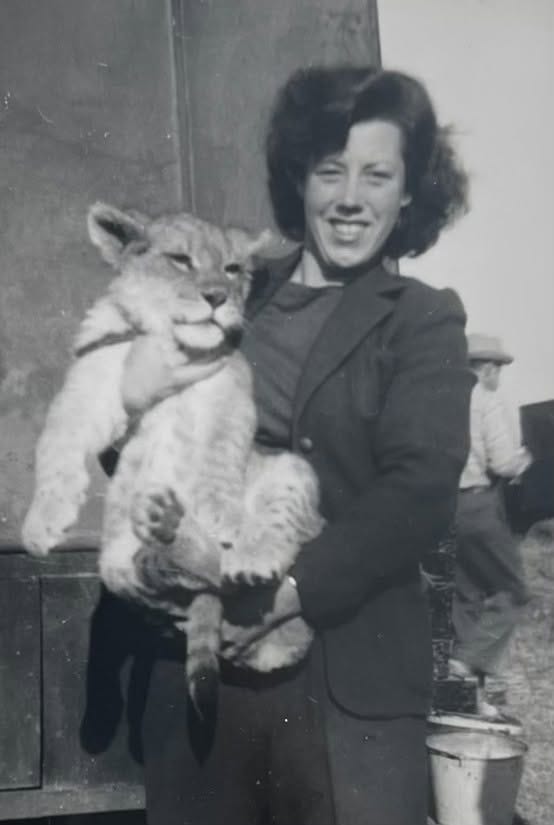
As a teenager she already showed the restlessness and physical confidence that would define her. She excelled in sports, then took a factory job building B-24 bombers during World War II. Disliking her given name, she legally changed it at seventeen to Mars Bennett and set out for the big top. She worked as a clown, animal performer, web girl, and trapeze artist, first with Clyde Beatty’s circus and later with the Ringling Bros. and Barnum & Bailey Circus—the Greatest Show on Earth. The demands of aerial work and the constant travel hardened her body and sharpened her sense of showmanship.
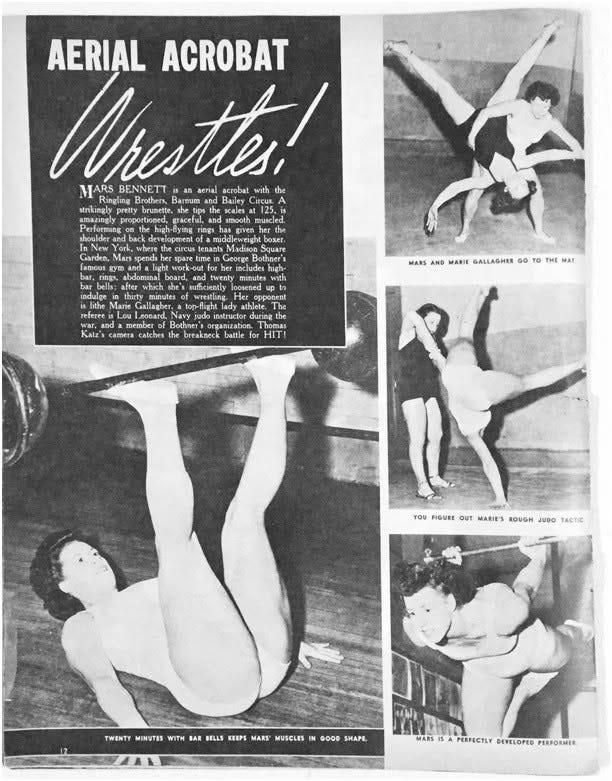
That same physicality drew her into bodybuilding, weightlifting, and boxing. Training at Bother’s Gymnasium in New York City, she caught the eye of magazine photographers and became a favorite of the muscle and “cheesecake” pin-up publications of the late 1940s. Photographs of her lifting men or displaying defined musculature circulated widely, presenting a strong, capable image of womanhood that stood apart from conventional glamour. Mildred Burke and Billy Wolfe recognized the potential in her athletic build and circus background. In 1950 she stepped into the professional wrestling ranks.
For the next seven years Mars Bennett worked the women’s circuits across the United States and into Canada. She faced the era’s top names—Mildred Burke, June Byers, the rising Fabulous Moolah, Mae Young, Cora Combs, Penny Banner, Bonnie Watson, Ella Waldek, Theresa Theis, and others. She competed in two-out-of-three-falls singles, tag matches (often paired with June Byers), battle royals, mixed tags with male wrestlers, and Texas Death Matches. She held the Texas Women’s Championship briefly in early 1951 and the NWA Florida Women’s Championship for three weeks in February–March 1953.
Bennett’s Biggest Opponents
June Byers — partner, opponent, and the closest thing to a running program
This is the best-documented relationship. They met early. In December 1950, Byers beat Bennett in two-out-of-three-falls matches in Joplin, Missouri, and Little Rock, Arkansas. Between those dates Bennett scored a disqualification win over Byers in Little Rock. That pattern—Byers as the more established hand, Bennett as the athletic newcomer who could steal a fall or a DQ—set the tone.
By 1956 the roles had sharpened. Byers was the recognized NWA World Women’s Champion. In mid-May she defended that title against Bennett four times in four days across Texas: Houston (May 18), Waco (May 21), Dallas (May 22), and San Antonio (May 23). The recorded finishes are clean Byers victories, including two-fall sweeps. Those were not one-off house-show fill-ins. They were a concentrated title tour with Bennett as the challenger.
At the same time they were partners. the NWA women’s tag history list June Byers and Mars Bennett as NWA World Women’s Tag Team Champions for one recognized reign, dated around August 15, 1956. In July 1956 they defended that pairing against Penny Banner and Bonnie Watson in Calgary and Edmonton. Banner and Watson took the two-out-of-three-falls matches, including billed tag-title bouts of 15:55 and 26:00.
John Cosper, who wrote biographies of both women, has said they were good friends outside the ring. A rare 36-second clip of the two wrestling each other shows them throwing one another around with real snap—friends working stiff, not strangers going through the motions. That combination—title challenger, tag partner, and personal friend—makes Byers the central “rivalry” of Bennett’s career.
Penny Banner — opponent across the ring from Bennett’s team
Bennett and Banner’s documented clashes are mostly tag matches, not a long singles series. The July 1956 Alberta cards put Banner and Bonnie Watson against Byers and Bennett three times in two weeks. Banner’s side won all three. Banner was already Byers’ most respected singles rival of that period; Byers later named Banner among her toughest opponents. Bennett was the partner Byers brought into that program. In other words, Banner was Bennett’s opponent because Bennett was standing next to the champion.
Banner also appears in the broader women’s-title picture Bennett was circling in May 1956, when Bennett won #1 contendership matches in Texas just before the Byers title defenses. The records do not show a deep Bennett–Banner singles feud, but they show repeated, high-level tag work against Banner’s team at the exact moment Bennett was being used as a world-title challenger.
Slave Girl Moolah (Lillian Ellison, later the Fabulous Moolah) — partner more than rival
The surviving 1953 Texas results put Bennett and Moolah on the same side, not opposite each other. In August 1953 they teamed in Dallas and San Antonio against Daisy Mae, Princess Maritza, and Darling Dagmar in two-woman tags and three-on-two handicap matches. Results went both ways. This is Moolah’s “Slave Girl Moolah” period, still years before the 1956 battle royal that made her the NWA’s dominant women’s champion.
Book blurbs list Moolah among the champions Bennett “went toe to toe with.” That is plausible on the circuit, but the match database that is public today shows them as tag partners in Texas rather than a documented singles program. By the time Moolah became the face of the NWA women’s title in late 1956, Bennett had less than a year to live and was working Mid-America and Florida more than the offices Moolah would later control.
Cora Combs — early Texas opponent and battle-royal peer
The earliest clear singles result is January 4, 1951, in Galveston: Mars Bennett defeated Cora Combs. The same Texas swing has Bennett and Millie Stafford beating Combs and Nell Stewart on January 11 in Galveston, and Combs and Stewart beating Bennett’s side on another card that week. Combs was a regular in Wolfe’s group and later one of the names June Byers herself listed among her toughest opponents (with Penny Banner and Lilly Bitter).
They also shared multi-woman matches. On November 24, 1952, at Ellis Auditorium in Memphis, Bennett won a five-woman battle royal that included Cora Combs, Carol Carota, Donna Marie Dieckman, and Dot Dotson. That is typical of how women’s cards were built: the same core group rotating through singles, tags, and royals rather than one exclusive feud.
Mae Young — named as an opponent; fewer dated singles on the public lists
Cosper’s book and the promotional copy for it state that Bennett wrestled Mae Young. Young was already a veteran when Bennett debuted in 1950 and had been inaugural NWA Women’s Tag champion with Ella Waldek in 1952. Specific dated Bennett–Young singles results are thinner in the public Cagematch extracts than the Byers and Combs dates. That does not mean they never met; it means the surviving newspaper and office records that have been entered online have not preserved a long string of Bennett–Young main events the way they preserved the 1956 Byers title loop.
Young’s place in Bennett’s story is still important. She trained or finished many of the women Bennett worked with, including Byers. She was part of the same Wolfe-era locker room. Battle royals and mixed cards of 1950–53 almost certainly put them in the same building even when a one-on-one result was not written down.
Mildred Burke — the champion who opened the door, and the name used as a comparison
Burke and Billy Wolfe are the reason Bennett got into the business. Promoters used Bennett’s muscular build and resemblance to Burke as a selling point. The standard line in later writing is that Bennett “feared no woman or man” and went “toe to toe” with Burke. That is consistent with how Wolfe booked new athletic women against the champion and the top heels.
What is missing is a thick file of dated Burke–Bennett title matches comparable to the May 1956 Byers series. Burke was still the dominant world champion when Bennett arrived in 1950. By 1953–54 the Burke–Wolfe marriage and business had exploded, Byers had been pushed as the new standard-bearer, and Burke was moving toward California and her own claim. Bennett’s peak as a title challenger on the public record is 1956—against Byers, after Burke’s Atlanta match with Byers had already split the championship picture.
So the Burke “rivalry” is real in the sense that Bennett was brought in under Burke’s system, compared to her physically, and worked in the same championship ecosystem. It is less a recorded series of Burke-vs-Bennett main events than a structural relationship: new muscle girl vs. the queen who defined the division.
How these names actually fit together
The pattern is not six separate blood feuds. It is one circuit:
• Burke and Wolfe created the office.
• Mae Young and Cora Combs were established hands Bennett had to beat or survive early (1950–52).
• Moolah, still Slave Girl Moolah, was a tag partner in Texas in 1953.
• Byers became both Bennett’s most frequent high-profile opponent and her tag-title partner.
• Banner was the top name on the other side of those 1956 tag-title matches.
Bennett’s role was the athletic, circus-strong middle-to-upper card who could lose clean to the champion in Houston and San Antonio, win a battle royal in Memphis, team with Moolah in Dallas, and stand next to Byers against Banner in Calgary—all in the same career. That is how women’s wrestling worked before television packaged exclusive rivalries. The records that survive put June Byers at the center of Bennett’s in-ring story, with Banner as the principal opposing star of her last full year, and Burke, Young, Combs, and Moolah as the champions and locker-room fixtures she had to work with to belong on those cards at all.
Promoters valued her reliability and toughness; one lasting story recalls her absorbing a legitimate punch from Dory Funk Sr. during a mixed or exhibition bout. She worked Florida, Texas, the Western States, the northern territories, and the Mid-America circuit that included Tennessee and Alabama towns. Her final recorded matches came in Anniston, Alabama, only days before her death.
Off the road she formed a lasting partnership with fellow wrestler Belle Drummond. The two shared a home, a car, dogs, and the demanding life of the territories at a time when such relationships were kept largely private. She had been engaged twice earlier—once to a jeweler and once to comedian Larry Storch before his television fame—but the bond with Drummond endured. Family later confirmed the relationship and noted that Drummond’s daughter was named Mars Belle in her honor.
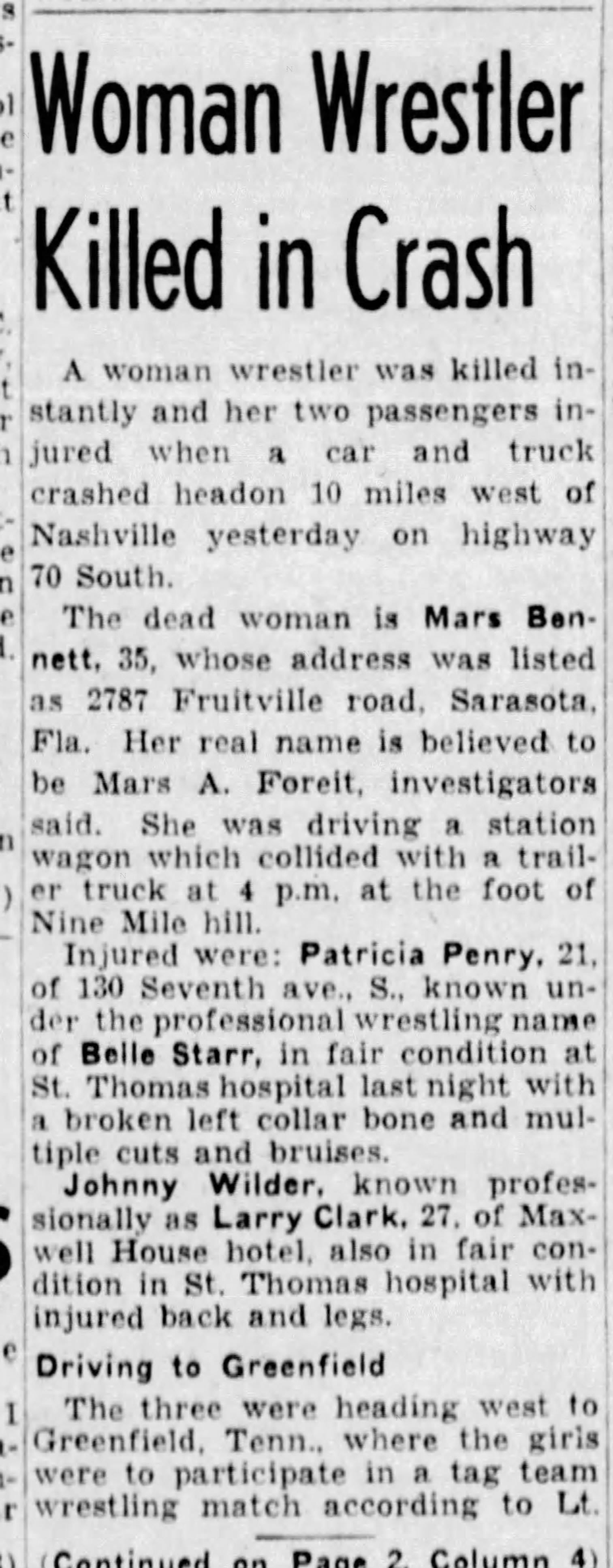
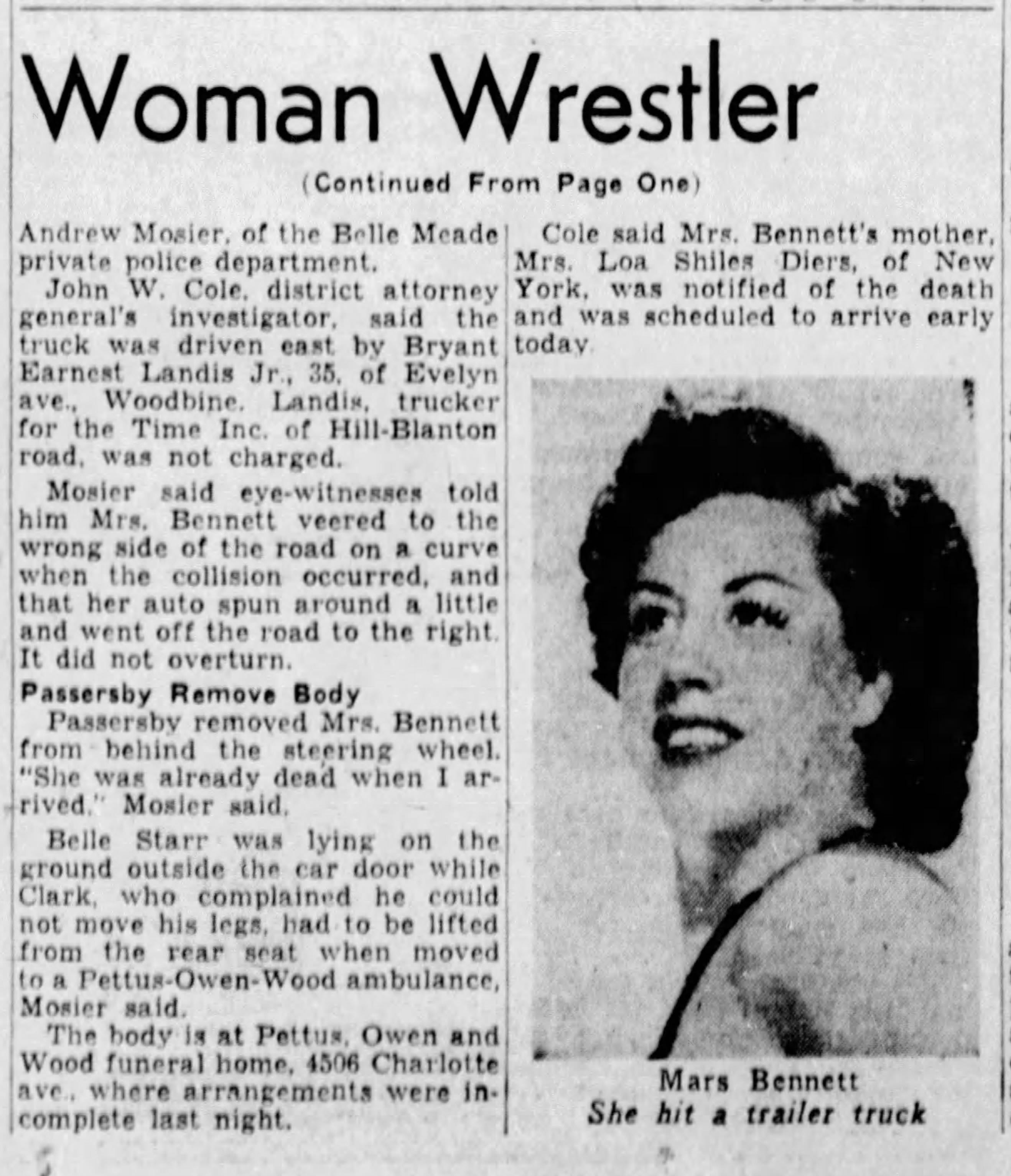
On Friday, August 23, 1957, at approximately 4 p.m., that road life ended. Mars Bennett was driving a station wagon westbound on Highway 70 South, about ten miles west of Nashville, Tennessee, at the foot of Nine Mile Hill. She and her two passengers were headed to Greenfield, Tennessee, for a tag-team wrestling match. Riding with her were Patricia Penry, twenty-one, who wrestled as Belle Starr, and Johnny Wilder, twenty-seven, who performed as Larry Clark.
On a curve, witnesses said Bennett’s station wagon veered onto the wrong side of the road and collided head-on with an eastbound trailer truck driven by Bryant Earnest Landis Jr., thirty-five, of Woodbine. The station wagon spun slightly and left the roadway to the right but did not overturn. Passersby pulled Bennett from behind the steering wheel; she was already dead. Penry, found lying outside the car, suffered a broken left collarbone along with cuts and bruises. Wilder, who had been in the rear seat and could not move his legs, sustained back and leg injuries. Both were treated at St. Thomas Hospital and later reported in good condition. Landis was not charged.
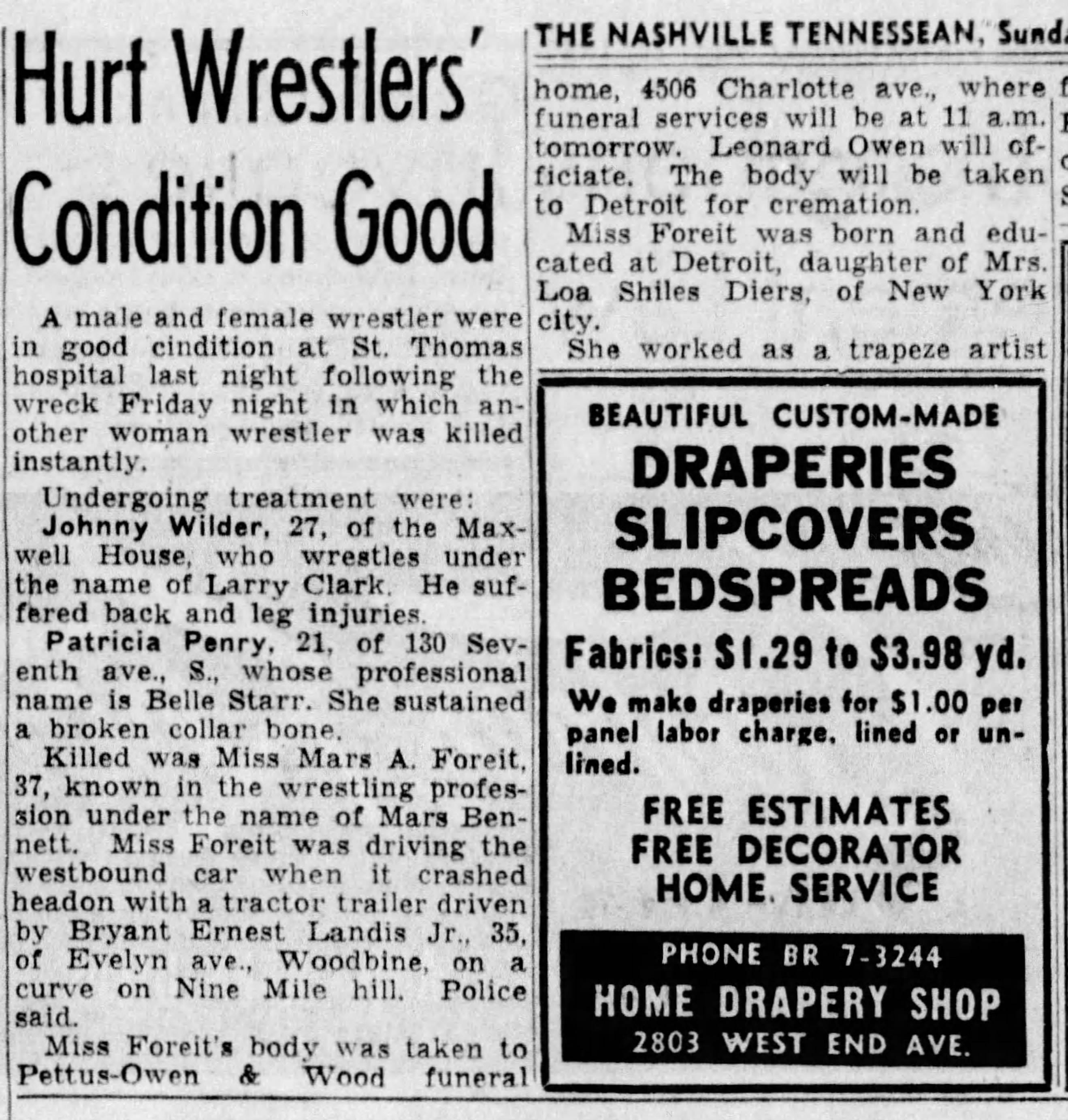
Bennett’s body was taken to the Pettus, Owen & Wood Funeral Home on Charlotte Avenue in Nashville. Services were arranged for the following day, after which the remains were to be sent to Detroit for cremation. Her mother, Mrs. Loa Shiles Diers of New York, was notified and traveled to Nashville. Contemporary reports listed Bennett’s address as 2787 Fruitville Road, Sarasota, Florida, and noted her earlier work as a trapeze artist. Her ashes were ultimately scattered over the Gulf of Mexico off the Florida coast by her mother; a marker was placed at Woodmere Cemetery in Detroit.
Mars Bennett never reached the household fame of Burke, Byers, or Moolah, yet she embodied a particular strain of the 1950s women’s division: the circus-trained, muscle-magazine athlete who could deliver in every style of match the territories demanded. She traveled from Florida to Canada, worked the rough Southern and Texas cards as readily as the more athletic northern programs, and lived the full, often hidden life of the road. The newspaper accounts of her final afternoon—heading to one more tag match, driving the station wagon, crossing the center line on a curve outside Nashville—bring a sharp human focus to a career that had already contained more than most. In the end, the Girl with the Iron Jaw left the ring the same way she had lived much of her life: in motion, on the highway, between towns.
One Thing I Learned About Stan Hansen
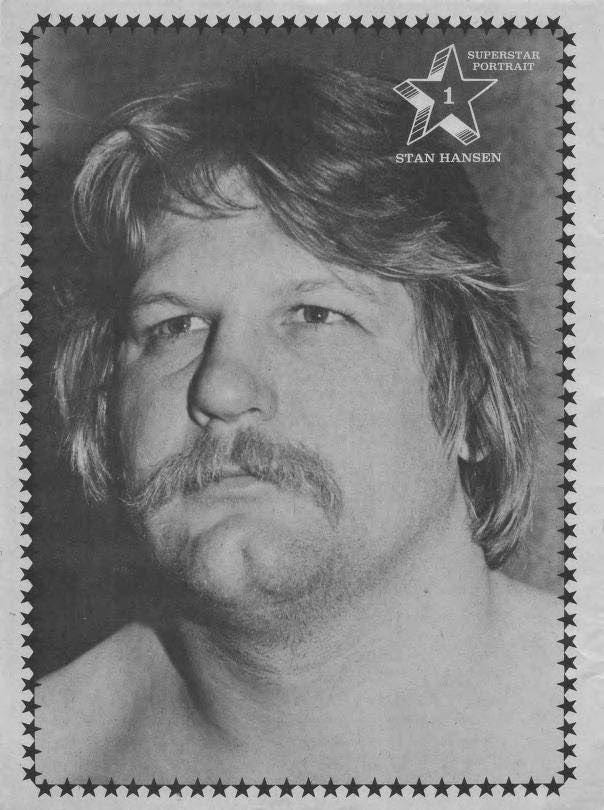
He was born in Knox City, Texas. He simply preferred being introduced as “the Bad Man from Borger” because the name sounded tougher and more fitting for the wild cowboy character he was building.
Thank You for Watching and Listening
I’m Tony Richards, Pro Wrestling Historian, Author and Storyteller. I share pro wrestling historical items in each issue of the Time Tunnel Pro Wrestling History Newsletter and each episode of our podcast show. Thanks for your support! If you enjoy my information on select events, matches and insights, please share with folks you think might like to be a subscriber!
Remember, Premium subscribers get access to exclusive and special content such as some special issues including a multi-part deep dives on wrestling territories, wrestler bios and championship title histories, special audio and video interviews on territory pro wrestling and more available in the Pro Wrestling Time Tunnel for Premium Subscribers. Being a Premium Subscriber also means you support me in my efforts to document Pro Wrestling History through my research, writing, books, vidoes and podcasts. And…I have something very special planned for our Premium Subscribers on the Podcast side of things in 2026! Details soon here in the Pro Wrestling Time Tunnel.