Today’s Favorite Quote: It is in your moments of decision that your destiny is shaped - Tony Robbins
Happy Birthday to those who have passed on and to those great wrestlers still with us:
In Memoriam:
Rocky Johnson 1944
Happy Birthday:
Vincent K. McMahon (80)
Shoichi Funaki (57)
Gran Metalik (37)
RIP Memorial: We stop & remember those who have passed on this day and gave themselves to the business for us, the fans. We salute you and thank you.
Fred Kohler 8-24-1969 at the age of 66
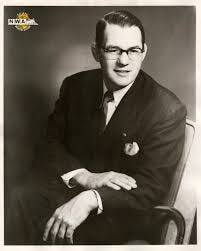
Vivian Vachon 8-24-1991 at the age of 40
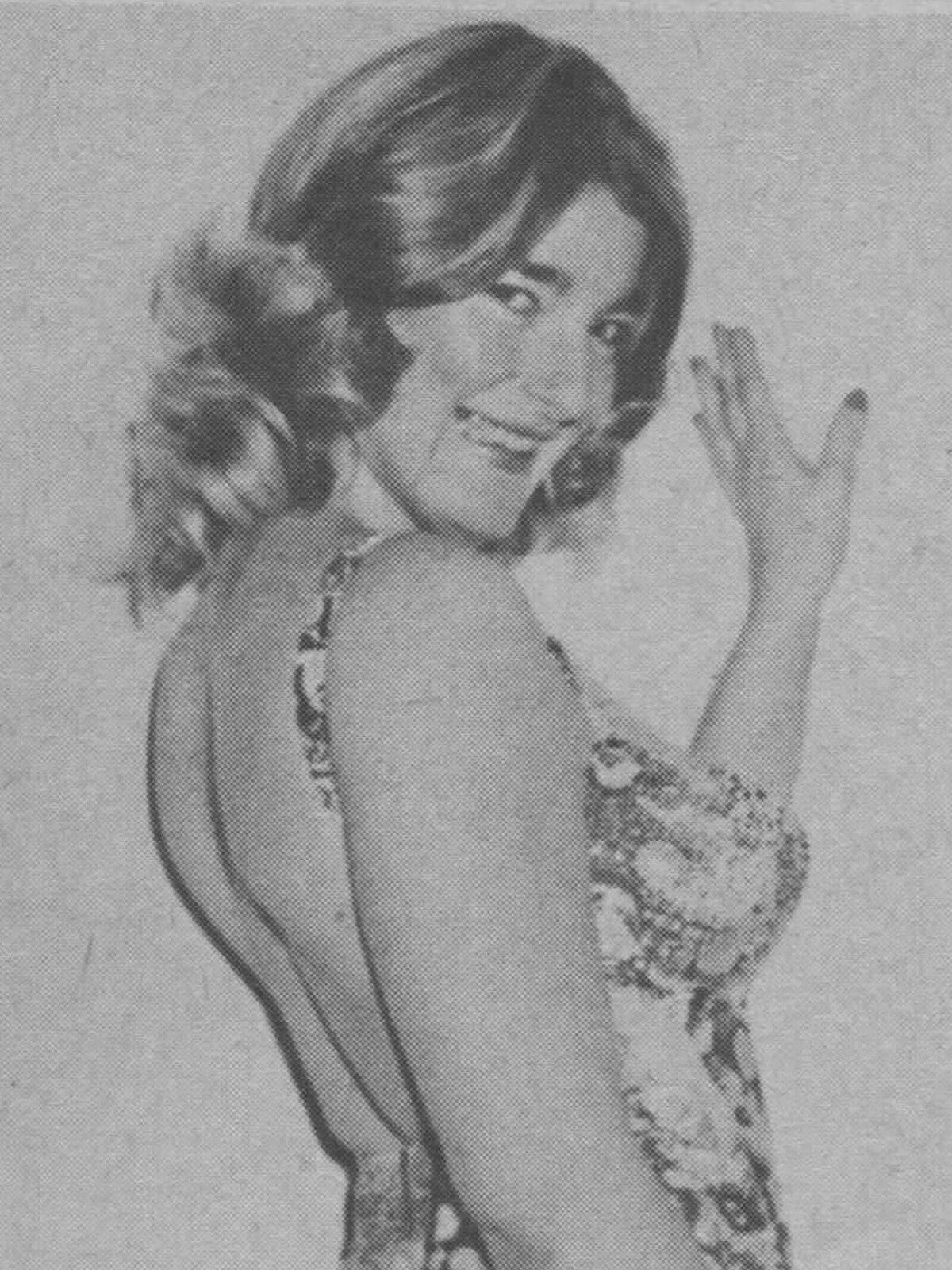
Killer Karl Krupp 8-24-1995 at the age of 61
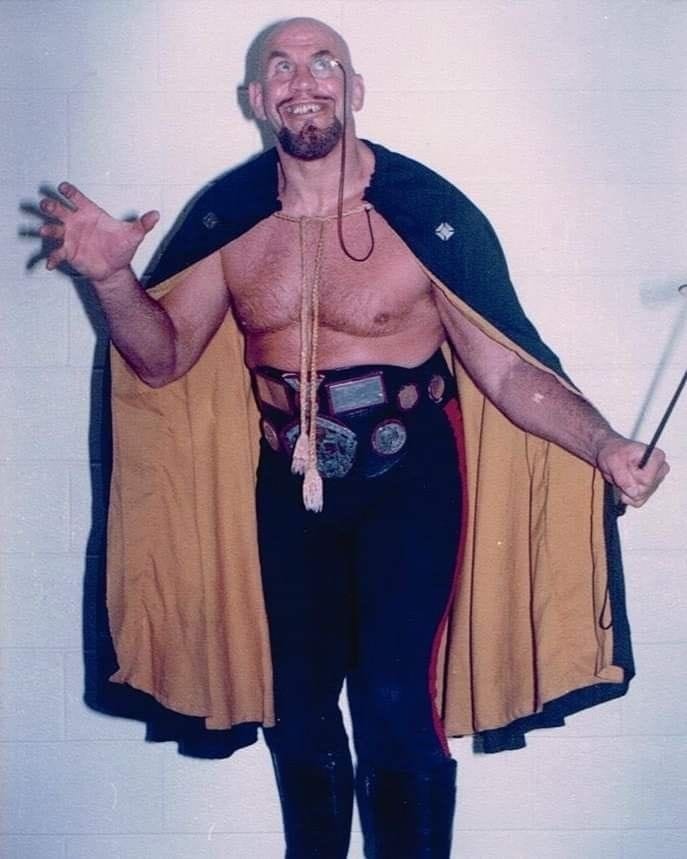
“The Lawman” Don Slatton 8-24-2013 at the age of 75
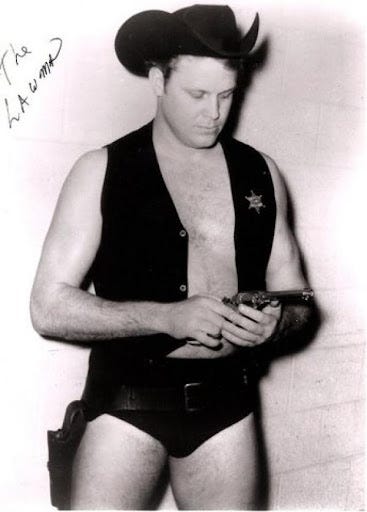
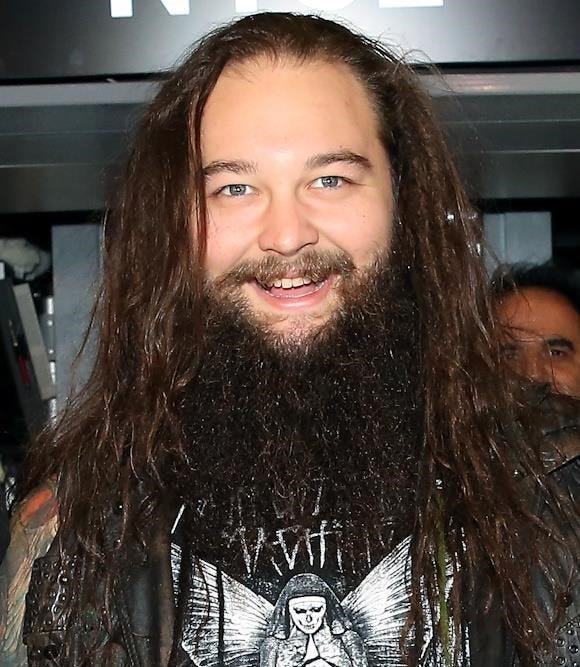
Windham Rotundo\Bray Wyatt 8-24-2023 at the age of 36
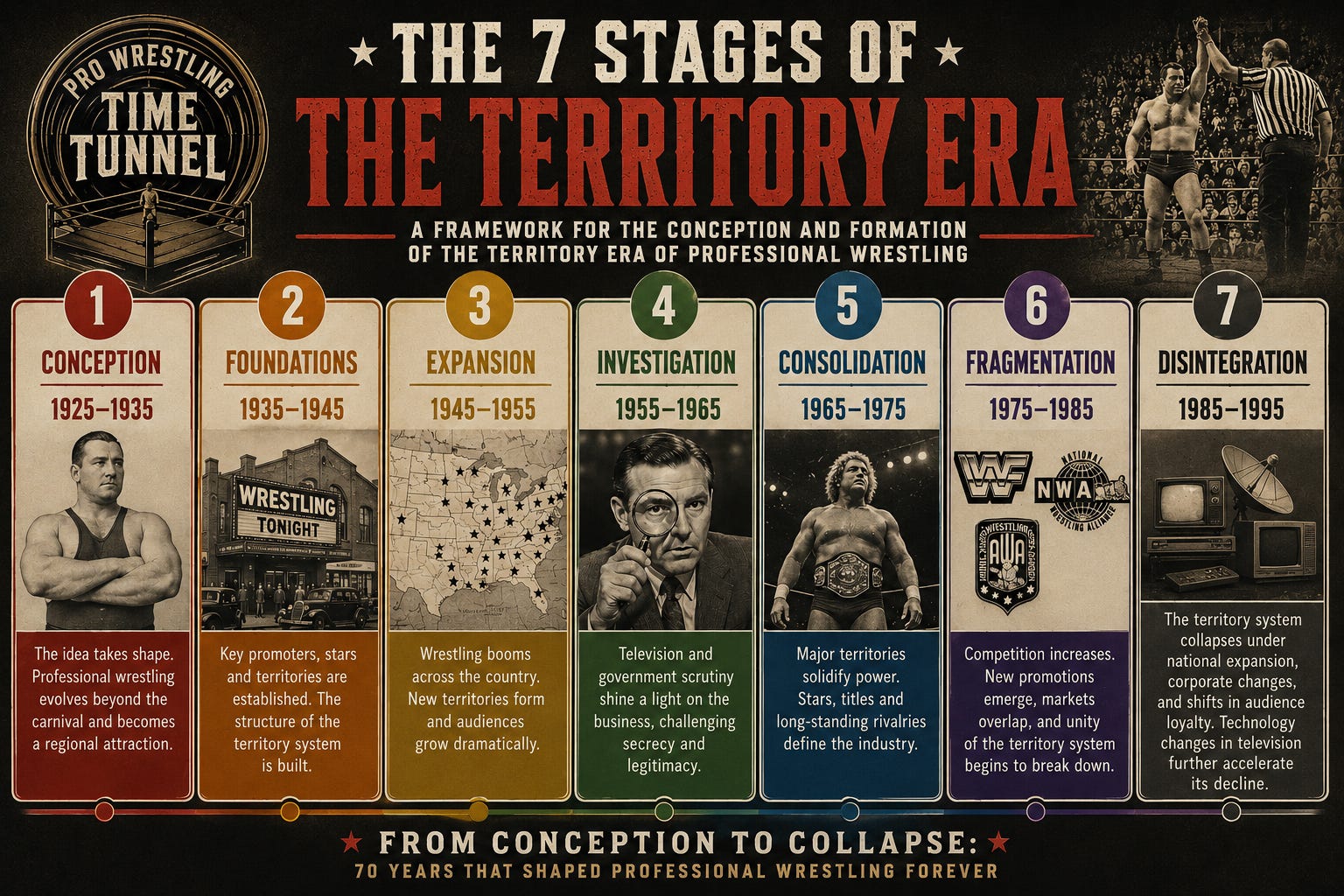
7 Stages of the Territory Era
Stage 6: Fragmentation
August 1976
Year Two Month Eight
August 1976 belongs to Stage 6: Fragmentation. The territorial system that had operated with relative cohesion for decades was beginning to show visible seams. The NWA World Championship still traveled and elevated local cards. Major offices still drew strong houses. Television remained the primary promotional engine. Yet the underlying stresses that would accelerate later in the decade were already present: more independent maneuvering by the larger promotions, increased competition for talent, rising operational costs, and the first clear signals that some offices were prioritizing short-term gains over long-term system stability. The machine still ran, but the parts were no longer moving in perfect synchronization.
The Northeast: WWWF and the Bruno-Hansen Culmination
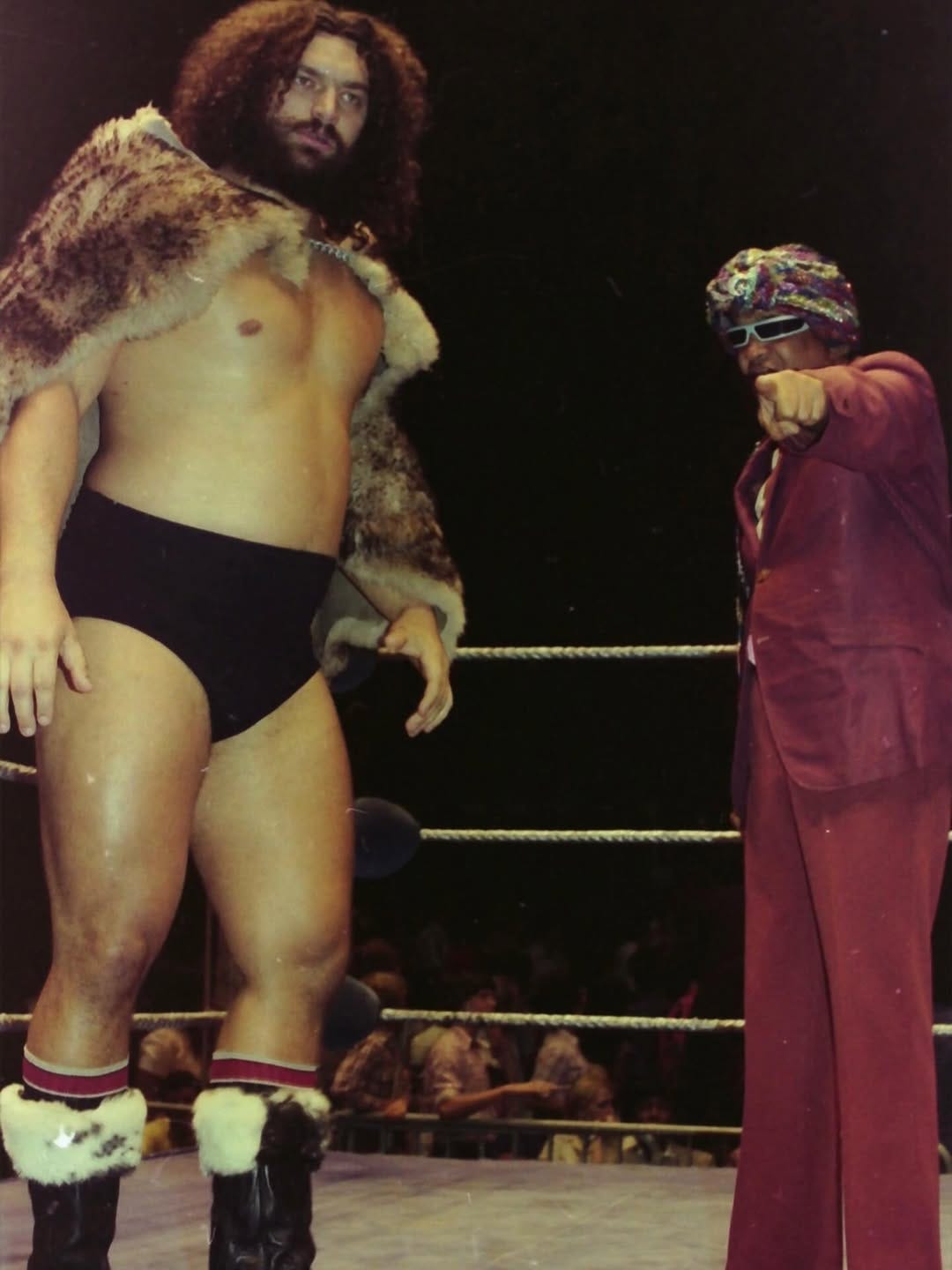
Pictured: Bruiser Brody makes his MSG debut in NEw York City, New York with The Grand Wizard, August 7th, 1976
The World Wide Wrestling Federation remained the strongest and most self-contained office in the country. Bruno Sammartino continued his second long reign as WWWF Heavyweight Champion. The major program of the period reached its climax on August 7 at Madison Square Garden when Bruno defeated Stan Hansen inside a steel cage before approximately 22,000 fans. The match closed the long-running angle that began earlier in the year when Hansen’s lariat “broke” Bruno’s neck. It was only the second cage match in Garden history and carried genuine heat.
VIDEO: Bruiser Brody vs Kevin Sullivan, August 7th, 1976, MSG, NYC
The same card featured Bruiser Brody’s Madison Square Garden debut under the management of the Grand Wizard in a squash over Kevin Sullivan. The Executioners (Killer Kowalski and Big John Studd) retained the WWWF Tag Team Championship against Dominic DeNucci and Jose Gonzalez. Strong undercard work from Chief Jay Strongbow, Billy White Wolf, Ivan Putski, and Bobo Brazil rounded out a deep show that was televised on the MSG Network.
The rest of the month kept the program alive on the road. On August 21 in Baltimore (approximately 10,000), Bruno and Hansen fought to a double count-out. Brody continued his rapid ascent with count-out victories and a growing reputation as a legitimate monster. The Executioners remained the dominant heel tag team under Captain Lou Albano. House show business across the Northeast circuit—Philadelphia, the Boston-area towns, Long Island, and secondary markets—stayed consistently strong. The WWWF was operating at a high level, but its increasing independence from the broader NWA talent pool was itself a marker of Stage 6 fragmentation.
The Midwest: AWA Stadium Spectacle
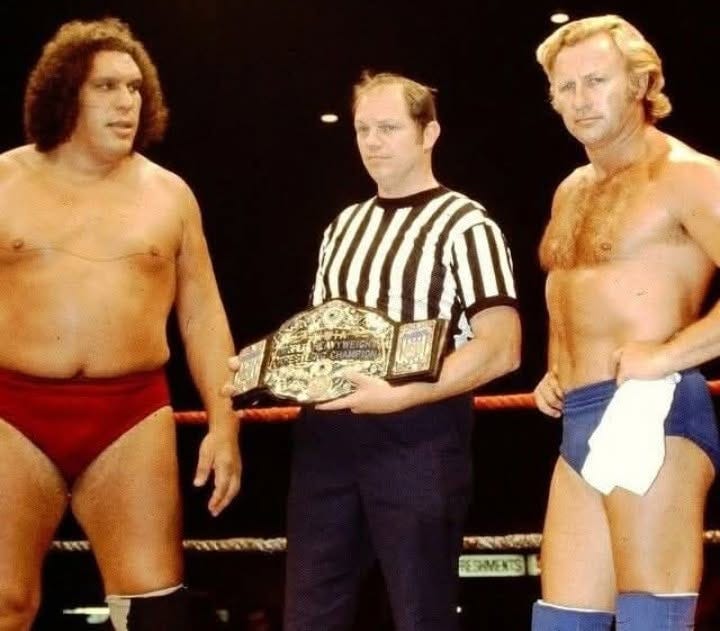
Pictured: The referee holds the AWA World Championship title belt before th ematch with Nick Bockwinkel and Andre The Giant for the AWA World Heavyweight Championship in August 1976
VIDEO: Raw footage from Nick Bockwinkel, the AWA Champion vs Andre The Giant at Comiskey Park in Chicago, Illinois, August 27th, 1976
Verne Gagne’s American Wrestling Association staged one of the month’s showcase events on August 27 at Comiskey Park in Chicago. Attendance estimates range between 12,000 and 15,000. Nick Bockwinkel, managed by Bobby Heenan, defended the AWA World Heavyweight Championship against André the Giant in a double disqualification. In the main event steel cage match, AWA World Tag Team Champions Blackjack Lanza and Bobby Duncum retained against Dick the Bruiser and The Crusher. The undercard mixed established names—Peter Maivia, Moose Cholak, and the High Flyers of Greg Gagne and Jim Brunzell—with solid mid-card work. The stadium show demonstrated that the AWA could still draw significant numbers in a major market, yet it also underscored the growing separation between the AWA and the NWA system.
The South: Georgia, Memphis, and Mid-Atlantic Intensity
Georgia Championship Wrestling saw “Dirty” Dick Slater capture the NWA Georgia Heavyweight Championship from The Spoiler on August 20 in Atlanta. Slater’s reign proved brief—Dusty Rhodes defeated him by disqualification one week later on August 27—but the change reflected the territory’s continued strength. Rhodes remained the biggest drawing babyface in the office. Mr. Wrestling II stayed a major attraction. Jim Barnett’s booking continued to cycle talent effectively even as the larger system began to fray.
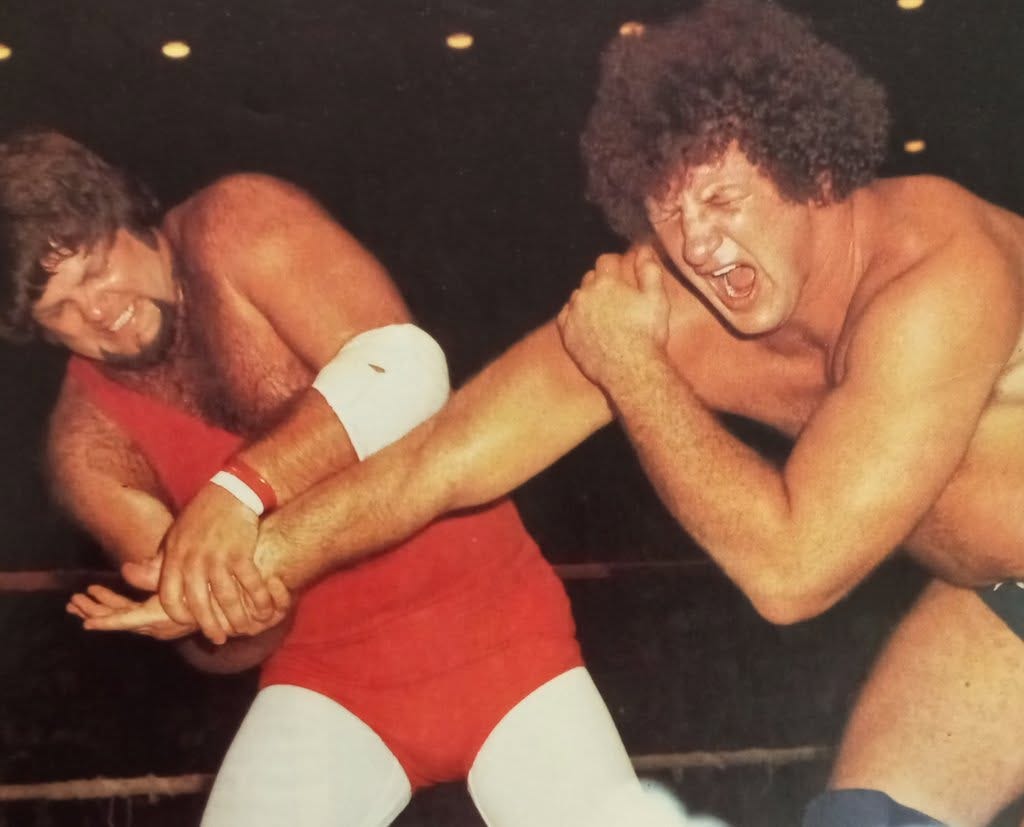
Pictured: Jerry Lawler cranks on Terry Funk’s arm during thier only world title match for Funk’s NWA World Title, August 22nd, 1976
The Tennessee Territory delivered some of the strongest consistent houses of the month. On August 9 at the Mid-South Coliseum, Jack Brisco defeated Jerry Lawler to win the Southern Heavyweight Championship in front of 10,098 fans. Lawler regained the title one week later on August 16 before another strong crowd. On August 22, NWA World Champion Terry Funk wrestled Lawler to a 60-minute draw in front of 10,430. Memphis in 1976 still possessed the classic Stage 6 traits of a hot local champion, credible short-term title changes with legitimate outsiders, and periodic World title appearances that elevated the entire card.
VIDEO: Jerry Lawler claims he beat Funk for the NWA World Title the following week on WHBQ-TV13 in Memphis, Tennessee
Mid-Atlantic Championship Wrestling under Jim Crockett Promotions earned the informal label “Month of the Casts.” Ole Anderson used a cast on his arm as a weapon throughout the month, battering “Mr. Wrestling” Tim Woods, Dino Bravo, and Wahoo McDaniel. Paul Jones, whose hand had been broken by Blackjack Mulligan, responded in kind with his own cast. On August 11 at the WRAL studios in Raleigh, Angelo Mosca defeated Paul Jones (with assistance from Mulligan) to win the Mid-Atlantic Television Championship.
The Anderson Brothers successfully defended the NWA World Tag Team Championship (Mid-Atlantic version) against the former champions Bravo and Woods. The ongoing Flair-Wahoo program for the Mid-Atlantic Heavyweight Championship continued to generate heat. The territory remained one of the most talent-rich and consistently booked offices in the country, even as the broader system showed early signs of strain.
Texas and the Central States
Fritz Von Erich’s Big Time Wrestling in Texas stayed active with regular cards in Dallas, Fort Worth, and San Antonio. Rocky Johnson, José Lothario, and the usual mix of heels kept the Sportatorium and surrounding towns busy. Kevin Von Erich made early appearances around this period, beginning the next generation of the family.
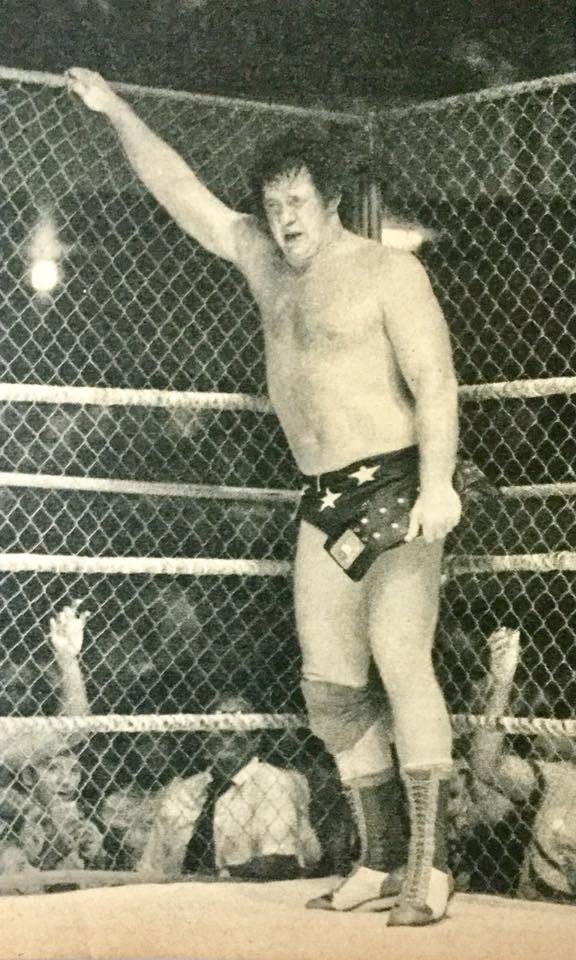
Pictured: Terry Funk after his successful defense of the NWA World Title against former champion, Gene Kiniski atthe Kiel Auditorium in St. Louis, August 13th, 1976
In the Central States and St. Louis territory, Harley Race and Bob Backlund continued their Missouri Heavyweight Championship program. On August 13 at Kiel Auditorium in St. Louis, Terry Funk retained the NWA World title against Gene Kiniski in a steel cage best-of-three-falls match before nearly 10,000 fans. The St. Louis office under Sam Muchnick remained the gold standard for prestige bookings, yet even here the increasing independence of the larger promotions was becoming noticeable.
Canada, Mexico, and Japan
In Canada, Stampede Wrestling ran its regular Calgary and regional cards with Archie Gouldie as North American Heavyweight Champion. The Maritimes (ESA) and Pacific Northwest/Vancouver (NWP) offices continued their weekly schedules with solid local business but little national attention.
Empresa Mexicana de Lucha Libre maintained its traditional Super Viernes cards at Arena México. The NWA Light Heavyweight, Welterweight, and various national titles continued their usual cycles involving Alfonso Dantés, Carlos Plata, Blue Demon, Perro Aguayo, and the established lucha stars. The product remained distinct from the American style while still connected through the NWA framework.
Japan was building its own parallel structure. All Japan Pro Wrestling concluded portions of its Summer Action Series. On August 28 at Kuramae Kokugikan, Jumbo Tsuruta defeated Jack Brisco to win the NWA United National Championship, a significant step in Jumbo’s rise as Giant Baba’s chosen successor. New Japan Pro Wrestling continued its Asia League series with Antonio Inoki facing Tiger Jeet Singh and other foreign talent. Both Japanese promotions were successfully developing domestic stars while still relying on American and international imports for legitimacy—another marker of a system that was beginning to fragment into more independent spheres.
VIDEO: Jumbo Tsuruta vs Jack Brisco, August 28th, 1976 for the NWA United National Championship in Japan
Business Analysis: Stage 6 Fragmentation
August 1976 illustrated both the residual strength and the emerging cracks of the territorial system. Key markets still delivered strong numbers: Madison Square Garden at 22,000, Memphis repeatedly above 10,000, Comiskey Park in the 12–15,000 range, and St. Louis near 10,000 for a World title cage match. Television remained the primary promotional tool. Talent still moved between offices, but the movement was becoming less cooperative and more competitive.
The NWA World Championship continued to function as the central prestige attraction. Terry Funk’s August itinerary—Florida, Texas, St. Louis, Memphis, and Georgia—demonstrated that the old system could still elevate multiple territories in the same month. Yet the WWWF and AWA operated with increasing independence. Stadium shows required significant investment and could not be sustained weekly. Travel and operational costs continued to rise. The early signals of national ambition and talent raiding that would define the late 1970s and early 1980s were already visible if one looked closely.
Stage 6 is the phase in which the territorial machine still produces strong results while the structural integrity that made those results possible begins to erode. August 1976 captured that tension cleanly: Bruno closing a major program in the Garden, Funk grinding through another month of defenses, Lawler and Rhodes packing houses, young talent rising, and the system still functioning—yet no longer with the same shared sense of long-term stability that had characterized earlier stages. The fragmentation had begun.