


Today’s Favorite Quote: Speak when you are angry and you will make the best speech you will ever regret - Ambrose Bierce
Happy Birthday to those who have passed on and to those great wrestlers still with us:
In Memoriam:
Nat Pendleton 1895
Dwayne Peal\Buddy Wayne 1934
Little Brutus\Tiny Tim Girard 1937
Happy Birthday:
Caleb DeWall\Silas Young (46)
Sam Polinsky\Sam Adonis (37)
Alexis Cabrera\Alexa Bliss (35)
RIP Memorial: We stop & remember those who have passed on this day and gave themselves to the business for us, the fans. We salute you and thank you.
Chris Davros\Babe Zaharias 8-9-1957 at the age of 43

Sam Avey 8-9-1962 at the age of 67
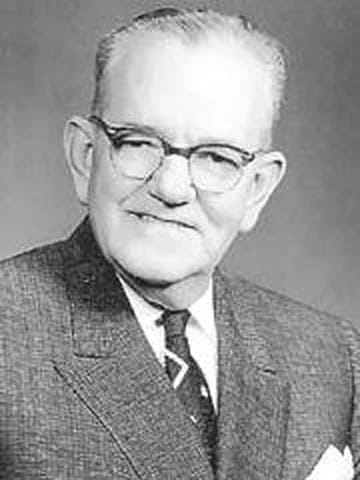
Jackie Sato 8-9-1999 at the age of 41
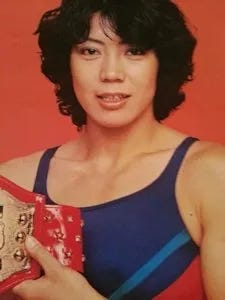
Frederich Von Schacht 8-9-2001 at the age of 90

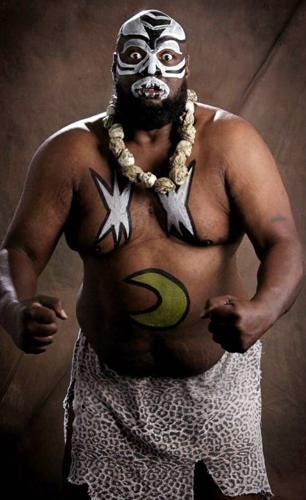
James Arthur Harris\Kamala 8-9-2020 at the age 70
Gene LeBell 8-9-2022 at the age of 89
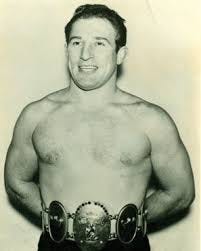
Kevin Sullivan 8-9-2024 at the age of 74

Significant Debuts:
8-9-1955 Don Kent
He debuted at the Mar-Creek Inn in Battle Creek, Michigan going to a 20 minute draw with Arvid Silas.
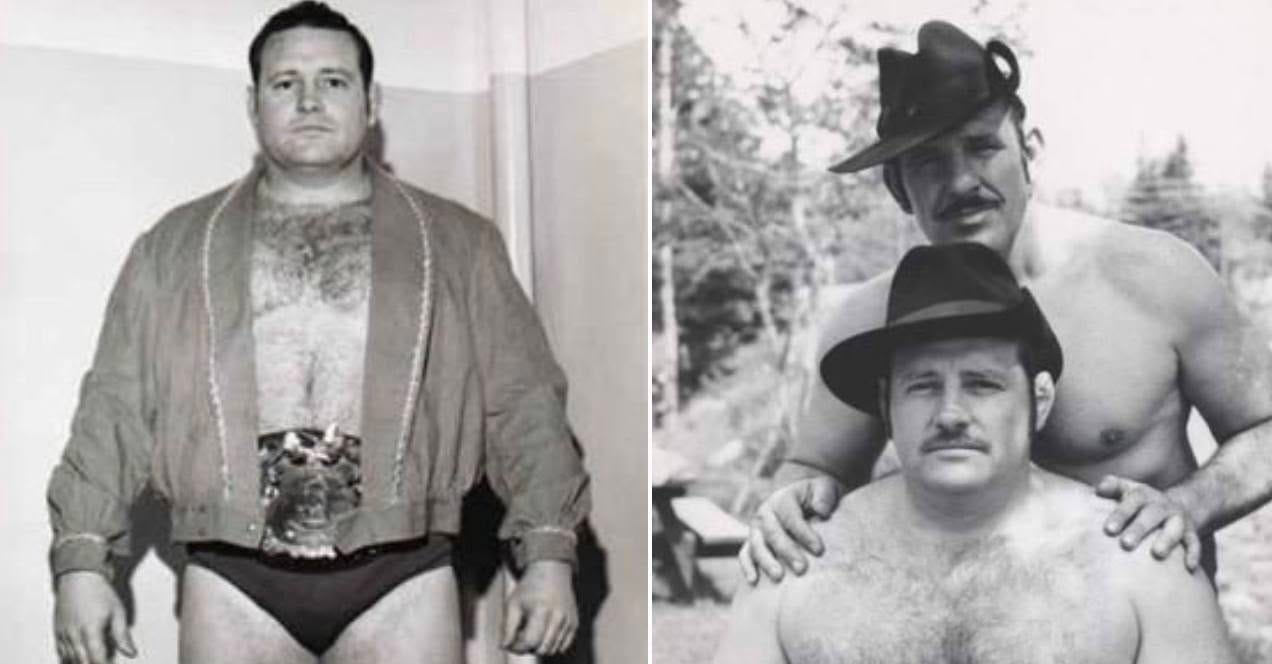
8-9-1977 Terry Bollea\Hulk Hogan
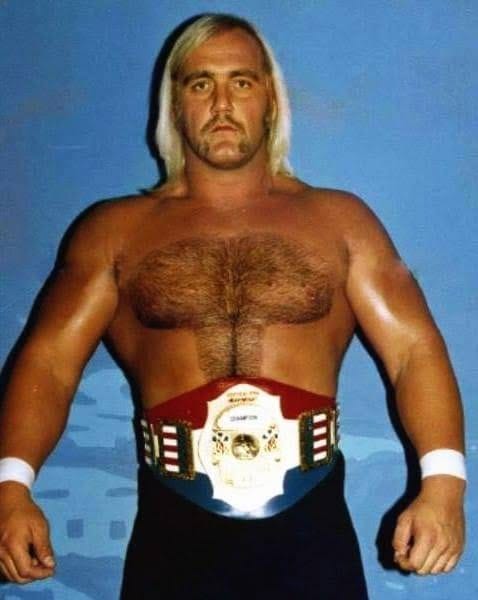
He debuted under a mask as the Super Destroyer and lost his first match to Don Serrano at the John Carroll High School Gym in Fort Pierce, Florida
Flashback 1976
3rd Quarter Analysis
July-September
WWWF
New York City, New York Office
The third quarter of 1976 found the World Wide Wrestling Federation operating as a stable, high-drawing Northeastern territory under Vince McMahon Sr. Bruno Sammartino remained the undisputed centerpiece as WWWF Heavyweight Champion, still deep into his second reign that had begun in December 1973. The territory’s business model continued to revolve around monthly Madison Square Garden shows, strong Spectrum and Capital Centre gates, weekly television from Philadelphia (Championship Wrestling) and Hamburg, Pennsylvania (All-Star Wrestling), and a dense schedule of house shows across New York, Pennsylvania, New England, Maryland, and surrounding markets. Q3 was defined by the lingering fallout from Stan Hansen’s April neck injury to Bruno, the elevation of new monster heels, a dominant masked tag team, and the steady drawing power of ethnic babyfaces who connected with the territory’s core audiences.
July 1976: Rebuilding Momentum After the Injury
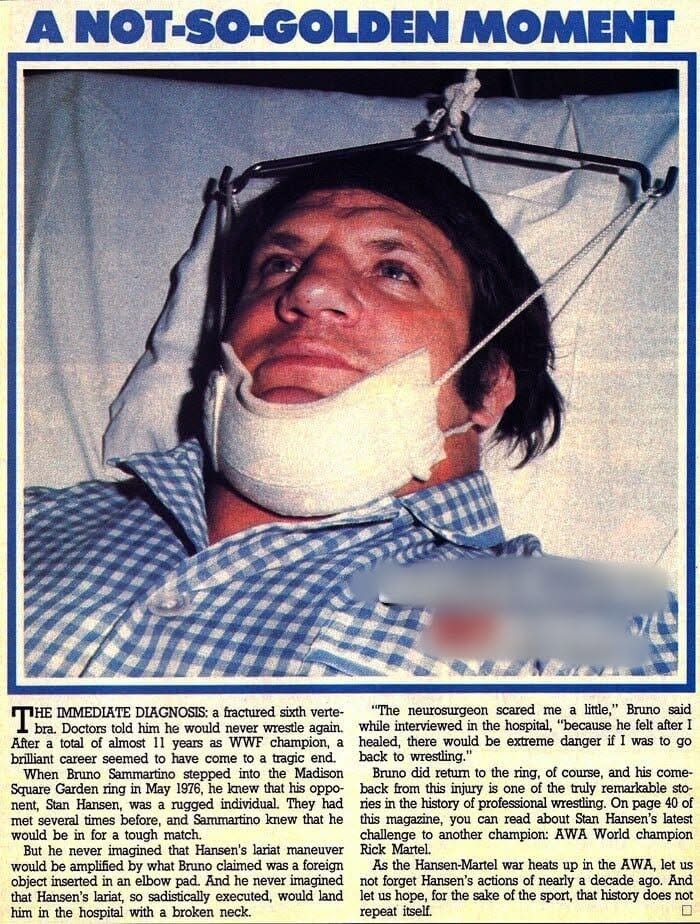
July opened with Bruno fully returned and active after the legitimate neck fracture suffered against Stan Hansen at Madison Square Garden on April 26. That injury—caused by a botched scoop slam that left Bruno landing on his head and fracturing a vertebra—had been sold on television as the result of Hansen’s loaded Lariat. The angle generated enormous heat. Hansen, managed by Freddie Blassie, was positioned as a dangerous Texas wildman who had nearly ended the champion’s career. Bruno’s return matches throughout the spring and into summer carried the weight of unfinished business.
The Executioners (Killer Kowalski as Executioner #1 and Big John Studd as Executioner #2), managed by Captain Lou Albano, held the WWWF World Tag Team Championship they had captured on May 11 from Louis Cerdan and Tony Parisi. In July they remained the clear top heel tandem. They used battle royals and special stipulations to earn title shots at Bruno while simultaneously defending against the popular Native American duo of Chief Jay Strongbow and Billy White Wolf. Matches between the Executioners and the Indians frequently ended in disqualification or double count-out, protecting the titles while building heat through Albano’s interference and the Executioners’ masked anonymity and size advantage.
Key undercard and midcard figures included Ivan Putski (the popular Polish strongman whose Polish Hammer and crowd-pleasing persona made him a reliable babyface), Bobo Brazil (still a respected veteran and frequent U.S. Champion figure in the territory), Kevin Sullivan, Jose Gonzalez, S.D. Jones, Baron Mikel Scicluna, Rocky Tomayo, Johnny Rodz, and Skandor Akbar. Nikolai Volkoff began appearing more regularly as a Russian heel. Multi-man tags and handicap matches filled cards, with Strongbow and White Wolf often teaming with Putski or others against combinations of Hansen, the Executioners, and secondary heels.
Business in July was solid rather than spectacular. Houses at secondary venues such as Scranton and smaller New England towns ran in the 1,000–2,000 range, consistent with territorial midweek shows. Larger buildings such as the Spectrum and Capital Centre drew stronger numbers when Bruno or major multi-man matches were featured. The territory’s television continued to serve its primary purpose: creating heat for the house shows and establishing the ongoing feuds without overexposing the biggest matches.
August 1976: The Cage Match Peak and Brody’s Arrival
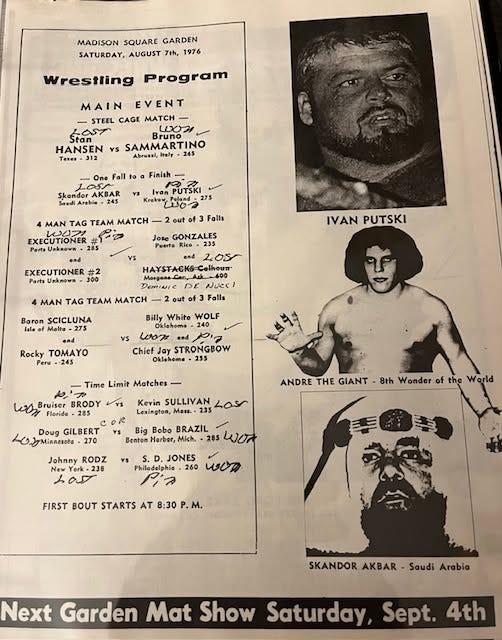
August delivered the quarter’s signature moment. On August 7 at Madison Square Garden, Bruno Sammartino met Stan Hansen inside a steel cage in a highly anticipated rematch. The card drew a reported 22,000 fans and was televised on the MSG Network with Vince McMahon on commentary. Bruno defeated Hansen by escaping the cage after ripping off Hansen’s loaded elbow pad and using it against him. The match provided catharsis for the audience that had watched Hansen nearly end their champion’s career months earlier. It was classic WWWF booking: a violent, personal feud resolved in a stipulation that allowed Bruno to look dominant while still acknowledging the earlier damage.
The same card marked Bruiser Brody’s (Frank Goodish) Madison Square Garden debut. Managed by the Grand Wizard, Brody squashed Kevin Sullivan in under three minutes with a backbreaker. Brody’s wild appearance, size, and intensity immediately marked him as a different kind of monster heel. Throughout the rest of August and into September he was used in squash matches, short dominant wins, and multi-man tags, often alongside Hansen or the Executioners. His presence added a new layer of physical threat that complemented Hansen’s established heat.
Tag team action remained consistent. The Executioners continued to defend against Strongbow and White Wolf in best two-of-three-falls matches that almost always protected the titles via disqualification. Ivan Putski remained a reliable midcard attraction, frequently defeating secondary heels or teaming with Bruno or the Indians. Undercard matches featured the usual mix of time-limit draws, quick pinfalls, and occasional blood or brawling finishes that kept local audiences engaged.
Business in August was strong at the major buildings. The MSG gate for the cage match was excellent. Secondary markets continued to perform at expected territorial levels. The combination of Bruno’s drawing power, the residual Hansen heat, and the fresh presence of Brody kept the territory humming without requiring radical changes to the formula.
September 1976: Sustaining the Heat and Expanding the Heel Threat
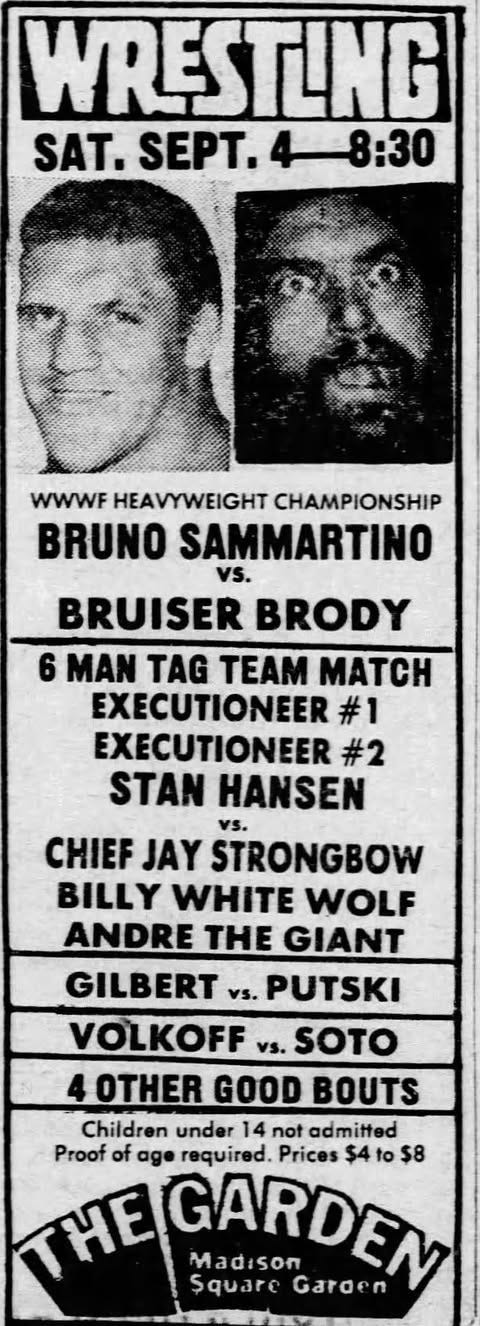
September maintained the momentum. On September 4 at Madison Square Garden (attendance reported around 18,900), Bruno defended against Bruiser Brody and won by disqualification after Brody used the ropes for leverage on a pin attempt that was later overruled by judges. The same card featured a best three-of-five-falls six-man tag in which Andre the Giant, Strongbow, and White Wolf defeated Hansen and the Executioners. Andre’s occasional appearances added star power and spectacle to multi-man matches without requiring him to carry a full program.
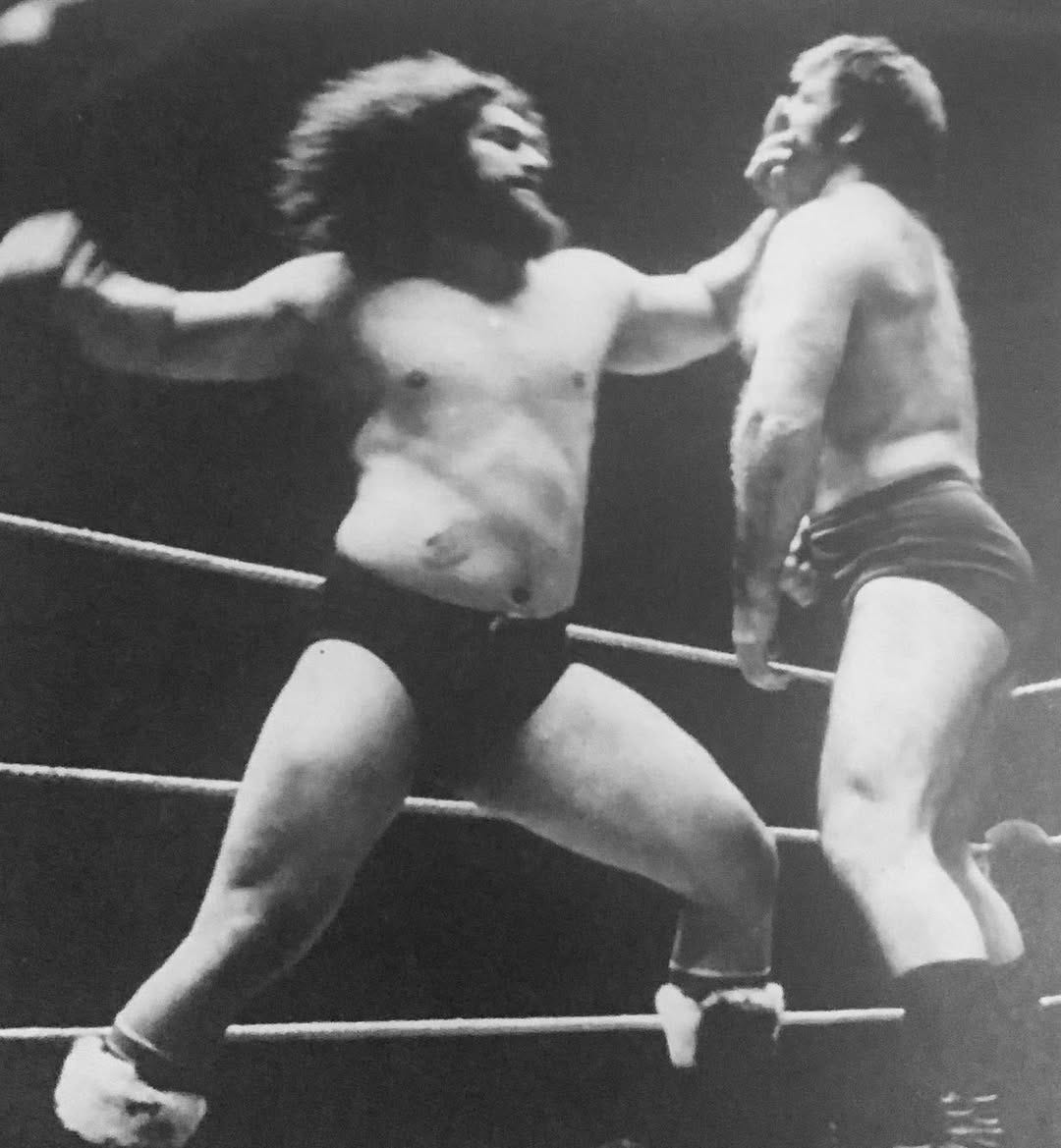
The Executioners continued their pattern of controversial title defenses against the Indians. Matches often ended in disqualification, keeping the titles on the heels while allowing Strongbow and White Wolf to look strong and sympathetic. Stan Hansen remained active as a top challenger, scoring count-out wins over Bruno in some markets (notably the Spectrum on September 18) that preserved the champion’s status while giving the heel credibility. Ivan Putski, Bobo Brazil, and the midcard regulars filled out cards across the territory.
Television continued to feed the house shows. Championship Wrestling and All-Star Wrestling segments focused on Albano’s scheming with the Executioners, the Grand Wizard’s association with Brody, Blassie’s work with Hansen, and the babyfaces’ determination to settle scores. The booking avoided major title changes, relying instead on near-falls, disqualifications, and multi-man chaos to create the sense that the heels were dangerous but the faces—led by Bruno—were ultimately resilient.
Business remained healthy. Major arena gates held up well. The territory’s formula of ethnic heroes (Bruno, Putski, Strongbow, White Wolf, Brazil) against larger-than-life foreign or masked heels continued to connect with the Northeast’s working-class and immigrant audiences. Secondary towns provided steady if unspectacular income, while the big buildings delivered the profits that sustained the operation.
Overall Analysis: Wrestlers, Angles, and Business
The key performers of Q3 1976 were clearly defined. Bruno Sammartino was still the irreplaceable drawing card; even recovering from a serious neck injury, his presence sold tickets. Stan Hansen had been transformed by the April injury into a top-level heel with genuine heat. Bruiser Brody arrived as a fresh, intimidating physical presence who would become a major attraction in the months ahead. The Executioners provided a reliable championship heel act whose masked gimmick and Albano management generated consistent heat against the popular Indian team. Ivan Putski, Strongbow, White Wolf, and Bobo Brazil formed a strong supporting babyface core that could headline secondary markets or work upper midcard on major cards.
Storylines were personal and physical rather than elaborate. The Hansen-Bruno feud was built on a real injury that the promotion turned into powerful kayfabe. The Executioners-Indians program relied on size, cheating, and manager interference. Brody was simply turned loose as a destructive force. These angles required little intricate booking; they needed only credible violence, clear good-versus-evil alignment, and Bruno’s star power.
From a business perspective, Q3 1976 showed a healthy, mature territory. Attendances at Madison Square Garden remained strong (22,000 in August, nearly 19,000 in September). The Spectrum and Capital Centre delivered solid mid-five-figure crowds when properly carded. Television continued to function as an effective promotional tool rather than a revenue center in its own right. The roster was deep enough to support a full schedule without overexposing the top stars. McMahon Sr.’s operation remained one of the most consistent and profitable in the NWA-affiliated territorial system, built on the enduring appeal of Bruno Sammartino and a supporting cast that delivered reliable heat and local identification.
By the end of September 1976 the WWWF was positioned for a strong Fall. The Hansen program had been largely resolved in Bruno’s favor, Brody was established as a new threat, the Executioners still held the tag titles, and the core babyfaces remained popular. The formula that had worked for years—Bruno at the center, credible monsters challenging him, ethnic heroes battling cheating heels—continued to fill arenas across the Northeast.
Thank You for Watching and Listening
I’m Tony Richards, Pro Wrestling Historian, Author and Storyteller. I share pro wrestling historical items in each issue of the Time Tunnel Pro Wrestling History Newsletter and each episode of our podcast show. Thanks for your support! If you enjoy my information on select events, matches and insights, please share with folks you think might like to be a subscriber!
Remember, Premium subscribers get access to exclusive and special content such as some special issues including a multi-part deep dives on wrestling territories, wrestler bios and championship title histories, special audio and video interviews on territory pro wrestling and more available in the Pro Wrestling Time Tunnel for Premium Subscribers. Being a Premium Subscriber also means you support me in my efforts to document Pro Wrestling History through my research, writing, books, vidoes and podcasts. And…I have something very special planned for our Premium Subscribers on the Podcast side of things in 2026! Details soon here in the Pro Wrestling Time Tunnel.