


Today’s Favorite Quote: Knowing how to deal with change effectively is a primary requirement for living successfully in perhaps the most exciting time in all of human history ― Brian Tracy
Happy Birthday to those who have passed on and to those great wrestlers still with us:
In Memoriam:
Tim Woods\Mr Wrestling 1934
Luke Brown\The Kentuckian 1935
Happy Birthday:
Tomoko Kitamura\Lioness Asuka (63)
Dana White (57)
Xia Zhao Li\Lei Ying Lee (38)
Nick Massie Jackson (37)
Sammy Guevera (33)
RIP Memorial: We stop & remember those who have passed on this day and gave themselves to the business for us, the fans. We salute you and thank you.
Janet Wolfe 7-28-1951 at the age of 18
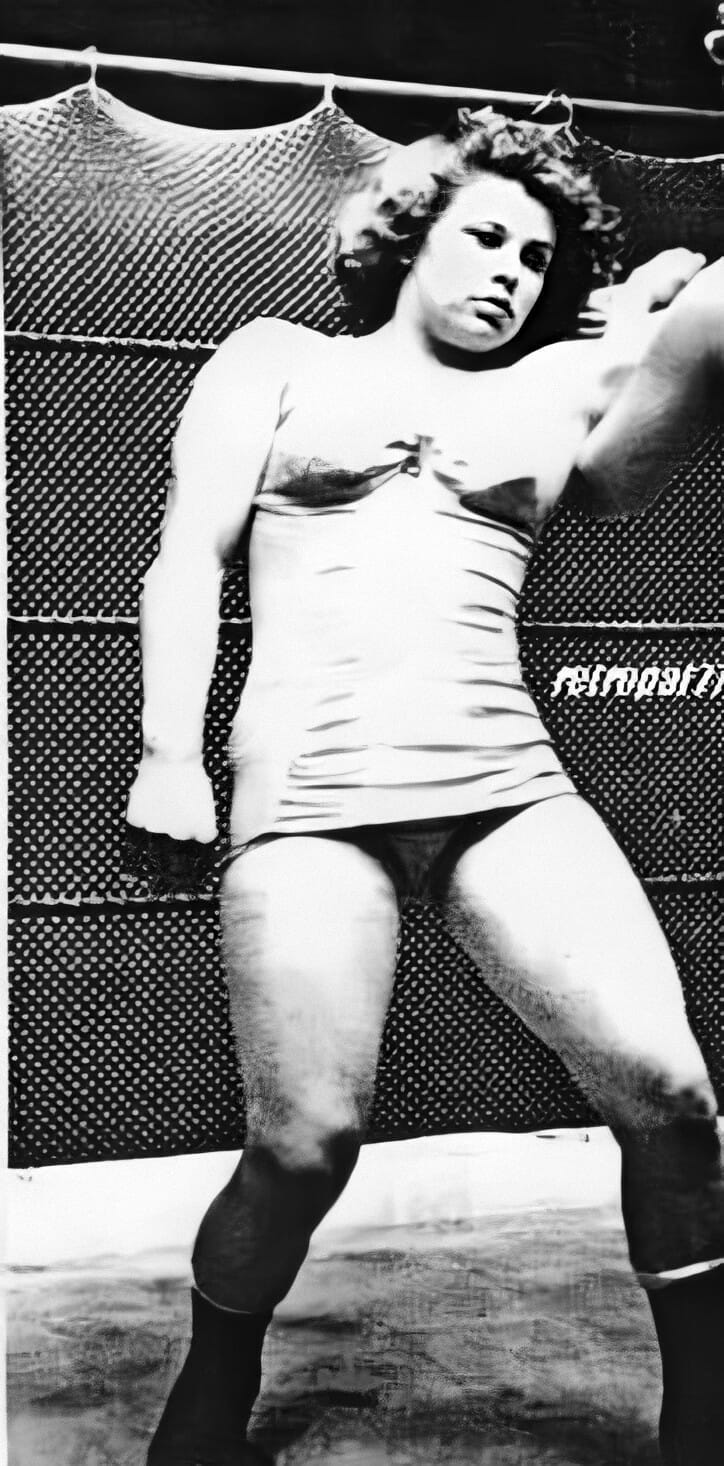
Bull Ortega\Mighty Ursus 7-28-1977 at the age of 55

Karl Gotch 7-28-2007 at the age of 82
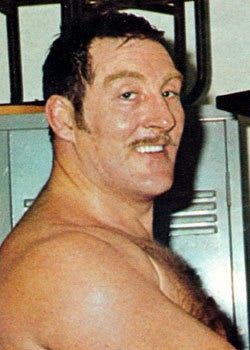
Ted Lewin 7-28-2021 at the age of 86
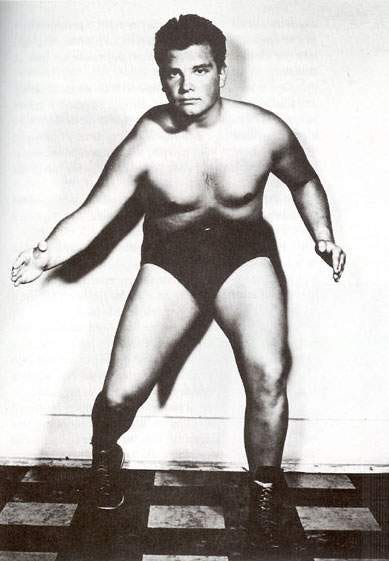
Gil Hayes 7-28-2022 at the age of 83
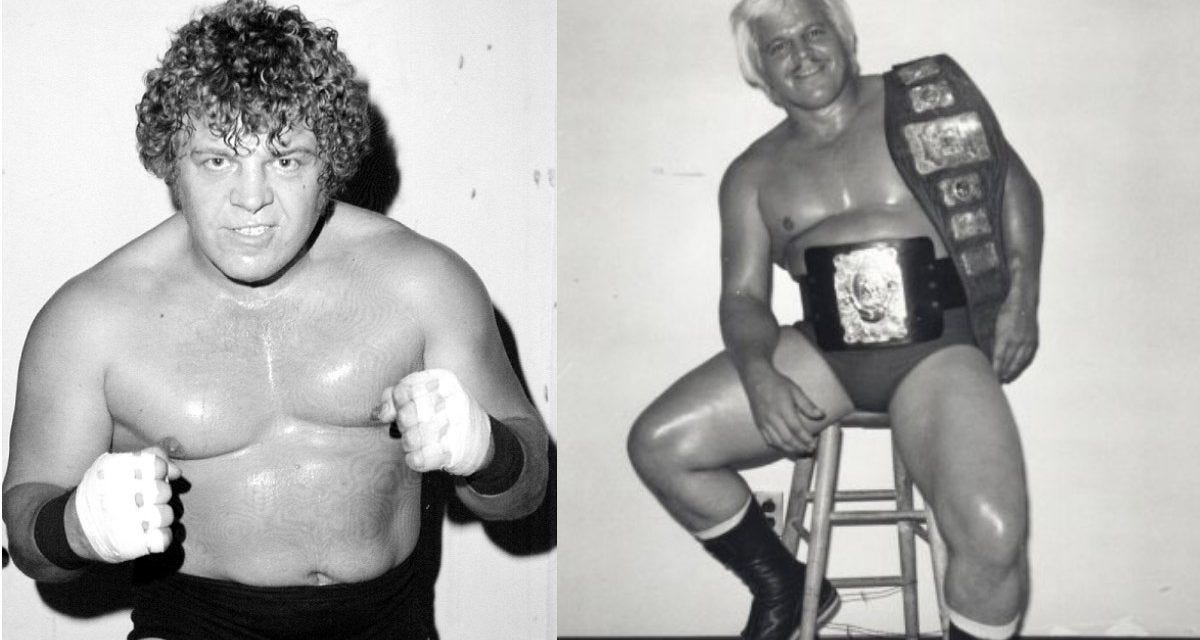
A History of The Ric Flair and Dusty Rhodes 1985-1986 Program
Dusty Rhodes vs. Ric Flair stands as one of the defining rivalries of the Territory Era and the single most important feud in Jim Crockett Promotions history. It was never just about the NWA World Heavyweight Championship. It was a sustained cultural and philosophical collision that ran for more than a decade, peaked in 1985–86, and gave JCP its strongest emotional engine during the very years the old territorial system was disintegrating under WWF expansion.
The Core Contrast
Ric Flair was the ultimate embodiment of excess and privilege: the limousine-riding, Rolex-wearing, jet-setting Nature Boy who lived the high life and reminded everyone that “to be the man, you gotta beat the man.” Dusty Rhodes was the polar opposite—the blue-collar “American Dream,” the son of a plumber who spoke in the language of textile mills, closed factories, and working people trying to keep the lights on.
Every time they stood across from each other, the match became a morality play. Flair represented everything the audience resented or envied; Dusty represented everything they felt they were. That class-warfare framing, delivered with genuine heat and top-tier promo work from both men, is why the program transcended typical championship chasing.
Early Foundations and the 1981 Title Change
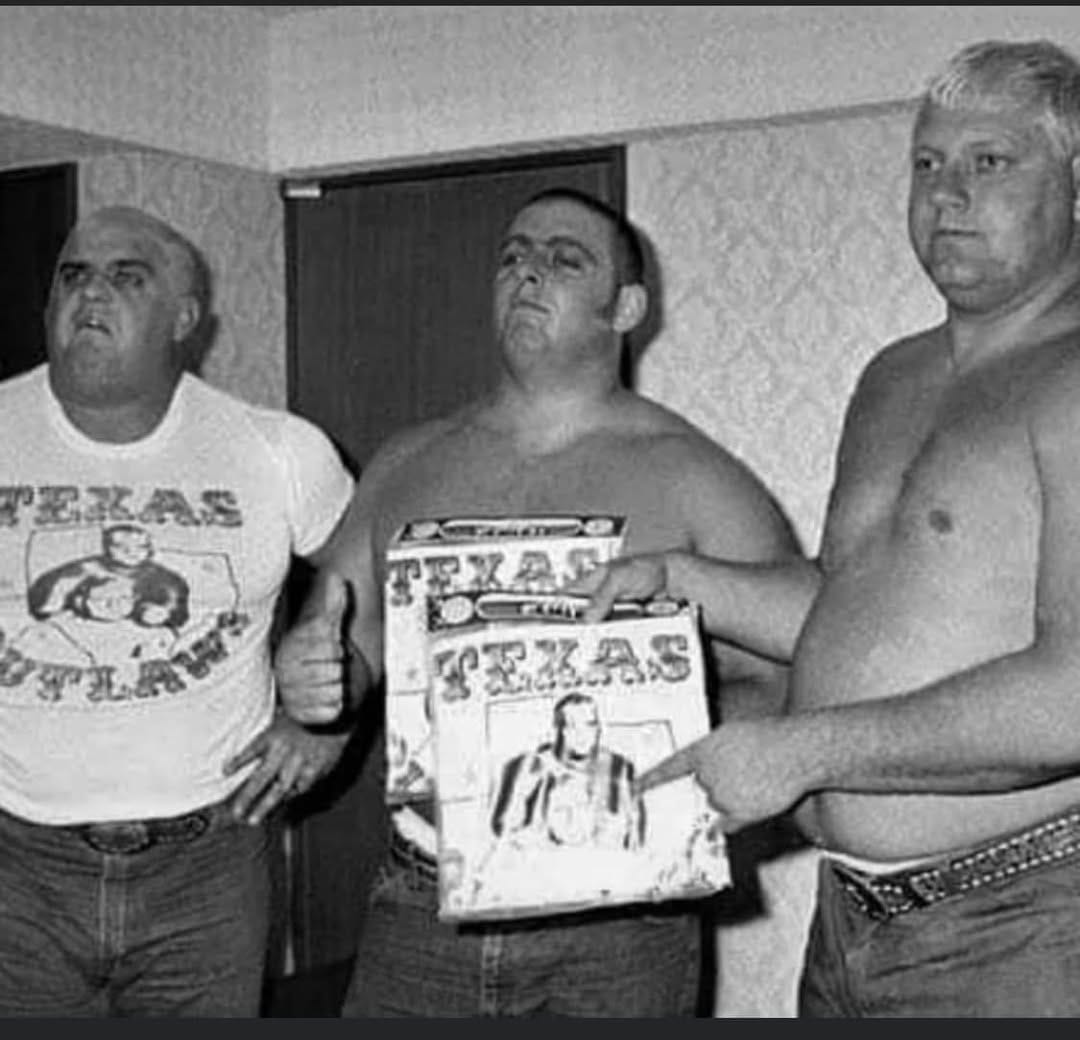
Pictured: Dusty Rhodes, Ric Flair and Dick Murdoch, when Flair idolized Rhodes and wanted to be a 3rd member of The Texas Outlaws
They had met before the peak years, but the rivalry crystallized when Flair defeated Dusty for the NWA World Title on September 17, 1981 in Kansas City. That victory gave Flair his first recognized world title reign and established the pattern: Flair as the opportunistic, arrogant champion; Dusty as the relentless everyman challenger. They would trade wins, draws, and blood across multiple territories for years, but the Mid-Atlantic/JCP version of the feud is the one that became legendary.
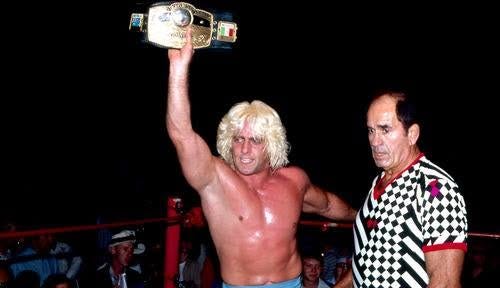
Pictured: Flair raises the NWA World Title following his first title win, September 17th, 1981 in Kansas City, Kansas defeating Dusty Rhodes for the championship
1985: The NWA World Title Loses it’s Shine and Value
Jim Crockett Promotions now controlled the NWA World Heavyweight Chapionship. After purchasing the television contract to be the exclusive content provider of professional wrestling on Ted Turner’s WTBS, Channel 17 Superstation in March of 1985, Crockett needed to lock in his two biggest stars. AS far as the NWA World Title was concerned, Crockett signed Ric Flair to an exclusive contract on May 1st, 1985 guaranteeing Flair he would make no less than $170,000 per year. This deal was for the next six years, through 1991 and granted Jim Crockett Promotions sole, exclusive rights to book Flair and promote him around the world.
The contract referred to Crockett’s extensive television reach and stated it would give JCP the ability to expand into new television markets with live events thus giving Flair additional exposure and more opportunities to wrestle. Also included were merchandising rights as well as Flair’s service marks and trademarks. Historically, the NWA World Champion was available to the membership of the NWA through the bookings of the organization’s Secretary. Now, Flair (who was the champion with few other candidates) would be booked, hence also would the title, through one member of the NWA, Jim Crockett Promotions, who would also now have the largest and most extensive television exposure in the world as far as any NWA member was concerned. The old system of the champion being controlled by the Alliance on behalf of it’s membership was now over.
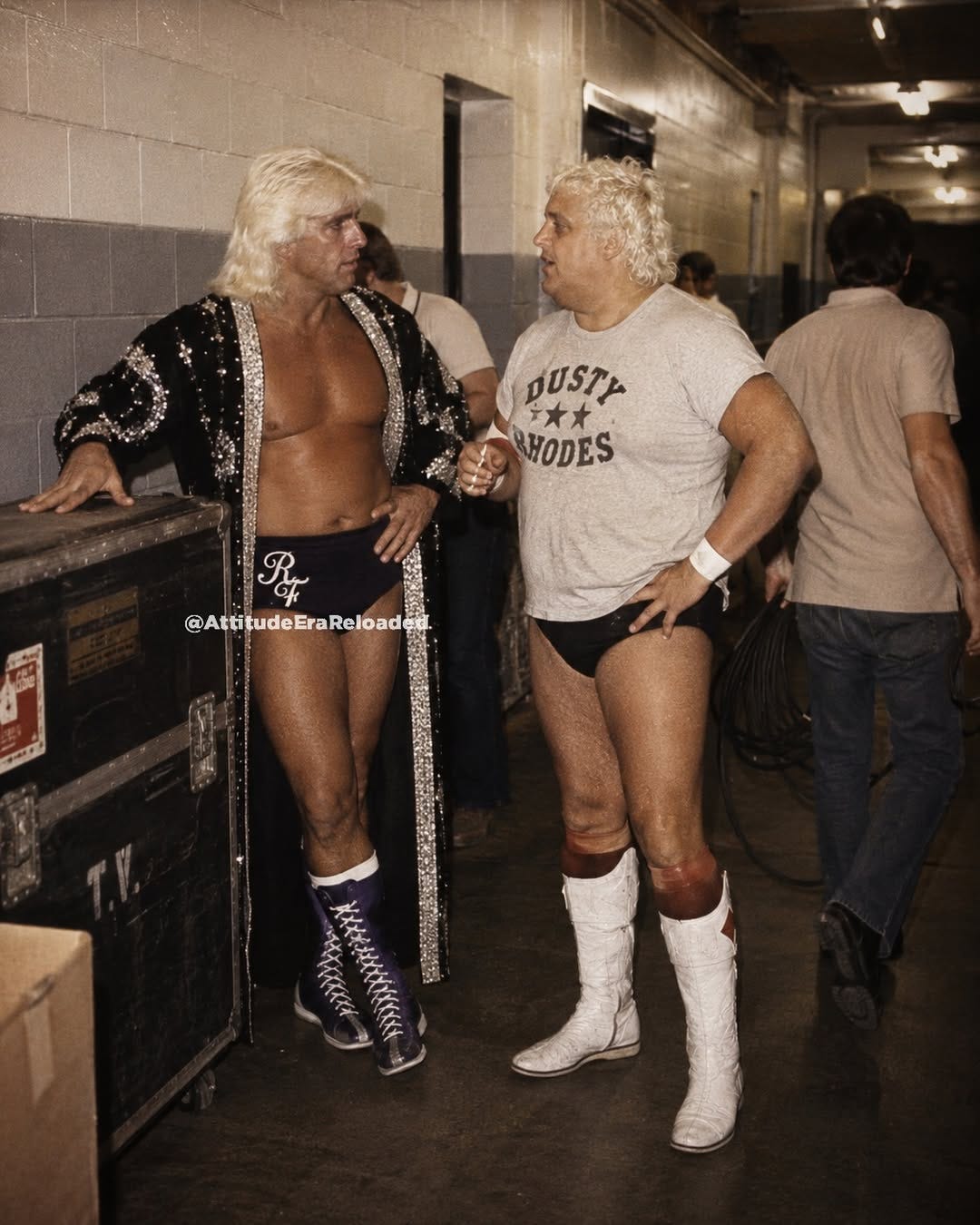
Pictured: Jim Crockett Promotions’ two biggest stars backstage chatting during a show
Also, the same day, May 1st, 1985, Crockett also signed his booker and other major star to a similar contract and thus guaranteeing that neither of his biggest stars would jump to the WWF. Flair and Rhodes belonged to JCP for the next six years. With Crockett and Rhodes laying out a path for national expansion, Flair was the wrestler who would help blaze the trail and for the next 12-15 months, the Flair and Rhodes program would be the main event match that would open those new markets. With both under contract for guaranteed money as far as base salary was concerned, neither were concerned about being the title holder, as the lucrative nature of holding the NWA World Title was now gone. Rather than a symbol of excellence and the goal of every wrestler to hold it for what it said about the wrestler as far as prestige and money opportunity, that era was gone. Now in this final Stage 7 of Disintegration, the title was just something to be passed from man to man in a storyline, as both were making big money for the time whether they held the title or not.
The Explosion That Created the Four Horsemen
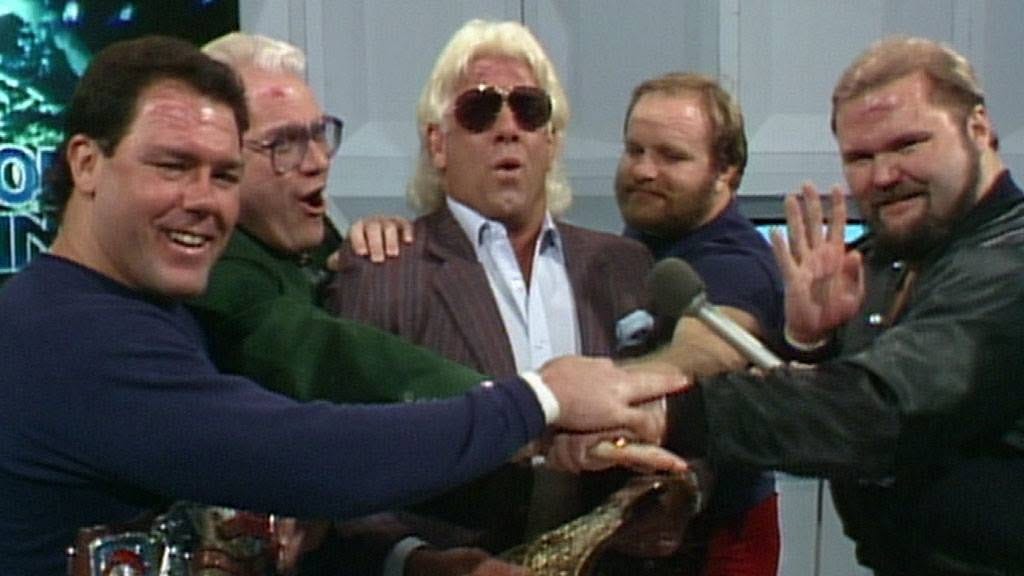
The Flair and Rhodes feud reached its most intense and historically important phase in the fall of 1985. On September 29 at the Omni in Atlanta, Dusty saved Flair from a beatdown by Ivan Koloff, Nikita Koloff, and Krusher Khrushchev. Flair turned on him immediately. Ole and Arn Anderson joined the attack and kayfabe broke Dusty’s ankle. That angle is the true birth of the Four Horsemen (Tully Blanchard and J.J. Dillon would solidify the group shortly afterward).
The attack forced Dusty to vacate the NWA Television Title and set up months of personal vitriol. On October 29, 1985, Dusty delivered the “Hard Times” promo—still widely regarded as one of the greatest interviews in wrestling history. He framed Flair’s actions not as a wrestling angle but as the same hard times working people faced every day: mills shutting down, jobs disappearing, families struggling. The promo turned a title program into something that felt like shared struggle.
Starrcade 1985 became the emotional climax of that year. The match itself was a violent, bloody affair that reinforced everything the angle had built. The Horsemen were now the most hated group in the territory, and Dusty was the people’s champion even when he wasn’t wearing the belt.
1986: The Great American Bash and the Title Change
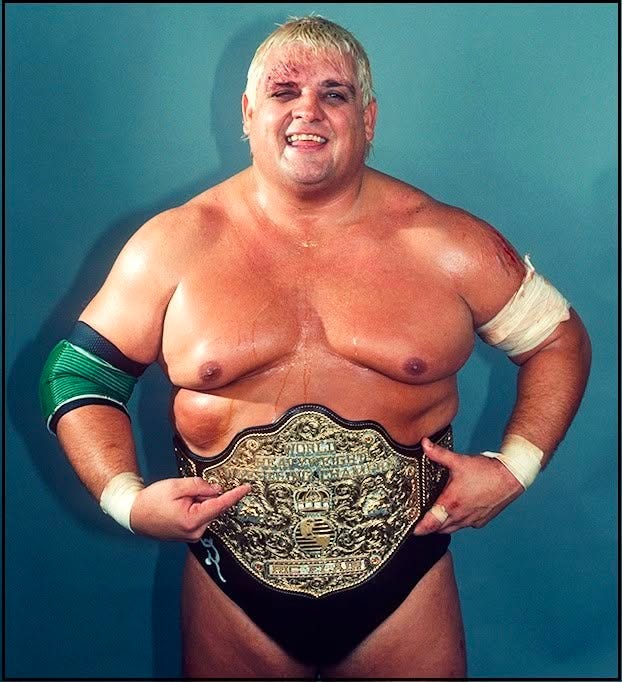
By the summer of 1986 the program was the centerpiece of JCP’s ambitious Great American Bash tour. Flair defended the title repeatedly across the stadium shows while the Horsemen ran interference and the supporting cast (Road Warriors, Magnum T.A., Rock & Roll Express, Wahoo, Ron Garvin) kept the larger war going. Dusty was the constant pursuer.
On July 26, 1986 at the Greensboro Coliseum, inside a steel cage, Dusty finally pinned Flair with an inside cradle to win the NWA World Heavyweight Championship for the third (and final) time. Both men bled heavily. The post-match celebration—babyfaces pouring into the ring, David Allan Coe involved, the crowd losing its mind—was pure catharsis. It was the emotional high point of the entire Bash tour.
The reign lasted only 14 days. Flair regained the title on August 9, 1986 in St. Louis, Missouri. The short reign was classic territory booking: give the people their moment, show the fans that tyhe popular babyface is capable of beating teh champion to keep hope alive for a few more years then put the belt back on the champion who could work every night and draw across the entire NWA map. Yet the Greensboro cage match remains the signature moment of the entire rivalry and would lead to the blow-off to the program on television when Flair won the title back in St. Louis and Rhodes would move on to another program with Tully Blanchard.
In-Ring Style and Chemistry
Their matches were rarely technical masterpieces in the pure-wrestling sense. They were wars. Dusty’s brawling, punching, and bionic elbow met Flair’s knife-edge chops, figure-four, and dramatic selling. Blood was frequent. The storytelling was advanced for the era: Flair’s arrogance and cowardice when the odds turned, Dusty’s refusal to stay down, the constant presence of the Horsemen as external pressure. They could go 20–30 minutes and make every minute feel personal.
Business and Structural Importance
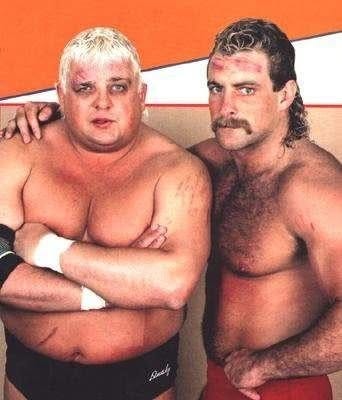
Pictured: Rhodes and Flair’s next planned challenger, Magnum T.A.
In the mid-1980s this feud was the financial backbone of Jim Crockett Promotions. While the WWF was expanding nationally with Hogan, JCP used Flair–Rhodes (and the Horsemen war) to keep its core markets hot and to justify its own larger stadium shows and national television ambitions. The program helped JCP survive and even thrive for a few more years during Stage 7 disintegration. Without the emotional intensity and consistent drawing power of Dusty vs. Flair, Crockett’s attempt to go national would have been far weaker.
Legacy
The rivalry is routinely ranked among the greatest in wrestling history for good reason. It perfected the class-warfare template that later programs tried to copy. It created the Four Horsemen, one of the most influential factions ever. It produced one of the most quoted promos of all time. And it defined both men: Flair as the ultimate arrogant champion, Dusty as the ultimate people’s champion.
They would cross paths again in later years (including a brief 2001 WCW reunion and a 2006 WWE tag match), but nothing matched the heat and cultural weight of the 1985–86 run. In the context of the Territory Era’s final phase, the Dusty–Flair feud was both a last great flowering of traditional regional storytelling and a desperate, high-quality attempt to hold the line against the national expansion that was already winning.
One Thing I Learned About Dusty Rhodes
In 1980, after Dusty Rhodes and André the Giant lost a No-DQ “Loser Leaves Town” match to Gene and Ole Anderson in Georgia Championship Wrestling, Dusty quickly returned under a mask as the wonderfully named Uvalde Slim.
It was an earlier version of the more famous “Midnight Rider” angle he pulled in Florida a few years later (where, as the masked Midnight Rider, he even defeated Ric Flair for the NWA World Heavyweight Title on February 9, 1983 in Tampa—only to have to surrender it because he refused to unmask and prove he wasn’t violating his suspension).
The Uvalde Slim run is a perfect early example of Dusty’s willingness to lean into absurd, obvious-yet-undeniable masked-babyface storytelling that still got over with the fans.
One Thing I Learned About Ric Flair
Ric Flair was adopted as a baby through the infamous Tennessee Children’s Home Society, a notorious black-market adoption operation run by Georgia Tann that was later exposed for kidnapping children from poor families and selling them illegally.
He has said he doesn’t even know his exact birth name for certain (records list possibilities like Fred Phillips, Fred Demaree, or Fred Stewart). He was adopted by the Fliehr family and has generally chosen not to dig deeper into his biological origins, considering his adoptive parents his real family.
Thank You for Watching and Listening
I’m Tony Richards, Pro Wrestling Historian, Author and Storyteller. I share pro wrestling historical items in each issue of the Time Tunnel Pro Wrestling History Newsletter and each episode of our podcast show. Thanks for your support! If you enjoy my information on select events, matches and insights, please share with folks you think might like to be a subscriber!
Remember, Premium subscribers get access to exclusive and special content such as some special issues including a multi-part deep dives on wrestling territories, wrestler bios and championship title histories, special audio and video interviews on territory pro wrestling and more available in the Pro Wrestling Time Tunnel for Premium Subscribers. Being a Premium Subscriber also means you support me in my efforts to document Pro Wrestling History through my research, writing, books, vidoes and podcasts. And…I have something very special planned for our Premium Subscribers on the Podcast side of things in 2026! Details soon here in the Pro Wrestling Time Tunnel.