


Happy Birthday to those who have passed on and to those great wrestlers still with us:
In Memoriam:
Bonnie Watson 1932
Sweet Daddy Siki 1940
Paul Jones 1942
Dale Hey\Buddy Roberts 1947
Jim Hellwig\The Ultimate Warrior 1959
Happy Birthday:
Ted Arcidi (68)
James Fullington\The Sandman (63)
Gzim Selmani\Rezar (32)
Jack Perry\Jungle Boy (29)
RIP Memorial: We stop & remember those who have passed on this day and gave themselves to the business for us, the fans. We salute you and thank you.
Alberto Torres 6-16-1971 at the age of 37

The Life and Career of Alberto Torres
Alberto Torres was an American professional wrestler whose career embodied the spirit of the National Wrestling Alliance (NWA) territorial system during its mid-20th-century heyday. Billed at around 228 pounds and often from Sonora, Mexico (despite his California roots), Torres was a reliable, athletic babyface known for his technical prowess, tag team excellence, and resilience. As the youngest of the Famous Torres Brothers—alongside older brothers Enrique and Ramon—he helped define an era where family acts, multi-territory travels, and hard-hitting rivalries drove business. Though his life was cut tragically short at age 37, Torres amassed an impressive collection of tag team championships across North America, leaving a legacy as a dependable draw in an industry built on grit and geography.
Born in California (often associated with Santa Ana in family accounts), Alberto grew up in the shadow of his eldest brother Enrique Torres, a trailblazing star who captured NWA World Heavyweight Championship recognition and became a major name in the 1940s and 1950s. Enrique’s success inspired Alberto and middle brother Ramon to pursue the same path, but the elder Torres insisted on a rigorous foundation. He required his younger brothers to master amateur wrestling first—training at places like the YMCA in San Francisco—to become competent “shoot” wrestlers before turning pro. This emphasis on legitimate grappling skills shaped Alberto’s in-ring style, favoring arm and leg locks alongside high-impact moves like the Cannonball.
Alberto debuted around 1957, entering a business still deeply rooted in regional promotions. The Torres family’s Mexican-American heritage and polished tag team work made them natural babyfaces who could connect with diverse audiences, from California to the Deep South.
The Torres Brothers became one of the most decorated family units in NWA history. They were top babyfaces in numerous territories, excelling in both singles and especially tag team competition. Their chemistry, athleticism, and willingness to travel made them ideal for the territorial model, where promoters relied on proven acts to headline and build rivalries.
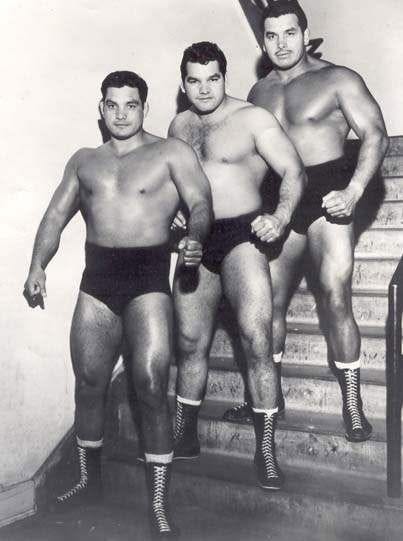
Pictured: The Torres Brothers, Alberto, Ramon and Enrique
Alberto and his brothers compiled an extraordinary championship résumé that spanned multiple regions. They captured the NWA World Tag Team Championship in the Florida version once, teaming together as Ramon and Alberto. They secured multiple reigns with the NWA World Tag Team Championship in both the Georgia and San Francisco versions. In Georgia, Alberto earned four reigns as NWA Georgia Tag Team Champion and six as NWA Southern Tag Team Champion, often partnering with Enrique or Ramon. He added six reigns with the NWA Pacific Coast Tag Team Championship out of San Francisco. The brothers also claimed the WWA World Tag Team Championship three times, including runs with Ramon and later with Thunderbolt Patterson. Additional success came with five reigns as NWA Tri-State United States Tag Team Champions, the Stampede Wrestling International Tag Team Championship alongside Ramon in Calgary, and the AWA Midwest Tag Team Championship with Cowboy Bob Ellis. They collected further titles during stops in Texas, Hawaii, and other territories.
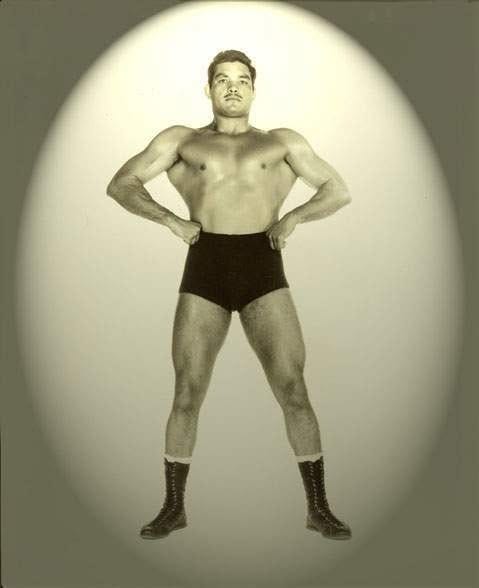
In the late 1950s, Alberto shone in Arizona’s Phoenix territory. The 1960s saw the brothers at their peak. In Florida (1963), Ramon and Alberto were the top babyface duo, feuding memorably with the Von Brauners and Keomuka & Matsuda. They headlined across the South, drawing strong crowds with their polished, scientific style against rugged heels.
In Georgia, they engaged in the heated “Vachon-Torres Brother War” (around 1967) against the Vachon family (including Mad Dog, Butcher, and Stan). These programs showcased multi-man family brawls and sold-out arenas, highlighting the dramatic storytelling of the era. The brothers also ventured into Stampede Wrestling in Calgary, Hawaii, Texas, and Los Angeles’ WWA promotion, adapting to regional styles while maintaining their core identity as exciting, resilient faces.

Pictured: The three Vachon Brothers, Paul, Stan and Maurice
**Photo credit: Chris Swisher, CS Classic Photos, all rights reserved
Alberto occasionally worked singles matches and international spots (including Japan and a notable 1959 bout in Havana, Cuba, on the night of the Batista regime’s fall). His reliability made him a promoter’s favorite for building house show business.
As a consistent babyface, Alberto Torres projected honesty, athleticism, and heart. He wasn’t a flashy gimmick wrestler but a solid worker who could carry matches with technical exchanges, come-from-behind rallies, and strong tag team psychology. His feuds often pitted the Torres Brothers’ unity against chaotic or villainous opponents, resonating in an era when wrestling emphasized clear moral lines and physical storytelling.
On June 13, 1971, in Verdigre, Nebraska, Alberto teamed with Cowboy Bob Ellis against Ox Baker and The Claw in an AWA Midwest Tag Team title match. He collapsed during or shortly after the bout and died three days later on June 16. The official cause was heart disease combined with a ruptured pancreas and other internal injuries. He had reportedly been wrestling while already ill but did not disclose it.
In classic wrestling kayfabe, promoters amplified Baker’s “Heart Punch” finisher as the culprit, bolstering the heel’s dangerous persona (a narrative later echoed in other incidents). In reality, it was a tragic coincidence tied to pre-existing health issues. Alberto’s death at just 37 underscored the physical toll of the road warrior lifestyle in the territorial era—long travels, frequent matches, and limited medical oversight.
His brothers continued in the business; Enrique lived into later decades and reflected on the family’s accomplishments. Alberto’s passing was mourned in wrestling circles as the loss of a dedicated performer who gave everything to the squared circle.
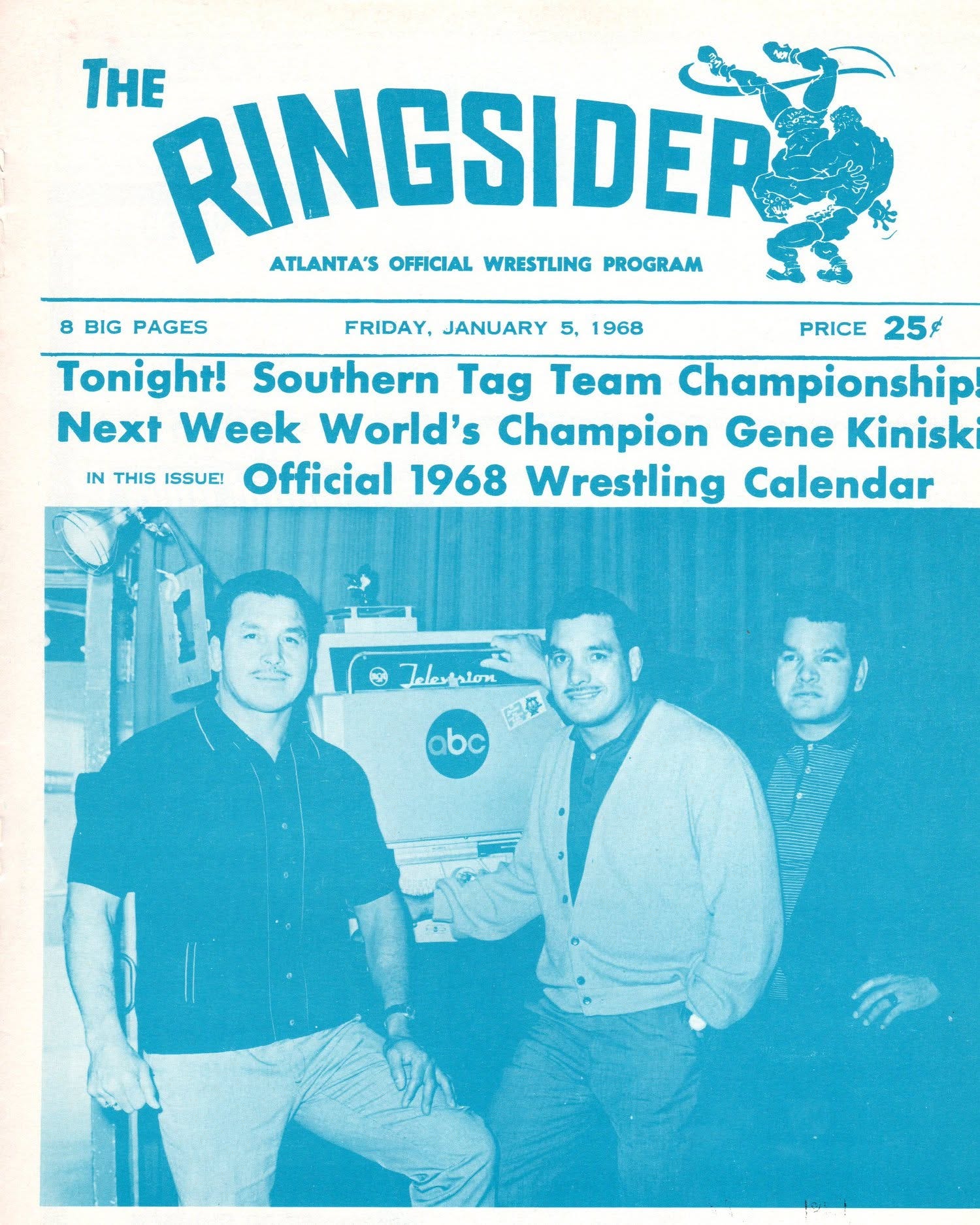
Alberto Torres’ career fits squarely into the expansion and peak years of the NWA territorial system. The Torres Brothers exemplified successful multi-territory operations: leveraging family bonds for storytelling, winning titles to establish credibility, and traveling to fill cards wherever promoters needed draws. They helped sustain regional wrestling before the industry’s later national consolidation.
Though less individually famous than some contemporaries, Alberto’s contributions to tag team wrestling—particularly in California, the South, and Midwest—were substantial. Matches against teams like the Sharpes, Vachons, and Medics remain highlights of 1960s footage and tape trading lore. His story also serves as a poignant reminder of the human cost behind the spectacle.
For fans of the territorial era, Alberto Torres represents the unsung heroes who built houses night after night, brother by brother, territory by territory. His brief but impactful run reminds us that wrestling’s golden age was powered not just by superstars, but by reliable, passionate workers like the youngest Torres.
The TV Wrestling Interview That Never Left Tom Andrews
In the wake of Alberto Torres’ tragic death on June 16, 1971—just three days after collapsing during a tag team match in Verdigre, Nebraska—the wrestling promotion (under promoter Joe Dusek in the Omaha/Central States area) leaned heavily into kayfabe to capitalize on the tragedy for heat and business. Tom Andrews, wrestling as the masked heel The Claw, was thrust into one of the most insensitive on-screen angles of the era.
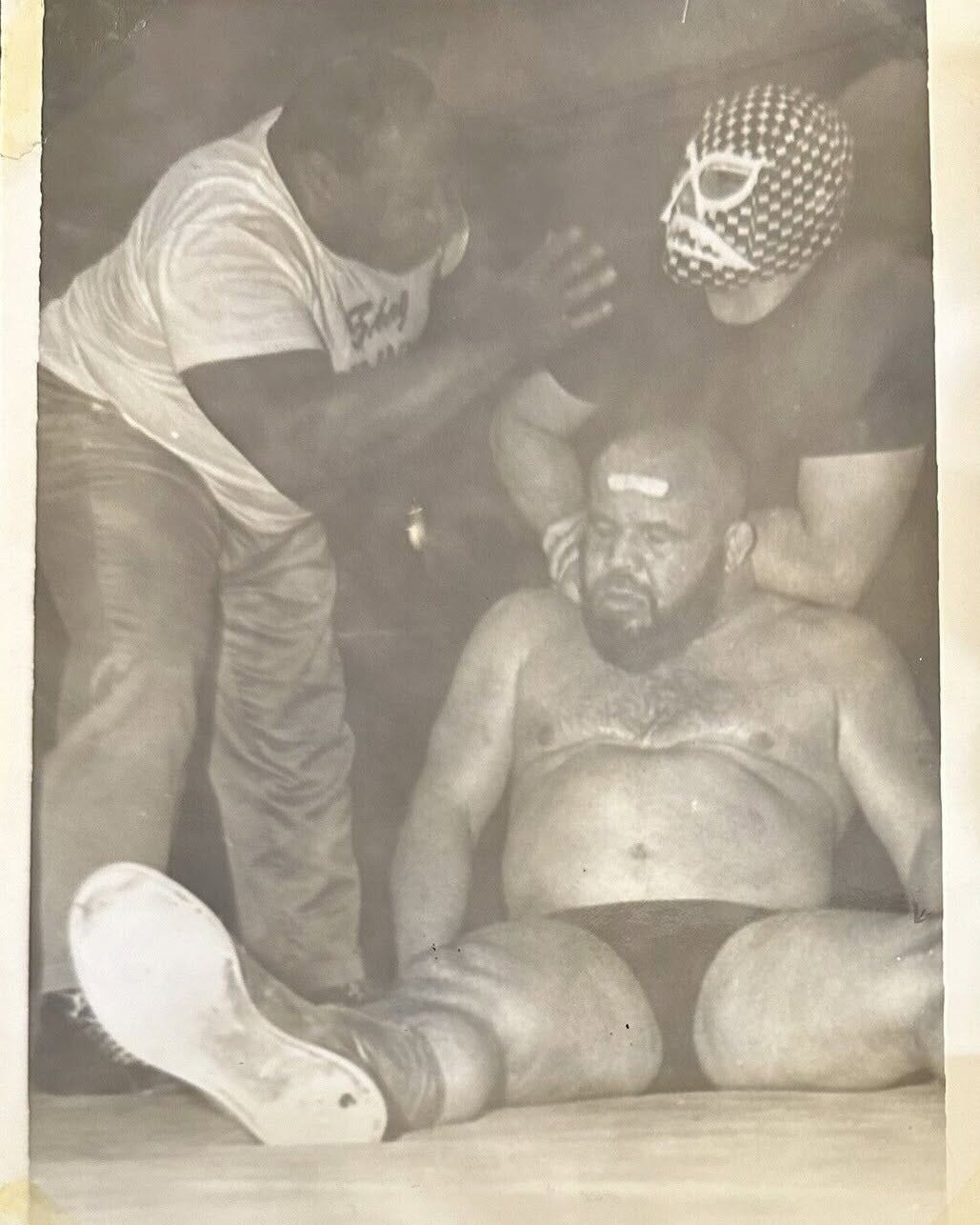
Pictured: Tom Andrews as “The Claw” puts his devastating nerve hold on Tough Tony Bourne as referee Shag Thomas gives a warning to break the hold
On June 13, 1971, Torres (teaming with Cowboy Bob Ellis) defended the AWA Midwest Tag Team titles against Ox Baker and The Claw (Tom Andrews). Torres collapsed in the ring or shortly after and was hospitalized. He passed away from pre-existing conditions including heart disease, a ruptured pancreas, and internal injuries—issues he had reportedly been wrestling with undisclosed. In storyline, promoters amplified the danger of the heels’ moves (particularly Baker’s Heart Punch, though accounts also reference a kneedrop or actions by The Claw).
While Torres was still in the hospital (and before his death became public), promoter Joe Dusek had Andrews appear on television as The Claw. Andrews was instructed to cackle and boast about the severe injuries he had “inflicted” on the popular babyface Torres. The promotion continued pushing this narrative even after Torres’ death, claiming The Claw had “killed” him to generate massive heel heat.
Details of the exact wording are sparse in surviving records but contemporary accounts describe it as Andrews (in character) gleefully taking credit for Torres’ condition. This was not a standard promo—it crossed into exploitative territory by referencing a real, ongoing medical crisis involving a well-liked wrestler.
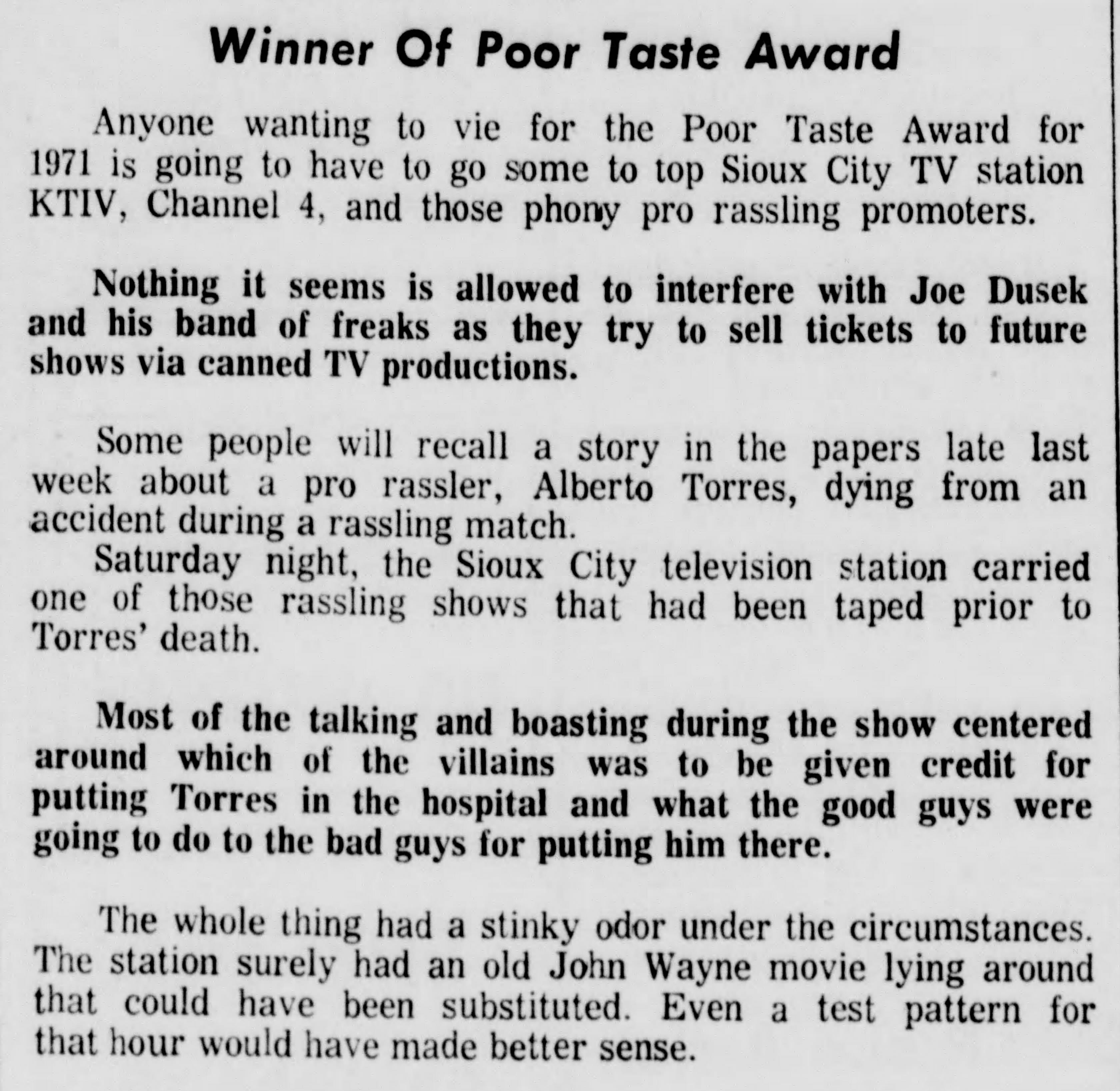
Pictured: June 23rd, 1971 Lincoln Star, Lincoln, Nebraska
The angle drew significant criticism. Lincoln Star editor Hal Brown awarded promoter Joe Dusek the “Poor Taste Award for 1971” for exploiting the tragedy in this manner. Fans and local media viewed it as bilking a real human loss for ticket sales and ratings. Andrews himself later reflected on the emotional toll in interviews, stating it led him to serious soul-searching and nearly caused him to quit the business. He emphasized that he hadn’t done anything physically wrong in the match but regretted participating in the on-screen celebration of the injury.
This incident was emblematic of the “anything for heat” philosophy in the NWA territories during the early 1970s. Promoters like Dusek often blurred lines between reality and storyline to sell arenas, especially with masked heels like The Claw whose anonymity allowed for more vicious personas. Similar controversial angles occurred elsewhere (e.g., The Claw’s earlier Portland promo threatening the Easter Bunny with Beauregarde, which also sparked viewer outrage and forced an on-air apology).
Seven weeks after Torres’ death, his brother Ramon Torres unmasked Andrews as The Claw in a challenge match, providing some narrative closure while further drawing on the family’s real grief for business.
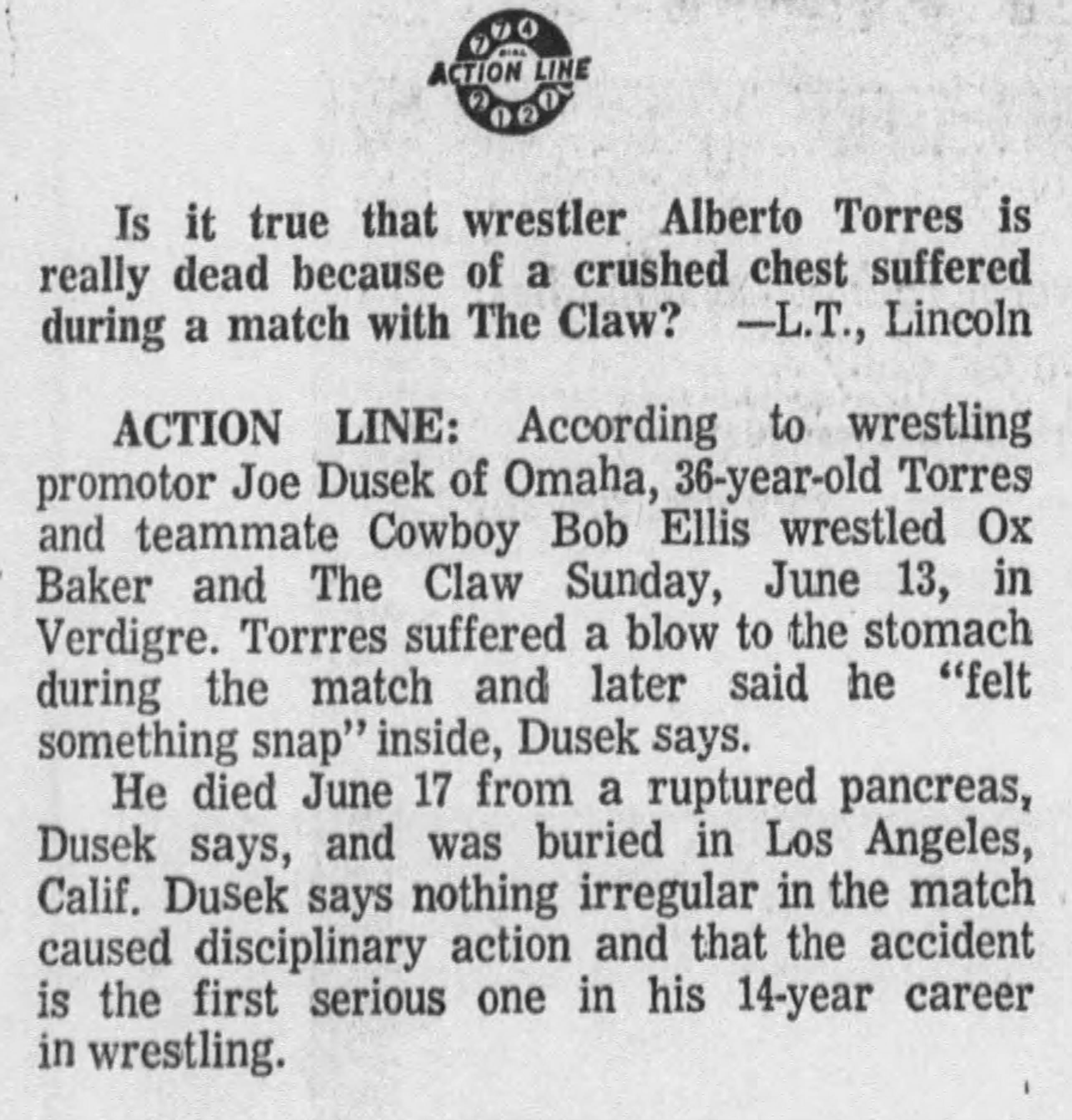
Pictured: July 28th, 1971 Lincoln Star, Lincoln, Nebraska
Andrews went on to greater success as one of the masked Interns (with Jim Starr), but the Torres angle remained a dark chapter. It highlighted the physical and ethical risks of the road-warrior lifestyle and the sometimes callous promotional tactics of the time In an interview for the book, “Pro Wrestling Hall of Fame: The Tag Teams” by Greg Oliver and Steve Johnson, Andrews was quoted as saying about the incident, “When that thing happened, I was ready to quit the business. I had to do a lot of soul searching.”
No full video footage of the specific interview appears to be available today, but wrestling historians and participants’ recollections consistently frame it as a notorious example of poor taste in an era when real injuries and deaths were sometimes turned into angles without thorough thought.
This event adds a somber layer to Alberto Torres’ legacy and underscores why many in the business, including Andrews, grappled with the human cost behind the sport of the era.
One Thing I Learned About Buddy Roberts
Before becoming the wild, whiskey-loving Buddy “Jack” Roberts of The Fabulous Freebirds, Dale Hey debuted in 1965 as Dale Valentine — billed as the younger brother of the legendary Johnny Valentine. He was trained by Ivan Koloff and spent his early years working as a preliminary wrestler, including in the AWA, before Bill Watts renamed him Buddy Roberts in 1970.
This early “Valentine brother” gimmick helped him gain experience and connections in the business long before he teamed with Michael Hayes and Terry Gordy to revolutionize tag team wrestling.
Thank You for Reading
I’m Tony Richards, Pro Wrestling Historian, Author and Storyteller. I share pro wrestling historical items in each issue of the Time Tunnel Pro Wrestling History Newsletter. Thanks for reading! If you enjoy my information on select events, matches and insights, please share it with folks you think might like to be a subscriber!
Remember, premium investors get access to exclusive and special content such as some special issues including a multi-part deep dives on wrestling territories, wrestler bios and championship title histories, special audio and video interviews on territory pro wrestling and more available in the Pro Wrestling Time Tunnel for Premium Investors.
I grew up watching the Torres brothers in the mid to late 60s in Georgia on TV and in person. Alberto was my mother's favorite. This brought back a lot of childhood memories. Thanks for the story, Tony!