



Happy Birthday to those who have passed on and to those great wrestlers still with us:
In Memoriam:
George “Bunk Two-Ton” Harris 1927
Stan Vachon\Kalmikoff 1933
Jim Wilson 1942
Flying Fred Curry 1943
Charles Meserole\Gary Lawler 1954
Hector Garza 1969
Happy Birthday:
Jerry Lynn (63)
Johnny “Hotbody” Weiss (63)
Mark Henry (55)
Tomoyuki Oka\Great-O-Khan (35)
RIP Memorial: We stop & remember those who have passed on this day and gave themselves to the business for us, the fans. We salute you and thank you.
Aurelian “Grizzly” Smith, Sr 6-12-2010 at the age of 7
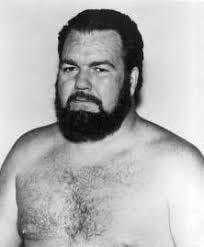
Barbara Baker 6-12-2025 at the age of 82

Flashback 1936: The June 12, 1936, Match Between Ali Baba and Dave Levin: A Pivotal Moment in the Fractured World Heavyweight Championship Landscape of the 1930s.
In the chaotic world of 1930s professional wrestling—marked by territorial disputes, promoter rivalries, double-crosses, and multiple competing claims to the World Heavyweight Championship—the June 12, 1936, bout at Meadowbrook Field in Newark, New Jersey, between champion Ali Baba (Arteen “Harry” Ekizian) and rising star Dave Levin stands out as a controversial flashpoint. It exemplified the era’s fragmented title scene, where state athletic commissions, promoters, and opportunistic grapplers vied for supremacy amid shifting alliances. What was billed as a standard title defense became a disqualification victory for Levin, propelling the 23-year-old “Jamaica Butcher Boy” into the championship picture while highlighting the precarious nature of “world” titles in pre-NWA wrestling.
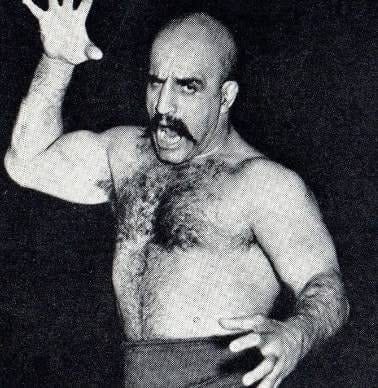
Pictured: Ali Baba
Ali Baba (Arteen Ekizian) was born on September 28, 1901 (some sources say June 21), in Samsun, Ottoman Empire (modern-day Turkey). An Armenian survivor of the Armenian Genocide, he escaped to the United States around 1920. Ekizian served in the U.S. Navy, where he excelled as an amateur wrestler, claiming fleet championships in multiple weight classes and even a “World Champion Navy Wrestler” title. He received recognition at a White House reception from President Calvin Coolidge in 1927. Turning pro in the 1930s, he wrestled under variations like Ali Yumid and Harry Ekizian before officially adopting the exotic “Ali Baba” gimmick in April 1936—a “Terrible Turk” or “Krushing Kurd” persona that tapped into popular Middle Eastern exoticism for American audiences.
Baba’s path to the title involved high drama. On March 2, 1936, Dick Shikat had controversially (in a shoot) defeated Danno O’Mahoney for a major version of the World Heavyweight Championship at Madison Square Garden. Shikat then lost the title to Baba on April 24/25, 1936, in Detroit (some records note a May 5 win in New York for additional recognition). Baba’s reign was already contested; New York State initially withheld full recognition, and the broader title picture included claims by Vincent Lopez in California and others. Baba was a capable but transitional figure in a landscape still recovering from the “trust” era of promoters like Toots Mondt and Jack Curley.

Pictured: Dave Levin
Dave Levin (born George William Wenzel on February 27, 1913, in Brooklyn) was the fresh-faced prodigy. Discovered working in a Jamaica butcher shop, he trained at Bothner’s Gym and debuted in 1934. Levin quickly built a reputation as a “wrestling prodigy,” going undefeated in his first 28 matches. By 1936, he was a popular draw in the New York area, often headlining for promoters like Jess McMahon. Initially a light heavyweight contender, he bulked up and earned a shot at Baba after defeating Hans Schacht and Salvatore Balbo. At just 23, Levin represented youthful athleticism and the next generation against the more experienced Baba.
The 1930s title scene was notoriously splintered. Promoters operated semi-independently, with state commissions granting (or withholding) recognition. The “original” lineage traced back through Jim Londos, Danno O’Mahoney, and Shikat, but rival versions existed in different regions. This created opportunities for ambitious young wrestlers and opportunistic bookers.
Promotion for the Newark event was handled by the Dreamland Sporting Club (their initial show at the venue). It was originally billed as Ali Baba defending his World Heavyweight Championship against Hans Schnabel, with Levin slated for a separate match against Maurice LaChappelle. Levin was substituted in at the last minute for Schnabel, a common practice that fueled later suspicions of setup or double-cross involving “Trust” promoters.
New Jersey’s involvement added layers: The state athletic commission did not fully sanction unified “world” titles, yet the match carried championship billing. This fit the era’s promoter-driven, commission-influenced chaos, where claims shifted by region and alliances.
Advertising ran through the day of the show with the original matchups. The outdoor summer card at Meadowbrook Field aimed to capitalize on local interest amid the title turmoil, with Levin’s youth, Brooklyn roots, and recent momentum (including a win over Balbo on June 8) positioned against Baba’s controversial and already-weakened reign. Baba’s real identity as Harry Ekizian had been exposed in newspapers shortly after his title win, undermining the exotic heel gimmick and adding intrigue to the promotion. New Jersey’s athletic commission involvement added another layer, as the state did not fully sanction unified “world” titles, yet the match carried championship billing. This fit the era’s promoter-driven, commission-influenced chaos, where claims shifted by region and alliances.
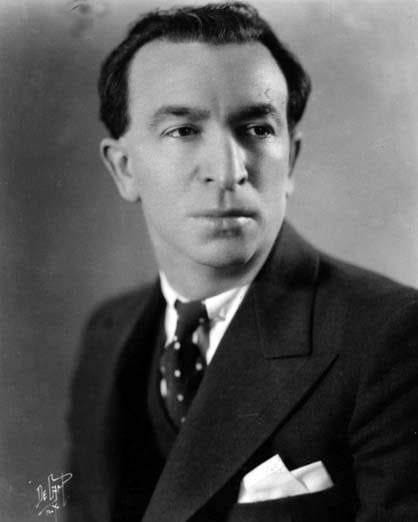
Pictured: Jack Pfefer
Another important fact to consider was that Jack Pfefer’s machinations were instrumental in the splintering of the World Heavyweight Championship following Dick Shikat’s legitimate shoot victory over Danno O’Mahoney on March 2, 1936, at Madison Square Garden. Shikat’s win exposed the Trust’s vulnerabilities. Subsequently, promoters including Al Haft and Pfefer facilitated (or were accused of backing) arrangements for Ali Baba to defeat Shikat on April 24/25, 1936, in Detroit—widely regarded as a paid “drop” or work to install a controllable champion.
Pfefer had a direct stake: He was closely associated with the promotion of Baba’s reign and, crucially, managed or controlled the contract of the rising star Dave Levin. Levin had been discovered in a butcher shop, trained at Bothner’s Gym under Pfefer’s guidance (via Herb Freeman), and built as a prodigy under his influence. Pfefer saw Levin as a vehicle for his own ambitions.
Pfefer’s role in the Baba-Levin affair was not always front-and-center in contemporary reports, many of the power brokers preferred shadows, but historical consensus from wrestling databases, books, and archives positions him as a key architect alongside Haft and Mondt. This made the June 12 match a microcosm of 1930s grappling politics: ambition, betrayal, and the blurred line between work and shoot.
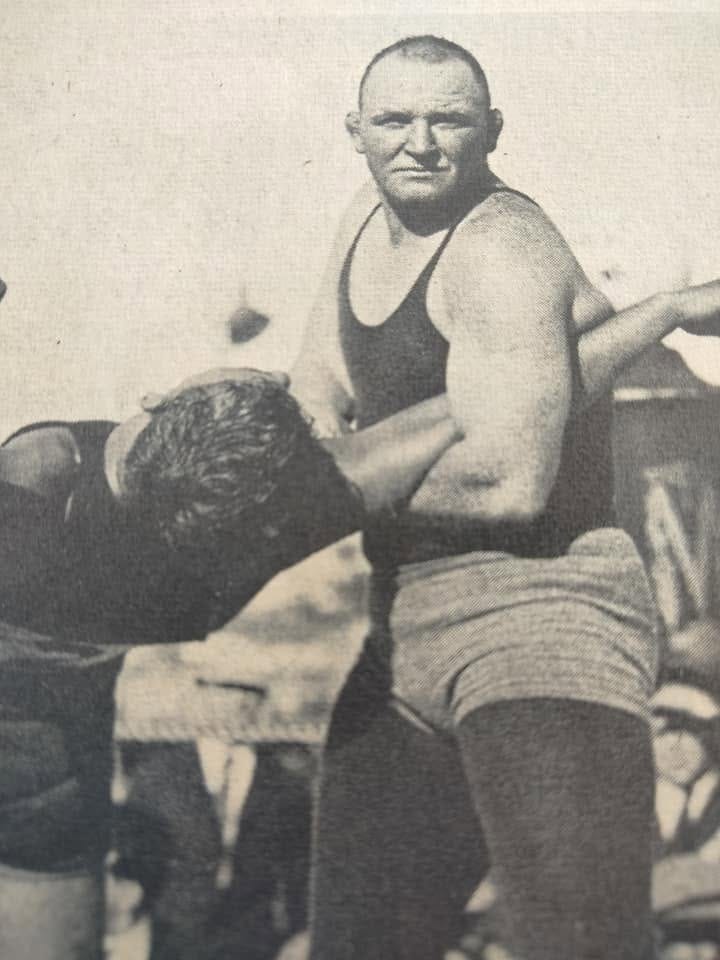
Pictured: Toots Mondt in his wrestling days
Toots Mondt was deeply embedded in the Curley Trust alongside partners like Ray Fabiani. The Trust aimed to control top talent and share bookings across regions, but it faced internal fractures and external challenges. Shikat’s March 2, 1936, shoot win at Madison Square Garden exposed the worked nature of the business and weakened the Trust’s grip.
Mondt played a direct role in the controversial installation (and removal) of Ali Baba as champion. After Shikat’s win, promoters like Al Haft and Adam Weissmuller arranged for Baba to defeat Shikat in Detroit on April 24/25, 1936, with a follow-up in New York. Historical accounts indicate that Toots Mondt paid Jack Pfefer $17,000 to facilitate a double-cross on Haft/Sandow’s champion Baba, maneuvering the title toward a more controllable figure.
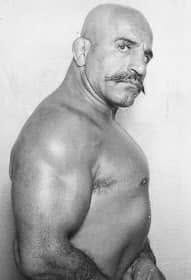
Pictured: Ali Baba
The event took place on Friday, June 12, 1936, at the outdoor Meadowbrook Field, promoted by the Dreamland Sporting Club. Referee Frank Sinborn officiated, with Dr. Wolf Emmer of the New Jersey State Athletic Commission serving as the ringside physician. Attendance details vary but drew significant local interest for a summer outdoor show.
Accounts describe a roughly 21-minute contest. The match proceeded as a standard grappling affair until around the 21-minute mark. Baba landed a dropkick (or kick) to Levin’s midsection/groin area. Referee Frank Sinborn ruled it a foul/low blow, awarding Levin the first fall. Levin was knocked to the mat and reportedly in significant pain.
The referee allowed Levin a 10-minute recovery period to continue the bout. After the interval, Levin was unable to continue (some accounts note he was taken to City Hospital afterward). The match was awarded to Levin by disqualification (or default), scored as 2-0 in his favor. Levin was a last-minute substitute for Hans Schnabel.
Baba protested vehemently post-match, telling reporters: “I’ve met good men all over the country, beat Shikat twice and sent him to the hospital, only to be robbed here. If that’s the way championships are won, I’d rather not have a title and be a plain working wrestler. You bet I’ll kick about the decision. And if I ever get that Levin in a ring again, I’ll murder him and finish him in a minute.”
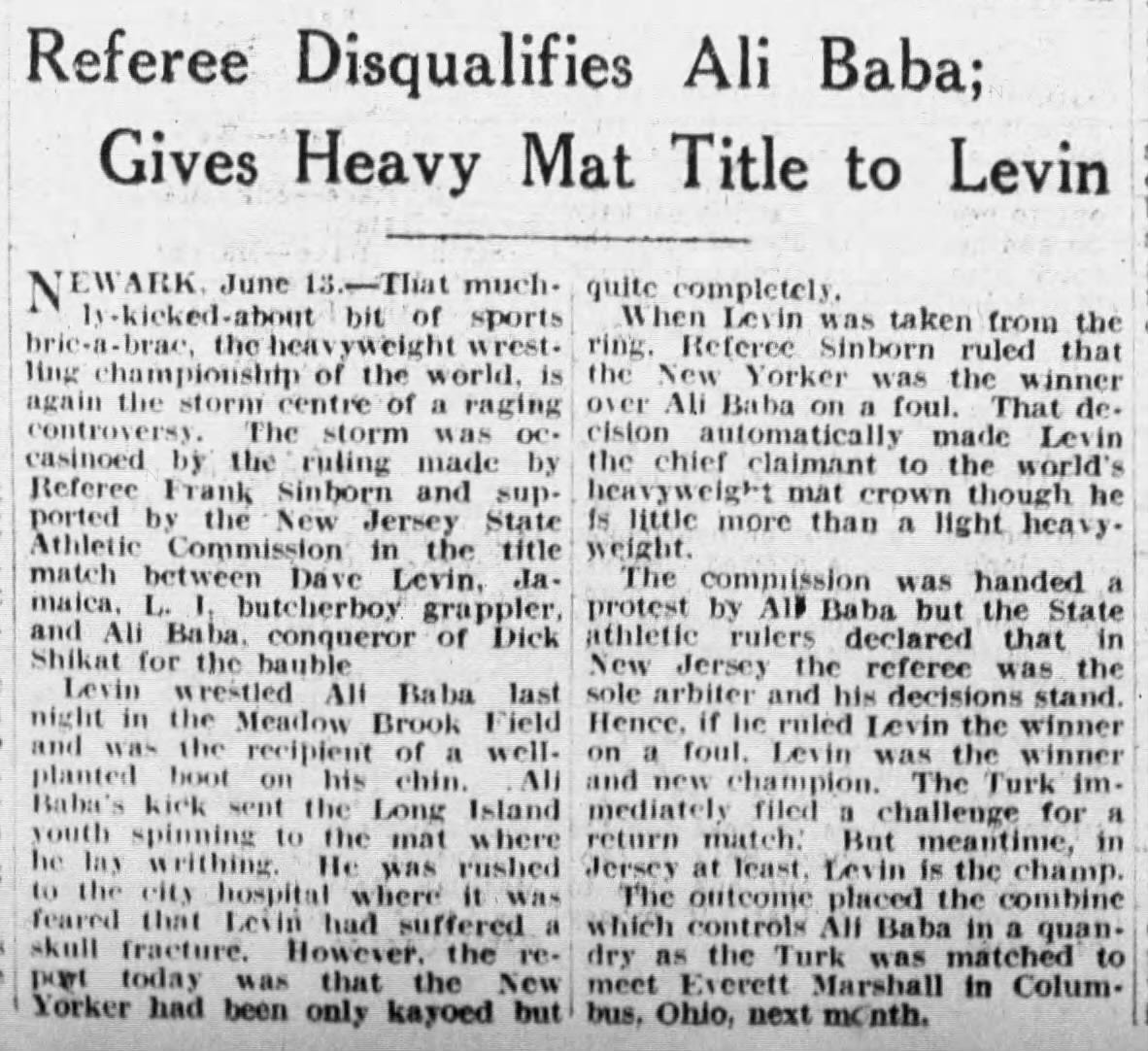
The New Jersey State Athletic Commission initially backed Levin the next day, stating “the referee is the sole arbiter of the decision of a match,” making the 23-year-old one of the youngest World Heavyweight Champions at the time. However, they later clarified that New Jersey did not officially sanction “world” titles in a coalition sense. New York withdrew recognition of Baba. The decision fueled ongoing disputes, with Baba retaining claims in states like Michigan.
Levin began billing himself as champion and embarked on a busy defense schedule, defending in multiple states and earning recognition in places like Pennsylvania and New Jersey. He later unified aspects of the title by defeating Vincent Lopez in Los Angeles. Baba’s claim faded; he lost to Everette Marshall on June 26, 1936, in Columbus, Ohio, further fragmenting the picture.
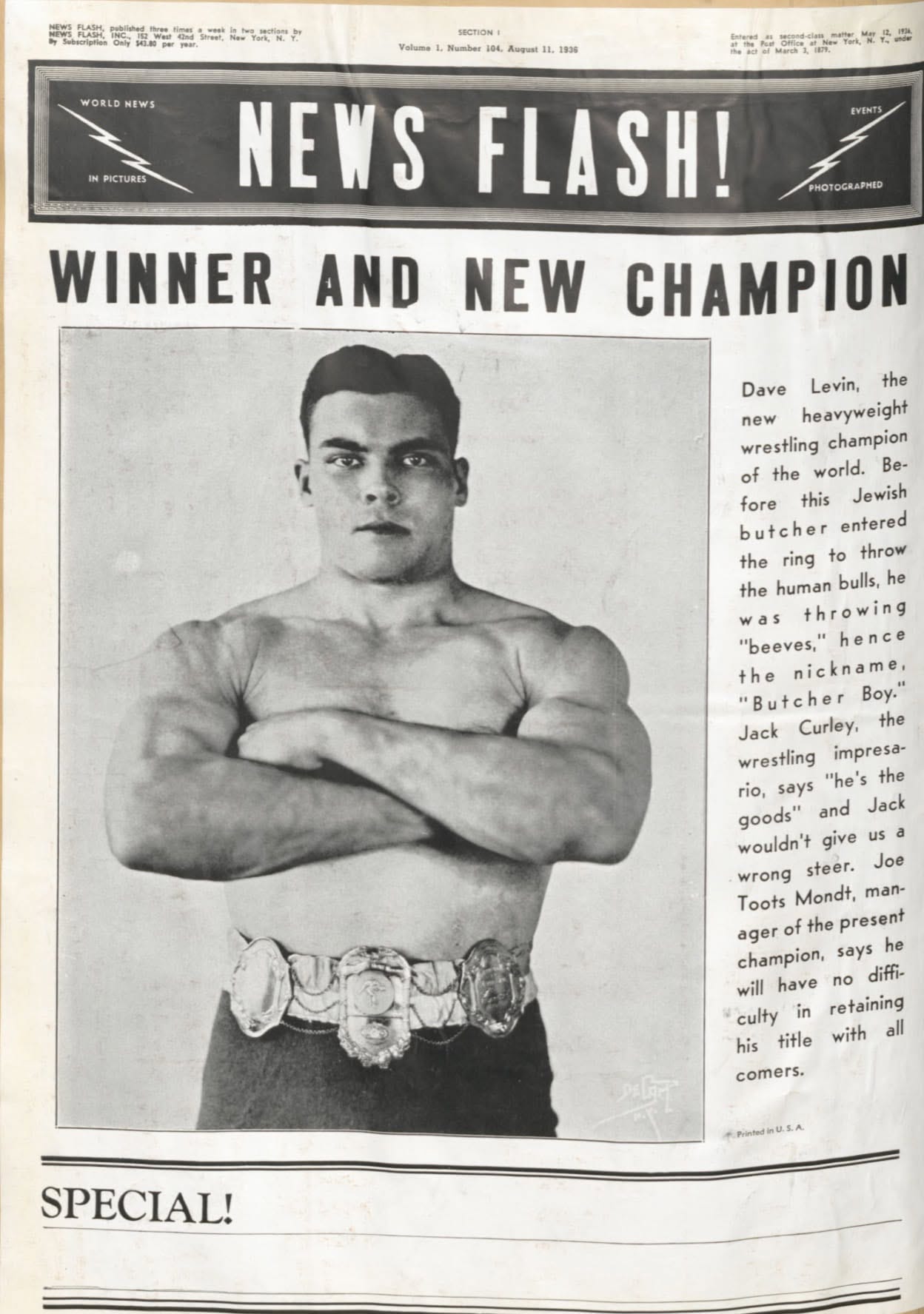
Pictured: Dave Levin, the new World Champion
Historians note possible promoter involvement. Some accounts suggest a “double-cross” or setup tied to the “trust” (Mondt/Pfefer circles) to elevate Levin, similar to earlier controversies. Jack Pfefer and others were active in the Northeast, and Levin’s rapid rise aligned with their interests. Baba later reflected on it as being crossed by the establishment.
I believe Mondt’s influence, alongside Pfefer, helped engineer the outcome to elevate Levin as a fresh, marketable babyface champion under Trust control. After Levin’s victory, Mondt actively managed his title claims. In July 1936, Levin appeared in St. Louis with Mondt, announcing readiness to face other claimants like Everette Marshall for unification (with a $6,000 guarantee demanded). Mondt positioned Levin as a Northeast-based champion while coordinating defenses and cross-territory talks. Another thing to consider as far as ingredients leading to later territory booking, was that Monday’s booking approach emphasized theatrical elements, strong babyfaces like Levin, and opportunistic booking—hallmarks that would define his later work with Vince McMahon Sr. in Capitol Wrestling Corporation (precursor to WWWF/WWE).
This June 12th, 1936 title match with Levin and Baba underscored the era’s kayfabe fragility and business machinations, as covered in newspapers and later histories. It propelled Levin’s career—he defended extensively, toured, and became a star before retiring in 1954. Baba continued wrestling into the 1950s, living until 1981.
Within frameworks like my “7 Stages of the Territory Era,” this bout fits into the ongoing Foundations phase of the 1930s. It was another catalyst in laying the foundations of characters, booking and title importance.The post-Londos/O’Mahoney era saw titles splinter due to shoots (Shikat), promoter wars, and weak central authority. Here’s the key inflection point about this match: matches like this one highlighted how a single DQ in a substitute bout could shift claims across territories, prefiguring the NWA’s 1948 unification efforts. It perfectly highlighted the need for a better ruling authority. Another key point was it also showcased the rise of gimmick wrestlers (Baba’s exotic persona) and athletic babyfaces (Levin), influencing drawing power and storytelling.
Reflecting on the impact of this event, it exemplifies wrestling’s “worked” yet volatile reality: athleticism mixed with semi-predetermined outcomes, all amid real commissions and egos. Levin’s youth and Baba’s resilience added dramatic layers to an already colorful decade.
This encounter, though short and controversial, was no mere footnote. It was an important microcosm of 1930s grappling politics—a young butcher boy dethroning an Armenian survivor-turned-exotic champion under dubious circumstances, forever altering multiple title lineages and careers in the process. In the rich tapestry of territorial wrestling history, it remains a compelling case study in ambition, controversy, and the pursuit of championship gold.

Thank You for Reading
I’m Tony Richards, Pro Wrestling Historian, Author and Storyteller. I share pro wrestling historical items in each issue of the Time Tunnel Pro Wrestling History Newsletter. Thanks for reading! If you enjoy my information on select events, matches and insights, please share it with folks you think might like to be a subscriber!
Remember, premium investors get access to exclusive and special content such as some special issues including a multi-part deep dives on wrestling territories, wrestler bios and championship title histories, special audio and video interviews on territory pro wrestling and more available in the Pro Wrestling Time Tunnel for Premium Investors.