


Happy Birthday to those who have passed on and to those great wrestlers still with us:
In Memoriam:
Ronnie P. Gossett 1944
Happy Birthday:
Sam Anoa’i\Samu (63)
Peter Gasparino\Pete Gas (56)
Steve Corino (53)
Brian Kendrick (47)
Savelina Fanene\Nia Jax (42)
Hornswaggle (40)
Josh Alexander (39)
Kanosuke Takeshita (31)
RIP Memorial: We stop & remember those who have passed on this day and gave themselves to the business for us, the fans. We salute you and thank you.
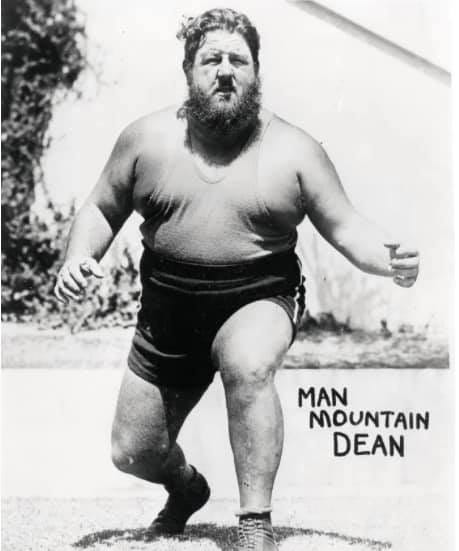
Man Mountain Dean 5-29-1953 at the age of 61
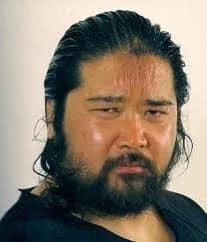
Tarzan Goto 5-29-2022 at the age of 58
The Life and Career of Ray Candy
Ray Candy, born Ray Canty on December 3, 1951, in Decatur, Georgia, was a powerful and versatile professional wrestler whose career spanned the territorial era of the 1970s and 1980s. Standing 6’5” and weighing around 340–341 pounds, Candy possessed the imposing physical presence that promoters prized in a big man, combining size with surprising agility for his era. Though he never reached the national superstardom of WWF or WCW main events in their peak, he left a lasting mark across multiple regions, Japan, and Puerto Rico as both a beloved babyface and a hated heel.
Canty grew up in Decatur and graduated from Booker T. Washington High School in 1971. He was trained by the legendary Dory Funk Jr., a former NWA World Heavyweight Champion known for his rigorous training methods. Candy made his professional debut on January 19, 1973, facing John Caruso. He adopted the ring name “Ray Candy”—a playful modification of his real surname—as a babyface powerhouse. Early in his career, he worked extensively in the southern and midwestern territories, including Georgia Championship Wrestling, Championship Wrestling from Florida, Jim Crockett Promotions, Tri-State/Mid-South, and the Nashville-based Mid-America region.
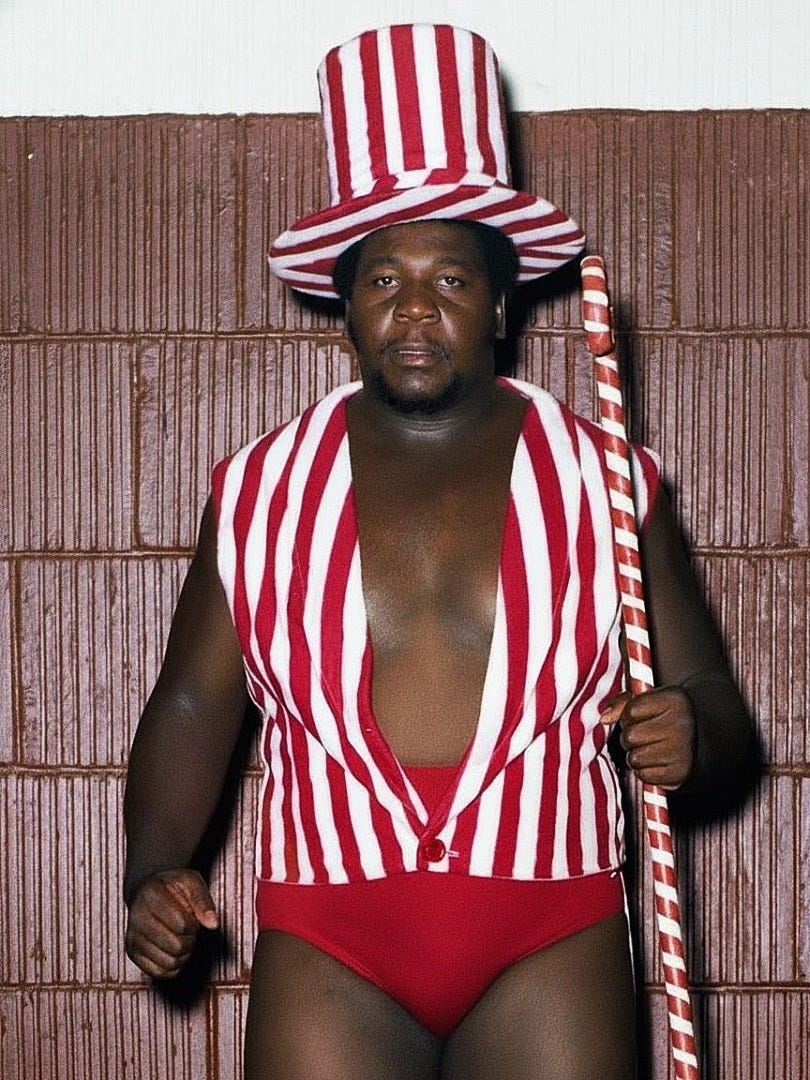
As a face, Candy was popular for his strength-based style and larger-than-life persona, often billed from Decatur, Georgia. He competed successfully in singles and tag team matches, holding various regional titles. His travels took him internationally to All Japan Pro Wrestling (AJPW) and the World Wrestling Council (WWC) in Puerto Rico, where big American wrestlers were often featured attractions. He also used several other gimmicks over the years, including Blackstud Williams, Commando Ray, Masked Superfly, and Super Mario Man.
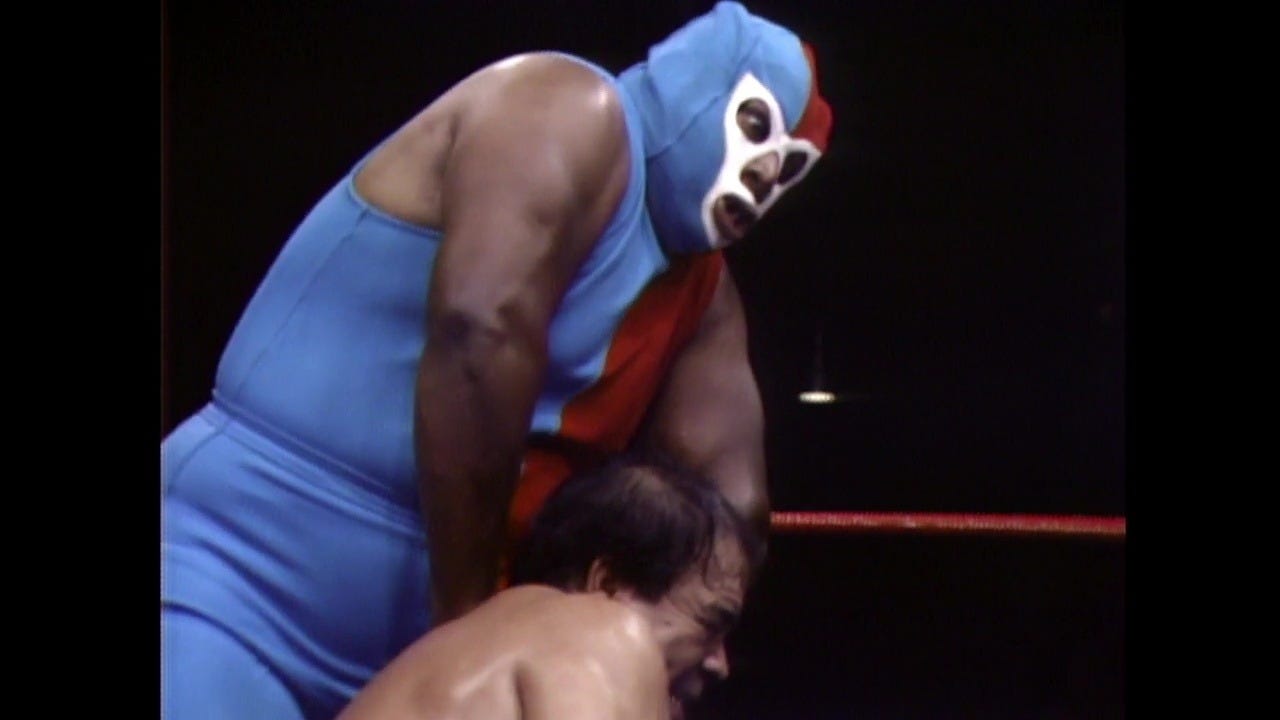
Pictured: Ray Candy as The Masked Superfly
The most memorable phase of Candy’s career came in the early 1980s when he turned heel. In 1983, Florida bookers paired him with Leroy Brown to form The Zambuie Express (sometimes billed as The Muslim Connection). Candy became Kareem Muhammad, while Brown was Elijah Akeem. The team adopted a militant, racially charged persona inspired in part by the Black Panther Party, complete with camouflage attire and aggressive promos. Managed at times by Sir Oliver Humperdink as part of the “House of Humperdink,” they became top heels in Florida and other southern promotions. They captured the NWA Florida Global Tag Team Championship (later transitioning to the United States Tag Team version) and feuded with stars like Dusty Rhodes and Blackjack Mulligan. The Zambuie Express also worked in Memphis (winning AWA Southern Tag Team titles) and the Carolinas, drawing heat with their controversial act.
Candy was also affiliated with Skandor Akbar’s Devastation Inc. stable and other groups like The Shock Troops. His ability to play both sympathetic giant and menacing villain showcased his range, though the era’s reliance on racial stereotypes in booking has aged poorly by modern standards.
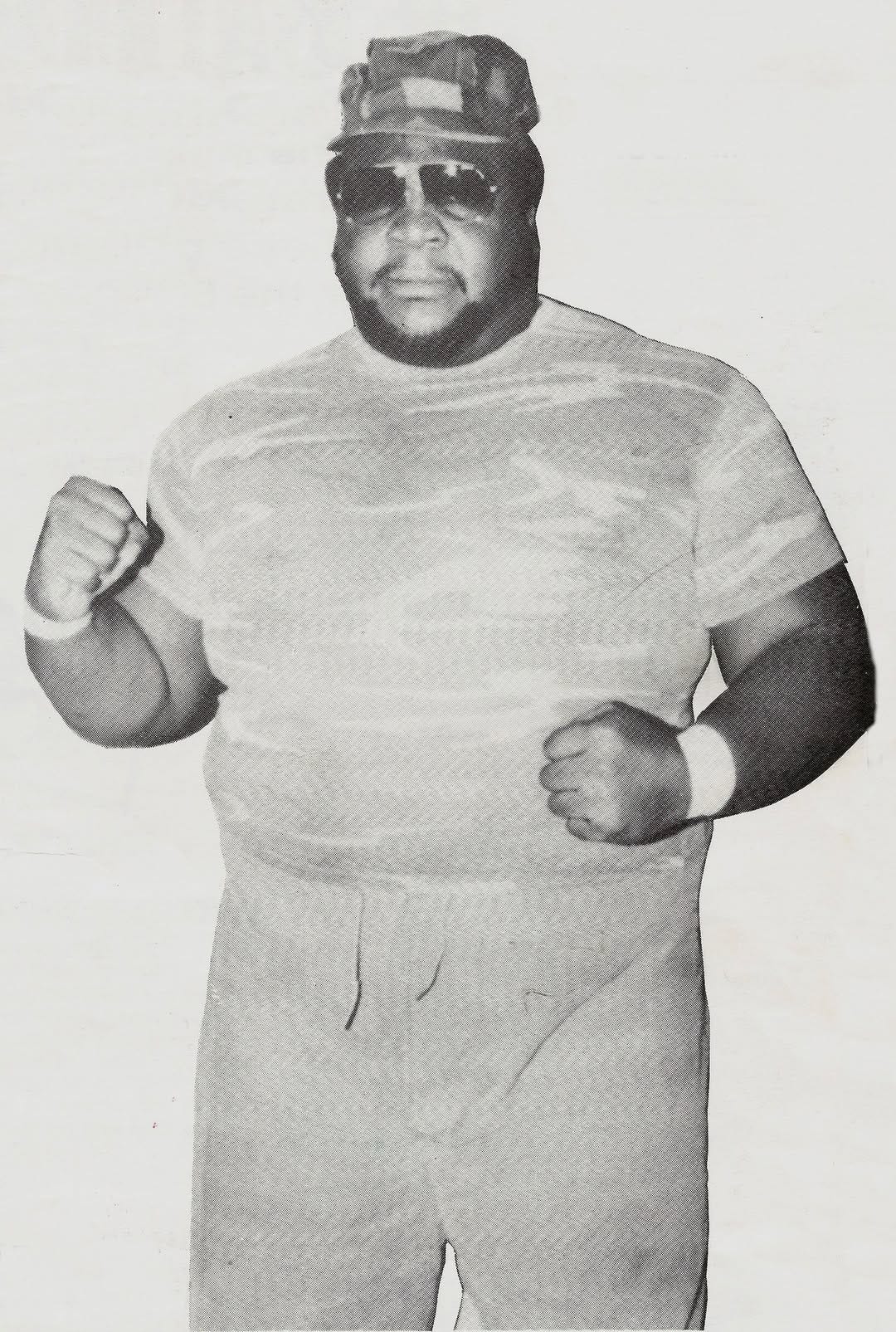
Pictured: Ray Candy as Kareem Muhammad in the Zambuie Express
After nearly two decades in the ring, Candy retired around 1990. He returned to Decatur and worked as a dispatcher and supervisor for a local trucking/transport company. Post-retirement, he trained aspiring wrestlers, most notably ECW hardcore legend New Jack (Jerome Young), who credited Candy’s guidance for his start in the business. Some sources also credit him with training Glenn Jacobs (later Kane in WWE).
Tragically, Ray Candy’s life was cut short. On May 23, 1994, at age 42, he suffered a fatal myocardial infarction (heart attack) in Decatur, Georgia—reportedly collapsing while returning from a doctor’s appointment with his wife, Ruby. He was pronounced dead at DeKalb Medical Center. He is buried under his real name, Ray Canty, at Washington Memorial Gardens in Decatur.
Ray Candy’s career exemplified the grind and diversity of the pre-national wrestling territory system. He was never a world champion but was a reliable draw and performer who adapted to different roles and audiences. In an era when big men often relied on power moves, Candy brought charisma and versatility that helped him stand out. Though his most famous gimmick was polarizing, it highlighted the bold (and sometimes problematic) storytelling of 1980s wrestling. His influence lives on through the wrestlers he trained and the memories of fans who saw him dominate rings across the South and beyond. In the often-overlooked world of territorial wrestling, Ray Candy was a true “Candy Man” who delivered plenty of sweet victories and bitter rivalries.
One Thing I Learned About Tarzan Goto
Before becoming the hardcore icon Tarzan Goto (real name Seiji/Masaji Goto), his parents strongly discouraged him from pursuing pro wrestling as a child, insisting he choose a more “honorable” sport like sumo instead. He listened and joined the prestigious Kokonoe stable at age 15 in 1979, training as a sumo wrestler before eventually chasing his true passion and debuting in pro wrestling in 1981.
This early detour from his dream adds depth to the gritty, no-nonsense deathmatch pioneer who later helped revolutionize Japanese “garbage wrestling” with exploding barbed wire bouts against Atsushi Onita in FMW.
Thank You for Reading
I’m Tony Richards, Pro Wrestling Historian, Author and Storyteller. I share pro wrestling historical items in each issue of the Time Tunnel Pro Wrestling History Newsletter. Thanks for reading! If you enjoy my information on select events, matches and insights, please share it with folks you think might like to be a subscriber!
Remember, premium investors get access to exclusive and special content such as some special issues including a multi-part deep dives on wrestling territories, wrestler bios and championship title histories, special audio and video interviews on territory pro wrestling and more available in the Pro Wrestling Time Tunnel for Premium Investors.