


Happy Birthday to those who have passed on and to those great wrestlers still with us:
In Memoriam:
Bull Montana 1887
Frederich Von Schnacht 1911
Buddy Knox 1914
Nikita Mulkovitch 1917
Kinji Shibuya 1921
Happy Birthday:
Johnny Rodz (88)
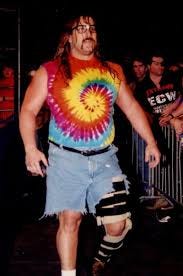
Charles Wright\Godfather (65)
Mike Bennett (41)
Omos (34)
RIP Memorial: We stop & remember those who have passed on this day and gave themselves to the business for us, the fans. We salute you and thank you.
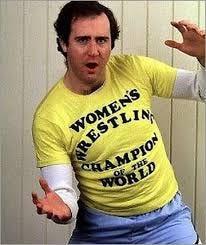
Andy Kaufman 5-16-1984 at the age of 35
Alexander Rizszo\Big Dick Dudley 5-16-2002 at the age of 34
“Pretty Boy” Doug Somers 5-16-2017 at the age of 65

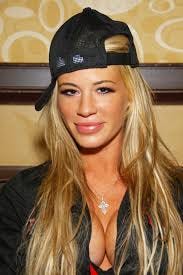
Ashley Massaro 5-16-2018 at the age of 39
The Life and Career of George Gordienko
George Gordienko (January 7, 1928 – May 13, 2002) stands as one of professional wrestling’s most accomplished yet underappreciated figures—a legitimate “shooter” praised by legends like Lou Thesz as among the finest in the world, a globe-trotting champion denied a shot at the NWA World Heavyweight title by Cold War politics, and a talented artist who transitioned seamlessly from the ring to the canvas.  Born into immigrant hardship in Winnipeg’s North End and raised amid the Great Depression, Gordienko embodied resilience, athletic excellence, and creative passion. Over a 30-year wrestling career (1946–1976), he conquered titles across Canada, the United Kingdom, and New Zealand while headlining sold-out arenas from Greece to Iraq. In retirement, he became a respected surrealist and expressionist painter, exhibiting internationally and teaching in Canada. Though McCarthy-era blacklisting kept him from American television stardom, Gordienko’s legacy endures as a true Renaissance man of the squared circle.
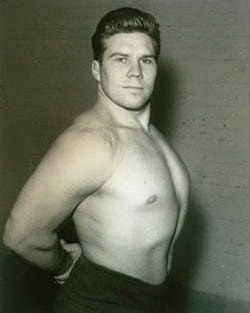
Gordienko’s early life forged the discipline and physicality that defined his career. The youngest of three brothers born to first-generation Ukrainian and Cossack-Canadian parents, he grew up in North Winnipeg during tough economic times. By age 17, he had earned numerous awards for athletic prowess in sports like American football and weightlifting. An older friend introduced him to wrestling at the Winnipeg YMCA, where he trained alongside Olympic-level coaches such as bronze medalist Jimmy Trifunow. A chance meeting with wrestler and trainer Joe Pazandak opened doors to promoter Tony Stecher in Minneapolis; Gordienko debuted professionally in 1946 at age 18 and quickly gained experience in the United States.
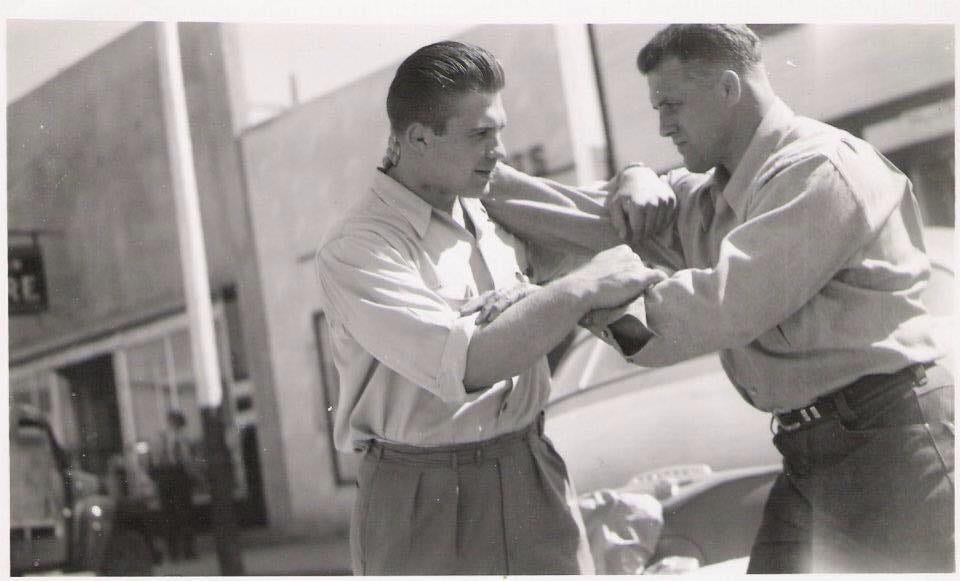
Pictured: George Gordienko and Stu Hart in 1953
**Photo Credit: Smith Hart
His American aspirations were short-lived, however. While studying medicine in the U.S., Gordienko was arrested for distributing communist literature—a youthful association with the Communist Party that led to deportation back to Canada. This episode would haunt him during the McCarthy-era Red Scare of the 1950s, resulting in an effective blacklist from wrestling or even visiting the United States. The political persecution cost him lucrative opportunities on the emerging TV wrestling circuit and, crucially, a planned run with the NWA World Heavyweight Championship. Lou Thesz, the era’s premier champion and a close friend, had personally selected Gordienko to succeed him as titleholder in 1956, but the blacklist forced Gordienko to decline.
Undeterred, Gordienko built an extraordinary international career centered first in his native Canada and then across Europe, the Commonwealth, and beyond. He trained under and frequently teamed with Stu Hart in Calgary’s Stampede Wrestling promotion, forming a formidable partnership and winning regional titles. In 1955, he captured the Alberta Golden Jubilee tournament by defeating Adrien Baillargeon in the finals and later held the NWA Canadian Heavyweight Championship (Calgary version) in 1956. He also secured tag team gold, including the NWA International Tag Team Championship (Calgary) with Super Hawk and the NWA Canadian Tag Team Championship (Vancouver) with Leo Madril in 1974. Memorable bouts included a hard-fought loss to Thesz for the NWA world title in 1953 and a legendary 90-minute draw with him in Edmonton in 1955.
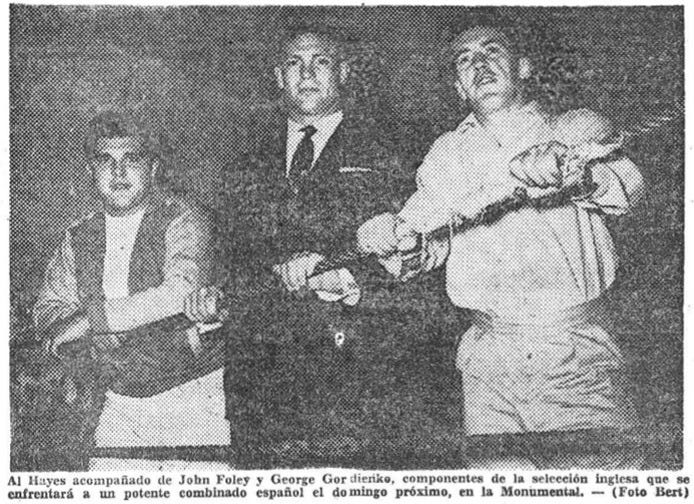
Pictured: Lord Alfred Hayes, George Gordienko and Lord John Foley in Barcelona, Spain in July 1960
Gordienko’s greatest success came overseas. Settling primarily in the United Kingdom from 1957, he became one of Joint Promotions’ top stars, renowned for his skill, strength, and no-nonsense style. British observers hailed him as “magnificent” and “never defeated” in peak form during the 1960s against elite competition like Albert Wall, Geoff Portz, Gwyn Davies, and Pat Roach (whom he reportedly demolished in two rounds). In 1963, he was rated the best heavyweight wrestler in the UK. He capped this era by winning the prestigious Royal Albert Hall Heavyweight Tournament in April 1970, defeating Hans Streiger, Al Hayes, and Bruno Elrington en route to the trophy, and later claimed the British Commonwealth Heavyweight Championship. He also won New Zealand’s version of that title in 1968.
His travels took him to Australia, India (where he wrestled under the name Firpo Zyzbsko), South Africa, Japan, the Caribbean, France, Germany, and more. Highlights included selling out stadiums in Greece against Spiros Arion, headlining Baghdad’s Al-Shaab Stadium against Iraqi hero Adnan Al-Kaissie in 1970, and competing in rigorous environments like Wigan’s famed Snake Pit. Gordienko also held the French version of the World Heavyweight Championship. Throughout, he earned universal respect as a “hooker” (legitimate wrestler) from peers including Thesz, Karl Gotch, and Billy Robinson.
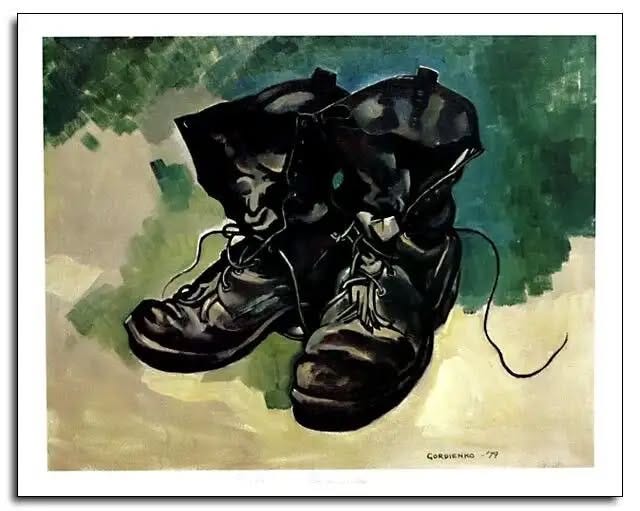
Pictured: “My Old Boots” art created by George Gordienko
A severe ankle injury inflicted by Roland Bock in Germany prompted his retirement in 1976 at age 48. Gordienko had already balanced wrestling with his lifelong passion for art, taking a five-year hiatus early in his career to study painting in Winnipeg and later at London’s St Martin’s School of Art under sculptor Anthony Caro. Post-retirement, he fully embraced this second calling. He lived in Italy from 1976 to 1990 with his partner Christina Tassou, traveling for exhibitions and inspiration. His surrealist and expressionist works—bold, vibrant, emotionally charged pieces featuring dramatic poses and subjects like harlequins (notably J’accuse)—earned membership in the Ontario Society of Artists and the Royal Canadian Academy of Arts. He taught at the Ontario College of Art and the University of Toronto, and his admiration for Pablo Picasso, whom he reportedly met, influenced his style.
Gordienko returned to Canada and settled in British Columbia, first in Victoria and later Campbell River. He died of melanoma on May 13, 2002, at age 74. His contributions were later honored with inductions into the Stampede Wrestling Hall of Fame (1995), the George Tragos/Lou Thesz Professional Wrestling Hall of Fame (2010), the Professional Wrestling Hall of Fame (2012), and a posthumous Cauliflower Alley Club award (2009). Steven Verrier’s 2022 biography, George Gordienko: Canadian Wrestler, Artist and Renaissance Man (with forewords by Bret Hart and Greg Oliver), finally brought his remarkable story to wider attention.
In an era when professional wrestling often prioritized spectacle over substance, George Gordienko excelled through pure athleticism, technical mastery, and professionalism. Barred from American superstardom by forces beyond his control, he instead became a global ambassador for the sport and a bridge between the ring and the fine arts. His life reminds us that greatness is not always measured by mainstream fame or championship belts alone, but by the respect of peers, the breadth of one’s travels, and the courage to reinvent oneself. Though largely overlooked during his active years, Gordienko’s dual legacy as wrestler and artist ensures he remains a shining example of Canadian excellence on the world stage.
One Thing I Learned About Nikita Mulkovitch
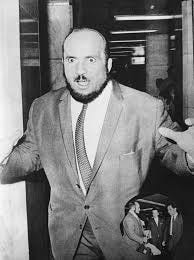
He was the longtime Russian heel who wrestled as Nikita Kalmikoff and feuded with stars like Danny Hodge, was an accomplished artist and sculptor who hand-crafted many one-of-a-kind championship belts for NWA territories in the 1970s–80s (including famous tag team versions) — plus custom items like a gold-colored ring bell with an eagle for a Greenville, SC promoter.
Beyond the ring (where he was billed from Leningrad or Ukraine and often teamed with “brothers” like Ivan Kalmikoff), this creative sideline made him a unique figure in wrestling history.
It’s a cool, under-the-radar detail for a veteran territory grappler.
Thank You for Reading
I’m Tony Richards, Pro Wrestling Historian, Author and Storyteller. I share pro wrestling historical items in each issue of the Time Tunnel Pro Wrestling History Newsletter. Thanks for reading! If you enjoy my information on select events, matches and insights, please share it with folks you think might like to be a subscriber!
Remember, premium investors get access to exclusive and special content such as some special issues including a multi-part deep dives on wrestling territories, wrestler bios and championship title histories, special audio and video interviews on territory pro wrestling and more available in the Pro Wrestling Time Tunnel for Premium Investors.