


Happy Birthday to those who have passed on and to those great wrestlers still with us:
In Memoriam:
Frank Andersson 1956
Mike Shaw 1957
Happy Birthday:
George Gulas (78)
Kevin Kelly (59)
RIP Memorial: We stop & remember those who have passed on this day and gave themselves to the business for us, the fans. We salute you and thank you.
Adrian Ballargeon 5-9-1995 at the age of 74
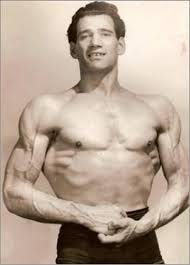
Jesse James 5-9-2000 at the age of 83
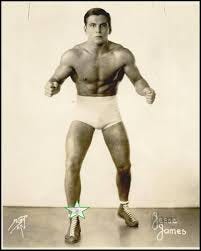
Winona Littleheart 5-9-2020 at the age of 64

The Life and Career of Jesse James
“The Oklahoma Cyclone”—was a hard-working professional wrestler whose career embodied the gritty, road-warrior ethos of the National Wrestling Alliance (NWA) territory system. Active from the mid-1930s until the early 1970s, he was a fixture in dozens of regional promotions across the United States, Canada, and even Japan. Though never a national superstar on the level of Lou Thesz or Buddy Rogers, James carved out a respectable niche as a reliable junior heavyweight and tag-team specialist, winning multiple championships and engaging in memorable feuds during the 1960s and 1970s. His real name was Demitros Stephanos Tzizikas (sometimes spelled Tzitzikas), and he hailed from Houston, Texas, though he was occasionally billed from Oklahoma to fit the “Cyclone” persona. Standing 5’10” and weighing around 212 pounds, he was compact, agile, and technically sound—qualities that served him well in an era when wrestling emphasized in-ring psychology over spectacle.
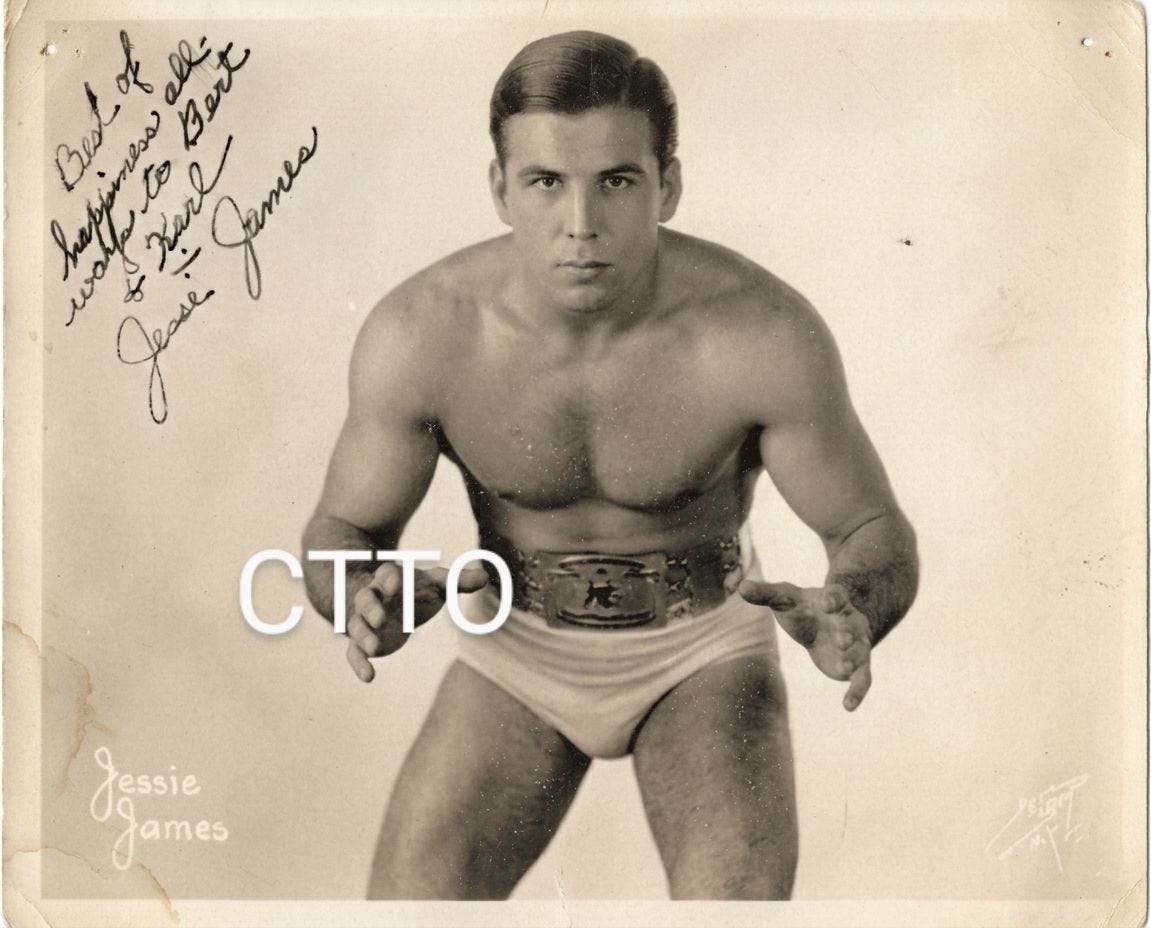
James debuted in 1934 and wrestled for an astonishing four decades, retiring around 1974. He was part of a wrestling family: his brother Johnny James frequently teamed with him, and he was married to fellow wrestler Terry Majors. Over the years he used aliases such as Jimmy James and Crusader #2, but “Jesse James” became his most enduring ring identity. His signature moves included the seated armbar, a tight lock-up (often called the “locklock”), and crisp hip-tosses—moves that highlighted his scientific style rather than brawling or high-flying antics.
By the 1950s, James had established himself as a dominant force in the junior heavyweight division. He captured the NWA Southern Junior Heavyweight Championship on at least three documented occasions (1952, 1956, and 1959), defeating opponents such as Tex Riley, Frank Jares, and Yvon Robert. He also held NWA Southwest Tag Team gold with his brother Johnny in 1954 and earned early recognition in promotions like Gulf Coast Championship Wrestling (GCCW) and Mid-America. These reigns helped him build a reputation as a dependable champion who could carry matches against larger or more flamboyant opponents.
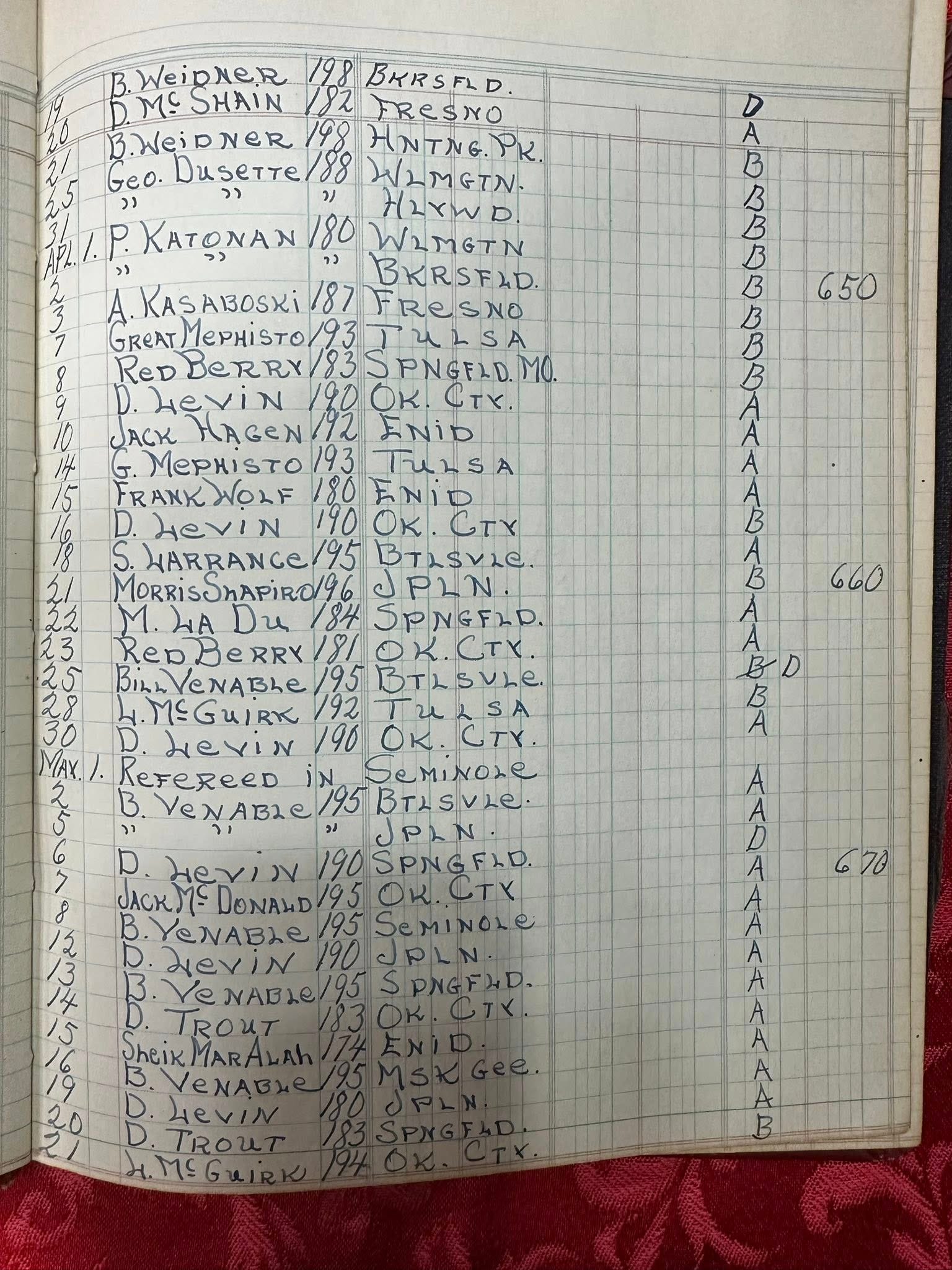
Pictured: Jesse James’ Personal Booking Book for March 1941 as he wrestled in the Midwest. Provided by his Grandson, Justin Adams
The 1960s marked one of James’s most visible decades, particularly in the Southeast. In March 1965, he and Buddy Fuller defeated the Mysterious Medics to win the NWA (Georgia) Southern Tag Team titles in Atlanta. That same year, James scored an upset pinfall victory over Mario Galento on Georgia television, though Galento reclaimed the Georgia Heavyweight crown the following week. James also competed in Big Time Wrestling (BTW), capturing the United States Heavyweight Championship twice (circa 1966 and 1967) by defeating Gypsy Joe. These bouts placed him squarely in the Georgia and Texas circuits, where he feuded with the likes of the Red Demon, Tim Geohagen, the Christy Brothers, and Jim Grabmire. His work in NWA Los Angeles also yielded three reigns as World Light Heavyweight Champion, further cementing his status as a respected light-heavyweight contender.
James’s style—clean, chain-wrestling oriented with occasional fiery comebacks—made him a natural fit for the territorial system. He traveled extensively, appearing in promotions from the Atlantic Athletic Commission in the Northeast to NWA Hollywood, Maple Leaf Wrestling in Canada, and even New Japan Pro Wrestling. Whether he was defending a regional strap or working as a solid mid-card hand, promoters valued his professionalism and ability to make opponents look strong.
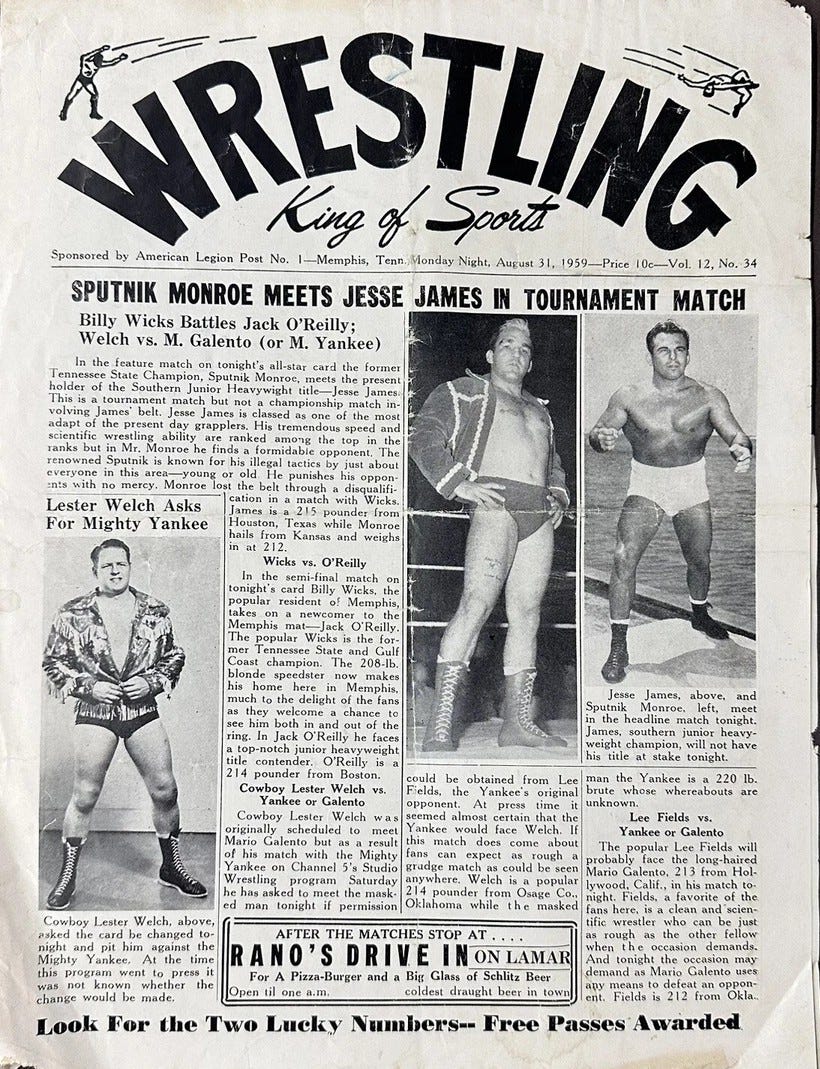
Pictured: Jesse James vs Sputnik Monroe in the tournament for the first NWA Tennessee Heavyweight Championship, Ellis Auditorium, Memphis, Tennessee, August 31st, 1959
By the early 1970s, James was in the twilight of his in-ring career but remained active in the Southeast. In 1970 he returned to Atlanta, wrestling Bobby Shane to a time-limit draw and defeating the Red Demon on television with his signature running headbutts and forward cradle. In November 1972, he followed promoter Ann Gunkel into the newly formed All South Wrestling Alliance (ASWA) promotion. On the very first ASWA card in Atlanta (November 24, 1972), James defeated Skandor Akbar by disqualification. He continued appearing on ASWA shows into 1972, including a televised match against Pedro Gadoy in Atlanta’s City Auditorium, where his veteran savvy helped anchor the fledgling promotion’s early cards. These late-career appearances showed a wrestler who still commanded respect even as the industry began shifting toward heavier, more athletic styles.
James retired around 1974 after a career that spanned more than 40 years and countless territories. He passed away on May 9, 2000. While detailed personal information remains scarce—typical of many wrestlers from the pre-internet era—his legacy lives on in the records of NWA-affiliated promotions and in vintage footage from Georgia and Los Angeles. He was never inducted into major halls of fame, yet historians of territorial wrestling remember him as a prototypical “good hand”: reliable, versatile, and always willing to put the promotion and his opponent over.
In an era when wrestlers often labored in obscurity outside their home territory, Jess James exemplified the backbone of professional wrestling. From junior heavyweight gold in the 1950s to tag-team success and main-event challenges in Georgia during the 1960s and early 1970s, his career offers a window into the daily grind and quiet dignity of the NWA territory days
One Thing I Learned About Tatsumi Fujinami
In June 1990, during a match against Big Van Vader, Fujinami suffered a severe back injury that included a pulled hernia, forcing him out of the ring for several months. When he returned in September 1990, he made a subtle but highly unusual change: he altered the kanji spelling of his first name from “辰巳” (Tatsumi) to “辰爾” (still pronounced Tatsumi).
It’s a tiny personal detail that rarely gets mentioned in his otherwise well-documented career, yet it feels deeply symbolic—like a quiet act of reinvention or superstition after a near-career-ending moment. Most fans know him as the innovator of the Dragon Sleeper and Dragon Suplex, the man who briefly beat Ric Flair for the NWA title, or the founder of Dradition… but this little kanji tweak is one of those deep-cut puroresu nuggets that shows even legends have their private rituals and turning points.

Thank You for Reading
I’m Tony Richards, Pro Wrestling Historian, Author and Storyteller. I share pro wrestling historical items in each issue of the Time Tunnel Pro Wrestling History Newsletter. Thanks for reading! If you enjoy my information on select events, matches and insights, please share it with folks you think might like to be a subscriber!
Remember, premium investors get access to exclusive and special content such as some special issues including a multi-part deep dives on wrestling territories, wrestler bios and championship title histories, special audio and video interviews on territory pro wrestling and more available in the Pro Wrestling Time Tunnel for Premium Investors.