


Happy Birthday to those who have passed on and to those great wrestlers still with us:
In Memoriam:
Martin Levy\The Blimp 1905
Joe McHugh 1904
Joe McCarthy 1929
Happy Birthday:
Shawn Daivari (42)
Santos Escabar (42)
RIP Memorial: We stop & remember those who have passed on this day and gave themselves to the business for us, the fans. We salute you and thank you.
Lee Wykoff 4-30-1974 at the age of 72

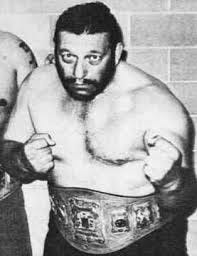
Man Mountain Mike 4-30-1988 at the age of 47
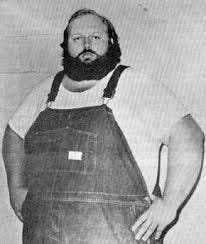
Joe Tomasso 4-30-1988 at the age of ?
The Life and Career of Kay Noble
Mary Charlene Noble—known from childhood by her lifelong nickname “Kay Noble”—was one of the most respected and resilient figures in the often-overlooked world of mid-20th-century women’s professional wrestling. Born on October 15, 1940, in St. Joseph, Missouri, and passing away on April 27, 2006, at age 65 in Amarillo, Texas, from inoperable stage-four stomach cancer, Noble carved out a nearly 30-year career (1957–1987) that spanned the territorial era’s peak and decline. At 5’7” and 132 pounds, she combined fresh-faced femininity with genuine athletic toughness, high-flying agility, and a no-nonsense in-ring style that earned her the admiration of male peers and fans alike. Unlike many of her contemporaries who were positioned as glamorous side attractions or “powder-puff” performers, Noble was celebrated for her ability to “do anything the men could do—and do it real.” She held major titles including the AWA World Women’s Championship (for roughly eight years), the NWA Texas Women’s Championship (twice), and the NWA Central States Women’s Championship, while working alongside legends like Penny Banner, The Fabulous Moolah, Gladys Gillem, and even mixed-tag partners such as Terry Funk.
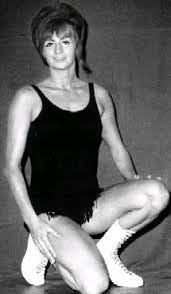
Noble’s entry into wrestling was the fulfillment of a childhood dream. After watching a match as a youngster, she decided wrestling was her calling. At age 15 she approached St. Louis-area promoter Gust Karras for advice, but it was a hometown promoter in St. Joseph who finally gave her the break in 1957, when she was 18. Trained by Laura Martinez and Sonny Myers, Noble debuted that same year and quickly proved she belonged. Early in her career she already displayed the fearlessness that would define her. In October 1958, Noble, along with Lorraine Johnson, Penny Banner, and Laura Martinez, was charged with inciting a riot after a post-match brawl spilled outside the ring in Amarillo; all four pleaded not guilty, and promoters paid the fine. The incident only added to her growing reputation as a gritty competitor who would not back down.
By the early 1960s, Noble was based primarily in Minneapolis and working across NWA and AWA territories. Her breakout came in 1963 when she defeated Kathy Starr in Minnesota to win the vacant AWA World Women’s Championship. She held the title for approximately eight years—one of the longest reigns in the division’s history—until losing it to Vivian Vachon in Canada in November 1971. During this period she also captured the NWA Texas Women’s Championship (twice, including a lengthy reign beginning in 1974) and the NWA Central States Women’s Championship under promoter Bob Geigel. She even teamed with Lolita Martinez (Laura’s relative) to win the NWA World Women’s Tag Team Championship once and claimed the National Women’s Television Championship and Kansas Women’s Championship. In 1971 she was named “Girl Wrestler of the Year” by the Wrestling Fans International Association (WFIA).
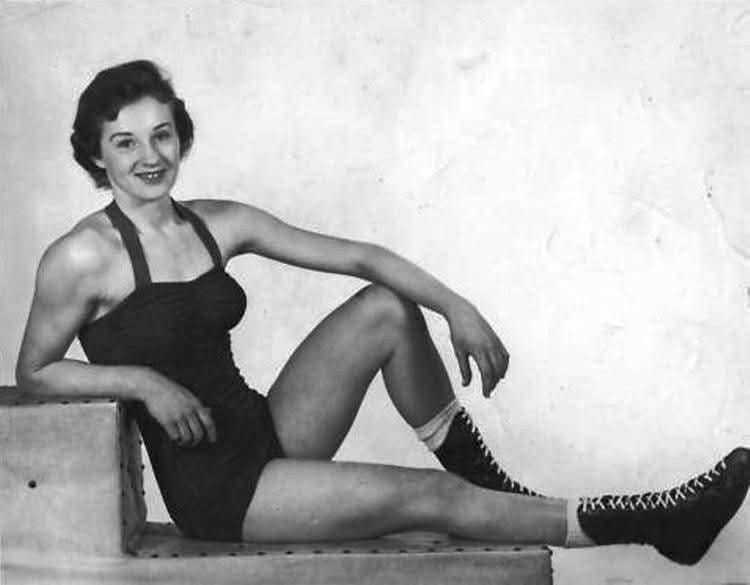
Noble’s in-ring style was athletic and aerial for the era. Peers described her as a “flier” who could perform nip-ups, high spots, and maneuvers that many male wrestlers avoided. Trainer Sonny Myers called her “tremendous… She didn’t back up from nothing.” Kansas City veteran Leo Burke remembered a mixed-tag match in which Noble responded to one-handed push-ups by the men with nip-ups of her own, forcing the boys to scramble. Ed Wiskoski (later Colonel DeBeers), whom she helped train, recalled her performing moves “men at that time would not attempt.” She was equally at home in rough-and-tumble brawls, mixed-tag bouts (frequently partnering with her first husband Doug Gilbert against teams like Roy Collins & Barbara Baker or teaming with Jack Cain against Jean Antone & Terry Funk), and straight singles matches. She feuded with top names of the day—Penny Banner, Betty Niccoli, The Fabulous Moolah, and Gladys Gillem—while also appearing in the early-1970s film Wrestling Queen, which featured her alongside family members and other wrestlers.
Noble wrestled throughout the 1970s as a full-time star and continued part-time into the 1980s while raising a family. She worked territories from the Midwest to the Southwest, made occasional trips to Japan, and even appeared in the WWWF. Her toughness was legendary: one story has her wrestling with a broken foot after going over the top rope, being carried to the ring on Dicky Murdoch’s shoulders, and still selling the injury convincingly as a heel. Bob Geigel, who both tagged with her in mixed bouts and employed her as a bartender in Kansas City, recalled her handling rowdy bar patrons with the same ferocity she showed in the ring.
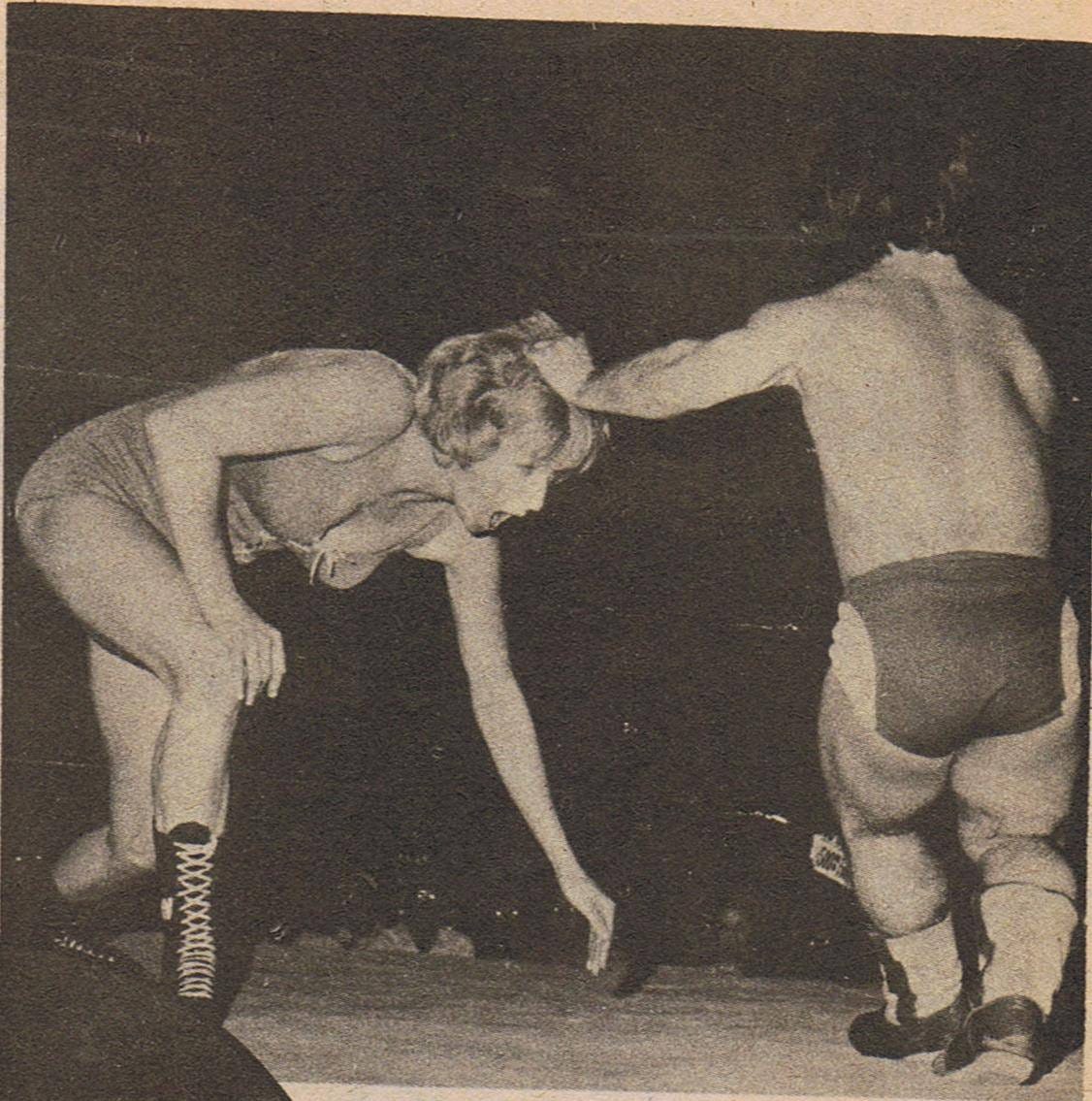
Pictured: Cowboy Lang holds Kay Noble’s head steady for a move in a mixed tag team match with Marie LaVerne and Billy The kid
Off-screen, Noble balanced a demanding career with motherhood long before it was common. In 1959 she married wrestler Doug Gilbert (real name Doug Lindzy) after meeting him in an elevator; they had three children (Theresa, Michael, and Steve) and tried to coordinate bookings so they could work the same territories. The couple eventually settled in South Bend, Indiana, where they kept horses. A second marriage to Dean Fortune produced two more sons (David and Danny). In November 1985 she married Dick Bell in St. Joseph; they remained together until her death, and she was known in retirement as Kay Noble-Bell. By the time of her passing she had five children, 20 grandchildren, and one great-granddaughter.
After stepping away from full-time wrestling, Noble reinvented herself. She owned Kay’s Upholstery in Amarillo, worked in pest control, and later took a job in pediatrics at Baptist St. Anthony’s Hospital. She played piano and guitar (favorites included “How Great Thou Art”), loved animals (her German shepherd Gunner reportedly sensed her illness before doctors did), and remained close with wrestling friends like Marie Laverne, Jean Antone, and Terry Funk. In 2001 the Cauliflower Alley Club honored her as a women’s wrestling legend; she attended reunions as late as 2005. She was later inducted into the Professional Wrestling Hall of Fame and Museum (Class of 2010) as a Lady Wrestler.
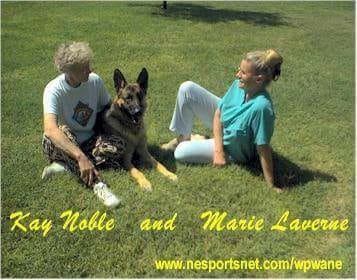
Pictured: Kay Noble and two of her best friends, Mary Nelson (Marie LaVerne) and Gunner, the German Shepard dog
Diagnosed with stomach cancer in October 2005, Noble faced her final opponent with the same quiet strength she showed in the ring. She underwent radiation and chemotherapy, but the cancer was inoperable. She died peacefully on April 27, 2006, surrounded by family and friends; Terry Funk delivered part of her eulogy at the May 1 funeral in Amarillo. Tributes poured in from across the wrestling world, highlighting not only her in-ring accomplishments but her character: “She did not complain,” said Marie Laverne (Mary Nelson). “If anybody could go as Kay did… she did not complain.”
Kay Noble’s legacy endures as a bridge between the early days of women’s wrestling—when female performers were often treated as novelties—and the more athletic, respected division that followed. In an era when women earned far less than men and were frequently relegated to “powder-puff” matches, Noble demanded respect through skill, toughness, and professionalism. She proved that a woman could be both feminine and ferocious, a high-flyer and a brawler, a mother and a main-eventer. Her long AWA reign, memorable feuds, mixed-tag versatility, and post-career grace cemented her place among the true pioneers. As Sonny Myers put it simply: “Kay Noble was a tremendous girl wrestler… She just absolutely was great.”
One Thing I Learned About Joe Stecher
As a farm kid in Dodge, Nebraska, he and his brother would wrestle each other on top of moving hay wagons. They’d grapple right on the mounds of hay while horses pulled the wagon down the road—basically turning chore time into an impromptu training session. Local folks in Dodge still tell the story decades later.
It’s a perfect glimpse into how this farm-raised powerhouse (who later crushed opponents with his legendary body scissors) honed his skills in the most old-school, Nebraska way possible. He went on to dominate the sport, but that hay-rack wrestling origin is pure early-20th-century grit.
Thank You for Reading
I’m Tony Richards, Pro Wrestling Historian, Author and Storyteller. I share pro wrestling historical items in each issue of the Time Tunnel Pro Wrestling History Newsletter. Thanks for reading! If you enjoy my information on select events, matches and insights, please share it with folks you think might like to be a subscriber!
Remember, premium investors get access to exclusive and special content such as some special issues including a multi-part deep dives on wrestling territories, wrestler bios and championship title histories, special audio and video interviews on territory pro wrestling and more available in the Pro Wrestling Time Tunnel for Premium Investors.