



Happy Birthday to those who have passed on and to those great wrestlers still with us:
In Memoriam:
Lou Thesz 1916
Alejandro Munoz Morena\Blue Demon 1922
Happy Birthday:
William Vaughn\Lance Von Erich (66)
Yugi Nigata (58)
RIP Memorial: We stop & remember those who have passed on this day and gave themselves to the business for us, the fans. We salute you and thank you.
Johnny Valentine 4-24-2001 at the age of 72
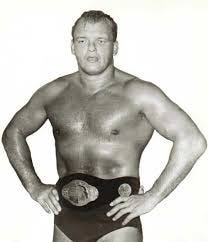
Joe Garibaldi 4-24-2003 at the age of 91
Karl Lauer 4-24-2022 at the age of 83

The Life and Career of The Blue Demon
Born into rural poverty, he rose to become a masked wrestling superstar whose blue-and-silver mask symbolized honor, technical prowess, and cultural pride. Alongside El Santo, he helped define the golden age of lucha libre in the mid-20th century, both in the ring and on the silver screen. His 41-year in-ring career, spanning from 1948 to 1989, produced unforgettable rivalries, championship reigns, and an unblemished record in high-stakes Lucha de Apuestas (bet matches). Beyond wrestling, Blue Demon starred in roughly 25 action-horror-science fiction films that exported lucha libre’s mythic heroism to Mexican popular culture. He retired undefeated in his mask, was buried wearing it, and left a legacy second only to El Santo’s.
Alejandro Muñoz Moreno was born on April 24, 1922 (some records list an October registration date), in the small town of García (or nearby Rinconada), Nuevo León, Mexico, the fifth of twelve children in a farming family.
Life was modest; he dropped out of school early, seeing little future in his rural surroundings. After a brief, unsuccessful attempt at a music career, he moved to Monterrey to live with relatives and took a job on the National Railroad. There, coworkers nicknamed him “Manotas” (“Big Hands”) for his powerful grip—an attribute that later served him well in the ring.

In Monterrey, Muñoz met trainer Rolando Vera, a veteran wrestler who recognized his potential. Vera not only schooled him in the fundamentals but also helped create the Blue Demon persona and its signature plain blue mask. The gimmick was simple yet striking: a mysterious, blue-clad avenger whose technical style and never-say-die attitude would resonate with working-class Mexican audiences.
Muñoz made his professional debut on March 31, 1948, in Laredo, Texas, wrestling unmasked under his real name (or as “Tosco Muñoz”) against Chema López. He officially adopted the Blue Demon identity later that year, debuting the mask in Mexico City around September 1948 against Benny Arcilla. He began as a rudo (heel), forming the popular tag team Los Hermanos Shadow with Black Shadow. The duo captured the Mexican National Tag Team Championship and drew packed houses across Mexico.
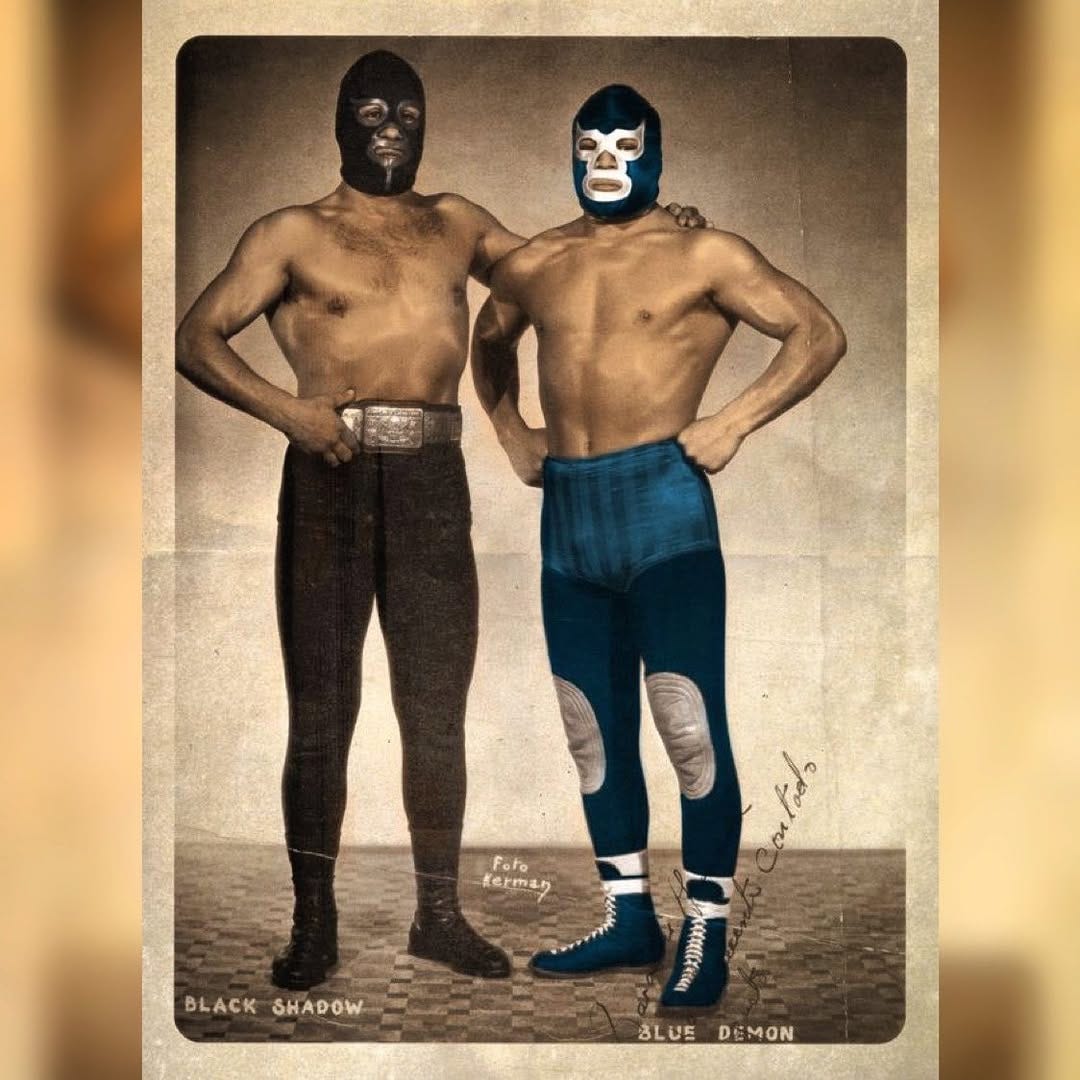
Pictured: Blue Demon and tag team partner, Black Shadow
A pivotal turning point came in 1952 when El Santo unmasked Black Shadow in a famous Lucha de Apuestas. The betrayal and subsequent fallout prompted Blue Demon to turn técnico (face). What followed was one of lucha libre’s greatest rivalries. Blue Demon and El Santo clashed repeatedly in the early 1950s. On September 25, 1953, at Arena Coliseo, Blue Demon defeated El Santo to win the NWA World Welterweight Championship—the first of two reigns. He held the title for approximately four-and-a-half years, defending it across Mexico and on tours. He also won the Mexican National Welterweight Championship three times and continued teaming successfully with Black Shadow even after the turn.
El Santo and Blue Demon are the two towering figures of Mexican lucha libre, often ranked as the greatest and second-greatest wrestlers in the sport’s history. Both were masked enmascarados who embodied justice, technical excellence, and working-class heroism on the mat and the silver screen. Their legendary 1950s rivalry—sparked when Santo unmasked Blue Demon’s tag partner Black Shadow in 1952—defined an era, yet evolved into one of the most successful on-screen partnerships in Mexican cinema. While Santo is widely regarded as the undisputed #1 cultural phenomenon (with broader global reach through comics, films, and folk-hero status), Blue Demon was his closest rival in popularity, a superior technician in the ring, and the only one to decisively defeat Santo for a major world title.
Santo was an urban, second-generation wrestler who rose in the 1930s–1940s golden age. Blue Demon was a self-made rural outsider who exploded onto the scene in the late 1940s, riding the post-WWII boom.
Santo’s career was longer and more decorated overall. He formed the legendary “The Atomic Pair” tag team with Gory Guerrero that was undefeated for years and held multiple titles: NWA World Welterweight, NWA World Middleweight (twice), Mexican National titles across divisions, and tag gold. He was a versatile brawler-showman known for charisma and high-impact moves.
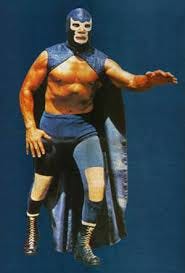
Blue Demon specialized in the welterweight division. His crowning achievement came in 1953 when he defeated Santo to win the NWA World Welterweight Championship—holding it for roughly 4.5 years. He also captured the Mexican National Welterweight title three times and tag gold with Black Shadow. At 5’6” and ~170 lbs, he relied on speed, agility, and submission holds (e.g., Cerrajera armbar, La Desnucadora neckbreaker) powered by his “Manotas” grip. Many consider him the superior pure technician of the two.
The rivalry was personal and historic. After Santo unmasked Black Shadow in 1952 (one of the most important Lucha de Apuestas matches ever), Blue Demon turned técnico and sought revenge. Their 1952–1953 series drew massive crowds; Blue Demon’s welterweight victory over Santo remains one of the biggest upsets in lucha history. Yet by 1963 they began teaming regularly, forming a dream partnership despite lingering tension—Santo reportedly never forgot the loss.
Santo had an extensive winning record (unmasking or shaving dozens, including Black Shadow’s mask and Perro Aguayo’s hair). Blue Demon was undefeated in apuesta bouts—he never lost his mask or hair and claimed high-profile victories over Espectro II, El Matemático, Rayo de Jalisco (1989), and Cavernario Galindo’s hair. Santo retired after a 1982 farewell tour with the final match taking place on September 12, 1982.
Blue Demon’s style emphasized technical wrestling—leveraging his “Manotas” grip for holds like the Cerrajera (a twisting armbar), La Desnucadora (a neckbreaker), and La Estaca Mortal (or El Pulpo, a submission hold). At 5’6” and around 170 pounds, he was not the largest wrestler, but his speed, agility, and resilience made him a fan favorite.
His Lucha de Apuestas record remains legendary: he never lost a mask or hair match. Among his victims were the masks of Espectro II, El Matemático, and Rayo de Jalisco (in 1988–89), and the hair of Cavernario Galindo. These high-drama bouts cemented his aura of invincibility. Even as his rivalry with El Santo cooled into an on-screen alliance (they teamed in the ring and in films), the competitive edge lingered; Santo reportedly never forgot the welterweight loss.
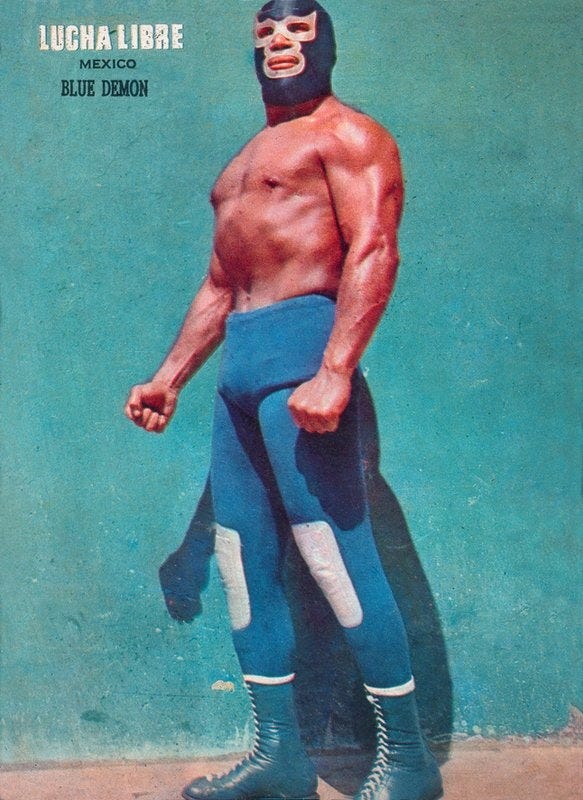
Blue Demon wrestled internationally in the U.S. South, New York, and Latin America, but remained loyal to Mexican promotions. As he aged into the 1980s, he mentored younger talent at his own Blue Demon Instituto Atletico and introduced his adopted son, Blue Demon Jr. (not a biological child, though Muñoz had biological offspring; the “Jr.” name rights have been a point of family discussion).
On August 27, 1989, at Monterrey Arena, the 67-year-old Blue Demon wrestled his final match, teaming with Blue Demon Jr., his adopted son. He retired with his mask intact—one of the few legends to do so.
Blue Demon’s film career amplified his fame far beyond the arenas. He made brief cameos in 1961’s La Furia del Ring and 1962’s Asesinos de la Lucha Libre. Producer Enrique Vergara, seeking to diversify beyond El Santo’s successful series, gave the 42-year-old Blue Demon his own starring vehicles starting in 1964. Between 1964 and 1979 he appeared in approximately 25 films—action-packed, low-budget adventures blending wrestling, horror, science fiction, and crime-fighting.
Many featured supernatural foes: vampires, mummies, mad scientists, and aliens. Notable solo outings include Demonio Azul (1965), Blue Demon vs. el Poder Satánico (1966), and Blue Demon y las Invasoras (1969). He also led the heroic group Los Campeones Justicieros in three films alongside Mil Máscaras, Tinieblas, and Rayo de Jalisco. Yet his most iconic screen work paired him with his old rival: the pair co-starred in nine films, including classics like Santo y Blue Demon contra los Monstruos (1970), Santo y Blue Demon vs. Dracula y el Hombre Lobo (1973), and Misterio en las Bermudas (1979). On screen they fought greater evils together, their real-life tension adding dramatic spark.
These films, while campy by modern standards, were hugely popular in Mexico and Latin America. They transformed luchadores into pop-culture superheroes, blending athleticism with moral tales of justice. Blue Demon’s calm, professorial demeanor (earning him the nickname “El Profe”) contrasted with the flamboyant Santo, making him a relatable everyman hero.
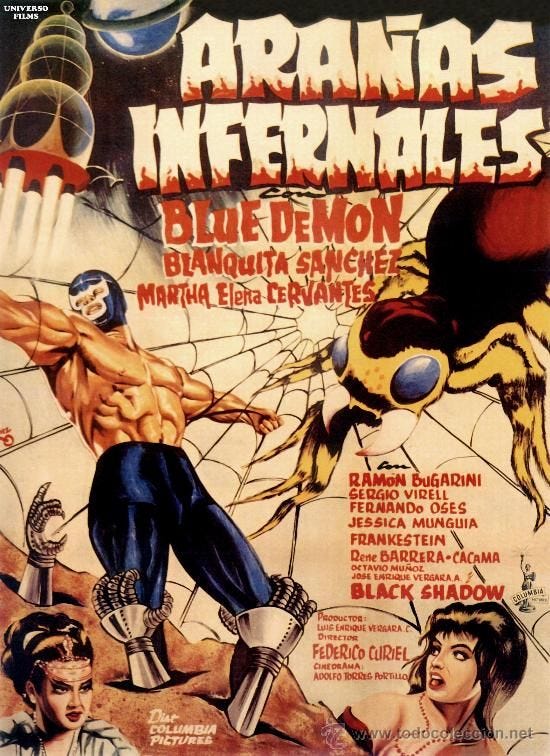
Pictured: Film poster for “Hellish Spiders” starring Blue Demon in 1968
Off-camera, Muñoz was married to Gregoria Moreno and lived relatively quietly, preserving the kayfabe of his masked identity. He ran wrestling schools and remained active in the community. His adopted son carried the legacy forward, debuting in the 1980s and continuing to wrestle into the 21st century.
On December 16, 2000, after a training session at his institute, the 78-year-old Muñoz suffered a heart attack while sitting on a park bench near a Mexico City subway kiosk. He died shortly afterward. True to his legend, he was buried at Parque Memorial Gayosso in Naucalpan wearing his blue-and-silver mask—his face never publicly revealed in life or death.
Blue Demon ranks among the “Big Three” of lucha libre (with El Santo and Mil Máscaras) and is widely regarded as second only to Santo in overall popularity and influence. His mask remains an iconic symbol of Mexican wrestling, recognized worldwide. CMLL honors him annually with the Leyenda de Azul tournament, which began in 2000 shortly after his death; the winner receives a belt and plaque endorsed by his family.
He was inducted into the Wrestling Observer Newsletter Hall of Fame (1996, inaugural class) and AAA’s Hall of Fame (2022). A 2016–2017 Televisa/Sony TV series, Blue Demon, dramatized his early life. His films, though niche outside Mexico, helped globalize the colorful spectacle of lucha libre.
More than championships or movie roles, Blue Demon embodied the luchador ideal: a working-class hero who rose through grit, never compromised his principles, and protected the sacred mystery of the mask. From the railroads of Monterrey to the arenas of Mexico City and the silver screen, Alejandro Muñoz Moreno became Blue Demon—an eternal guardian of justice, honor, and the vibrant tradition of Mexican wrestling. His story continues through Blue Demon Jr. and the countless fans who still cheer for the Demonio Azul.
One Thing I Learned About Johnny Valentine
In the mid-1960s, during a tour of Japan, he played a pivotal but largely unheralded role in launching the career of a young Antonio Inoki.
Valentine, already a major American star and one of the stiffest, most believable workers in the business, faced Inoki in a high-profile series of matches. He deliberately “put Inoki over” — including dropping the Toronto version of the NWA United States Heavyweight Championship to him. At the time, Valentine was the biggest-name foreign opponent Inoki had ever faced. Those bouts are widely credited in Japanese wrestling history with helping elevate Inoki from a promising prospect to main-event superstar status.
It’s a classic example of old-school territory-era generosity: a veteran American heel helping build the next generation in another country, something that rarely gets mentioned alongside Valentine’s more famous reputation for toughness, his plane-crash survival story, or being Greg Valentine’s father. The “Atomic Skull Crusher” elbow he popularized even influenced moves like Dusty Rhodes’ Bionic Elbow — but his quiet contribution to Inoki’s rise remains one of wrestling’s better-kept international footnotes.
Thank You for Reading
I’m Tony Richards, Pro Wrestling Historian, Author and Storyteller. I share pro wrestling historical items in each issue of the Time Tunnel Pro Wrestling History Newsletter. Thanks for reading! If you enjoy my information on select events, matches and insights, please share it with folks you think might like to be a subscriber!
Remember, premium investors get access to exclusive and special content such as some special issues including a multi-part deep dives on wrestling territories, wrestler bios and championship title histories, special audio and video interviews on territory pro wrestling and more available in the Pro Wrestling Time Tunnel for Premium Investors.