


Happy Birthday to those who have passed on and to those great wrestlers still with us:
In Memoriam:
Leon Chandler 1950
Terry Gordy 1961
Mark Scarpa 1967
Happy Birthday:
Tony Atlas (72)
John Cena (49)
Christopher Dijak\Dominij Dijakovic (39)
Britt Baker (35)
Paige Wooding\Jayme Hayter (31)
RIP Memorial: We stop & remember those who have passed on this day and gave themselves to the business for us, the fans. We salute you and thank you.
Frank Williams 4-23-1991 at the age of 51

Steve McMichael 4-23-2025 at the age of 67
The Life and Career of Duke Keomuka
Martin Hisao Tanaka, better known to wrestling fans as Duke Keomuka, was a pioneering Japanese American professional wrestler and later a promoter whose career spanned more than three decades. Born on April 22, 1921, in Los Angeles, California, Tanaka rose to prominence in the territorial era of professional wrestling as a charismatic heel who blended legitimate martial arts skills with theatrical villainy. He became a multi-time champion in key NWA territories, most notably in Texas and Florida, and eventually transitioned into a behind-the-scenes role as a co-owner and promoter of Championship Wrestling from Florida (CWF). He passed away on June 30, 1991, at age 70 in Las Vegas, Nevada, leaving a lasting legacy as both a performer and a family figure in the wrestling world—most notably as the father of wrestler Pat Tanaka.
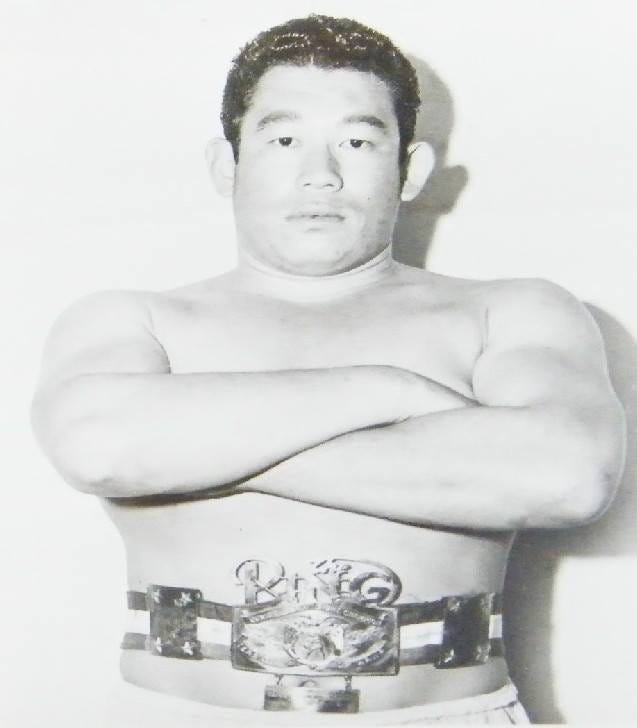
Pictured: Duke Keomuka, NWA Hawaiian Heavyweight Champion
Tanaka’s early life was shaped by the hardships faced by Japanese Americans in the mid-20th century. As a young man during World War II, he was interned at the Manzanar War Relocation Center in California following Executive Order 9066, which forcibly relocated thousands of Japanese Americans. This experience of discrimination and confinement occurred before he entered the squared circle. After the war, Tanaka turned to professional wrestling, debuting in 1947. He was trained by Tsutao Higami (and, according to some accounts, Honolulu promoter Al Karasick) and initially competed under his real name, Hisao Tanaka, or variations like Oki Keomuka. He possessed a strong background in catch-as-catch-can wrestling, Judo, and even Sumo, which gave him a credible athletic foundation that set him apart from many performers of the era.
By the late 1940s and early 1950s, Tanaka had adopted the ring name Duke Keomuka, a persona that leaned into exotic “foreign heel” stereotypes common in post-war American wrestling. Promoters often booked him as a cunning Japanese villain who used karate chops, kicks, and underhanded tactics like throwing salt in opponents’ eyes. He quickly became a top star in the NWA’s Texas territory, capturing the NWA Texas Heavyweight Championship six times between 1951 and 1960 against opponents such as Ray Gunkel, Cyclone Ayala, Pepper Gomez, and Torbellino Blanco. His tag team success was even more prolific: he won the NWA Texas Tag Team Championship a remarkable 14 times with a rotating cast of partners that included Danny Savich, Ivan Kalmikoff, Mr. Moto, Tiny Mills, Kinji Shibuya, Tony Martin, Tokyo Joe, and John Tolos.
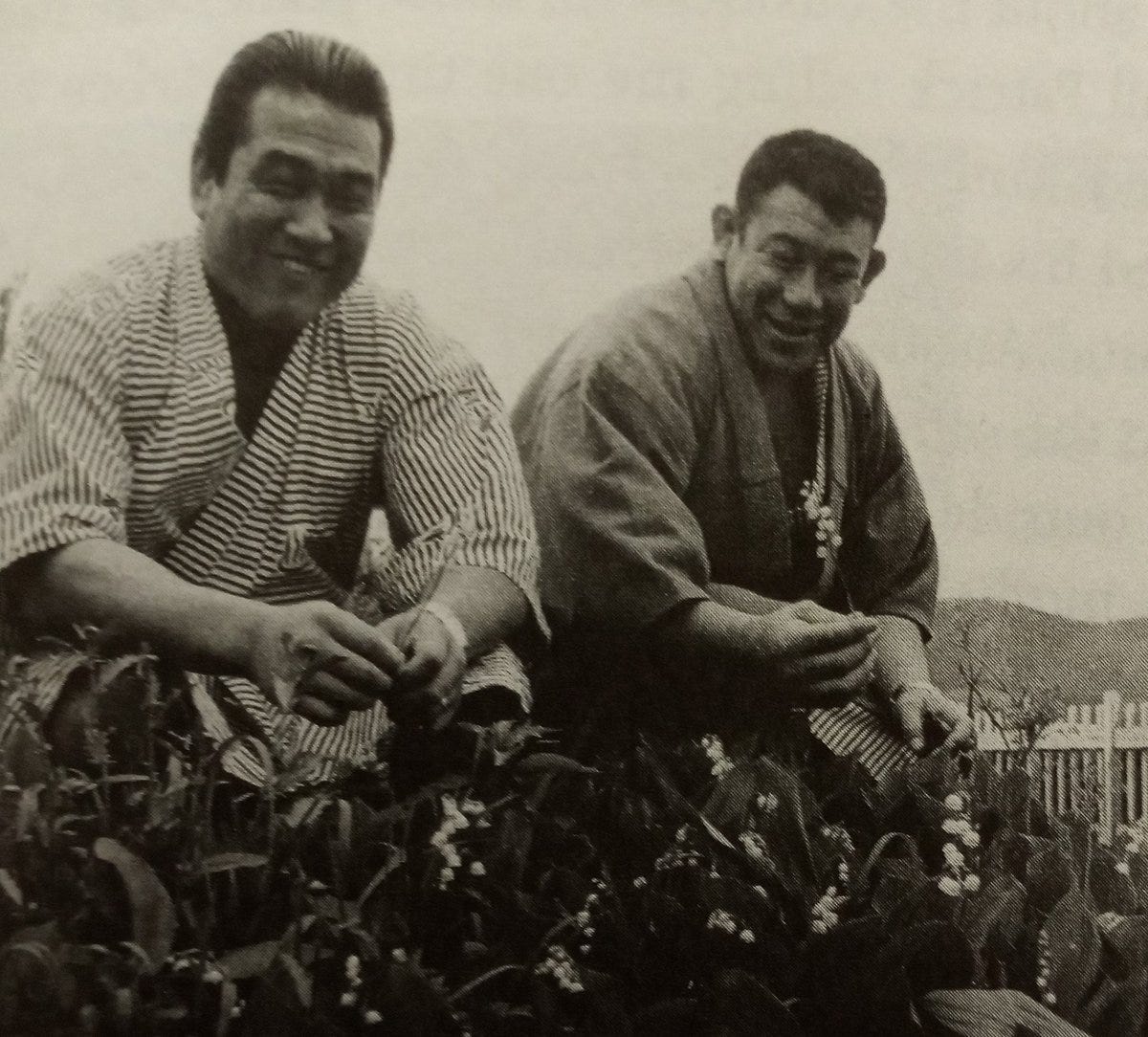
Pictured: Duke Keomuka and Hiro Matsuda, NWA World Tag Team Champions
Keomuka’s most enduring partnership formed in the 1950s with fellow Japanese American wrestler Hiro Matsuda. Together, they dominated the Florida territory as a top heel team, winning the NWA World Tag Team Championship (Florida version) four times. Their chemistry and ability to draw heat made them box-office attractions across the Southeast. Keomuka also held additional tag gold in other regions, including the NWA Southern Tag Team Championship (Mid-Atlantic version) twice with Mr. Moto and various Ohio titles with Sato Keomuka. Notable singles and tag feuds pitted him against legends like Bobo Brazil, Bruno Sammartino, the Tolos Brothers, Eddie Graham, and Danny Hodge. One particularly memorable (and reportedly stiff) encounter was a 1960s “loser leaves town” match against Timothy Geohagen in Fort Worth, Texas, where real tension escalated into injury.
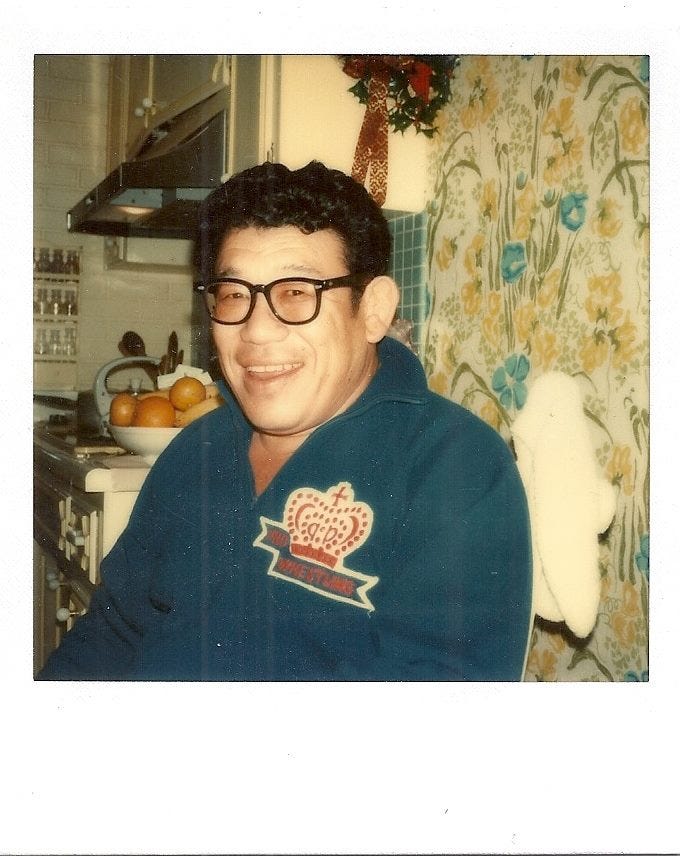
Beyond the ring, Keomuka played a significant role in the business side of wrestling. He and Matsuda bought into the Championship Wrestling from Florida office in the 1960s. After founder Eddie Graham’s suicide in January 1985, Matsuda and Keomuka assumed greater responsibility for running the promotion, effectively serving as co-promoters and owners during its final years. In the 1980s, Keomuka was also described as an NWA promoter in Florida, helping sustain the territory amid the national expansion of larger promotions like the WWF. His vision helped keep traditional territorial wrestling alive in the Sunshine State longer than many expected.
Keomuka’s influence extended to his family. He trained his son Patrick Tanaka, who went on to a successful career as Pat Tanaka, a star in the AWA, WWF (as part of the Orient Express), WCW, and ECW. Another son, Jimmy Tanaka, worked as a referee in Championship Wrestling from Florida. The elder Keomuka’s death on June 30, 1991, came just before a scheduled WWF match in which Pat Tanaka was set to team with Paul Diamond (then Kato of the Orient Express) against Haku and The Barbarian; Pat missed the show, and Mr. Fuji substituted. Duke Keomuka died of heart failure in Las Vegas, where he had reportedly retired.
Duke Keomuka’s career encapsulated the golden age of territorial wrestling. As a skilled in-ring performer who could sell tickets as both a technical wrestler and a despised villain, he thrived in an era when regional rivalries and weekly live events built loyal fan bases. His later contributions as a promoter helped bridge the old territory system with the changing landscape of the 1980s. Though he never achieved national mainstream fame like some contemporaries, his record of championships, successful tag teams, and business acumen left an indelible mark on professional wrestling. Today, he is remembered fondly by historians and fans of classic wrestling as a trailblazing Japanese American athlete who turned adversity into a lifelong passion for the squared circle.
One Thing I Learned About Terry Gordy
He and his Fabulous Freebirds teammates (Michael Hayes and Buddy Roberts) appeared uncredited in the opening scene of the 1986 fantasy film Highlander (starring Christopher Lambert).
They wrestled a six-man tag match against The High Flyers (Greg Gagne & Jim Brunzell) and The Tonga Kid, filmed at the Brendan Byrne Arena in New Jersey but presented as happening at Madison Square Garden. The Freebirds come out to Queen’s music, and the scene cuts between the wrestling action and the movie’s immortal battles—it’s a wild, early crossover that most casual fans (and even some hardcore ones) have no idea about.
Gordy was already a beast in the ring by then, the Freebirds had formed in 1979, but this pop-culture cameo is a fun, obscure nugget from his career before his huge runs in Japan as part of the Miracle Violence Connection or his later masked stint as The Executioner in WWF.
Thank You for Reading
I’m Tony Richards, Pro Wrestling Historian, Author and Storyteller. I share pro wrestling historical items in each issue of the Time Tunnel Pro Wrestling History Newsletter. Thanks for reading! If you enjoy my information on select events, matches and insights, please share it with folks you think might like to be a subscriber!
Remember, premium investors get access to exclusive and special content such as some special issues including a multi-part deep dives on wrestling territories, wrestler bios and championship title histories, special audio and video interviews on territory pro wrestling and more available in the Pro Wrestling Time Tunnel for Premium Investors.