


Happy Birthday to those who have passed on and to those great wrestlers still with us:
In Memoriam:
Jack Curtis 1911
Jack Curtis, Jr. 1935
Chuck Conley 1938
Roddy Piper 1954
Happy Birthday:
Kevin Kelly\Nailz (68)
Dasha Gonzalez (38)
Bandido (31)
RIP Memorial: We stop & remember those who have passed on this day and gave themselves to the business for us, the fans. We salute you and thank you.
Andrew Lutzinger\Paul Jones 4-17-1988 at the age of 86

Jose Alfredo Diaz Mendoza\Villano II 4-17-1989 at the age of 39
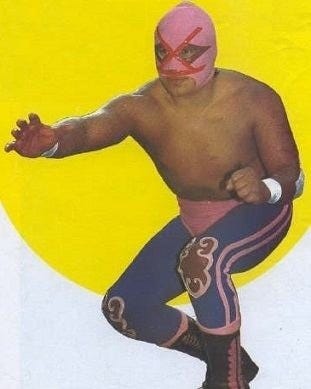
Mitsu Arakawa 4-17-1997 at the age of 69
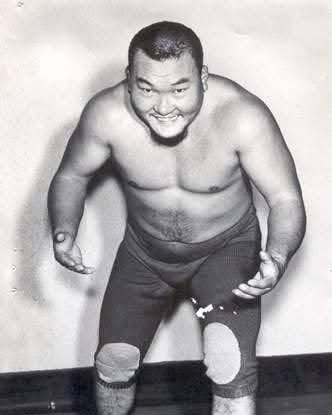
Ella Waldek 4-17-2013 at the age of 83
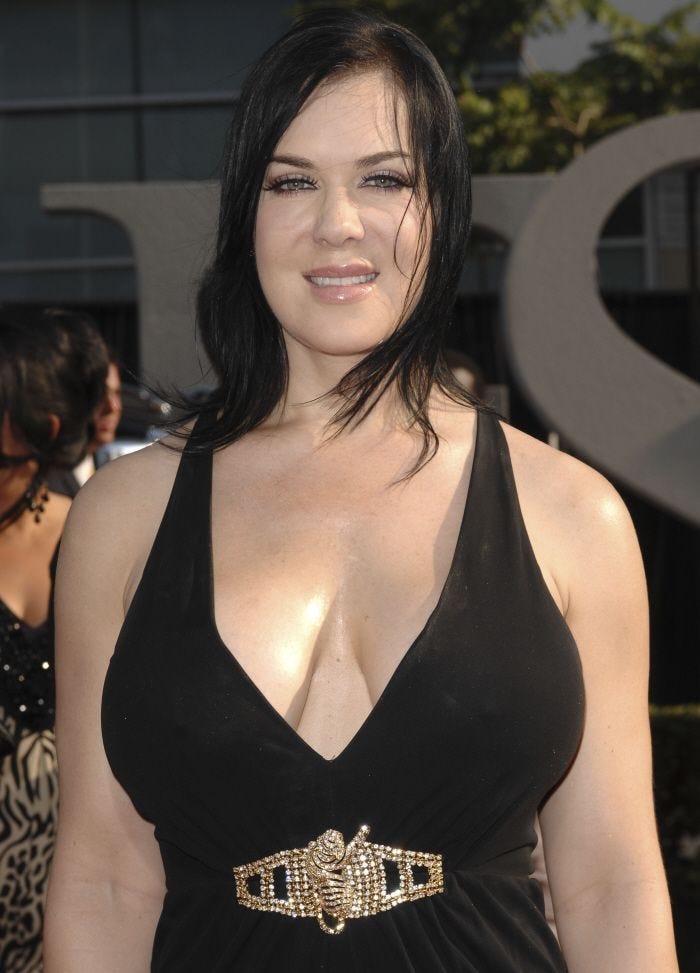
Joanie Laurer\Chyna 4-17-2016 at the age of 46
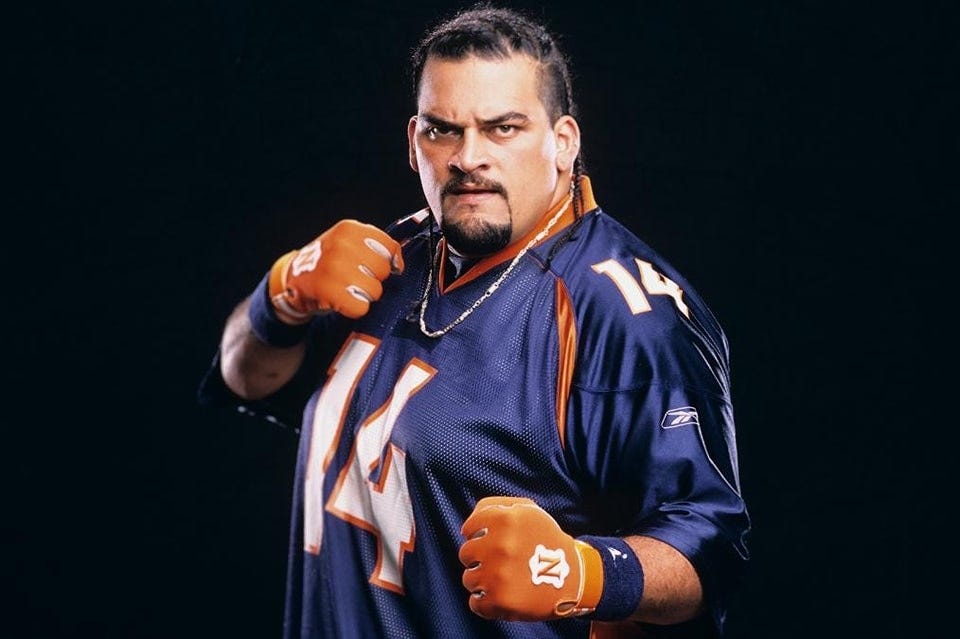
Matthew Anoa’I\Rosey 4-17-2017 at the age of 47
Significant Debut:
Wild Bill Longson 4-17-1931 at the age of 24
The Life and Career of Atlanta Promoter Paul Jones
Andrew Lutzinger—better known by his ring name Paul Jones (sometimes billed as John Paul Jones or simply “Paul Jones”)—stands as one of the most influential yet underappreciated figures in the history of professional wrestling’s territorial era. Born on June 23, 1901, in Russia, he immigrated to the United States and built a dual career that spanned more than five decades: first as an in-ring competitor from 1922 to roughly 1944, and then as a pioneering promoter who essentially founded and shaped what became Georgia Championship Wrestling (GCW) in Atlanta. He died on April 17, 1988, at age 86, near the end of an era when the NWA territorial system still dominated American wrestling.

Lutzinger’s story is one of immigration, athletic prowess, shrewd business sense, and quiet empire-building in the Southeast. Often overshadowed in modern accounts by the more flamboyant “No. 1” Paul Jones (real name Paul Frederick, 1942–2018), the younger wrestler who was explicitly nicknamed “Young” Paul Jones in Texas to avoid confusion with the veteran, Lutzinger was the original bearer of the name and the man who turned Atlanta into a wrestling powerhouse.
Not much is known about his childhood beyond his Russian birth in 1901 and subsequent move to the United States. By the early 1920s, he had entered the rough-and-tumble world of professional wrestling. He debuted around 1922 and quickly established himself as a singles wrestler with a signature finishing hold: the hook scissors (a punishing body-scissors variation, sometimes described as a Texas hook scissors). He earned the nickname “Hook Scissors King” for his mastery of the move.
In January 1944, Lutzinger (still wrestling occasionally) took over the weekly wrestling cards at Atlanta’s Municipal Auditorium (later the City Auditorium). He operated under the banner of ABC Booking, a company he headed that would serve as the direct precursor to Georgia Championship Wrestling. This move marked the start of a thirty-year promotional reign in Atlanta that transformed the city into one of the NWA’s most reliable and respected territories.
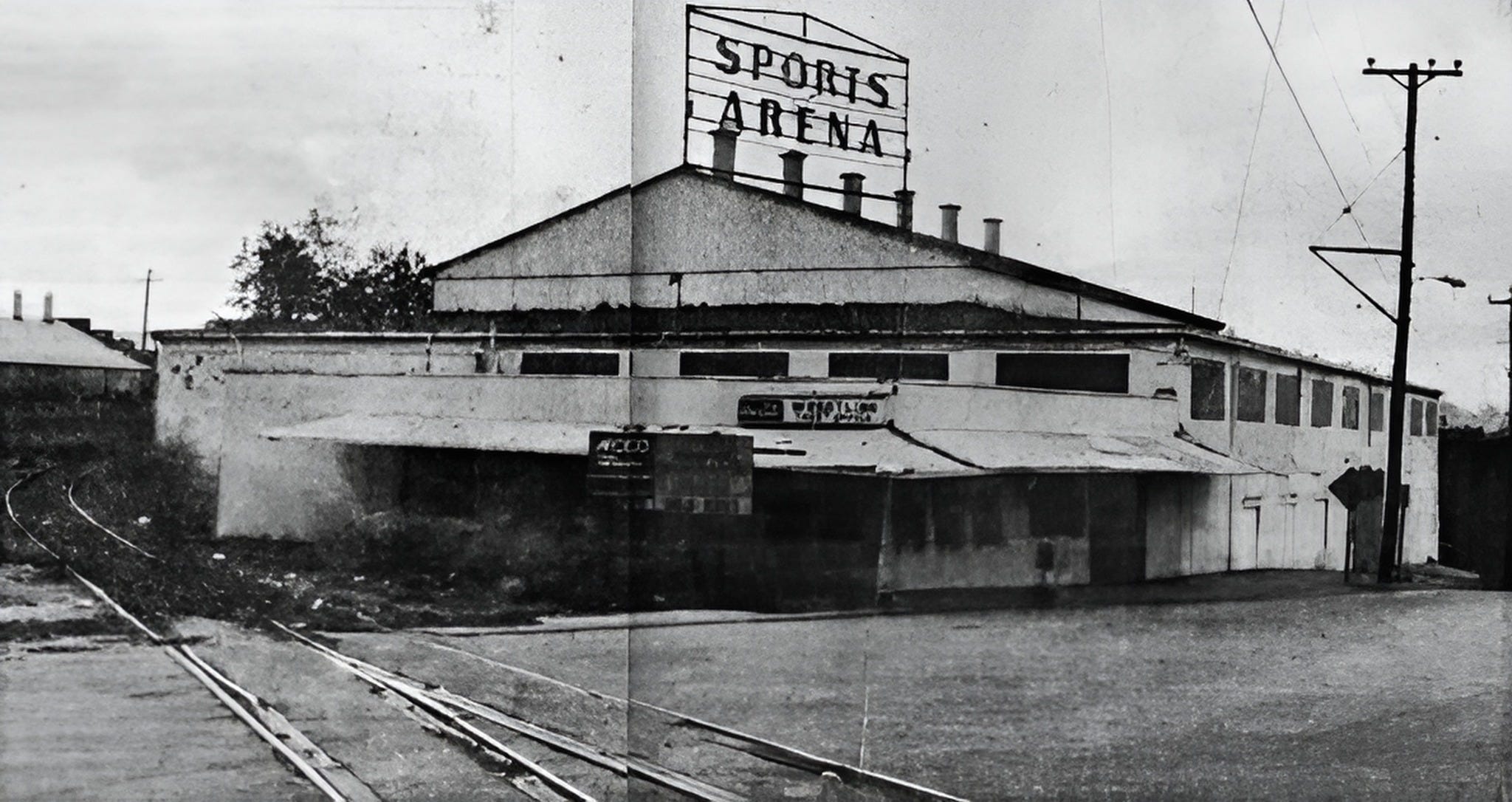
Pictured: The Sports Arena where Paul Jones first promoted cards in Atlanta, Georgia. Paul Jones bought the building in the early 1960s.
By 1949 he had been formally admitted to the National Wrestling Alliance as the Atlanta booking office representative. The NWA’s territorial system suited him perfectly: he controlled a defined geographic area (primarily Georgia, with spillover into neighboring states) and could book top talent without direct national competition. ABC Booking’s office was located at addresses such as 76 Houston Street N.E. in Atlanta; Lutzinger himself was listed at the White House Inn (70 Houston St. N.E., penthouse) as late as the mid-1970s. Friday-night shows at the Auditorium became a staple for Atlanta sports fans, drawing consistent crowds with a mix of local talent and touring NWA stars.
Due to the timing of his entry into becoming a promoter, one can draw comparisons to a handful of NWA promoters who became forever branded and linked to one singular town. The two other legendary promoters whose careers overlapped his own in time, philosophy, and impact: Paul Boesch in Houston and Sam Muchnick in St. Louis. All three were respected for their integrity in an industry notorious for sharp dealing, yet each brought a distinct style, timeline, and legacy to their respective markets.
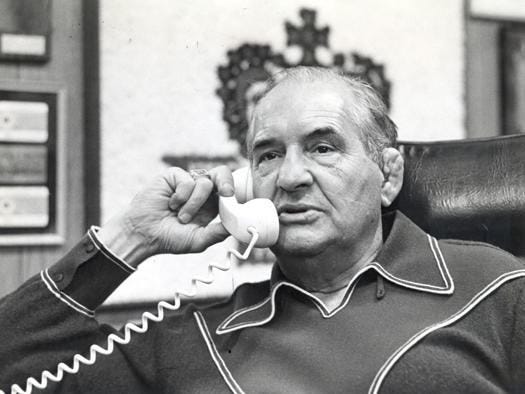
Pictured: Houston, Texas Promoter, Paul Boesch
Paul Boesch (1912–1989) mirrored Lutzinger in his transition from in-ring competitor to promoter. A former wrestler whose career ended prematurely due to a car accident, Boesch joined Houston’s Morris Sigel as a radio announcer in 1947 and became the territory’s pioneering television commentator in 1949. He purchased the Houston Wrestling promotion outright in 1967 (after Sigel’s death) and ran it successfully until selling to the WWF in 1987. Like Lutzinger, Boesch emphasized consistency and fairness; he earned a reputation as the “last promoter to give the boys a fair payday,” treating talent generously and maintaining strong relationships with both the NWA and Verne Gagne’s AWA. Boesch’s long-running Houston Wrestling TV program and regular sellouts at the Sam Houston Coliseum made his territory a beloved local institution, much as Atlanta’s Friday-night Auditorium cards did under Lutzinger. Both men were steady builders rather than flashy innovators, focusing on reliable gates and talent development rather than national politicking.
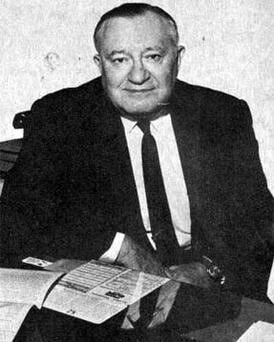
Pictured: St. Louis, Missouri Promoter, Sam Muchnick
am Muchnick (1905–1998), by contrast, represented the political and organizational pinnacle of the NWA era. A former sportswriter who began promoting in St. Louis in 1945, Muchnick co-founded the National Wrestling Alliance in 1948 and served as its president for a combined 22–25 years (1950–1960 and 1963–1975). He operated the St. Louis Wrestling Club and launched the iconic Wrestling at the Chase television program in 1959, which ran for over 1,100 episodes and helped elevate wrestling into mainstream local entertainment. Muchnick was universally known as “the honest wrestling promoter”—a stabilizing force who kept the territorial system intact through fairness, diplomacy, and an uncanny eye for talent and big-money cards. While Lutzinger and Boesch were reliable regional operators who worked within the NWA framework, Muchnick shaped that framework, wielding influence far beyond any single city.
Key parallels and contrasts emerge across the three promotions. All three men built enduring territories that thrived on weekly live events, strong local TV, and NWA affiliations, and each earned lasting respect for ethical business practices in a cutthroat business. Lutzinger’s Atlanta operation stood out for its early start (1944) and sheer longevity under one continuous banner—more than 30 years—despite his minority-partner status in later decades; it ultimately provided the platform for national expansion via Ted Turner’s superstation. Boesch’s Houston run (full control from 1967) was shorter but intensely personal and fan-centric, remembered for warmth and talent-first policies. Muchnick’s St. Louis model combined local dominance with national leadership, making his territory a proving ground for world champions and a model of polished presentation.
In an era when promoters often clashed over talent raids or territorial incursions, these three exemplified cooperation and professionalism. Lutzinger’s quiet, partnership-driven approach in Atlanta complemented Boesch’s hands-on, announcer-turned-promoter warmth in Houston and Muchnick’s statesman-like authority in St. Louis. Together they helped sustain the NWA’s golden age, proving that reliable, honest promotion could create loyal audiences and lasting legacies even without the spotlight.
Jones, Boesch and Muchnick all were in the right place, at the right time in the mid-1940s. Jones basically owned Atlanta, Boesch worked for the man (Morris Sigel) who owned Houston, and Muchnick was in the fight of his life trying to gain a foothold in St. Louis. Another thing they all had in common besides having one town to focus promotional efforts on, was the emergence of television as an entertainment vehicle to use to showcase the product and sell tickets.

Paul Boesch’s Houston strategy was the earliest and most consistently local. He debuted as the promotion’s first television commentator in 1949 on KHTV (channel 39), turning Friday-night cards from the Sam Houston Coliseum into a Sunday-morning television staple that aired for more than thirty years. Boesch’s on-air presence—warm, authoritative, and fan-friendly—became the show’s centerpiece. The broadcasts emphasized dream matches, strong storytelling, and direct promotion of live gates, while his later affiliations with Mid-South, the AWA, WWF, and World Class Championship Wrestling ensured a steady supply of national talent. The goal was straightforward: build unbreakable local loyalty and consistent sellouts in a single-city market through reliable, personality-driven television rather than spectacle or expansion.

Sam Muchnick’s St. Louis approach combined elegance with shrewd business. He aired St. Louis’s first local wrestling program in 1953, then in 1959 partnered with station owner Harold Koplar to create Wrestling at the Chase on KPLR-TV. Taped in the opulent Crystal Ballroom of the Chase Park Plaza Hotel, the show ran until 1983 and produced roughly 1,100 episodes. Its polished, almost upscale production values projected respectability, helping wrestling gain mainstream acceptance in a sophisticated Midwestern city. Muchnick used the program strategically to incite blood feuds that paid off at Kiel Auditorium or the St. Louis Arena, driving ticket sales while showcasing NWA world champions. Television was a precision tool for local dominance and NWA stability rather than national reach—Muchnick’s influence came through diplomacy, not syndication.
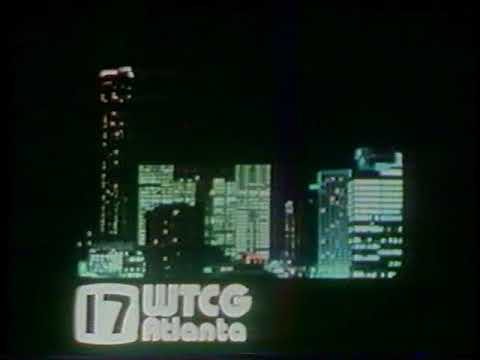
Jones’ Atlanta operation started modestly with local and regional TV experiments on an ABC affiliate in the 1950s with a live Saturday show called “Live Atlanta Wrestling”.. After a top secret move to the WTCG studios by the ring crew on Christmas Eve 1971, the later breakthrough came in 1976 when GCW begn to be broadcast on the satellite uplinked superstation. The program, Georgia Championship Wrestling, hosted by the legendary Gordon Solie, became the highest-rated show on the network once it went national via satellite.
Unlike Boesch’s personality-driven local broadcasts or Muchnick’s elegant studio presentations, GCW’s TV strategy was built for scale: studio-based action, rapid-fire angles, and a format designed for cable’s growing footprint. It transformed a regional territory into a de facto national platform years before Vince McMahon’s national expansion, directly fueling the cable-television wrestling boom and setting the stage for Jim Crockett Promotions in 1985 and WCW in late 1988. Jones’ successors, Jim Barnett and partners leveraged Turner’s infrastructure to reach millions beyond Georgia, proving that television could transcend territorial boundaries.
The arenas where the three men promoted wrestling were also legendary.

Pictured: Atlanta City (Municipal) Auditorium
Jones’ GCW made the Atlanta City Auditorium (formerly the Municipal Auditorium) its undisputed home for more than thirty years. Friday-night cards there became a cultural fixture, drawing consistent crowds in a venue perfectly sized for the territory’s core audience. As television exposure grew in the early 1970s, Lutzinger and his partners laid the groundwork for expansion into the brand-new Omni Coliseum (opened 1972). By 1973–1974, GCW was running periodic big shows at the Omni—often every two to three months—featuring out-of-state stars and higher-capacity crowds. This move signaled ambition without abandoning the Auditorium as the territory’s reliable weekly base, helping bridge the gap from regional stability to the national platform that followed.

Pictured: Houston’s City Auditorium
Boesch followed a similar upward trajectory in Houston but completed the transition earlier and more decisively. Early Houston Wrestling under Morris Sigel and the young Boesch called the City Auditorium home, but once Boesch took full control he shifted the promotion’s primary operations to the larger Sam Houston Coliseum. The Coliseum became the enduring heart of Friday-night wrestling in Houston for decades, hosting sellout crowds and serving as the backdrop for Boesch’s television tapings and major matches. The move to the bigger venue allowed for expanded production values and bigger gates while preserving the personal, community feel Boesch cultivated as both promoter and ring announcer.

Pictured: St. Louis’ Kiel Auditorium
Sam Muchnick, ever the strategist, kept the Kiel Auditorium as the rock-solid foundation of St. Louis Wrestling Club cards. Most regular house shows—usually twice a month—took place in the comfortable, mid-sized Kiel, where fans enjoyed consistent quality and the polished atmosphere that matched Wrestling at the Chase. For blockbuster events, world title matches, or special occasions, Muchnick would move to the much larger St. Louis Arena (later rebranded the Checkerdome in the late 1970s/early 1980s). These arena spectacles drew massive crowds (sometimes exceeding 15,000–20,000) and delivered the high-profile payoffs that justified the extra logistics, reinforcing Muchnick’s reputation for delivering exactly what fans paid to see. This balanced approach maximized both steady revenue and the excitement of occasional “big nights,” helping all three territories thrive within the NWA framework
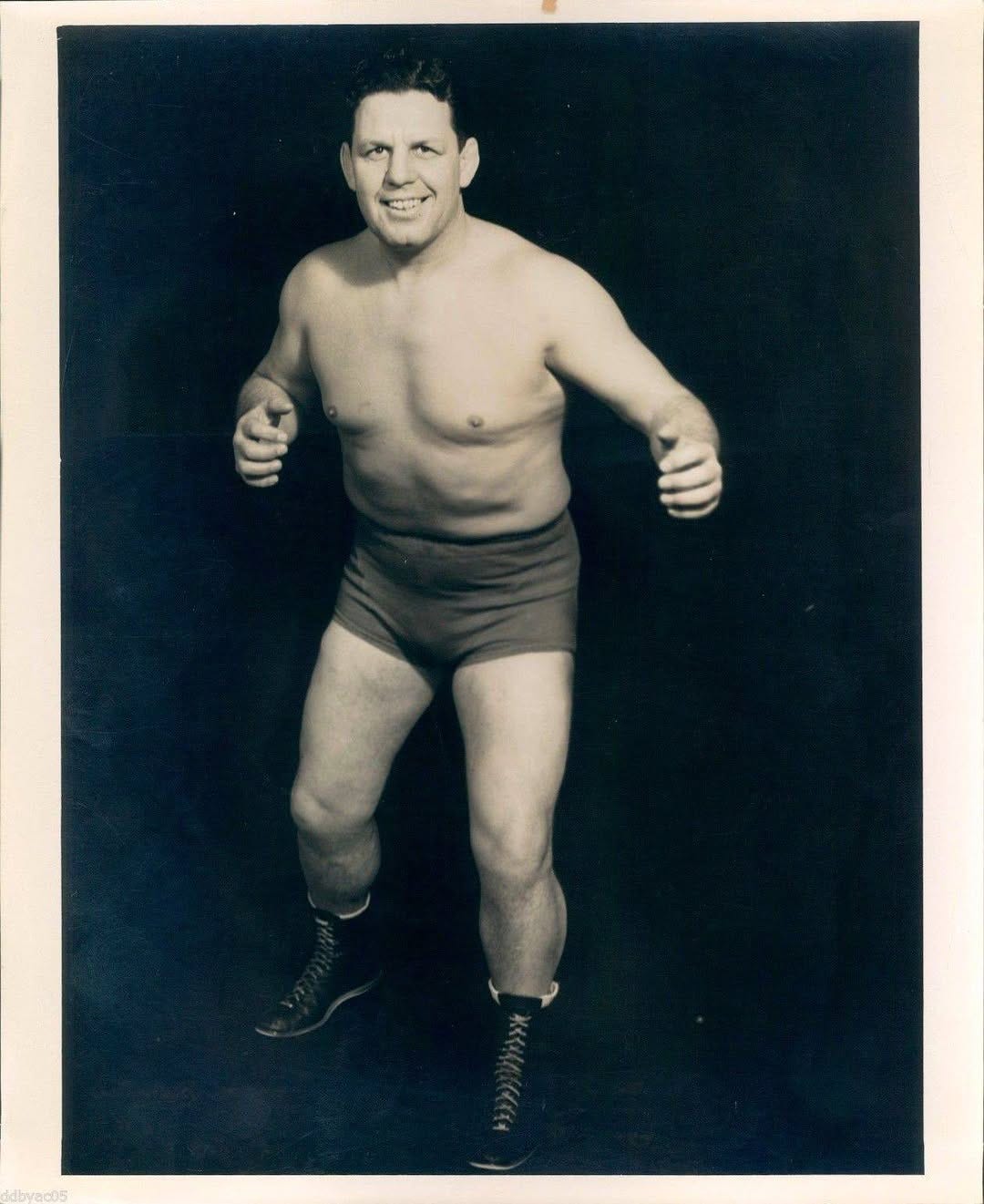
Pictured: Multi-time NWA Southern Heavyweight Champion, Don McIntyre
In the early phases of owning the booking office in Atlanta,, Lutzinger formed a key partnership with former wrestler Don McIntyre. The two men collaborated closely to stabilize and grow the Atlanta office. In the late 1950s, Ray Gunkel—a former amateur champion turned wrestler—bought into the office as a shareholder and partner. Then, in 1965, Buddy Fuller bought out Don McIntyre’s interest. Following this transaction, Buddy Fuller and Ray Gunkel became the equal majority partners, with Andrew Lutzinger (Paul Jones) holding a minority stake.
Lutzinger was not a flashy showman; he was a businessman. Together with his partners—including Ray Gunkel, a former amateur champion turned wrestler and co-promoter—they booked legends including Freddie Blassie, Gorgeous George, Eddie Graham, Gene Anderson, and occasional appearances by world champions like Lou Thesz. In 1949 Lutzinger helped establish the NWA Southern Heavyweight Championship, giving the territory its own prestigious singles title. He also promoted at venues beyond the Auditorium, including the Paul Jones Sports Arena (which he reportedly purchased around 1965). By some accounts he became one of the wealthier NWA promoters, owning properties and operating with a reputation for reliability and fairness in an often cutthroat industry.
The 1950s and 1960s represented the golden age of Lutzinger’s promotional career. ABC Booking delivered consistent quality cards that kept the Atlanta office financially stable and respected within the NWA. A brief hiatus or reduced involvement occurred in the early 1960s, but he returned stronger. By the late 1960s the promotion had incorporated formally as A.B.C. Booking, Inc. (1968) and later Mid-South Sports, Inc. (1972), with partners including members of the Welch family (Buddy Fuller Welch and Lester Welch). In 1974 the company was officially renamed Georgia Championship Wrestling, Inc.—the name by which it is best remembered today.

Pictured: Ray and Ann Gunkel
A major ownership shift occurred in 1972 when tragedy struck: Ray Gunkel suffered a fatal heart attack during a match against Ox Baker in Savannah. In the wake of Gunkel’s death, Buddy Fuller traded his stock in the Atlanta promotion to Lester Welch in exchange for Welch’s stock in Championship Wrestling from Florida. This swap consolidated the Welch family’s influence in Georgia while allowing Fuller to focus southward.
Gunkel’s widow, Ann, inherited her husband’s stake and clashed with Lutzinger and the Welch interests over the future direction of the territory. She broke away to form Gunkel Enterprises and the outlaw All-South Wrestling Alliance (ASWA), sparking a brief promotional war. The conflict ultimately resolved in favor of the NWA-aligned GCW. After the resolution of the Ann Gunkel split, Lester Welch sold his interest to Jim Barnett, who was returning to the United States from Australia. Barnett’s arrival injected fresh capital and national connections that helped stabilize and expand the promotion.
Late in his tenure, GCW began experimenting with television. Local and regional TV exposure in the early 1970s laid the groundwork for the national breakthrough that would occur after Lutzinger’s retirement. By the mid-1970s he had largely stepped back due to health issues, though he remained connected to the office. The promotion continued to thrive under new leadership and, by 1976, was broadcasting World Championship Wrestling on Ted Turner’s on WTCG, which would become a satellite superstation, changing call signs to WTBS and reaching homes across the country helping ignite the cable-television wrestling boom. Vince McMahon’s WWF ultimately purchased GCW’s stock and the WTBS television contract in 1984, ending the independent territorial run that Lutzinger had started forty years earlier.
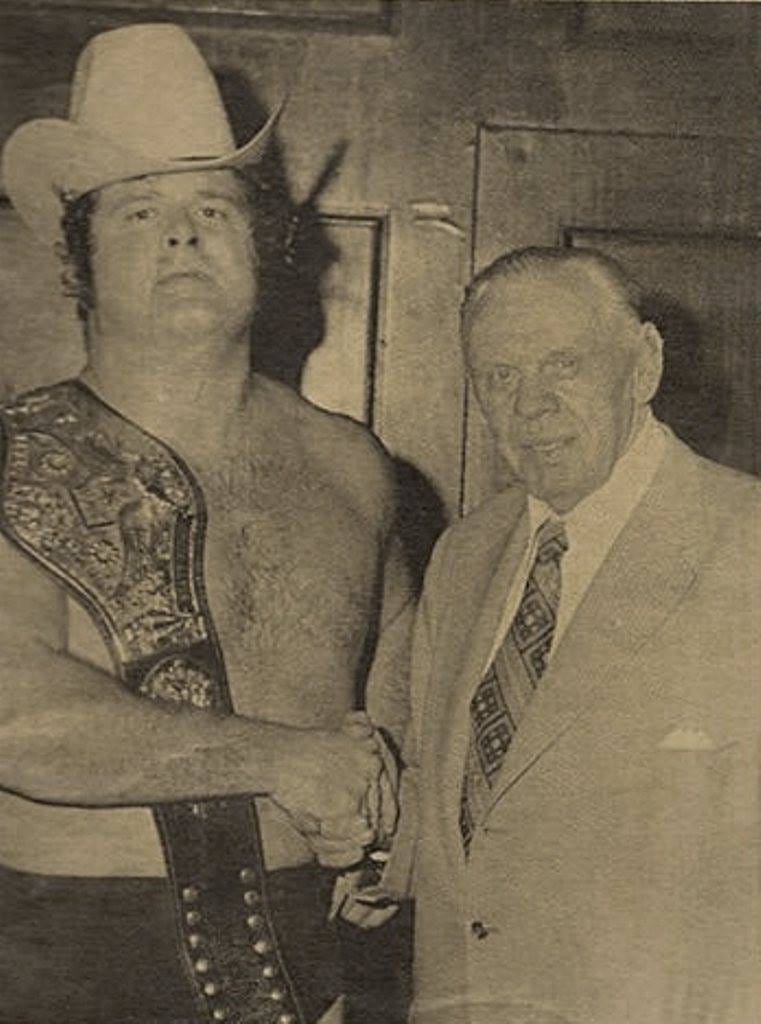
Pictured: Atlanta Promoter Paul Jones and NWA Georgia Champion, Cowboy Bill Watts
Biographical details about Lutzinger’s private life remain scarce—a common trait for promoters of his generation who preferred to stay behind the curtain, although I do have photographs of Jones taking a tyrip to visit Barnett in Australia with his family. He was married and by all accounts, he lived comfortably in Atlanta. He was described as a hands-on promoter who occasionally refereed matches and maintained personal relationships with wrestlers and NWA officials. His Russian immigrant roots and long career made him something of an elder statesman in Southern wrestling circles.
He retired from active promotion around 1974, though he lived to see GCW’s national television success in the late 1970s and the eventual corporate shifts of the 1980s. Andrew Lutzinger died on April 17, 1988. His passing received relatively little fanfare outside wrestling insider circles—another sign of how the territorial era was already fading from public memory.
Paul Jones (Andrew Lutzinger) never held a world title or headlined Madison Square Garden, yet his impact on professional wrestling rivals that of more celebrated figures. He took a regional wrestling scene in postwar Atlanta and built it into a stable, respected NWA territory that endured for decades. Through strategic partnerships—with Don McIntyre, Ray Gunkel, Buddy Fuller, Lester Welch, and eventually Jim Barnett—he created the infrastructure that allowed GCW to explode onto national television in the 1970s and 1980s. Stars like Dusty Rhodes, Ric Flair, Roddy Piper, and Gordon Solie—all of whom became household names—owed part of their platform to the foundation Lutzinger laid.
In an industry rife with territorial wars, double-crosses, and egos, Lutzinger was remembered as a steady, fair operator who prioritized the long-term health of his promotion. The confusion with the younger Paul Jones is ironic but fitting: the veteran’s name lived on through the younger wrestler’s success in the very territory he had built. Today, when fans revisit classic GCW footage or trace the roots of what became WCW and eventually WWE’s Southern expansion, they are looking at the legacy of a Russian-born immigrant who arrived in America, mastered the hook scissors, and then mastered the art of local promotion.
One Thing I Learned About Villano II
In addition to being a masked luchador and the oldest of Ray Mendoza’s wrestling sons (despite the “II” numbering, which came from his brother debuting first in the family gimmick), he was a talented freelance artist in his spare time. While his brothers were building the legendary Los Villanos legacy in the ring, “El Villano Olvidado” (the Forgotten Villano) quietly pursued drawing and painting as a creative outlet.
This artistic side is rarely mentioned in wrestling histories, which tend to focus on his sporadic career, tag-team work with Villano I, and the tragic circumstances of his early death at age 39. It adds a surprisingly human, creative layer to a wrestler who often flew under the radar even within his own famous family.
Thank You for Reading
I’m Tony Richards, Pro Wrestling Historian, Author and Storyteller. I share pro wrestling historical items in each issue of the Time Tunnel Pro Wrestling History Newsletter. Thanks for reading! If you enjoy my information on select events, matches and insights, please share it with folks you think might like to be a subscriber!
Remember, premium investors get access to exclusive and special content such as some special issues including a multi-part deep dives on wrestling territories, wrestler bios and championship title histories, special audio and video interviews on territory pro wrestling and more available in the Pro Wrestling Time Tunnel for Premium Investors.
Thanks Tony! This article brought back a lot of good memories for me. I started watching Live Atlanta Wrestling when I was about four years old. I grew up in Athens GA and we were on Paul Jones circuit with live wrestling every Thursday night. I was amazed by seeing the stars that once I had only seen on television. It was always a big deal when Paul Jones come on the TV to talk with Ed Capital about the upcoming Friday night card in Atlanta. I will always remember the excitement when Jones would announce the world champion Dory Funk Jr Would be in Atlanta next Friday night! On very rare occasions they also send the world champion to Athens on Thursdays before the big event on Friday in Atlanta. Thanks again for bringing back some wonderful memories.
Standard brilliance from you. Also, feel free to keep the Ann Gunkel photos coming—no such thing as too many!