



Happy Birthday to those who have passed on and to those great wrestlers still with us:
In Memoriam:
Yukon Eric 1916
George Steele 1937
Frankie Laine 1943
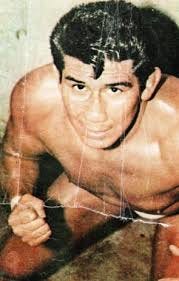
Mario Gonzalez\Gran Apache 1959
Happy Birthday:
Damian Kane (66)
Vickie Guerrero (58)
Paul London (46)
Stehanie Lee\Mia Yim (37)
RIP Memorial: We stop & remember those who have passed on this day and gave themselves to the business for us, the fans. We salute you and thank you.
Ray Mendoza 4-16-2004 at the age of 73
Howard Finkel 4-16-2020 at the age of 69

The Life and Career of Mitsu Arakawa
Mack Mitsukazu Arakawa, better known to wrestling fans as Mitsu Arakawa, was one of the most effective and enduring heels of the territorial era. Born on May 23, 1927, in Honolulu, Hawaii, to Japanese immigrant parents, he carved out a 23-year career (1953–1976) that spanned the Midwest, Pacific Northwest, Canada, Australia, and even a brief but memorable run in the WWWF. At just 5’7” and around 242 pounds, Arakawa was never the biggest man in the ring, but his technical prowess, stamina, and perfectly calibrated “inscrutable Oriental” villain persona made him a top draw and one of the most despised foreign heels in the American Wrestling Association (AWA) territory.
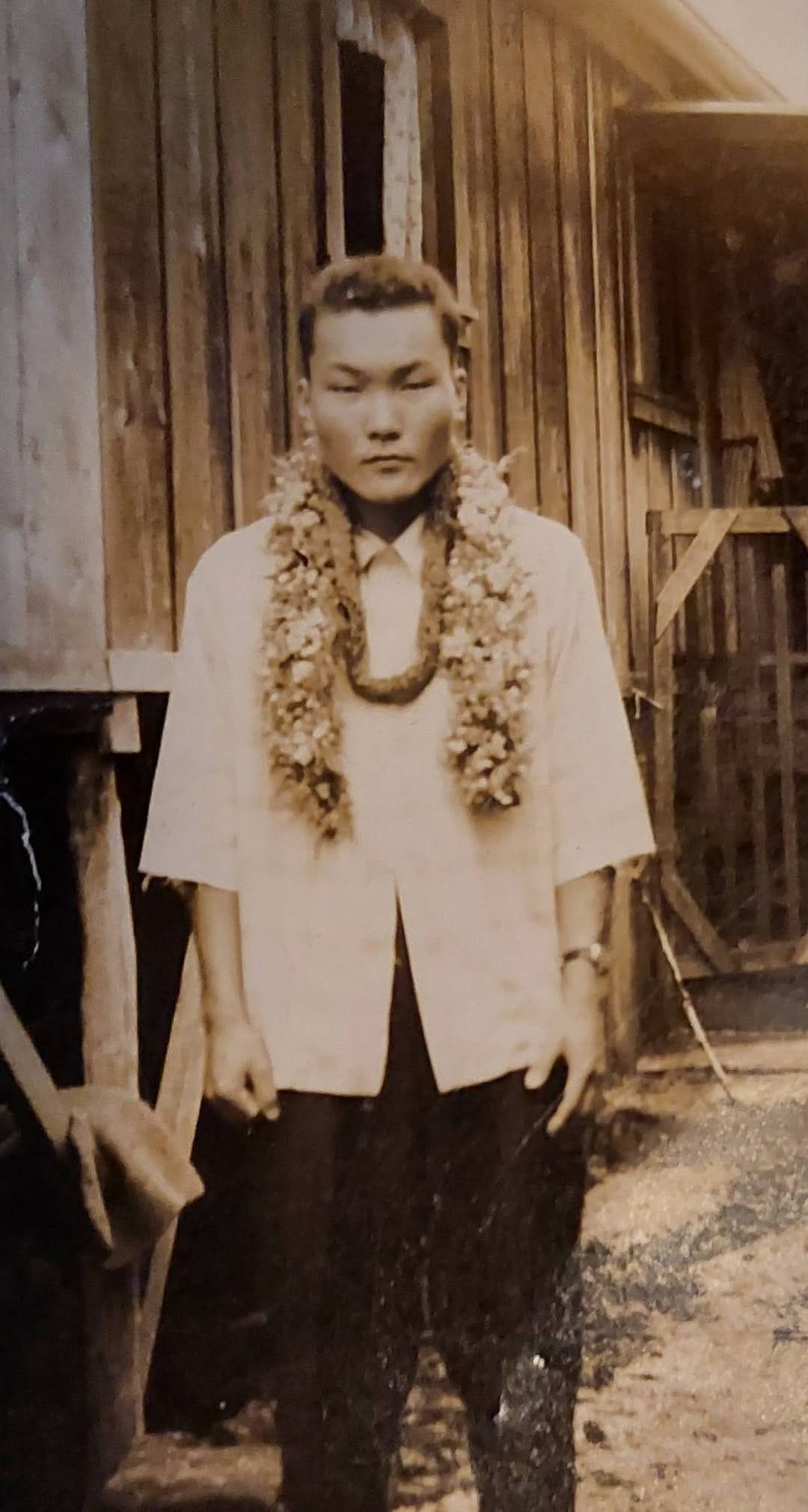
Pictured: Mitsu Arakawa’s High School Graduation Photo, 1944, Honolulu, Hawaii
Arakawa’s real-life background stood in sharp contrast to the character he would portray. On November 27, 1945—just months after the end of World War II and at the age of 18½—he enlisted in the United States Army. In kayfabe, however, he was billed as a Japanese citizen who had survived the atomic bombing of Hiroshima and harbored a deep grudge against America. This fiction was central to his heat-drawing ability throughout his career.
Trained by the legendary Hawaiian wrestler The Great Yamato, Arakawa made his professional debut in 1953. He quickly established himself as a reliable singles competitor and especially as a tag-team specialist in the Midwest NWA territories. His early work was mostly in the Indianapolis-based World Wrestling Association (WWA) and the Minneapolis Boxing & Wrestling Club (later the AWA), where promoters valued his crisp in-ring style and ability to generate genuine audience hatred.
Arakawa’s gimmick was nearly identical to those of his frequent partners and contemporaries, forming what historian and wrestling analyst Dave Meltzer-era discussions have described as a virtual “stock Japanese heel” template. Kinji (or Kenji) Shibuya, often billed as Arakawa’s cousin despite no actual relation, shared the exact same look, moveset, and anti-American heat. Born in Utah but presented as Japanese, Shibuya teamed with Arakawa to win multiple NWA tag titles and was positioned as a top heel alongside him in San Francisco and elsewhere. Both men threw salt, used chops, and projected the same cold, calculating menace.
Even closer was Professor Toru Tanaka. Tanaka and Arakawa formed “The Rising Suns” in the WWWF in 1969, winning the inaugural International Tag Team Championship in a fictional Japan tournament. Tanaka’s gimmick mirrored Arakawa’s almost beat-for-beat: traditional Japanese robes, exaggerated bows, broken-English promos (or stoic silence), salt-throwing rituals, and judo-based offense. Tanaka later achieved greater mainstream visibility teaming with Mr. Fuji in the 1970s WWWF, but the foundational character was the same one Arakawa had perfected earlier. Fuji himself—another Hawaiian-Japanese wrestler Arakawa reportedly helped train—followed the blueprint: salt in the eyes, devious rule-breaking, and a foreign invader persona that made him one of the longest-reigning U.S. champions in San Francisco history.
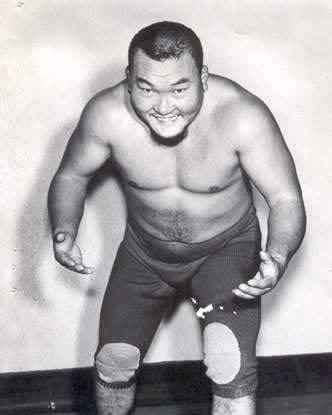
Mr. Moto was another frequent Arakawa partner whose gimmick was cut from the same cloth. These wrestlers were not portraying distinct characters so much as variations on a single proven formula. As one detailed historical analysis notes, “all of these men played essentially the same kind of heel character, right down to the habit of throwing salt in their opponents eyes.” The formula worked because it was simple, visually distinctive, and tapped directly into lingering wartime xenophobia. Promoters like Roy Shire in San Francisco or Verne Gagne in the AWA could drop any one of them into a main event and instantly generate heat without needing long backstories or elaborate promos.
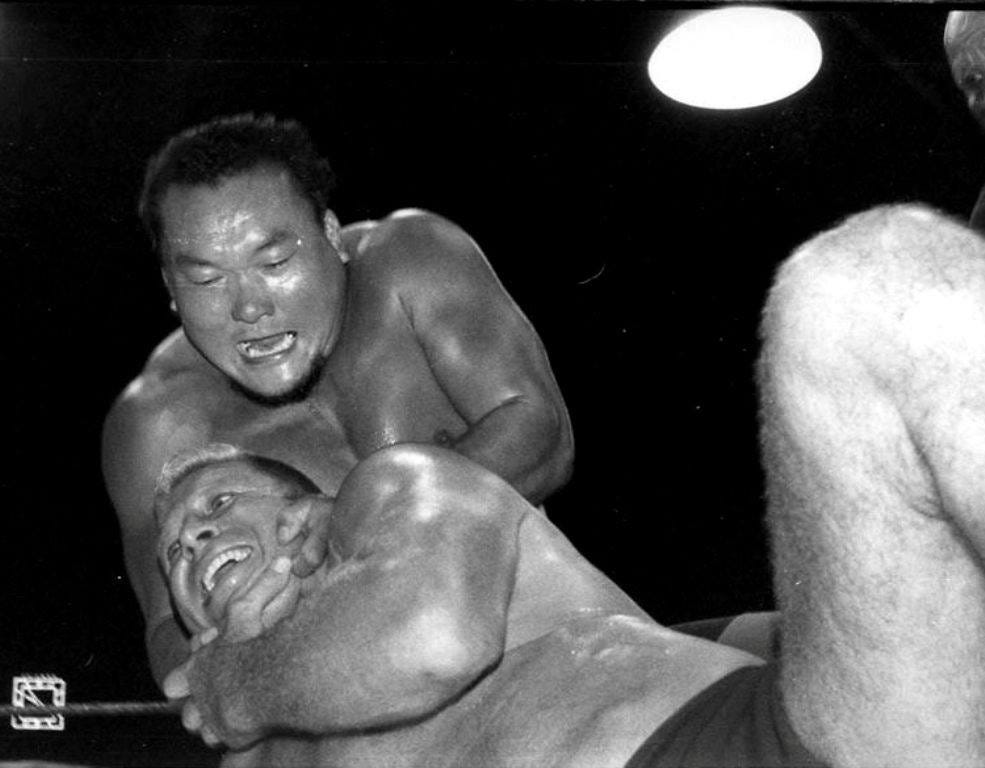
Pictured: Arakawa puts the choke on Wilbur Snyder on the mat
Arakawa’s act fit squarely into the larger post-WWII “foreign menace” trend. Just as Canadian wrestlers like Hans Schmidt or Baron Von Raschke were booked as sneering German heels complete with goose-stepping and clawholds (Baron’s claw was thematically similar to Arakawa’s stomach claw), Japanese heels like Arakawa capitalized on Axis-power resentment. Earlier pioneers such as The Great Togo (George Okamura) had laid the groundwork in the 1950s as one of the first major Japanese-American foreign heels in Southern California. These characters were deliberately interchangeable with other “evil foreigner” archetypes—Russians, Arabs, or Iranians—because the heat came from the same source: the outsider threatening American values and heroes.
Where Arakawa stood out within this group was his restraint. Many foreign heels were larger-than-life monsters (Abdullah the Butcher) or wild brawlers (The Sheik/Ed Farhat). Arakawa was smaller, more technical, and almost gentlemanly in his villainy until the salt flew or the claw locked in. His stoicism contrasted with the ranting style that would define later anti-American heels.
By the 1980s, the foreign heel evolved with shifting global tensions. The Iron Sheik (Khosrow Vaziri, an actual Iranian) is the clearest spiritual successor. Like Arakawa, the Sheik used martial-arts flair (camel clutch instead of claw), anti-American promos, and geopolitical heat—this time tied to the Iran hostage crisis rather than WWII. But key differences emerge: the Sheik was loud, bombastic, and verbally abusive, screaming about America’s weakness, whereas Arakawa’s heat was generated through silent menace and underhanded tactics. The Sheik’s act was amplified by the national TV era and Hulk Hogan’s patriotism; Arakawa thrived in regional arenas where word-of-mouth and live crowd reaction mattered more than mic work.
Other Cold War-era examples—Nikolai Volkoff (Russian Bear), Boris Zhukov, or even Ludvig Borga (anti-environmental Finn)—leaned into vocal flag-waving or ideological rants. Arakawa’s gimmick predated and influenced this wave but remained rooted in the subtler, more ritualistic territorial style. Modern echoes, such as Rusev’s Bulgarian brute or Jinder Mahal’s Maharaja, retain the anti-American core but add layers of nationalism or cultural pride that Arakawa’s character largely avoided in favor of pure, silent resentment.
Arakawa’s gimmick was remarkably durable across territories precisely because it was so formulaic: salt + chops + claw + anti-U.S. backstory = instant heat. It required minimal adaptation and allowed him to be a reliable draw without ever becoming the promotion’s top babyface or a national superstar. Yet this same interchangeability limited his individual legacy. While Mr. Fuji and Professor Toru Tanaka enjoyed longer WWWF runs and later managerial success (Fuji especially), Arakawa retired in the mid-1970s with fewer mainstream crossover moments. His act was so perfectly of its time—tied to 1950s–60s cultural memory—that it didn’t transition easily into the rock ’n’ wrestling or attitude eras.
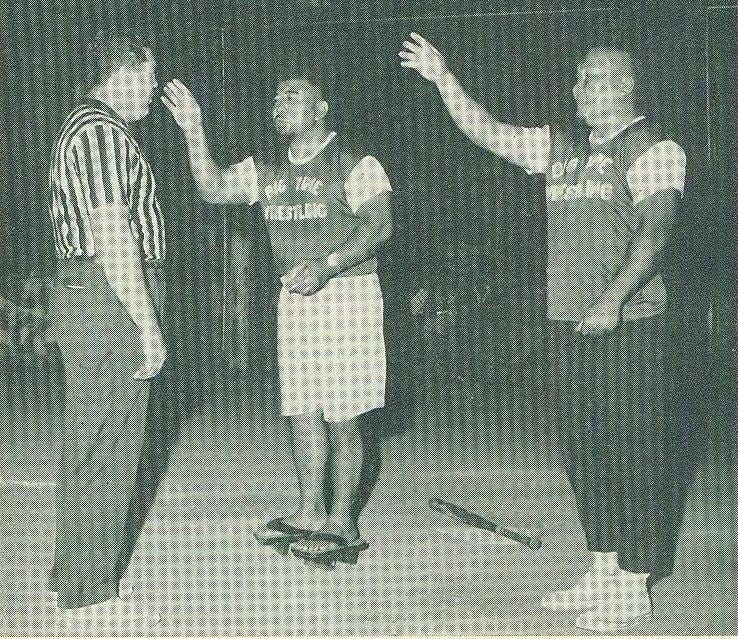
Pictured: Kenji Shibuya and Mitsu Arakawa
Mitsu Arakawa’s greatest success came in tag-team competition, often alongside fellow Japanese-American or billed-Japanese wrestlers. His longest and most productive partnership was with Kinji Shibuya, whom he was frequently billed as a cousin. Together they won the NWA World Tag Team Championship (Minneapolis version) on August 13, 1957, defeating Ivan and Karol Kalmikoff before losing the belts to Joe and Guy Brunetti in November of the same year. The duo also captured tag gold in Vancouver (NWA Pacific Coast and Canadian Tag Team titles), Stampede Wrestling (International Tag Team Championship in 1963), and San Francisco.
In the late 1960s Arakawa formed another high-profile team with the aforementioned Mr. Moto. On December 2, 1967, they defeated Pat O’Connor and Wilbur Snyder for the AWA World Tag Team Championship and held the titles for over a year—one of the longest reigns of the era—before dropping them to The Crusher and Dick the Bruiser in December 1968. They also won the WWA World Tag Team Championship twice in Indianapolis.
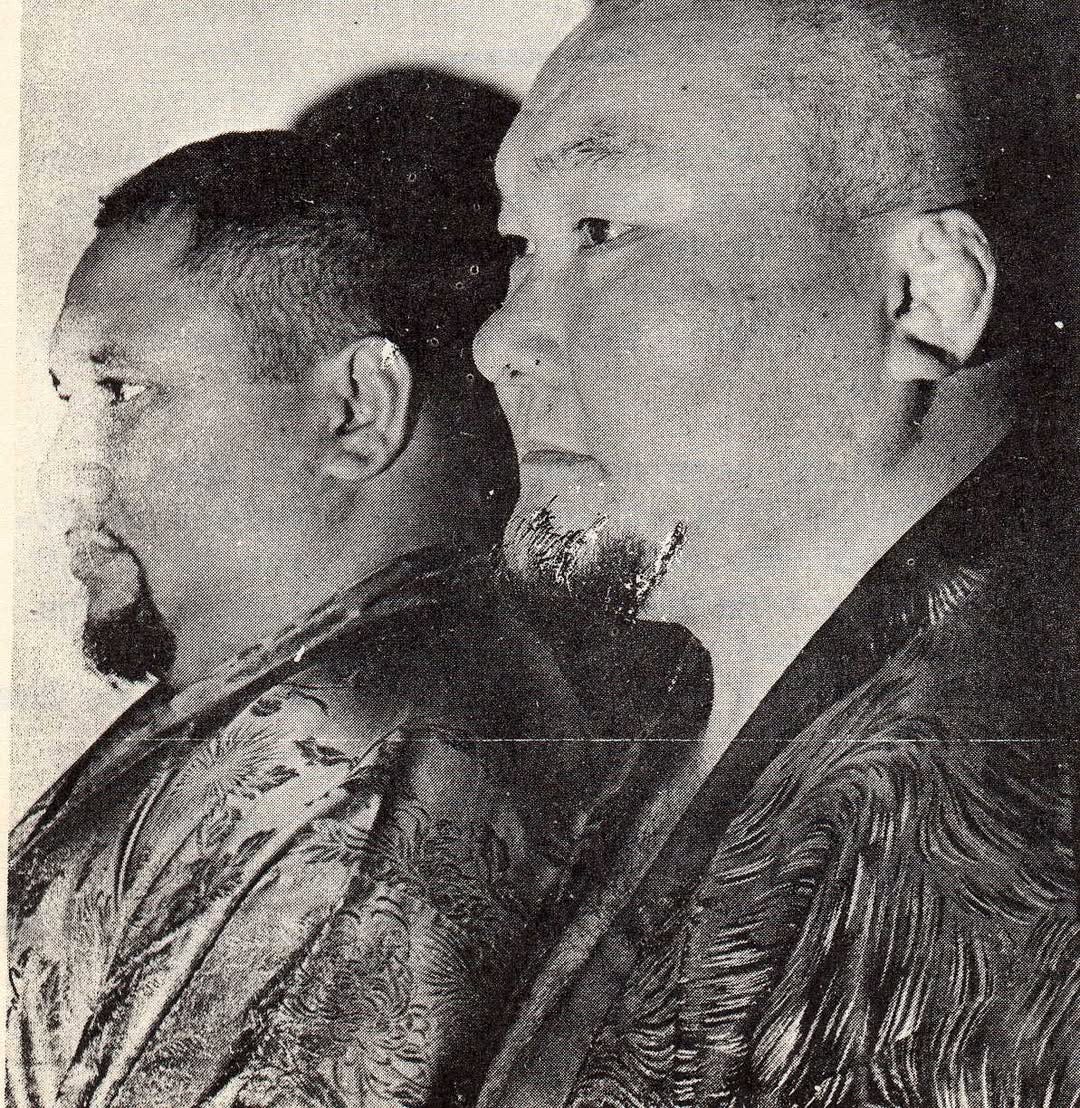
Pictured: Dr.(Mr.) Moto and Mitsu Arakawa
His final major tag run came in the WWWF (later WWF) as one-half of “The Rising Suns” alongside Toru Tanaka (Professor Tanaka). In June 1969 the duo was awarded the inaugural WWWF International Tag Team Championship after a fictitious “tournament victory in Japan.” They held the belts until December 1969, when they lost to Tony Marino and Víctor Rivera at Madison Square Garden. Arakawa also teamed with Yoshino Sato (later known in some circles as part of the Sato family lineage) to win the NWF World Tag Team Championship in a 1972 tournament.
Beyond championships, Arakawa’s tag work helped launch or elevate several careers. Historical accounts credit him with playing a significant role in training and introducing to the business such future stars as Toru Tanaka (Professor Tanaka), Mr. Fuji, Masa Saito, and Yoshino Sato.
Though primarily a tag wrestler, Arakawa enjoyed notable singles triumphs. In October 1966 he defeated Dick the Bruiser to win the WWA World Heavyweight Championship in Indianapolis, holding it until September 1967. He also toured Australia three times (1965, 1966, and 1970). During his first visit he captured the IWA World Heavyweight Championship from Dominic DeNucci in early 1965 and held it for roughly a month.
These international excursions, combined with runs in Canada’s Stampede territory and the Pacific Northwest, underscored the truly territorial nature of his career. He was never a national superstar in the mold of a Verne Gagne or Bruno Sammartino, but he was a consistent, money-drawing heel who could be dropped into virtually any promotion and immediately generate heat.
Arakawa’s gimmick was pure 1960s–70s territory gold: the stoic, grudge-holding Japanese villain who threw salt into opponents’ eyes, chopped with judo precision, and finished with his devastating clawhold. Promoters leaned heavily into anti-American sentiment for maximum crowd reaction, even though Arakawa himself was a U.S. Army veteran and Hawaiian-born American citizen. The kayfabe was so convincing that he was widely regarded as one of the most hated foreign heels ever to work the AWA.
His feuds read like a who’s-who of territory babyfaces: Verne Gagne, Dick the Bruiser, The Crusher, Wilbur Snyder, Pat O’Connor, Pepper Gomez, Moose Cholak, and many others. Whether battling for singles gold in Indianapolis or trading AWA tag titles with the Bruiser-Crusher combination, Arakawa excelled at making every match feel personal and volatile. In 1973 he appeared as himself in the documentary The Wrestling Queen, offering a rare behind-the-scenes glimpse into the life of a working territory wrestler and the rookie career of Vivian Vachon.
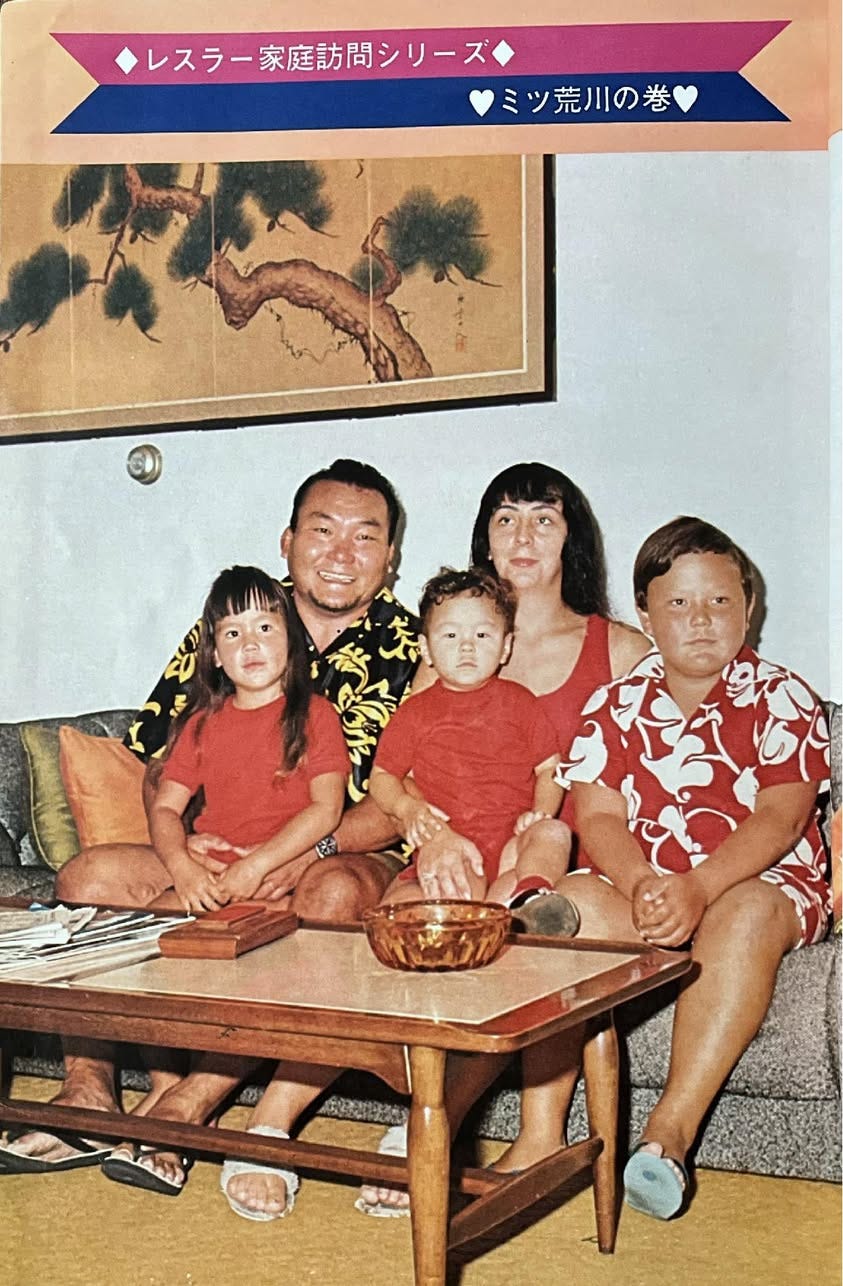
Pictured: Mitsu Arakawa, his wife, Patti and children at their home when living in Ohio
Arakawa curtailed his in-ring activity by the mid-1970s and officially retired around 1976. He settled in California with his wife, Patti, and their three children—sons David and Michael, and daughter Teresa. Later family remembrances also mention seven grandchildren.
On April 17, 1997, Mack Mitsukazu Arakawa died of heart failure in Concord, California, at the age of 69. He was buried in Honolulu, returning to the islands where his wrestling journey had begun.
Mitsu Arakawa is remembered not as a household name but as the quintessential territory-era supporting player: a dependable draw, a gifted technician, a master of heat, and a mentor to the next generation of Japanese-American stars. In an era before cable television and national syndication, he helped fill arenas from Minneapolis to Melbourne by doing the unglamorous but essential work of making the heroes look heroic. His career stands as a testament to the richness and regional flavor of pre-WWF wrestling—a time when a 5’7” Hawaiian-born Army veteran could convincingly portray the ultimate foreign menace and, in doing so, become an indelible part of the sport’s territorial era.
One Thing I Learned About Yukon Eric
Despite his fearsome “Yukon lumberjack” persona in the ring—bare feet, blue jeans held up by a clothesline belt, and that famous 66-inch chest he loved to show off—he had a legendary appetite that matched his size. He once ate an entire 20-pound turkey in a single sitting during a Thanksgiving dinner with fellow wrestler Ray Dunkle.
He was also known for other over-the-top feats like polishing off six lobsters at an all-you-can-eat special (the restaurant owner honored him as a guest but quietly banned him from future lobster nights) and even attempting a 24-scoop ice cream sundae.
Thank You for Reading
I’m Tony Richards, Pro Wrestling Historian, Author and Storyteller. I share pro wrestling historical items in each issue of the Time Tunnel Pro Wrestling History Newsletter. Thanks for reading! If you enjoy my information on select events, matches and insights, please share it with folks you think might like to be a subscriber!
Remember, premium investors get access to exclusive and special content such as some special issues including a multi-part deep dives on wrestling territories, wrestler bios and championship title histories, special audio and video interviews on territory pro wrestling and more available in the Pro Wrestling Time Tunnel for Premium Investors.