


Happy Birthday to those who have passed on and to those great wrestlers still with us:
In Memoriam:
George Romanoff 1893
Angelo Poffo 1925
Tex McKenzie 1936
Kurt Von Hess 1942
William Moody\Paul Bearer 1954
Jeremy Layman\Jax Dane 1976
Happy Birthday:
Joseph “Juice” Robinson (37)
RIP Memorial: We stop & remember those who have passed on this day and gave themselves to the business for us, the fans. We salute you and thank you.
Leo Voss 4-10-1989 at the age of 76
(no photo available)
Larry Sharpe 4-10-2017 at the age of 65
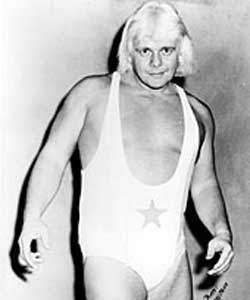
Thomas Kosat\Teijo Khan 4-10-2020 at the age of 64

Ralston Hutchings\Hartford Love 4-10-2025 at the age of 84

Significant Debuts:
Reed Detton 4-10-1931 at the age of 24
The Life and Career of Paul Bearer
William Alvin “Bill” Moody (April 10, 1954 – March 5, 2013), better known to generations of wrestling fans as Paul Bearer, stands as one of professional wrestling’s most memorable and influential non-wrestling personalities. With his ghostly white face paint, jet-black hair, ill-fitting suit, and an urn that supposedly held supernatural power, Bearer was the perfect gothic foil to The Undertaker’s Deadman persona. But behind the high-pitched “Ohhhh yesss!” catchphrase and the macabre theatrics lay a deeply layered man: a U.S. Air Force veteran, licensed funeral director and embalmer, devoted husband and father, and a lifelong student of the wrestling business who managed future Hall of Famers long before he ever stepped foot in a WWE ring.

Born in Mobile, Alabama, Moody grew up in a working-class Catholic household. Two events in 1963 profoundly shaped him: the death of his grandfather and the assassination of President John F. Kennedy. Attending his grandfather’s funeral and watching the televised state funeral of JFK sparked a lifelong fascination with mortality, grief, and the rituals surrounding death. As a child he would stage mock funerals for dead pets and animals.
After high school, Moody enlisted in the United States Air Force in 1972. He served four years (until 1976), rising to the rank of Sergeant while stationed at Keesler Air Force Base in Mississippi. He earned the Air Force Good Conduct Medal and occasionally wrestled on independent cards during off-duty hours. Upon discharge he began working part-time as an emergency medical technician, often transporting bodies, and apprenticed as a shomer (a Jewish ritual watcher of the dead) before pursuing formal education in mortuary science.
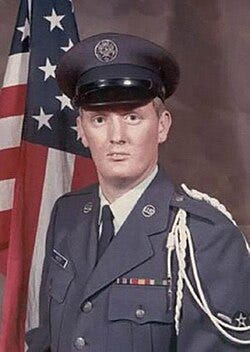
Moody attended San Antonio College and the University of South Alabama, earning his degree in mortuary science in 1981 and becoming a licensed funeral director and embalmer. He worked at funeral homes in Texas and Mississippi, including Coastal Funeral Home & Crematory in Moss Point, Mississippi. This real-world expertise later lent chilling authenticity to his most famous character
Moody’s wrestling journey began in his teens as a ringside photographer. He made his in-ring debut in June 1974 under the masked gimmick “Mr. X,” but soon realized his talents lay in management. In 1979, booker Frankie Cain christened him Percival “Percy” Pringle III—a flamboyant, obnoxious heel manager with blonde hair, loud suits, and a motor-mouth style reminiscent of Bobby Heenan. Friends and colleagues called him “Percy” for the rest of his life.
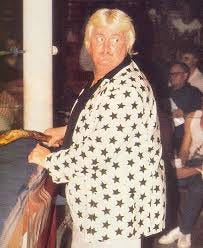
In 1978–1979, Mississippi promoters George Culkin and booker Frankie Cain (the legendary Great Mephisto) gave the young Moody his big break as a last-minute replacement manager. Cain christened him Percival Pringle III — a name that already existed in wrestling lore but was reborn under Moody. The character was an instant hit in southeastern independents: flamboyant, boastful, and relentlessly heelish. Pringle quickly became known for his motor-mouth promos and over-the-top antics.
After the birth of his first son, Moody stepped away from full-time wrestling in the early 1980s to focus on family and complete his degree in mortuary science. He became a licensed funeral director and embalmer — skills that would later define Paul Bearer, but for now they took him out of the ring.
In late 1984/January 1985, Moody returned to wrestling full-time and exploded onto the scene in Championship Wrestling from Florida (CWF). Here he formed the “Pringle Dynasty” — a stable of cocky heels that dominated the Sunshine State. His flagship client was the rising star “Ravishing” Rick Rude, whom Pringle guided to the Florida Heavyweight Championship. He also managed the rookie Lex Luger (who briefly served as Pringle’s bodyguard and wrestled his first professional match under him), the Pretty Young Things tag team, the Missing Link, and others.
Pringle’s Florida run was filled with colorful stories that showcased his personality: ribs with Michael Hayes and the Freebirds, dealing with the aftermath of Eddie Graham’s suicide, and surviving a house fire that nearly killed several wrestlers. His high-pitched voice (already a trademark) and flashy presentation made him a must-see attraction every week.
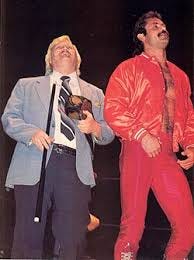
Pictured: Percy Pringle and Rick Rude
In 1985, Pringle and Rude jumped to the nationally syndicated World Class Championship Wrestling (WCCW) in Texas — the promotion that gave Pringle his biggest platform. Booked as WCCW’s direct counterpart to Bobby Heenan (blonde hair, loud suits, and razor-sharp promos), Pringle immediately elevated Rude to the NWA American Heavyweight Championship. When WCCW withdrew from the NWA in February 1986, Rude became the first WCWA World Heavyweight Champion under Pringle’s guidance.
Pringle’s stable in WCCW was stacked with future stars:
Dingo Warrior (the man who would become The Ultimate Warrior) — Pringle managed him until a heated 1986 six-man tag fallout with Buzz Sawyer and Matt Borne turned the Warrior babyface.
Buzz Sawyer & Matt Borne — Pringle led the underrated duo to the WCCW World Tag Team Titles.
Eric Embry — Pringle not only managed him but occasionally teamed with him in tag matches.
Mark Calaway (as the masked Texas Red) — In one of wrestling’s great full-circle moments, Pringle was in Calaway’s corner for his very first professional match on June 26, 1987, at the Dallas Sportatorium against Bruiser Brody.
Other clients included “Stunning” Steve Austin in his early days and occasional appearances with the Missing Link. Pringle’s major feuds revolved around the promotion’s top faces: the Von Erich family, Chris Adams, Iceman King Parsons, and later Devastation Inc. (led by Skandor Akbar).
Beyond managing, Pringle wrote programs for the promotion and ran a fan club — further embedding himself in WCCW’s ecosystem.
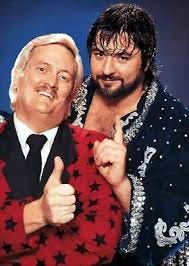
Pictured: Percy Pringle and Eric Embry
In 1989, Pringle shocked fans with a rare face turn. He aligned with Eric Embry against Skandor Akbar’s Devastation Inc. in a memorable angle that included a letter-writing campaign (over 25,000 fan letters) and Pringle dramatically tearing down a WCCW banner in the ring. It was one of the most emotional turns in territory history.
The Pringle years weren’t just a warm-up act — they were where Moody perfected the manager’s craft. He learned how to cut promos that popped crowds, how to protect and elevate talent without overshadowing them, and how to create chemistry with future legends. Rude, Warrior, Luger, Austin, Embry, and especially Mark Calaway all benefited enormously from his guidance. The high-pitched voice that became iconic as Paul Bearer was already a weapon as Percy.
As WCCW wound down and transitioned into the United States Wrestling Association (USWA), Pringle continued working, managing Steve Austin in a high-profile feud with Chris Adams. But by 1990 the territories were collapsing. Financial struggles mounted — Moody’s car was repossessed right before Christmas, and he was on the verge of bankruptcy while working as a funeral director.
In late 1990, facing financial struggles after WCCW’s closure, Moody called his old protégé Rick Rude, then in the WWF. Rude urged him to contact Vince McMahon. On December 22, 1990—his wedding anniversary—Moody flew to Stamford, Connecticut, and signed with the WWF after a meeting in which McMahon laughed at his mortuary science degree. The company had been looking for a manager for the newly debuted Undertaker (Mark Calaway); Moody’s real-life funeral background was the perfect fit. Road Warrior Hawk suggested the name “Paul Bearer” as a play on “pallbearer.”

Bearer debuted on WWF television in January 1991 and quickly became inseparable from The Undertaker. Carrying the urn that supposedly contained the “power” to revive his charge, Bearer’s high-pitched voice, dramatic gestures, and eerie presence elevated the Deadman gimmick from simple monster heel to supernatural phenomenon. He hosted the talk-show segment The Funeral Parlor, where he once locked the Ultimate Warrior in a casket. At Survivor Series 1991, Bearer guided The Undertaker to his first WWF Championship victory over Hulk Hogan.
The duo became one of wrestling’s most iconic pairings. Bearer turned face with The Undertaker in 1992 after stopping Jake Roberts from attacking Randy Savage and Miss Elizabeth. They headlined WrestleMania VIII together, and Bearer remained at ringside through The Undertaker’s 1990s title reigns, feuds with Yokozuna, and the early “Phenom” years.
Bearer turned heel again at SummerSlam 1996, betraying The Undertaker to align with Mankind. He briefly managed The Executioner and Big Van Vader before the company launched one of its most famous long-term storylines: the introduction of Kane.

In 1997 Bearer (kayfabe storyline) revealed he had witnessed The Undertaker set fire to their family funeral home as a youth, killing their parents and (supposedly) his younger brother. Bearer claimed he had hidden the surviving brother, Kane, in a mental institution. Kane debuted at Badd Blood: In Your House 1997, costing The Undertaker a Hell in a Cell match. The angle escalated when Bearer claimed Kane was his biological son from an affair with The Undertaker’s mother. A DNA test on Raw confirmed it. The brothers’ feud defined the late 1990s, culminating in Bearer briefly managing both men before the Ministry of Darkness era and his on-screen retirement after WrestleMania 2000.
From 2000–2002 Bearer worked backstage as a road agent, stage manager, and talent scout until his contract expired.
After leaving WWE, Moody briefly returned to his Percy Pringle III persona in NWA Total Nonstop Action (TNA) in 2002–2003. In October 2003 he re-signed with WWE. The company paid for his gastric-bypass surgery to combat severe obesity. He returned at WrestleMania XX in 2004 to manage The Undertaker against Kane, then endured a brutal kayfabe “burial” in cement at The Great American Bash 2004.
Health issues continued to plague him. He was released from his full-time contract in 2005 but retained a legends deal for appearances and autograph sessions. He made occasional returns: a 2007 house-show reunion with The Brothers of Destruction, a major 2010 run on SmackDown where he turned on The Undertaker to side with Kane again, and a final 2012 appearance in Kane’s feud with Randy Orton.
On the independent circuit in 2010–2012 he managed in smaller promotions, including the Millennium Wrestling Federation. He continued working as a funeral director in Mississippi, occasionally fielding awkward fan requests at the funeral home.
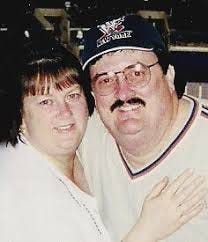
Moody married Dianna Lynne McDoyle on December 22, 1978. They had two sons, Michael and Daniel. Dianna passed away in 2009. Moody spoke movingly about how his real-life experiences with grief—both personally and professionally—deepened his empathy as a funeral director, often referencing Elisabeth Kübler-Ross’s Five Stages of Grief.
On March 5, 2013, Moody died at age 58 from a heart attack while hospitalized in Mobile, Alabama, for complications from a blood clot. His death sent shockwaves through the wrestling world.
On March 3, 2014, WWE announced Paul Bearer’s posthumous induction into the WWE Hall of Fame Class of 2014. Kane delivered the induction speech; Moody’s sons Michael and Daniel accepted on his behalf. The Undertaker appeared in character to pay tribute, creating one of the most emotional moments in Hall of Fame history.
Paul Bearer’s influence endures. He helped define the “New Generation” and Attitude Eras through his storytelling, mic work, and perfect chemistry with The Undertaker and Kane. His real-life mortuary background gave the character an unmatched layer of realism that no scripted gimmick could replicate. More than a manager, he was a storyteller, a mentor to young talent, and a man who lived his two childhood dreams—professional wrestling and funeral service—on his own terms.
One Thing I Learned About Larry Sharpe
In August 1988, while he was already running the Monster Factory and still occasionally wrestling, Sharpe was diagnosed with leukemia. He endured 23 months of brutal chemotherapy that included having a hole the size of a quarter drilled into his skull so doctors could insert a tube and deliver medication directly into his central nervous system. He also went through multiple bone-marrow biopsies and a spinal tap. By the end of the treatment, doctors at Fox Chase Medical Center declared him leukemia-free.
Despite everything, Sharpe kept the Monster Factory doors open the whole time and continued training the next generation of monsters (Bam Bam Bigelow and others were already making noise by then). It’s a raw, rarely-mentioned chapter that shows the kind of toughness the old-school territory guys had — the same guy who once pinned a real wrestling bear in Hawaii and later became one of pro wrestling’s most respected trainers.
Thank You for Reading
I’m Tony Richards, Pro Wrestling Historian, Author and Storyteller. I share pro wrestling historical items in each issue of the Time Tunnel Pro Wrestling History Newsletter. Thanks for reading! If you enjoy my information on select events, matches and insights, please share it with folks you think might like to be a subscriber!
Remember, premium investors get access to exclusive and special content such as some special issues including a multi-part deep dives on wrestling territories, wrestler bios and championship title histories, special audio and video interviews on territory pro wrestling and more available in the Pro Wrestling Time Tunnel for Premium Investors.