



Happy Birthday to those who have passed on and to those great wrestlers still with us:
In Memoriam:
Al Sabath 1916
Les Thornton 1934
Terry Garvin 1937
Happy Birthday:
Joel Deaon\Thunderfoot (69)
Tomas Mendoza\Villano IV (61)
Bianca Crawford\Bianca Belair (37)
RIP Memorial: We stop & remember those who have passed on this day and gave themselves to the business for us, the fans. We salute you and thank you.
Wee Willie Davis 4-9-1981 t the age of 74
Significant Debut:
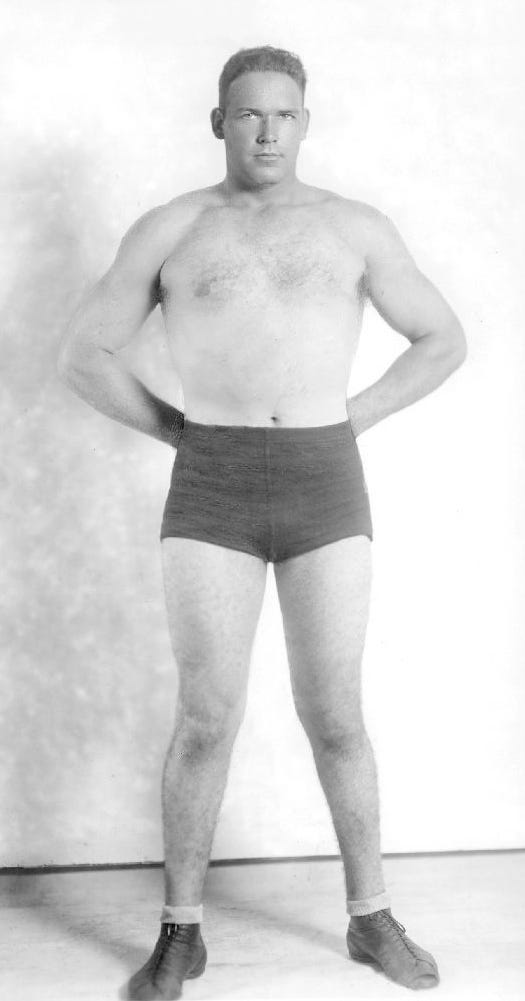
Frank Valois 4-9-1940 at the age of 18
The Life & Career of Bearcat Brown
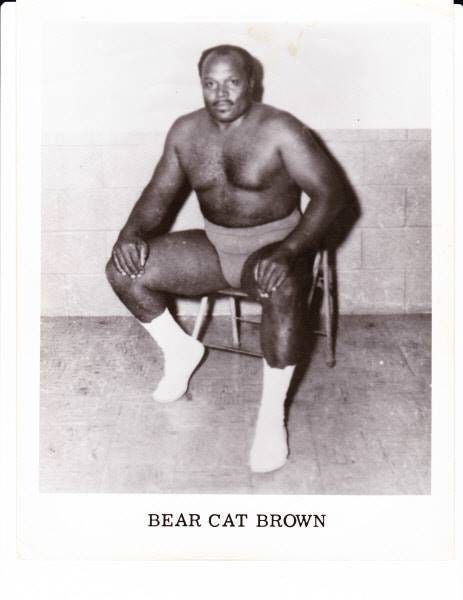
Born on August 31, 1935, in Georgia, Jewel passed away on April 7, 1996, at the age of 60. He stood 245 pounds of powerhouse muscle and wrestled under several monikers—including Fatback Brown and Mystery Man #2—but it was as Bearcat Brown that he etched his name into wrestling history. A trailblazing African-American performer in an era of deep racial segregation, Brown rose to prominence in the NWA Mid-America territory under promoter Nick Gulas. His career, spanning from a 1961 debut to a retirement around 1981, was defined not only by championship success but by his role in breaking color barriers in the Deep South.
Little is publicly documented about Jewel’s pre-wrestling life, reflecting the era’s limited coverage of Black athletes outside the ring. He entered the squared circle in 1961, honing his craft in regional promotions in Kansas City and his home state of Georgia. Like many of his contemporaries, Jewel began as a heel (villain) in some territories before transitioning to a beloved babyface (hero) persona. His early work built the foundation for a style characterized by raw power, brawling, and a signature headbutt—sometimes gimmicked with a “steel plate” in his forehead from a backstory involving a car accident or military service.
By 1966, Jewel arrived in NWA Mid-America, working for Nick Gulas and the Welch brothers in Alabama and surrounding states. This territory, centered on cities like Birmingham and Memphis, was a hotbed of Southern wrestling—but one still grappling with the racial tensions of the Civil Rights era. Black wrestlers were rare in main-event roles, and integrated matches were virtually nonexistent. Jewel’s arrival as a regular performer marked him as one of the territory’s first prominently featured African-American talents.
Bearcat Brown’s career truly ignited in 1969 when he formed a tag team with white wrestler Len Rossi in Birmingham. Their partnership at Boutwell Auditorium became a landmark moment in professional wrestling history—the first regular interracial tag team in the Deep South. In an era when many venues still enforced segregated seating, Brown and Rossi drew massive crowds of both Black and White fans, packing the arena consistently for three straight years.
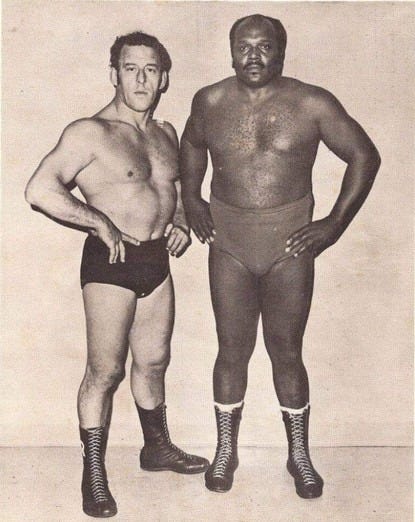
Pictured: Len Rossi and Bearcat Brown
The duo shattered racial boundaries on television and in live events. Rossi, a established star, and Brown’s chemistry as babyfaces resonated deeply. Their matches symbolized progress amid the lingering effects of Jim Crow laws, helping to integrate not just the ring but the audience. As one historical account notes, they were “wildly popular” in Alabama, turning Boutwell into a melting pot where fans united behind the heroes regardless of race.
Their success translated into hardware. Brown and Rossi captured the NWA World Tag Team Championship (Mid-America version) seven times between 1969 and 1972 alone. Overall, Brown held that title 16 times with various partners, including Rossi (7), Les Thatcher (1), Robert Fuller (1), and Mr. Wrestling II (1). They also claimed the NWA Mid-America Tag Team Championship once and the NWA Southern Tag Team Championship 19 times (with Rossi holding it five times alongside Brown). Additional reigns included six NWA Tennessee Tag Team titles and one NWA Brass Knuckles Championship (Southeastern version). In 1970s Memphis and Alabama circuits, Brown even teamed in six-man tags, such as with Jackie Fargo and George Gulas for the NWA Southern 6-Man Tag Team Championship.
As a powerhouse brawler, Brown’s in-ring presence was commanding. Without question, Bearcat Brown’s signature move—and de facto finisher—was the headbutt. Contemporary accounts, match photos, and wrestling historians consistently describe it as his go-to offensive weapon and the move that most often ended bouts.
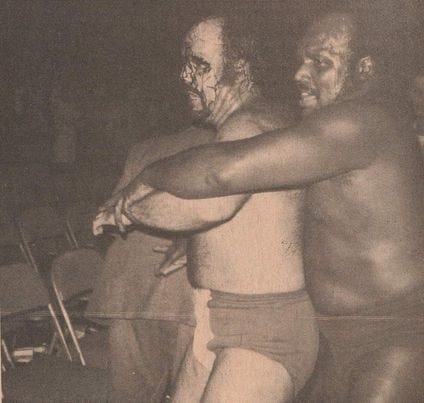
Pictured: Bearcat Brown applies a rear wristlock to a bloody Don Greene
What made Brown’s headbutt special was the elaborate kayfabe gimmick that surrounded it: promoters sold the idea that he had a steel plate surgically implanted in his forehead following a (fictional) car accident or injury. This backstory gave the headbutt an aura of legitimate danger and extra destructive power—fans were told the plate turned his skull into a literal weapon. The gimmick was so well-established that longtime partner Len Rossi later confirmed it was heavily promoted (and sometimes treated as semi-real in interviews).
The move itself was delivered with full commitment: Brown would charge, lower his head, and crash it directly into an opponent’s forehead, chest, or shoulder. It was portrayed as devastating enough to stun even the toughest heels. A perfect example is the now-iconic moment from July 15, 1974, at the Mid-South Coliseum in Memphis. In front of a sold-out overflow crowd of 11,700 fans, Brown unloaded his signature headbutt on Mike Loren; the strike visibly rocked Loren and set up the immediate pinfall. Photos and footage from that night are still shared in wrestling history groups as the definitive visual of Brown’s finishing sequence.
Brown frequently used the headbutt in both singles and tag-team action. In tag matches with Len Rossi, he would “tag in hot,” bouncing on his feet with fists clenched before charging in with the headbutt to turn the tide. Opponents sold it like a sledgehammer, and the move became so associated with him that announcers and fans simply referred to it as “Bearcat’s headbutt” without further explanation.
The repeated use of such a high-impact strike unfortunately contributed to the long-term physical toll common among 1960s–70s wrestlers, but in the moment it was pure theater—crowds erupted every time Brown’s forehead connected.
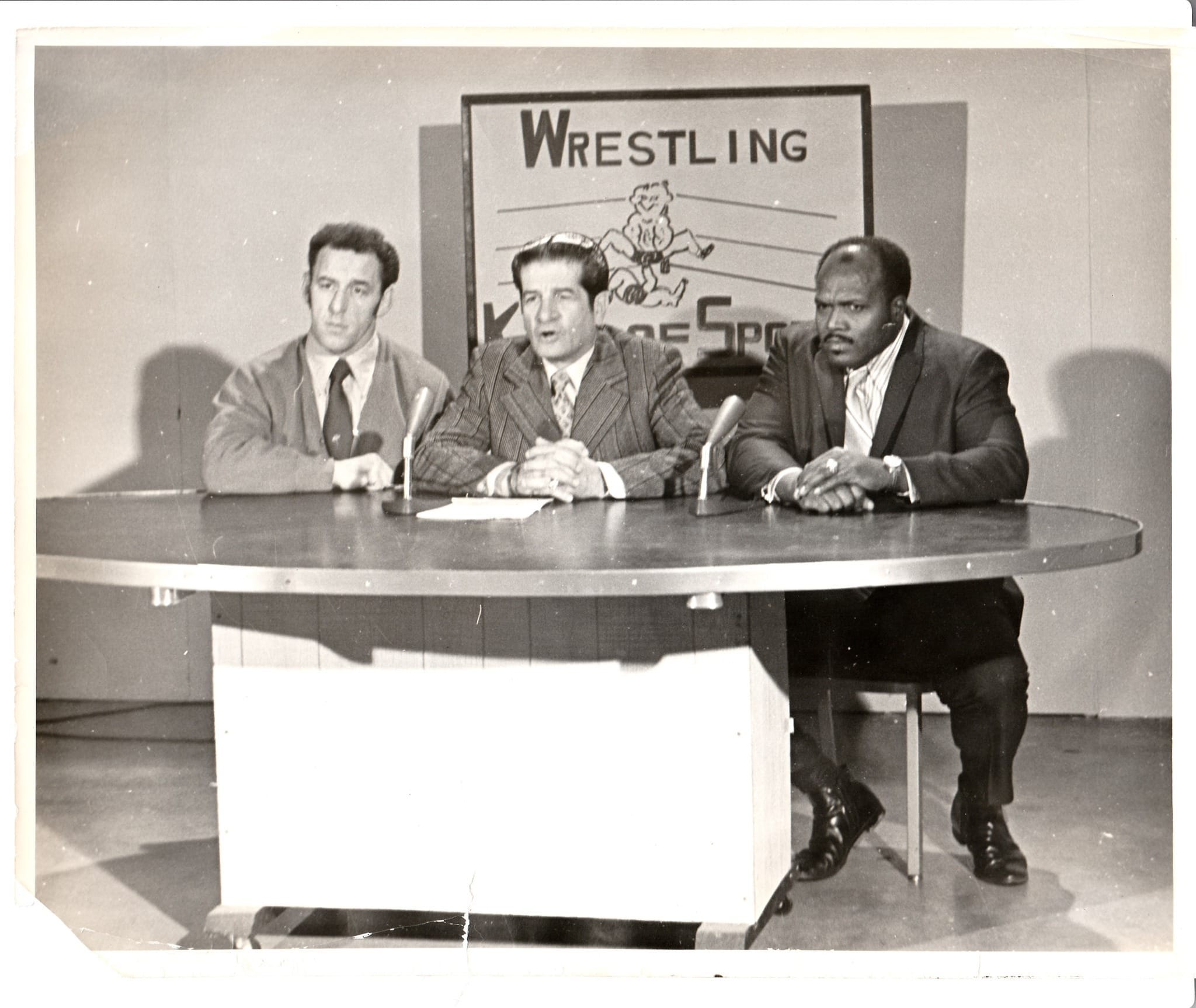
Pictured: Len Rossi, Nick Gulas and Bearcat Brown on the set of Gulas-Welch Championship Wrestling
Unlike modern wrestlers who catalog multiple named headbutt variations (diving, top-rope, running bulldog-style, etc.), Brown’s version was straightforward, brutal, and highly effective within the hard-hitting NWA Mid-America and Memphis style of the late 1960s–1970s. There were no flashy setups or aerial twists. Instead, the “variations” came from context, timing, setup, and psychology—how and when he deployed the move to maximum crowd-popping effect. Surviving match descriptions, photos, and fan recollections paint a clear picture of a move that was simple in execution but versatile in application.
1. The Core Steel-Plate Headbutt (Standard/Finisher Version)This was the default version—the one most associated with Brown and the one that usually ended matches.
Execution: Brown would square up, often after absorbing punishment or “firing up” the crowd with clenched fists and bouncing on his toes. He’d lower his head like a charging bull and crash it forward directly into the opponent’s forehead, chest, or upper body. The strike was sold as a sledgehammer blow that could stun or flatten even the toughest heels.
Finish: It frequently led straight to a pinfall. The most iconic surviving visual is from July 15, 1974, at the Mid-South Coliseum in Memphis. In front of a sold-out overflow crowd of 11,700 fans, Brown prepares to land the headbutt on Mike Loren; the photo captures him mid-motion, and historical accounts note the move immediately preceded the three-count.
Psychology: The steel-plate gimmick made every headbutt feel like it carried extra risk. Opponents would sell it by staggering backward, clutching their heads, or collapsing dramatically. Announcers emphasized that “no one could withstand Bearcat’s steel plate!”
This version was pure babyface heroism—simple, believable violence that fit the blue-collar Southern wrestling crowds.
The Charging / Running Headbutt (Momentum-Based Variation) Brown occasionally added forward motion for extra impact, especially when turning the tide in a match.
Execution: Instead of a stationary crash, he’d take a short run or lunge across the ring, building speed before lowering his head for the collision. This created a visual “explosion” on contact and looked more devastating from ringside.
When used: Often as a comeback spot after being dominated, or to cut off a heel’s momentum. The 1974 Loren photo and several tag-match descriptions imply this charging style was common when Brown “unloaded” on an opponent.
Effect: The added velocity made the move feel unstoppable, amplifying the steel-plate myth. Fans loved the visual of Brown barreling forward like a freight train.
This variation was never given a special name (no “Bearcat Charge” or similar), but it was a natural evolution of his brawler style and appeared frequently in both singles and tag bouts.
The Hot-Tag Flurry / Multiple Headbutts (Tag-Team Comeback Version) In his legendary interracial tag team with Len Rossi (and later Joey Rossi), Brown’s headbutt became a high-energy sequence rather than a one-off strike.
Execution: When tagged in “hot,” Brown would bounce excitedly on the apron with fists clenched (a signature mannerism), explode into the ring, and unload a rapid series of headbutts on one or both opponents. He might deliver two, three, or more in quick succession, staggering the heels and setting up the legal man for a tag or pin.
Classic example: Surviving footage from a 1970s Memphis match against Kent & Gallagher shows Brown “unloading” the headbutt on Chris Gallagher, with the commentator highlighting the move as the turning point. The flurry often forced the opposing team to scramble and created chaos that played perfectly to integrated crowds.
Psychology: This version turned the headbutt into a momentum-shifting weapon for tag psychology. It symbolized Brown’s resilience and power, especially powerful in an era when his presence as a Black babyface in the Deep South carried extra meaning.
The Psychological Threat (The “Tease” Variation) One of the more subtle but effective uses of the move was simply threatening it.
Execution: Brown would stalk an opponent, lower his head slightly, and pause—letting the crowd roar in anticipation. Sometimes he’d feint the headbutt, causing the heel to flinch or backpedal.
Effect: As noted in Birmingham wrestling histories, “Brown often finished opponents with a head-butt, or just the threat of it.” The steel-plate gimmick made the mere suggestion of the move enough to sell vulnerability. This was classic territorial psychology: the move became larger than life even when not fully delivered.
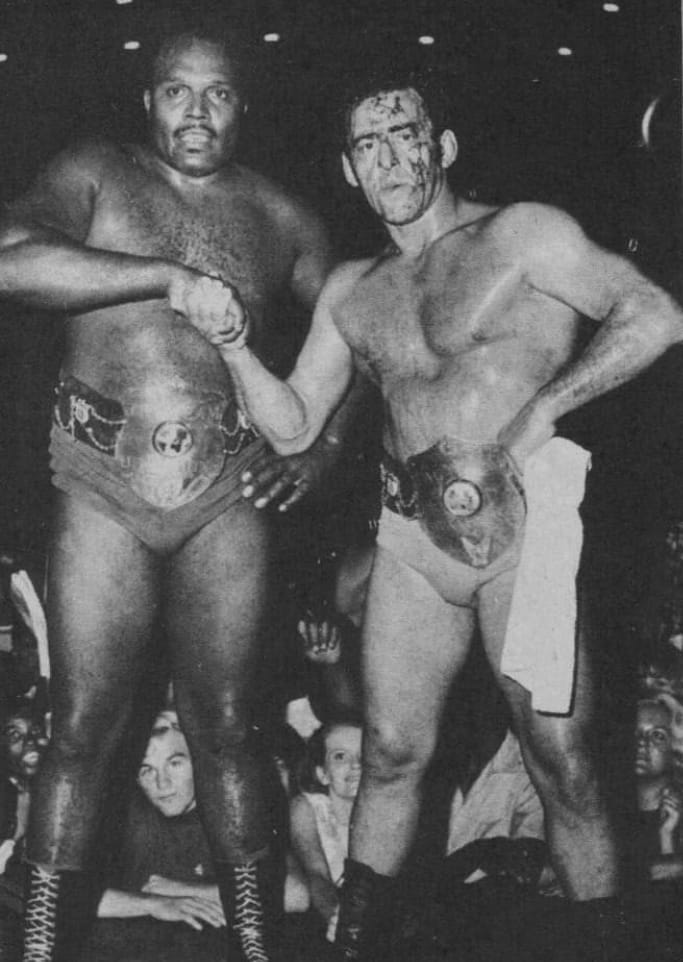
Pictured: NWA World Tag Team Champions (Tennessee version) Bearcat Brown and Len Rossi
Bearcat Brown’s era and style explain the limited menu. Southern territorial wrestling prized believability and toughness over athletic flash. A simple, repeated headbutt—sold as uniquely lethal because of the steel plate—fit his powerhouse babyface persona perfectly. He wasn’t a high-flyer or chain wrestler; he was the guy who could trade bombs with anyone and win on raw power and heart. The move’s effectiveness came from repetition and storytelling, not from a dozen different setups.
In footage and photos that survive, the headbutt is always portrayed as the same devastating strike, just deployed in different match contexts. No records mention Brown using diving headbutts from the top rope, corner headbutts as a setup, or any exotic modifications. It was raw, direct, and unmistakable.
Today, when wrestling historians and Memphis/Birmingham fans recall Bearcat Brown, the steel-plate headbutt is the first image that comes to mind. But, Brown’s style wasn’t limited to just one move or the variations of that one move. As a pure brawler, he relied on:
Stiff forearm smashes and punches — short, clubbing blows that looked and sounded punishing.
Body slams and shoulder tackles — basic but effective power moves that emphasized his size and strength.
The “Drop Over Leg Lock” — a submission hold he used effectively in certain matches (notably referenced in surviving 1970s Memphis footage against teams like Kent & Gallagher). It functioned as a grinding leg-based hold that wore down opponents and gave him a credible way to control the ring when the headbutt wasn’t the immediate finish.
He rarely ventured into technical chain wrestling, dropkicks, or aerial maneuvers—those were left to more agile partners like Rossi or later teammates. Instead, Brown’s presence was all about intimidation through sheer physicality. His entrance (jumping up and down with clenched fists when tagged in) and the constant threat of the steel-plate headbutt created a larger-than-life persona that fans loved.
Bearcat Brown’s straightforward, power-based style was perfectly suited to the interracial tag-team revolution he helped spark with Len Rossi. In an era of deep racial tension, a flashy technician might have been dismissed; a no-frills brawler who could trade headbutts and punches with anyone projected strength, resilience, and equality inside the ring. The headbutt became a symbol of his unbreakable toughness—something audiences of both races could cheer without reservation.
Today, Bearcat Brown is remembered first as a pioneer who integrated Southern wrestling. But for those who saw him live or have studied the surviving footage and photos, his steel-plate headbutt stands as one of the most visually striking and memorable signature moves of the territorial era. In a time before scripted “finishing moves” had flashy names or elaborate setups, Brown’s headbutt was simple, brutal, and effective—just like the man himself.
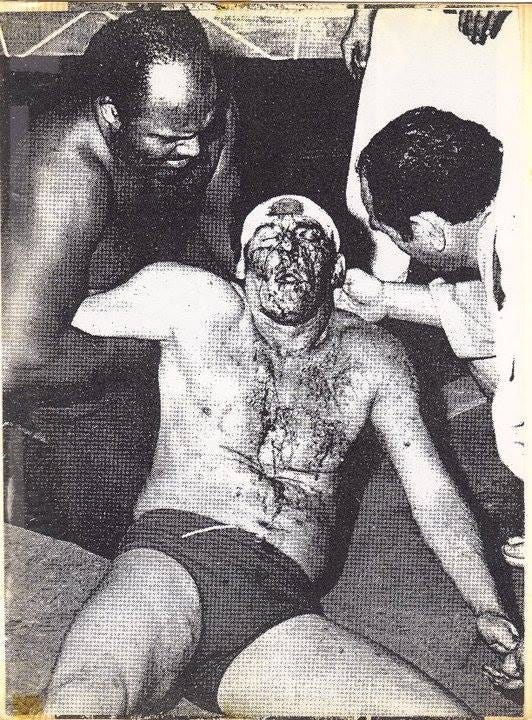
Pictured: Bearcat Brown checks on his bloody and bandaged partner, Len Rossi
After Rossi’s retirement in 1972 following a serious car accident, Brown continued teaming with Rossi’s son, Joey, maintaining the family legacy and the integrated appeal. By the mid-1970s, Brown had become a fixture in the region, occasionally using the “Fatback Brown” gimmick in certain markets.
In 1977, he shifted north to Tennessee, joining the Continental Wrestling Association (CWA) under Jerry Jarrett. Archival records show him competing in Memphis and Louisville shows in 1978, often in tag matches alongside emerging talents like Koko Ware and Doug Gilbert. These later bouts kept him active into his 40s, though the grueling road schedule of territorial wrestling eventually took its toll. Brown’s final in-ring appearances are noted around 1979–1981, after which he stepped away from the spotlight.
Bearcat Brown’s impact extended far beyond title reigns. He was a pioneer who proved that talent and charisma could transcend racial divides in one of America’s most segregated sports regions. His work with Rossi helped pave the way for future generations of Black wrestlers in the South, influencing the more diverse rosters that emerged in the 1980s and beyond. Wrestling historians remember him as a “super guy” who worked hard and carried himself with professionalism, even when racial tensions made every match a statement.
Jewel passed away quietly on April 7, 1996. While mainstream wrestling media gave him limited coverage at the time, modern retrospectives—especially in Memphis and Alabama wrestling circles—honor him as a barrier-breaker alongside figures like Len Rossi (who died in 2020 and often credited their partnership with integrating Southern wrestling).
Today, Bearcat Brown stands as a reminder of wrestling’s complex social history. In an industry that has produced larger-than-life icons, his quiet courage in the face of systemic racism remains one of its most enduring legacies.
One Thing I Learned Today About Les Thornton
He played professional rugby for about 12 years, boxed while serving in the British Navy (stationed in Korea), and dabbled in amateur wrestling at the local YMCA. That athletic base—strength, toughness, and grappling instincts—made him a perfect candidate for the Snake Pit’s unforgiving style.
The gym turned Thornton into a master technician nicknamed “The Man of 1,000 Holds.” His pro style was rooted in that mat-based, submission-heavy approach: stiff forearm uppercuts, over-the-knee backbreakers, suplexes, and an endless arsenal of holds that made him a nightmare in junior heavyweight divisions.

Thank You for Reading
I’m Tony Richards, Pro Wrestling Historian, Author and Storyteller. I share pro wrestling historical items in each issue of the Time Tunnel Pro Wrestling History Newsletter. Thanks for reading! If you enjoy my information on select events, matches and insights, please share it with folks you think might like to be a subscriber!
Remember, premium investors get access to exclusive and special content such as some special issues including a multi-part deep dives on wrestling territories, wrestler bios and championship title histories, special audio and video interviews on territory pro wrestling and more available in the Pro Wrestling Time Tunnel for Premium Investors.