


Happy Birthday to those who have passed on and to those great wrestlers still with us:
In Memoriam:
Gust Karras 1902
Bobby Becker 1918
John Tolos 1931
Mike Loren 1937
Sika Anoa’i 1945
Happy Birthday:
Diamond Dallas Page (70)
Thomas Mendoza\Villano VI (61)
Ashley Fliehr\Charlotte Flair (40)
Dominik Mysterio (29)
RIP Memorial: We stop & remember those who have passed on this day and gave themselves to the business for us, the fans. We salute you and thank you.
Ruffy Silverstein 4-5-1980 at the age of 66
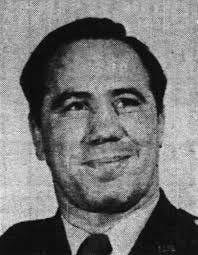
Al Smith 4-5-1986 at the age of 71

Sara Lee 4-5-2008 at the age of 76

Steve Rickard 4-5-2015 at the age of 85

50 Year Flashback
Q2 April-June Territory Analysis
Kansas City Office, Central States Territory
n the spring of 1976, NWA Central States Wrestling—operating under the banner of Heart of America Sports Attractions out of Kansas City, Missouri—embodied the classic territorial model of the National Wrestling Alliance. Promoted primarily by Bob Geigel (a wrestler-promoter who doubled as an on-screen authority figure), the territory ran weekly television out of Kansas City’s Memorial Hall and a circuit of house shows across Missouri, Kansas, and Iowa arenas such as the Memorial Coliseum in Cedar Rapids, the McElroy Auditorium in Waterloo, and smaller venues in Topeka, Wichita, Emporia, and St. Joseph. The roster mixed veteran Midwest heels, local babyfaces, Japanese imports, and occasional big-name tourists. The product was blue-collar and physical: chain matches, pole battle royals, lumberjack bouts, and double-DQ finishes were staples designed to generate heat on live cards rather than relying on national television exposure.
The three-month window of April through June 1976 was dominated by one central storyline: the volatile, back-and-forth rivalry between babyface Mike George and heel “Bulldog” Bob Brown for the NWA Central States Heavyweight Championship. This feud drove the bulk of the territory’s main-event booking and exemplified the rapid title turnover that kept fans returning in a pre-cable era when word-of-mouth and weekly TV interviews built anticipation for rematches.

Pictured: Mike George, NWA Central States Heavyweight Champion
Entering April, Mike George, a solid, athletic Kansas City-area favorite, was the champion. On April 10 in Wichita, Kansas, Brown—already a six-time titleholder and the territory’s most reliable draw as a bullying, rule-breaking veteran—defeated George to claim his sixth reign. One week later, April 17, also in Wichita, George regained the belt in a quick turnaround that signaled the promoters’ intent to keep the championship “hot” and the feud alive rather than letting one man dominate.
Road shows that month reinforced the program. On April 25 at Cedar Rapids’ Memorial Coliseum, George won a pole battle royal and then defeated Ed Wiskowski in the main event. Undercard tags featured Ronnie Etchison & Akio Sato over Otto Von Heller & Mike York, while Tank Patton drew Omar Atlas—standard mid-card mixers that gave the audience blood-and-guts action without overexposing the title.

Pictured: Bulldog Bob Brown
By May the Brown-George program had escalated. On May 18 in Topeka, Kansas, Brown recaptured the title for the seventh time, beginning a reign that would last into July. The feud continued with stipulation matches to sell tickets. May 5 in Emporia featured an 8-man pole battle royal ($500 base prize, $1,000 on the pole) with George vs. Wiskoski, Sato vs. Brown, Ray Candy vs. Patton, and Atlas vs. York—classic territory booking that combined money angles with the ongoing title chase.
May 8 in Waterloo saw George defeat Brown in a non-title bout, keeping the rivalry alive. May 12 in Des Moines ran a chain match between Brown and George, plus tags with Jim Brunzell/Chris Taylor vs. Baron Von Raschke/Wiskoski and lumberjack rules for Mike York vs. Ray Candy. May 16 in Cedar Rapids brought a rare big-name boost: Andre the Giant defeated Wiskoski in the semi-main, while George & Chris Taylor teamed with Pat O’Connor to beat Brown & Patton. May 30 again in Cedar Rapids had George over Wiskoski and Sato over Great Seki, with Brown & Super Intern defeating Candy Man & O’Connor—setting up tag-team storylines.
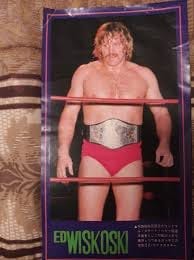
Pictured: Ed Wiskowski
hese cards illustrate the territory’s efficient use of a small roster. Brown and George anchored the top, Wiskoski and Atlas provided credible mid-card threats, Sato and Seki added exotic heat as Japanese heels, and Geigel occasionally inserted himself or his allies (like Sato) into tags to maintain promoter credibility.
June continued the pattern while planting seeds for future angles. On June 6 in Cedar Rapids, Brown (now champion) and George went to a double disqualification in the main event; contemporary reports and title histories treat this as the effective handoff back to Brown’s control. June 12 in Waterloo (a sparsely attended show of roughly 500 fans) saw George defeat Brown again, Harley Race score a DQ win over Super Intern, and Ronnie Etchison over Patton—indicating Race was already being positioned as the next major player.
Tag-team business heated up. On June 19 in St. Joseph, Missouri, Tank Patton & Super Intern defeated Akio Sato & Pat O’Connor to win the NWA World Tag Team Championship (Central States version), giving the division fresh blood after earlier vacancies and short Geigel/Sato runs. June 20 in Cedar Rapids featured Brown & Super Intern over George & O’Connor, with women’s action (Jean Antone d. Sylvia Hackney) and Sato over John Foley. June 26 in Waterloo had Race pinning Brown (non-title), further teasing Race’s impending heavyweight run, plus Etchison over Seki and Antone over Hackney.
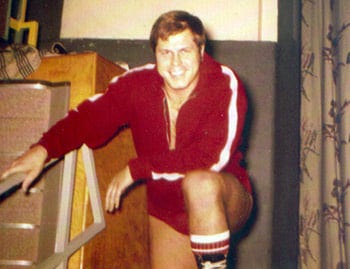
Pictured: NWA Central States Heavyweight Champion Mike George
Concrete attendance and gate figures for Central States in this era are scarce—territories rarely publicized numbers and reporting was limited. The only documented figure located is the June 12 Waterloo card at 500 fans, a modest turnout even for a small-market arena and suggestive of the territory’s mid-tier status. Larger Kansas City Thursday night shows at Memorial Hall typically drew 1,000–2,000 in the 1970s, but no exact April–June 1976 gates survive in public records. The reliance on pole-money angles and frequent title changes points to a promotion working hard to manufacture excitement without blockbuster touring stars every week.
Spring 1976 in Central States was textbook territorial wrestling at its most functional. The rapid George-Brown title flips (three changes in roughly six weeks) prevented staleness and gave TV interviews endless fodder: Brown would cut promos on George’s “softness,” George would vow revenge, and the next card would deliver another bloody war. Gimmick matches—chains, poles, lumberjacks—served dual purposes: they protected wrestlers from clean jobbing while giving fans perceived value (“something extra”). Japanese talent like Sato and Seki added international flavor without the expense of full-time gaijin pushes. Touring names like Andre and to a certain extent, Race provided occasional spikes without overshadowing the homegrown main event.
Structurally, the territory was healthy but not booming. It functioned as a developmental or veteran holding ground: Race used it as a home base en route to his eventual NWA World Title push; younger or transitional talents like Wiskoski and Etchison paid dues; Brown remained the anchor heel who could lose the title without losing heat. The lack of major business data reflects the era—Central States never rivaled the crowds of St. Louis or the WWWF, but it sustained itself on loyal regional fans who valued physical, story-driven matches over spectacle.
In retrospect, April–June 1976 captures the territory on the cusp of change. Brown’s seventh reign set up Harley Race’s July 8 victory in Kansas City, which in turn positioned Race for bigger national opportunities. The George-Brown program, with its quick flips and stipulation-heavy road shows, kept the engine running through a quiet spring. It was not flashy, but it was effective: a microcosm of how the NWA territories survived—week after week, town after town, one heated feud at a time.
Thank You for Reading
I’m Tony Richards, Pro Wrestling Historian, Author and Storyteller. I share pro wrestling historical items in each issue of the Time Tunnel Pro Wrestling History Newsletter. Thanks for reading! If you enjoy my information on select events, matches and insights, please share it with folks you think might like to be a subscriber!
Remember, premium investors get access to exclusive and special content such as some special issues including a multi-part deep dives on wrestling territories, wrestler bios and championship title histories, special audio and video interviews on territory pro wrestling and more available in the Pro Wrestling Time Tunnel for Premium Investors.