


Happy Birthday to those who have passed on and to those great wrestlers still with us:
In Memoriam:
Jack Johnson 1878
Jim Browning 1903
Emil Dusek 1905
Larry Hamilton\The Missouri Mauler 1931
Rich Landrum 1946
Happy Birthday:
Noya Ogawa (58)
Allison Danger (49)
RIP Memorial: We stop & remember those who have passed on this day and gave themselves to the business for us, the fans. We salute you and thank you.
(none)
The Life and Career of Jerry Miller
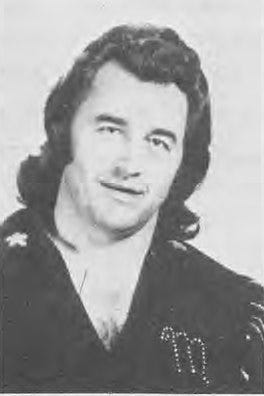
Jerry Miller, better known to wrestling fans as “The Duke” or Duke Miller, was a reliable and versatile performer who thrived in the territorial era of professional wrestling. Born on March 30, 1928, in Waterloo, Iowa, Miller stood 6’1” and weighed approximately 238 pounds during his prime. He possessed the classic heavyweight build of the post-World War II era—strong, agile, and capable of both technical wrestling and rugged brawling. Though he never achieved national superstardom, that was never the goal in the era of Miller’s career, instead achieved the goal of wrestlers at the time, he became a fixture across North America’s independent territories, earning respect as a solid mid-carder, tag-team specialist, and occasional main-event heel.
Like many of his generation, he entered the squared circle during the 1950s wrestling boom, when the sport transitioned from carnival attractions to television-friendly entertainment. Billed at times from Illinois to suit local storylines, Miller quickly adapted to the demanding road schedule of the era. He worked under several ring names, including Mighty Yankee #2, Challenger #2, Jerry Hannigan, and simply “Duke.” His most enduring persona was “Duke Miller,” complete with a regal goatee and, by the early 1970s, a prominent mullet that predated the hairstyle’s popularity in the late ’70s and early ’80s.

Miller’s career spanned more than two decades and took him through some of the most important promotions of the time. He competed in the American Wrestling Association (AWA) in the Midwest, National Wrestling Alliance (NWA) affiliates across the South and Mid-America, the World Wide Wrestling Federation (WWWF), Championship Wrestling from Florida (CWF), Gulf Coast Championship Wrestling, Pacific Northwest Wrestling, and others. The constant travel—driving hundreds of miles between towns for nightly shows—was typical of the territorial system, and Miller embraced it, becoming a trusted “worker” who could make opponents look strong while drawing heat as a heel.
One of Miller’s greatest strengths was tag-team wrestling. He captured the AWA Midwest Tag Team Championship twice, both times partnering with Johnny Valentine Jr. In NWA Mid-America territory, he formed the Mighty Yankees with Mighty Yankee #1, winning the NWA Southern Tag Team Championship twice and the NWA Tennessee Tag Team Championship twice. He also held the NWA Gulf Coast Tag Team Championship on two occasions (once with The Wrestling Pro and once with Mighty Yankee #1) and the WP Western States Tag Team Championship with Tito Montez. These partnerships highlighted his ability to build chemistry quickly in short-term bookings.
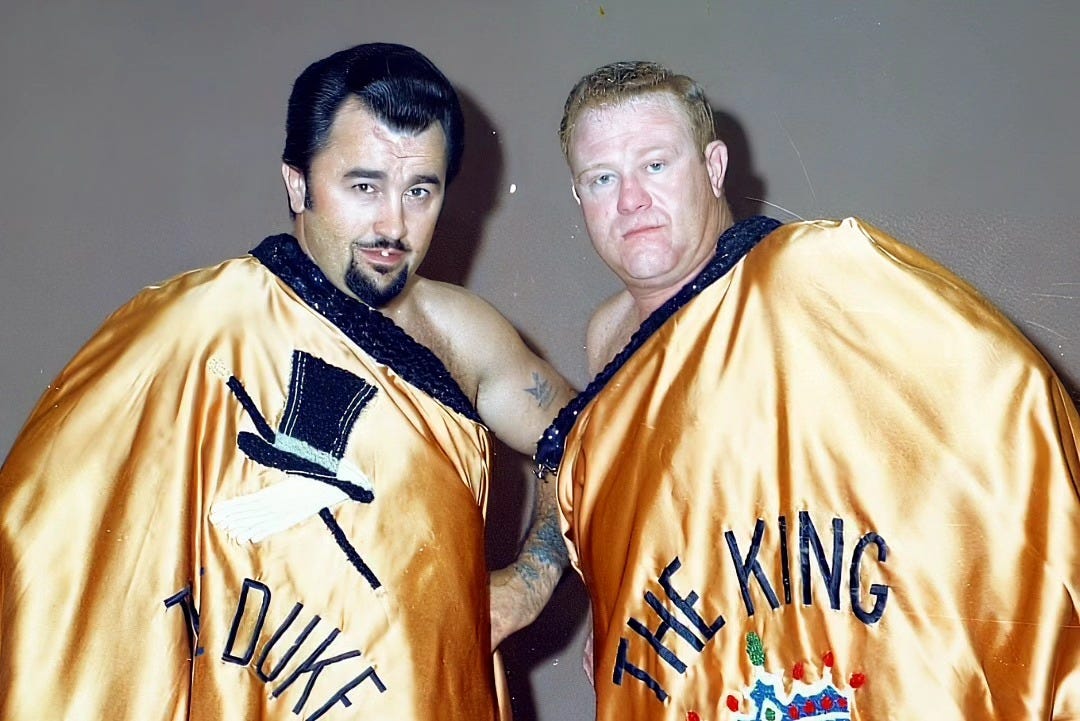
Pictured: The Duke and The King, Jerry Miller and Jim Osbourne in LeRoy McGuirk’s NWA Tri-States Wrestling in 1969
In 1969, within the NWA Tri-States territory (spanning Louisiana, Arkansas, and Oklahoma), the tag team of Jerry “The Duke” Miller and Jim “The King” Osborne—billed as The Duke & The King—emerged as a notable duo with an aristocratic gimmick. They captured the NWA Louisiana Tag Team Championship on May 4 in Baton Rouge by defeating Frank Dalton and Danny Little Bear, though their reign was brief and the titles were vacated shortly thereafter in June for unknown reasons. Prior to the win, the pair competed regularly in Shreveport and Oklahoma City, including losses to teams like Matty Suzuki & Sputnik Monroe and victories over opponents such as Gorgeous George Jr. & Tarzan Baxter Lorenzo. Jim Osborne had earlier worked the territory as midcarder “Red” Osborne and would later return masked as Dr. X (after his Double XX stint in the AWA), while Jerry Miller continued as a versatile singles and tag performer; together, they added color to Tri-States’ competitive tag scene during the late 1960s.
In singles competition, Miller was equally accomplished in regional circuits. He won the NWA Alabama Championship three times and the NWA City of Mobile Championship. His most notable singles success came in Gulf Coast Championship Wrestling, where he held the NWA Gulf Coast Heavyweight Championship a remarkable five times between the early 1970s and 1976. One of his most memorable victories occurred on February 12, 1974, in Mobile, Alabama. In a title-versus-hair match against the Mysterious Medic, Miller put his signature mullet on the line. When the Medic refused to release a Boston Crab after Miller reached the ropes, the referee disqualified the challenger, awarding Miller both the win and the retention of his hair. The feud with the Medic continued through tag and non-title bouts, cementing Miller’s status as a top heel in the territory.
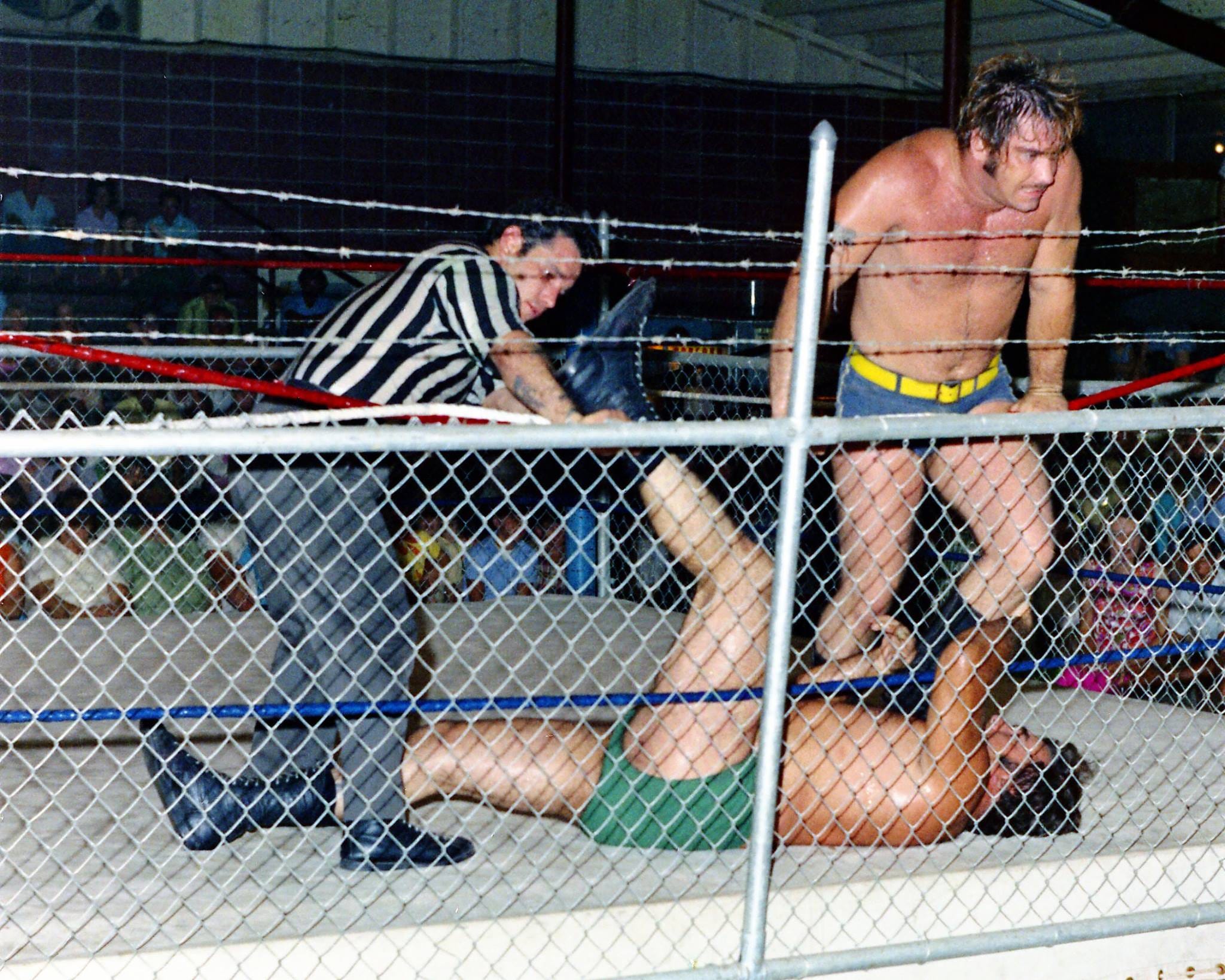
Pictured: Frank Dalton puts a foot on the throat of Jerry Miller in a barbed wire cage match in Louisiana
*Photo published by permission of Chris Swisher of CS Classic Photos, all rights reserved
Miller also engaged in high-profile rivalries that tested his credibility against legitimate tough guys. He feuded with NWA World Junior Heavyweight Champion Danny Hodge in the McGuirk territory (Oklahoma and surrounding areas), a series that showcased Miller’s willingness to work stiff and sell for established stars. Other notable opponents included Mike Boyette, Ken Lucas, and various regional veterans. Though he was never a world champion, Miller’s ability to elevate younger talent and draw consistent crowds in secondary markets made him valuable to promoters.
Miller and Frank Dalton lit up the Gulf Coast and Tri-State territories with a hard-hitting feud centered on the NWA Louisiana Heavyweight Championship that continued from 1969 through 1972. Their rivalry featured a string of intense matches in Baton Rouge and other Louisiana towns that frequently ended in draws or double countouts, as neither man could gain a decisive edge despite their toughness and no-nonsense styles. Tensions boiled over to the point that booker Bill Watts booked a brutal barbed-wire cage match as the ultimate feud-ender, locking the two inside a steel enclosure wrapped in razor-sharp wire with no escape and no interference allowed. The blood-soaked showdown became a memorable example of the raw, grudge-match violence that defined Southern wrestling during that era.
A rare audio interview from fall 1976, conducted while Miller was working in CWF, survives as one of the few personal glimpses into his thoughts. In it, he reflected on his experiences in the business shortly before his career ended. Tragically, Miller’s life was cut short on November 21, 1976. While driving in Florida as part of his CWF schedule, he died in an automobile accident at the age of 48. His death was one of many premature losses in wrestling during that era, underscoring the physical and logistical dangers of the road-warrior lifestyle.
There are no publicly available detailed accounts of the exact circumstances surrounding Jerry “Duke” Miller’s fatal accident beyond the basic facts. No newspaper stories, obituaries, accident reports, death notices, or wrestling publications from 1976 appear to have provided or preserved specifics. The only thing we have about his accident is a small blurb that ran a day or two after the accident is various newspapers in Florida cities.
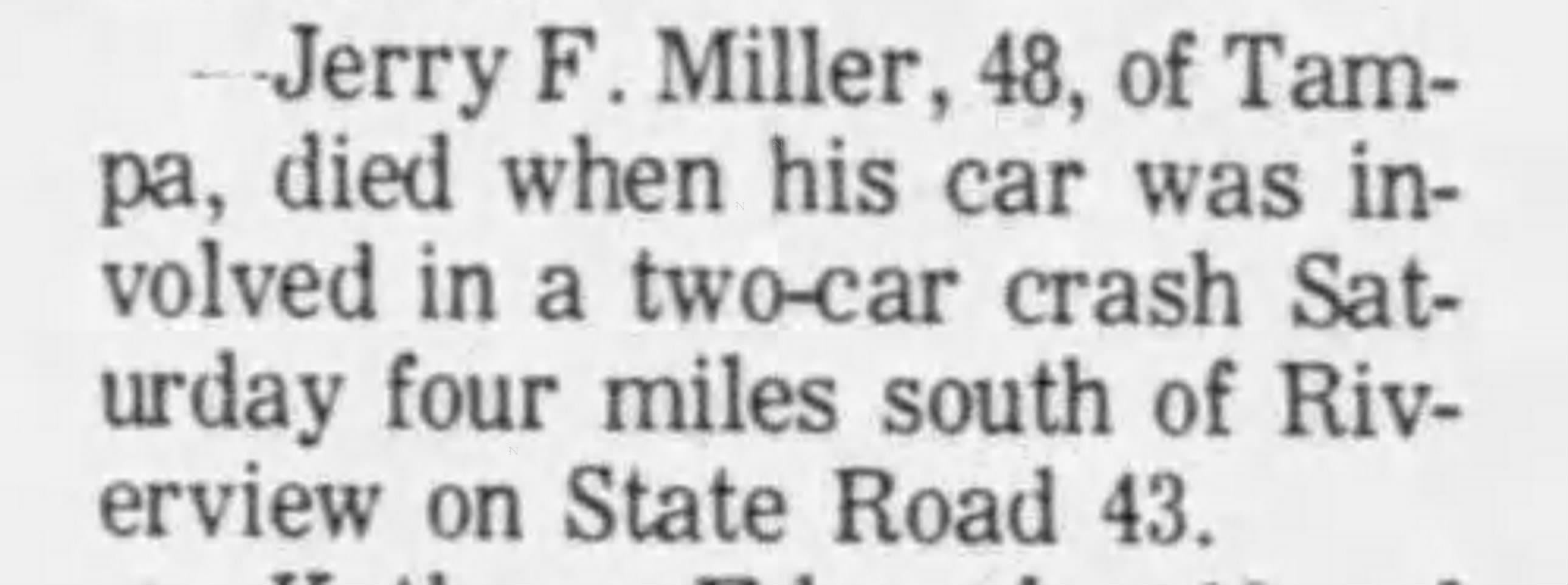
Pictured: November 22nd, 1976 mention in the St. Augustine Record in St. Augustine, Florida
This scarcity of information is typical for many territorial-era wrestlers in the 1970s. Unlike today’s wrestling deaths, which often receive immediate coverage and investigations, road accidents involving mid-card performers in smaller promotions were frequently noted only in passing within the industry. Miller’s death is occasionally listed alongside other premature wrestling fatalities of the era, but always with the same one-sentence summary.
Jerry “Duke” Miller’s legacy endures among wrestling fans of the territorial period and some modern fans who desire to know about the wrestlers who helped entertain fans during these times. He was never a household name, but his résumé—multiple tag and singles titles across diverse regions, memorable gimmicks, and consistent professionalism—illustrates the backbone of the industry before national expansion. In an age when wrestlers often remained unknown outside their local markets, Miller left an impression through hard work, adaptability, and memorable feuds that entertained crowds from the Midwest heartland to the humid Gulf Coast.
One Thing I Learned About Rich Landrum
He was already a local TV personality in Richmond, Virginia (working at WXEX-TV), and in the early 1970s a friend dragged him to a live wrestling card at the State Fairgrounds just to get in free using Landrum’s TV credentials. About 20 minutes before the first match, promoter Joe Murnick realized the regular ring announcer had no-showed. Spotting Landrum in the crowd, Murnick offered him $10 cash on the spot to fill in. Landrum jumped in, did a solid job with his broadcast voice, and was immediately asked back the next week—eventually becoming the regular ring announcer for Richmond-area Crockett shows for years before landing the TV hosting gig on World Wide Wrestling.
Landrum hosted World Wide Wrestling from October 1978 until early 1982.
Thank You for Reading
I’m Tony Richards, Pro Wrestling Historian, Author and Storyteller. I share pro wrestling historical items in each issue of the Time Tunnel Pro Wrestling History Newsletter. Thanks for reading! If you enjoy my information on select events, matches and insights, please share it with folks you think might like to be a subscriber!
Remember, premium investors get access to exclusive and special content such as some special issues including a multi-part deep dives on wrestling territories, wrestler bios and championship title histories, special audio and video interviews on territory pro wrestling and more available in the Pro Wrestling Time Tunnel for Premium Investors.