


Happy Birthday to those who have passed on and to those great wrestlers still with us:
In Memoriam:
Conrad Efraim\SD Jones 1945
Jerry Miller 1928
Happy Birthday:
Ron Garvin (81)
Mike Rotunda (68)
RIP Memorial: We stop & remember those who have passed on this day and gave themselves to the business for us, the fans. We salute you and thank you.
Jack Welch 3-30-1986 at the age of 80
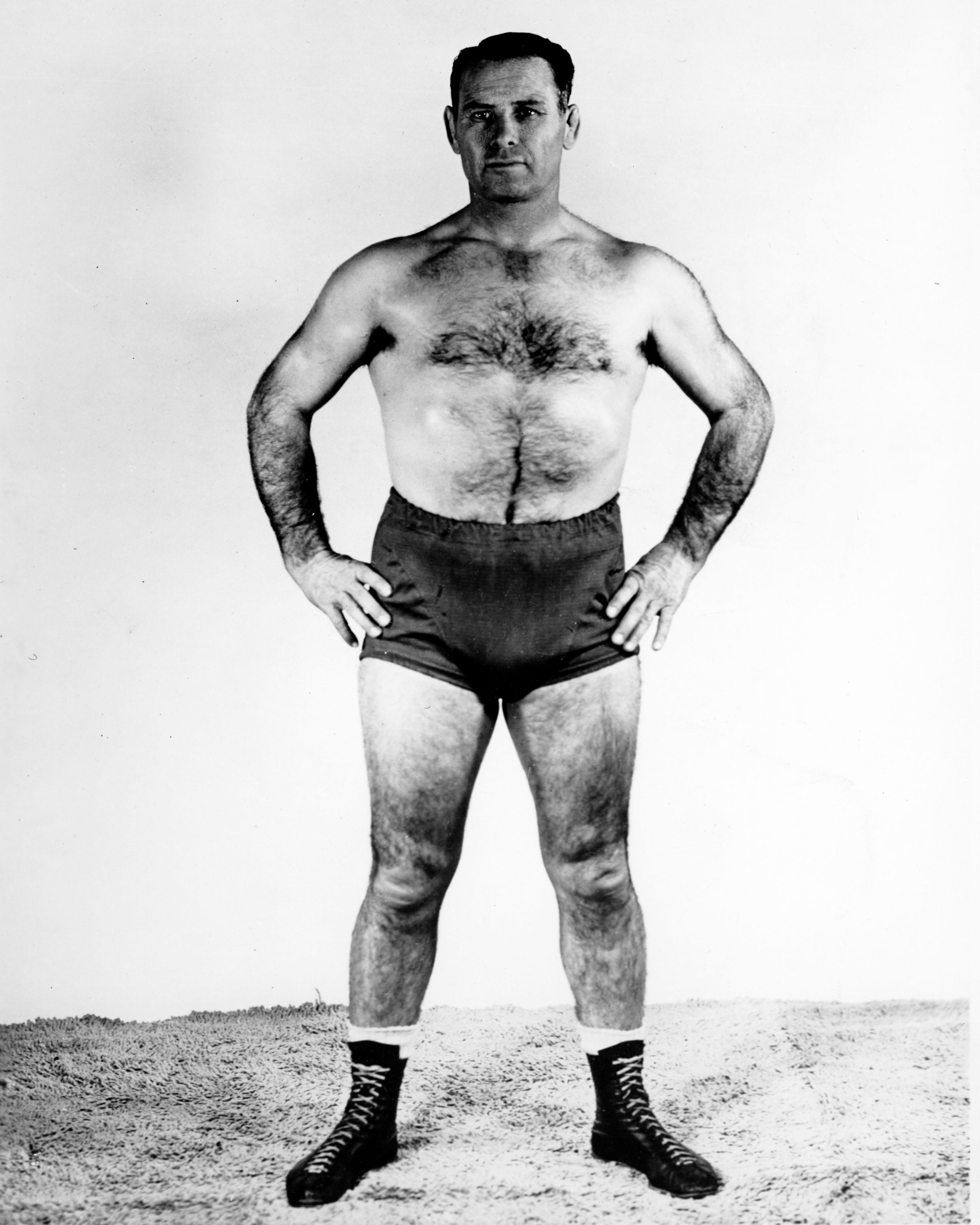
Stu Gibson 3-30-1988 at the age of 62
40 Year Flashback
March 1986: The Month In Pro Wrestling
Stage of the Territory Era: Disintegration
The month of March 1986 stands as a pivotal microcosm of the professional wrestling landscape during the very late stages of the Territory Era. By this point, Vince McMahon’s WWF had fully nationalized through aggressive syndication, cable television expansion, and star power centered on Hulk Hogan, fundamentally disrupting the longstanding territorial system that had defined the industry for decades. Meanwhile, the remaining major territories—JCP/NWA, the newly rebranded UWF (formerly Mid-South), WCCW, and AWA—clung to regional identities while attempting counter-strategies like rebranding, cross-promotional tournaments, and independent world titles. These efforts masked deeper erosion: talent drains to the WWF, audience fragmentation toward national programming, and economic pressures that would accelerate over the next decade.
Let’s take a look at the the key storylines, angles, matches, and events across the primary territories in March 1986, then situates them within my 7 Stages of the Territory Era model. With Stage 7, known as the final stage, Disintegration (spanning roughly 1985–1995), March 1986 exemplifies the early phase of this stage: the territorial system’s once-stable ecosystem beginning to fracture under national competition, prompting desperate adaptations that only delayed the inevitable collapse of most independents.

By March 1986, the WWF operated as the clear national leader, with Hulk Hogan as its unchallenged face. The month revolved almost entirely around building to WrestleMania 2 on April 7, 1986—a three-city spectacular featuring celebrity crossovers and multi-man matches. The flagship angle kicked off on Saturday Night’s Main Event V (taped and aired March 1 from Phoenix, Arizona Veterans Memorial Coliseum). In the main event, WWF World Champion Hulk Hogan defeated The Magnificent Muraco (with Mr. Fuji) by disqualification after interference. Post-match, King Kong Bundy (managed by Bobby Heenan) attacked Hogan with a splash on the floor, cementing their WM2 steel-cage title match. This angle perfectly encapsulated WWF’s sports-entertainment formula: simple, high-stakes personal feuds amplified by celebrity and spectacle.
Supporting angles fed directly into WM2:
Mr. T vs. “Rowdy” Roddy Piper in a boxing match was set up via a Piper/Orton vs. Mr. T/Orton undercard bout and Piper’s trash-talking segments.
The Dream Team (Greg Valentine & Brutus Beefcake) defended the tag titles against the British Bulldogs in a featured match, with ongoing interference building their WM2 collision.
Randy Savage (Intercontinental Champion with Miss Elizabeth) continued his heated feud with Tito Santana, highlighted by count-out and disqualification finishes on house shows and TV tapings (e.g., Santana pinning Savage via figure-four on March 2 in Toronto).
Jake “The Snake” Roberts made his WWF debut around mid-March TV tapings, immediately establishing his psychological mind games with the DDT and python, debuting against jobbers and teasing future feuds.
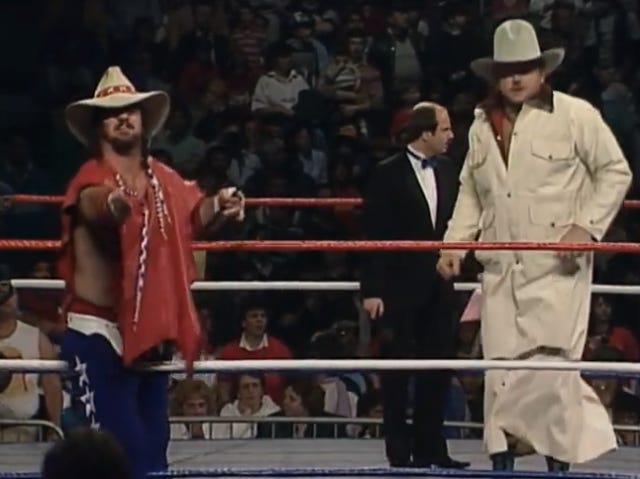
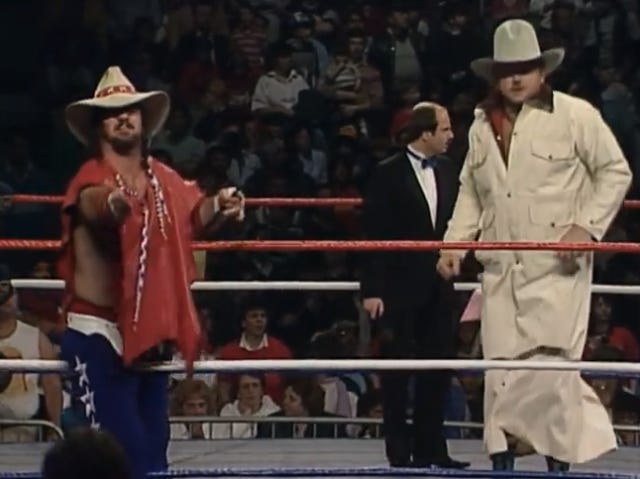
Pictured: Terry Funk and Dory Funk, Jr. in the WWF in 1986
House shows across the U.S. reinforced these narratives. On March 8 at Boston Garden, Hogan & Junkyard Dog defeated Terry & Dory Funk Jr. in a wild brawl; Orndorff pinned Piper in a steel cage; and the Bulldogs challenged the tag champs. March 9 at Madison Square Garden equivalents and regional arenas saw similar multi-man tags and title defenses, drawing strong crowds (e.g., 17,700 at Meadowlands). TV episodes (Prime Time Wrestling, Championship Wrestling) featured squash matches, celebrity hype for the WM2 battle royal (involving William “The Refrigerator” Perry, Big John Studd, etc.), and interview segments pushing the three-city format.
WWF’s March programming demonstrated total national saturation—syndicated shows, NBC specials, and house-show loops—eroding regional loyalties.
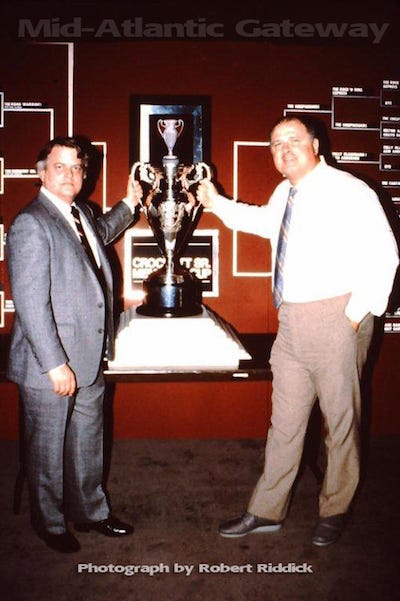
Pictured: Jim Crockett, Jr. and Bill Watts with the Jim Crockett Memorial Cup Trophy
Jim Crockett Promotions, operating under the NWA banner and controlling the World Championship, remained the strongest traditional territory. March focused on hyping the inaugural Jim Crockett Sr. Memorial Cup—a 24-team, two-night tag tournament set for April 19 in New Orleans’ Superdome (co-promoted with UWF, offering a $1 million prize). Seeding was announced via PWI and TV: #1 Road Warriors, #2 Dusty Rhodes & Magnum T.A., #3 Midnight Express (NWA Tag Champs Bobby Eaton & Dennis Condrey), #4 Ric Flair & Arn Anderson (with Tully Blanchard subbing for Flair), and others including UWF and Memphis teams.
Conceived as a tribute to Jim Crockett Sr., a pioneering wrestling promoter who started his company in 1935, it was billed as the first NWA-sanctioned 24-team, single-elimination tag tournament with a storyline prize of $1,000,000 and an oversized trophy. Held on April 19, 1986, at the Louisiana Superdome in New Orleans, the event spanned a matinée session (qualifying/first rounds) and evening session (later rounds to finals) in one marathon day. It drew a poor live crowd and remains legendary for its stacked roster and cross-territory alliances.
Initial top-10 seeds (announced on TV, with adjustments):
Road Warriors (Animal & Hawk)
Dusty Rhodes & Magnum T.A.
Midnight Express (Bobby Eaton & Dennis Condrey, NWA World Tag Team Champions)
Ric Flair & Arn Anderson
Rick Martel & Dino Bravo
Rock ‘n’ Roll Express (Ricky Morton & Robert Gibson)
Giant Baba & Tiger Mask (AJPW)
Ivan & Nikita Koloff
Sheepherders (Butch Miller & Luke Williams)
UWF representatives (initially Ted DiBiase & “Dr. Death” Steve Williams)
Adjustments were announced live: Flair opted out to defend the NWA World Title against Rhodes in a separate Superdome match (teased as the “surprise main event” for the afternoon show). Arn Anderson partnered with Tully Blanchard (NWA National Heavyweight Champion) instead—the Four Horsemen faction entry. Magnum T.A. (NWA U.S. Champion) tagged with Ron Garvin (after injury/storyline tweaks), keeping their high seed. UWF’s DiBiase/Williams slot shifted due to ongoing angles, with Fantastics (Bobby Fulton & Tommy Rogers, UWF Tag Champs) and others (e.g., Buzz Sawyer & Rick Steiner) filling UWF slots.
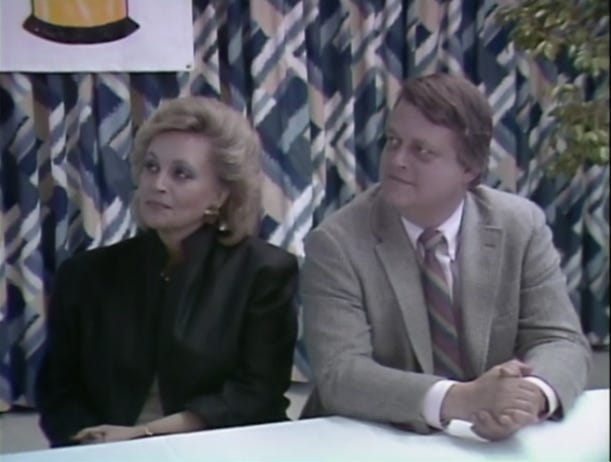
Pictured: Jim Crockett, Jr. and sister Frances Crockett of Jim Crockett Promotions
The entire month on JCP television (World Championship Wrestling and syndicated shows) revolved around hyping the Cup. This included the on-air press conference, seed announcements, wrestler interviews, and feuds explicitly tied to tournament positioning.
March 1986’s Crockett Cup hype perfectly captures early Disintegration Stage: JCP’s ambitious unification effort (co-promoting with rival Watts, importing international teams, million-dollar spectacle) was a desperate scale-up to match WWF’s WrestleMania 2. It temporarily boosted attendance and morale but accelerated the eventual centralization—JCP absorbed more talent/territories soon after, while the “NWA alliance” proved fragile. By 1987, UWF was fully folded into JCP; by 1988–89, the Cup continued under diminishing returns until the Monday Night Wars sealed the territory system’s fate. The March promos’ optimism masked the underlying talent drain and audience splintering.
Key feuds on weekly TV (World Championship Wrestling, Pro Wrestling) and house shows:
Ric Flair (NWA World Champion) defended against challengers like Ron Garvin (multiple no-contests and DQ finishes) and Dusty Rhodes (leg-brace attacks and brawls). Flair mocked Rhodes’ “common man” persona and Baby Doll.
The Four Horsemen (Flair, Arn Anderson, Tully Blanchard, Ole Anderson, J.J. Dillon) dominated, with Blanchard winning the NWA National Heavyweight Title from Rhodes on March 4 in Spartanburg via foreign object.
Rock ‘n’ Roll Express vs. Midnight Express built toward a potential cage match, with Ricky Morton suffering a broken hand in a real-life altercation that added realism.
Road Warriors feuded with Ivan & Nikita Koloff, setting up steel-cage matches and tournament clashes.
Magnum T.A. pursued the U.S. Title against Nikita Koloff (DQs and challenges).
House shows drew solid numbers (e.g., 10,700 sellout in Cincinnati on March 1; Greensboro Coliseum crowds). March 1–2 events featured Flair vs. Rhodes and tag defenses. The Crockett Cup press conference and seedings were heavily promoted, signaling JCP’s ambition to unify NWA territories against the WWF.

In March 1986, Bill Watts renamed Mid-South Wrestling the Universal Wrestling Federation (UWF) to pursue national syndication and compete head-on with the WWF. The transition aired on TV: the final Mid-South episode gave way to the first UWF show, featuring three title changes in one episode—Buzz Sawyer won the TV Title, The Sheepherders (Butch Miller & Luke Williams) captured the Tag Titles, and “Hacksaw” Jim Duggan won the North American Heavyweight Title from a tricked champion.
Angles emphasized gritty, realistic storytelling:
Duggan feuded with “Mad Dog” Buzz Sawyer (who mentored young Rick Steiner).
Dick Murdoch vs. Dr. Death Steve Williams in a steel-cage match (guest ref Killer Karl Kox).
Dick Slater’s convoluted departure storyline; Jack Victory debut; Chavo Guerrero arrival.
DiBiase “injured” by Sheepherders; Fantastics (Bobby Fulton & Tommy Rogers) highlighted as underrated babyfaces.
The UWF joined the Crockett Cup (seeded #10 with DiBiase & Williams), showing cross-territory cooperation. Watts’ push for national exposure via syndication was a direct response to WWF dominance, but it highlighted financial strain.

World Class Championship Wrestling (Dallas) had already seceded from the NWA in mid-February 1986, recognizing its own WCWA World Heavyweight Title with “Ravishing” Rick Rude (managed by Percy Pringle, later Paul Bearer) as inaugural champion. March TV from the Sportatorium (hosted by Bill Mercer) centered on Rude defending against Kerry Von Erich in the March 15 main event. Kerry leapfrogged and dropkicked but fell to Rude’s atomic drops and sleepers amid interference.
The Freebirds (Michael Hayes, Buddy Roberts, Terry Gordy remnants) and Lance Von Erich remained entangled in family feuds. Rude’s heel charisma and Percy’s urn-like props added drama. WCCW’s independence was a clear act of territorial defiance, but it isolated them further from NWA alliances.

Pictured: Stan Hansen, AWA World Heavyweight Champion
The AWA (Minneapolis) ran steady house shows and ESPN tapings (e.g., March 1 in Rockford, March 4 TV). Stan Hansen was the reigning AWA World Heavyweight Champion (having won the title on December 29, 1985), defending it frequently on house shows against mid-carders like Leon White while also clashing with Sgt. Slaughter in a bunkhouse match that ended in a countout. Curt Hennig and Scott Hall held the AWA World Tag Team Championship and were featured prominently in six-man and tag bouts, often against Russian invaders like Boris Zhukov and Nord the Barbarian or the Irwin Brothers. The Midnight Rockers—Shawn Michaels and Marty Jannetty—were the hottest rising act, racking up wins over Doug Somers, Colonel DeBeers, and Buddy Rose & Doug Somers on both TV and live events, positioning them as future contenders. Women’s champion Candi Devine traded victories with Sherri Martel, while veteran rivalries like Nick Bockwinkel vs. Larry Zbyszko played out in repeated countout and disqualification finishes, including a multi-fall “death match” on March 23 in Rosemont, Illinois.
Television remained a key platform, with ESPN Championship Wrestling episodes spotlighting rookie-of-the-year Shawn Michaels in singles action against jobbers like Buddhakhan and continuing to push the Rockers as an exciting, high-flying babyface team. House shows crisscrossed the Midwest strongholds—Rockford IL, Green Bay WI, St. Paul MN, Salt Lake City UT, Denver CO—with attendances ranging from a few thousand to over 8,000, while TV tapings in Las Vegas and Hammond, Indiana fed weekly programming. The promotion was already building hype for its biggest card of the year, WrestleRock ’86, set for April 20 at the Hubert H. Humphrey Metrodome.
By March 1986 the AWA was clearly in decline, caught between its traditional territorial roots and the WWF’s aggressive national expansion. While it still had recognizable stars and a loyal regional audience, the roster showed signs of age and talent drain; the company’s refusal to fully embrace the cartoonish, entertainment-driven style that was dominating pop culture left it vulnerable. Emerging talents like the Rockers and Hennig provided flashes of excitement and solid in-ring work, but the constant threat of WWF raids loomed (as would happen repeatedly later in the year). House show business was respectable in AWA heartland markets, yet the promotion was fighting a losing battle for national relevance. WrestleRock ’86 would represent one last big swing at recapturing glory, but the broader trend was unmistakable: the AWA’s glory days were fading fast as the wrestling landscape shifted irreversibly toward Vince McMahon’s vision.

Pictured: Buddy Landel and Bill Dundee bragging to Lance Russell at WMC-TV 5 in Memphis, Tennessee
The Memphis territory, anchored by the Mid-South Coliseum and TV shows hosted by Lance Russell and Dave Brown, centered on high-drama personal feuds and title turnover. The biggest angle involved Jerry “The King” Lawler’s return. Lawler had lost a “loser-leaves-town” match to Bill Dundee in late December 1985, but by early March the heels Dundee and “Nature Boy” Buddy Landel viciously attacked Jerry Jarrett and his son Jeff Jarrett on TV. This split the heel trio (Dundee, Landel, and Dutch Mantell) and prompted Eddie Marlin to call for Lawler’s comeback. Lawler teamed with Mantell against Dundee & Landel in explosive tag matches. This was the biggest angle that would be executed in the 2nd half of the 1980s in the Memphis territory.
Key matches included:
March 3 at the Mid-South Coliseum (11,300 fans): Jerry Lawler & Dutch Mantell defeated Bill Dundee & Buddy Landel (the bout ended in a referee stoppage due to excessive bleeding from Landel). In the same card, Abdul Gaddafi (a foreign heel gimmick) dethroned Rick Casey for the CWA International Heavyweight Title.
March 9 follow-up at the Coliseum (10,200 fans): Another Lawler & Mantell vs. Dundee & Landel tag, plus undercard bouts featuring the Fantastics (Southern Tag Team champions) defending against the MOD Squad, and Frank Morrell vs. Pat Rose.
TV episodes (March 1, 8, 15, 22, and 29) built heat with promos: Landel bragged about Figure-Fouring Ric Flair; Dundee slapped announcer Lance Russell on the March 22 show; and Paul Diamond & Michael Lee debuted as a new tag team. A marathon 26-fall Texas Death Match between the Lawler/Mantell and Dundee/Landel sides reportedly capped the month on March 24. The territory also pushed younger talent like Billy Joe Travis and the Fantastics while using the Jarrett family attack as the emotional hook.
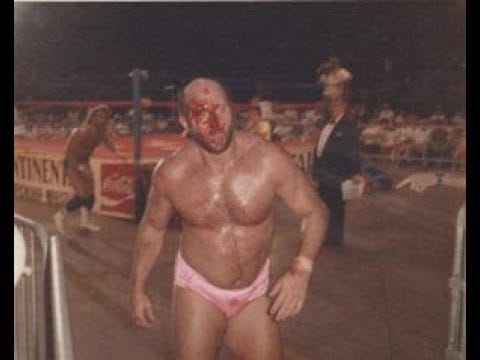
Pictured: A bloody Jerry Stubbs tries to run away from the aggressive Brad Armstrong during their feud in 1986
Ron Fuller’s Southeastern-based promotion (running TV from Birmingham and Knoxville) emphasized family legacies and masked-man intrigue. The central ongoing feud pitted Brad Armstrong against Jerry “The Stud” Stubbs for the NWA Continental Heavyweight Title; the two traded the belt in bloody, back-and-forth matches throughout the first half of 1986. The Armstrong family (including Scott and Steve) battled the “Stud Stable” of Fuller, Jimmy Golden, and associates like Tom Prichard. The masked Bullet (widely believed to be Bob Armstrong, banned from the area) continued defending his identity against challengers, building toward bigger confrontations later in the year.
Exact house-show cards from March are sparse in surviving records, but TV tapings featured standard undercard action with mid-carders like Tim Horner (U.S. Junior Heavyweight scene), Wendell Cooley, and Tommy Rich. Angles focused on rulebreaker tactics—powder in the eyes, referee distractions—and the Bullet’s mask. Kevin Sullivan’s demonic persona had not yet fully arrived (his major program with the Bullet intensified later), so March remained rooted in the Armstrong vs. Stud Stable rivalry. Gordon Solie’s commentary gave the shows a serious, Southern-fried atmosphere that fans loved.
Central States, based around Kansas City’s Memorial Hall, was a smaller territory struggling with attendance but still booking big-name NWA crossovers. Bob Brown held the NWA Central States Heavyweight Title (a reign that began in December 1985 and lasted until his injury-forced vacancy in May). The territory leaned heavily on visiting stars for drawing power.

Pictured: Harley Race and Bruiser Brody on All Star Wrestling in Kansas City, Missouri
The standout event was March 20 at Memorial Hall in Kansas City, KS, where Harley Race & Bruiser Brody defeated NWA World Champion Ric Flair & Bob Brown in a steel-cage main event. This high-profile crossover mixed territory regulars (Brown, the Batten Twins in tags) with national talent. Other March programming included TV-style cards with mid-carders like Marty Jannetty, Rufus R. Jones, and the MOD Squad. Angles were straightforward—title defenses by Brown and tag feuds—but the steel-cage match with Flair provided a rare big-draw boost amid the territory’s challenges.
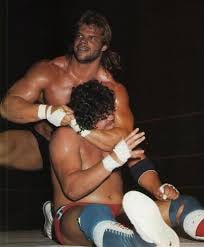
Pictured: New Star Lex Luger cranks down on a chinlock in Florida
CWF, still recovering from Eddie Graham’s personal struggles but featuring strong TV with Gordon Solie and Mike Graham, mixed NWA world-title crossovers with local blood feuds. Barry Windham remained a top babyface, often clashing with heels like Ron Bass (barbed-wire matches lingered from earlier programs). Lex Luger defended the NWA Southern Heavyweight Title (Florida version) in several house shows, while Jesse Barr and the Army of Darkness (including Kevin Sullivan’s dark, occult-tinged stable) created sinister angles. Blackjack Mulligan’s family (Barry and Kendall Windham) wrapped up a feud with the Army around early March.
Notable March action included:
March 10 in Leesburg and March 14 in Tallahassee: Jesse Barr challenging Luger for the Southern title; Barry Windham in featured singles; and undercard bouts with Bob Roop, Kendall Windham, and Kendo Nagasaki (fresh off claiming a bounty on Wahoo McDaniel on March 4).
TV episodes (e.g., March 25–26) spotlighted Windham, Luger, and the Mulligans vs. Sullivan’s crew. The territory’s style blended athleticism with hardcore elements, keeping crowds engaged despite the national shift toward the WWF.
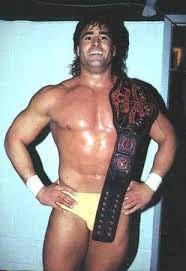
Pictured: Tom Zenk, NWA Pacific Northwest Champion
Don Owen’s PNW was known for its tough, no-frills style and lengthy feuds. The marquee storyline was the continuation of Tom Zenk vs. Bobby Jaggers for the NWA Pacific Northwest Heavyweight Title. Zenk had won the belt from Jaggers in a big January 21 Superstar Extravaganza cage match at the Portland Memorial Coliseum, but Jaggers reclaimed it on March 9 in Findley, Washington (Zenk was stretchered out, heightening the rivalry). This back-and-forth title chase, plus Zenk’s undefeated babyface push earlier in the year, drove attendance.
Supporting angles featured rugged workers like Billy Jack Haynes, Rip Oliver, and Buddy Rose in brawls and stretcher matches. TV and house shows emphasized Pacific Northwest pride and physicality, with Don Owen’s booking keeping the territory distinct even as bigger promotions raided talent. March cards were more routine than January’s supercard but sustained heat through the Zenk-Jaggers rematches and tag-team programs.
The 7 Stages of the Territory Era Model
My model for understanding the changes and transformationsinf this part of pro wrestling history (1925-1995) positions the Territory Era as evolving through seven stages, with Stage 7 (Disintegration, 1985–1995) marking the system’s collapse: rapidly changing techology combined with national expansion by WWF and JCP that erodes regional monopolies, talent migrations, audiences fragment and then cololidate, and the weakest territory companies either fold, merge, or reinvent futilely until the Monday Night Wars finalize the shift.
March 1986 is textbook early Disintegration Phase:
National vs. Regional Tension: WWF’s WM2 hype and syndication dominance pulled viewers and dollars nationwide. Territories responded with big swings—UWF rebrand/syndication push, JCP’s million-dollar Crockett Cup uniting NWA remnants, WCCW’s NWA secession—but these were reactive, not sustainable.
Talent and Economic Pressure: Jake Roberts’ jump from Mid-South to WWF foreshadowed the drain. JCP’s inclusion of UWF/Memphis teams showed consolidation efforts, yet it diluted individual territory identities.
Alliances as Desperation: The Crockett Cup co-promotion with UWF and multi-territory seeding was an attempt at a “super territory” counter, but it accelerated centralization under JCP (which would buy more territories soon).
Foreshadowing Collapse: Rebrands (UWF), secessions (WCCW), and tournaments delayed the inevitable. By 1987–1991, most territories (including UWF folding into JCP, WCCW struggling, AWA sold) would disintegrate or be absorbed. The 1985–1995 window captures WWF’s peak expansion through the 1990s indie revival before the Attitude Era.
March 1986 was not the end but the unmistakable beginning of the end. The territories were still producing compelling, regionally flavored wrestling—gritty UWF realism, Von Erich drama, Flair/Rhodes passion—but the national machine had already rewritten the rules. The era’s disintegration was underway, one syndicated episode and WM2 sellout at a time. This month perfectly illustrates your model’s thesis: the territorial system did not die overnight but eroded progressively from 1985 onward, with March 1986 capturing the first visibly open fault lines in the foundation.
Thank You for Reading
I’m Tony Richards, Pro Wrestling Historian, Author and Storyteller. I share pro wrestling historical items in each issue of the Time Tunnel Pro Wrestling History Newsletter. Thanks for reading! If you enjoy my information on select events, matches and insights, please share it with folks you think might like to be a subscriber!
Remember, premium investors get access to exclusive and special content such as some special issues including a multi-part deep dives on wrestling territories, wrestler bios and championship title histories, special audio and video interviews on territory pro wrestling and more available in the Pro Wrestling Time Tunnel for Premium Investors.
Being a wrestling fan living in north central Florida during that era, there wasn't much to look forward to. Championship Wrestling from Florida (CWF) was on its death knell, and the void left by Georgia Championship Wrestling after 1984’s "Black Saturday" felt permanent. I never quite warmed to the Crockett product on TBS; there is only so much of David Crockett’s commentary a person can take. My sustenance was provided by Mid-South and the UWF. If only Jerry Jarrett’s Memphis territory had found its way onto my local airwaves.