



Happy Birthday to those who have passed on and to those great wrestlers still with us:
In Memoriam:
Kurt Von Poppenheim 1914
George “Cry Baby” Cannon 1932
Curt Hennig 1958
Frederick Seawright\Brickhouse Brown 1958
Edward Fatu\Umaga 1973
Happy Birthday:
Dangerous Danny Davis (70)
Terry Szopinski\The Warlord (64)
Tony Richards (63)
Mustafa Ali (40)
Happy Birthday to Me

March 28th has arrived once again—my birthday—and with it comes the annual tradition that has become as reliable as a sold-out arena on a big-show night. Every year on this date, I step out of my busy life, out of my coaching practice, out of my investing company and out of the Pro Wrestling Time Tunnel, turn off the lights on the past twelve months, and take honest stock of the year that was. Then I lace up the boots for the next 365 days and commit to becoming the next best version of myself.
This past year was one for the books. It brought one of the greatest honors of my career when I won the 2026 James C. Melby Award from the Tragos-Thesz Hall of Fame for excellence in wrestling journalism and historical preservation. I can’t wait to celebrate with my community this July in Waterloo, Iowa. I was also proud to deliver the Jim Barnett Series as well as the extensive Roy Welch Family Legacy Series alongside Gerald Brisco, John Bradshaw Layfield, and Ron Fuller on the Stories with Brisco and Bradshaw Show. The Time Tunnel itself kept rolling forward—digging into forgotten territories, shining a spotlight on overlooked pioneers, and reliving matches that still give us goosebumps decades later.
There were weeks when the words flowed like a perfect chain-wrestling sequence and weeks when the research felt like fighting out of a rest hold. Personally, I faced a few body slams I didn’t see coming, but I also hit some of the biggest comebacks of my own career. Through every deadline, every late-night tape review, and every quiet moment of doubt, one thing stayed constant: the incredible support from all of you who ride shotgun through wrestling history with me each issue.
Reflection done, the bell has rung on year whatever-this-is. Now it’s time for the next turn. The next 365 days are about leveling up—sharper storytelling, deeper dives, fewer blown spots, and a renewed fire for the work we love. Just like the greats who reinvented themselves (new gimmick, better conditioning, stronger psychology), I’m stepping through the curtain committed to growth, consistency, and giving you the very best Time Tunnel yet.
As I have been for most of my life, I am committed to having no regrets.
And if it seems or looks like I am going to have one, I shift, I pivot, I do something about it to make sure it doesn’t become a regret, but a taken-advantage of opportunity.
Thank you for being part of this journey. Your reads, replies, re-stacks, comments, likes and shared passions are the crowd that keeps me coming back stronger every single day.
Here’s to March 28th, to fresh ring gear, and to another full year of time-traveling through pro wrestling’s greatest eras—together.
Let’s make the next 365 days a hell of a run.
Your Publisher and Storyteller,
Tony
RIP Memorial: We stop & remember those who have passed on this day and gave themselves to the business for us, the fans. We salute you and thank you.
Corsica Jean 3-28-1992 at the age of 71

Abe Coleman 3-28-2017 at the age of 101

Ron Slinker 3-28-2008 at the age of 62
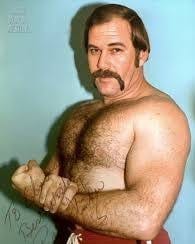
The Life and Career of Kurt Von Poppenheim
Kurt von Poppenheim stands as one of the enduring figures of mid-20th-century professional wrestling, a rugged competitor whose German heel persona helped define the territorial era in the Pacific Northwest. Born into a Volga German immigrant family and later legally adopting his ring name, he embodied the tough, larger-than-life characters that packed arenas from Portland to Vancouver.
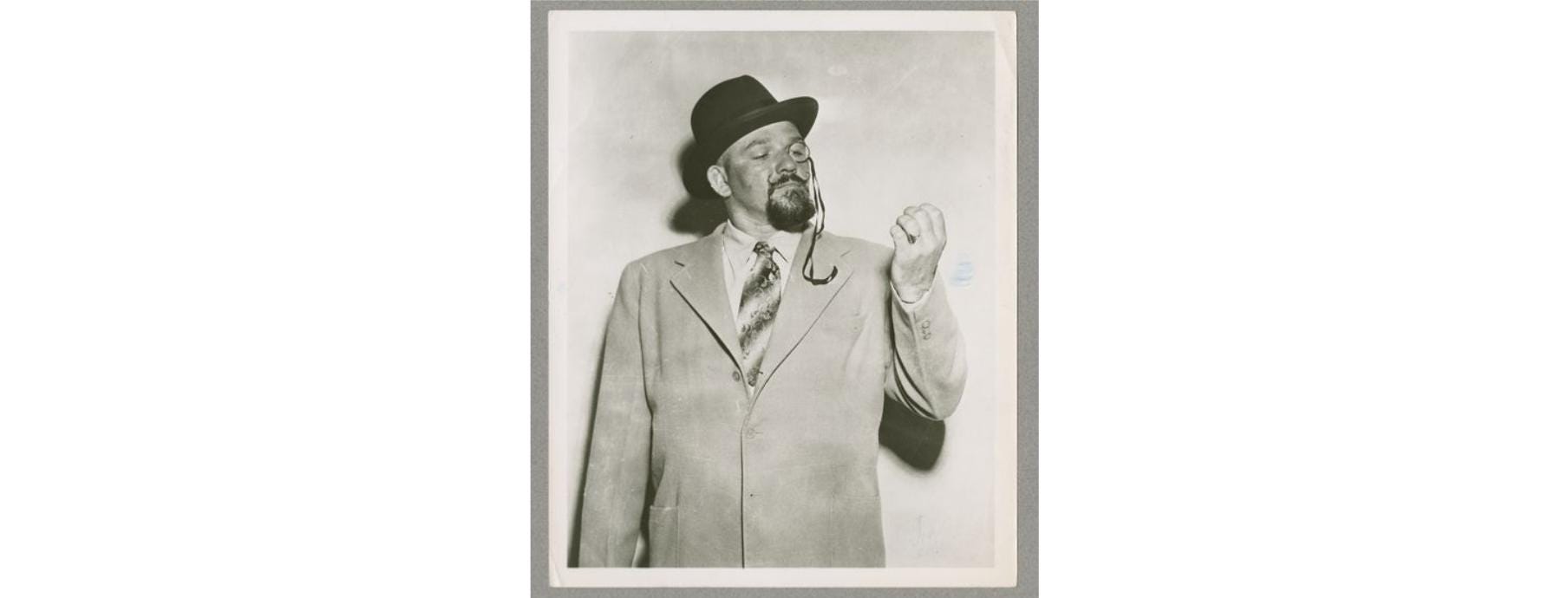
The Volga Germans—ethnic Germans who settled along Russia’s Volga River in the 1760s at the invitation of Empress Catherine the Great—left an indelible mark on American agriculture and communities. Promised free land, religious freedom, tax exemptions, and military service waivers, they built thriving colonies. By the 1870s, however, these privileges evaporated under Russification policies, mandatory conscription, land restrictions, and cultural suppression. Thousands packed up and sailed for the United States, drawn by the Homestead Act and reports from scouts (Kundschafter). Their journeys involved grueling ocean crossings, Midwest prairie hardships, and later moves westward. Many ended up in Kansas, Nebraska, Colorado—and, crucially for Pacific Northwest tales, Portland, Oregon.
In 1874, Volga colony leaders sent scouts to America. Their glowing reports—soil samples, ads for free land—sparked the first wave. On June 28, 1875, the steamship City of Brussels docked in New York carrying seven families and two single men—the very first documented Volga Germans to reach the U.S. They had sailed from Liverpool after traveling through Russia and Germany. The group included the families of Friedrich Jörg, Heinrich Trüber, and George and Elizabeth Schreiber (from the Norka colony). After two years of backbreaking ditch-digging and farm labor in Bluffton, Ohio, they pushed on to Sutton, Nebraska, seeking their own land. George Schreiber and his wife became parents to Helena, the first child of Volga German descent born in America—a symbolic milestone amid uncertainty
These early arrivals started at the bottom: men on railroads, women in domestic work. Their German dialect, mixed with Russian words, marked them as outsiders even among other Germans. Yet their legendary work ethic soon earned respect. A second ship, the Montreal, brought more in December 1875, seeding settlements in Kansas.
By the early 1880s, some Midwest Volga Germans sought better opportunities in the Pacific Northwest. In 1881, about 17 families—many from daughter colonies of Yagodnaya-Polyana and Pobochnaya (including Neu-Yagodnaya-Polyana, Schöntal, and Schönfeld)—arrived in Portland after years in Rush and Barton Counties, Kansas. Led by figures like Conrad Appel, Phillip Fuchs, George Green, and Henry Repp (along with Kleweno, Ochs, and Scheuermann families), they traveled via special emigrant fares on the Union Pacific Railroad and Oregon Steam Navigation Company.
Disappointed by Portland’s forested, already-claimed lands, they took jobs in lumber mills and railroad grading (building the Albina fill). In spring 1881, they learned of vast acreage east of the Cascades. A small vanguard inspected the hilly Palouse country in Washington—its terrain echoing the Volga’s Bergseite—and helped colonize areas near Endicott, St. John, and Colfax.
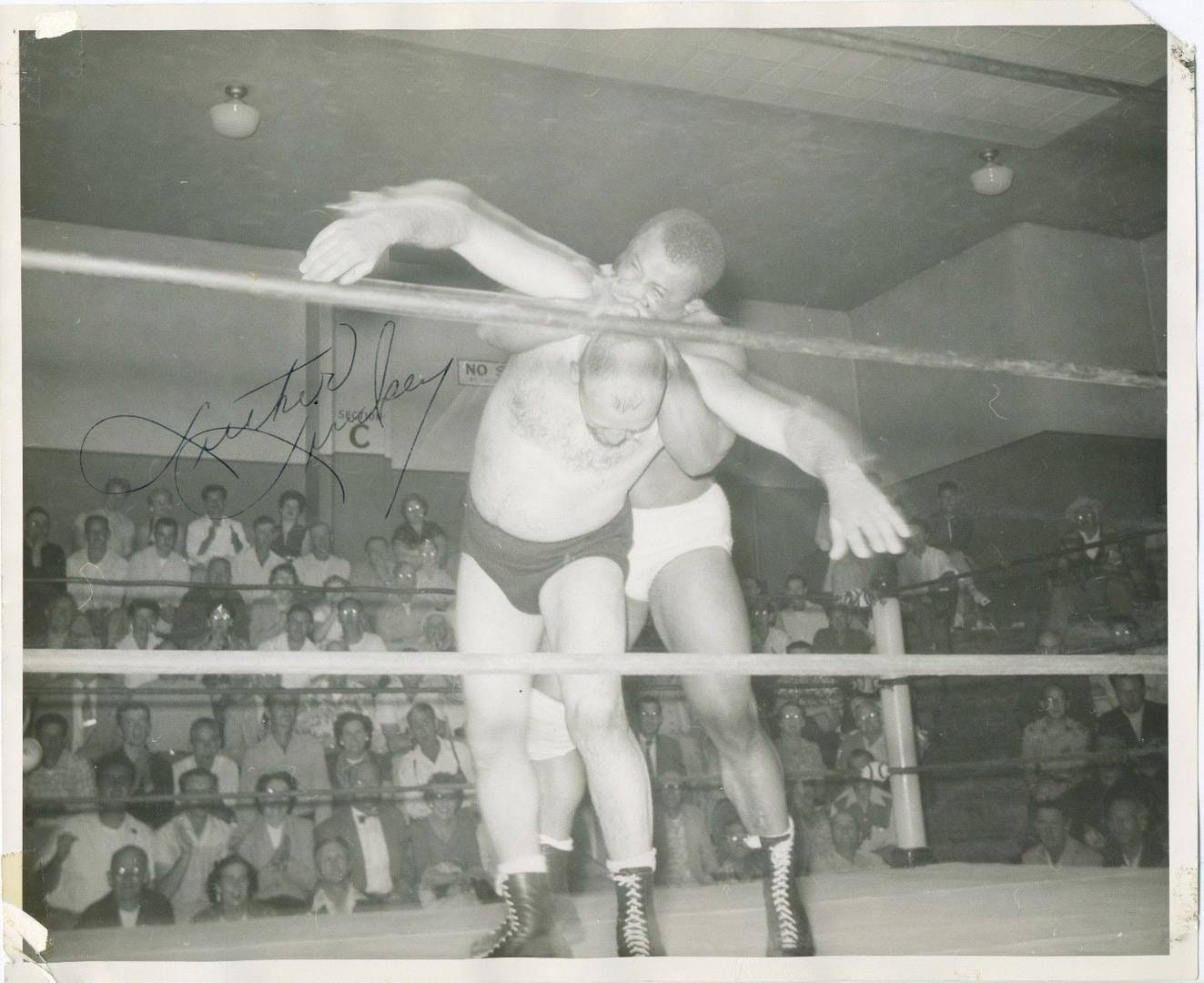
Pictured: Luther Lindsey with a full nelson applied to Von Poppenheim in the 1950s
Subsequent waves followed: Norka colonists in 1882 via San Francisco by ship; Balzer and Frank families in 1888–1890; and hundreds more from 1890–1905, mostly from Norka. By the early 1900s, roughly 500 families from colonies like Brunnental (Bretthauer, Greenwald, Hergert, Melcher), Hussenbach (Mehling, Schwab), Frank, and others had settled northeast Portland’s Albina district, forming tight-knit Evangelical Protestant congregations.
One such family from Brunnental and Hussenbach arrived in Portland in February 1912—echoing the roots of wrestler Kurt von Poppenheim’s parents, Jacob Pappenheim and Maria Elisabeth Linker. Like many, they built lives as farmers, upholsterers, and tavern owners while preserving German-Russian traditions amid assimilation pressures.
Post-1917 Bolshevik Revolution brought new horrors—famine, expropriation, and violence—for those who stayed behind. Lydia Maier was 11 when her family fled Gnadenthau in 1920. Her father had vanished in WWI; wealthy grandparents, targeted as “robbers of the poor,” handed over buried gold and urged flight. In a crowded boxcar, passports and gold were stolen. Her mother contracted typhoid in Minsk; the girls were fostered in seven Russian homes, doing chores for food. After two years, a remarriage and U.S. relative’s affidavit secured passage. They endured German Red Cross trains, orphanages, and a Hamburg sailing on August 1, 1923, bound for Nebraska kin. Lydia’s story highlights how earlier immigrants funded relief and provided affidavits to beat quotas—saving thousands during the 1921 famine.
From the 1875 City of Brussels pioneers to Portland’s Albina enclave and 1920s refugees, Volga German stories reveal a people who turned dislocation into dominion over American soil. Organizations like the American Historical Society of Germans from Russia preserve these narratives through archives, oral histories, and books like Hardship to Homeland. They remind us that immigration built not just farms, but enduring communities—resilient threads in the American tapestry.
These Volga roots can bee seen in Kurt Von Poppenheim’s journey with a career spanning nearly three decades, he wrestled more than 1,100 matches, captured multiple championships, and became a fixture in the Pacific Northwest Wrestling (PNW) scene while moonlighting as a homesteader, upholsterer, and tavern owner. His story is one of resilience, showmanship, and quiet off-ring kindness.
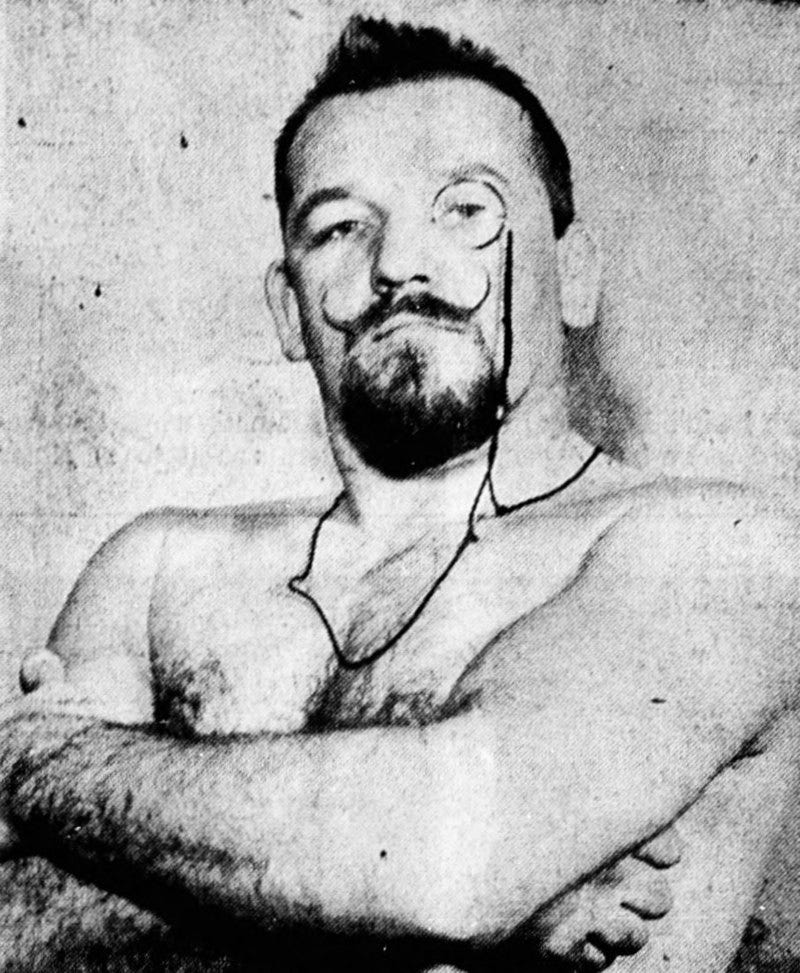
Jacob “Jake” or “Jack” Pappenheim was born on March 28, 1914, in Portland, Oregon, to Jacob Pappenheim and Maria Elisabeth Linker, Volga Germans whose families originated from the colonies of Brunnental and Hussenbach in Russia. His parents had immigrated to the United States in 1912 and settled in Portland’s German community. Young Jake married Flora Luella Helzer on September 26, 1931; the couple would remain together for more than six decades. Before entering the squared circle professionally, he spent seven years as an amateur wrestler under his real name, building the foundation for a career that would test his stamina and skill.
Most accounts place his first pro bouts in the late 1930s (some cite 1937 as a rookie under the name Jack Pappenheim), with a formal entry into the paid ranks on January 3, 1944, after his amateur years. He initially competed as himself before adopting the villainous “Kurt von Poppenheim” gimmick around 1950—one of the earlier Nazi-coded German heels in American wrestling. The character played on postwar ethnic tensions, complete with a stern demeanor and a thick accent that drew heat from crowds. He also worked under aliases such as Eric von Hess and Jack Poppenheimer. In 1958 he legally changed his name to Kurt von Poppenheim, fully embracing the persona even outside the ring.
Von Poppenheim’s career was built on consistency rather than flash. Standing around 5’9” and weighing roughly 187 pounds, he was not the tallest or heaviest man in the business, but his conditioning allowed him to sustain a grueling schedule. He competed in 1,122 matches—placing him in an elite minority of wrestlers who reached the 1,000-match milestone—across the United States (including Madison Square Garden), Western Canada, and reportedly Mexico. His home base remained the Pacific Northwest, where he became a perennial draw at venues like Portland’s Fairgrounds Arena. He was named Pacific Northwest Wrestler of the Year five times and was respected for his work ethic and ability to make opponents look strong.
The Iron Crossbow was his signature finishing hold—a punishing submission that showcased his technical prowess and helped him secure victories night after night. Championship gold came frequently, especially in tag-team competition. He held the NWA Pacific Northwest Tag Team Title on nine occasions (1952, 1954, 1955, 1958, twice in 1959, 1960, and 1962) with partners including Dan Manoukian, Fritz Von Goering, and Jack O’Reilly. Additional singles and tag honors included the Vancouver Northwest Tag Team Title (1952, 1953, 1959), Intermountain Junior Heavyweight Title (1954, 1956), Vancouver Pacific Coast Junior Heavyweight Title (multiple reigns in the mid-1950s), Vancouver Pacific Coast Heavyweight Title (1958), and the NWA Pacific Northwest Heavyweight Title (won in 1959 by defeating Bill Savage). In total, he claimed 19 championship titles, cementing his status as a regional powerhouse.
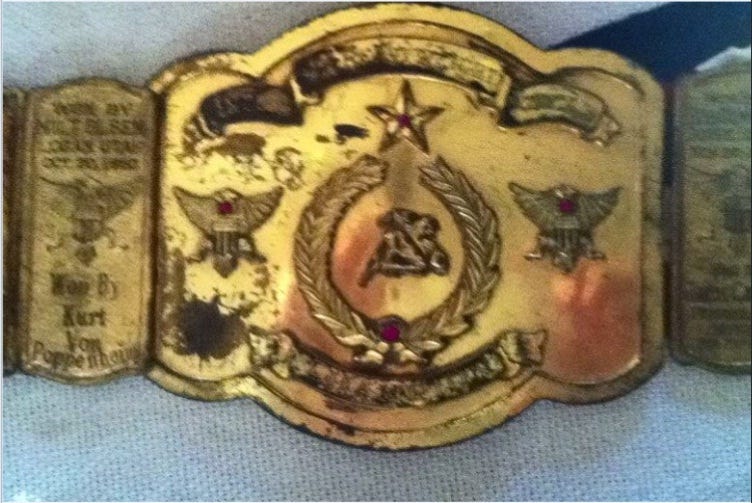
Pictured: The Intermountain Junior Heavyweight Championship Belt
Photo credit: Kevin Orcutt
Beyond the ring, von Poppenheim was a multifaceted man. He operated the Airport Tavern and Wilshire Tavern in Portland and held a license as an upholsterer. After retiring on May 10, 1963 (with some sources extending occasional appearances into 1964), he lived the life of a Pacific Northwest homesteader while maintaining close ties to the wrestling community. Peers affectionately called him “Pappy,” a nickname coined by longtime road partner Dano McDonald. Cauliflower Alley Club president Red Bastien later recalled von Poppenheim’s habit of accidentally bloodying Bastien’s nose during chops, joking that the shorter wrestler “always tried to hit me on the forehead, but somehow missed.” His likeness even appeared in sports artist Ted Lewin’s book I Was a Teenage Professional Wrestler, captured in a Madison Square Garden scene.
In 1998 the Cauliflower Alley Club honored him with the Golden Potato Award and induction into the Old Time Wrestlers’ Hall of Fame, recognizing a lifetime of excellence. Off-camera, those who knew him described a kind, gentle family man far removed from his on-screen villainy. He and Flora raised a son, Jack, and daughters Joan, Carol, Judy, Vikki, and Vonnie (who predeceased him). Flora passed in 1995; von Poppenheim followed on May 1, 2003, in Portland at age 89, after a battle with cancer.
Kurt von Poppenheim’s legacy endures not through national television exposure or world titles, but through the quiet grit that defined the territorial era. In an industry built on spectacle, he proved that longevity, regional loyalty, and genuine toughness could create a lasting name. From Volga German roots to the bright lights of Madison Square Garden and back to the taverns and homesteads of Oregon, his journey remains a classic chapter in professional wrestling’s rich, often overlooked history—one that reminds us the greatest wrestlers are often those who simply showed up, night after night, and left everything in the ring.
One Thing I Learned About Curt Hennig
He once saved the life of MLB Hall of Famer Wade Boggs during a deer hunting trip in Iowa.
Hennig and Boggs were close friends who frequently hunted and fished together. On this trip, Boggs got tangled in barbed wire, slicing his leg badly from knee to ankle and losing a lot of blood. Hennig quickly freed him, hoisted the injured baseball legend onto his shoulders, and carried him roughly three miles back to their truck before rushing him for medical help. Boggs has since called Hennig his “guardian angel” and confirmed the story in interviews.
Thank You for Reading
I’m Tony Richards, Pro Wrestling Historian, Author and Storyteller. I share pro wrestling historical items in each issue of the Time Tunnel Pro Wrestling History Newsletter. Thanks for reading! If you enjoy my information on select events, matches and insights, please share it with folks you think might like to be a subscriber!
Remember, premium investors get access to exclusive and special content such as some special issues including a multi-part deep dives on wrestling territories, wrestler bios and championship title histories, special audio and video interviews on territory pro wrestling and more available in the Pro Wrestling Time Tunnel for Premium Investors.
Many happy returns Tony!