


Happy Birthday to those who have passed on and to those great wrestlers still with us:
In Memoriam:
Cowboy Clarence Luttrall 1906
Tony Garibaldi 1913
Johnny Barend 1926
Swede Hanson 1933
Gordon Nelson 1930
Jerry Bryant 1953
Happy Birthday:
Octogon (65)
Charlie Haas (54)
Paige Mayo\SoCalVal (40)
RIP Memorial: We stop & remember those who have passed on this day and gave themselves to the business for us, the fans. We salute you and thank you.
Roy McClarity 3-27-1998 at the age of 79

Dennis Stecher 3-27-1977 at the age of 60
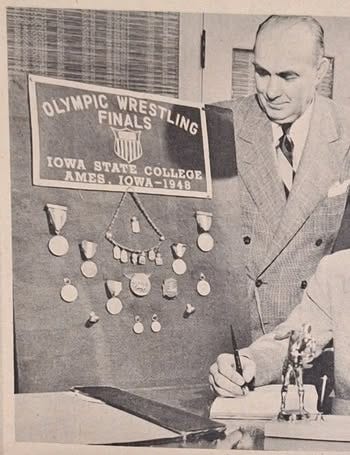
Pat O’Dowdy 3-27-1992 at the age of 83

Rocky King 3-27-2022 at the age of 61

**Taken from my upcoming book: The Life & Times of Dory Funk, Sr: The King of the Texas Death Match
The Life & Career of Pat O’Dowdy
Pat O’Dowdy, born George Euclid Dowdy on May 5, 1908, in the small town of Duke, Oklahoma, emerged as a rugged journeyman wrestler in the 1930s and 1940s before transforming into one of the most influential promoters in the Southwest territory system. Standing 5’10” and weighing around 170 pounds, the Irish-American grappler—often billed as Pat O’Dowdy, Jack Dowdy, Patrick O’Dowdy, or the more colorful Patrick O’Shaughnessy O’Dowdy—carved out a career defined by toughness, travel, and later community impact in Odessa, Texas. Though nowhere near a national superstar like his friend Gorgeous George, O’Dowdy’s story embodies the gritty, regional fabric of mid-20th-century territory-era professional wrestling: a hardworking athlete who transitioned from the ring to the town promoter’s desk, spending innumerable days and late nights at the Ector County Coliseum sustaining the sport in the oil-industry driven town of the Permian Basin for decades.

O’Dowdy’s earliest years were spent trying to break in the business in rural Oklahoma, but by the late 1930s he had entered the professional ranks during wrestling’s pre-television boom. He competed primarily as a light heavyweight or middleweight brawler with a “tough style” that suited the rough-and-tumble circuits of the Midwest, Southwest, and even occasional stops on the West Coast and in Mexico. He wrestled for a dizzying array of promoters and territories, including Al Haft Sports in Ohio, Fred Kohler Enterprises in Illinois, the St. Louis Wrestling Club, Central States Wrestling, the Hollywood Boxing Office in California, and various Southwest outfits such as the El Paso Booking Office, John McIntosh Promotions, M & M Promotions, and Mike London Sports (covering Arizona, Colorado, New Mexico, and Texas).
His affiliates and opponents read like a who’s-who of the era’s regional stars: Benny Trudel, Alex Kasaboski, Rod Fenton, Frank Murdoch, Billy Hickson, Dory Detton, Pierre LaBelle, and George Drake, among others. He was particularly active in the 1940s—his busiest decade—logging an estimated 1,300 matches across the country.
O’Dowdy’s in-ring persona leaned into his Irish heritage with gimmick names that evoked old-country toughness, but he was respected as a straight-shooting worker rather than a flashy showman. He feuded regularly with competitors like Billy Hickson and Johnnie James in the early 1950s, and he shared rings with legends such as Dory Detton, one of the fathers of Amarillo wrestling. The relationship with Detton would be pivotal, as Detton would give O’Dowdy a chance for re-invention as a local town promoter on the Amarillo circuit once Detton re-established the booking office in Amarillo in 1946 after it had been dark since Dutch Mantell’s death in 1941.
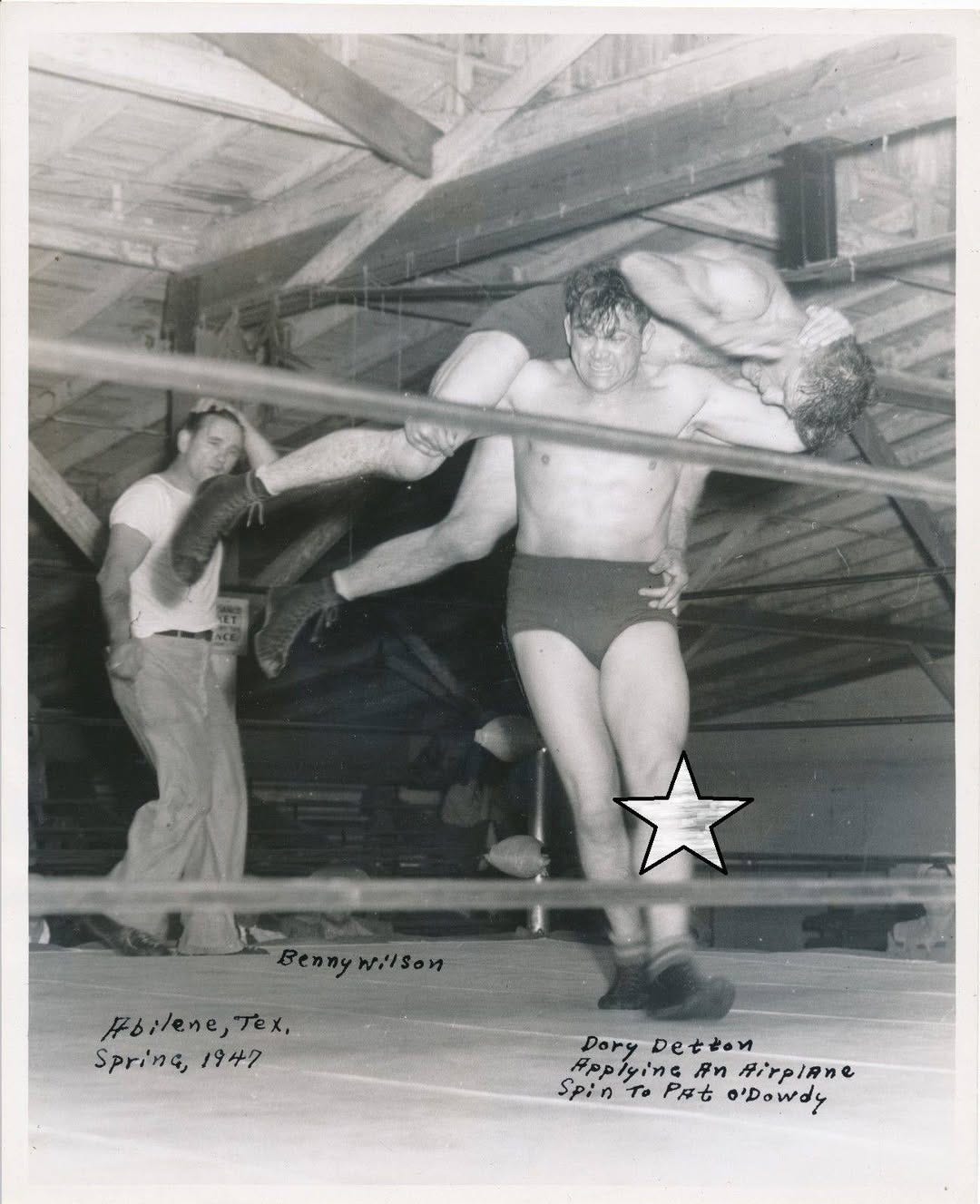
Pictured: Dory Detton has Pat O’Dowdy in an airplane spin as referee, former Texas Middleweight Champion, Benny Wilson officiates the match in Abilene, Texas in 1947.
O’Dowdy’s toughness and shooting ability was legendary, and it was well known Detton had O’Dowdy around in the “policeman” and “enforcer” role, particularly in the role of “testing guys” who wanted to break into pro wrestling. He was the Pat Malone of Tennessee, the Danny Hodge of Oklahoma or Bob Roop of Florida in his day during the 1940s and 1950s in West Texas.
While he never captured major world titles, he was competitive in regional light-heavyweight divisions; one early record notes a loss to Bulldog Jackson for the Pacific Coast Light Heavyweight Championship in 1939. His friendship with Gorgeous George was particularly noteworthy—O’Dowdy promoted George’s appearances in West Texas and later recalled the flamboyant star’s transformative impact on the business. By the early 1950s, as television began reshaping wrestling, O’Dowdy’s active ring career wound down, though he occasionally refereed matches in his later promotional years.
The aforementioned pivot to promoting came naturally in the mid-1950s. Initially based in Big Spring, Texas, O’Dowdy took over local cards before relocating his primary operations to Odessa, the heart of the Permian Basin oil boom. There, he became the face of professional wrestling for the Ector County Coliseum and Floyd Gwin Auditorium, running weekly or bi-weekly shows that drew blue-collar crowds hungry for live entertainment. He also branched out once into boxing, promoting his first boxing card on March 10, 1959, at the same Coliseum doing amixed wrestling + boxing program.
His promotions were initially independent but soon aligned with the powerful Amarillo territory—headquartered by the legendary Doc Sarpolis in the 1950s and 1960s and the Funk family in the 1970s. This affiliation elevated the quality of his cards dramatically. Promoters in the broader Amarillo network included figures like Nick Roberts in Lubbock, Gory Guerrero in El Paso, and Don Slatton in Abilene; O’Dowdy’s Odessa shows became a key stop on the circuit, featuring studio-style television tapings from Amarillo’s show and house-show main events that aired across West Texas, New Mexico, and southern Colorado.
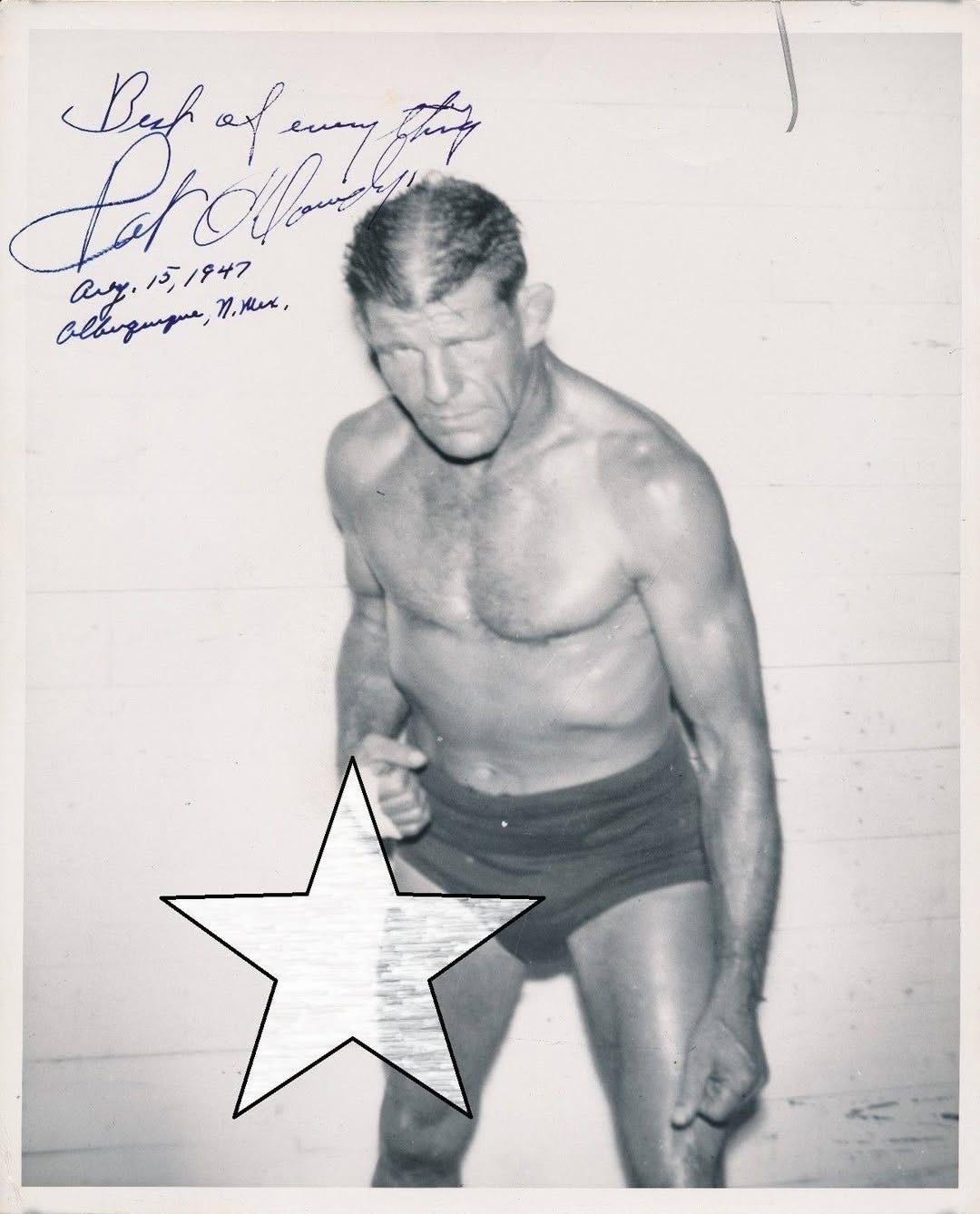
Pictured: One of West Texas’ most noted old-time shooters, Pat O’Dowdy in 1947 in Albuquerque, New Mexico.
O’Dowdy’s booking philosophy emphasized star power and accessibility. In cooperaation with Detton and then later, Doc Sarpolis in the Amaarillo Office, he routinely brought in national headliners alongside territory regulars: Gorgeous George headlined in the late 1940s/early 1950s, while later cards featured local star Terry Funk, Wahoo McDaniel, Lou Thesz, Dory Funk Sr., Karl Von Steiger, Ciclon Negro, Ricky Romero, and many others.
Matches like Terry Funk versus Pat O’Connor in 1976 or blood-feud bouts at the Coliseum became local lore. He also dabbled in cross-promotions, occasionally hosting boxing cards. In an era before national cable dominance, O’Dowdy’s events provided consistent, high-quality wrestling to a loyal regional fanbase, helping sustain the Amarillo territory’s reputation as one of the most vibrant in the NWA. Never wanting to get too far from the action in the ring, no matter as he aged, O’Dowdy routinely worked as the primary referee for the cards in the Coliseum in Odessa. While he broke in other referees for his shows on preliminary matches, Pat handled the important matches and main events. The Funk Family, especially Dory Funk, Sr. loved O’Dowdy’s referee work in his matches.
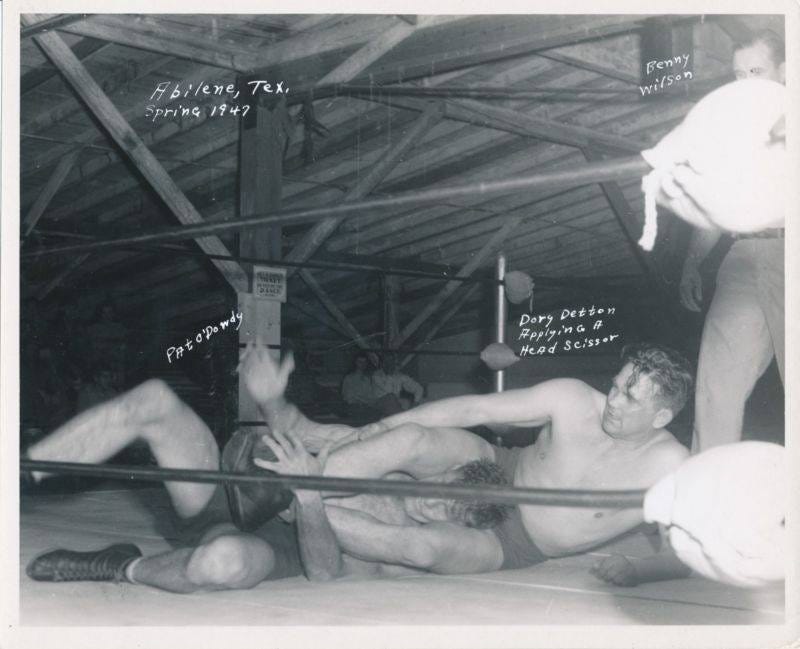
Pictured: Dory Detton holds Pat O’Dowdy in a head scissors in a match in Abilene, Texas in 1947
Beyond the arena, O’Dowdy put down roots in Odessa. He married Ruth Ali Coleman, and the couple raised a family; their son, Danny O’Dowdy (1938–2019), was a longtime Odessa resident. Locals remembered O’Dowdy as a community figure—tough in the ring but genial outside it, often described in anecdotal accounts as a “gentle giant” in his later years despite his wrestling past. He continued promoting into the 1970s, adapting to the changing business as larger promotions and television deals began consolidating territories. By the 1980s, as the national expansion of the WWF and other groups eroded the old territory system, O’Dowdy stepped back, having already left an indelible mark on West Texas wrestling.
George Euclid “Pat” O’Dowdy passed away on March 27, 1992, in Ector County, Texas, at age 83. His death marked the end of an era for independent regional wrestling in the Southwest. Though he never achieved mainstream fame, O’Dowdy’s legacy endures in the memories of fans who packed the Ector County Coliseum, in the historical records of the Amarillo territory, and in the careers of the countless wrestlers who passed through his promoted cards. In an industry built on larger-than-life characters, Pat O’Dowdy represented something equally vital: the steadfast local promoter who kept the lights on, the ring assembled, and the tradition alive in towns far from the spotlight. From Oklahoma farm boy to Texas wrestling impresario, his journey mirrored the sport itself—gritty, resilient, and deeply rooted in the American heartland.
One Thing I Learned About Rocky King
He was homeless in Atlanta in the early 1980s—often eating out of garbage bins—before breaking into wrestling, and he later kept a personal vow to God by becoming a tireless advocate for the homeless there, earning the nickname “King of the Streets.”
He persistently hung around Jim Crockett Promotions events until owner Jim Crockett Jr. gave him a shot as a jobber in 1984. After a solid career in NWA/JCP and WCW (including a memorable 1990 run as the face-painted, flamboyant “Little Richard Marley” roadie/manager for the Fabulous Freebirds, where he even accidentally cost them a Starrcade match), he retired from the ring in 1998.
True to the promise he made during his tough times, King spent his later years feeding the homeless, collecting food and clothing in Atlanta’s poorer neighborhoods, running family-friendly charity wrestling shows through his Boulware Wrestling Association (often in churches and Boys & Girls Clubs), operating a gym for at-risk kids, and partnering on programs like “Kids Nite Out” to keep youth off the streets. Atlanta TV station WXIA even dubbed him “King of the Streets” for it. He also did Bible studies with comedian Jeff Foxworthy, who called him one of the most selfless people he’d ever met.
Thank You for Reading
I’m Tony Richards, Pro Wrestling Historian, Author and Storyteller. I share pro wrestling historical items in each issue of the Time Tunnel Pro Wrestling History Newsletter. Thanks for reading! If you enjoy my information on select events, matches and insights, please share it with folks you think might like to be a subscriber!
Remember, premium investors get access to exclusive and special content such as some special issues including a multi-part deep dives on wrestling territories, wrestler bios and championship title histories, special audio and video interviews on territory pro wrestling and more available in the Pro Wrestling Time Tunnel for Premium Investors.